READ THESE TERMS AND CONDITIONS CAREFULLY BEFORE USING THIS WEBSITE.
https://nrc-publications.canada.ca/eng/copyright
Vous avez des questions? Nous pouvons vous aider. Pour communiquer directement avec un auteur, consultez la première page de la revue dans laquelle son article a été publié afin de trouver ses coordonnées. Si vous n’arrivez pas à les repérer, communiquez avec nous à [email protected].
Questions? Contact the NRC Publications Archive team at
[email protected]. If you wish to email the authors directly, please see the first page of the publication for their contact information.
NRC Publications Archive
Archives des publications du CNRC
This publication could be one of several versions: author’s original, accepted manuscript or the publisher’s version. / La version de cette publication peut être l’une des suivantes : la version prépublication de l’auteur, la version acceptée du manuscrit ou la version de l’éditeur.
Access and use of this website and the material on it are subject to the Terms and Conditions set forth at
PMS: A PVC Management System For ATM Networks
Yang, Chunsheng; Phan, Sieu
https://publications-cnrc.canada.ca/fra/droits
L’accès à ce site Web et l’utilisation de son contenu sont assujettis aux conditions présentées dans le site LISEZ CES CONDITIONS ATTENTIVEMENT AVANT D’UTILISER CE SITE WEB.
NRC Publications Record / Notice d'Archives des publications de CNRC:
https://nrc-publications.canada.ca/eng/view/object/?id=5e5d30fb-11c0-435e-b06e-b6cc7b04fa27 https://publications-cnrc.canada.ca/fra/voir/objet/?id=5e5d30fb-11c0-435e-b06e-b6cc7b04fa27
National Research Council Canada Institute for Information Technology Conseil national de recherches Canada Institut de Technologie de l’information
PMS: a PVC Management System for
ATM Networks
C. Yang and S. Phan
July 2001
Copyright 2001 by
National Research Council of Canada
Permission is granted to quote short excerpts and to reproduce figures and tables from this report, provided that the source of such material is fully acknowledged.
*published in Proceedings of IEEE International Conference on Networking (ICN '01), Colman, France. July 9-13, 2001. NRC 44165
PMS: A PVC Management System for ATM Networks
Chunsheng Yang and Sieu PhanNational Research Council of Canada, Canada {Chunsheng.Yang, Sieu.Phan}@nrc.ca
Abstract. Reported in this paper is the developed PMS, a PVC management system for ATM networks. PMS provides a scalable, end-to-end path management solution required for managing today’s complex ATM networks. It aims to assist the network operators to perform PVC operations with simplified procedures and automatic optimum route selection. It also aims to provide effective decision-making support for PVC fault identification and prevention to the network operators.
1 Introduction
ATM communication network is playing more and more important role in today’s telecommunication networks. It has been widely used in backbone networks, transmission networks, access networks, and even enterprise networks. Such emerging large heterogeneous ATM networks have raised many new challenges for researchers and developers in the area of network management. In the management of ATM communication networks that have increased dramatically in size and complexity, the PVC (Permanent Virtual Circuit) management [8][9] is considered as one of the most important tasks. This task mainly consists of PVC operation, which includes path creation, path upgrade and path deletion; PVC fault identification; PVC fault correction; PVC fault prevention; and PVC QoS guarantee and service management. Existing COTS (Commercial Off-the-Shelf) software components provided by different ATM switch vendors can only provide partial support for operators to perform such task, and the procedure of PVC operation is disparate. It is difficulty for operator to perform automatic PVC operation and management. To assist the operator to perform automatic PVC operation and management in complex heterogeneous ATM networks, we developed PMS, a PVC management system for ATM networks based on our DPSAM (Distributed Proactive Self-Adjusting Management) framework [1]. DPSAM framework is generic framework that facilitates the incorporation of AI, distributed-computing, and web-based technologies in the development of network management system. The developing environment is Jess4.0, JDK1.1.6, OrbixWeb3.1, Apach1.3.0 Web-server for Solaris platform and Microsoft Peer Web-server for NT platform. PMS offers a simple mechanism for setting up Permanent Virtual Path Connections (PVPC) and Permanent Virtual Channel Connections (PVCC) with a point-and-click user interface. The PVC can be established automatically or manually according to user-specified requirement and QoS parameters such as throughput and delay. It also monitors and maintains the managed PVCs by performing real-time traffic data analysis, fundamental alarm correlation, and incident association. When PMS detects some problems or foresees some future anomalies, it will perform the
necessary correction or prevention automatically whenever feasible. On the situations that automatic actions are not possible, PMS will notify network operator with detailed information such as the nature of the problems, the location where they occur, the reasons why they happen, and the procedures to correct or prevent them. The developed PMS is an ATM network management tool for service providers and enterprise network operators to effectively manage network resource, to provide good quality service, to improve network performance and to reduce downtime loss. During the research and development of PMS, we have focused on two main issues: PVC operation support with automatic optimum route selection and PVC fault identification and prevention. In this paper, the PMS system architecture and the implementation of PVC operation and management will be presented. This paper is organised as follows: Section 2 discusses the CORBA-based system architecture; Section 3 describes the PVC operations and management; Section 4 is on an experiment environment; and the final section concludes the paper.
2 CORBA-Based System Architecture
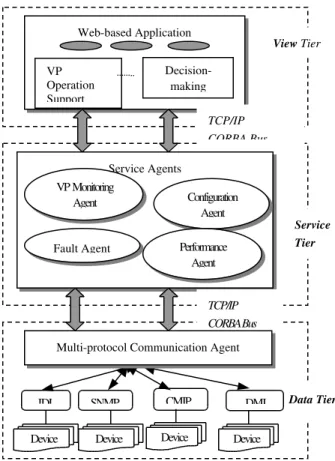
PMS is developed based on CORBA-based and three-tiered architecture. The architecture accommodates existing management protocol standards such as SNMPv1, SNMPv2, and CMIP, and uses CORBA as the underlying distributed middleware. The
Figure 1 A CORBA-Based Three-Tiered Architecture Service Agents Web-based Application VP Operation Support Decision-making VP Monitoring Agent Configuration Agent Fault Agent Performance
Agent Device IDL Device SNMP Device CMIP View Tier Service Tier Data Tier TCP/IP CORBA Bus Device DMI Multi-protocol Communication Agent
TCP/IP CORBA Bus
key characteristic of a three-tiered architecture is the separation of distributed computing environment into three layers: presentation, functionality, and data components. This is needed for building flexible, scalable, reusable, maintainable application. CORBA was chosen as the distributed middleware because it is a stable standard with mature products available. The Object Request Broker (ORB) provides a way to invoke methods on remote objects without necessarily knowing the location of those objects, or even their exact functionality. Thus, CORBA clients can manage distributed devices without explicit knowledge of the composition, size, or topology of the network. As shown in Fig.1, the top tier is the view layer. The middle tier is the service layer. The bottom tier is the data layer. For the developed PMS, these three tiers are implemented as follows.
View Tier. This tier is made up of user interface applications. These applications invoke the methods of the objects in the middle tier, which may be located in different locations and platforms. PMS View Tier provides web-based user graphical interface for operator to access and control ATM networks from remote locations by using Java-enable browser. These downloadable applications consist of the following user interfaces:
PVC operation support;
network representation and network element view; PVC status monitoring;
decision-making support for fault management; and on-line knowledge base updates.
Service Tier. It contains the service agents. The main service agents are configuration agent, fault agent, performance agent and PVC monitoring agent. They perform the PVC monitoring and management tasks that include the fundamental functionality recommended by the OSI and TMN. They provide service in response to the requests from the View Tier applications. These agents could be distributed on different locations and platforms, because they are designed to support CORBA IDL communication. These agents mainly perform the following PVC operation and management tasks:
simplified PVC operations with automatic optimum path selection; fault identification and correction;
fault prediction and prevention; and automatic fault correction and prevention.
Data Tier. This tier is usually made up of objects that interact with database management systems. Because PMS is developed to be able to manage ATM networks that contain multi-vendor equipment [10], this tier is made up of multi-protocol communication agents, which comprise different protocol objects such as SNMP, CMIP, and DMI. Multi-protocol communication agents perform all the interacting operations with device agents and cope with the requests from service agents to the device agents. From the viewpoint of devices, they map different protocol data objects to IDL data objects and delivers them to service agents. The details how to map the data between IDL and different protocols will be reported in a different paper.
3 PVC Operation and Management
The goals of PMS are to assist the network operator to perform PVC operation with simplified procedures and automatic path routing and selection, and to provide them with effective decision-making support for fault identification and prevention. In this section, we describe briefly the PVC operations, PVC fault identification, and PVC fault prevention.
3.1 PVC Operations
PVC operations and configuration are the principal PVC management tasks in ATM networks. The disparate and proprietary management procedure provided by individual ATM switch vendors has created an environment where it is very difficult to automate the process. The situation will become increasingly untenable in the future as networks continue to develop in size, intricacy and volatility. To solve this problem, Boyer et al [11] proposed to configure the PVC using intelligent mobile agents. Such approach requires that ATM switch can provide an environment to run mobile agents from elsewhere in the network. However, existing ATM switches almost provide SNMP or CMIP support for remote access. Considering such a situation, we are using distributed agents to access ATM switches sequentially by sending requests to each switch. Requests from CORBA clients are IDL data package. Service agent, configuration agent in PMS, will determine the PVC operation sequence (scenario), pack the operation scenarios and pass them to multi-protocol agent. According to operation scenario, multi-protocol agent will determine the action commands to perform PVC operation corresponding to different switches, which support different communication protocols such as SNMPv1, SNMPv3, or CMIP. This methodology is shown in Fig.2. In PMS, the system can perform PVC creation, PVC upgrade, and PVC deletion. PVC creation is to set up a path across a set of ATM switches within an ATM network; PVC upgrade is to route path or negotiate the parameter for existing path; and PVC deletion is to release a path across a set of ATM switches within an ATM network.
User-specified Requirements: (SW/PNE/VPI/VCI) Switch A (SNMP) Switch B (CMIP) SNMP Request SNMP Response CMIP Request CMIP Response IDL Request IDL Response Operator PMS
Figure 2, The Methodology of PVCOperations Switch C
In this study, we have two objectives for providing PVC operations to operators. The first goal is to provide the simplified procedures to assist operators to perform PVC operations. Using such procedures, operators do not need to worry about the switch specification, operation environments, locations on network, and so on. What they need to do is to specify the node name, the name of group, VPI and VCI for each connected switch. All procedures for PVC operation will be hidden in the system. The second goal is to assist operators to perform PVC operation with the support of automatic path routing and path selection. In a way, operators do not need to determine the path route by themselves from the available resource, which contains thousands of VPI and VCI parameters and network topology. To this end, constraint-based reasoning is used to determine path route and to select an optimal path for the requested PVC path operations. The details how to automatically route and select path will be reported in a different paper due to space limitation.
3.2 PVC Fault Identification
PVC fault identification and prevention are the main PVC management tasks in PMS. To reduce the human error and misunderstanding in the process of fault identification, a knowledge-based approach is considered as one of the most effective approach [2][5][6][7]. There have been a number of achievements in applying knowledge-based approach to alarm correlation. However, these knowledge-based alarm correlation systems can only reduce the amount of alarms, it cannot detect the problem from the viewpoint of PVC management requirement, and it also cannot help operators to make decision for PVC fault identification and fault prevention. Therefore, the operator still needs to make decision for PVC fault correction and prevention by himself. To assist the operators to effectively manage the PVC, we developed a knowledge-based system to identify the PVC problems and make decision on fault correction. This knowledge-based system is implemented by using Jess4.0. The knowledge base consists of DPSAM knowledge, PMS system knowledge, Generic PVC management knowledge, and vendor’s ATM specification knowledge. As shown in Fig. 3, PHB, PSB, PC and PO are defined as PVC fault problems [1]. They stand for path hardware break, path software break, path congestion, and path overload, respectively.
IS
phb,IS
psb,IS
pc, andIS
po are incident sets defined for each problem. PVC fault identification comprises fourmain inference procedures: data collection, fault detection, fault isolation, and fault correction. They are described as follows.
3.2.1 Data Collection
Fault is a disorder occurring in the hardware or software of the managed ATM switches, or is caused by network traffic density and path routing. Alarm events are external manifestations of the faults. Alarm events are defined by ATM vendors and generated by ATM equipment and they are observable to network operators. In PMS, alarm events are the most important data that must be collected. Alarm events are very useful for detecting PHB and PSH problems. In order to effectively detect path congestion and path overload, it is necessary to collect traffic data for the monitored
PVCs. Another reason why we need traffic data is that alarm events might be lost and not real time because they are sent to management system via notification. Consequently, we collect the alarm events from all the managed ATM switches and the traffic data for the monitored PVCs.
3.2.2 Fault Detection
The task of fault detection is to find out the symptoms for PVC problem identification from the collected alarm events and traffic data. According to the definition of the incident, fault detection is to generate the corresponding incidents by using fundamental alarm correlation and traffic data analysis; then to associate the incidents and open an incident set for the PVC problems. The following is the description of alarm correlation, traffic data analysis and incident association.
3.2.2.1 Alarm Correlation
In the network management area, alarm correlation is often used to aid the operator to diagnose network faults by reducing the amount of alarms. In PMS, besides reducing the amount of alarms, more fundamental alarm correlation is used to generate more meaningful incidents for incident association. The fundamental mechanisms of alarm correlation [3][4] mainly contain compression, suppression, count, generalisation, temporal relations, andBoolean relations.
3.2.2.2 Traffic Data Analysis
The task of traffic data analysis is to analyse the collected traffic data and to generate the corresponding incidents. Usually, traffic data analysis is used to detect the congestion and overload problems by monitoring used bandwidth of the managed PVC. The used bandwidth is obtained from the collected traffic data. For example, when a PVC is being monitored, if its used bandwidth at a given time gets close to or
Collected Data P PS PH Isolation Dm D1 D D2 Traffic Data Analysis An A1 A 2 A3 A4 A5 Alarm Correlation: [A,A,…,A] A [A, B, p(A)<p(B)] [nxA] B [A,A B] B T[A, B…] C [A, B,… , ] Incident Association PVC Matching, Classification, Conflict Resolution… Incidents ISphb ISpsb ISpc ISpo Correction Decision-making Support or Automatic Operation P Rule-based Knowledge Bases for PVC Fault Incidents
Figure 3 PVC Fault Identification Detection
greater than the pre-determined upper-threshold of its bandwidth utilisation, a new incident will be formulated. Its attributions will be assigned: the time stamp is the given time; the location will be assigned to one of group equipment name or number, VPI and VCI; the current status will be set to “path congestion problem”; the severity will be assigned to “MAJOR”. This opened incident will be used in the incident association.
3.2.2.3 Incident Association
The task of incident association is to open an incident set for PVC problems in terms of the generated incidents from alarm correlation and traffic data analysis. To do this, the system needs to classify and group the obtained incidents into different incident sets and maps the incident set to the monitored PVC.
3.2.3 Fault Isolation
Once an incident set is opened in fault detection, we need to further confirm the problem. The task of fault isolation is to isolate the problem when the opened incident set contains several incidents. To confirm a problem, we could use other supporting means such as loop test. The assumption is that the monitored PVC can only have one problem at any given time.
3.2.4 Fault Correction
The fault correction is to determine an effective reactive action for the identified problem. This task is done with a policy-based fault correction strategy. When the problem can’t be corrected automatically, it will give the decision-making supporting information to assist the operators.
3.3 Fault Prevention
In order to prevent the fault and provide a proactive PVC management support, it is necessary to predict the future status of the managed PVCs. Considering that ATM network has complexity, wide-scale, dynamic network configuration, we adopt a Neural Network (NN) approach to predict the future status according to historical data and current status. To reflect the dynamic change of ATM network, the PVC configuration data are included in the neural network training input parameters. The training of the designed neural network was done off-line. In on-line path monitoring, the NN component is used to predict the future status for the monitored path. According to the predicted status, the fault detection procedure is used to detect the future problems. Once a problem is predicted, a proactive control action will be taken to prevent the problem. The details about fault prevention are referred in reference [1].
4
Experiment
To test the prototyped system and evaluate the effectiveness of the decision-making support capability for fault identification and prevention, we built an experiment
network consisting of an ATM network simulator and a small real ATM network. The communication protocol between PMS and ATM network simulator is CORBA IDL, and between PMS and the real ATM network is SNMP. The ATM network simulator generates raw alarm events and raw traffic data in terms of X.721 standard and vendor’s specifications. The alarm events are generated according to simulated network problems. The traffic data are generated in terms of QoS parameters of the managed PVC and the simulated network problems. The real ATM network is set up with a Fore System ASX200 switch and 2 SBA200 ATM adapters installed on 2 Sun workstations. Several PVCs are set up between two Sun Workstations through ATM switch ASX200. By using such environment, it is not hard to test the effectiveness of decision-making support capability for fault identification and prevention.
5
Conclusions
Based on the DPSAM framework, we have prototyped PMS, a PVC management system for ATM networks incorporating AI, CORBA and web-based technologies. PMS can provide effective support to network operators on:
• End-to-end path management with automatic route selection;
• Simplified PVC operation with user-specified requirements;
• Decision-making for fault identification and correction; and
• Proactive decision-making for fault prediction and prevention.
As to our future work, it is necessary to enhance the knowledge base and its management. We will also focus on the policy-based automatic fault correction and prevention as well as PVC service management.
References
1 Chunsheng Yang and Sieu Phan, “Fault Identification and Prevention for PVC Management in ATM Networks“, Procedings of ATM 2000, Gernamy, June 2000, pp. 431-438
2 Gabriel Jakobson, Robert Weihmayer, and Mark D. Weissman, “A Domain-oriented Expert System Shell for Telecommunication Network Alarm Correlation,“ Procedings of the 2nd IEEE Network
Management and Control WKSP, 1993, pp. 365-380.
3 Gabriel Jakobson and Mark D. Weissman, “Alarm Correlation, IEEE Network,“, November 1993, pp. 52-59.
4 Robert D. Gardner and David A. Harle, “ Alarm Correlation and Network Fault Resolution using the Kohonen Self-Organizing Map,“ Procedings Of IEEE GLOBECOM’97, Nov. 1997, pp. 1398-1402. 5 Simona Brugnonia, et al, “ An Expert System for Real-time Fault Diagnosis of the Italian
Telecommunication Networks,“ Integrated Network Management, 1993, pp. 617-628.
6 Kar-wing Edward Lor, “ A Network Diagnostic Expert System for Acculink Multiplex Based on a General Network Diagnostic Scheme,“ Integrated Network Management, 1993, pp. 659-669. 7 Elliot Eichen, et al, “DSTS: An Expert System for Diagnosis of Advanced Digital Subscriber
8 Ken-ichi Sato, et al, “Broad-Band ATM network Architecture Based on Virtual Paths,“ IEEE Transaction on Communications, Vol. 38, NO. 8, 1990, pp. 1212-1222.
9 Yu Watanabe and Toshikane Oda, “ Dynamic Routing Schemes for International Networks,“ IEEE Communications Magazine, Vol. 38, No. 8, 1990, pp. 70-75.
10 N. Soukouti and U. Hollberg, “Joint Inter Domain management: CORBA, CMIP and SNMP,“ Proceedings of 15th Int’l Symposium on Integrated Network Management, 1997, pp. 153-164.
11 John Boyer, Bernard Pagurek, and Tony White, “Methodologies for PVC Configuration in Heterogeneous ATM environments Using Intelligent Mobile Agents,“ MATA’99 –1st International