Anomalous Interface and Surface Strontium Segregation
in (La[subscript 1-y]Sr[subscript y])[subscript
2]CoO[subscript 4±#]/La[subscript 1-x]Sr[subscript
x]CoO[subscript 3-#] Heterostructured Thin Films
The MIT Faculty has made this article openly available. Please share how this access benefits you. Your story matters.
Citation Feng, Zhenxing, Yizhak Yacoby, Milind J. Gadre, Yueh-Lin Lee,
Wesley T. Hong, Hua Zhou, Michael D. Biegalski, et al. “Anomalous Interface and Surface Strontium Segregation in (La[subscript 1– y]Sr[subscript y])[subscript 2]CoO[subscript 4±δ]/La[subscript 1– x]Sr[subscript x]CoO[subscript 3−δ] Heterostructured Thin Films.” The Journal of Physical Chemistry Letters 5, no. 6 (March 20, 2014): 1027–1034.
As Published http://dx.doi.org/10.1021/jz500293d
Publisher American Chemical Society (ACS)
Version Original manuscript
Citable link http://hdl.handle.net/1721.1/97718
Terms of Use Creative Commons Attribution-Noncommercial-Share Alike
Anomalous Interface and Surface Strontium
Segregation in (La
1-y
Sr
y
)
2
CoO
4±δ
/La
1-x
Sr
x
CoO
3-δ
Heterostructured Thin Films
Zhenxing Feng1, 2 , Yizhak Yacoby4 , Milind J. Gadre7 , Yueh-Lin Lee1, 2, 7 , Wesley T. Hong1,3 , Hua Zhou5 , Michael D. Biegalski6 , Hans M. Christen6 , Stuart B. Adler8 , Dane Morgan7, * , and Yang Shao-Horn1, 2, 3, * 1Electrochemical Energy Laboratory, 2
Department of Mechanical Engineering, 3
Department of Materials Science and Engineering, Massachusetts Institute of Technology, Cambridge, Massachusetts, 02139, USA
4Racah Institute of Physics, Hebrew University, Jerusalem, 91904, Israel
5
Advanced Photon Source, Argonne National Laboratory, Argonne, Illinois, 60439, USA
6
Center for Nanophase Materials Science, Oak Ridge National Laboratory, Oak Ridge, Tennessee, 37831, USA
7
Department of Materials Science and Engineering, University of Wisconsin—Madison, 1509 University Avenue, Madison, Wisconsin 53706, USA
8
Department of Chemical Engineering, University of Washington, Seattle, Washington 98195, USA
ABSTRACT:
Heterostructured oxides have shown unusual electrochemical properties including enhanced catalytic activity, ion transport, and stability. In particular, it has been shown recently that the activity of oxygen electrocatalysis on the Ruddlesden-Popper/perovskite (La1-ySry)2CoO4±δ/La
1-xSrxCoO3-δ heterostructured structure is remarkably enhanced relative to the Ruddlesden-Popper
and perovskite constituents. Here we report the first atomic-scale structure and composition of (La1-ySry)2CoO4±δ/La1-xSrxCoO3-δ grown on SrTiO3. We observe anomalous strontium segregation
from the perovskite to the interface and the Ruddlesden-Popper phase using direct X-ray methods, as well as with ab initio calculations. Such Sr segregation occurred during the film growth and no significant changes were found upon subsequent annealing in air. Our findings provide insights for the design of highly active catalysts for oxygen electrocatalysis.
Table of Contents artwork
KEYWORDS: surface and interface, heterostructure perovskites, oxides, fuel cell, coherent Bragg rod analysis, ab initio calculation
Interfaces in many heterostructured epitaxial materials exhibit intriguing physical, chemical, and electrochemical properties including enhanced oxygen electrocatalytic activity1-9
and electronic/ionic conductivity10-12
compared to bulk materials. The combination of a Ruddlesden-Popper (RP) (La0.5Sr0.5)2CoO4±δ (LSCO214)
13-14
layer on top of the perovskite La0.8Sr0.2CoO3-δ (LSCO113, a mixed electronic and ionic conducting perovskite)
2, 10
was found to greatly enhance the activity for the oxygen reduction reaction (O2 + 4e
–
↔ 2O2–) at high temperatures13, 15-16
, resulting in 1~3 orders of magnitude enhancement compared to LSCO113
alone.
A number of studies have been made to understand the high catalytic activity of these LSCO heterostructured catalysts using well-defined thin film systems. Density functional theory (DFT) calculations have shown that there is a large driving force for A-site cationic interdiffusion across the heterostructure interface, stabilizing Sr in LSCO214 and La in LSCO113
with predicted Sr concentrations ~0.75 near the interface and Sr depletion in LSCO113 17
. Such interdiffusion has been postulated to result from coupling of Sr ions to the increased oxygen vacancy content near the surface18
, and is predicted to reduce the oxygen vacancy formation energy17
. The reduced enthalpy of oxidation at the interface due to the presence of Sr may play a direct role in enhancing the oxygen surface exchange17
or indirectly via the electronic activation of LSCO214
9
. These findings highlight the need to determine the Sr redistribution within LSCO heterostructure films, which can provide new insights into developing catalysts with enhanced activity and stability.
However, to date there have been limited methods for obtaining the atomic-scale compositional and structural information needed to properly characterize the LSCO214/LSCO113
interface. XPS18-20
and chemical etching21
changes in Sr content before and after annealing, with high surface sensitivity. Unfortunately, these techniques lack the structural information for differentiating Sr in the LSCO113 and
LSCO214 phases and the atomic-level of detail necessary to properly identify spatial proximity to
the interface.
Recently, we have demonstrated that Coherent Brag Rod Analysis (COBRA) of LSCO113
thin films can provide unprecedented chemical and structural details relevant to high temperature oxygen electrocatalysis.22
COBRA is a powerful tool for providing sub-Å resolution structural information of systems composed of atoms that are well-registered to a crystal lattice, and has been successfully applied in epitaxial thin film and quantum dot systems.23-25
. The method utilizes the measured X-ray diffraction intensities along crystal truncation rods to determine the three-dimensional (3D) electron density (EDY) of a thin film structure. Employing the energy-modulated differential COBRA, which provides elemental information through the energy dependence of atomic scattering cross-sections, further allows for the determination of atomic concentrations of individual crystallographic sites. Differential COBRA has also been successfully applied to studying thin film26 and quantum dot27 systems.
In this Letter, we use the COBRA method to study the atomic structure and layer-by-layer strontium distribution in ~6 nm thick LSCO214-LSCO113 heterostructure thin films.
Supported by ab initio calculations, we demonstrate that anomalous Sr segregation to the interface has a strong thermodynamic driving force and is present in as-deposited films. The COBRA results also reveal polar distortion of the LSCO113 unit cell and significant A-site
cationic ordering in the LSCO214 phase, details that have not been previously considered and may
A polished SrTiO3(001) (10 × 10 × 1 mm 3
, CrysTec) single crystal substrate was cleaned, acid-etched, and then O2 annealed to obtain atomically flat surfaces. An epitaxial thin film of
LSCO113 on SrTiO3 (STO) was prepared by pulsed laser deposition (PLD) at ~550 °C under 50
mTorr O2 for 360 pulses (~2 nm). Subsequently, 450 pulses of LSCO214 (~ 2.5 nm) were
deposited on LSCO113 to form heterostructured LSCO214/113. To study the films under the
intermediate temperature (400 o
C ~ 600 o
C) of the oxygen electrocatalysis condition, the LSCO film was annealed in a vacuum tube furnace (MTI GSL-1700X-KS60) at 550 °C for 1 hour in 450 Torr pure O2 and quenched down to room temperature as the “frozen” working status.
In the as-deposited LSCO film, terrace steps from the STO substrate surface were still visible from atomic force microscopy (AFM), indicating conformal growth (Figure S1, Supporting Information). Interestingly, there are two distinct features on the surface; films close to terrace edges are ~0.8 nm higher than the rest part on the same terraces. This observation suggests that the LSCO214 grows by full LSCO214 unit cells (rather than by perovskite-like and
rock-salt-like building blocks), and nucleation is favored at the top of a terrace step (indicating a large Ehrlich-Schwoebel barrier). This growth mode yields a less uniform surface, and therefore poorly defined reflection high-energy electron diffraction (RHEED) oscillations during film growth (Figure S2, Supporting Information). Upon annealing to 550 o
C, the surface morphology changed significantly. The AFM image (Figure S1b, Supporting Information) shows the formation of large particles (~150 nm in diameter and ~ 7 nm in height) on top of a base film, which is composed of small particles ~20 nm in diameter.
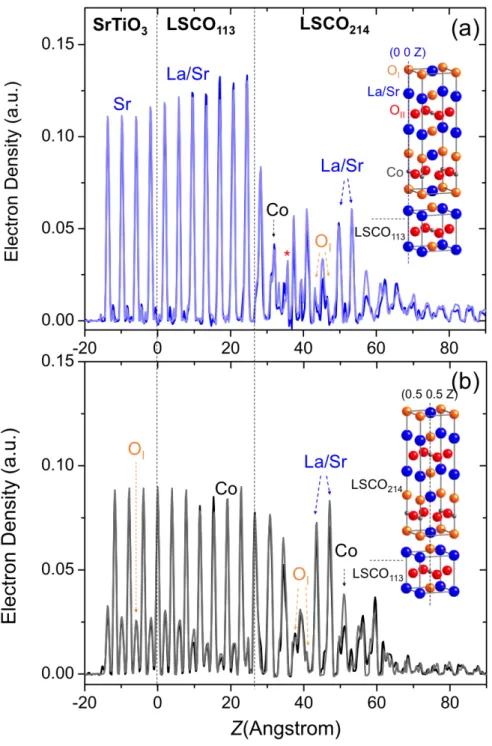
Representative experimental and COBRA-calculated diffraction intensities for the as-deposited and annealed LSCO films are in good agreement, where the diffraction intensities along the (11L) Bragg rods are shown as an example in Figure 1. Figure 2 shows EDYs along (a)
the (0,0,Z) line that passes through (La,Sr) atoms in LSCO113 and (La,Sr)/Co/OI in LSCO214, and
(b) the (0.5,0.5,Z) line that passes through Co/Ti/OI atoms in LSCO113 and (La,Sr)/Co/OI in
LSCO214. It should be noted that the stacking sequence for atoms along (0,0,Z) is A - - A - -
A for perovskite and A - - A – O – B – O … for RP, while along (0.5,0.5,Z) the sequence is O – B – O – B for perovskite and O – B – O – A - - A for RP. All atoms and their positions can be clearly identified in the EDY plot, including oxygen, except those at the very surface of the film. The interface of LSCO214-on-LSCO113 can also be clearly identified, and the atomic
structures are consistent with the previous STEM observation13
. Only one EDY peak at ~37 Å along the (0,0,Z) line (red star in Figure 2a) cannot be assigned unambiguously to either Co or La.
The small EDY fluctuations between peaks shown in Figure 2 provide a measure of the EDY uncertainty28-29
, which is generally smaller than the oxygen EDY. The EDY along the (0,0,Z) line going through the La/Sr atoms (Figure 2a) is larger in the LSCO113 film region than
in STO, as expected from the larger number of electrons in La relative to Sr. The EDY in the LSCO214 region is smaller compared to the LSCO113 region, indicating these films are partially
covered and/or partially coherent films, which is consistent with the growth mode proposed previously from the AFM images and RHEED oscillations (Figure S1 and S2, Supporting Information).
The as-deposited and annealed diffraction intensities were found to be similar (Figure 1) and the differences between the as-deposited and annealed EDYs were found to be on the order of the experimental uncertainty (Figure S3, Supporting Information). Significant changes in the surface morphology upon annealing were nevertheless observed by AFM (Figure S1, Supporting Information). We interpret this to indicate that particulates and outgrowths are present at the
surface (without coherence to the substrate and therefore not detected by COBRA), and these features indeed change upon annealing, without effect on the majority of the material. It is proposed that surface Sr segregation rather than surface morphologies alone may play an important role in the surface oxygen exchange kinetics at elevated temperatures but further studies are needed to test this hypothesis.
The atomic positions in the Z direction were determined by fitting Gaussians to the EDY peaks in Figure 2. Using an ideal STO crystal frame of reference, extended throughout the entirety of the film, we plotted out the substrate relative displacement (SRD) profile for each element in LSCO113 region (Figure S4, Supporting Information). Increasing polarization of the
LSCO113 unit cell was observed, with the octahedra displaced relative to the (La,Sr) ions. This
polarization is identical in direction to distortions in LSCO113 films observed recently 22
, however in that work we did not observe the displacement of Co or equatorial oxygen ions. The precise physical origin is beyond the scope of this work, but merits further investigation as a potential contributor to the enhanced catalytic activity of the LSCO214-on-LSCO113 system.
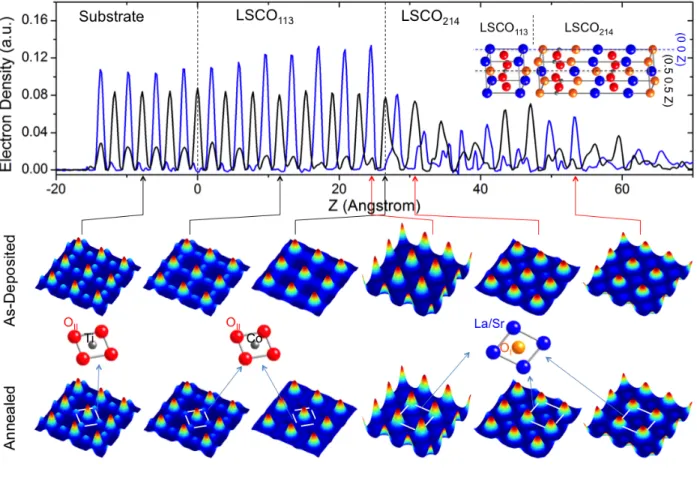
Oxygen at the LSCO214/LSCO113 interface behaved differently from oxygen within the
LSCO113 or LSCO214 film, which can be clearly visualized from the 2-dimensional folded unit
cell through a number of in-plane EDYs at different depths of the film (Figure S5, Supporting Information). In these plane-cuts, the positions of oxygen atoms are well-defined for the Ti-OII
plane of the substrate, Co-OII plane of the LSCO113 film, and La(Sr)-OI plane of the LSCO214
film. However, near the LSCO113/LSCO214 interface, the oxygen EDY is smeared in both the
Co-OII plane and La(Sr)-OI planes (Figure S5, Supporting Information). This observation indicates a
wider distribution of in-plane positions for oxygen atoms at the interface, which can result from the displacement of oxygen atoms from the centrosymmetric crystallographic sites and/or
decrease in site occupancy. Similar behavior was observed previously at the interface of LSCO113
films and surface SrCoOx particles. 22
The poor registry of oxygen atoms with the substrate-defined lattice indicates the presence of oxygen vacancies and/or increased oxygen mobility at the LSCO214-on-LSCO113 interface.
Experimental differential COBRA data and fits of the as-deposited LSCO film are in good agreement (Figure 3), from which the Sr concentration depth profile, along the corresponding thin-film structure based from ordinary COBRA, was obtained, as shown in Figure 4. The LSCO film (0—26 Å) and the topmost few layers in the STO are almost completely depleted of Sr and partially replaced by La, suggesting a La1-xCoO3/La1-xTiO3-like
film chemistry at the LSCO113/STO interface. This Sr deficiency at the film/substrate interface
was also found in our previous study of LSCO113/STO, which we attributed to the oxidizing
nature of the STO substrate during the film growth.22
Such an interface can introduce a dipole moment that points toward the film/substrate interface, which may induce the aforementioned polarization of the LSCO113 unit cell. More significantly, Sr was found to strongly segregate near
the LSCO214/LSCO113 interface and in the first 2-3 layers of LSCO214 from the surface, with a
mean Sr occupancy of ~1 in LSCO113 and ~1 in LSCO214. As the error of Sr occupancy in each
layer is approximately ±10%, the average Sr occupancy of the entire film remains consistent with the nominal Sr concentration: 0.2 in La1-xSrxCoO3-δ and 0.5 in (La1-ySry)2CoO4±δ. This finding
provides the first experimental measurements of absolute Sr atomic occupancy of LSCO214 at the
atomic scale, which reveals, for the first time, clear evidence of Sr segregation on the LSCO214
surface, and support Sr segregation in LSCO214 at the LSCO214/LSCO113 interface predicated from
recent DFT studies.17
To further understand the physical origin of Sr segregation in the LSCO214-on-LSCO113
bilayer, ab initio calculations were performed to understand the thermodynamic driving force for Sr substitution of La in the structures of LSCO214 and LSCO113. The Sr-for-La-substitution (SrLa)
energies for the film away from interfaces were first approximated using those found in bulk LSCO113 and bulk LSCO214 (dashed lines, Figure 4), which was referenced to that in LSCO113.
The substitution energy for each atomic layer near the LSCO214/LSCO113 interface and in
LSCO214 was then calculated (circles, Figure 4) and compared to that in LSCO113. SrLa
substitution was found thermodynamically more stable at the LSCO113/LSCO214 interface (up to ~
-0.8 eV/Sr), which was in agreement with our previous work17
. Moreover, the thermodynamic driving force for Sr segregation near the LSCO214 surface was even greater than to the
LSCO113/LSCO214 interface, with values up to ~ -1.5 eV/Sr compared to LSCO113. This result is
consistent with the strong Sr segregation in the first 2-3 layers from the LSCO214 surface
obtained from differential COBRA measurements. It should be mentioned that such segregation was present after PLD growth and also after subsequent annealing in air and no significant changes was found in the Sr distribution in the film after the annealing (Figure S6, Supporting Information). This result supports that the segregation is an equilibrium phenomenon, consistent with the DFT predicted segregation tendencies.
Differential COBRA data of both as-deposited and annealed LSCO214-on-LSCO113 films
further revealed the presence of A-site cationic ordering in the LSCO214 film. The alternating
Sr-rich and Sr-depleted layers in LSCO214 (Figure 4 and Figure S6) suggest that La and Sr may
order in the films. Preliminary DFT results showed that there was weak thermodynamic driving force for cation ordering in LSCO214, which can be further enhanced by strains (Figures S7 and
quantitative prediction of the chemical compositions of A-site ordering by performing full LSCO214/LSCO113 heterointerface modeling as we have only sampled a small fraction of possible
chemical configurations in this work (details can be provided in the Supplementary Information).
The Sr segregation at the LSCO214-on-LSCO113 revealed by the COBRA measurements
provides fundamental insights that can explain the enhanced surface oxygen exchange kinetics reported previously13
. Sr segregation (Sr occupancy on the A site of ~1) in the perovskite structure at the LSCO214/LSCO113 interface can lift the oxygen 2p band center relative to the
Fermi level30-31
shown by DFT studies, which is correlated with increasing surface oxygen kinetics30
. In addition, such Sr segregation can promote oxygen ion transport kinetics as higher Sr concentrations in bulk LSCO113
32
increases the oxygen vacancy concentration due to the charge imbalance from the substitution of Sr2+
for La3+
in the perovskite structure17-18
, which is supported by the weak EDY of oxygen ions in the LSCO214/LSCO113 interface in Figure 2
(indicative of a local increase in the oxygen vacancy concentration and oxygen ion mobility). Since LSCO214 only partially covers LSCO113, the Sr occupancy equal to ~1 in the
LSCO214/LSCO113 interface indicates the surface layer of the LSCO113 base film contains fully
occupied Sr at the A-sites while the previously reported LSCO113 base film (without LSCO214)
has a surface layer at lower Sr occupancy (~0.6)22
. Considering the correlation between the computed O 2p band center (relative to the Fermi level) and the oxygen surface exchange kinetics for perovskites30
, here we show that the O 2p band center vs. the Fermi level of LSCO113
interface layer is lifted upwards with increasing Sr occupancy (Figure 5). In addition, although the dominant oxygen defects in LSCO214 can be oxygen vacancies or oxygen interstitials (which
dominates is dependent on the Sr concentration33
, oxygen partial pressure, and temperature) it is proposed that oxygen vacancies are the dominant anionic defect for Sr-segregated LSCO214
-on-LSCO113 surface under SOFC conditions based on previous findings of LSCO214 defect
concentrations. Specifically, LSCO214 has been found to have understochiometry ~ 0.1 for Sr
occupancies greater than 1.5 in air at 704 o
C34
. Figure 5 shows the surface exchange activity as a function of the bulk O 2p band center for the LSCO214 and select other materials, and it is seen
that the fully Sr occupied top surface layer of the LSCO214 islands on the LSCO113 film also
contains a higher O 2p band center than the surface layer of the particles on the LSCO113 film,
which could lead to higher activities. At the Sr occupancy of ~1 both near the LSCO214/LSCO113
interface and LSCO214 surface as detected by differential COBRA, the position of the computed
O 2p band center relative to the Fermi level becomes comparable to the most active perovskites (i.e. Ba1-xSrxCo1-yFeyO3-d, BSCF) for surface oxygen exchange kinetics
30
. Therefore, the unique Sr occupancy changes within the LSCO214-on-LSCO113 heterostructure might be responsible for the
enhanced surface exchange kinetics relative to LSCO113. Caution should be given to the proposed
correlation between the atomic structure information of films grown STO obtained from COBRA and surface exchange kinetics obtained from films grown on YSZ as the atomic positions and Sr segregation in LSCO113 and LSCO214 may vary depending on film deposition conditions and
substrate22
. Nevertheless, understanding the driving forces that yield this non-uniform Sr distribution and potentially controlling surface Sr segregation represents a critical next step in designing oxides with high activities and stability for surface exchange kinetics.
In summary, we have investigated the LSCO214-on-LSCO113 heterostructure using
COBRA and ab initio calculations to provide, for the first time, atomic-scale structural and chemical information. Different COBRA analysis reveals significant Sr segregation at the interface of LSCO214/LSCO113 (within the rocksalt layer shared between LSCO214 and LSCO113)
can be attributed to a reduction in the SrLa substitution energy at the LSCO113/LSCO214 interface
and at the surface of LSCO214, which qualitatively agrees with the experimental Sr occupancy
profile. The increased Sr content at the LSCO214/LSCO113 interface is coupled with a smearing of
the oxygen EDY, indicative of higher local oxygen vacancy concentration and/or enhanced oxygen mobility. Our findings provide fundamental insights into unique structural and chemical information of oxide surface and interfaces that may be responsible for the enhanced catalytic activities of such oxide heterostructures for oxygen electrocatalysis at elevated temperatures.
EXPERIMENTAL AND THEORETICAL METHODS:
Atomic Force Microscopy Characterization. An Asylum Research MFP-3D AFM was
used to examine the surface morphology of the LSCO heterostructured film at as-deposited and annealed conditions.
Coherent Bragg Rod Analysis (COBRA). The atomic structure and Sr depth profile of the
LSCO214-on-LSCO113 film under as-deposited and annealed conditions were investigated at
beamline ID-33 of the Advanced Photon Source (APS) at Argonne National Laboratory (ANL). Procedures for measuring the diffraction intensities along the substrate-defined Bragg rods have been described previously22, 24-25
. Ordinary COBRA measurements were performed using an incident X-ray photon energy of 16.09 keV (just below the Sr absorption edge), while energy differential COBRA were performed by modulating between 16.09 and 16.11 keV (just above the Sr absorption edge). COBRA uses the measured diffraction intensities and the fact that the complex structure factors (CSFs) vary continuously along the substrate-defined Bragg rods to
determine the diffraction phases and the CSFs. The CSFs are then Fourier transformed into real space to obtain the three-dimensional EDY of the film and substrate with sub-Angstrom resolution. Energy differential COBRA provides elemental sensitivity through the energy-dependence of the Sr atomic scattering factors above and below the absorption edge. Using the structural information directly obtained from ordinary COBRA, then varying the Sr concentration (i.e. occupancy of Sr) in each La/Sr layer to fit the differential intensity from the energy-modulated measurements, a depth profile of the Sr distribution can be determined.
Ab-initio calculations. Spin-polarized Density Functional Theory (DFT) calculations
were performed with the Vienna Ab-initio Simulation Package35-36 using the Projector-Augmented plane-Wave method37 with a cutoff energy of 450 eV. Exchange-correlation was treated in the Perdew-Wang-9138 Generalized Gradient Approximation (GGA) using the soft O_s oxygen pseudopotential (which includes 2s2 2p4 electronic configuration). The GGA+U calculations39 were performed with the simplified spherically averaged approach40, where the Ueff
(Ueff = Coulomb U - exchange J) is applied to Co d electrons (Ueff = 3.3 eV). All calculations
were performed in the ground state ferromagnetic arrangement in order to use a consistent and tractable set of magnetic structures. While elevated temperatures used during synthesis and electrochemical testing in this study is expected to be in a paramagnetic state, such disordered moments are significantly more difficult to model and we believe that the trends and conclusions identified here would not be altered by using random spin arrangements. Multiple previous studies on LSC and related materials, e.g., LaMnO3, have obtained good agreement with
experimental data at high temperatures using ferromagnetic arrangements.1, 30, 41
Sr substitution (i.e. Sr replaces La) energy calculations of bulk LSCO113, LSCO214,
LSCO113 -LSCO214 heterointerface was simulated with a fully periodic 176-atom supercell
(2a113×2a113 supercell in the x-y plane (a113=3.85 Å) with 12 layers of LSCO113 and 6 layers of
LSCO214 along z where c113=3.83 Å). The in-plane lattice parameter for the interface calculation
was fixed to that of LSCO113 (a113). Calculations of LSCO214 (001) free surfaces were performed
using a symmetric slab with 72 atoms (the primitive LSCO214 cell has 14 atoms) with 2a214×2a214
in the x-y direction and both surfaces terminating with rocksalt AO-AO layers in the z-direction. Bottom AO-AO layers were fixed to the bulk and all other layers were internally relaxed. The bulk LSCO214 structure was simulated with 2a214×2a214×2c214 supercell, and the bulk LSCO113 was
simulated with a 4 layer, or 2a113×2a113×2a113 supercell. The LSCO113-LSCO214 heterointerface
structural model were reported previously17
and the simulated bulk LSCO113, LSCO214, and
LSCO214 surface slab model are provided in Figure 4 below. Sr substitution energy was
calculated by taking the total energy change from the stoichiometric supercell after one La ion is replaced by Sr. More details of the calculation methods in this study can be found in the SI.
FIGURES
Figure 1. A representative example of the dependence of diffraction intensity on the momentum transfer measured on (La0.5Sr0.5)2CoO4+δ (LSC214) / La0.8Sr0.2CoO3-δ (LSC113) / SrTiO3(001) for
Figure 2. The COBRA-determined electron density (EDY) of as-deposited LSCO214/LSCO113/STO along: (a) the (0 0 Z) line; (b) the (0.5 0.5 Z) line.
Figure 3. Differential COBRA data (black circles) and fit (green lines) for the as-deposited sample.
Figure 4. Top panel: Layer-by-layer Sr concentration vs. depth profile determined from differential COBRA for the as-deposited LSCO thin film. The double arrow on the top-right corner indicates the uncertainty in Sr concentration. The region between two dashed black lines close to Z = 30 Å and the dashed line at Z = 0 Å represent the (La1-xSrx)2CoO4±δ (LSCO214)/La
1-xSrxCoO3-δ (LSCO113) and LSCO113/SrTiO3 (STO) interfaces, respectively. Middle panel: The
schematic atomic model of the heterostructured film reflects results obtained by ordinary COBRA. Bottom panel: Ab initio Sr for La substitution energies (relative to that of bulk La0.75Sr0.25CoO3) of bulk La0.75Sr0.25CoO3 (dark blue dashed line), the
(La0.5Sr0.5)2CoO4/La0.75Sr0.25CoO3 heterointerface (filled circles between Z= 20 Å and Z = 35 Å),
bulk (La0.5Sr0.5)2CoO4 (light blue dashed line), and (La0.5Sr0.5)2CoO4 surface (filled circles at Z >
52 Å). The horizontal dashed lines represent data from bulk supercell calculations of the relevant phases and therefore have no influence from the interfaces. The calculated La for Sr substitution
energy in SrTiO3 (not shown in the figure) is found to be +2.4 eV relative to that of
La0.75Sr0.25CoO3. The schematics in the bottom figure represent the simulated supercells for the
bulk La0.75Sr0.25CoO3, (La0.5Sr0.5)2CoO4/La0.75Sr0.25CoO3 heterointerface, and (La0.5Sr0.5)2CoO4
Figure 5. The figure shows surface exchange coefficients kq
or k* vs. the calculated O 2p band centers (relative to the Fermi level) calculated for bulk unit cells. The specific details for each data point are as follows. kq values are shown for uncoated La
0.8Sr0.2CoO3-δ films (LSCO113, red
diamonds) and (La0.5Sr0.5)2CoO4±δ (LSCO214, blue squares) covered LSCO113 films, both on the
yttria-stabilized zirconia (001) single crystals buffered by a gadolinium-doped ceria layer at T= 550 °C, P(O2)= 1 bar
13. Each of these cases has associated with two separate O 2p band center
values corresponding to two possible compositions used in the bulk calculations for each case, which compositions are estimated from COBRA measurements of the most relevant active surface or interface layers. Although the compositions are estimated from surface or interface
La0.8Sr0.2CoO3-δ LaSrCoO4±δ
-8.5
-8
-7.5
-7
-6.5
-6
-5.5
-5
-2.6
-2.4
-2.2
-2
-1.8
-1.6
-1.4
Log k
q(c
m
/s
)
O p-band center (eV)
LSCO113 film surface (X=0.625) Surface particles (X=0.875) LSCO214 surface (y=1.0) LSCO113 interface layer (x=1.0) Ba0.5Sr0.5Co0.8Fe0.2O3-‐δ kq of LSCO113/GDC/YSZ13 kq of
compositions, the O 2p band center calculations are done with bulk unit cells. For uncoated LSCO113 film
22
we use a bulk composition of La1-xSrxCoO3 at x=0.625 (red filled diamond), as
previous COBRA measurements reveal Sr segregation on the LSCO113 film surface to x= 0.59. 22
For the LSCO214-on- LSCO113 film we use a bulk composition of La1-xSrxCoO3 at x=1 (blue filled
squares), as the interface layer of the LSCO214-on-LSCO113 heterostructure is near x=1 as
revealed in Figure 4. The possible error in the COBRA measurement for the Sr occupancy (~10%) is represented by the thin horizontal bars. Bulk DFT calculations have been done to estimate the O 2p band centers at the end points of these bars, which represent compositions of x=0.5 (left) and x=0.75 (right) for the uncoated LSC113 film and x=0.875 (left) and x=1.0 (right)
for the LSCO214-on-LSCO113 film. A similar assessment for k
qs of the uncoated LSCO
113 and
LSCO214-on-LSCO113 film vs. the calculated O 2p band centers (relative to the Fermi level) of
bulk La1-xSxCoO3 and (La1-ySry)2CoO4 based on the compositions of the top surface of
Sr-segregated particles on the LSCO113 film 22
(x=0.875, open red triangle) and the top surface layer of LSCO214 islands on the LSCO113 of LSCO214-on-LSCO113 (y=1.0, open blue square),
respectively. Again, the possible error in the COBRA measurement for the Sr occupancy (10%) represented by the horizontal dashed bars. The endpoints of the bars represent compositions of x=0.75 (left) and x=1.0 (right) for the uncoated LSC113 film and x=0.875 (left) and x=1.0 (right)
for the LSCO214-on-LSCO113 film. The black circles are the reported experimental k* of bulk
LSCO113 42
and Ba0.5Sr0.5Co0.8Fe0.2O3-δ (BSCF) 43
at p(O2) = 1.0 bar at T = 600 °C vs. the calculated
bulk O 2p band centers30
. The dashed circle is the estimated k*
eq of bulk LSCO214 at y=0.5 at
T=600 °C and p(O2) = 1.0 bar. 17
(based on the reported interfacial conductivity of the porous LSCO214 electrode
44
) vs. the calculated bulk (La0.5Sr0.5)2CoO4 O 2p band center. The structures
ASSOCIATED CONTENT
Supporting Information. Details about sample preparation, ordinary and differential COBRA analysis, error analysis, and octahedral distortion and ab-initio calculations. This material is available free of charge via the Internet at http://pubs.acs.org.
AUTHOR INFORMATION Corresponding Author
* [email protected], [email protected]
ACKNOWLEDGMENT
This work was supported in part by DOE (SISGR DESC0002633) and King Abdullah University of Science and Technology. The authors like to thank the King Fahd University of Petroleum and Minerals in Dharam, Saudi Arabia, for funding the research reported in this paper through the Center for Clean Water and Clean Energy at MIT and KFUPM. This research was supported by the Israel Science Foundation under grant No. 1005/11. Support for Y.-L. Lee provided by
Department of Energy (DOE), National Energy Technology Laboratory (NETL), Solid State Energy Conversion Alliance (SECA) Core Technology Program, Funding Opportunity Number DEFE0009435
and for M. Gadre by U.S. Department of Energy, Office of Basic Energy Sciences, Division of Materials Sciences and Engineering under award number DESC0001284. Use of the Advanced Photon Source, an Office of Science User Facility operated for the U.S. Department of Energy (DOE) Office of Science by Argonne National Laboratory, was supported by the U.S. DOE under Contract No. DE-AC02-06CH11357. Authors thank the support from the beamline
scientists including Zhan Zhang, Christian M. Schlepuetz and Lynette Jirik at ID-33 of APS. Samples were synthesized at the Center for Nanophase Materials Sciences, which is sponsored at Oak Ridge National Laboratory by the Scientific User Facilities Division, Office of Basic Energy Sciences, U.S. DOE under Contract No. CNMS2012-284.
REFERENCES
(1) Lee, Y. L.; Kleis, J.; Rossmeisl, J.; Morgan, D. Ab Initio Energetics of LaBO3(001) (B=Mn,
Fe, Co, and Ni) for Solid Oxide Fuel Cell Cathodes. Phys. Rev. B 2009, 80, 224101.
(2) Adler, S. B. Factors Governing Oxygen Reduction in Solid Oxide Fuel Cell Cathodes. Chem.
Rev. 2004, 104, 4791-4843.
(3) Suntivich, J.; Gasteiger, H. A.; Yabuuchi, N.; Nakanishi, H.; Goodenough, J. B.; Shao-Horn, Y. Design Principles for Oxygen-Reduction Activity on Perovskite Oxide Catalysts for Fuel Cells and Metal-Air Batteries. Nat. Chem. 2011, 3, 647-647.
(4) Suntivich, J.; May, K. J.; Gasteiger, H. A.; Goodenough, J. B.; Shao-Horn, Y. A Perovskite Oxide Optimized for Oxygen Evolution Catalysis from Molecular Orbital Principles. Science 2011, 334, 1383-1385.
(5) Kim, C. H.; Qi, G. S.; Dahlberg, K.; Li, W. Strontium-Doped Perovskites Rival Platinum Catalysts for Treating NOx in Simulated Diesel Exhaust. Science 2010, 327, 1624-1627.
(6) Gorte, R. J.; Vohs, J. M. Catalysis in Solid Oxide Fuel Cells. Annu. Rev. Chem. Biomol. 2011, 2, 9-30.
(7) Orikasa, Y.; Ina, T.; Nakao, T.; Mineshige, A.; Amezawa, K.; Oishi, M.; Arai, H.; Ogumi, Z.; Uchimoto, Y. X-ray Absorption Spectroscopic Study on La0.6Sr0.4CoO3-δ Cathode Materials
Related with Oxygen Vacancy Formation. J. Phys. Chem. C 2011, 115, 16433-16438.
(8) Dusastre, V.; Kilner, J. A. Optimisation of Composite Cathodes for Intermediate Temperature SOFC Applications. Solid State Ionics 1999, 126, 163-174.
(9) Chen, Y.; Cai, Z. H.; Kuru, Y.; Ma, W.; Tuller, H. L.; Yildiz, B. Electronic Activation of Cathode Superlattices at Elevated Temperatures – Source of Markedly Accelerated Oxygen Reduction Kinetics. Adv. Energy Mater. 2013, 3, 1221-1229.
(10) Goodenough, J. B. Electronic and Ionic Transport Properties and Other Physical Aspects of Perovskites. Rep. Prog. Phys. 2004, 67, 1915-1993.
(11) Kendall, K. R.; Navas, C.; Thomas, J. K.; zurLoye, H. C. Recent Developments in Perovskite-Based Oxide Ion Conductors. Solid State Ionics 1995, 82, 215-223.
(12) Carter, S.; Selcuk, A.; Chater, R. J.; Kajda, J.; Kilner, J. A.; Steele, B. C. H. Oxygen-Transport in Selected Nonstoichiometric Perovskite-Structure Oxides. Solid State Ionics 1992,
53, 597-605.
(13) Crumlin, E. J.; Mutoro, E.; Ahn, S. J.; la O', G. J.; Leonard, D. N.; Borisevich, A.; Biegalski, M. D.; Christen, H. M.; Shao-Horn, Y. Oxygen Reduction Kinetics Enhancement on a Heterostructured Oxide Surface for Solid Oxide Fuel Cells. J. Phys. Chem. Lett. 2010, 1, 3149-3155.
(14) Sase, M.; Yashiro, K.; Sato, K.; Mizusaki, J.; Kawada, T.; Sakai, N.; Yamaji, K.; Horita, T.; Yokokawa, H. Enhancement of Oxygen Exchange at the Hetero Interface of (La,Sr)CoO3/(La,Sr)2CoO4 in Composite Ceramics. Solid State Ionics 2008, 178, 1843-1852.
(15) la O', G. J.; Ahn, S. J.; Crumlin, E.; Orikasa, Y.; Biegalski, M. D.; Christen, H. M.; Shao-Horn, Y. Catalytic Activity Enhancement for Oxygen Reduction on Epitaxial Perovskite Thin Films for Solid-Oxide Fuel Cells. Angew. Chem., Int. Ed. 2010, 49, 5344-5347.
(16) Mutoro, E.; Crumlin, E. J.; Biegalski, M. D.; Christen, H. M.; Shao-Horn, Y. Enhanced Oxygen Reduction Activity on Surface-Decorated Perovskite Thin Films for Solid Oxide Fuel Cells. Energy Environ. Sci. 2011, 4, 3689-3696.
(17) Gadre, M. J.; Lee, Y. L.; Morgan, D. Cation Interdiffusion Model for Enhanced Oxygen Kinetics at Oxide Heterostructure Interfaces. Phys. Chem. Chem. Phys. 2012, 14, 2606-2616.
(18) Crumlin, E. J.; Mutoro, E.; Liu, Z.; Grass, M. E.; Biegalski, M. D.; Lee, Y. L.; Morgan, D.; Christen, H. M.; Bluhm, H.; Shao-Horn, Y. Surface Strontium Enrichment on Highly Active Perovskites for Oxygen Electrocatalysis in Solid Oxide Fuel Cells. Energy Environ. Sci. 2012, 5, 6081-6088.
(19) Cai, Z. H.; Kubicek, M.; Fleig, J.; Yildiz, B. Chemical Heterogeneities on La0.6Sr0.4CoO3-δ
Thin Films-Correlations to Cathode Surface Activity and Stability. Chem. Mater. 2012, 24, 1116-1127.
(20) Feng, Z.; Crumlin, E. J.; Hong, W. T.; Lee, D.; Mutoro, E.; Biegalski, M. D.; Zhou, H.; Bluhm, H.; Christen, H. M.; Shao-Horn, Y. In Situ Studies of Temperature-Dependent Surface Structure and Chemistry of Single-Crystalline (001) Oriented La0.8Sr0.2CoO3-δ Perovskite Thin
Films. J Phys. Chem. Lett. 2013, 4, 1512-1518.
(21) Kubicek, M.; Limbeck, A.; Fromling, T.; Hutter, H.; Fleig, J. Surface Cation Segregation and its Effect on the Oxygen Reduction Reaction on Mixed Conducting Electrodes Investigated by ToF-SIMS and ICP-OES. ECS Trans. 2011, 35, 1975-1983.
(22) Feng, Z.; Yacoby, Y.; Hong, W. T.; Zhou, H.; Biegalski, M. D.; Christen, H. M.; Shao-Horn, Y. Revealing the Atomic Structure and Strontium Distribution in Nanometer-Thick La0.8Sr0.2CoO3-δ Grown on (001)-Orientated SrTiO3. Energy Environ. Sci. 2014, DOI:
10.1039/C3EE43164A
(23) Yacoby, Y.; Sowwan, M.; Stern, E.; Cross, J. O.; Brewe, D.; Pindak, R.; Pitney, J.; Dufresne, E. M.; Clarke, R. Direct Determination of Epitaxial Interface Structure in Gd2O3
Passivation of GaAs. Nat. Mater. 2002, 1, 99-101.
(24) Sowwan, M.; Yacoby, Y.; Pitney, J.; MacHarrie, R.; Hong, M.; Cross, J.; Walko, D. A.; Clarke, R.; Pindak, R.; Stern, E. A. Direct Atomic Structure Determination of Epitaxially Grown Films: Gd2O3 on GaAs(100). Phys. Rev. B 2002, 66, 205311.
(25) Yacoby, Y.; Brooks, C.; Schlom, D.; Cross, J. O.; Walko, D. A.; Cionca, C. N.; Husseini, N. S.; Riposan, A.; Clarke, R. Structural Changes Induced by Metal Electrode Layers on Ultrathin BaTiO3 films. Phys. Rev. B 2008, 77, 195426.
(26) Yacoby, Y.; Zhou, H.; Pindak, R.; Bozovic, I. Atomic-layer synthesis and imaging uncover broken inversion symmetry in La2-xSrxCuO4 films. Physical Review B 2013, 87 (1), 014108. (27) Yacoby, Y.; Elfassy, N.; Ray, S. K.; Singha, R. K.; Das, S.; Cohen, E.; Yochelis, S.; Clarke, R.; Paltiel, Y. Morphology and Growth of Capped Ge/Si Quantum Dots. J. Nanopart. Res. 2013,
15, 1608.
(28) Zhou, H.; Yacoby, Y.; Butko, V. Y.; Logvenov, G.; Bozovic, I.; Pindak, R. Anomalous Expansion of the Copper-Apical-Oxygen Distance in Superconducting Cuprate Bilayers. P. Natl.
Acad. Sci. USA 2010, 107, 8103-8107.
(29) Zhou, H.; Pindak, R.; Clarke, R.; Steinberg, D. M.; Yacoby, Y. The Limits of Ultrahigh-Resolution X-ray Mapping: Estimating Uncertainties in Thin-Film and Interface Structures Determined by Phase Retrieval Methods. J. Phys. D Appl. Phys. 2012, 45, 195302.
(30) Lee, Y. L.; Kleis, J.; Rossmeisl, J.; Shao-Horn, Y.; Morgan, D. Prediction of Solid Oxide Fuel Cell Cathode Activity with First-Principles Descriptors. Energy Environ. Sci. 2011, 4, 3966-3970.
(31) Grimaud, A.; May, K. J.; Carlton, C. E.; Lee, Y. L.; Risch, M.; Hong, W. T.; Zhou, J.; Shao-Horn, Y. Double Perovskite as a Family of Highly Active Catalysts For Oxygen Evolution in Alkaline Solution. Nat. Comm. 2013, 4, 2439.
(32) Mizusaki, J.; Mima, Y.; Yamauchi, S.; Fueki, K.; Tagawa, H. Nonstoichiometry of the Perovskite-Type Oxides La1-XSrxCoO3-δ. J. Solid State Chem. 1989, 80, 102-111.
(33) Tealdi, C.; Ferrara, C.; Mustarelli, P.; Islam, M. S. Vacancy and Interstitial Oxide Ion Migration in Heavily Doped La2-XSrxCoO4±δ. J. Mater. Chem. 2012, 22, 8969-8975.
(34) Prasanna, T. R. S.; Navrotsky, A. Energetics of La2-XSrxCoO4-y (0.5<x<1.5). J. Solid State
Chem. 1994, 112, 192-195.
(35) Kresse, G.; Hafner, J. Ab Initio Molecular Dynamics for Liquid Metals. Phys. Rev. B 1993,
47, 558.
(36) Kresse, G.; Furthmuller, J. Efficient Iterative Schemes for ab initio Total-Energy Calculations Using a Plane-Wave Basis Set. Phys. Rev. B 1996, 54, 11169-11186.
(37) Blochl, P. E. Projector Augmented-Wave Method. Phys. Rev. B 1994, 50, 17953-17979. (38) Perdew, J. P.; Wang, Y. Accurate and Simple Analytic Representation of the Electron-Gas Correlation Energy. Phys. Rev. B 1992, 45, 13244.
(39) Anisimov, V. I.; Aryasetiawan, F.; Lichtenstein, A. I. First-Principles Calculations of the Electronic Structure and Spectra of Strongly Correlated Systems: The LDA+U Method. J.
Phys.-Condens. Mat. 1997, 9, 767-808.
(40) Dudarev, S. L.; Botton, G. A.; Savrasov, S. Y.; Humphreys, C. J.; Sutton, A. P. Electron-Energy-Loss Spectra and the Structural Stability of Nickel Oxide: An LSDA+U Study. Phys.
Rev. B 1998, 57, 1505-1509.
(41) Lee, Y. L.; Morgan, D. Ab Initio and Empirical Defect Modeling of LaMnO3±δ for Solid
Oxide Fuel Cell Cathodes. Phys. Chem. Chem. Phys. 2012, 14, 290-302.
(42) De Souza, R. A.; Kilner, J. A. Oxygen Transport in La1-xSrxMn1-yCoyO3±δ Perovskites Part II.
Oxygen Surface Exchange. Solid State Ionics 1999, 126, 153-161.
(43) Wang, L.; Merkle, R.; Maier, J. Surface Kinetics and Mechanism of Oxygen Incorporation Into Ba1-xSrxCoyFe1-yO3-δ SOFC Microelectrodes. J. Electrochem. Soc. 2010, 157, B1802-B1808.
(44) Yashiro, K.; Nakamura, T.; Sase, M.; Hermes, F.; Sato, K.; Kawada, T.; Mizusaki, J. Composite Cathode of Perovskite-Related Oxides, (La,Sr)CoO3-δ/(La,Sr)2CoO4-δ, for Solid Oxide
Fuel Cells. Electrochem. Solid St. 2009, 12, B135-B137.
Supporting Information
Anomalous Interface/Surface Strontium Segregation in (La
1-y
Sr
y)
2CoO
4±δ/La
1-xSr
xCoO
3-δHeterostructured Thin Films
Zhenxing Feng1, 2 , Yizhak Yacoby4 , Milind J. Gadre7 , Yueh-Lin Lee1, 2, 7 , Wesley T.Hong1,3 , Hua Zhou5 , Michael D. Biegalski6 , Hans M. Christen6 , Stuart B. Adler8 , Dane Morgan7, * and Yang Shao-Horn1, 2, 3, *
1Electrochemical Energy Laboratory, 2Department of Mechanical Engineering, 3Department of
Materials Science and Engineering, Massachusetts Institute of Technology, Cambridge, Massachusetts, 02139, USA
4Racah Institute of Physics, Hebrew University, Jerusalem, 91904, Israel
5Advanced Photon Source, Argonne National Laboratory, Argonne, Illinois, 60439, USA
6Center for Nanophase Materials Science, Oak Ridge National Laboratory, Oak Ridge,
Tennessee, 37831, USA
7Department of Materials Science and Engineering, University of Wisconsin—Madison, 1509 University Avenue, Madison, Wisconsin 53706, USA
8
Department of Chemical Engineering, University of Washington, Seattle, Washington 98195, USA
*
Index Page
Supplementary Methods S2 – S4
Figures S1 – S10 S5 – S19
References S20
Supplementary Methods
Pulsed Laser Deposition (PLD) Target Synthesis and Growth.
La0.8Sr0.2CoO3-δ (LSCO113) powders were synthesized by a solid-state reaction using a
stoichiometric mixture of La2O3, SrCO3, and Co3O4 (Alfa Aesar, USA) 1,000 C in air for 12
hours. (La0.5Sr0.5)2CoO4±δ (LSCO214) was prepared by the Pechini method using La(NO3)3·6H2O,
Sr(NO3)2·6H2O, and Co(NO3)2·6H2O. The precursors were dissolved in deionized water with
citric acid, and ethylene glycol (Sigma-Aldrich, USA) mixture. After esterification at 100 °C, the resin was charred at 400 °C and then calcinated at 1000 C in air for 12 hours. PLD targets of LSCO113 and LSCO214 with a diameter of 25 mm were fabricated by uniaxial pressing at 50 MPa
and sintering at 1,350 °C in air for 20 hours.
Polished SrTiO3(001) (STO, 10 × 10 × 1 mm 3
, CrysTec) single crystal substrates were acid-etched in buffered HF solution for 30 s and subsequently annealed in oxygen at 1050 °C for 2 hours to obtain atomically flat surfaces. Heterostructured thin films of LSCO on STO were prepared first by pulsed laser deposition (PLD) of 360 pulses of LSCO113 (~2 nm) at 557 °C
was done under the following conditions: KrF excimer laser (λ = 248 nm), 10 Hz pulse rate, ~50 mJ pulse energy, and the growth rate ~ 70 pulses per LSCO113 unit cell.
Density Functional Theory Calculations.
Spin polarized Density Functional Theory (DFT) calculations were preformed with the Vienna Ab-initio Simulation Package1-2
using the Projector-Augmented plane-Wave method3
. Exchange-correlation was treated in the Perdew-Wang-914
Generalized Gradient Approximation (GGA). The pseudopotential valence electron configurations for each atom are as follows: La: 5s2 5p6 5d1 6s2 , Sr_sv: 4s2 4p6 5s2 , Ti_pv: 3p6 3d2 4s2 , Co: 3d8 4s1 and O_s: 2s2 2p4 . The GGA+U calculations5 are performed with the simplified spherically averaged approach6, where the U
eff
(Ueff = Coulomb U - exchange J) is applied to Co 3 d electrons (Ueff(Co) = 3.3 eV)
7
. All calculations are performed in the ground state ferromagnetic arrangement in order to use a consistent and tractable set of magnetic structures.
Sr-La substitution energy of LSCO214-LSCO113 heterointerfaces and LSCO214 surfaces are
performed as follows. The LSCO214-LSCO113 heterointerface was simulated with a fully periodic
176-atom supercell (2a113×2a113 supercell in the x-y plane (a113=3.85 Å) with 12-layers of
La0.75Sr0.25CoO3 and 6-layers of (La0.5Sr0.5)2CoO4 along z where c113=3.83 Å). The in-plane
lattice parameter for the interface calculation was fixed to that of La0.75Sr0.25CoO3 (a113). The
bulk LSCO214 structure was simulated with 2a214×2a214×2c214 supercell, and the bulk LSCO113
was simulated with an 8 layer, or 2a113×2a113×2a113 supercell. The LSCO214-LSCO113
heterointerface calculations and structural model were reported previously7 and the simulated LSCO214 surface slab model is provided in Figure 4.
Calculations for Sr-La substitution energy at (001)-LaO-terminated LSCO214 free
surfaces are performed using a symmetric supercell with 72 atoms (the primitive LSCO214 cell
has 14 atoms) with 2a214×2a214 in the x-y direction and both surfaces terminating with rocksalt
AO-AO layers in the z-direction. Bottom AO-AO layers are fixed to the bulk and all other layers are internally relaxed. The reference supercell contains 0.5 Sr in each AO plane parallel to the free surface, with two Sr atoms arranged as second nearest neighbors. The slab used for the surface calculation is shown in Figure 4.
Calculations for Sr-La swapping energy in bulk SrTiO3 were performed using a 2×2×2
with 2×2×2 k-point mesh and 500 eV plane-wave energy cut-off. The Sr-La swapping energy for SrTiO3 bulk was taken as the difference in energies of a perfect STO bulk and the supercell with
one of the Sr replaced with a La.
Bulk (La0.5Sr0.5)2CoO4 calculations to investigate its Sr ordering tendency are performed
using a214× a214×c214 supercells (where a214 is the in-plane cubic lattice parameter, and
c214 is oriented along the stacking of (La,Sr)O and CoO2 planes, which we will designate the
(001) z direction) with 2×2×1 k-points and 450 eV plane-wave energy cut-off. Six investigated Sr-La arrangements on the A-sites of the simulated (La0.5Sr0.5)2CoO4 supercell along with the
a214 and c214 relaxed from the experimental structural parameters (a214=3.085 Å, c214=12.489 Å) 8
are provided in Figure S7. We note the use of the GGA+U method generally gives rise to overestimated lattice parameters than the experiments9, which is also seen in our results . Three ordered (La0.5Sr0.5)2CoO4 phases with alternating Sr-O and LaO rocksalt layers were calculated,
as shown in Figure S7a~c, and the disordered phase treated with the special quasi-random structure approximations10
(the first to third nearest neighbor (up to ~ 4 Å) pair correlations equal to 0) for random La-Sr arrangement in the (La0.5Sr0.5)2CoO4, as shown in Figure S7c and S7d. In
addition an ordered phase with each rocksalt layer composition equal to (La0.5Sr0.5)O layers is
also included as a reference for comparing the relative stability, as shown in Figure S7f. Strained calculations are performed by fixing the in-plane lattice constant a to the relaxed lattice constant of STO (3.93 Å with the GGA-PW91), while the c/a ratio is constrained to 3.2 based on the experimental COBRA information, instead of using relaxed c214 parameters among the various
investigated configurations under the in-plane epitaxial strain of STO. Figure S8 shows the relative stability of the bulk and strained LSCO214 configurations shown in Figure S7, including
perfect bulk, bulk containing oxygen-vacancy, and bulk containing oxygen-interstitial. Three configurations of the LSCO214 containing oxygen Frenkel pair defects are simulated using the
a× a×2c supercells with 2×2×1 kpoints, as illustrated in Figure S9a-S9c, and the
calculated relative stabilities are shown in Figure S9d.
The ordering energy required to overcome the configurational entropy for the A-site disorder under the PLD conditions within the (La0.5Sr0.5)2CoO4 structure has to be larger or at
least comparable to 100 meV per formula unit (i.e., 2kbT•ln(1/2), where kb is the Boltzmann
constant, T is temperature, and a factor of 2 is to account for the total number of A-site per
2 2
formula unit of (La0.5Sr0.5)2CoO4). We note that if one takes into account the maximum
experimental error of Sr concentration in each layer (~±0.1), the layered ordered phase can be stabilized by ~46 meV per formula unit ((i.e., 2kbT•[0.1•ln(0.1)+ 0.9•ln(0.9)), which reduces the
required ordering energy from ~100 meV to ~54 meV per formula unit for the layered ordered phase with partial occupancy 0.9 of Sr or La in each layer. In the discussions and stability results below, the ordered phase is treated as full layered ordering (occupation 1 of Sr or La in each layer) to assess the maximum possible value of the A-site ordering energy, and we note the ordering tendency may be equal to or smaller than the assessed ordering energy results discussed below.
To understand the influence of epitaxial strain on the A-site ordering tendency, both relaxed bulk and strained (La0.5Sr0.5)2CoO4 calculations are performed to assess the La-Sr
ordering tendency. The ordered phase with each rocksalt layer composition equal to (La0.5Sr0.5)O
layers (Figure S7f) is used as a reference for comparing the relative stability of the layered A-site ordered vs. the disordered phases. The increase in stability with ordered, or ordering tendency, in the relaxed bulk is found to be ~20 meV/FU (FU=formula unit) relative to the most stable SQS and the reference structure (Figure S8a). On the other hand, the strained (La0.5Sr0.5)2CoO4 shows
a significantly enhanced ordering tendency to 40~80 meV/FU, suggesting strain may contribute to the A-site ordering in (La0.5Sr0.5)2CoO4 (Figure S8a). This ordering tendency is comparable to
the disordering entropy, suggesting that some ordering may occur in the strained films. Furthermore, it has previously been shown that A-site ordering can occur in the 0.5 Sr-doped LSCO113 on an STO substrate at T=650 K
11
, which ordering was suggested to originate from the interplay between epitaxial strain imposed by STO and coupling to oxygen vacancy content and ordering. We therefore investigated the ordering tendency in the bulk and strained LSCO214 with
anionic defects, including oxygen vacancy (Figure S8b), oxygen interstitial (Figure S8c), and the oxygen vacancy-interstitial Frenkel pair (the calculated three (La0.5Sr0.5)2CoO4 configurations
with the oxygen Frenkel pair defects are shown in Figure S9a, S9b, and S9c), as all these oxygen defects may possibly exist in the LSCO214
12
. With an oxygen interstitial (Figure S8c) or oxygen interstitial-vacancy Frenkel pair (Figure S9d) present in the calculation at a concentration of 0.125 per FU, the change in relative stability between the ordered and the disordered (La0.5Sr0.5)2CoO4±δ can be increased to 100~140 meV/FU for the bulk and the strained film,
while the A-site ordering tendency for the (La0.5Sr0.5)2CoO4-δ with oxygen vacancy alone shows
relatively weaker enhancement. Our results suggest the A-site ordering may be significantly enhanced by coupling to strain and both oxygen interstitials and oxygen Frenkel defect pairs in the LSCO214 film. Further work is still needed for quantitative prediction of chemical distribution
of LSCO214/LSCO113 interfaces, as we have only sampled a small fraction of possible
configurations, and the A-site cation ordering observed in LSCO214 LSCO214/LSCO113
heterointerfaces could further be altered by the LSCO214 being only a few nanomateres thick and
Figure S1. (a) AFM (1 × 1 μm2
) images: (a) as-deposited and (b) annealed 2 unit cells (La0.5Sr0.5)2CoO4±δ on 7 unit cells La0.8Sr0.2CoO3-δ film. The annealing was carried out in a tube
furnace at 550 °C for 1 hour in pure O2 at 450 Torr. Although the terraces originating from the
STO substrate surface (Figure S1) were still visible after film deposition and annealing, particles can be identified after anneal (~150 nm lateral size, ~7 nm height).
Figure S2. RHEED oscillations (intensity of the specular reflection measured as a function time) recorded during growth of (a) LSCO113 on STO and (b) LSCO214 on LSCO113. These oscillations
indicate the layer-by-layer growth of LSCO113 and then islands or mixed islands and
Figure S3. The electron density (EDY) along two lines shown in the crystal model insets. (a) The EDY along the (0 0 Z) line, (b) the EDY along the (0.5 0.5 Z) line for as-deposited (dark color) and annealed (grey/light color) samples. The topmost four unit cells of the substrate are
included in the structure determination. The dashed line represents the nominal LSCO113/STO
Figure S4. COBRA-determined atomic positions of each type of atoms for (a) as-deposited and (b) annealed samples. The positions are shown as displacements relative to the corresponding atoms in an ideal STO lattice used as a frame of reference.
Figure S5. Electron density on various planes parallel to the surface of LSCO214/LSCO113 on
STO substrate. The upper panel shows the representative electron density of as-deposited LSCO214/LSCO113/STO with a crystal model inset as the guide (blue and black are curves along
the (0 0 Z) and (0.5 0.5 Z) lines, respectively). Black arrows indicate the positions of the in-plane cuts. (b) Substrate Ti/OII plane. The lower panel shows the in-plane cuts at different depths.
Figure S6. (a) Layer-by-layer Sr concentration vs. depth profile determined from differential COBRA method for LSCO214/LSCO113/STO as-deposited (dark blue) and annealed (light blue)
sample. The double arrow indicates the error bar. The black dashed lines represent the nominal LSCO113/substrate interface and LSCO214/LSCO113 interface, respectively.
(a) a214 = 3.84Å; c214= 12.58Å (b) a214 = 3.82Å; c214= 12.80Å (c) a214 = 3.81Å; c214= 12.92Å (d) a214 =3.84 Å; c214= 12.64Å (e) a214 =3.83 Å; c214= 12.71Å (f) a214 = 3.82 Å; c214= 12.62Å
Figure S7. The investigated La (green spheres)/Sr (blue spheres) arrangements from ab initio calculations for the relaxed bulk and strained (La0.5Sr0.5)2CoO4. For the oxygen defect
calculations, oxygen vacancy is placed at the oxygen lattice site (0.75, 0.75, 0.50) and oxygen interstitial is placed at the rocksalt layer interstiatial site (0.25, 0.25, 0.25) in the fractional coordinate of the simulated a× a×c supercell. Configurations (a), (b), and (c) represent
different arrangement for the full Sr and full La rocksalt layers, configuration (d) and (e) are the special quasi-random structures with the A-site (1st to 3rd nearest pair correlations equal to 0), and configuration (f) represents the structure with half Sr and half La evenly distributed in each rocksalt layer, which is used a reference for comparing the relative stability of the (La0.5Sr0.5)2CoO4. For the strained (La0.5Sr0.5)2CoO4 calculations, the c/a ratio is constrained to 3.2
based on the experimental COBRA information and a is fixed to the calculated STO lattice constant (3.93 Å with GGA-PW91).
(a)
(b)
(c)
Figure S8. The relative stability of the relaxed (blue) and strained (red) bulk (La0.5Sr0.5)2CoO4±δ
configurations in Figure S7, where the configuration in Figure S7f is chosen as the reference and positive (negative) energy indicates less (more) stable. Relaxed bulk (La0.5Sr0.5)2CoO4±δ
-0.1 0 0.1 a b c d e f R el ati ve En er g y (e V/ F. U .)
LSCO214 Configuration in Figure S7
relaxed strain
SQS
Layered A-site ordering Ref.
-0.2 -0.1 0 0.1 0.2 a b c d e f R el ati ve En er g y (e V/ F. U .)
LSCO214 Configuration in Figure S7
relaxed(O_vac) strain(O_vac)
SQS
Layered A-site ordering Ref.
-0.2 -0.1 0 0.1 0.2 0.3 a b c d e f R el ati ve En er g y (e V/ F. U .)
LSCO214 Configuration in Figure S7
relxed(O_int) strain(O_int)
SQS
calculations are performed with full relaxation. Strained LSCO214 calculations are performed by
fixing the in-plane lattice constant a to the relaxed lattice constant of STO (3.93 Å with the GGA-PW91), while the c/a ratio is constrained to 3.2 based on the experimental COBRA information. The disordered phase treated with the special quasi-random structure (SQS) approximations. For the oxygen defect calculations, oxygen vacancy is placed at the oxygen lattice site (0.75, 0.75, 0.50) and oxygen interstitial is placed at the rocksalt layer interstiatial site (0.25, 0.25, 0.25) in the fractional coordinate of the simulated a× a×c supercells shown in
Figure S7. We note the energy shown in Figure S8 does not include -0.1 eV per formula unit for the SQS and the reference configurations to account for the A-site configurational entropy (i.e., 2kbT•ln(1/2), where kb is the Boltzmann constant, T is the PLD temperature ~550 C, and a factor
of 2 is to account for the total number of A-site per formula unit of (La0.5Sr0.5)2CoO4), which will
further stabilize the A-site disordered phase).
(a)
(b) (c)
(d)
Figure S9. The investigated (La0.5Sr0.5)2CoO4 configurations containing oxygen Frenkel pair
defects. The configuration (c) contains the same A-site arrangement as the configuration of -0.2 -0.1 0 0.1 a b c R el ati ve En er g y (e V/ F. U .) LSCO214 Configurations relaxed strain SQS
Figure S7f. An oxygen vacancy is placed at the oxygen site indicated by the arrow, while an oxygen interstitial is placed in the rocksalt layer near the bottom of the suprecell and is presented by the red filled circle. Figure S9d shows the relative stability of the three configurations of the relaxed and strained bulk (La0.5Sr0.5)2CoO4. The strain condition is described in the caption of
Figure S7. We note the energy shown in Figure S9 does not include -0.1 eV per formula unit for the SQS and the reference configurations to account for the A-site configurational entropy (i.e., 2kbT•ln(1/2), where kb is the Boltzmann constant, T is the PLD temperature ~550 C, and a factor
of 2 is to account for the total number of A-site per formula unit of (La0.5Sr0.5)2CoO4), which will
(a) (b)
(c) (d)
(e)
(f) (g)
Figure S10. The bulk supercells used to calculate the O 2p band centers of La1-xSrxCoO3-δ
(LSCO113) (a) x=0.5, (b) x=0.625, (c) x=0.75, (d) x=0.875, (e) x=1.0, and (La1-ySry)2CoO4±δ
(LSCO214) (f) y=0.875 (g) y=1.0 for Figure 5 of the main manuscript. The dark blue octahedra,
light blue, green and red spheres represent Co centered octahedra, Sr, La, and O ions, respectively.
References
1. Kresse, G.; Hafner, J. Ab initio molecular dynamics for liquid metals. Physical Review B 1993, 47, 558.
2. Kresse, G.; Furthmuller, J. Efficient iterative schemes for ab initio total-energy calculations using a plane-wave basis set. Physical Review B 1996, 54 (16), 11169-11186.
3. Blochl, P. E. PROJECTOR AUGMENTED-WAVE METHOD. Physical Review B 1994,
50 (24), 17953-17979.
4. Perdew, J. P.; Wang, Y. Accurate and simple analytic representation of the electron-gas correlation energy. Physical Review B 1992, 45 (Copyright (C) 2010 The American Physical Society), 13244.
5. Anisimov, V. I.; Aryasetiawan, F.; Lichtenstein, A. I. First-principles calculations of the electronic structure and spectra of strongly correlated systems: The LDA+U method. Journal of
Physics-Condensed Matter 1997, 9 (4), 767-808.
6. Dudarev, S. L.; Botton, G. A.; Savrasov, S. Y.; Humphreys, C. J.; Sutton, A. P. Electron-energy-loss spectra and the structural stability of nickel oxide: An LSDA+U study. Physical
Review B 1998, 57 (3), 1505-1509.
7. Gadre, M. J.; Lee, Y. L.; Morgan, D. Cation interdiffusion model for enhanced oxygen kinetics at oxide heterostructure interfaces. Physical Chemistry Chemical Physics 2012, 14 (8), 2606-2616.
8. Sánchez-Andújar, M.; Señarı́s-Rodrı́guez, M. a. A. Synthesis, structure and microstructure of the layered compounds Ln1−xSr1+xCoO4 (Ln: La, Nd and Gd). Solid State
Sci. 2004, 6 (1), 21-27.
9. Lutfalla, S.; Shapovalov, V.; Bell, A. T. Calibration of the DFT/GGA+U Method for Determination of Reduction Energies for Transition and Rare Earth Metal Oxides of Ti, V, Mo, and Ce. Journal of Chemical Theory and Computation 2011, 7 (7), 2218-2223.
10. Wei, S. H.; Ferreira, L. G.; Bernard, J. E.; Zunger, A. Electronic-Properties of Random Alloys - Special Quasirandom Structures. Physical Review B 1990, 42 (15), 9622-9649.
11. Donner, W.; Chen, C. L.; Liu, M.; Jacobson, A. J.; Lee, Y. L.; Gadre, M.; Morgan, D. Epitaxial Strain-Induced Chemical Ordering in La0.5Sr0.5CoO3-delta Films on SrTiO3.
Chemistry of Materials 2011, 23 (4), 984-988.
12. Tealdi, C.; Ferrara, C.; Mustarelli, P.; Islam, M. S. Vacancy and interstitial oxide ion migration in heavily doped La2-xSrxCoO4 +/-delta. Journal of Materials Chemistry 2012, 22 (18), 8969-8975.