Publisher’s version / Version de l'éditeur:
Vous avez des questions? Nous pouvons vous aider. Pour communiquer directement avec un auteur, consultez la
première page de la revue dans laquelle son article a été publié afin de trouver ses coordonnées. Si vous n’arrivez pas à les repérer, communiquez avec nous à [email protected].
Questions? Contact the NRC Publications Archive team at
[email protected]. If you wish to email the authors directly, please see the first page of the publication for their contact information.
https://publications-cnrc.canada.ca/fra/droits
L’accès à ce site Web et l’utilisation de son contenu sont assujettis aux conditions présentées dans le site
LISEZ CES CONDITIONS ATTENTIVEMENT AVANT D’UTILISER CE SITE WEB.
The 9th International Conference on Electronic Commerce (ICEC'07)
[Proceedings], 2007
READ THESE TERMS AND CONDITIONS CAREFULLY BEFORE USING THIS WEBSITE. https://nrc-publications.canada.ca/eng/copyright
NRC Publications Archive Record / Notice des Archives des publications du CNRC :
https://nrc-publications.canada.ca/eng/view/object/?id=98b799da-16a8-456e-a640-2ea5763eaf88
https://publications-cnrc.canada.ca/fra/voir/objet/?id=98b799da-16a8-456e-a640-2ea5763eaf88
NRC Publications Archive
Archives des publications du CNRC
This publication could be one of several versions: author’s original, accepted manuscript or the publisher’s version. / La version de cette publication peut être l’une des suivantes : la version prépublication de l’auteur, la version acceptée du manuscrit ou la version de l’éditeur.
Access and use of this website and the material on it are subject to the Terms and Conditions set forth at
Assimilation ontological additions in convergent negotiation protocols
Spencer, Bruce
Assimilation Ontological Additions in
Convergent Negotiation Protocols *
Spencer, B.
2007
* 9th International Conference on Electronic Commerce (ICEC’07). August
19th, 2007. NRC 49821.
Copyright 2007 by
National Research Council of Canada
Permission is granted to quote short excerpts and to reproduce figures and tables from this report, provided that the source of such material is fully acknowledged.
Assimilating Ontological Additions in Convergent
Negotiation Protocols
Bruce Spencer
National Research Council Canada and University of New Brunswick 42 Dineen Drive, Fredericton, New Brunswick, E3B 7E1
[email protected]
ABSTRACT
We consider negotiation protocols in which each offer con-tains a price and a description from some given ontology. If the opposing negotiation agents do not share the same ver-sion of this ontology, for instance because not all have been made aware of the latest changes, then a fixed communica-tion protocol may be expected to fail when one opponent is faced with an offer including a concept novel to it. However, the communication may proceed if the agent is allowed to ask for, receive and assimilate the missing information. This information may come from the other partner, a trusted source, or the human that the agent is serving. We propose a method whereby assimilation is accomplished dynamically so that existing conversations do not need to be abandoned. Our setting employs negotiation protocols that are required to be convergent, i.e. to make progress by exploring a finite negotiation space and thus terminate, either with a mutu-ally acceptable offer or with an indication that no such offer exists. We show that existing convergent negotiation pro-tocols, when applied in a setting that allows assimilation of monotonic additions, retain the property of convergence despite the permissibility of messages that do not meet the condition of making progress. We motivate the work within an e-marketplace where negotiation is over product features and can lead the conversation deeper into specific features, about which some fact may not be mutually known until more information is shared.
Categories and Subject Descriptors
H.4 [Information Systems Applications]: Miscellaneous
General Terms
Algorithms
Keywords
Negotiating Agents, Assimilation, Convergent Negotiation, Ontologies, Negotiation Protocols
Copyright 2007 Crown in Right of Canada.
This article was authored by employees of the National Research Council of Canada. As such, the Canadian Government retains all interest in the copyright to this work and grants to ACM a nonexclusive, royalty-free right to publish or reproduce this article, or to allow others to do so, provided that clear attribution is given both to the NRC and the authors.
ICEC’07,August 19–22, 2007, Minneapolis, Minnesota, USA. ACM 978-1-59593-700-1/07/0008.
1.
INTRODUCTION
Consider the following conversation: Buyer: “How much for the bike?”
Seller: “$4000 for the basic model. $6000 if you want the titanium frame.”
Buyer: “What’s a titanium frame?”
It is easy for people to imagine that the seller then dis-cusses something about the titanium frame and the conver-sation follows. Perhaps the buyer feels that the titanium frame is not worth the extra money, and makes a counterof-fer for the titanium model for, say $5000. The point here is that new information is assimilated into the conversation. The seller would be surprised if the buyer again asked for the price for the basic bicycle.
When negotiations of this type are undertaken by mecha-nized agents, we expect that the agents will share a common ontology of the products. In cases where new features and other information are rapidly emerging, it may happen that one negotiating party does not enter the conversation with all of the facts known to the other, or that each contains a subset. This will be revealed when one agent mentions a concept that the other agent has not heard of. At this point that second agent will ask for information around that new concept, either of the first agent or a trusted third party responsible for maintaining the ontology. After that infor-mation is added, the second agent will likely need some more information that helps him evaluate the usefulness of that item to him, i.e., his utility for that item. Then he is able respond to the first agent without having to end and restart the conversation. This dynamic assimilation of ontology ad-ditions will be necessary in any real world negotiation situ-ation since agents cannot know a priori every detail about every item they will negotiate.
Consider also this conversation:
Buyer: “How much for a cell phone with MP3Player but no camera?”
Seller: “The phone with the MP3 player only comes with the camera.”
In this conversation the buyer is told new information of a different kind. He has just learned that the model he wants is not available. In this paper we consider the first conversation where the agent learns about new items in the ontology. We do not focus on the problem of agents having different, conflicting information, which is a special case of the belief revision problem[1]. We only consider adding new information monotonically to the store of existing believed information.
progress exploring a finite space of offers, so that agents will terminate their conversations, either with an mutually ac-ceptable offer or an indication that so such offer exists. In a convergent protocol, an agent is not allowed to repeat an of-fer to his opponent, or make an ofof-fer which, when compared to previous offers he has made, he knows to be worse for his opponent. We assume this is governed by a mutually-known partial order on offers. The protocol uses this ordering to control what offers can be made in the future. For instance a seller is not allowed to make an offer that differs from a previous offer only in that it has a higher price; nor is the buyer allowed to ask for an item with a longer warrantee for the same price as he previously bid for it. Other common mutual knowledge is that more features are better for the buyer so the buyer would be seen as bargaining in bad faith if he asks for a superset of features at the same or a lower price compared to one of his previous offers. Thus the space of open offers can be seen as monotonically decreasing as the negotiation proceeds; new offers eliminate some portions of the space that would be less interesting to the opponent.
This paper addresses the following question: The conver-gent negotiation process monotonically decreases the space of offers while the assimilation process monotonically in-creases it; which one wins? As may be expected, when assimilation is completed, convergent negotiation will even-tually force the parties find a mueven-tually agreeable offer, or determine none exists.
This paper investigates negotiation protocols, i.e. allow-able offers, but does not discuss or propose any negotiation strategy.
In the following sections we cover the basics of description logic and protocols for negotiation over multiple attributes, including convergent protocols, and discuss how items can be evaluated. We then illustrate how in the assimilation setting convergent protocol appear to allow cycling, following which we show in the case of finitely many monotonic additions, convergence is preserved.
2.
BACKGROUND
Description logic statements express information about in-dividuals, the classes they belong to and the properties or roles associated with those classes. Formulas are partitioned into two sets: the T-Box for class or concept information (i.e. types or terminology) and the A-Box for assertions about individuals and their roles which are binary relations over individuals.
Different description logics are categorized according to the syntactic constructors. We will consider the description logic ALC[2], which contains negation, conjunction and dis-junctions on classes, and exists and value restriction on roles. The syntax allows atomic concepts written as A, B, ... or words (and phrases) starting in upper case such as DogLover, negations, conjunctions and disjunctions of concepts written as ¬A,A ⊓ B,and A ⊔ B, respectively. Respectively these represent classes, complements, intersection and unions of classes. ⊤ and ⊥ are also classes, interpreted as the uni-verse of discourse and the empty set, respectively. Classes are interpreted according to the standard set theoretic se-mantics. The syntax also includes a set of constants a, b, c, representing individuals in the domain of discourse and roles R, S, ...or words (and phrases) starting in upper case such as P etOf, representing binary relations over individuals. Thus < a, b >: R states that b plays the R role for a, or simply
that a is related to b through R.
A= D states that A is the name of the class described by. the class-valued formula D. If we want to assert that a new class is a subclass, we can assert A ⊑ D, which is equivalent to A= D ⊓ D. 1 for some D1.
Classes can also be written using universal and existential restrictions. The value restriction ∀R.C expresses the class of individuals all of whose R roles are filled by elements of C. The exists restriction ∃R.C expressed the class of individuals where at least one of the R roles is filled by an element of C. For instance, we can define a dog lover as someone whose pets are all dogs, DogLover = ∀P etOf.Dog, while a dog. liker is someone whose has a dog for a pet but may have other types of pets DogLiker= ∃P etOf.Dog..
2.1
Negotiation
We consider multi-attribute negotiations in a simple form, where each partner can express the exchange they would be willing to perform, consisting of a price or a range of prices, and a description of an item to be exchanged. Sup-pose someone is asking to buy a table made of wood de-scribed at about $100, as < T able ⊓ W ooden, $100 >. A counter offer might use a different price and/or a differ-ent description. A pedestal table has a single pedestal sup-port, rather than having legs, and is a special type of table: P edestalT able ⊑ T able. If a negotiator receives a coun-teroffer < P edestalT able ⊓ W ooden, $150 > but does not know about pedestal tables, he is free to ask for a def-inition of this new set, and to enter into a conversation where he continues to ask questions until he has enough information to estimate his value for the pedestal table: < P edestalT able⊓ W ooden,$125 >. Either agent is also free to offer a range of prices, so if the seller has a num-ber of tables in the range of $100 to $1000, he can offer < T able,$100 − $1000 >. Typically negotiation would end when both sides agreed on a single price.
2.2
Convergent Negotiation
In some negotiation protocols, the agents are free to make offers that repeat or are known to be of lower utility to the other party, and thus waste time. We consider the setting of convergent protocols that restrict these messages, and therefore force the parties to make progress[6]. Even though the agents are forced to make progress, there may still be a large space of offers to explore. But for convergent nego-tiation protocols, the agents are guaranteed to find an offer acceptable to both if such an offer exists, and otherwise to terminate with an indication that no such offer exists. In convergent negotiation protocols, all offers remain “on the table” in that any offer can be accepted by the opponent at any future time.
For a given negotiation over an item with multiple at-tributes, where each attribute has several values, there is a combinatorially large set of possible configurations of those attributes. The convergent negotiation protocols will re-strict the partners from making repeat offers. Thus they are required to progress at least through an enumeration of the space. In fact any protocol can become a convergent one simply by eliminating duplicate offers, forcing an enumera-tion of all possible offers.
The CONNEG protocol[6] will do better than enumera-tion in two respects: for attributes that are set-valued, the protocol will often be able to eliminate subsets or supersets
Bicycle
AluminumFrame
Bicycle
AluminumFrame
hasFrame
hasFrame
Frame
Figure 1: Bicycle Example Ontology
of previous offers, and for attributes whose values are scalars from a partial order, the protocol will eliminate some values. In both cases there must be a mutually known partial order of preferences. For instance it is usual that the buyer will prefer to buy more features for the same price than less. So if the feature set is a set-valued attribute, then the seller is disallowed from making an offer that is identical to a some previous offer except that it contains fewer features. Like-wise for scalar-valued attributes, such as number of years of warranty; the seller is not allowed to offer fewer years of warranty. For set-valued attributes where supersets are bet-ter than subsets for the buyer, the subset relation induces a partial order on offers. A partial order on the preference over some attribute induces a partial order on offers. When these partial orders are mutually known, that agent’s oppo-nent is not allowed to make an offer that is less favorable to the given agent in these partial orders.
Experiments with a convergent protocol for privacy shows that negotiation agents can be built that often achieve con-vergence with a number of offers that is linear in the number of choices in space, rather than exponential in that num-ber[4].
3.
NEGOTIATION FRAMEWORK AND
AS-SIMILATION
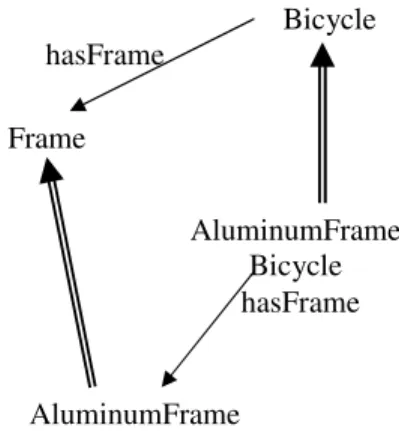
In our framework, negotiation is over a description of an item. For example, consider the shared ontology in Figure 1. It is the graphical representation of the following ontology in ALC:
Bicycle⊑ ∃hasF rame.F rame AluminumF rame⊑ F rame AluminumF rameBicycle⊑ Bicycle AluminumF rameBicycle⊑
∃hasF rame.AluminumF rame
These lines state that bicycles have frames, that aluminum frames are frames, that aluminum-framed bicycles are bi-cycles, and that aluminum-framed bicycles have aluminum frames.
Consider the following negotiation between the buyer B
and the seller S:
S:< Bicycle, $1000 − $8000 > (1) B:< Bicycle, $3000 − $5000 > (2) S:< AluminumF rameBicycle, $4000 > (3) B:< AluminumF rameBicycle, $3000 > (4) S:< T itaniumF rameBicycle, $5000 > (5) In line 1, the seller offers a bicycle for anywhere from $1000 to $8000 as the seller has a range prices for bicycles. The buyer in line 2 narrows the range of interest to between $3000 and $5000. The seller selects the aluminum-framed bicycle, and prices it at $4000. The buyer seems to value the aluminum-framed bicycle rather lower, and offers $3000 in line 4. Recognizing the seller’s low value of aluminum, the seller offers a titanium-framed bicycle for $5000.
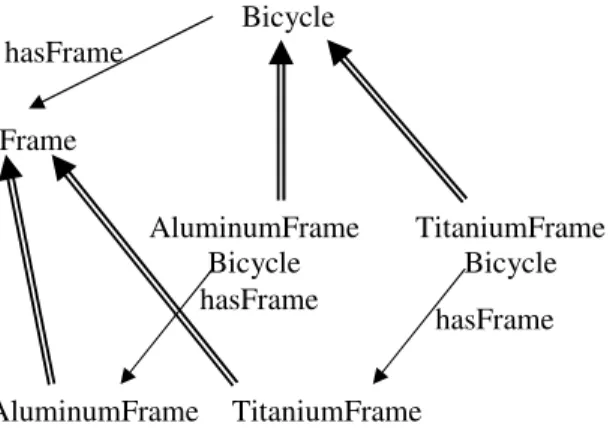
The condition of convergence requires the parties to make progress toward an eventual deal, and thus prevent them from making offers that do not make progress. For in-stance, the seller could not offer $9000 in line 3 for the AluminumF rameBicycle, since this is outside of the range of prices for bicycles, previously set at $1000 − $8000. Like-wise, the buyer at any time after line 4 cannot offer to buy an aluminum-framed bicycle for $3000 or any lower price, since this would waste time and may lead to endless negotiations. Assimilation:At this point the buyer is not able to pro-ceed since he has no knowledge of titanium-framed bicycles. He asks for and receives this information from a trusted party, which may be the seller. This gives rise to the new shared ontology, shown in Figure 2.
T itaniumF rameBicycle⊑ Bicycle
T itaniumF rameBicycle⊑ ∃hasF rame.T itaniumF rame T itaniumF rame⊑ F rame
He also asks for and receives information about the value of a titanium frame.1 Suppose the seller determined that
a titanium frame is indeed worth $5000. He accepts the seller’s last offer and the negotiation is completed.
Now suppose instead that the buyer does not know that titanium-framed bicycles are generally accepted to be more valuable, and the buyer offers a price of $3000 for the titanium-framed bicycle, which is lower than his previous offer for the aluminum-framed bicycle. To the seller, this seems to be wasting time, as the negotiation is considering offers that would have been eliminated if the buyer had shared this or-dering information. In this case, we see that the assimilation of new information seems to be undermining the convergent negotiation progress.
Moreover, any time new information is added, it takes time for the agents to investigate the consequences of that new information, and this naturally extends the time needed to reach convergence.
4.
EVALUATION OF OFFERS
We propose to exchange descriptions of items coming from a description logic, so the evaluation of offers must deal with
1Since the seller is an opponent in the negotiation, he may
want to receive information on the worth of a titanium frame from some other source.
Bicycle
TitaniumFrame
Bicycle
AluminumFrame
Bicycle
TitaniumFrame
AluminumFrame
hasFrame
hasFrame
hasFrame
Frame
Figure 2: Second Bicycle Example Ontology
the inherent ambiguity of these descriptions, i.e. they are not forced to be fully described items, only to belong to the extension of the description. Thus we allow the evaluation to return a range of values. This means finding the lowest and highest valued items in the class defined by the description. We give some general idea of how this can be done without paying attention to efficiency. In this paper we do not specify how to assign a value to an object, but it is common to use standard utility theory to do so[7, 5].
Given an ontology and a description, generating one item that adheres to the description is merely a operation of con-structing a canonical instance from a set. This is guaranteed to exist and to be finite, by the finite tree model property of ALC[3].
The canonical object construction procedure can be pic-tured as follows: for simplicity assume that the description is simply a class in the ontology. From this starting point, we manufacture an object to be a candidate instance in this class, and incrementally add information about it. Two classes are said to be compatible if they transitively abstract the same class. Construct a set of classes compatible with the given description in two steps: (1) nondeterministically select any chain of abstraction links below, following them in the reverse direction back to a most specific class, and (2) construct the transitive closure of abstraction links above, following them in the forward direction. The set of compat-ible classes is constructed as the union of these two steps. From each element of the set, follow all existential quantifi-cation links in the forward direction to find all of the objects that are entailed to fill roles for that object. For each of these classes, recursively construct a set of compatible classes and again find all of the objects entailed to fill roles. Alternate in this manner until a complete tree is build for each object. Because the above procedure is nondeterministic, it is ca-pable of generating a variety of candidate objects. Not all of those objects necessarily exist, as there are constraints should be applied. For instance. it is commonly assumed that classes that are not compatible are therefore disjoint, a form of the closed world assumption. Thus if the same role is filled by two different types of objects that are not compatible, that candidate is eliminated. Other constraints are imposed by the universal quantification links, which re-quire that roles to filled by objects be of a fixed class. If this fixed class is not be compatible with the class already pro-posed by the construction procedure, the candidate object
is eliminated.
For example, given Figure 1, and starting from Bicycle, the only other compatible class is AluminumF rameBicycle. The role of hasF rame is filled by a F rame (looking from Bicycle) and by an AluminumF rame (looking from Alu-minumFrameBicycle. Both types of frames are compatible and there is no conflict. Thus the only object that can be constructed is an aluminum-framed bicycle.
For another example, given Figure 2, again starting from Bicycle we can construct an object of class Bicycle and AluminumnF rameBicyclefor which the role of hasF rame is filled by a F rame (looking from Bicycle) and by an Alu-minumFrame (looking from AluminumF rameBicycle). But if we choose to specialize F rame by following the abstrac-tion link to T itaniumF rame, we find that the hasF rame role is filled by an object with two incompatible classes: Ti-taniumFrame and AluminumFrame. Thus this candidate is eliminated. The nondeterministic construction procedure is capable of generating four candidates, of which only two are consistent, so in the end, there are only two canoni-cal objects: the aluminum-framed bicycle and the titanium-framed one.
Once all of the items that match a description have been constructed, each is evaluated for utility for the agent, and the lowest and highest values are used in the counteroffer.
For the purposes of convergent negotiation, we also al-low ranges to shrink, and consider this still to be making progress. For example, an offer by the buyer for an item in the range $10-$20 could be followed by an offer in the range $10-$15. While this second offer is worse for the seller, it does represent progress on the part of the buy as he is spe-cializing the range of items to be considered. However, we do not allow the buyer to then make an offer for the same item if the range includes numbers less than $10.
5.
PRESERVING CONVERGENCE DURING
ASSIMILATION
As outlined in Section 3, this paper addresses a problem that arises when two processes are undertaken that seem to conflict with each other. On the one hand, in conver-gent negotiation protocols, as the negotiation proceeds the space that is left to be explored by negotiation monotoni-cally decreases. On the other hand, as both either or both agents increase their ontologies, the space to be negotiated increases. The question this paper sets out to answer is un-der what conditions does the protocol retain the property of convergence.
When one agent is given new information in the ontology, but not given information that is widely known about the relative values of the new items being considered, that agent can enter into time-wasting offers. While these may prevent the negotiation from proceeding as quickly as it would be forced to had the agent been given relative values, the con-vergent negotiation protocol will retain it convergence just on the basis of disallowing repeat offers.
Given the previous discussion, it is now a straightforward observation that if the set of information to be assimilated is finite, then after all assimilation is done, the convergent negotiation will have no opponent, and will enforce conver-gence. We expect this to be the case, since new information is not expected to be infinite. Thus we are assured that convergence is preserved.
CellPhone
MP3Player
hasDevice
CellPhoneWithMP3
AndCamera
CellPhone
WithMP3
MP3Player
hasDevice
Camera
hasDevice
Figure 3: Cellphone Example
6.
RELATED WORK
Beyond our work on CONNEG, there is closely related work on convergent protocols[11, 8, 9]. All proposals share the fundamental idea to demonstrate termination by enu-merating offers within a finite space.
Previous work on ontologies of negotiations makes a differ-ent use of ontologies, proposing to adapt negotiating agdiffer-ents to different negotiation situations, such as various types of auctions. The negotiation conditions state what offers are allowed at what time and what constitutes an agreement. Different choices give rise to different protocols. [10] de-scribe an ontology of such choices, and an agent that can adapt to these choices. On the other hand we negotiate by exchanging ontological descriptions, rather than fully con-structed objects.
7.
CONCLUSIONS AND FUTURE WORK
This paper investigates questions about two-party negoti-ation protocols: Can a protocol allow dynamic integrnegoti-ation of novel information? Can a convergent protocol allow this as-similation and preserve convergence? We observe that both of these are answered yes, when the additions are monotonic. We focus on negotiating protocol and do not make any contribution to negotiation strategies. However, we note that the CONNEG protocol makes only a few reasonable restrictions, and so interferes little, if at all, with strategies. In this paper we have focused on two-party negotiation and in the future we will consider assimilation of new infor-mation in multiparty negotiations, including auctions.
We have also focused on monotonic additions to the pro-tocol. Consider again the example from the introduction:
Buyer: “How much for a cell phone with MP3Player but no camera?”
Seller: “The phone with the MP3 player only comes with the camera.”
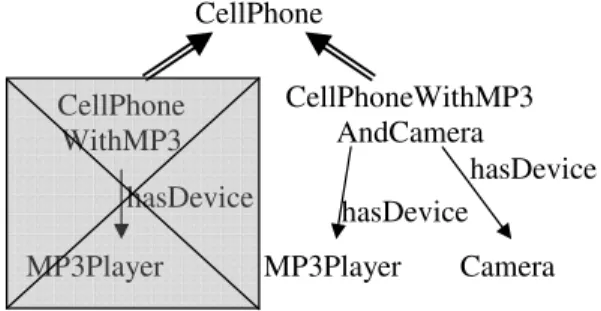
The agent’s initial belief can be expressed in the formula in Figure 3, and in these clauses:
CellP honeW ithM P3 ⊑ CellP hone ⊓ ∃hasDevice.M P3P layer
CellP honeW ithM P3AndCamera ⊑ CellP hone ⊓ ∃hasDevice.M P3P layer ⊓
∃hasDevice.Camera
As the buyer finds out there is no device CellPhoneWithMP3, the first formula above needs to be eliminated from the
A
C
B
⊥
Figure 4: Negative Update Example
buyer’s ontology. While simply deleting information from an ontology may not be difficult to deal with, the buyer may not always be able to update his ontology so simply. For instance if the buyer is told that some combination of features is not available, it may mean that some of his be-liefs are not true, and it is not clear which bebe-liefs need to be removed. Consider the Figure 4, where the agent is told that the intersection A ⊓ B is empty. It may be that C 6⊑ A or C 6⊑ B or some other problem, but the agent has no way to tell which.
8.
REFERENCES
[1] Association for the Advancement of Artificial Intelligence. Belief revision,
http://www.aaai.org/aitopics/html/belief.html, Accessed 2007 June 12.
[2] F. Baader, D. Calvanese, D. L. McGuinness, D. Nardi, and P. F. Patel-Schneider, editors. The Description Logic Handbook: Theory, Implementation, and Applications. Cambridge University Press, 2003. [3] F. Baader and U. Sattler. An overview of tableau
algorithms for description logics. Studia Logica, 69:5–40, 2001.
[4] S. Buffett, K. Jia, S. Liu, B. Spencer, and F. Wang. Negotiating exchanges of P3P-labeled information for compensation. Computational Intelligence,
20(4):663–677, 2004.
[5] S. Buffett, N. Scott, B. Spencer, M. M. Richter, and M. W. Fleming. Determining internet users’ values for private information. In Second Annual Conference on Privacy, Security and Trust (PSTˇS04), pages 79–88, 2004.
[6] S. Buffett, B. Spencer, L. Comeau, and M. W. Fleming. Detecting opponent concessions in
multi-issue automated negotiation. In Eighth Annual International Conference on Electronic Commerce, ICEC06), pages 11–18, 2006.
[7] P. C. Fishburn. Utility theory. Management Science, 14:335–378, 1968.
[8] D. Li and Y. Yue. Negotiation based on plan recognition and fuzzy sets for multiobjective process planning. In Artificial Intelligence and Soft
Computing, 2005.
[9] F. Sadri, F. Toni, and P. Torroni. Logic agents, dialogues and negotiation: an abductive approach. In AISBˇS01 Convention, 2001.
[10] V. Tamma, M. Wooldridge, and I. Dickinson. An ontology for automated negotiation, 2002.
[11] P. Torroni. A study on the termination of negotiation dialogues. In AAMAS ’02: Proceedings of the first international joint conference on Autonomous agents and multiagent systems, pages 1223–1230, New York, NY, USA, 2002. ACM Press.