HAL Id: hal-00303051
https://hal.archives-ouvertes.fr/hal-00303051
Submitted on 10 Aug 2006
HAL is a multi-disciplinary open access
archive for the deposit and dissemination of
sci-entific research documents, whether they are
pub-lished or not. The documents may come from
teaching and research institutions in France or
abroad, or from public or private research centers.
L’archive ouverte pluridisciplinaire HAL, est
destinée au dépôt et à la diffusion de documents
scientifiques de niveau recherche, publiés ou non,
émanant des établissements d’enseignement et de
recherche français ou étrangers, des laboratoires
publics ou privés.
Statistical analysis of Stromboli VLP tremor in the band
[0.1?0.5] Hz: some consequences for vibrating structures
E. de Lauro, S. de Martino, M. Falanga, M. Palo
To cite this version:
E. de Lauro, S. de Martino, M. Falanga, M. Palo. Statistical analysis of Stromboli VLP tremor in the
band [0.1?0.5] Hz: some consequences for vibrating structures. Nonlinear Processes in Geophysics,
European Geosciences Union (EGU), 2006, 13 (4), pp.393-400. �hal-00303051�
www.nonlin-processes-geophys.net/13/393/2006/ © Author(s) 2006. This work is licensed
under a Creative Commons License.
Nonlinear Processes
in Geophysics
Statistical analysis of Stromboli VLP tremor in the band
[0.1-0.5] Hz: some consequences for vibrating structures
E. De Lauro1, S. De Martino1,2,3, M. Falanga1,2,3, and M. Palo1
1Dipartimento di Fisica, Salerno University, via S. Allende, I-84081 Baronissi (SA), Italy
2INFM, unit`a di Salerno, via S. Allende, I-84081 Baronissi (SA), Italy
3INFN, gruppo collegato di Salerno, via S. Allende, I-84081 Baronissi (SA), Italy
Received: 16 January 2006 – Revised: 24 May 2006 – Accepted: 1 June 2006 – Published: 10 August 2006
Abstract. We analyze time series of Strombolian volcanic
tremor, focusing our attention on the frequency band [0.1–
0.5] Hz (very long period (VLP) tremor). Although this
frequency band is largely affected by noise, we evidence two significant components by using Independent Compo-nent Analysis with the frequencies, respectively, of ∼0.2 and
∼0.4 Hz. We show that these components display wavefield
features similar to those of the high frequency Strombolian signals (>0.5 Hz). In fact, they are radially polarised and located within the crater area. This characterization is lost when an enhancement of energy appears. In this case, the presence of microseismic noise becomes relevant. Investi-gating the entire large data set available, we determine how microseismic noise influences the signals. We ascribe the microseismic noise source to Scirocco wind. Moreover, our analysis allows one to evidence that the Strombolian conduit vibrates like the asymmetric cavity associated with musical instruments generating self-sustained tones.
1 Introduction
The Stromboli volcano is situated on the homonymous is-land, in the Eolie Archipelago, not far from the coast of Sicily. The activity of this volcano has been attracting the attention of the geophysical community for long time. It is characterized by a continuous tremor on which frequent ex-plosive events are superimposed and it is present on many volcanoes worldwide. It is known as “Strombolian activity”. The seismic wavefield of the Stromboli volcano has been in-vestigated, focusing the attention on the explosion quakes (Chouet et al., 1997, 1998; Del Pezzo et al., 1992; Acernese et al., 2003, 2004; Bottiglieri et al., 2005).
Correspondence to: S. De Martino
The properties of the volcanic tremor field are not yet well established. Due to the low signal-to-noise ratio, one is re-quired to perform the analysis by considering a large data set, in order to obtain information on a statistical basis.
Strombolian volcanic tremor and explosion quakes show similar features at high frequency (>0.5 Hz), both in time and frequency domain (Ciaramella et al., 2004; De Lauro,
20061). This suggests the existence of a common source
to be ascribed to the degassing process. Recently, signifi-cant components of the volcanic tremor have been evidenced at low frequencies (<0.5 Hz) (De Martino et al., 2005; De Lauro et al., 2005). One of these components was seen in the frequency band [0.1−0.5] Hz. It displays the same field properties of the high frequency band (>0.5 Hz), i.e. a radi-ally polarised wavefield and an apparent velocity of ∼1 km/s. We remind the reader that this frequency band is affected by microseismic noise, whose nature has been investigated for a long time. It is the result of a nontrivial combina-tion of atmospherical processes (e.g. wind waves) and sea
waves. The microseismic noise is mainly composed of
Raleigh waves. Its most significant spectral peak is around 0.2 Hz but it can corrupt seismic signals over almost any fre-quency (e.g. Webb, 1998, and references therein).
This paper is devoted to the careful analysis of this fre-quency band in order to obtain information about the proper-ties of volcanic tremor and microseismic noise. We analyse the [0.1−0.5] Hz frequency band (VLP tremor) to infer the possibility of simpler hidden structures.
1De Lauro, E., De Martino, S., Del Pezzo, E., Falanga, M., Palo,
M., and Scarpa, R.: Model for high frequency Strombolian tremor inferred by wavefield decomposition and reconstruction of asymp-totic dynamics, J. Geophys. Res., submitted, 2006.
394 E. De Lauro et al.: Microseismic noise at Stromboli
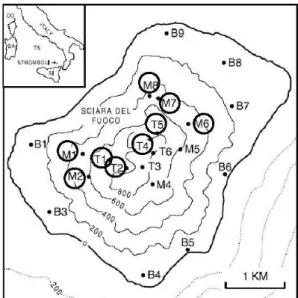
Fig. 1. Location map of the seismic stations. We have analysed the recordings relative to the stations indicated with a circle.
Table 1. Scheme of the operating seismometers selected for our analysis. The effective acquisition time periods for each station are indicated with the symbol X.
1st period: 2nd period 3rd period 4th period
from 18 Sep 22:00 UT 19 Sep 22:00 UT 22 Sep 11:00 UT 24 Sep 12:00 UT to 19 Sep 06:00 UT 20 Sep 06:00 UT 23 Sep 12:00 UT 25 Sep 10:00 UT
T1 X X X X T2 X X X X T4 X X X X T5 NO NO X X M1 X X X X M2 X X X X M6 X X NO X M7 NO X NO X M8 X X X NO
2 Data set and preliminary analysis: time energy evolu-tion
Here, we analyse the large data set recorded during the ex-periment performed in 1997 (see Chouet et al. (1999, 2003) and references therein). Twenty-one three-component Gu-ralp CMG-40T broad-band (0.02−60 s) seismometers were deployed on the Stromboli volcano by the U.S. Geological Survey, University of L’Aquila, Osservatorio Vesuviano and National Seismic Survey. The seimometers were set on the flanks of the volcano, forming three rings around the crater area at different altitudes (top, middle and bottom ring indi-cated on the map with the letters T, M, B, respectively). The distances of the stations from the crater zone ranged from 0.3 to 2.2 km. In Fig. 1, we show the location map of the seismic network. 0 100 200 300 400 500 600 700 800 900 −1000 −500 0 500 1000 time [s] 0 50 100 150 200 250 300 350 400 450 500 −1000 −500 0 500 1000 time [s]
ground velocity [counts]
Fig. 2. VLP tremor series recorded at the T1 station, vertical chan-nel. These signals are representative of a tremor (a) recorded on 19 September at 00:33 UT; (b) recorded on 24 September at 12:17 UT. We will see in Sect. 5 that they are characterized by radial and el-liptical polarisation, respectively.
The stations have been recording for a week. The whole data set is composed of 60 h of recorded signals distributed in four disjointed time periods, lasting 7, 7, 25, 21 h, respec-tively. During these periods not all the instruments have been working.
We have selected for the analysis the best set for our aim. This is composed of the recorded signals along the four time periods indicated above and relative to the nine stations re-ported in Table 1. As an example of the tremor recorded in different periods, we report in Fig. 2 two representative series of VLP Strombolian tremor.
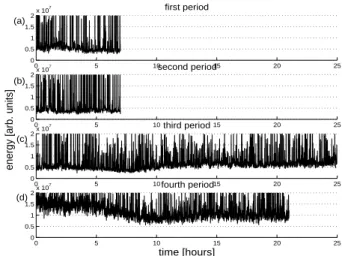
We start to characterize these four time periods in terms of energy. We evaluate a quantity proportional to the energy by taking the integral of power spectrum. We use for this eval-uation sliding windows of 90 s with an overlapping of 90%. In Fig. 3, we report these evaluated quantities for the four considered time periods by looking at the radial component of the station M2. The other stations display the same be-haviour. Notice that the spikes correspond to the explosions; we concentrate our attention on the background energy.
In the first two periods the background energy is almost stationary. In the third period, we observe an enhancement of this background energy followed by a gradual decrease up to a slightly higher cutoff occurring in the fourth period.
We will see that this time evolution of background energy is related to the level of microseismic noise. Accordingly, the polarisation features of the tremor in this frequency band
[0.1−0.5] Hz will vary.
3 Independent component analysis
The first step is to understand what is changing in terms of the sources corresponding to the observed variations of back-ground energy. To achieve this goal we apply Independent Component Analysis (ICA) (for details see Hyv¨arinen et al., 2001).
It is convenient to give some remarks about this tech-nique (for its application to seismic signal see Acernese et al., 2003).
We can suppose to have m different recorded time series
x, that we hypothesize to be the linear superposition of n
mutually independent unknown sources s, due to different mixing, represented by a constant unknown m×n matrix A. This mixing is essentially due to path, noise, instrumental transfer-functions, etc. If the mixing has to be linear, nothing is assumed with respect to the sources, which can be linear or nonlinear.
Formally, the mixing model is written as
x = As . (1)
In addition to the source independence request, ICA assumes that the number of available different mixtures m is at least as large as the number of sources n. Under these hypothesis, the ICA goal is to obtain a separating matrix W, the inverse of A, in such a way that the vector
y = Wx (2)
is an estimate y's of the original independent source signals. ICA is a statistical model based on the central limit theo-rem, which establishes that the distribution of a sum of in-dependent random variables tends towards a Gaussian dis-tribution, under certain conditions. Hence, the main idea of the ICA model is to maximize the non-Gaussianity (super-Gaussianity or sub-(super-Gaussianity) to extract the independent components. Some heuristic approaches have been proposed in literature to achieve the separation. Among them, a good measure of independence is given by negentropy J . It re-lays upon the information-theoretic quantity of differential entropy H of a random vector and it is defined as follows:
J (z) = H (zgauss) − H (z), (3)
where z is a random variable and zgaussis a Gaussian random
variable with the same covariance matrix as z. The estimate of negentropy is difficult and, in practice, some approxima-tions must be introduced. These approximaapproxima-tions involve the estimate of 4th order statistical moments.
In the following we shall use the fixed-point algorithm, namely FastICA, based on an approximative Newton itera-tion scheme. An extensive descripitera-tion of theoretical struc-ture and FastICA algorithm can be found in Hyv¨arinen et al. (2001).
The basic ICA model, in summary, requires the following assumptions: 0 5 10 15 20 25 0 0.5 1 1.5 2x 10 7 first period 0 5 10 15 20 25 0 0.5 1 1.5 2x 10 7
energy [arb. units]
second period 0 5 10 15 20 25 0 0.5 1 1.5 2x 10 7 third period 0 5 10 15 20 25 0 0.5 1 1.5 2x 10 7 time [hours] fourth period (a) (b) (c) (d)
Fig. 3. Time energy evolution estimated for the recordings rela-tive to the M2 station, looking at the four acquisition periods (see Table 1). The spikes correspond to the explosion quakes. The un-derlying trend is clearly visible (background energy).
– all the independent components, with the possible
ex-ception of one component, must be non-Gaussian (Bell and Sejnowski, 1995);
– the number of the observed linear mixtures must be at
least as large as the number of independent components;
– the matrix A must be of full column rank.
We have to underline that we cannot recover the ampli-tudes of the extracted source signals by ICA. In fact, this method cannot determine the variances (proportional to ener-gies) of the extracted independent components, namely little information is assumed on matrix A, therefore, the magni-tudes of the basis vectors of the matrix A and the amplimagni-tudes of the source signals can be interchanged in Eq. (1). There-fore, the most natural way to obtain a unique expansion is to assume that each source has a unit variance. This is ac-complished by Principal Component Analysis (PCA). This method involves a mathematical procedure that transforms a number of (possibly) correlated variables into a (smaller) number of uncorrelated variables called principal compo-nents. The first principal component accounts for as much of the variability in the data as possible, and each succeeding component accounts for the remaining variability. Tradition-ally, is PCA accomplished by diagonalization of covariance matrix (Bishop, 1995).
3.1 Application of ICA to VLP tremor
We have applied ICA to the VLP tremors (considering all available stations) recorded during the first and fourth acqui-sition periods which were representative of the two observed states: low and high level of energy. We report the results for the recording relative to the vertical direction but the same holds for the other.
396 E. De Lauro et al.: Microseismic noise at Stromboli
0 100 200 300 −5
0 5
Amplitude [arb. units]
0 0.2 0.4 0.6 0 500 1000 1500 0 100 200 300 −5 0 5 0 0.2 0.4 0.6 0 500 1000 1500 0 100 200 300 −2 0 2 0 0.2 0.4 0.6 0 150 300
Power Spectrum Density
0 100 200 300 −2 0 2 time [s] 0 0.2 0.4 0.6 0 500 1000 1500 frequency [Hz] (a) (b)
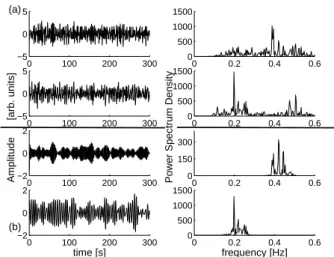
Fig. 4. (a) Components extracted by ICA analyzing the first acqui-sition period (tremor on 19 September at 00:33 UT, vertical channel recorded at the all stations working in that period). These are the components associated with the principal eigenvalues of the covari-ance matrix. The relative spectra are reported on the right; (b) the independent components after the application of a nonlinear, de-noising method to better evidence the “beats”.
0 0.2 0.4 0.6 0 500 1000 0 0.2 0.4 0.6 0 500 1000
Power Spectrum Density
0 0.2 0.4 0.6 0 500 1000 frequency [Hz] 0 100 200 300 −5 0 5 0 100 200 300 −5 0 5
amplitude [arb. units]
0 100 200 300
−5 0 5
time [s]
Fig. 5. Components extracted by ICA analyzing the fourth ac-quisition period (tremor 24 September 12:17 UT, vertical channel, recorded at all stations working in that period). The waveforms and the relative spectra suggest that ICA is not able to isolate indepen-dent components.
In the first period, the method has extracted only two inde-pendent components with well shaped waveforms and spec-tral content. These two components are associated with the principal eigenvalues of the covariance matrix. In Fig. 4, we show the extracted waveforms and the corresponding spec-tra before and after the application of a denoising technique (Kostelich and Schreiber, 1993). The time evolution of both components appears to be characterized by “beats”; this is a common feature of the Strombolian high-frequency wave-field. We may conclude that the low energy state is the linear superposition of two signals peaked, respectively, around 0.2 and 0.4 Hz. 0.05 0.1 0.15 0.2 0.25 0.3 time [hours] azimuth [degree] 0 1 2 3 4 5 6 0 20 40 60 80 100 120 140 160 180 time [hours] azimuth [degree] 0 1 2 3 4 5 6 0 20 40 60 80 100 120 140 160 180 0 0.1 0.2 0.3 0.4 (a) (b)
Fig. 6. Example of the evolution of the azimuths during the first (a) and second (b) acquisition periods at stations M2 and T4, respec-tively: the tremor is radially polarised.
The application of ICA to VLP tremor segments belong-ing to the first hours of the fourth acquisition period is inef-ficacious, namely, as one can see in Fig. 5, the previous two modes can still be distinguished in the spectrum (notice that the frequencies are slightly higher than the first case), but they are entangled in an inseparable way. This suggests that the high level of energy may be due to the presence of an ex-ternal source (microseismic noise), which, superimposing on volcanic source signals, entangles them by a strong coupling (in this case the signals are inseparable).
4 Polarisation analysis
To obtain information about the polarisation properties of the tremor, we apply a Kanasewich filter (Kanasewich, 1981). The basic idea of this method is the diagonalization of a co-variance matrix computed by the three components of ground motion. The parameters of polarisation (azimuth and dip) are defined in terms of the eigenvector with the highest eigen-value. Using the eigenvalues of this matrix, we can evaluate a rectilinearity coefficient:
RL =1 − λmin+λint
2λmax
,
where λmin, λintand λmaxare, respectively, the minimum,
in-termediate and maximum eigenvalues. If RL is close to one, the waves are linearly polarised and the eigenvector corre-sponding to the highest eigenvalue defines the direction of polarisation.
We consider the four acquisition periods separately at all the selected stations in order to perform the analysis on a sta-tistical basis. Due to the low signal-to-noise ratio, we look at the results of the polarisation analysis, focusing the attention on the distributions of the three parameters: azimuth, dip and
RL.
In detail, we apply a Kanasewich filter by considering the frequency band [0.1−0.5] Hz (excluding the explosions) on windows 5 s in length, sliding 1 s every step. We select only
azimuth [degree] time [hours] 0 5 10 15 20 0 20 40 60 80 100 120 140 160 180 0.05 0.1 0.15 0.2 0.05 0.1 0.15 0.2 0.25 time [hours] azimuth [degree] 0 5 10 15 20 0 20 40 60 80 100 120 140 160 180 (b) (a)
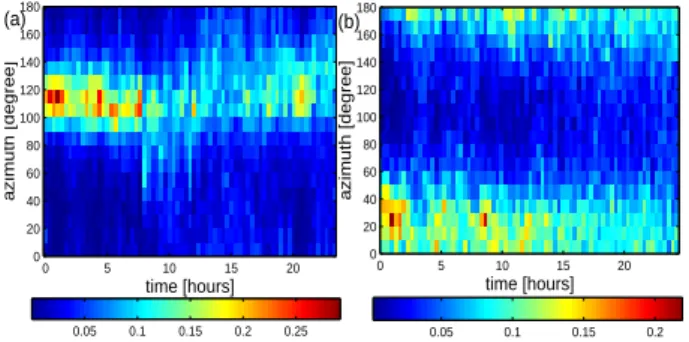
Fig. 7. Example of the evolution of the azimuths relative to the third acquisition period at stations T4 and M2, placed, respectively, one on the east (a) and on the west (b) flank. The behaviour appears to be linked to the energy: when the energy increases, at the east side the azimuths become more dispersive. At the west side the radial direction of the azimuths generally is preserved.
those windows for which RL is high (>0.7). Then, we show, as a function of time and azimuth, the fraction of these win-dows which have every ten minutes azimuths within ten de-grees; the color bar (from blue to red) indicates the values assumed by these fractions (see Figs. 6–8).
Figure 6 refers to the first two acquisition periods, each one lasting seven hours and recorded over two different days. The bold red band indicates azimuths pointing towards the crater zone. This feature is common to all the stations. This confirms and generalizes the results of De Lauro et al. (2005). The third acquisition period (∼25 h) shows a more com-plex behaviour of azimuths. In Fig. 7, the results of the two stations placed on both flanks of volcano are reported. On the right (Fig. 7b) there are the results relative to the west flank. This graph shows that the polarisation is radial, during the first 11 h, otherwise in the subsequent times, the azimuths become more dispersive. During this period, looking at the evolution of energy, immediately one realizes that polarisa-tion is radiality lost when energy grows. A strong micro-seismic noise affects the signals. In Fig. 7a, a station in the east flank shows again a radial polarisation in the first hours; then, the azimuth around 120 deg becomes slightly more dis-persive.
The behaviour of polarisation at the east flank lets us sup-pose that the microseismic noise comes from this direction. This is the direction of the Scirocco wind (south, southeast direction) that blows on Stromboli during summer season.
The influence of a source coming from the southeast direc-tion on azimuths is also evident in the fourth acquisidirec-tion pe-riod (Fig. 8). At all the stations a direction of polarisation of 120 deg during the first 6 h is visible when the energy is high. Then the energy decreases to a level up to its mean value in the third acquisition period, and the azimuths relative to the stations on the east flank show no appreciable variation (see Fig. 8a). The polarisation at stations on the west flank ap-pears more complex (Fig. 8b), namely the distribution of the
0.02 0.04 0.06 0.08 0.1 azimuth [degree] time [hours] 0 5 10 15 20 0 20 40 60 80 100 120 140 160 180 0.02 0.04 0.06 0.08 0.1 0.12 azimuth [degree] time [hours] 0 5 10 15 0 20 40 60 80 100 120 140 160 180 (b) (a)
Fig. 8. Example of the evolution of the azimuths during the fourth acquisition period at M7 (a) and T1 (b): the two sides of the vol-canic cone manifest different behaviour. When the energy decreases the radial component of the polarisation at the stations on the west flank (see the graph b) become more evident; at the other flank the energy step does not influence the azimuths (see graph a). azimuths shows two large peaks: one at ∼120 deg and the other pointing towards the crater.
Now, we take into account only the period in which polari-sation is clearly radial. On the basis of the results of ICA, we subdivide the [0.1−0.5] Hz frequency band into two bands, respectively, [0.1−0.3] Hz, and [0.3−0.5] Hz and we apply the polarisation analysis. The window selected for the anal-ysis is 5 s in length and moves 1 s every step.
In Fig. 9 the distributions of RL, the azimuth and the dip parameters are shown relative to a tremor lasting 6 min. We report only the values of the azimuths and the dip corre-sponding to a very high RL (>0.9). It appears clear that in these two bands, the wavefield shows radial polarisation. The distributions of the dip parameters indicate little differences in the depth of the source, suggesting the existence of slightly different vibrating structures. Moreover, looking at the RL distribution, the tremor around 0.4 Hz is better polarised.
The signals recorded at the other stations reveal simi-lar features, but with the influence of their different eleva-tion. For example, at middle stations, dip parameters are slightly more superficial than at the top; the azimuths esti-mated on the tremor in the band [0.1−0.3] Hz appear more disperse. This period is weakly influenced by microseismic noise (see Fig. 3). This appears indeed on the frequency band
[0.1−0.3] Hz, since this is the narrow band of microseismic
noise.
To continue, we claim that the tremor at Stromboli in the frequency band [0.1−0.5] Hz is well polarised and points to the craters when the energy is relatively low. Moreover, the signals can be decomposed into independent signals that show the same polarisation properties. When the energy grows up, the oscillations produced by source processes are often hidden and the rectilinearity of the motion decreases. But a direction of azimuths pointing towards southeast can be isolated, probably linked to the blowing of the Scirocco wind, that influences above all the flank of the volcano di-rectly exposed.
398 E. De Lauro et al.: Microseismic noise at Stromboli 0.4 0.6 0.8 1 0 100 200 300 400 500 600 0 100 200 0 50 100 150 200 250 300 40 60 80 100 0 50 100 150 200 0.4 0.6 0.8 1 0 200 400 600 800 1000 1200 rectilinearity 0 100 200 0 100 200 300 400 500 azimuth [degree] 40 60 80 100 0 100 200 300 400 500 dip [degree] (a) (b)
Fig. 9. Distribution of parameters of the polarisation obtained by analyzing the radially polarised tremor (19 September at 00.33 at T4) in the two sub-bands estimated: (a) [0.1−0.3] Hz; (b)
[0.3−0.5] Hz. Number of windows are on the y-axes.
5 Zero lag cross correlation analysis
The estimate of the source position of seismic events is usu-ally carried out by comparing the times of the onsets on seis-mograms and the distances between the stations. The lack of clear arrivals in the volcanic tremor makes this proce-dure unapplicable. It is possible to localize the source of the tremor by using the cross-correlation function. The Zero Lag Cross Correlation (ZLCC) method is based on this idea. The classical ZLCC method has been largely used in volcano-seismology: it is based on the approximation of a planar wave front. Fixing the incoming direction of the wavefield, theoretical time delays can be estimated. They will be used to shift the seismic series recorded at the various stations. The estimated parameters of the source will be the ones which maximize the correlation between the shifted signals. Two parameters of travelling waves are estimated: the modulus of the apparent slowness (defined as the inverse of the ap-parent velocity) and the direction of propagation (azimuth). De Lauro et al. (2005) have applied the ZLCC technique on VLP tremors, in order to obtain information about incoming directions and to estimate the apparent velocity of travelling waves.
It is possible to improve this method by assuming that waves propagate with a circular front (ZLCC-circular). In this case, the method will depend on an additive parameter, i.e. the epicentral distance (Almendros et al., 1999). Choos-ing arbitrarily an origin point, we will obtain a probable epi-center zone (individuated by an azimuth and a distance from origin) and a distribution of apparent slowness. Moreover, this improvement is needed when we are dealing with a cir-cular array or a network, and the source is supposed to be internal to it.
We apply the ZLCC-circular method on the VLP tremor. In particular, we have chosen (as above) two tremor series representative of the two polarisation states, using the
ver-0 0.5 1 −0.3 0 0.3 0.6 y [Km] (a) 0 0.5 1 −0.3 0 0.3 0.6 y [Km] (b) 0 0.5 1 1.5 2 2.5 0 2 4 6 8 10 12 14 0 0.5 1 1.5 2 2.5 0 5 10 15 20 25 30 35 40 a) 0 0.5 1 −0.3 0 0.3 0.6 x [Km] y [Km] 0 0.5 1 1.5 2 2.5 0 2 4 6 8 10 12 apparent slowness [s/Km] (c) b)
Fig. 10. Estimate of the source position for the VLP tremor (ver-tical channel): (a) [0.1−0.3] Hz (19 September at 00:33 UT); (b)
[0.3−0.5] Hz (19 September at 00:33 (a)); (c) [0.1−0.5] Hz in the
case of a nonpolarised state (24 September at 12:17 UT). The ori-gin of the axis coincides with the M1 position. The estimated source region is the same in all cases, corresponding to the crater area (rep-resented by the dotted circle). On the right, there are the relative estimates of the apparent slowness. The number of time windows are reported on the y-axis. These histograms show primarily two peaks: one in the range of 500–700 m/s and another at ∼2 km/s.
tical component of motion recorded by seismometers in the middle ring, which can be considered planar. For the radially polarised state, we repeat the analysis for the two frequency sub-bands previously distinguished. We have used a search grid for the x and y components of slowness varying in the range [−2 : 2] s/km, with a step of 0.1 s/km. The search grid for the epicentral distance from the M1 station (chosen as origin) varies from 500 m to 2 km, with a step of 100 m. The windows of the signals used for the correlation are 5 and 8 s long, for the two sub-bands, respectively.
In the first column of Fig. 10 we show the estimated posi-tion of the source (projected on the north-south, east-west plane) relative to the radially polarised tremor filtered in
[0.1−0.3] Hz (Fig. 10a) and [0.3−0.5] Hz (Fig. 10b); in the
second column there are the corresponding distributions of apparent slowness. The graphs are plotted using only the parameters corresponding to high values of the correlation function (>0.9).
For both sub-bands, the source region appears localized near the crater area, although it is better peaked for the 0.4 Hz tremor. The correlation values for the tremor in the
[0.1−0.3] Hz band are slightly lower than in the other
sub-band, on average. Moreover, the source region appears less localized, suggesting a stronger influence of microseismic noise.
These results confirm that both independent signals of this VLP tremor are generated into the crater area and that they are produced by vibrations of volcanic structures. In addi-tion, the apparent velocity is estimated around 500 m/s or a bit more for the higher frequency sub-bands, while the lower frequencies show a bimodal distribution, with an additive maximum around 2 km/s, as seen by De Lauro et al. (2005).
We have proceeded in a similar way by applying a ZLCC-circular analysis to the elliptically polarised tremor. The re-sults are shown in Fig. 10c. We have investigated the en-tire band [0.1−0.5] Hz. The position of the source appears to be approximately within the crater area, but some points do not fall into the same zone. Here, the maximum of the search grid of the epicentral distance has been extended up to 2.5 km.
We notice that, including the windows with a correlation lower than 0.9, some points thicken on the upper border of the epicentral search grid (2.5 km), suggesting a sort of di-rect influence of an external source, as already pointed out by De Lauro et al. (2005). The apparent velocities show a large peak centered around 500–700 m/s and another around 2 km/s, as above.
We can conclude that the ZLCC-circular analysis has fur-nished an estimation of the source position on the north-south, east-west plane and of the apparent velocity of the waves. We have basically found only one source region, co-incident approximately with crater area. No differences are noted for the VLP tremor with different polarisation proper-ties nor for the two independent signals constituting the VLP tremor. The estimation of the apparent velocity has shown two maxima: one around 500–700 m/s, and another corre-sponding to faster waves (∼2 km/s).
6 Conclusions and discussion
We have studied the tremor of the Stromboli volcano in the frequency range [0.1−0.5] Hz (VLP tremor). This band, as is well known, can be affected by microseismic noise. De-spite this, De Lauro et al. (2005) have shown that it con-tains a coherent and radially polarised signal. In this paper, we have improved their preliminary results, by considering a large data set and a statistical approach.
Our results can be summarized and discussed as follows:
– the elliptical polarised state is consistent with the
contri-bution coming from the external source, primarily due to the Scirocco wind. This is clearly evidenced when performing the polarisation analysis and looking at the distribution of the azimuths at the stations. On a statis-tical basis, the predominance of an azimuth of 120 deg (south, southeast direction) is well evident at the sta-tions on the east flank of the volcano. This state is al-ways associated with more energetic signals. On the other flank, the direction pointing to the crater is also present; 0 1 2 3 4 5 6 7 8 9 10 0 2 4 6 8 10 12 14 16 18x 10 6 frequency [Hz] PSD [a.u.]
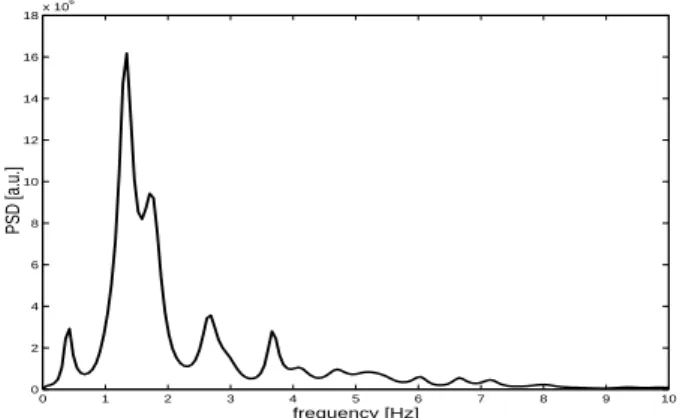
Fig. 11. Spectrum of high-frequency Strombolian tremor (>0.1 Hz) by using a Maximum Entropy-based algorithm.
– when the level of energy is quite low, the VLP tremor
appears well polarised towards the crater area. ICA has decomposed this band into two independent sub-bands, peaked, respectively at 0.2 Hz and 0.4 Hz. Though both independent source signals are still radially polarised, the first shows more dispersion. This can be ascribed to a low level of microseismic noise that prevalently in-fluences this component peaked around 0.2 Hz (Webb, 1998);
– zero-lag cross-correlation technique and its modified
version show that in the case of radial polarisation, the source is located in the crater area. When the energy grows and the polarisation becomes elliptical, an exter-nal source is adding. This exterexter-nal source, for its fea-tures of polarisation and incoming direction, can be as-cribed to the blowing of the Scirocco wind.
We conclude that the two sources, wind and degassing, that impact on the vibration of the volcano, produce the same macroscopic effect. When the two sources act simultane-ously (the more energetic state), the 0.2-Hz peaked signal is affected by microseismic noise. We are observing a typi-cal behaviour of vibrating cavities: by increasing the source energy, the fundamental peak in the spectrum shifts. Then this peak is superimposed on the 0.4-Hz peak, making indis-tinguishable the two separated signals extracted in the less energetic state.
Often, people discuss the possibility of describing the high frequency signals of Stromboli as due to a suitable vibrating cavity (e.g. organ pipe model). Our results evidence a new component in the frequency band [0.1−0.5] Hz that supports this model.
Organ pipes are generally grouped into two classes: cylin-drical and conic pipes. The first pipes have a symmetric shape and they are characterised by a decreasing exponen-tial spectrum (the first mode is the most energetic and so on). The second pipes are asymmetrically shaped or not ho-mogeneous (i.e. with some holes or restrictions), and they
400 E. De Lauro et al.: Microseismic noise at Stromboli are characterised by a bell-shaped spectrum, in which the
first mode is less energetic than the others. If we consider the cleaned spectrum of the Strombolian tremor at a high frequency (>0.1 Hz) computed using a Maximum Entropy-based algorithm (Burg (1967)) (see Fig. 11), we recognize a spectral shape like a conic pipe (Benade and Lutgen, 1988).
We conclude that there is some evidence that the Strombo-lian conduit vibrates like a very complex asymmetric vibrat-ing cavity.
Edited by: M. Thiel Reviewed by: two referees
References
Acernese, F., Ciaramella, A., De Martino, S., Falanga, M., and Tagliaferri, R.: Neural Networks for blind sources separation of Stomboli explosion quakes, IEEE Trans. Neural Netws., 14, 167–175, 2003.
Acernese, F., Ciaramella, A., De Martino, S., Falanga, M., Godano, C., and Tagliaferri, R.: Polarisation analysis of the independent components of low frequency events at Stromboli volcano (Eo-lian Island, Italy), J. Volc. Geotherm. Res., Special Issue: an in-troduction, edited by: Harris, A., Hort, M., Ripepe, M., 137, 1–3, 153–168, doi:10.1016/j.jvolgeores.2004.05.005, 2004.
Almendros, J., Ibanez, J. M., Alguacil, G., and Del Pezzo, E.: Ar-ray analysis using circular wavefront geometry: an application to locate the nearby seismo-volcanic source, Geophys. J. Int., 136, 159–170, 1999.
Bell, A. J. and Sejnowski, T. J.: An information-maximisation approach to blind separation and blind deconvolution, Neural Comp., 7, 1129–1159, 1995.
Benade, A. H. and Lutgen, S. J.: The saxophone spectrum, J. Acoust. Soc. Am., 83, 1900–1907, 1988.
Bishop, M. C.: Neural Networks for Pattern Recognition, Claren-don Press-Oxford, 1995.
Bottiglieri, M., De Martino, S., Falanga, M., Godano, C., and Palo, M.: Statistics of inter-time of Strombolian explosion-quakes, Eu-rophys. Lett., 72, 3, 492–498, doi:10.1209/epl/i2005-10258-0, 2005 and Research Highlights, Nature Physics, 1, December, 2005.
Burg, J. P.: Maximum entropy spectral analysis, in: Modern Spec-tral Analysis, edited by: Childers, D. G., IEEE Press, New York 90, 1881–1893, 1967.
Chouet, B. A., Saccorotti, G., Martini, M., Dawson, P., De Luca, G., Milana, G., and Scarpa, R.: Source and path effect in wavefield of tremor and explosions at Stromboli Volcano, Italy, J. Geophys. Res., 102, 15 129–15 150, 1997.
Chouet, B. A., Dawson, P., De Luca, G., Martini, M., Milana, G., Saccorotti, G., and Scarpa, R.: Array analyses of seismic wave-fields radiated by eruptive activity at Stromboli volcano, Italy, CNR-Gruppo Nazionale per la Vulcanologia, Felici editore, Os-pedaletto, Pisa, 1998.
Chouet, B. A., Saccorotti, G., Dawson, M., Martini, M., Scarpa, R., De Luca, G., Milana, G., and Cattaneo, M.: Broadband mea-surements of sources of explosions at Stromboli Volcano, Italy, Geophys. Res. Lett., 26, 13, 1937–1940, 1999.
Chouet, B. A., Dawson, P., Ohminato, T., Martini, M., Saccorotti, G., Giudicepietro, F., De Luca, G., Milana G., and Scarpa, R.: Source mechanism of explosions at Stromboli determined from moment tensor inversions of very-long-period data, J. Geophys. Res., 108, B1, 2019, doi:10.1029/2002JB001919, 2003. Ciaramella, A., De Lauro, E., De Martino, S., Di Lieto, B., Falanga,
M., Tagliaferri, R.: Characterization of Strombolian events by using Independent Component Analysis, Nonlin. Proc. Geo-phys., 11, 453–461, 2004.
De Lauro, E., De Martino, S., Falanga, M., Palo, M., and Scarpa, R.: Evidence of VLP volcanic tremor in the band [0.2–0.5] Hz at Stromboli Volcano, Italy, Geophys. Res. Lett., 32, L17303, doi:10.1029/2005GL023466, 2005.
Del Pezzo, E., Godano, C., Gorini, A., and Martini, M.: Wave po-larization and location of the source of the explosion quakes at Stromboli volcano, IAVCEI Proceed. in Volcanology III, in: Vol-canic seismology, edited by: Gasparini, P., Scarpa, R. and Aki, K., Springer Verlag, Heidelberg, 279–296, 1992.
De Martino, S., Falanga, M., Scarpa, R., and Godano, C.: Very long period volcanic tremor at Stromboli, Italy, Bulletin of Seis-mological Society of America, 95, 3, 1186–1192, 2005. Hyv¨arinen, A., Karhunen, J., and Oja, E.: Independent Component
Analysis, John Wiley & Sons, New York, 2001.
Kanasewich, E. R.: Time sequence analysis in geophysics, Univ. of Alberta Press, Edmonton-Canada, 1981.
Kostelich, E. J. and Schreiber, T.: Noise reduction in chaotic time series data: A survey of common methods, Phys. Rev. E, 48, 1752–1763, 1993.
Webb, S. C.: Broadband seismology and noise under the ocean, Rev. Geophys., 36, 105–142, 1998.
![Fig. 9. Distribution of parameters of the polarisation obtained by analyzing the radially polarised tremor (19 September at 00.33 at T4) in the two sub-bands estimated: (a) [ 0.1 − 0.3 ] Hz; (b) [0.3−0.5] Hz](https://thumb-eu.123doks.com/thumbv2/123doknet/14801173.606339/7.892.472.810.94.391/distribution-parameters-polarisation-obtained-analyzing-polarised-september-estimated.webp)