
Publisher’s version / Version de l'éditeur:
Vous avez des questions? Nous pouvons vous aider. Pour communiquer directement avec un auteur, consultez la
première page de la revue dans laquelle son article a été publié afin de trouver ses coordonnées. Si vous n’arrivez pas à les repérer, communiquez avec nous à [email protected].
Questions? Contact the NRC Publications Archive team at
[email protected]. If you wish to email the authors directly, please see the first page of the publication for their contact information.
https://publications-cnrc.canada.ca/fra/droits
L’accès à ce site Web et l’utilisation de son contenu sont assujettis aux conditions présentées dans le site LISEZ CES CONDITIONS ATTENTIVEMENT AVANT D’UTILISER CE SITE WEB.
Internal Report (National Research Council of Canada. Division of Building Research), 1958-01-01
READ THESE TERMS AND CONDITIONS CAREFULLY BEFORE USING THIS WEBSITE.
https://nrc-publications.canada.ca/eng/copyright
NRC Publications Archive Record / Notice des Archives des publications du CNRC :
https://nrc-publications.canada.ca/eng/view/object/?id=80270ceb-ce4a-473c-a727-cceea1fa5369 https://publications-cnrc.canada.ca/fra/voir/objet/?id=80270ceb-ce4a-473c-a727-cceea1fa5369
NRC Publications Archive
Archives des publications du CNRC
For the publisher’s version, please access the DOI link below./ Pour consulter la version de l’éditeur, utilisez le lien DOI ci-dessous.
https://doi.org/10.4224/20338139
Access and use of this website and the material on it are subject to the Terms and Conditions set forth at
Snow loads on roofs 1956-57: a progress report
SNOW LOADS ON ROOFS
1956-57
A Progress Report by D. E. Allen ANALYZED Report No.134
of theDivision of Building Research
Ottawa
PREFACE
Roofs of all houses and buildings in Canada must
be capable of supporting snow loads. Snow loads to be
expected in Canada are given in the National BUilding Code (1953) in the form of a map from which the design
snow load can be obtained for any re8ion. The loads
shown on this map were based on measurements on the ground of "maximum snow depths, from records taken over a period of years at a number of points across the
country. The opinion has been widely expressed that
measurements of snow depths on the ground cannot directly be applied to the determination of design snow loads for
roofs and that the snow load values given in the 1953 Code are too hi8h for some regions.
The Associate Committee on the National
Building Code is responsible for the preparation and the
revision of the Code. As a service to this Committee,
the Division of Building Research of the National
Research Council has decided to study actual snow loads
as they occur on roofs. This study must, due to
cli-matio variations from place to place and from year to year, extend over several years and must take into account the whole of Canada.
Before starting such an extensive survey, it seemed advisable to conduct a preliminary survey for
testing the procedures proposed for this work. (The
proposed procedure is given in DBR Internal Report 106.) The observations of this preliminary survey carried out during the winter of 1956-57 are summarized and discussed in this report and as a result, a procedure for the actual
survey is recommended. Also included is an appendix"
which summarizes the snow loads used for building design
in セaュ・ other countries.
Ottawa,
1. Results of the
1956-57
Pilot Survey •••••••••••••••••••• 1 • ••• •••• • •••••• • •••••••• •••••••• • •2. Maximum Observed Loads
1956-57 -
Summary ofResults - Table I 1
.
...
.
.
.
.
.
..
...
..
..
..
.
.
.
..
..
...
..
.
.
...
..
.
...
...
..
..
.
..
.
.
..
..
...
...
.
.
.
.
...
..
.
..
.
..
..
.
..
.
.
.
.
.
...
..
...
3 3 3 3 3 3 4 4.
.
...
.
.
.
.
....
.
.
.
.
....
.
.
.
.
..
..
....
.
....
.
...
....
..
.
Discussion of Observations at Eaoh Station •••••••••••••
(a) Vancouver, B.C.
(b) Saskatoon, Sask.
(c) Ottawa, Onto
(d) Kingston, Onto ••••••••••••••.•••••••.•••••
(e) Camp Gagetown, N.B.
(f) Halifax, N.S.
(g) Toronto, Onto
4.
Disoussion of Factors Affeoting Snow AccumulationC>!l iエHIHIセei • • • • • • • • • • • • • • • • • • • • • • • • • • • • • • • • • • • • • • • • • • • • (a) Wind· · · ... · . · • • · ... · · · · . • . . . • . . . . (b) Heat Loss ••••••••••••••••••••••••••••••••• (c) Solar Radiation ••••••••••••••••••••••••••• 4 4 5 5
5.
Summary ••..••••..•..•.••..•••...•.•...••••...•. 56. Recommended Snow Load Survey ••••••••••••••••••••••••••• 6
Reference 7
Appendix A.Summary of Snow Load Requirements in Some Other Countries.
SNOW LOADS ON ROOFS 1956-57 A Progress Report
by
D. E. Allen
As described in DBR Internal Report No. 106 (1) it was decided in 1956 to undertake a survey of snow loads
occurring on roofs with the following objectives: to
obtain information of snow loads actually occurring on roofs, to compare them to snow loads on the ground, and to study such factors as wind, heat loss and solar radiation which
are significant in snow accumulation. During the winter of
1956-57, a pilot survey was carried out to check the method of investigation and to ascertain the usefulness of a more complete continuous survey.
This report summarizes and reviews the results of the pilot survey and interprets the results with regard to
the possible value of a future more extensive survey. An
appendix is included sllowing the approach to design snow loads used in some other countries.
1. Results of the 1956-57 Pilot Survey
In the winter of 1956-57, maximum observed roof loads were all qUite small and nowhere did the average roof
load and ground load exceed 10 psf and 33 psf respectively.
Weather data show that the total seasonal snowfall throughout Canada was fairly near to average of previous yearly snow-falls, thus indicating a typical year.
The ratios of maximum average observed roof loads to maximum average observed ground loads varied from 20 to 100 per cent indicating that there are significant differences between snow on the roof and snow on the ground even for the
fairly small loads that were observed. The observations
indicated that Wind. heat loss, and sun were factors which
brought about these differences. The observations also
indicated that the greatest differences were due to wind,and lesser differences due to heat loss, with sun of least
significance. Snow drifting due to wind was noticeable
especially in roof valleys, near parapets and at surface intersections.
2. Maximum Observed Loads 1956-57
Table I shows a suwnary of the results of all
observations taken during the winter and includes for each roof:
(a) Computed maximum snow load (for horizontal surface) from the National Building Code of Canada (1953);
(b) Maximum average ground load observed in the vicinity of
the roof in 1956-57 by taking a number of depth and density measurements;
(0) Maximum average roof load observed in 1956-57. These
are the average of the loads occurring at snow gauges
on a roof at the time of maximum average observed
load. Loads are determined from depths either by
actual density or from densities estimated by considering the type of snowfall, age of existing
snow, and conditions under the roof.* The loads
are not actual values because the densities are not measured for each depth reading and because the
densities are sometimes estimated. However, the maxima
are fairly reliable because density readings are
usually taken after heavy snowfalls when the greatest
seasonal snow load is likely to occur. Average
roof loads are calculated as the arithmetic average of all the gauges in all cases except where extreme drifting produced large snow depths mainly at the
snow gauges (e.g. near parapet). For the latter
case, the extent of roof area drifted is taken into account;
(d) Maximum observed roof load 1956-57. This is the
maximum observed gauge load and does not represent the maximum occurring load which may occur at a localized point between gauges;
(e) Ratios of the maximum average roof load to the maximum
average ground load during 1956-57;
(f) In order of significance, the factors ( Wind, heat loss,
and sun) indicated by the observed weather data
which bring about a difference between the maximum average roof and ground loads.
(g) Approximate length of time during which snow accumulated
to a maximum on the ground.
*
The following procedure was followed in estimatingdensities: if the density on the ground was measured
and the snow on the ground seemed the same as the snow on the
roof, then this value was used for both. Otherwise the
following densities are used:
0.15 glee new light snow
0.20 glee heavy and wet new snow; light snow on
considerable old snow
0.25 glce heavy snow on old snow
TilLE 1
SUMMARY OF RESULTS - MAXIMUM OBSERVED LOADS - WINTER 1956-57
I
NBC(l) Maximum AverageI (2) Maximum Average(3) Maximum Observed(4) (5) (6) (7)Roof Factors Which Brought Time of Accumulation at Time Load Ground Load Observed Roof Roof Load Ground About Difference Between of Maximum Depth
Place Roof Ib/sq.ft. Ib/sq.ft. LO"ld Ib/sq.ft. 1b/sq.ft. '"/0 Roof and Ground on Ground
Vancouver Gable (heated, 30 6 4 4 70% (1) heat loss 12 hours
uninsulated)
12 hours
Flat (unheated 30 6 6 6 100%
building, unin-sulated
Saskatoon Hip (unheated, 35 6 1 6 15% (I) wind (2) solar 1 day
insulated) radiation
Flat (unheated 35 7 2 6 30% (1) wind 1 day
air spaoe, in-sulated
Ottawa Gable (heated, 50 11 5 9 45;' (1) heat loss (2) wind 2 weeks
insulated)
" It
Gable (heated, 50 11 6 8 55% (1) heat loss (2) wind
insulated)
It It
Gable (heated, 50 11 2 6 20% (1) heat loss (2) wind
insulated) (3) solar radiation
" "
Gable (unheated, 50 11 7 14 75% (1) wind (2) solar
insulated) radiation It It
Flat; (unheated 50 14 6 20 45f, (1) wind
attic, insulated)
Kingston Gable (unheated 55 9 9 10 100% 1-& days
attic,uninsulated)
ャセ days
Flat (Unheated 55 8 6 10 75% (1) wind
attic,insulated)
Gagetown Flat (insulated no 70 33 8 14 25%' (1) wind (2) heat loss 2 months
air space
Halifax Gable (uninsulated 40 20 4 8 20;; (1) wind (2) heat loss 7 days
attic)
7 days
Flat (insulated, 40 20 6 21 30% (1) wind
unheated air space)
Toronto Gable (insulated 35 7 3 5 45% (1) heat loss (2) wind Rセ days
3.
Discussion of Observations at Each Station(a) Vancouver, British Columbia
Due to the relatively warm weather (with snowfalls occurring at or near freezing point temperatures), the snow in Vancouver remained for short periods only and did not
accumulate. Snowfalls were usually accompanied by
consider-able rain and fairly low wind velocities. The snow load
on the roofs was therefore evenly distributed, the same as on the ground or lasted for only a period of a few hours.
It was noted that if there was any slope on セィ・ roof, the
rain which followed the snowfalls drained off fairly quickly, removing the snow more quickly than that on the ground.
Observations and weather reports indicate that snowfall is extremely variable in the Vancouver locality.
(b) Saskatoon, Saskatchewan
Medium winds and light snow in a cold climate brought about little snow accumulation on both flat and hip roofs
as compared to the ground. Deep localized drifting occurred
in roof valleys and close to parapets. Snow disappeared on
insulated roofs more quickly than on the ground.
(c) Ottawa, Ontario
Snow was retained on the ground during the winter months although warm periods packed it down considerably. On an insulated flat roof with parapets, snow did not accumu-late as much but was retained almost as long as on the
ground. Winds between snowfalls caused very localized
drifting along the parapet edges. On gable roofs, gradual
drifting occurred toward the edges, corners, or ridge of
each roof. Snow was not as deep nor retained as long as
on the ground or flat roofs. Comparison of similar gable
roofs showed differences of snow retention due to heat loss and solar radiation.
(d) Kingston, Ontario
High temperatures accompanied by heavy wet snow and
rain prevented long period accumulation. Maximum loads on
the roof and ground were of equal magnitude and were fairly
evenly di'stributed. Drifting occurred toward the parapets
of a flat roof whereas on a gable roof drifting occurred in
a localized roof valley only. Snow was not retained on the
gable roof as long as on the ground or flat roof.
(e) Camp Gagetown, New Brunswick
HiGh winds occurring directly after snowfalls, blew considerable snow off a flat roof and accumulation was not
4
-experienced extensive smooth drifts covering central areas of the roof and high localized drifts on the roof near the
base of the wall of a raised wing. The large difference in
accumulation on the ground
(33
psf) compared to the roof(9 psf) was due in part to wind action and in part to a
thaw which removed all the snow on the roof and only part of the snow on the ground.
(f) Halifax, Nova Scotia
Warm weather prevented long-period accumulation
and maximum loads were from a single snowfall. High winds
prevented snow accumulation especially on a gable roof. The
gable roof experienced gradual drifts towards the eaves
and very short retention due in part to lack of insulation.
A flat roof with no parapets showed considerable drifting on the lee side of a penthouse obstruction but otherwise the
snow was of fairly オョゥヲッャセ depth.
(g) Toronto, Ontario
As in Kingston, Vancouver, and Halifax warm weather
prevented long-period snow accumulation. Slight drifting
occurred on a hip roof, with more snow accumulating on the
north slope. The load on the roof was less than on the ground
which was due in part to wind and in part to heat loss and roof slope.
4. -Discussion of Factors Affecting Snow Accumulation
(a) Wind
The wind had considerable influence in preventing accumulation of snow on the roof compared to the ground and
in ーイッ、オ」ゥイセ localized drifting in roof valleys and parapet
edges. This effect was more noticeable in cold districts
such as Saskatoon having light snow and long period accumu-lation; whereas in Kingston and Vancouver, the effect of
the wind was relatively small. In Halifax and Camp Gagetown,
where there was considerable snow accumulation mixed with a few thaws, very high winds prevented accumulation on the
roof compared to the ground. The following are examples
of drifts on roofs:
Fig. 1 - Ottawa. Deep localized drifting at the
parapets of a flat roof. All flat roofs with
parapets observed show the same type of drifting
except in the case of a single heavy snowfall.
Fig. 2 - Ottawa. ReAF Hangar with barrel roof.
Drifting at the intersection of the barrel with the lean-to structure.
Fig.
2 -
Halifax. Drift accumulation of snow ontEe leeward side of a penthouse obstruction. There
are no parapets.
Fig.
4 -
Camp GagetoviU. Localized drifting at theparapets
(1
ヲッッエセゥァィI and rolling drifts in thecentre of the roof after a l2-inch snowfall on 6 inches of old snow on the ground.
fゥセN
5 -
Saskatoon. Localized drifting into a roofva ley.
(b) Heat Loss
In general heat loss contributed to the quick disappearance of snow from roofs and therefore prevented
accumulations on the roof as great as on the ground. It
had little effect, however, on maximum loads due to single snowfalls except possibly where rain was mixed with snow or
following snow on ーゥエ」ィセ、 roofs. The longer the accumulation
the more effective was heat loss. Figures 1, 6 and
7
provide a comparison of three insulated buildings, one heated with a well-insulated flat roof, one a heated gable and one an unheated gable.
(c) Solar Radiation
The effect of solar radiation is seen in Figs. 8
and
9
which show the south and north slopes of an unheatedbuilding at the end of an intermittent 7-day snowfall of 2
inches. The sun helped to prevent long period accumulation
of snow on surfaces facing the south.
5. Summarz
Although the results of the pilot survey are meagre
they indicate that snow loads can be considerably smaller
on the roof than on the ground. Wind, heat loss and solar
radiation, in this order, have an influence in preventing snow accumulation on the roof as compared to the ground
over long periods of time. Wind may also prevent
accumu-lation on a roof during a snowstorm. During short
accumu-lations (i.e. one snowstorm), heat loss and sun are not
effective and wind may not be relied upon. The results
therefore suggest that snow load reductions for roofs will" be dependent on the typ,e of climate varying from a long
cold winter to a llwarm' climate in which the snow lasts only
a short time. Since the snow loads were small and the
observations few, however, the above indications should not be interpreted as definite conclusions.
6
-6. Recommended Snow Load Survey
The pilot survey shows that the results of a con-tinuous survey are likely to be useful in measuring and studying actual snow loads on the roof and in studying
the factors that are significant in preventing snow
accumu-lation on the roof as compared to the ground. The pilot
survey indicates trends and with more complete data, it should be possible to refine the snow loads considerably
in applying them to roofs. It is interesting to note that
the Japanese government is recommending modifications for applying snow loads determined on the ground to design roof loads for conditions of wind, solar radiation, heat loss, and snow removal as estimated by the local building official
according to the actual conditions. Reductions up to 80
per cent are allowed (see Appendix A).
A survey of snow loads on roofs should stress observations of maxima since design loads are based on maxima and should include all maxima over a period of time in any location in order to predict future loads reliably.
Therefore all extremes should be recorded in as ュ。セセ
locations as possible across Canada. Also the survey should
be used to study the occurrence of snow accumulation and
the factors that cause differences between typical roof
loads and the basic value of snow on the ground. Large and
peculiarly shaped roofs such as hangar roofs require special investigation, particularly when considering the large effect
of セィ・ design load on the cost of such structures. The
following procedure therefore is recommended:
A Stations.- These stations will セ。ォ・ detailed
surveys of snow loads on roofs chosen for permanent
obser-vations. Snow gauges and density equipment will be made
available to the observers to take observations of snow depths and densities on the ground and roof regularly with
data on wind, snow type, new snow and so on. Standard
gauge arrangements will be used on gable and flat roofs for at least one observation station in each snow district in
Canada. If possible photographs should be taken to
supple-ment the observations.
B Stations.- These stations making less detailed
observations, are intended to collect data on yearly
maximum occurring snow depths - roof and ground, and, as well,
to make short reports of unusually deep accumulations
occurring in the locality. Periodic measurements of average
snow depth on a roof and on the ground will be tabulated to
pick out maximum occurrences. For deep accumulations ground
and roof measurements will be supplemented with brief des-criptions of weather conditions and an account of snow on
roofs in the locality. Measurements of depth can be taken
C Stations.- These stations will survey snow loads on large or specially shaped structures, such as hangars. Since these roofs are too extensive to be supplied with sufficient gauges, measurements using yardstick and density
equipment can be used. Photographs may replace regular
observations when the amount of snow on the roof is small. Observations at C stations may be carried out in conjunction with organizations such as the RCAF, the Army and the
Department of Transport. Reference
1. Allen, D.E. Snow loads on roofs - The present
require-ments and a proposal for a survey of snow loads on
roofs. National Research Council, Division of
Building Research, Internal Report No. 106, September
1956. 19p.
Bibliography
National Building Code of Canada (1953), Part 2. Climate
and Part
4.
Design: General Requirements. NationalFigure 1. Drifting on Division of Building Research Building, Ottawa. Building heated,
insulated. January 21,
1957.
February
15, 1957.
2 2
セ .. PREVAILING WIND
i..J
DURING SNOW STORM. 4 3 PENTHOUSE III HIGH PENTHOUSE 51 HIGH 3 t---2 5 6SNOW DEPTHS SHOWN IN INCHES
FI€URE 3 REGIONAL
DRIFTING ON ATLANTIC LABORATORY, HALIFAX N.S.
DRIFT
SNOW DEPTHS SHOWN IN INCHES
3 7
,,/
5/
13 2 2Lセdrip
13 II 3 ... 12 '" I ャOセ ;-6 3--
51 ABOVE MAIN ROOFエGセ^MN
9'-..1
FIGURE 4 BUILDING DRIFTING ON R C E B-18, CAMP GAGETOWN N.B.BR
7288
Figure5.
Drifting on Hip Root, Saskatoon. Deoember21, 1956.
BR
6071
Figure
6.
Heat Loss,116
Research Road, Ottawa.Building Heated, insulated. January 21,
1957.
BR 6072
Figure
7.
Heat Loss, 118 Research Road, ottawa.Building not heated - insulated. January
21, 1957.
Figure 8.
BR
6332
Sun Effect, 118 Research Road, Ottawa,
South Slope. February 10, 1957.
February
10, 1957.
Appendix A
SNo\V LOAD REQUIREMENTS IN SOME OTHER COUNTRIES
-At the beginning of this study of snow loads on roofs the Division contacted a number of organizations or individuals in some other countries where considerable snow precipitation takes place. Interesting information about snow load requirements and determination of snow loads in these countries was received.
The Division wishes to express its appreciation to those persons who have contributed to this valuable
information. The following are abstracts of the information available about snow loads as used in these other countries. United States
Snow load zones have been recommended by the Amerioan Standards Assooiation (A.I) based upon an investigation by the U.S. Weather Bureau as shown in Fig. A-I. The baok-ground of the map is described in "Snow Load Studies" (A.2). The follOWing prooess was used in estimating the weight of seasonal snowpaok expeoted to be equalled or exoeeded onoe
in ten years.
(1)
Data of yearly snowfalls were available from50 weather stations in the United States for periods of at least 10 years. With these a イ・セ。エゥッョウィゥー was found between the la-year seasonal snowfall* (maximum seasonal snowfall ocourring in 10 years of observation) and the mean ウ・。ウセョ。ャ
snowfall. This relationship was used to determine la-year seasonal snowfalls for many stations having mean seasonal snowfalls only.
(2) Some weather stations reoorded water equivalent (snow load) along with seasonal snowfalls. These were
compared for about 120 station years and a relationship was found between maximum water eqUivalent and seasonal
snowfall. Using the la-year seasonal snowfalls found above, la-year maximum water eqUivalents were found by this relation-ship. These la-year maxima were plotted and used to draw
up Fig. A-I.
Norway, Sweden (A.3, A.4)
Snow loads reoommended in Swedish and Norwegian building oodes vary from 15 to 20 psf on the southerly
coastal regions to 40 to 60 psf in the interior mountainous
areas. It is expected that snow loads in the mountains
ex-ceed these recommendations but that these areas have very few buildings.
Switzerland, Austria, France
In the mountainous areas of these countries the extreme variation of local snow loads due to differences of elevation are taken care of by empirical formulae which
relate snow load to elevation. Austria and France have
three zones, each zone having its own snow load - elevation
relationship. Figure A-2 shows specifications for snow
load according to height for Austria and Switzerland and
inoludes some observed values in Switzerland. The following
1s an exoerpt translated from "Maximum Snow Loads and Their Relationship to Altitude Above Sea Level" by Zingg (A.5)
"In Switzerland and in adjacent regions no continuous snow cover (i.e. not continuous over the winter or snow season) can be expected every year at altitudes up to approximately 700 meters (2300 feet) above
sea level. The snow cover can be present on the
ground during the months from November to March; it can, however, also be absent in any one of these
months. Air temperatures below 700 meters above
sea level are responsible for a frequent melting of
any occurring snow cover. In this zone the maximum
snow loads have to be based on snowfall of a number of days (snowfall is accumulated depths of freshly fallen snow) and only the type of climate determines the maximum value.
"Above 700 meters above sea level a continuous snow cover oan be expected, the duration of which increases with the altitude in a regular manner up to the snow
limit.* The increase of the duration of the
con-tinuous snow cover occurs for instance, in the central part of Graubunden above 700 meters above sea level according to the equation
D = 0.24 h 2 + 0.9 h + 86
h
=
altitude above sea level in 100 metersD = number of days duration
At these altitudes the snow loads are thus deter-mined by the amount of precipitation during months
or even seasons. Hセャ・ snow load elevation
relation-ship used is given in Fig. A-2.)
*
Snow limit is the elevation above which there isA - 3
"At some altitude, which is not yet lmown but is oertainly above the snow limit, the total yearly precipitation must be considered as the maximum snow load.
"Only at altitudes above the snow limit, where the total yearly precipitation is equal to the increase of the existing snow cover, do we find new conditions
(acoumulation)." Japan
The Building Research Institute of Japan has carried out a research program on snow load including observations of snow on small test huts and some experiments of
slide-off for different materials. As a result they have drawn
up a new draft of a snow load speoification with an appendix which explains the snow load draft and summarizes the
re-sults of research on snow load. Professor Hisada, Head of
the Structural Department of the Building Research Institute has kindly fonvarded the snow load draft, appendiX and some
observations of snow load (unpublished material). This new
draft on snow loads involves a considerable change in the approaoh to snow load requirements especially in applying snow loads determined from ground measurements to design loads on roofs.
The following is the snow load draft prepared by the Committee of Design Loads and BUilding Structures of
the Arohiteotural Institute of Japan dated September 1956.
"1. Snow loads shall be figured in consideration
of the deepest fall*, unit weight, duration of snow and the shape of the building.
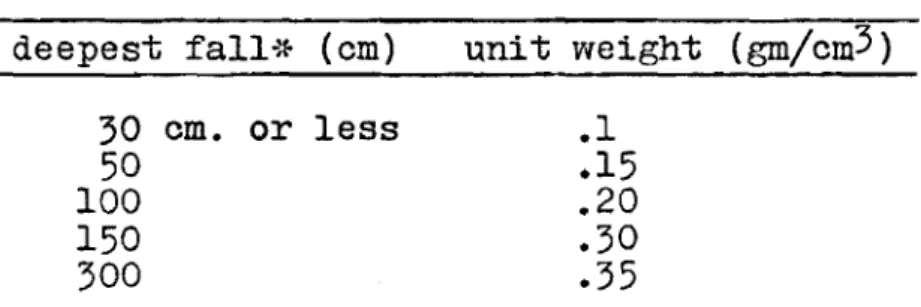
"2. Unit weight of snow to calculate the maximum
snow pack weight should be taken as the follOWing (Table A):
Table A deepest fall* (em)
30 em. or less 50 100 150 300 unit weight (gm/cm3 ) .1 .15 .20 .30 .35
Intermediate values shall be obtained by linear interpolation.
"3.
Maximum snow pack weight on the ground shall be obtained by multiplying unit weight or snow with deepest rall* of the locality."4.
Maximum snow load on a roof shall be obtained from maximum snow pack weight on the ground by multiplying it with the following reduction factor due to roof slope (Table B):Table B
slope 25° or less VPセッイ more Value to be multiplied 0.90 0
for snow load on the ground
*
For roofs of steel plate covering take UPセ Inter-mediate values shall be obtained by linear inter-polation.Above values shall not be applied for roofs covered by materials which prevent snow from sliding down.
"5.
In
heavy snow district, where deepest snow-fallon the ground was more than I meter, the effect of long continued loading of snow shall also be considered. In this case the design snow load shall be reduced to 70% of the value obtained in4.
"6. Design snow load obtained in 4 or 5 shall be modified by the following, considering time
effect of each item.
(a) In -windy district, the snow load may be reduced to 50% thereof, according to the local wind velocity in winter time.
(b) In districts where strong sunshine, and solar radiation are expected, the snow load may be reduced to 50% thereof, accor-ding to the actual condition.
(0) If a bUilding has an effioient heating equipment, the snow load may be reduced to 50% thereof.
(d) In locality where people are accustomed to remove snow from roof from time to time, the snow load may be reduced, according to theactuai condition.
(e) Mul1i1p!Le reduction of the snow load may be permitted by considering the items mentioned above,but,even in this case, the design snow load shall not be less than 20% of the value obtained in
4
or 5.A -
5
"7.
Snow load which should be considered to act together with wind pressure or seismic forcemay be reduced to
35%
of the value of temporaryloading obtained in
4
and6.
"8. For roof part where deeper snow piling is
expected, such as valley or eave, the snow
load obtained in 4, 5 and 6 should be increased,
according to the actual oondition.
"9.
If there is possibility of snow piling on a roof in unbalanced way, its influence shall be considered in structural oalculation."10. When deep snow piling is expected in contact with outside walls of a building, side pressure of snow shall be considered in calculation of wall construction as well as building structure."
An
appendix is included giving explanation andinformation to the above snow load draft. The followine are
excerpts from this appendix and reworded slightly to be
more concise and better understood. The subdivisions
correspond with the section numbers in the standard.
2. Unit Weight of Snowpack
Table A is a convenient form of expressing what
maximum snow load will likely occur knowing the maximum snow depth for Japanese districts and is based on measurements
of density in these districts. It takes into consideration
that maximum snow load may ocour at some time other than
maximum snow depth over any period of time.
3. Maximum Snmv Depth
By applying data over 20 years to the normal distribution ourve, the snow depths expected once in 30 years and once in 50 years were estimated (the average existing period of a wooden building is supposed to be
about 30 years and that of a steel bUilding about 50 years). Figures A-3 and A-4 show the design snow load based on
estimated maximum snow depth.
4.
Snow Load on RoofsThe conditions of snowpack on the roof are to some extent different than those on the ground because:
(a) the former is retained in a higher place, and is subject
to the wind flow resulting in greater evaporation
(d) (b) (c)
snow on the roof is more easily heated by solar radia-tionf
melted snow on a roof is rapidly drained away, (these factors decrease the snow depth and the unit weight* on a roof); and
snowpack on a roof is compressed at the windward side, and the unit weight* increases.
Acoording to several reports, the unit weighti!- of snow on roofs is about 10% less than on the ground.
The following conclusions about snow on roof slopes are based on the results of many researches and investigations.
(a) Slide-off of snow occurs when the temperature rises, especially on sunny days. When the temperature is above 40.C and the roof is heated by the sun for more than
4
hours, snow slides down even on a low-pitched roof.(b) Slide-off of snow occurs when the pitch of a roof is: more than TUセ and the roof is made of ironplates; more than 509 and the roof is made of glazed-tile
or shingle-roof; and
more than 550. and the roof is made of cement-tile or asbestos tile.
(c) Even when the roofs are made of the same kind of ma-terials, their surface conditions influence snow
sliding. For example, when a metallic part of a roof is rusted, snow does not slide off as easily.
5. Long Continued Snow Load
In heavy snowfall districts, long continued snow load should be considered in order to prevent the large deformations and destruction of constructions due to the creep of structural materials and joints.
It is recommended that, in districts where snowpack does not melt for a long time, the long-term snow load applied to wooden structures is about 80% of the temporary snow
load, and, in other districts about 50%. For convenience 70% is adopted.
6. Reduction of Snow Loads
(i) Wind - In the snowstorm districts, such as Akita, No shiro , Sakata and Shinjo the snow load on a roof is very small compared to that on the ground. When the wind blows perpendicular to the ridge, the snow collects in an un-balanced way. If the wind blows parallel to the ridge, the snow load is generally less than if the wind blows perpen-dicular to the ridge, and the leeward section of the roof
N[セN The Japanese use the term water equivalent here and in other places where it means unit weight. However, there is still some confusion about this.
A - 7
collects a little more snowpack than the windward section.
(ii) Solar Radiation - uセ・ョ one slope of a roof
faces south, unbalanced セッ。、ウ occur which cause differences
often more than 200 kg/m (41 psf). Care should be taken
when reducing the design snow load for solar radiation lest there be less sunny days than expected.
(iii) The effect of internal heating depends on
heating system, roof-materials, etc.
roof material factor
tile-roofing .84-iron-plate
.75
sand-roofing.84
slate 0.73 shingle-roofing 0.65 cement tile 0.94If heating is not continued throughout the cold season, no reduction should be expected.
7.
Oombined LoadsSince a 「uゥャ、セョァ might be subject to storms and
earthquakes during the snow season, 35% of the maximum
snow load expected in 30 years (which is the average con-dition of snow piling} is added to the maximum wind or
earthquake loading expected in 30 or 50 years during the
snow season.
8; Snow drifts into roof valleys and lower roof sections
such as roofs of extended wings, and reaches depths as much
as 1.5 to 2 times the depth around the ridge. Snowpack
creeps towards the eave and icicles cling from the eaves of a pitched roof resulting in a high force on the eaves.
9.
As mentioned above, wind, solar radiation and otherfactors cause unbalanced load on a roof. Recognition of
this fact should be taken in the structural design for snow load.
10. Sometimes snow on a sloEe creeps and presses against
the walls of a building. Pressures have been estimated
at 130 kg/m2
2(27 psf) when the snow depth is 170 cm (5.6 ft)
and 350 kg/m (72 psf) when the snow depth is 350 cm
(11.5 ft).
Summarl
In all the countries contacted where snow load is of significant magnitude, design snow loads have been
on the ground which are observed by meteorological or
hydrological observers. Using these observed maximum depths
along with studies of density, basic snow loads have been
estimated for each locality in the country. Since local
variations of snow load due to local climatic variation cannot be included in a national code, some codes stress that local data should be used in determining design snow load wherever available.
Most bUilding code requirements apply these loads estimated from measurements on the ground directly to all flat roofs on the basis that snow may accumulate as much on
the roof as on the ground. Reductions are allowed for
roof slopes greater than 25 degrees, the value being deter-mined by interpolating linearly between 0 and 100 per cent for angles between 25 and 60 degrees.
Also most building codes state that consideration should be made of (i) concentrations of snow in roof
valleys or obstructions (ii) the possibility of snow
accumUlating on certain parts of the roof causing reversal of stress in some of the roof members.
References
A.l American Standard Building Code requirements for
minimum design loads in buildings and other
structures. American Standards Association.
Approved September 3, 1955.
A.2 United States Division of Housing Research, Housing
and Home Finance Agency. Snow load studies.
rlousing research paper no. 19, Washington, May 1952. 19p.
A.3 Norwegian BUilding Code. December 15, 1949.
A.4 Swedish Building Code. February 1950.
A.5 Zingg,
Dr.
Th. Die maximalen Schneelasten und ihreAbhangigkeit von der Meereshohe (Maximum snow loads and their relationship to altitude above
sea level). Shweizerische Bauzeitung, vol. 69,
no. 45, 1951.
Krapfenbauer, R.J. Zur Schneebelastung der
Hochbauten (German), (Snow loads on buildings).
No English summary. Abhandlungen des
Dokumentationszentrums fur Technik und Wirtschaft,
LEGEND ォセエャm 40 POUNDS
FHH
30 POUNDS セ 20 POUNDS セ 10 POUNDS 0 ( 1 0 POUNDSO
ZONES EXCLUDED FROM STUDYFIGURE A-I ESTIMATED WEIGHT OF SEASONAL SNOWPACK OR EXCEEDED ONE YEAR IN TEN. CP.S.F.). (A. I)
AUSTRIA (A.6) I ... - - ZURICH 1931 • LUGANO 1888 800 t - - - I J - - + - H - - - t - - - . . t ' - ' - + - - - , . - - - . . . , . . . - - - _ I NEW SWISS SPECIFICATION 1956 2800 J - - - j 0 L D SWISS MセセGMMMMMMMMKMZGイMMMMMQ SPECIFICATION 3200 エMMMMMKMMMMTMMMMMMMャNMMMMZセセM⦅⦅⦅Q z2000
2
I セ II>
GARICHTE 1951 I.LI I I I ..J 1600 iMMセセKMKMMGLNjMMMエMMMMMェGMMa NDERMAT T 1951 I.LI I I I セbedretto 1951 /ャセァセセセセvセセャァセセrセZe
/ SWITZERLAND (AFTER ZINGG, 1951) (A.5) )--ILANZ 1875--
U) セ 2400 I - - / - - - - t f - - - - r - - - - r - - - , f - ....
I.LI ::& 1300 400 1 - - - H J ! V f - - - + - - - - + - - - + - - - + - - - - I 3900 1200 エMMKMBGMMMMMMMイャGャKMMMセGMKMMMMMMMMGMMMMMGMMMM⦅i 2600 10,500 9200 ;: 7900 I.LI I.LI LL.-
-セ 6600...
セ I.LI セ セSPP 410 400 800 1200 1600 SNOW LOAD (KG/M2 ) 82 164 246 328 SNOW LOAD (LB/SQ. FT)o
OI.oo&.lo... 1 - -..._ " ' O " ' - - - 1 . _ . . . l . . . _ " O " -..._ _o
2000o
FIGURE
A-2
AUSTRIA
AND
SWITZERLAND:
SPECI FICATION
FOR
SNOW
LOAD
'" • MAXIMUM WEIGHT
-YEARS IN P.S.F.ro
3000°FIGURE A-3 JAPAN: ESTIMATED
OF SEASONAL SNOWPACK· IN 30 c::?
a
\:)Nセセ
- - - - _ / "
0,,<)..
I
• (KG/M2xO'2= セsNヲ]ZI600
e
tJ°
"
FIGURE A-4 JAPAN: ESTIMATED MAXIMUM WEIGHT OF SEASONAL SNOWPACK EXPECTED IN 50 YEARS
IN P. S. F. (KG1M2 X O' 2
=
P. S. F.),
---/
'13




![FIGURE A-3 JAPAN: ESTIMATED OF SEASONAL SNOWPACK· IN 30c::?a\:)Nセセ- - - - _ / "0,,<)..I• (KG/M 2xO'2= セsNヲ]ZI](https://thumb-eu.123doks.com/thumbv2/123doknet/14499227.527536/31.1083.60.1053.60.777/FIGUREA3JAPANESTIMATEDOFSEASONALSNOWPACKIN3caNセセ34ltIKGM2xO2=セsNヲZI.webp)

