HAL Id: hal-02736263
https://hal.inrae.fr/hal-02736263
Submitted on 2 Jun 2020
HAL is a multi-disciplinary open access
archive for the deposit and dissemination of
sci-entific research documents, whether they are
pub-lished or not. The documents may come from
teaching and research institutions in France or
abroad, or from public or private research centers.
L’archive ouverte pluridisciplinaire HAL, est
destinée au dépôt et à la diffusion de documents
scientifiques de niveau recherche, publiés ou non,
émanant des établissements d’enseignement et de
recherche français ou étrangers, des laboratoires
publics ou privés.
Agent-based modelling of a synthetic pastoral landscape
Francois Guerrin
To cite this version:
Francois Guerrin. Agent-based modelling of a synthetic pastoral landscape. Landscape 2018, Mar
2018, Berlin, Germany. �hal-02736263�
Landscape 2018
Frontiers of agricultural
landscape research
Landscape 2018
Frontiers of agricultural
landscape research
12–16 March 2018
Berlin, Germany, Adlershof con.vent
sponsored by:
III. Landscape Synthesis – Integrated models
243
Agent-based modelling of a synthetic pastoral landscape
François Guerrin
UMR SELMET, Cirad, Inra, Montpellier SupAgro, 34398 Montpellier, France, e-mail: [email protected] Introduction
This model allows the spatial dynamics stemming from the interactions between mobile agents (herbivores) and their environment (rangeland) to be simulated. It features a herd grazing on a pasture. With a sustainability aim a dynamic balance must be found between grass intake by the animals and herbage growth. However, two behaviours may threaten this equilibrium: overgrazing, leading to desertification; under-grazing, leading to excessive vegetation and landscape ―closure‖ by invasive shrubs (issue dealt with in Anselme et al., 2010). Both processes may lead the herd, considered as free-grazers, to extinction by starving. This model‘s aim is not to mimic real specific rangelands but to offer a generic simple synthetic ecosystem to check ecological hypotheses.
Materials and Methods
The model has been implemented with the agent-based simulation NetLogo platform (Wilensky, 1999). It comprises two types of agents: spatial cells, called ―patches‖ in NetLogo, representing the landscape as a grid, and mobile agents, called ―turtles‖, standing for herbivores. Vegetation on patches are characterized by their color ranging from very light to very dark shades of green: darker the shade, higher the grass biomass and lower its quality. Herbivore attributes are their birth date, age, sex, previous location, destination, pathway, travelled distance, ingested feed, live-weight, calving dates. At each simulation time-step each individual iterates the following actions: stay on the current patch or move to another, graze, gain and lose weight, age and, possibly, reproduce or die. Although deliberately naive, the model was parameterized with real rangeland data borrowed from various authors (Bayer and Waters-Bayer, 1999; INRA, 1988; Vayssières et al., 2009). Based on a reference landscape comprising 1,225 patches (1 ha each) and 1,225 cattle heads (1 head/ha), simulations have been made to check variants of the ecosystem‘s structure and animal behaviours (see below). The main criteria of simulation assessment are animal and vegetal productions, herd demography, landscape fragmentation over temporal horizons spanning up to 55 years. Whereas the focus was put on comparing animal walks, the emphasis is now on challenging ecological theories (optimal foraging, ideal free distribution, marginal value theorem).
Results and Discussion
Heterogeneity of landscape at initialization: starting with patches uniformly green or with different
greens in a narrow range makes little difference. However, with higher heterogeneity the system‘s performances quickly decrease in terms of population size, pasture and shrub extensions. Whatever their initial state, all landscapes converge eventually towards a similar heterogeneity degree.
Heterogeneity of spatial distribution of animals at initialization: starting with all cattle on the same
patch leads to a quick resource depletion radiating in concentric circles around the origin with huge mortality. The remnants colonize a few peripheral patches where they stabilize at very low level, abandoning the rest of space to shrub invasion.
III. Landscape Synthesis – Integrated models
244
Should I stay or should I go? The best strategy for turtles proved to be: if grass on the current
patch is above a certain biomass*quality value, then keep on grazing, otherwise move to another patch.
Walk types: a directed walk like moving to patches with maximum herbage tends to create too
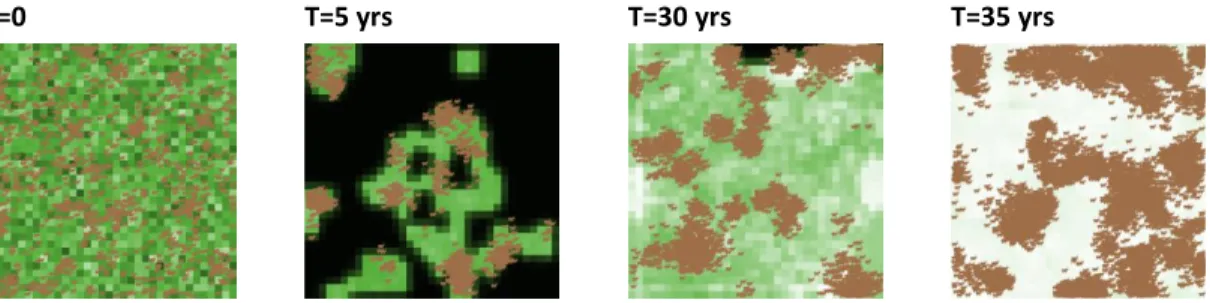
high local animal density, inducing overgrazing, high mortality and bush extension. However, keeping the same rule within a limited perception range of animals may lead on the long run to sustainable rangelands with low-biomass but high-productivity pastures supporting a huge animal stock above 8 times the initial one; this emerging phenomenon, known as ―grazing lawns‖ (Bonnet et al., 2010), is illustrated on Figure 1.
Move length: short moves lead to better animal and herbage production than long ones.
T=0 T=5 yrs T=30 yrs T=35 yrs
Figure 1. Example of a simulated 1,225ha landscape over 30 years. T=0, randomly generated rangeland with 1.12 heads/ha free-grazing cattle; T= 5 yrs, closing landscape, 0.76 heads/ha; T=30 yrs re-opening
landscape, 3.36 heads/ha; T=35 yrs, stable “grazing lawn”, 8.48 heads/ha. Conclusions
The most sustainable foraging strategies were found to be those fostering space occupation, local foraging, short walk steps and anticipating resource exhaustion. Animal movement proved to be crucial in shaping the system. The model also was used for testing theoretical hypotheses like ―Ideal Free Distribution‖. Simulations made on a long run allow the emergence of interesting succession of extreme phenomena also found in real cattle farming systems or natural ecosystems (e.g. grazing lawns).
References
Anselme, B., F. Bousquet, A. Lyet et al. (2010). Environmental Modelling & Software 25: 1385–1398. Bayer, W. and A. Waters-Bayer (1999). La gestion des fourrages. Margraf Verlag, Weikersheim, 246 pp. Bonnet, O., H. Fritz, J. Gignoux et al. (2010). Journal of Ecology, 98: 908–916.
INRA (1988). Tables de l‘alimentation des bovins, ovins & caprins. 1902 pp.
Vayssières, J., F. Bocquier and P. Lecomte (2009). Agricultural Systems, 101 (3): 139–151.