European Heart Journal (1980) 1,123-127
Isolated aortic valve replacement with the
Bjork-Shiley tilting disc prosthesis and the porcine
bioprosthesis
L. EGLOFF, M. ROTHLIN, M. TURINA AND A. SENNING Surgical Department A, University Hospital, Zurich, Switzerland
KEY WORDS: Bjork-Shiley tilting disc prosthesis, porcine bioprosthesis, aortic valve replacement.
Between 1977 and 1978, 239 patients underwent aortic valve replacement with either a bioprosthesis (100, BIO) or a Bjork-Shiley tilting disc prosthesis (139, BS). Early mortality was 2%, late mortality 4%. There was no statistically significant difference between the two groups. Anticoagulation was maintained indefinitively in patients with a BS, after implantation of a BIO only for three months except in the presence of atrial fibrillation or a history ofeinboli. ThromboeinboUc complications and anticoagulant hemorrhages were almost twice as frequent in patients with BS than with BIO (5'3 versus 2m8 episodes/100 patient years). This difference however is statistically not significant. There were an equal number (two) of reoperations because ofparavalvular leaks due to endocarditis or torn sutures in the two groups. A regurgitant murmur, though hemodynamically not significant, occurred more frequently in patients with BIO than with BS (10% versus 2%, P < 005). Its cause and importance cannot yet be determined. Postoperative results judged by the NYHA classification and reduction of heart size were similar in both groups. Of all patients,
13% with preoperative valvular incompetence and 15% with stenosis showed little or no reduction of the cardiothoracic ratio on X-ray indicating a worse long-term prognosis. The porcine BIO has become our preferred valvular substitute because of its low thromboembolic complication rate. The BS is mainly reserved for patients already on anticoagulants for other reasons.
From 1971 to 1977 the Bjork-Shiley prosthesis (BS) during this time period, the BS being the preferred has been our preferred valvular substitute for aortic choice during the early part of this series, whereas valve replacement (AVR). We have since started to later the BIO was used more often. The pre-use porcine bioprostheses (BIO) in increasing operative and operative data are outlined in Table numbers because of their lower reported incidence 1. On statistical analysis (Student's'/-test, chi-of thromboembolic complications as compared to square test) patients receiving a BIO were generally mechanical devices!'-1]. This retrospective study younger with less advanced disease. Operative analyses first results with BIO in reference to valve technique was the same in both groups (moderate related complications and compares them to those hypothermia to 26-28°C, K+ induced cardioplegia achieved with the BS over the same time period. and topical hypothermia). Postoperatively all patients with a BS received long-term anticoagu-Patients and methods l a n t s P a t i e m s w i t h a B I 0 w e r e a n t i c o a g uia t e d f o r
During 1977 and 1978, 239 patients underwent three months; in these patients anticoagulation was isolated AVR with either a BIO or a BS. BIO of continued only iiTthe presence of atrial fibrillation three different manufacturers were used: Carpentier or a history of preoperative emboli. The follow-up Edwards (51), Angell-Shiley (41) and Hancock (8). period lasted to June 1979 with a mean of 13 Indications for implanting a BIO or BS varied months for the BIO patients and 20 months for patients with a BS. To evaluate reduction in heart size postoperatively the cardiothoracic ratio (CTR) Received for publication 28 January 1980. i n p r e_ a n d s i x months postoperative chest X-rays Requests for reprints to: L. EglofT, Surgical Department A, w e r e compared. Only pOSterO-anterior views in the University Hospital, Zurich. Switzerland. upright position were considered for comparison. "'cK-AfiK>:/R0/O2O123+O5SOl.O0/0 ©1980 The European Society of Cardiology
Table 1 Preoperative and operative data
Number of patients Male/female ratio Mean age (years) Predominant stenosis Predominant regurgitation Mixed lesion
NYHA class (mean) ci. (mean)
Concomitant procedures CABG
Patch enlargement of aortic root Resection of asc. aortic aneurysm Resection of coarctation Closure of VSD Miscellaneous Average valve size
BIO 100 81/19 45(5-73)* 45 40 15 2-5* 2-9* 18* 3 4 3 0 2 6 28-2 BS 139 112/27 51(22-72)* 56 63 20 2-8* 2-6* 54* 12 6 15 2 4 15 28-2 Total 239 193/46 48 101 103 35 2-7 2-7 72 15 10 18 2 6 21 28-2
NYHA = New York Heart Association; ci. = cardiac index; CABG = coronary artery bypass grafting; VSD = ventricular septal defect.
*P < 0005.
Table 2 Mortality
BIO Early (< 30 days) 1 Late 4 Mean follow-up time 13 and BIO and BS, respectively.
BS 4 6 20 months Total 5 (2%) 10(4%)
for patients with
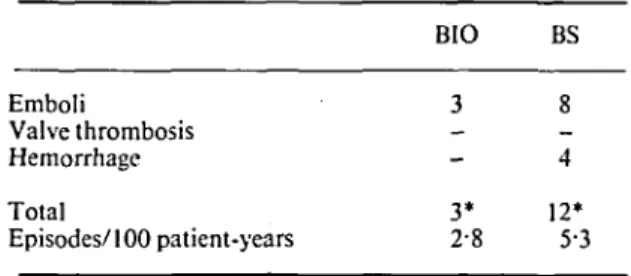
Table 3 Thwinboembolic complications Emboli Valve thrombosis Hemorrhage Total Episodes/100 patient-years and anticoagulation BIO 3 3* 2-8 related BS 8 4 12* 5-3 Results MORTALITY
Early and late mortality have been similar in both groups (Table 2). The cause of death was cardiac, but not valve related, in all patients [myocardial failure in nine (four early, five late), sudden unexplained death in six (one early, five late)]. Autopsies in three of the four late deaths with BIO and two of the six late deaths with BS were obtained. The prostheses in all cases examined were intact and functioning normally.
INCIDENCE OF THROMBOEMBOLISM (TE) AND ANTI-COAGULANT HEMORRHAGE
All recorded emboli were cerebral; none was fatal. Emboli in patients with BIO caused minor transient symptoms only whereas three patients with BS sustained a hemiplegia with variable
*P = not significant; (n BIO, 99; n BS, 135).
recovery. The total incidence of episodes however has statistically not been significantly different between the two groups, although calculated per 100 patient years (Table 3), it has been almost twice as high in patients with BS.
VALVE FAILURE
Severe regurgitation requiring reoperation oc-curred in both groups with almost equal frequency (Table 4). A murmur of mild, hemodynamically in-significant regurgitation was observed more often in patients with BIO (P<005); its cause and conse-quences remain unknown. The average valve size of patients with such a murmur was 29 and 28-6 in the BIO and BS groups, respectively. This is statistically not different from the mean valve size
Isolated aortic valve replacement 125
Table 4 Prosthetic valve dysfunction and endocarditis
BIO BS
Reoperation because of
endocarditis 1 1 Reoperation in absence of
endocarditis (paravalvular leak) 1 1 Endocarditis, conservatively
treated 1 1 Regurgitant murmur of
unknown cause, no reoperation 9* 3*
*P<005; (n BIO, 99; n BS, 135).
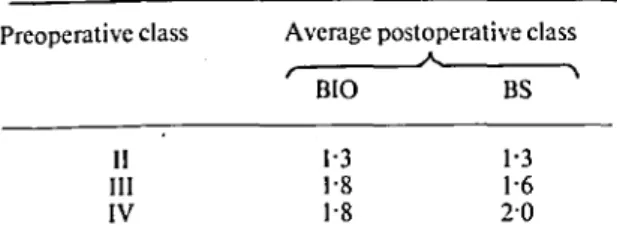
Table 5 Postoperative clinical classification compared to preoperative class (N YHA)
Preoperative class
II III IV
Average postoperative class
A. BIO 1-3 1-8 1-8 BS * 1-3 1-6 2 0
used in the entire group of patients. Seven of the nine patients with a murmur complicating a BIO had a Carpentier Edwards, one an Angell-Shiley and one a Hancock prosthesis.
POSTOPERATIVE CLINICAL CLASSIFICATION AND REDUCTION IN HEART SIZE
The average six months postoperative clinical improvement has been similar in both groups (Table 5). Objectively this was documented by a reduction in heart size assessed by pre- and post-operative CTR (Table 6). Good quality chest X-rays were available in 188 patients preopera-tively and in 155 postoperapreopera-tively. Patients with aortic regurgitation (AR) showed a greater reduc-tion of their postoperative CTR than patients with aortic stenosis (AS). Little change (< 5% reduction) was observed in eight of 60 patients with AR (two BIO, six BS). Nine of 59 patients with AS demon-strated an increase in postoperative CTR (five BIO, four BS); of 18 patients with AS and a small pros-thesis (25 or smaller, six BIO and 12 BS) the heart size enlarged postoperatively in only three (all BS).
Comment
The purpose of this analysis has been to point out clinical characteristics of the BIO compared to the
BS. Although the two groups of patients are not prospectively randomized and are different in some respects, certain comparisons are still justified.
As expected there are no differences in early and late mortality. Sudden unexplained death repre-sents half of the late mortality in both groups. Peri-operative tachyarrhythmias were a predisposing factor since all of these patients had to be treated for arrhythmias early postoperatively; four of the five patients had aortic regurgitation preoperatively. A similarly high incidence of sudden late death has been reported in the series of Copeland!5! and Davila!6!.
The lower TE complication rate is the major advantage of the BIO over the BS. Comparing the two groups in our series with regard to TE is, however, difficult because they differ in age and state of the disease. BS patients, who represent the less favourable group, show a higher incidence of emboli, although it is statistically not significant. The fact that the great majority of BIO patients have not been on long-term anticoagulants and that emboli in this group presented as minor transi-ent episodes only, contrary to BS patitransi-ents, weighs in favour of this type of valvular substitute. Our incidence of 2-8 episodes per 100 patient years for BIO patients is within the range of what is generally reported!'~IO1. As the follow-up period extends, this rate is likely to drop for BIO patients!9!. This, how-ever, is not the case for patients with a BS as has been reported from our institution in patients followed over a six year period!' •].
An unexplained complication, though not yet assessable in its significance, has been the occur-rence of a regurgitant murmur in the absence of endocarditis in 10% of patients with BIO (com-pared to 2% in BS patients). A similar observation has been made by Pipkin!2!. Whether the origin of this murmur is valvular or paravalvular cannot be determined clinically nor by echocardiography. The valve size per se is not a predictor for the occurrence of such a murmur. On the other hand we always have tried to insert a BIO as large as possible to minimize the postoperative gradients which have been""described in clinical and experi-mental studies with this type of valvular device!12'13!. One might speculate that the intention to insert a large prosthesis has led to a dispro-portion between anulus and prosthetic ring resulting in a paravalvular leak. The bulkier ring of the Angell-Shiley prosthesis may also provide a better seal than the Carpentier Edwards ring since most murmurs appeared in patients with the latter
Table 6 Postoperative reduction ofCTR * Prcoperative lesion Regurgitation BIO BS Stenosis BIO BS Mixed lesion BIO BS Preoperative CTR (mean) 056 0-57 0-50 0-54 050 0-53 Postoperative CTR (mean) 050 0-51 0-48 0-50 047 0-50 %Reduction 11 11 4 7 6 6 *CTR = Cardiothoracic ratio.
valve. We now pay particular attention so as not to insert too large a prosthesis for a given anulus. If necessary a patch enlargement of the aortic root into the non-coronary sinus will allow implan-tation of a prosthesis of appropriate size. Post-operative results, judged by the NYHA classifi-cation have been good in both groups without significant differences. As a more objective para-meter to follow postoperative recovery we have compared CTR of pre- and six months, post-operative chest X-rays. Reduction in CTR has been independent of valve type. There were altogether 13% of AR patients and 15% of AS patients with poor reduction or an increase of their postoperative CTR. This is of prognostic importance; particu-larly for patients with AR. In an earlier series of AVR with various mechanical devices RothlinI"] has statistically documented a worse prognosis for patients with little or no reduction in heart size postoperatively (six years follow-up). This has been the case also for patients with marked preoperative cardiomegaly (CTR>0'6) and those in preopera-tive clinical class IV.
At present we continue to use BS and BIO for AVR, but the latter has become the prosthesis of first choice because of the lower incidence of thromboembolism. Uncertain durability, however, remains its major drawback, but our earlier experi-ence with patients with fascia lata valves supports the concept that a reoperation after several years because of valve fatigue or degeneration is pre-ferable to the continued risk of thromboembolism and anticoagulant hemorrhage!14]. We reserve the BS, therefore, for patients already on
anticoagu-lants for other reasons, those already reoperated, or patients in an advanced state of disease.
References
[1] Carpentier A, Deloche A, Relland J, et al. Six-year follow-up of glutaraldehyde-preserved heterografts. With particular reference to the treatment of con-genital valve malformations. J Thorac Cardiovasc Surg 1974; 68: 771-82
[2] Pipkin RD, Buch WS, Fogarty FJ. Evaluation of aortic valve replacement with a porcine xenograft without long-term anticoagulation. J Thorac Cardiovasc Surg 1976; 71: 179-86.
[3] Roberts WC. Choosing a substitute cardiac valve: type, size, surgeon. Am J Cardiol 1976; 38:633-44. [4] Stinson EB, Griepp RB, Shumway NE. Clinical
experience with a porcine aortic valve xenograft for mitral valve replacement. Ann Thorac Surg 1974; 18:391-401.
[5] Copeland JG, Griepp RB, Stinson EB, Shumway NE. Long-term follow-up after isolated aortic valve replacement. J Thorac Cardiovasc Surg 1977; 74: 875-89.
[6] Davila JC, Magilligan DJ, Lewis JW. Is the Hancock porcine valve the best cardiac valve substitute today? Ann Thorac Surg 1978; 26:303-16.
[7] Angell WW. A nine year experience with the Angell-Shiley xenograft and a comparative literature review of the porcine bioprosthesis versus the mechanical prosthesis. In: Sebening F, Klovekorn \VP, Heisner H, Struck E, eds. Bioprosthetic cardiac valves. Proc Symp Bioprosthetic Cardiac Valves, Munich, 1979:81-106.
[8] Cevese PG, Gallucci V, Morea M, Dalla Volta S, Fasoli G, Casarotto D. Heart valve replacement with the Hancock bioprosthesis. Circulation 1977; 56 (supplll): 111.
[9] Oyer PE, Stinson EB, Reitz BA, Miller DC, Rossiter SJ, Shumway NE. Long-term evaluation of the porcine xenograft bioprosthesis. J Thorac Cardio-vasc Surg 1979; 78: 343-50.
Isolated aortic valve replacement 127
flO] Stinson EB, Griepp RB, Oyer PE, Shumway NE. Long-term experience with porcine aortic valve xenograft. J Thorac Cardiovasc Surg 1977; 73: 54. Ml] Rothlin ME, Senning A. Long-term survival after
aortic valve surgery with special reference to the preoperative risk factors. Proc 8th World Congr Cardiol, 1978.
[12] Gabbay S, McQueen D, Yellin EL, Becker RM, Frater RWM. In vitro hydrodynamic comparison of mitral valve prostheses at high flow rates. J Thorac Cardiovasc Surg 1978; 76: 771-87.
[13] Lurie AJ, Miller RR, Maxwell KS, Grehl TM, Vismara LA, Hurley EJ, Mason DT. Hemodynamic assessment of the glutaraldehyde-preserved porcine heterograft in the aortic and mitral positions. Circulation 1977; 56 (suppl II): 104-10.
[14] Rothlin ME, Senning A. Fifteen years experience with fascia lata aortic valves and the outlook of modern bioprostheses. In: Sebening F, Klovekorn WP, Heisner H, Struck E, eds. Bioprosthetic cardiac valves. Proc Symp Bioprosthetic Cardiac Valves, Munich, 1979:173-8.