Publisher’s version / Version de l'éditeur:
SPE Journal, 28, 7, pp. 25-29, 1972-11-01
READ THESE TERMS AND CONDITIONS CAREFULLY BEFORE USING THIS WEBSITE. https://nrc-publications.canada.ca/eng/copyright
Vous avez des questions? Nous pouvons vous aider. Pour communiquer directement avec un auteur, consultez la
première page de la revue dans laquelle son article a été publié afin de trouver ses coordonnées. Si vous n’arrivez pas à les repérer, communiquez avec nous à [email protected].
Questions? Contact the NRC Publications Archive team at
[email protected]. If you wish to email the authors directly, please see the first page of the publication for their contact information.
NRC Publications Archive
Archives des publications du CNRC
This publication could be one of several versions: author’s original, accepted manuscript or the publisher’s version. / La version de cette publication peut être l’une des suivantes : la version prépublication de l’auteur, la version acceptée du manuscrit ou la version de l’éditeur.
Access and use of this website and the material on it are subject to the Terms and Conditions set forth at
Long-term weathering can change the complexion of PVC
Blaga, A.
https://publications-cnrc.canada.ca/fra/droits
L’accès à ce site Web et l’utilisation de son contenu sont assujettis aux conditions présentées dans le site LISEZ CES CONDITIONS ATTENTIVEMENT AVANT D’UTILISER CE SITE WEB.
NRC Publications Record / Notice d'Archives des publications de CNRC:
https://nrc-publications.canada.ca/eng/view/object/?id=f8b7f7f3-4c53-4d3c-ba06-cf581a1805d8
https://publications-cnrc.canada.ca/fra/voir/objet/?id=f8b7f7f3-4c53-4d3c-ba06-cf581a1805d8
Aurel Blaga, Division of Building Research,
National Research Council of Canada, Ottawa
Long-Term Weathering Can
Change
the
Complexion of
PVC
If
you're in the vinyl building products business,
make sure you're using the right plasticizer. The wrong choice
can mean unexpected exudation
P
olyvinyl chloride is increasingly used in rigicl o r semi-rigid forn~ulations for such outdoor applications as e x t r ~ ~ d e d siding, window sash, g ~ ~ t t e r s , downspouts, and exterior cladding. Ultimate consumcr acceptance for these and other outdoor applicatio~is will depend upon thc ability of P V C to retain its physical, mechani- cal, and aesthetic qualities over long periods of time, perhaps 15-20 years. In spite of the work t o iruprove their weathering, P V C products still undergo consider- able deterioration on long-tcrm outdoor service, the most common types being discoloration, migration or loss of plasticizer, opacification, and embrittlement and- impairment of niechanical properties. .
Most of the work carriccl out o n outdoor wcathering of P V C has bcen associatccl with dcvelopment of ma- terials having improved rctcntion of propcrtics (1-9) or with attempts to correlate outdoor weatherability with laboratory-acccleratcd aging (1,3,5,10-12). Weathering performance of P V C and other plastics has also been studied by the U.S. A r ~ n y (1 3 ) and by government organizations throughout the world (14-16). Data on actual o ~ ~ t d o o r performance of P V C products is, how- ever, still very limited. This is a major reason that the growth of this plastic for outdoor applications is pro- gressing relatively moderately. T o accelerate the use of plastics in outtloor applications, we ~ ~ n d e r t o o k a study of semi-rigid PVC, during the course of which we subjected shecting to outdoor wcathcring at Ottawa, Canada, and to various laboratory aging tests.
Experimental
Samplcs of semi-rigid:" corrugated conlmercial P V C sheeting, each measuring 8
x
12x
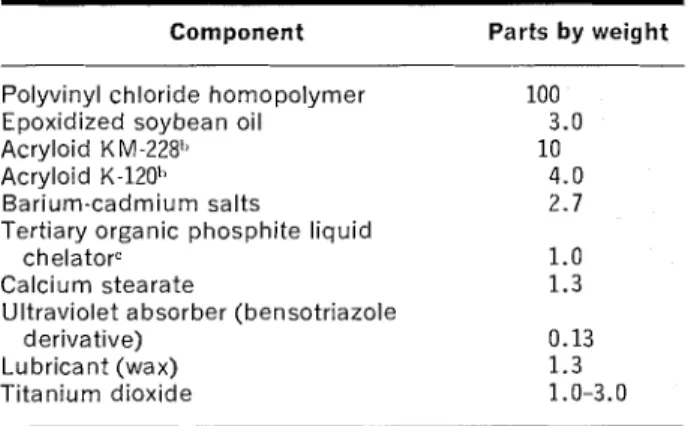
0.06 in., were acquirccl from two n ~ a n u f a c t ~ ~ r e r s . The samples were translucent or opaque and of various colors: green, light-green, orange, coral, and ycllow. They were madc from a n acrylic-n~odified P V C resin blend formulated with about 2.5% epoxidized soybean oil stabilizing plasticizer (Tcible I ) .T h e samples were exposed o n standard racks ( A S T M
D 1435-35) inclined at 45 deg to the horizontal and
tions were those of a tempcrate northern climate. T h e cxposure program was started in the fall of 1962 and tcrluinated in the spring of 1969.
T o supplement the outdoor wcathering study, replicate samplcs of P V C sheets were subjected to various treat- n ~ e n t s in the laboratory. P V C sheets were exposed to variations in hunlidity ant1 temperature in an Amcrican Instrument Corp. Climate-Lab. Relative humidity was cyclically varied between approximately 25 and 100% and temperature between 11 and 57°C. Cyclcs lasted 12 hr each. The humidity-tcmperatilre program cycle is detailed in Fig. I .
Samples were artificially weathered in a n Atlas Twin Enclosed Carbon A r c Weather-Orueter (1 8 ) in accord- ance with ASTM E42-56 method, Type D , using a
cycle only half as long as that prescribed, i t . , 51 nlin of light at a black panel tcmpcrature of 58-6S°C, a n d 9 mi11 of light and deionized water spray at a black panel temperature of 10°C. This procedure resulted in 24 cycles/day.
T h c tensile properties were determined in accordance with ASTM method D63S-64T i ~ s i n g a Tinius Olsen
Table
1.Formulation of semi-rigid
PVC used
in the weathering study."
Component Parts by weight
Polyvinyl chloride homopolymer Epoxidized soybean oil
Acryloid K M-228') Acryloid K-120"
Barium-cadmium salts
Tertiary organic phosphite liquid chelatorc
Calcium stearate
Ultraviolet absorber (bensotriazole derivative)
Lubricant (wax) Titanium dioxide
facing sollth, with no backing. The weathering con& n F o r m u l a t i o n of t h e colored sheets contained s m a l l a m o u n t s o f c h r o m a t i c pigments.
'1 Registered t r a d e m a r k o f Rohm a n d Haas.
2: ~h~ term rigid PVC should be llscd to designate unplasticized I n c o m b i n a t i o n w i t h b a r i u m - c a d m i u m organic salts a n d an u l t r a -
violet absorber, i t has synergistic s t a b i l i z ~ n g action. P V C containing only polymer, stabilizer, and lubricant ( 8 ) .
instrument. All sa~iiples were conditioned at 73OF and 5 0 % relative hu~uidity for at least 24 hr. Unless other- wise indicated, five specimens were ~ ~ s e d in each deter- mination. Flat c o r r ~ ~ g a t e d samples were tested sing the bottom portions of the sheets.
Electron n~icrographs were recorded with a Mark 2 A Stereoscan Scanning Microscopc (Cambridge Scientific I n s t r ~ ~ m e n t s Limited) operated at 20 kv. The tilt angle used was also 45 deg. Specimens were coated with metallic gold to render them conductive.
Effect of Weathering on Appearance
A n i~iiportant requirement for plastic sheets used in outdoor applications is thc retention of their aesthetic qualities during their servicc life. When used outdoors, the appearance of most k ~ i o w ~ i plastics ~ ~ n d e r g o e s some form of deterioration, e.g., change in color, surface cracking o r crazing, or loss of light t r a ~ i s ~ i i i s s i o ~ ~ property of initially translucent o r transparent sheets.
Figure 1 . Humidity-temperature program cycle ( 1 2 hr) i n the Aminco Climate-Lab.
9 0
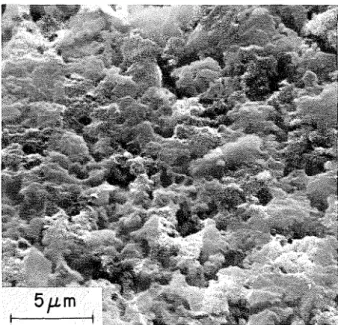
Figure 3. Surface of green control PVC sheet.
8 0
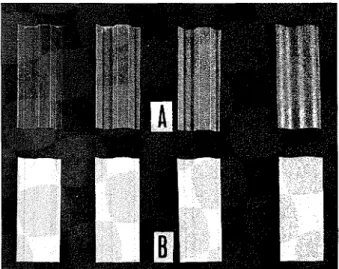
When weathered outdoors, the upper surface of sheets formulated with epoxidized soybean oil plasticizer became covered with a n exudate, or deposit, that made them appear grayish-white regardless of their initial color. Figure 2 conipares the appearance of the con- trol P V C sheets of various colors with that of corre- sponding sheets weathered o ~ ~ t d o o r s for five years. The deposit appeared after a b o ~ ~ t 18 months of outdoor weathering; and its thickness increased with exposure time. When it was scraped off, the color of the under- lying layer of material matched very closely that of the corresponding control sheet. T h e underside of weathered P V C sheet showed only slight exudate.
Examination of the weathered surfaces of P V C sheets by scanning electron microscopy demonstrated con- clusively that this failure was not superficial micro- cracking o r microcrazing. Fig~lres 3 aid 4 are micro- graphs of surfaces of control and weathered plastic sheets, respectively. T h e surface of the co~itrol sheet is continuous, has n o pores, and resembles the surface of a cooled molten material. T h e weathered surface is discontinuous and shows aggregates of irregularly shaped, sharp-edged particles similar in texture t o the residue left after the solvent of a solutio~i evaporated. T o identify the nature of this failure and understand the process by which it takes place, additional work was performed in the laboratory. F o r this, new saniples of various plastic sheets were subjected to aging under conditions of temperature and moisture cycling in the Climate-Lab, where the teniperat~lre was varied be- tween from 11 and 5 7 ° C and the relative humidity between 2 5 and l o o % , over a cycle period of 12 hr. After 2 5 days (50 cycles) both surfaces of each of the various samples of P V C sheets formulated with epoxi- I I I I I I
/---
---
\-
-
/
Humidity1
-dized soybean oil plasticizer were covered with a-thin Figure 2. PVC plastic sheets of various colors (from left layer of a white substance visually similar t o the exudate
to right) coral, green, yellow, light green. (A) Controls. o n the surface of sheets weathered outdoors. Likewise, (B) Weathered (5 yr a t Ottawa). the thickness of this white layer increased with the time
100 9 0
'
I
- \ T e m p e r a t u r e\
-'
\
\
\,
- I I I I I I I '26 SPE Jolrrt~nl, Jztly 1972-Vol. 28
- 8 O T 21 70
.$
.- 6 02
-50; - 4 0 3 0 20 0 2 4 6 8 10 12 Time, hra surface of green P V C sheet at the end of aging in the Climate-Lab (430 days). T h e microtopography is very similar to that of the exposed sample weathered outdoors for 5 yr (Fig. 4 ) . Porosity is somewhat less severc, howcver, indicating that the period of aging may have been too short to reproduce the effects of 5 yr of natural exposure.
When the exposed surfaces of the salnples weathered outdoors (or aged in the Climate-Lab) were treated with diethyl ether, the white exudate dissolved almost completely, a n indication that it was neither
a
poly- meric compound nor an inorganic pigment but very likely one of the organic additives or its derivative. Its infrared spectrulll was found to be very similar to that of the epoxidizcd soybean oil, the stabilizing plasticizer used in the resin formulation. Since the exudate is a n anlorphous solid, and the epoxidized soy- bean oil is a viscous liquid, they cannot be identical materials. T h e infrared spcctrum was then cornparcd with that of the acid-catalyzed hydrolysis product of epoxidized soybean oil, an an~orphous, low-melting solid material prepared in our laboratorv. Since their Aspectra were very similar, it is believed that the white
Figure 4. Green PVC sheet weathered outdoors for 5 yr.
Table 2. Color differences between exposed
and control samples of green PVC sheet.
Treatment
Laboratory Exterior exposure Color coordinate (175 days) (5 yr)
A L (lightness) 20.7 29.7
A a (red-green) 17.9 23.2
Figure 5. Green PVC sheetings. (A) Control. (0) Weath- ered outdoors for 5 yr. (C) Aged i n the Climate-Lab for 175 days (350 cycles).
of treatment. At the end of 175 days (350 cycles), the layer became thick enough to make the sanlples of various colors appear almost white on both surfaces. Figure 5 shows a green sample of P V C plastic sheet before weathering (control) after five years of outdoor weathering and after 175 days (350 cycles) of aging in the Climate-Lab. It is difficult to appreciate, from a black and white photograph, the large difference in color between the control and the laboratory-aged samples. Consequently, the colors were measured with a tristi- mulus calorimeter (Colormaster) and the difference in lightness and hue in the Adams color space determined. These values are given in Table 2 where it can be seen that both exposed samples became much lighter and less green (positive Aa) than the control. T h e total color differences were 32 and 4 2 units, respectively, where one unit is a change of commercial significance.
Similar trends were observed with the other colors. Figure 6. Green PVC sheet aged i n the Climate-Lab for Figure 6 presents a scanning electron micrograph of 430 days.
substance is a nlixture of hydrolytic derivatives of epoxidized soybean oil. U~lcler hot, humid conditions, the polyn~er matrix expands and absorbs water. This water in the presence of trace amounts of hydrogen chloride will hydrolyze the epoxy groups of the plasti- cizer. The hydrogen chloride is formed in the thermal dehyclrochlorination of the P V C polymer during the processing of the sheet or during weathering.
If the generalized formula (19) of epoxidized soybean oil given below is examined, it is evident that the hydrolysis of this compound will yield a complex mixture of products, e.g., compounds having a pair of adjacent hydroxyl groups, (-CHOH-CHOH-), and two epoxy groups (-CH-CH-), two pairs of adjacent hydroxyls on the
\ /
0
same ester chain or each pair on a different one and an epoxy group, and a compound having three pairs o f adjacent hydroxyls.
In addition, the mixture c o ~ ~ l c l conceivably contain some of the con~pounds resulting from the hydrolysis of the glyccryl ester group.
T h e hydroxyl-containing derivatives formed from the plasticizer as described above, (luring aging, cither out- doors or in the Climate-Lab, migrate by a mechanism in which water plays an important role. Under condi- tions o f high humidity and ~ ~ n d e r the influence of heat, water diffuscs through the surface of the P V C sheet and causes the matrix to swell. The water disturbs the existing operating dynamic equilibria, c.g., polyn~er- polynler, polynler-plasticizer ( o r derivative), and plas- ticizer (or dcrivative) -plasticizer (or dcrivative) equi- libria. T h e new equilibria that are set up, i t . , water-polymer, water-plasticizer ( o r derivative) will fa- cilitate the selective nligration of the hydroxyl-containing con~pounds (hydrolyzed plasticizer) from the polymer matrix. When the humidity in the environment de- creases, the water present in the matrix diffuses out and entrains the hydroxyl-containing derivative of the plasticizer. The diffusion from the matrix to the surface is also aided by contraction of the system as a result of temperature decrease. The process repeats itself with every cyclic variation of humidity and temperature in the environment. The water evaporates from the sur- face, while the plasticizer derivative remains and accu- mulates to form the white exudate. Plasticizer (or derivatives thereof) having hydroxyl groups in the molecule migrate faster than those possessing other functions ( 2 0 ) . Also, the rate of diffusion of s ~ ~ c h com- pounds, ~ ~ n d e r hot and humid conditions, increases with the number of hydroxyl groups ( 2 0 ) . Because of the lower temperature prevailing on the unexposed side of the P V C sheet, the process of exudate formation on
that surface is slowed down considerably. Thus that side showed only a slight white deposit. Higher tenlperat~lre favors the hydrolysis of the plasticizer and pron~otes the diffusion of water into the sheet by expanding the polynler matrix and by increasing the activity of the moisture. I n the Climate-Lab, however, both surfaces are subjected to the same conditions of temperature. Thus this is con~patible with the observation that the extent of white exutlate is the same on both sides.
In another experiment, samples of P V C shcets were heated for 3 inonths in an oven at 57OC and under low relative humidity of about 1 0 % . Examination of the s a n ~ p l e s at various intervals did not reveal any trace of exudate. Similarly, the formation of thc exudate did not take place when P V C sheets were subjected to artificial weathering for 6 months in the Weather- Onleter. T h e treatment involved a period of radiation (51 mi11 at 58-68°C black panel temperature) and radiation with deionized water spray ( 9 min at 1 0 ° C black panel temperature). This instrument produces a very intense radiation in the near ~~ltraviolet region ( I S ) , but the short period of spray does not permit the water to diffuse into the matrix in sufficient concen- tration either to affect thc hydrolysis of the plasticizer or to facilitate the ~nigration of the derivative if any has formed.
Effect of Weathering on Mechanical Properties
In Tahle 3 the mechanical properties of P V C sheets weathered for 5 yr or more are compared with those of the control san~ples. Generally, the tensile strength of samples showed a moderate decrease amounting at most to approximately 16% (orange). Moderate in- creases of approximately 6 to 7 % in modulus of elas- ticity were observed in all b ~ ~ t one sample, which showed no change (white). An increase in the modulus of elasticity indicates loss of plasticizer and an increase in stiffness (21, 2 2 ) . This agrees with observations made in this laboratory that in P V C containing epoxi- dized soybean oil some plasticizer was hydrolyzed to for111 a component which then migrated to the surface. Consequently, there was some loss of flexibility arising from loss of olasticizer.The mechanical property showing the greatest de- terioration was the percent elongation at break, which is considered by many workers as the nlost meaningful index of weatherability (4, 22, 2 3 ) . It rcflects to some extent changes in both plasticizer content and chemical cleconiposition ( 2 ) of the polymer resin. The loss in percent elongation of P V C sheets weathered outdoors was very severe. T h e retention of elongation ranged from about 1 7 % (coral) to about 30% (yellow).
Conclusions
Outdoor weathering causes deterioration in appearance of P V C sheets 111ade from formulations containing epoxidized soybean oil plasticizer, which undergoes chemical change, becomes incompatible, and migrates to the exposed surface as a white exudate. The exudate picks u p dust and renders all the sheets whitish-gray re- gardless of initial color; initially translucent sheets be- come opaque. Failure can be reproduced by subjecting san~ples of P V C sheets to aging under conditions of
Table
3.Effect of outdoor weathering at Ottawa on mechanical properties of
PVCsheeting."
T e n s i l e s t r e n g t h a t b r e a k , M o d u l u s of elasticity, p s i X lo-" Elongation a t b r e a k , % p s i X 10-5 Original colorI1 C o n t r o l W e a t h e r e d C o n t r o l W e a t h e r e d C o n t r o l W e a t h e r e d White 5.2 5.0 230 50 1.5 1.5 Green 6.0 5.3 260 60 1.6 1.7 Light-green 5.4 5.1 230 36 1.5 1.6 O r a n g e 6.3 5.2 250 52 1.5 1.6 Coral 5.4 5.0 250 42 1.5 1.6 Yellow 5.0 5.0 190 57 1.5 1.6Samples were weathered for 5 yr; epoxidized soybean oil was used a s a plasticizer.
11 The white sample was opaque; all others were initially translucent.
cyclic variation of tenlperature and humidity in the ab- sence of radiation.
Changes in tensile strength and modulus of elasticity were moderate. The mechanical property that showed considerable deterioration in P V C sheeting is the per- cent elongation at break. A retluction in extensibility of P V C plastic is indicative of loss of plasticizer o r chemical degradation or of both.
Acknowledgment
The author wishes to thank E. V. Gibbons who started the program of outdoor weathering, and to gratefully acknowledge the assistance of G. M. Polomark. This article is a contribution from the Division of Building Research, National Research Council of Canada, and is published with the approval of the Director of the
References
1. L. B. Weissfeld, G. A. Tacker ant1 L. 1. Nass, SPE J . , 21,
649 (July 1965).
2. J. B. Decoste and V. T . Wallder, lnd. Eng. Chem., 47, 314 (Feb. 1955).
3. E. E. Griesser and W. T . Higgins, 1Vir.e nricl Cnblc Prod.,
31, 304 (1956).
4. J. B. Decoste and R. H. Hansen, SPE J . 18, 43 1 (April
1962).
5. G . A. Ba~lm, Applied P ~ ~ J J I I I . Sj~r~rposio, 4, 187 (1967). 6. N. L. Perl-y, SPE J . , 15, 550 (July 1959).
7. J. B. Decoste. J. B. Howard and V. T . Wallder. I17d. Ella. Cherr~., 3, 131' (Jan. 1958).
8. W. S. Penn, "PVC Technology," MacLaren and Sons Ltd..
17. N. L. Perry, Mod. Plnst., 40, 156 (Sept. 1963).
18. "Atla.; Fatle-Ometer and Weather-Ometers," p. 6-7, Atlas Devices Co., Chicago.
19. "Stabilization of Polymers and Stabilizer Processes," Ad- vances in Chemistry Series 85, p. 63, R. F. Gould, ed., American Chemical Society Publications, Washington, D. C.
(1968).
20. B. M.' Rushton and N. S. Salomon, J. Appl. Polj~rrz. Sci., 13,
2341 (1969).
21. J. B. Decoste and V. T. Wallder. Iild. EIIR. Chem., 47. 314 (Feb. 1955).
22. D. A. Lannon and E. Haskings, ch. 7, "Physics of Plastics," ed. by P. D. Ritchie, London, Illiffe Books Ltd., London (1965).
23. H. M. Quackenboss and H. Samuel, Appliecl P U I ~ I I I . S J I I I I - posio, 4, 155 (1967).
About the Author
Aurel Blaga received his In- g e n i e u r Chimiste d e g r e e f r o m t h e University of C a e n , France, a n d his PhD in o r g a n i c chemistry f r o m McGill University in 1 9 5 9 . Before joining t h e Division of Building Research of t h e N a - tional Research Council of C a n - a d a in 1 9 6 6 , h e w o r k e d in pro- cess a n d product d e v e l o p m e n t of organics. He continued re- s e a r c h in synthetic fibers a n d n e w p o l y m e r s a t C a n a d i a n Industries London, Second Edition (1966). Ltd., C a n a d a , a n d a t t h e Allied Chemical C o r p o r a t i o n in 9. J. R. Darby and P. R. Graham, Mod. Plflsf., 39, 148 (May the U.S. H i s present interests l i e i n + h e d e g r a d a t i o n of
1962).
10. F. G . Clark, Irid. Ells. Cherrr., 44, 2697 (Nov. 1952). plastics a n d composites. 11. C. H. Kuist and L. D. Maxim, SPE J . 24, 46 (July 1968).
12. R. A. Barrish, SPE J., 24, 56 (May 1968).
13. R. Bnrl-ett, "Resistance of Plastics to Outdoor Exposure," Technical Report 2102, Picatinny Arsenal, Doover, N. J. (Feb. 1955).
14. D. Fugea, "Essai de caracttrisation du vieillissement natl~rel ~ I I polychlorure de vinyl," Cahiers du C.S.T.B., Livraison No. 106, Cahiel- 925 (1970).
15. H. W. Coover, Jr., R. L. McConnell, G . C. Newland, and J. W. Tamblvn. Plnst. TecI~rzol.. 6. 45 (Auc. 1966).
16. P. Dunn, D.-dldfield and R. H. ~tacehicz, J. ~ p p l . P U ~ J J I I I Sci., 14, 2107 (1970).