Publisher’s version / Version de l'éditeur:
Catalysis Today, 82, 2003
READ THESE TERMS AND CONDITIONS CAREFULLY BEFORE USING THIS WEBSITE. https://nrc-publications.canada.ca/eng/copyright
Vous avez des questions? Nous pouvons vous aider. Pour communiquer directement avec un auteur, consultez la première page de la revue dans laquelle son article a été publié afin de trouver ses coordonnées. Si vous n’arrivez pas à les repérer, communiquez avec nous à [email protected].
Questions? Contact the NRC Publications Archive team at
[email protected]. If you wish to email the authors directly, please see the first page of the publication for their contact information.
NRC Publications Archive
Archives des publications du CNRC
This publication could be one of several versions: author’s original, accepted manuscript or the publisher’s version. / La version de cette publication peut être l’une des suivantes : la version prépublication de l’auteur, la version acceptée du manuscrit ou la version de l’éditeur.
For the publisher’s version, please access the DOI link below./ Pour consulter la version de l’éditeur, utilisez le lien DOI ci-dessous.
https://doi.org/10.1016/S0920-5861(03)00235-9
Access and use of this website and the material on it are subject to the Terms and Conditions set forth at
Properties of SPEEK based PEMs for fuel cell application
Kaliaguine, S.; Mikhailenko, S. D.; Wang, K. P.; Xing, P.; Robertson, G. P.;
Guiver, Michael
https://publications-cnrc.canada.ca/fra/droits
L’accès à ce site Web et l’utilisation de son contenu sont assujettis aux conditions présentées dans le site LISEZ CES CONDITIONS ATTENTIVEMENT AVANT D’UTILISER CE SITE WEB.
NRC Publications Record / Notice d'Archives des publications de CNRC:
https://nrc-publications.canada.ca/eng/view/object/?id=3ae70c1e-2eb7-4c0b-9a71-48552853f17b https://publications-cnrc.canada.ca/fra/voir/objet/?id=3ae70c1e-2eb7-4c0b-9a71-48552853f17bCatalysis Today 82 (2003) 213–222
Properties of SPEEK based PEMs for fuel cell application
S. Kaliaguine
a,∗, S.D. Mikhailenko
a, K.P. Wang
a,
P. Xing
a,b, G. Robertson
b, M. Guiver
baChemical Engineering Department, Laval University, Quebec, Que., Canada G1K 7P4 bInstitute for Chemical Process and Environmental Technology, NRC, Montreal road,
M-12, Ottawa, Ont., Canada K1A 0R6
Abstract
Comparative studies of membranes prepared using different solvents, have shown that the casting solvent plays a significant role, affecting their proton conductivity and mechanical strength. It has been found that using DMF strongly decreases the membrane conductivity in comparison with other solvents studied. The1H NMR results yield an insight into the mecha-nism of this effect, evidencing the formation of the strong hydrogen bonding of sulfonic acid groups with DMF. This can explain the large discordances of more than an order of magnitude existing between the conductivity results for sulfonated polyetheretherketone (PEEK) in some previous studies and in this work. It is also found that residual sulphuric acid, which is very difficult to eliminate from highly sulfonated polyetheretherketone (SPEEK), also affects its conductivity and under high temperature treatment, enters into reaction with both DMF and N,N-dimethylacetamide (DMAc), causing their degradation. As discussed in the present contribution, the conductivity measurement technique may also be a reason for discrepancy in the reported conductivity characteristics of SPEEK.
© 2003 Elsevier B.V. All rights reserved.
Keywords:Proton exchange membrane; Proton conductivity;1H NMR
1. Introduction
Despite the many advances that have been made in proton exchange membrane (PEM) fuel cell tech-nology over the last decades, there still exists only one class of commercially available high performance membranes referred to as perfluorinated ionomers (PFI). However, despite their good chemical stability and high proton conductivity, several demerits of PFI membranes including high cost of production, poor performance above 100◦C (due to conductivity loss because of dehydration) and high methanol crossover
∗Corresponding author. Tel.: +1-418-656-2708;
fax: +1-418-656-3810.
E-mail address:[email protected] (S. Kaliaguine).
in DMFC strongly constrain their commercial appli-cation. This stimulated a number of approaches in the development of alternative non-fluorinated polymeric PEM, whose protogenic properties similar to PFI are usually provided by sulfonic acid groups. These approaches have been reviewed recently [1]. Among the polymers used in PEM synthesis, mention may be made of polyimides[2], polysulfone[3], polyben-zimidazole[4], polyetheretherketone (PEEK)[5–10] and some others. According to the results acquired in different laboratories[5,7–9,11]PEEK functionalized by electrophilic sulfonation possesses many of the required properties, including chemical inertness and high proton conductivity, which makes it promising as an alternative material for PEMFC application. Significant discrepancy exists however between the 0920-5861/$ – see front matter © 2003 Elsevier B.V. All rights reserved.
reported conductivity values and some other proper-ties of sulfonated PEEK (SPEEK) samples obtained in different works[5–13]. In Refs.[5,6]by Rikukawa and co-workers it was found for example that SPEEK sulfonated to the level of 65 mol% (DS = 0.65) pos-sesses a conductivity of σ = 10−5S/cm (room temper-ature, 100% RH) and σ = 7 × 10⁻⁴to 8 × 10⁻⁴S/cm at 60◦C. In Ref.[7]a thousand times higher conduc-tivity of σ25◦C = 6.4 × 10⁻²S/cm was revealed for
SPEEK with even lower DS = 0.60. SPEEK with the same DS exhibited a three times lower conductivity of ca. 2 × 10⁻²S/cm in work[8]while in Refs.[9,10] similar conductivity of σ25◦C=6.6 × 10⁻²S/cm was registered for a SPEEK sample with a much higher sulfonation level of DS = 0.73. In our previous works [11–13] SPEEK samples with various DS ranging from 0.45 up to 0.8 have shown conductivity values from σ25◦C =4 × 10⁻⁴to 8 × 10⁻³S/cm, which is
lower than in Refs.[7–10]but higher than what was observed in Refs.[5,6]. It should be pointed out that similar discrepancies were observed in many other cases. For example highly sulfonated polysulfone in Refs.[14]was found to possess a medium conductiv-ity of 9.4 × 10⁻⁴S/cm, while in works[15,16]very similar polymer exhibited extremely high conductiv-ity above 10−1S/cm even at DS = 0.4.
The present work represents an attempt to resolve at least partially the contradictions existing in reported conductivities of SPEEK membranes and to give an insight into the phenomena controlling the electro-chemical properties of the polymer. As the preparation and treatment conditions may be of prime importance, their influence as well as possible impact of measure-ment technique were studied in this work.
2. Experimental 2.1. Polymers
PEEK extrudate samples, used in the work were Vitrex®PEEKTM from Victrex and GatoneTMPEEK from Gharda Chemical Ltd. with molecular weights of 34 000 and 31 000, respectively. The glass transition temperatures of Victrex and Gatone PEEK were 150 and 156◦C. TGA analysis showed that their thermal weight loss profiles were similar starting at around 550 and 470◦C, respectively.
2.2. Sulfonation of polymers
Typically 20 g of PEEK was dried in a vacuum oven at 100◦
C and then dissolved in 500 ml of con-centrated (95–98%) H2SO4 sulfuric acid at room temperature under vigorous stirring and held for the desired time ranging from 24 to 140 h. In some cases the temperature was increased up to 50–80◦C and the reaction time decreased correspondingly down to sev-eral hours. To stop sulfonation reaction the polymer solution was decanted into a large excess of ice-cold water under continuous mechanical agitation. The polymer precipitate was filtered and washed several times with distilled water until the pH was neutral. The polymer was then dried under vacuum for 8–10 h at 25–100◦C. The degree of sulfonation was deter-mined by titration; 1–2 g of the SPEEK was placed in 0.5 M aqueous NaOH and kept for 1 day. The so-lution was then back titrated with 0.5 M HCl using phenolphthalein as an indicator.
2.3. Membrane preparation
The dry SPEEK polymer was first dissolved (10–15 wt.%) in N,N-dimethylacetamide (DMAc), DMF or water–acetone mixture and cast onto a glass plate. The samples were dried under ambient con-ditions for several days and then under vacuum at 25–140◦
C for a few more days.
2.4. Characterization of SPEEK membranes
The glass transition temperature (Tg) of SPEEK membranes was established by differential scanning calorimetry (DSC) using a DuPont 910 apparatus at a heating rate of 10◦C/min. The thermo-gravimetric analysis (TGA) was carried out using a Du Pont 951 thermobalance controlled by a 2100 analysis sta-tion. Specimens were heated to 900◦C at a rate of 10◦C/min under a nitrogen atmosphere. The1H NMR spectra were recorded on a Varian Unity Inova spec-trometer at a resonance frequency of 399.961 MHz. For each analysis, a 2–5 wt.% polymer solution was prepared in DMSO-d6, and TMS was used as the internal standard. The DS was determined by inte-gration of distinct aromatic signals[11]. The amount of water absorbed in SPEEK membranes was deter-mined by comparison of weights of a blotted soaked
S. Kaliaguine et al. / Catalysis Today 82 (2003) 213–222 215 membrane and vacuum dried one. The water uptake
was calculated with reference to the weight of the dry specimen: (Wwet/Wdry−1) × 100%.
2.5. Conductivity measurements
The proton conductivity of the polymer membrane samples was measured by AC impedance spectroscopy over a frequency range of 1–107Hz with oscillating voltage 50–500 mV, using a Solarton 1260 gain phase analyzer. For most part, the measurements were made in transversal direction across the membrane. A sam-ple of the membrane with 13 mm diameter was placed in an open, temperature controlled cell, where it was clamped between two blocking stainless steel elec-trodes with a permanent pressure of about 3 kg/cm2. The advantages and limitations of this technique were discussed elsewhere [11], it should only be recalled that the true proton conductivity can only be underes-timated in these measurements due to partial dehydra-tion of the specimens. The results of the conductivity tests can be regarded as an evaluation of a lower limit of the membrane conductivity at a given temperature. The conductivity σ of the samples in the transverse di-rection was calculated from the impedance data, using the relation σ = d/RS where, d and S are the thickness and face area of the sample respectively, and R was derived from the low intersect of the high frequency Table 1
Sample designation and characterization
Polymer Solvent DS Sample
designation Tg(◦C) Tdec(◦C), loss onset σ25◦Ca (S/cm) Water uptake at 25◦C (wt.%) Vitrex®PEEKTM DMF 59 V59F 200 185 8.7 × 10⁻⁴ 20.7 67 V67F 196 214 2.0 × 10⁻³ 21.6 69 V69F 199 184 3.8 × 10⁻³ 23.0 79 V79F – – 3.6 × 10⁻³ 29.0 88 V88F 206 209 3.3 × 10⁻³ 47.6 96 V96F 214 – 3.5 × 10⁻³ 94.0 DMAc 69 V69A 196 260 2.2 × 10⁻² 28.0 79 V79A – 258 3.9 × 10⁻² 40.0 88 V88A 206 253 5.1 × 10⁻² 58.2 96 V96A 214 185 1.1 × 10⁻¹ 90.1 GatoneTM PEEK DMF 48 G48F 196 168 6.8 × 10⁻⁴ 14.1 58 G58F 216 207 2.5 × 10⁻³ 18.9 67 G67F 219 182 2.6 × 10⁻³ 19.7 DMAc 59 G59A – 259 1.7 × 10⁻² 13.0 79 G79A 220 246 2.6 × 10⁻² 47.0
aMeasurements are made on fully hydrated samples.
semi-circle on a complex impedance plane with the Re(Z) axis. In some instances, the conductivity was measured in longitudinal direction along membrane surface in a frame cell proposed originally in Refs. [17]and also used for example in Refs.[16,18]. In this case conductivity was σ = l/Rdw where, l is distance between electrodes and w the width of a sample. In both cases the impedance data were corrected for the contribution from the empty and short-circuited cell.
3. Results and discussion
As the aim of the study is to compare the properties of differently prepared SPEEK based membranes, a number of samples with various DS has been prepared from Victrex and Gatone PEEK using mainly DMF and DMAc as solvents. InTable 1, these samples are listed along with their glass transition temperature, cross-sectional conductivity at ambient conditions and water uptake.
3.1. Influence of solvent 3.1.1. Conductivity observations
As can be seen from Table 1, the glass transi-tion temperatures of SPEEK are about 50◦C higher than that of PEEK (Tg =150–156◦C) and generally
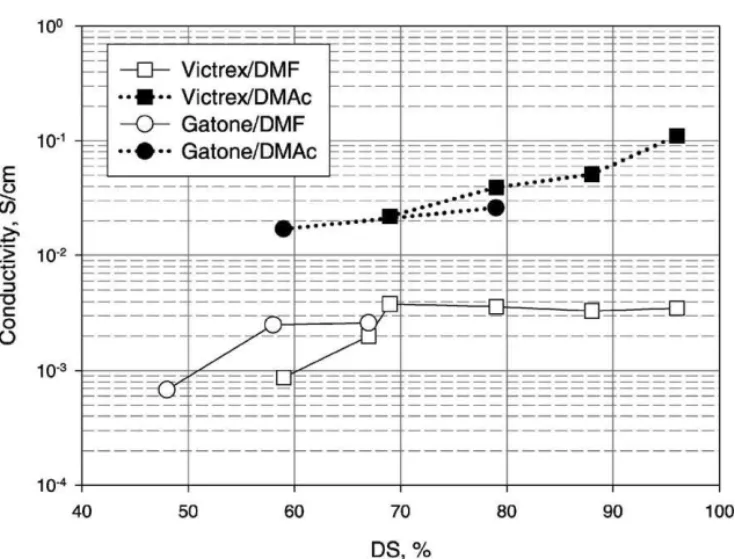
Fig. 1. Room temperature conductivity of the samples, designated inTable 1. Membranes were dried under vacuum at 125◦C and hydrated
by soaking in water prior to measurements.
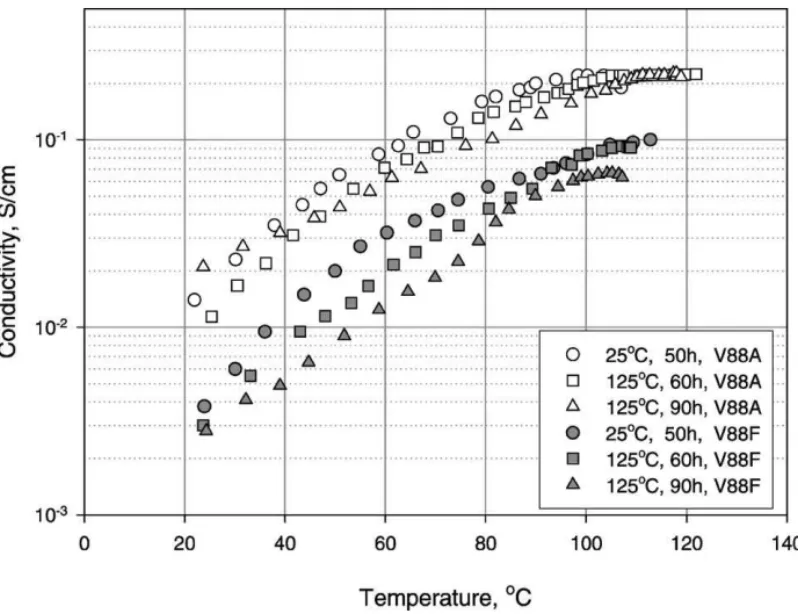
increase with DS due to the ionomer effect [19]. It follows from Table 1 that in both cases of Victrex and Gatone based SPEEK, the conductivity of mem-branes prepared using DMAc was significantly higher than that of membranes prepared with DMF.Fig. 1 provides a pictorial demonstration of this difference which is quite striking, taking into account the fact that the membranes were otherwise identical except for the nature of the casting solvent. Prior to con-ductivity measurement the membranes were freed of their solvent by evacuation at 125◦C. As this treat-ment can possibly provoke a reaction between the sulfonated polymer and the solvent, samples V88F and V88A were prepared without deep drying under vacuum. They were dried instead at ambient condi-tions for 2 days and the conductivity of these samples (still containing some residual solvent) was measured as a function of temperature. Fig. 2 illustrates their behavior and also displays the conductivities of the same membranes after vacuum treatments at 125◦C during 62 and 91 h. It follows from this figure that contrary to what one might expect, the pretreatment reduces the membrane conductivity, particularly for DMF cast membranes. FromFig. 2one can also see
a significant difference between membranes prepared with DMF and DMAc which becomes still more pro-nounced after long term vacuum thermo-treatment.
3.1.2. 1H NMR study results
1H NMR was employed in order to rationalize the observed effects. It was found that all SPEEK sam-ples prepared using DMF as the solvent have a singlet peak at 2.6 ppm which does not occur when DMAc was used as solvent.Fig. 3 represents a spectrum of membrane V67F after vacuum drying at 125oC for 2 days, which is typical of any DMF containing SPEEK even after treatment at temperature as low as 60◦C. The fact that the peak at 2.6 ppm is associated with DMF was confirmed by an experiment, where some DMF was added to a SPEEK sample, previously dis-solved in DMSO-d6 which resulted in the appearance of the 2.6 ppm peak. Another important observation is a broad peak at 8.2 ppm assigned to –SO3H. This peak was however not dependant on temperature and polymer concentration, which would normally be observed for sulfonic acid peak. In the presence of water, –SO3Hinevitably forms hydrogen bonds with its oxygen and the NMR shift of this proton should be
S. Kaliaguine et al. / Catalysis Today 82 (2003) 213–222 217
Fig. 2. Comparison of the conductivities of V88F and V88A samples after different treatments.
dependant on the electron density around the –SO3H hydrogen. Therefore, this chemical shift is depen-dant on the hydrogen bond strength, on temperature, concentration and on intra- or molecular inter-actions. Diluting the sample, for example, is spacing apart the –SO3H groups on the polymer chains, re-sulting in weaker H-bonding which should have the effect of increasing the electron density around the hydrogen atom, and bringing about a significant up-field shift of its 1H NMR absorption. That behavior was indeed observed with DMF free samples, where –SO3H water absorption revealed a peak at 5–7 ppm, the position of which depended on concentration. However, the DMF processed samples behaved other-wise. Upon dilution or heating of the sample to 80◦C the –SO3H peak always remained at 8.2 ppm indicat-ing a very strong hydrogen bond between the –SO3H and some other species, that was not disturbed by concentration or temperature changes.
Only in the case, when the weak base NaHCO3 was added to the sample did the –SO3H peak move from 8.2 to 3.5 ppm as a result of the base interfer-ing with the hydrogen bondinterfer-ing. The intensities of
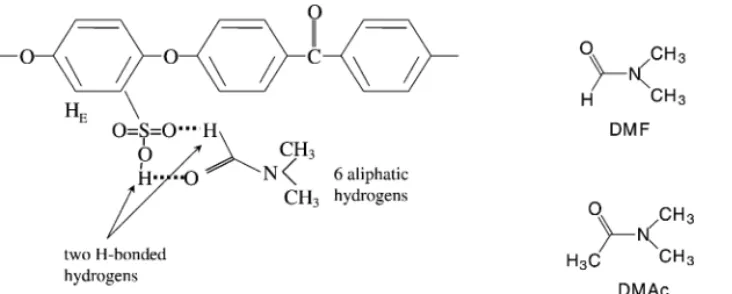
the H-bonding absorption at 8.2 and 2.6 ppm were exactly two and six times the intensity of the aro-matic hydrogen in ortho-position with respect to the sulfonic acid group (Fig. 3). This indicates that af-ter inaf-teraction with DMF, for every –SO3H group, a molecule that had exactly two types of hydrogen atoms in the ratio of 1:6 was present. As shown in Fig. 4, DMF exactly has these numbers of hydrogen atoms, six in the two methyl groups and one on the aldehyde carbon. From the above discussion it fol-lows that the peak at 8.2 ppm is a result of strong H-bonding between SPEEK and DMF as illustrated in Fig. 4. The intensity ratio of two instead of one, results from the two hydrogen atoms of both the –SO3H and the –CHO groups of DMF involved in hydrogen bonding. The peak at 2.6 ppm originates from the hydrogen atoms on the N,N-dimethyls of absorbed DMF.
When another solvent, such as DMAc (Fig. 5) was used to prepare the SPEEK films, no evidence of hy-drogen bonded DMAc could be seen in any recorded NMR data. This suggests that DMF molecule is partic-ularly prone to hydrogen bonding with –SO3H groups,
Fig. 3.1H NMR spectra of sample V67F.
while DMAc is not. Thus the difference between the conductivities of SPEEK membranes prepared using DMF and using other solvents is obviously explica-ble on the basis of strong bonding which blocks the protons of sulfonic acid groups excluding them from charge transfer. That was likely the reason for the low SPEEK conductivity observed in Refs.[5,6]in which DMF was used as the solvent.
Fig. 4. Structures of DMF and DMAc and a possible configuration of hydrogen-bonding between –SO3H groups of SPEEK and DMF
molecules.
3.2. Influence of the treatment and sulphuric acid residuals
Fig. 2 displays the conductivities of membranes V88F and V88A before and after vacuum treatments at 125◦
C during 62 and 91 h. It follows from the figure that the treatment brings down the conducti-vity not only of DMF cast membranes, but also that
S. Kaliaguine et al. / Catalysis Today 82 (2003) 213–222 219
Fig. 5.1H NMR spectra of sample V88F: (a) after 4 days of vacuum treatment at125◦C; (b) after 2 days of treatment at 100◦C in air.
of one prepared using DMAc, however to a lesser extent.
The reason for this was investigated using1H NMR. It was observed that the spectra of these samples as well as the spectra of other SPEEK membranes with high DS (above 0.8) are different from that of the samples with DS < 0.8.1H NMR spectra of mem-branes V88F, V88A, V96F, V96A (and many others with DS > 0.8 not listed in Table 1) treated under vacuum at 125◦C, exhibited a triplet at 2.6 ppm in-stead of a singlet as illustrated for sample V67F (with DS = 0.67) in Fig. 5. A specific experiment, where spectra of blends of concentrated H2SO4with either
Fig. 6. Reaction scheme of DMF or DMAc transformation in presence of sulphuric acid.
DMAc or DMF were recorded, demonstrated exactly the same pattern, which can be explained on the basis of the reaction scheme presented inFig. 6.
It is highly plausible that SPEEK with high DS con-tains some amount of residual sulphuric acid which is rather difficult to wash out. This acid reacts with DMF or DMAc, which results in their decomposition into DMAm sulphate and formic or acetic acids. The sharp peak at 8.15 ppm (Fig. 5b) is assigned to formic acid, which is believed to undergo further decomposi-tion into water and CO2, leading to its disappearance in the samples after long term treatment, as is indeed observed in the spectrum inFig. 5.
The problem of proper washing of highly sulfonated SPEEK is not a trivial one, as above DS = 0.8 the polymer becomes partially and at DS > 0.9 com-pletely soluble in water even at 0◦C. This was also noted in Ref.[10]. A thorough washing will therefore result in the loss of the most highly sulfonated (more conductive) fraction of the polymer. On the other hand residual sulphuric acid may not only affect the oper-ation of a device where membranes are used by af-fecting the apparent conductivity, but also provoke a degradation of the solvents with unpredictable conse-quences for the membrane performance.
3.3. Influence of PEEK polymer source
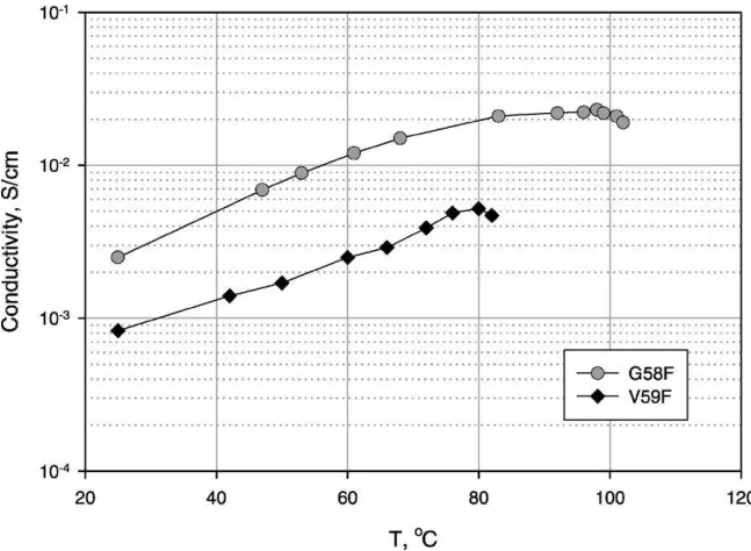
Fig. 1evidences that the origin of the PEEK ma-terials does not affect much, the room temperature conductivity of the SPEEK produced for DS >∼ 0.6. However, samples V59F and G58F having almost same DS showed different conductivities. The com-parison of their conductivity vs. temperature curves (Fig. 7) indicates that sulfonated GatoneTM PEEK has a conductivity always several times higher than Victrex PEEK. Besides the former starts to show de-hydration signs at about 100◦C while the latter at
Fig. 7. Temperature dependences of conductivity of G58F and V59F samples.
80◦C. This behavior can be explained by the differ-ence in the molecular weight of the PEEKs. Having lower Mw Gatone PEEK dissolves quickly (several minutes) when its granules are strewed into sulphuric acid at room temperature. Victrex has a higher Mw and it takes more than a day for it to be dissolved in the same conditions. Consequently, Gatone SPEEK is more homogeneous as all its mass is in contact with sulphuric acid during the sulfonation process. For Victrex the difference in reaction time between the first and last portions of dissolved polymer can be sig-nificant. Sulfonation time for these two samples was 60 and 66 h respectively, so that the reaction times of the dissolved fractions are significantly different. As a result the more homogeneously sulfonated G58F provides a membrane with a more uniform route for charge transfer, which better retains water at higher temperature. However, it should be remarked, that the mechanical properties of Gatone based SPEEK appear to be second to Victrex base polymer. At the same time as DS increases, the time of reaction also increases and the difference between sulfonation time for the first and last dissolved portion of PEEK becomes relatively smaller. Another way to improve homo-geneity of SPEEK is to use powder PEEK or increase
S. Kaliaguine et al. / Catalysis Today 82 (2003) 213–222 221
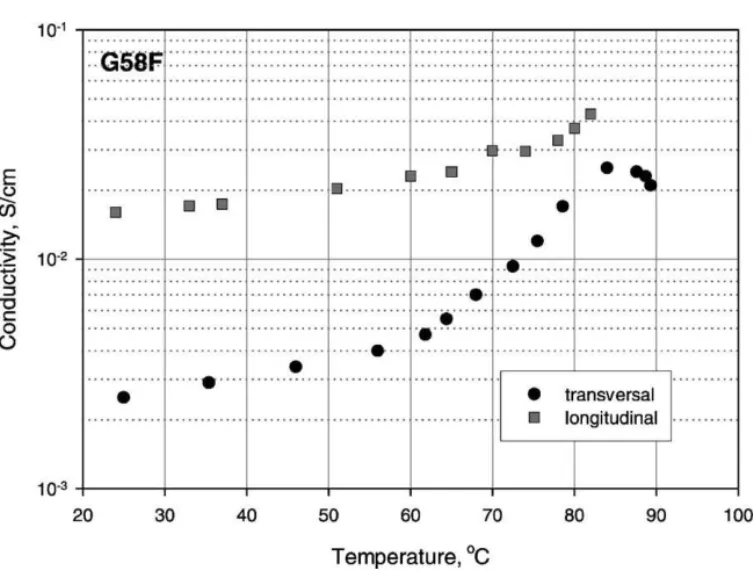
Fig. 8. Comparison of the conductivities of G58F measured in transverse and longitudinal directions.
the temperature of sulfonation. The latter however would make more difficult in obtaining exact DS, because, the sulfonation reaction is going on faster.
3.4. Influence of the measurement technique
Accurate measurement of the proton conductivity of electrolyte membranes presents an experimental chal-lenge due to the dramatic influence of PEM hydration rate. There exists several experimental schemes, each one however with its own merits and demerits. In the work[7]for instance, a membrane was equilibrated in a liquid electrolyte solution, which can obviously af-fect its chemistry due to ion exchange. This approach appears justified, when membrane is meant for elec-trodialysis, however in FC application the conductiv-ity measured in such a manner would be overestimated and far from reality.
In the above mentioned works [8,15,16], σ was measured in longitudinal direction on one membrane side. This allows a sample to be better equilibrated with its environment and for a coaxial cell[8]avoids parasitic inductance response from connecting leads. However it can strongly overestimate the true con-ductivity if bulk humidification is lower than that of
the surface where moisture adsorbs.Fig. 8presents a comparison of the conductivity measured in this work cell having blocking electrodes in transversal direction and the longitudinal conductivity of the same sample measured in a frame cell similar to the one used in Refs.[15–18]. The difference by almost one order of magnitude demonstrates that the measuring technique is of great significance and strongly affects the results. That is obviously the reason for the very high conduc-tivity values obtained in Refs.[8,15,16]. It seems that for membranes intended for FC application, the mea-surements in an electrochemical cell, imitating oper-ational regime of an actual fuel cell would be most appropriate. At least it should be in the cross-sectional direction, ideally sandwiched between gas-diffusion electrodes and correspondingly conditioned.
4. Conclusion
As has been found in this study by the example of SPEEK, many parameters very occasionally taken into account in the works on PEM, have however a significant impact on their properties, considerably in-fluencing the membrane conductivity. These factors
include the nature of initial material, its molecular weight, choice of casting solvent, membrane treat-ment conditions and experitreat-mental features of a mea-surement technique. It has been demonstrated that DMF enters in strong hydrogen bonding with sulfonic acid groups of SPEEK, reducing the number of pro-tons available for charge transfer, which dramatically brings down the PEM conductivity. DMF and DMAc solvents may also react with residual sulphuric acid during high temperature treatment, resulting in forma-tion of dimethylaminium sulphate and corresponding carboxylic acids. The immediate result of this interac-tion is a conductivity decrease due to the decrease in sulfonic acid concentration. However, in a more com-prehensive sense the consequences of such interaction are difficult to foresee.
References
[1] O. Savadogo, J. New Mater. Electrochem. Syst. 1 (1998) 47. [2] R. Genies, B. Mercier, N. Sillion, G. Cornet, G. Gebel, M.
Pineri, Polymer 42 (2001) 359.
[3] F. Lufrano, G. Squadrito, A. Patti, E. Passalacqua, J. Appl. Polym. Sci. 77 (2000) 250.
[4] S.R. Samms, S. Wasmus, R.F. Savinell, J. Electrochem. Soc. 143 (1996) 1225.
[5] T. Kobayashi, M. Rikukawa, K. Sanui, N. Ogata, Solid State Ionics 106 (1998) 219.
[6] M. Rikukawa, K. Sanui, Prog. Polym. Sci. 25 (2000) 1463. [7] W. Cui, J. Kerres, G. Eigenberger, Separ. Purif. Technol. 14
(1998) 145–154.
[8] B. Bonnet, D.J. Jones, J. Roziere, L. Tchicaya, G. Alberti, M. Casciola, L. Massinelli, B. Bauer, A. Peraio, E. Ramunni, J. New Mater. Electrochem. Syst. 3 (2000) 87–92. [9] M. Ise, K.D. Kreuer, J. Maier, Solid State Ionics 125 (1999)
213.
[10] K.D. Kreuer, J. Membr. Sci. 185 (2001) 185.
[11] S.M.J. Zaidi, S.D. Mikhailenko, G.P. Robertson, M.D. Guiver, S. Kaliaguine, J. Membr. Sci. 173 (2000) 17.
[12] S.D. Mikhailenko, S.M.J. Zaidi, S. Kaliaguine, J. Polym. Sci. B (Physics) 38 (2000) 1386.
[13] S.D. Mikhailenko, S.M.J. Zaidi, S. Kaliaguine, Catal. Today 67 (2001) 225.
[14] M.W. Park, J.C. Yang, H.S. Han, Y.G. Shul, T.H. Lee, Y.I. Cho, Denki Kagaku 64 (1996) 743.
[15] Y.S. Kim, F. Wang, M. Hickner, T.A. Zawodzinski, J.E. McGrath, Polym. Mater. Sci. Eng. 85 (2001) 521.
[16] F. Wang, M. Hickner, Y.S. Kim, T.A. Zawodzinski, J.E. McGrath, J. Membr. Sci. 197 (2002) 231.
[17] T.A. Zawodzinki, M. Neeman, L.O. Sillerud, S. Gottesfeld, J. Phys. Chem. 95 (1991) 6040–6044.
[18] J. Zaidi, S.F. Chen, S.D. Mikhailenko, S. Kaliaguine, J. New Mater. Electrochem. Syst. 3 (2000) 27–32.
[19] M.T. Bishop, F.E. Karasz, P.S. Russo, K.H. Langley, Solubility and properties of poly(aryl-ether-ketone) in strong acids, Macromolecules 18 (1985) 86.