THE USE OF MICROORGANISMS OF CASSAVA RETTING FOR THE PRODUCTION OF PECTINOLYTIC
ENZYMES
Sonagnon H. S. Kouhoundé,
1,2Kifouli Adéoti,
3Frank Delvigne,
1Aly Savadogo,
2Alfred S. Traore,
2Philippe Thonart
1Address(es):
1 Université de Liège, Faculté Universitaire des Sciences Agronomiques de Gemgloux (FUSAGx), Unité de Bio industrie, Centre Wallon de Biologie Industrielle (CWBI), Passage des Déportés 2, 5030 Gembloux, Belgium, Tél : +32.81.62.23.05.
2 Université de Ouagadougou, UFR-SVT, Centre de Recherches en Sciences Alimentaires et Nutritionnelles (CRSBAN), Laboratoire de Biotechnologie Microbienne, 03 BP 7131 Ouagadougou 03, Burkina Faso, Tél : +226.50.45.35.14.
3 Université d'Abomey-Calavi, Faculté des Sciences et Techniques, Laboratoire de Microbiologie et des Biotechnologies Alimentaires (LAMITA), Benin. *Corresponding author: [email protected]
ABSTRACT
Keywords: Pectinolytic enzymes, cassava retting, fermentation, microorganisms
INTRODUCTION
The fermentation of cassava (retting) is characterized by the activity of certain microorganisms which produce pectinolytic enzymes (EP). Investigating the fermentation of cassava leaves for the production of Ntoba mbodi,
Mokemiabeka et al., (2011) showed that the softening of cassava leaves resulted
from the enzymatic processes which occurred during fermentation. These changes occur due to the activity of cellulases and pectinases, and extend over the first 48 hours of the fermentation of cassava leaves (Padonou, 2010;
Mokemiabeka et al., 2011). These enzymes are produced by microorganisms
during the process and many of these microorganisms are also present during the fermentation of cassava roots (Brauman et al., 1995; Amoa-Awua et al., 1996). A good knowledge of these microorganisms will not only shorten the fermentation of cassava but also contribute to standardize this process.
Indeed, pectinolytic enzymes are known for their role in the hydrolysis of pectic substances present in plant tissues (Sharma et al., 2013; Whitaker, 1990). They belong to a group of enzymes of great industrial importance and are positioned prominently in the global market of industrial enzymes; this expanding market is experiencing a recovery, reaching over 2 billion euros each year (Charnock &
McCleary, 2005). These enzymes have many applications and are used in both
the food industry and in non-food industries where they are produced from various substrates (Prathyusha & Suneetha, 2011; Sandri et al., 2011; Ribiero
et al., 2010). Among the substrates used for their production, there are bagasse
from sugar cane, wheat bran, apple peel and lemon (De Gregorio et al., 2002;
Rezazadeh Bari et al., 2010; Botella et al., 2007; Murad & Azzaz, 2011).
Various methods are used to obtain these enzymes from vegetable raw materials or microorganisms. However, the processes employing microorganisms have a twofold advantage, being environmentally friendly and constituting a very convenient source (Boumendjel et al., 2009) for their production. Research conducted in the past has shown that the microorganisms used are varied and included many bacteria, yeasts and mold.
This paper aims to investigate the production of pectinolytic enzymes, using different substrates and microorganisms, highlighting the opportunity of
producing pectinases from retting microorganisms as an alternative worth exploring.
PECTINOLYTIC ENZYMES
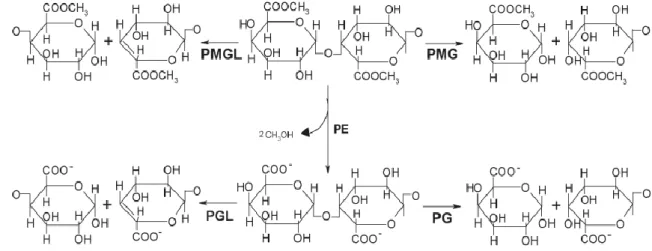
Pectinolytic enzymes (EP) are enzymes capable of acting on galacturonic pectic substances (Combo et al., 2011). Pectinolytic enzymes gather Pectin esterase, Polygalacturonase and Pectin Lyase. Depending on their mode of action, it has been distinguished that Pectin Esterase (PE) release methanol; polygalacturonase (PG) and Pectin Lyase (PL) hydrolyze galacturonic acid and produce small polymers. However, authors (Campos, 1993; Combo et al., 2011) have only investigated two major groups (figure1): the group of Pectin Esterase which attack methyl ester bonds and the group of Depolymerase, which operate on the α-(1-4) glycosidic bond (Bekhouche et al., 2006).
Figure 1 Classification of different pectinolytic enzymes Classification of the mode of action of pectinolytic enzymes
Depolymerases are classified into four categories: polygalacturonase (PG), polymethylgalacturonase (PMG), lyase polygalacturonate (PGL) and lyase Pectinolytic enzymes are used in the food industry for the extraction, clarification and filtration of fruit juice and wine. Depending on their mode of action, these enzymes are classified into two major groups, namely: esterases (methylesterase) and depolymerases (polygalacturonase and lyase). Among the methods for their preparation, fermentation is the most used, and its application depends upon knowledge of the strain’s requirements; many parameters are taken into consideration most of which relate to the strain used. Knowledge and control of these parameters are required for optimal production of these enzymes. Many microorganisms (Aspergillus niger; Kluyveromyces marxianus; Trichoderma viride BITRS-1001; Bacillus licheniformis; Saccharomyces pastorianus etc.) have already been studied and we suggested that there is a possibility of producing these enzymes using the microorganisms employed for the retting of cassava. This review provides a wealth of knowledge on the production of pectinolytic enzymes, using different substrates and microorganisms. ARTICLE INFO Received 10. 3. 2014 Revised 7. 6. 2014 Accepted 11. 11. 2014 Published 1. 12. 2014 Regular article doi: 10.15414/jmbfs.2014-15.4.3.277-281
polymethylgalacturonate (PMLG) (Combo et al. 2011). PGs are involved in the hydrolysis of the pectic substances and belong to the endo-PG (EC 3.2.1.15) and exo-PG (EC 3.2.1.67) group. Their reaction (figure 2) may be carried out either at random along the string or at the end of the chain causing a lowering of the viscosity, which enables distinguishing between endo- and exo-polygalacturonase
(Thibault, 1982). With an exo-PG, for example, the lowering of the viscosity is
observed after breaking 20% of the glycosidic linkages (Baron & Thibault,
1985; Combo et al., 2011). Endo-PG are present in some plants, especially in
fruit but are also produced by various microorganisms such as bacteria and fungi. Exo-PG is less frequent and is produced by some bacteria and fungi. The other subclasses of depolymerases are lyases or transeliminases which are enzymes that break the glycosidic linkage (-CO-) through the mechanism of β-elimination. Their depolymerizing action causes the release of unsaturated uronides and small oligomers (Baron & Thibault, 1985). PGL (Lyase Polygalacturonate) are produced by some bacteria and pathogenic fungi in which endo-PGL is the most
abundant form. On the other hand, PGL are produced by Aspergillus japonicus, Penicillium paxilli and Pichia pinus. PGL is activated by Ca2+ ions and, in some cases, by other divalent ions such as Mg2+, Mn2+ and conversely, they are inhibited by the chelating agent EDTA. PMGL are the only depolymerases able to damage High Methylated pectin (HM pectin) without the prior action of other enzymes (Jayani et al., 2005). Pectin esterases catalyze the hydrolysis of ester bonds of highly methylated pectins, resulting in the release of methanol and polygalacturonic acid. PE exist as depolymerases in many plants, but they are also produced by yeasts, fungi and some bacteria (Combo et al., 2012). The PE of plant, certain methyl esters and pectic acids are better known than those of fungal and bacterial origin. Their optimal pH is between 7 and 8, while the fungal and bacterial PE is more active at a pH between 4 and 5 (Martos et al., 2013). PE is inhibited by either increasing the number of free carboxyl along the demethylated polygalacturonic chains or by the side chains of neutral sugars in the pectin molecule.
PE: pectin esterase, PG: polygalacturonase, PMG: polymethylgalacturonase, PGL: polygalacturonate lyase, PMLG: polymethylgalacturonate lyase, Source : (Combo et al., 2011)
Figure 2 Different pectinolytic enzymes and their mode of action APPLICATION OF PECTINOLYTIC ENZYMES IN INDUSTRIES
The largest industrial application of pectinolytic enzymes (EP) is in the extraction and clarification of fruit juices. In this industry, pectins contribute to lower the viscosity and turbidity of the juice. When a mixture of PE and amylase was used to clarify the juice, it contributed to a reduction in the filtration time of up to 50%
(Blanco et al., 1999) and an increase in the juice extraction yield. These results
were reported for the treatment of banana pulp, grapes and apples (Kaur et al.,
2004). A combination of EP with cellulase, arabinase and xylanase, contributed
to strengthen the efficiency of the pressing for the extraction of fruit juice
(Gailing et al., 2000) in which 100% of the extraction yield was obtained for
cellulose (Alkorta et al., 1998). Furthermore, another application of EP is vacuum infusion which has commercial application and is applied to soften the skin of citrus fruit before removal. In the future, it could be extended to replace the manual work of canned segments during industrial production (Baker &
Wicker, 1996). EP also has applications in biotechnology, degumming fibers in
combination with xylanases as an ecological alternative (Kapoor et al., 2001). When EP is used in the pulp and paper industry, it is essentially to facilitate the filtration process. The water is evacuated during the process by using a cloth filter with large holes.
During modern papermaking, alkaline peroxides are used for pulp bleaching and the solubilization of polysaccharides (Pasha et al., 2013); among these polysaccharides pectins or polygalacturonic acids rank first. The degradation of polygalacturonic acids strongly depends on the degree of polymerization. Pectinolytic enzymes are used to depolymerize the galacturonic acid polymers and lower the cationic demand of pectin solutions (Reid & Ricard, 2000). Pectinolytic enzymes are also used in the fermentation of coffee to remove the mucilage of coffee beans; the microorganisms used in this method are bacteria (lactic bacteria) and yeasts belonging to the genus Saccharomyces (Ciza, 2001). It is important to note that in this method, the pectinolytic enzymes are used for limiting the occurrence of undesirable substances.
Production of pectinolytic enzymes
The development of microbiology allowed a better understanding of the systems that govern microbial enzyme synthesis. The industrial production of enzymes is based on the fermentation process. The main advantages of enzymes produced via fermentation compared with enzymes from an extraction process are: production which is independent of seasonal and geographical constraints, the possibility of using cheap raw materials, production yields can be increased
significantly by microbial strain improvement and optimization of fermentation conditions (Pasha et al., 2013). Furthermore, enzymes of microbial origin have various properties and characteristics, the advantages of which outweigh the disadvantages associated with fermentation industries (heavy investment, energy consumption, contamination etc.) (Mojsov, 2013).
Use of microorganisms for the production of pectinolytic enzymes
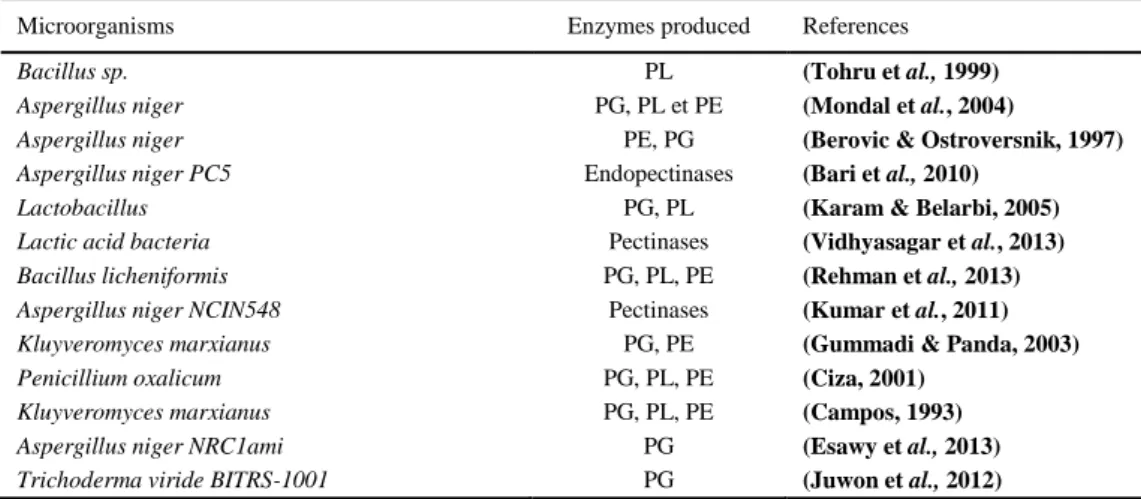
These characteristics explain their use in current technologies. Bacteria and fungi are mostly used for enzyme production using the fermentation process (Table1). Among the bacteria, certain genera namely Bacillus, Lactobacillus, Pediococcus and Leuconostoc are known to be effective during the fermentation process
(Bekhouche et al., 2006; Sakellaris et al., 1988). Lactobacillus plantarum was
used to produce an extracellular polygalacturonase by Sakellaris et al., (1988); the maximum enzyme production was obtained from MRS medium, supplemented with glucose and methylated pectin using low concentrations ranging from 0 to 5% and 1 to 5%, at 27°C and pH 6 - 8. Moreover, maximum polygalacturonase activity was reached at 30 °C at a pH of 4-5 with 5g/l glucose and 15g/l of pectin (i.e. wpectine / wglucose = 3). However, using Leuconostoc sp.
LLn1, Bekhouche et al., (2006) obtained a smaller production of extracellular polygalacturonase (0.17 U/ml without glucose) versus 29 U/ml obtained with 15g/l of glucose using Lactobacillus plantarum at 30° C and a pH of 4 to 5. These studies also showed that Mg2+ and Mn2+ ions were required in the medium for an increase in enzyme activity. In another study, conducted by Juven et al.,
(1985), Leuconostoc mesenteroides was used to reduce the viscosity of the
tomato juice. In vitro tests showed that the supernatant obtained from the culture of these cells was active on the highly methylated pectin, but inactive on pectin exhibiting a low degree of methylation and polygalacturonic acid. Furthermore, no pectin esterase activity was detected. However, these studies showed that lactic bacteria are low producers of EP compared with Bacillus strains. Sharma
& Satyanarayana (2012) have experimented using Bacillus pumilus dcsr1 for
the production of a thermostable and highly alkaline pectinase. These studies were conducted using solid fermentation with agricultural residues such as sesame, oil meals, wheat bran and citrus pectin. The fermentation lasted for 144 hours at 40°C and pH 9; the enzyme obtained from this study was important as it has enabled an improvement of the method of treating ramie fibers. During the fermentation of cassava leaves for the production of Ntoba mbodi, researchers observed a softening at the end of the fermentation process. This phenomenon (softening sheets) could be explained by the action of microorganisms such as Bacillus macerans, Bacillus subtilis, Bacillus cereus, Staphylococcus xylosus and
Erwinia spp., which are known to cause degradation of the cell wall of cassava leaves (Jayani et al., 2005; Louembé et al., 2002). However, this study didn’t identify these strains as responsible for this activity, even though pectinolytic activities were measured during the process. In addition, other studies conducted on eucalyptus kraft pulp (Ahlawat et al., 2007) showed a very high level of the
production of pectinases and xylanases, which were alkalophilic and thermostable, from newly isolated Bacillus subtilis and Bacillus pumilus strains respectively.
Table 1 Some microorganisms used for the production of pectinolytic enzymes
Microorganisms Enzymes produced References
Bacillus sp. PL (Tohru et al., 1999)
Aspergillus niger PG, PL et PE (Mondal et al., 2004)
Aspergillus niger PE, PG (Berovic & Ostroversnik, 1997)
Aspergillus niger PC5 Endopectinases (Bari et al., 2010)
Lactobacillus PG, PL (Karam & Belarbi, 2005)
Lactic acid bacteria Pectinases (Vidhyasagar et al., 2013)
Bacillus licheniformis PG, PL, PE (Rehman et al., 2013)
Aspergillus niger NCIN548 Pectinases (Kumar et al., 2011)
Kluyveromyces marxianus PG, PE (Gummadi & Panda, 2003)
Penicillium oxalicum PG, PL, PE (Ciza, 2001)
Kluyveromyces marxianus PG, PL, PE (Campos, 1993)
Aspergillus niger NRC1ami PG (Esawy et al., 2013)
Trichoderma viride BITRS-1001 PG (Juwon et al., 2012)
PG : Polygalacturonase ; PL : Pectin Lyase ; PE: Pectin Esterase EP production was carried out under SSF (Solid State Fermentation) using combinations of cheap agricultural residues to minimize the cost of production. Among the various substrates tested, the best production yield of pectinolytic enzymes and xylanase was observed using a combination of wheat bran and citrus waste (6592 U/g dry substrate) supplemented with 4% yeast extract, incubated at 37°C for 72 h and pH 7.0, and using deionized water as a moistening agent. The effect of these enzymes on biobleaching of eucalyptus pulp kraft was
determined. The two enzymes (xylanase and pectinase) showed stability over a wide pH range of 6 to 10 and temperatures of 55-70°C. The bleaching efficiency of EP and xylanase on kraft pulp was maximal after 150 minutes at 60°C. However, some authors restricted the production of EP to fungi. Fortunately, studies on these strains showed that they actually produced a wide range of these enzymes, which is not often the case with bacteria. An inspection of Table 2 shows that fungi are the species mostly used in the production of these enzymes.
Table 2 Physical properties of some microorganisms producing pectinolytic enzymes
Microorganisms Enzymes produced Optimal pH Optimal Temperature References
Amycolata sp. PGL 10,25 30-35 (Bruhlmann, 1995)
Bacillus sp. PGL 8,0 70 (Takao et al., 2000)
Saccharomyces pastorianus PG 4,2 50 (Astapovich & Ryabaya, 1997)
S. cerevisiae Endo PG 4,5 45 (Blanco et al., 1997)
P. oxalicum PG, PMG 3-9 45-55 (Ciza, 2001)
B. licheniformis - 10 45 (Rehman et al., 2013)
Bacillus PL 10,5 50-55 (Tohru et al., 1999)
PG : Polygalacturonase ; PL : Pectin Lyase ; PMG: Polymethylgalacturonase; PGL: Lyase polygalacturonate;
Among the fungi used for the production of pectinolytic enzymes, Aspergillus is the most studied and best known, resulting from extensive work on the Aspergillus niger species in order to improve its performance. Indeed (Antier et
al., 1993), the fermentation of coffee pulp by Aspergillus niger and its mutant
strain showed that the use of mutants had the advantage of improving the enzymatic activity during the fermentation process. This advantage led Akbar et
al., (2013) to assess the ability of Aspergillus carbonarius to produce
exo-pectinase using a submerged fermentation process; the study showed that this strain was very productive. Using physical or chemical mutagens (UV irradiation, colchicine, hydrogen peroxide and ethidium bromide), the research team was able to increase the potential production of pectinolytic enzymes by the strain. The mutants were selected based on enzyme activity, growth rate and morphology, and exhibiting an increase in enzyme production. All surviving mutants were quantitatively evaluated after the first mutagenic treatment. The stability of the best mutants was tested by repeated radiation exposure to obtain the third generation mutants. These mutants were tested to quantify their production of pectinolytic enzymes. Among all the mutants, only one showed a maximal pectinase production of 65U/ml compared with the others. According to the literature, the wild strain, A. carbonarius, exhibited little activity. This requires a study of the various parameters that may influence the enzymatic activity of microorganisms.
Control parameters of the production of pectinolytic enzymes
Many parameters are taken into account in the production of the microbial enzymes and are related to the type of microorganism employed. Most recent studies have addressed the medium composition and the physical parameters for enzyme stabilization and production optimization.
The influence of medium composition
The medium composition parameters that are monitored include: nitrogen composition, glucose/sucrose composition, minerals and inoculum. Indeed, soluble sugars can affect the synthesis of EP. Ciza (2001), studying the stimulatory or repressor effect of glucose on the enzymatic synthesis of the strain P. oxalicum, observed a high production of enzymes (PG, PME and PL) for glucose concentrations ranging between 0.5 and 1.0%, and keeping the pectin concentration (DM = 71%) at 2%. Moreover, any variation of these two factors (glucose concentration and pectin/pectic acid) should be a ratio (w/w pectin or pectic acid/glucose), varying between 2 and 4, as high concentrations (≥ 1.0%) of glucose repress PME and PG activity levels, which have been found to decrease considerably. However, for the detection of pectinolytic activity in Bacillus licheniformis KIBGE - IB21, Rehman et al., (2013), did not add glucose to the basal medium, nevertheless they observed pectinolytic activity in the strain.
Esawy et al., (2013) used lemon peels as a unique carbon source to immobilize
the Aspergillus niger NRC1ami strain to produce pectinolytic enzymes with industrial applications. However, for some strains an inductor is required to stimulate the production of these activities; sucrose may be sometimes replace glucose in this function. Thus, during the work of Juwon & Ogunmolu (2011) investigating the production of polygalacturonase by Trichoderma viride-1001 BITRS using submerged fermentation, the sucrose concentration was 0.2% and the pH of the medium was maintained at 6.0. Furthermore, an analysis of the effect of four different carbon sources (fructose, sucrose, maltose and lactose) after 24 hours of culture revealed a maximum activity of fructose at 3033U/ml versus 2816.7 U/ml for sucrose. This study also showed that four days were sufficient to follow enzyme kinetics as at the end of the 10-day culture, the maximum pectinolytic activity was obtained after 3 days, but between the 4th and 10th day, the activities were very low.
Nitrogen also affects the synthesis of pectinolytic enzymes. Indeed, the nitrogen source is the second most important parameter, after carbon, which significantly influences the production of biomass and metabolites (Ciza, 2001). According to
Guiraud (1998), the most assimilable form of nitrogen by microorganisms is the
ammonium form; this explains the high values recorded by Ciza (2001) with (NH4) 2S04 and (NH4) 2HP04. However, it should be noted that organic nitrogen (peptone) can also help to maximize the production of pectinolytic enzymes. However, the experiments of Ciza (2001) on P. oxalicum showed that the combination of two nitrogen sources only improved the PG activity to the detriment of PMEs and PL activities. In contrast, the sole use of yeast extract was found to improve PG and PL production. By combining the yeast extract with KNO3, Rehman et al., (2013) produced pectinolytic enzymes with Bacillus
licheniformis KIBGE-IB21 at pH 7 and after only 48 h of culture. Another no less important component of the medium is the source of inorganic phosphorous, the presence of which in the medium is necessary for the synthesis of biomass and metabolites. This element is heavily involved in energy metabolism and the synthesis of nucleic acids. One of the forms in which phosphorus improves the enzymatic synthesis is the association with potassium (K2HPO4) or with sodium (Na2HPO4). Finally, it is important to know the concentration of inoculum prior to the production of pectinolytic enzymes in the fermenter due to the problems of heat transfer and materials related to the particular morphology of the mycelium, which itself depends on the culture conditions. The mycelium can grow as long connected hyphae or as compact balls; both forms influence the viscosity of the culture medium and consequently influence microbial metabolism. During his studies on the strain P. oxalicum, Ciza (2001) showed that the inoculum concentration should be between 106 and 108 spores/100ml culture medium to promote a significant production of pectinolytic activity. It should be noted that all of these production conditions could be applied for solid and liquid fermentation. However, previous studies have shown that maximum enzyme production can be achieved by solid fermentation after only 96 hours for PMEs and PL, 120h for PG, and 144h against for all three activities in liquid fermentation (Solis-Pereira et al., 1993).
Influence of physicals parameters of the medium
The physical parameters which influence enzyme synthesis are aeration, pH and temperature. By studying the effects of aeration levels on the synthesis and excretion of pectinolytic enzymes, Ciza (2001) obtained higher levels of activity with culture volumes of 50 ml in 1000 ml flasks; the production kinetics were conducted in flasks without agitation. The flasks were fitted with a perforated plastic lid (2cm) and the orifices were closed with hydrophobic cotton. Microbial development and metabolism are also dependent on the pH and temperature of the medium, and many studies have shown that stability of the enzyme product is a function of these two factors. Hence, to enable a good understanding of enzymatic activity, investigations into the stability of the pH conditions of the strain as well as temperature are necessary. Table 3 shows the optimum pH and temperature for a few microorganisms.
CONCLUSION
Pectinolytic enzymes are mainly produced by fermentation using microorganisms such as bacteria, yeasts and molds. Many studies have been conducted on the genera Aspergillus, Bacillus and Saccharomyces; in addition, the production of pectinolytic enzymes using fungi has also been investigated. However, very few studies have shown the ability of lactic bacteria to produce these enzymes. Polygalacturonase was produced in experiments with some strains of lactobacillus; these studies showed the ability to produce these enzymes from this species, although the amount of enzyme produced is low. Lactobacillus is one of the most represented species observed during the fermentation of cassava and many authors have demonstrated their role in this process. Are microorganisms isolated from cassava fermentation capable of producing polygalacturonase? Our current studies on the microorganisms involved in cassava retting will enable the determination of which microorganisms are capable of producing this activity.
Acknowledgement: Sincere thanks to the University of Liege for funding this
project.
REFERENCES
AHLAWAT, S. BATTAN, B. DHIMAN, S.S. SHARMA, J., MANDHAN , R.P. 2007. Production of thermostable pectinase and xylanase for their potential application in bleaching of kraft pulp. Journal of Industrial Microbiology & Biotechnology, 34(12), 763–70. http://dx.doi.org/10.1007/s10295-007-0251-3 AKBAR, S., PRASUNA, R.G., KHANAM, R. 2013. Multistep mutagenic strain improvement in Aspergillus carbonarius to enhance pectinases production potential. International Journal of Applied Biology and Pharmaceutical Technology, 4(2), 92–98.
ALKORTA, I., GARBISU, C., LLAMA, M.J., SERRA, J.L. 1998. Industrial applications of pectic enzymes: A review. Process of Biochemestry., 33, 21–28. http://dx.doi.org/10.1016/s0032-9592(97)00046-0
AMOA-AWUA, W.K.A., APPOH, F.E., JAKOBSEN, M. 1996. Lactic acid fermentation of cassava dough into agbelima. International Journal of Food Microbiology, 31, 87–98. http://dx.doi.org/10.1016/0168-1605(96)00967-1 ANTIER, P., MINJARES, A., ROUSSOS, S., RAIMBAULT, M., GUSTAVO, V-G. 1993. Pectinase-hyperproducing mut ants of Aspergillus niger C28B25 for solid-state fermentation of coffee pulp. Enzyme Microbiology and Technology, 15, 254–260. http://dx.doi.org/10.1016/0141-0229(93)90146-s
BAKER, R.A., WICKER, L. 1996. Current and potential application of enzyme infusion in the food industry. Trends Food Sci. Technol., 7, 279–84. http://dx.doi.org/10.1016/0924-2244(96)10030-3
BARON, A., THIBAULT, J.-F. 1985. Les enzymes pectinolytiques. Hydrolases et dépolymérases. In Collection de Biochimie Appliquée Bordas. 143–164. BEKHOUCHE, F., BONNIN, E., BOULAHROUF, A., LEVEAU J-Y. 2006. Production d’enzyme polygalacturonase par des souches microbiennes isolées du lait cru et des olives noires et vertes. Canada Journal Microbiol., 52, 658–663. http://dx.doi.org/10.1139/w06-024
BLANCO, P., SIEIRO, C., VILLA, T.G. 1999. Production of pectic enzymes in yeast. FEMS Microbiology Letters, 175, 1–9. http://dx.doi.org/10.1111/j.1574-6968.1999.tb13595.x
BOTELLA, C., DIAZ, A., DE ORY, I., WEBB, C., BLANDINO, A. 2007. Xylanase and pectinase production by Aspergillus awamori on grape pomace in solid state fermentation. Process Biochemistry, 42, 98–101. http://dx.doi.org/10.1016/j.procbio.2006.06.025
BOUMENDJEL, A., BOUMENDJEL, M., LADJAMA, A. 2009. Etude des activités pectinases, lyases et α-amylases dans une souche locale d’Aspergillus species. Journal de la Société Algérienne de Chimie, 19(1), 153–157.
BRAUMAN, A., KELEKE, S., MAVOUNGOU, O., AMPE, F., MIAMBI, E. 1995. Étude cinétique du rouissage traditionnel des racines de manioc en Afrique centrale (Congo). Transformation Alimentaire du Manioc, 288–305.
CAMPOS, G.D. 1993. Contribution à l’étude de la production et de la caractérisation de la polygalacturonase de Kluyveromyces marxianus et de son mutant KF28. In Thèse de Doctorat unique, faculté des sciences agronomiques de gembloux Université de liège. Belgique, 262.
CHARNOCK, S.J., MCCLEARY, B. V. 2005. Les enzymes: Applications industrielles et analytiques. Revue des Oenologues, 116, 1–5.
CIZA, A. 2001. Etude de la production et de la caractérisation des enzymes pectinolytiques produites par Penicillium oxalicum. In Thèse de Doctorat unique, faculté des sciences agronomiques de gembloux Université de liège. Belgique, 220.
COMBO, A.M.M., AGUEDO, M., GOFFIN, D., WATHELET, B., PAQUOT, M. 2012. Enzymatic production of pectic oligosaccharides from polygalacturonic acid with commercial pectinase preparations. Food and Bioproducts Processing, 90(3), 588–596. http://dx.doi.org/10.1016/j.fbp.2011.09.003
COMBO, A.M.M., AGUEDO, M., PAQUOT, M. 2011. Les oligosaccharides pectiques : production et applications possibles. Biotechnologie Agronomie Société Environnement, 15(1), 153–164.
ESAWY, M.A., GAMALA AA., KAMELB, Z., ISMAILA, A.M.S., ABDEL-FATTAH, A.F. 2013. Evaluation of free and immobilized Aspergillus niger NRC1ami pectinase applicable in industrial processes. Carbohydrate Polymers, 92, 1463–1469. http://dx.doi.org/10.1016/j.carbpol.2012.10.061
GAILING, M.F., GUIBERT, A., COMBES, D. 2000. Fractional factorial designs applied to enzymatic sugar beet pulps pressing improvement. Bioprocess Eng., 22, 69–74. http://dx.doi.org/10.1007/pl00009104
GREGORIO, D.A., MANDALARI, G., ARENA, N., NUCITA, F., TRIPODO, M.M., LO CURTO, R.B., 2002. SCP and crude pectinase production by slurry-state fermentation of lemon pulps. Bioresources Technology 83, 89–94. http://dx.doi.org/10.1016/s0960-8524(01)00209-7
GUIRAUD, J. 1998. Microbiologie Alimentaire., p.Dunod Paris ISBN 2 10 003666 1.
GUMMADI, S.N., PANDA, T. 2003. Purification and biochemical properties of microbial pectinases: a review. Process Biochemistry, 38, 987–996. http://dx.doi.org/10.1016/s0032-9592(02)00203-0
JAYANI, R.S., SAXENA, S., GUPTA, R. 2005. Microbial pectinolytic enzymes : A review. Process Biochemistry, 40, 2931–2944. http://dx.doi.org/10.1016/j.procbio.2005.03.026
JUVEN, B.J., LINDNER, P., WEISSLOWICZ, H. 1985. Pectin degradation in plant material by Leuconostoc mesenteroides. Journal of Applied Microbiology, 58(6), 533–538. http://dx.doi.org/10.1111/j.1365-2672.1985.tb01708.x
JUWON, A.D., OGUNMOLU EMMANUEL, F. 2011. Effect of carbon and nitrogen sources on polygalacturonase production by Trichoderma viride (BITRS-1001) isolated from tar sand in Ondo State, Nigeria. Malaysian Journal of Microbiology, 7(3), 153–158. http://dx.doi.org/10.1155/2012/904763 KAPOOR, M., BEG, Q.K., BHUSHAN, B., SINGH, K., DADHICH, K.S., HOONDAL, G.S. 2001. Application of alkaline and thermostable polygalacturonase from Bacillus sp. MG-cp-2 in degumming of ramie (Boehmeria nivea) and sunn hemp (Crotolaria juncia) bast fibers. Process Biochemestry., 36, 803–7. http://dx.doi.org/10.1016/s0032-9592(00)00282-x KAUR, G., KUMAR, S., SATYANARAYANA, T. 2004. Production, characterization and application of a thermostable polygalacturonase of a
thermophilic mould Sporotrichum thermophile Apinis. Bioresource Technology, 94(3), 239–243. http://dx.doi.org/10.1016/j.biortech.2003.05.003
LOUEMBE, D., KOBAWILA, S.C., KELEKE, S., DIAKABANA, P., MOULASSOU, B.N. 2002. Rouissage des tubercules de manioc à partir de “ pied de cuve ” à base de manioc roui. Tropicultura, 20(3), 118–124.
MARTOS, M., ZUBRESKI, E.R., GARRO, O.A., HOURS, R.A. 2013. Production of pectinolytic enzymes by the yeast Wickerhanomyces anomalus isolated from citrus fruits peels. Biotechnology Research International, 2013, 1– 7. http://dx.doi.org/10.1155/2013/435154
MOJSOV, K. 2013. Use of enzymes in wine making: a review. International Journal of Management, IT and Engineering, 3(9), 112–127.
MOKEMIABEKA, S., DHELLOT, J., KOBAWILA, S.C., DIAKABANA, P., LOUKOMBO, N.N.R., NYANGA-KOUMOU, A.G., LOUEMBE, D. 2011. Softening and mineral content of cassava (Manihot esculenta Crantz) leaves during the fermentation to produce Ntoba mbodi. Advance Journal of Food Science and Technology, 3(6), 418–423.
MURAD, H.A., AZZAZ, H.H. 2011. Microbial pectinases and ruminant nutrition. Research Journal of Microbiology, 6(3), 246–269. http://dx.doi.org/10.3923/jm.2011.246.269
PADONOU S, W.G., 2010. Etude biochimique et microbiologique de la transformation du manioc (manihot esculenta, crantz) et qualité du lafun produit au Bénin. In Thèse de Doctorat unique Université d’Abomey calavi. p. 175. PASHA, K.M., ANURADHA, P. & SUBBARAO, D. 2013. Applications of pectinases in industrial sector. International Journal of Pure and Applied Sciences and Technology, 16(1), 89–95.
PRATHYUSHA, K., SUNEETHA, V. 2011. Bacterial pectinases and their potent biotechnological application in fruit processing / juice production industry : A Review. Journal of Phytology, 3(6), 16–19.
REHMAN, H.U., AMAN, A., SILIPO, A., QADER, S.A.U., MOLINARO, A., ANSARI, A. 2013. Degradation of complex carbohydrate: immobilization of pectinase from Bacillus licheniformis KIBGE-IB21 using calcium alginate as a support. Food Chemistry, 139(1-4), 1081–6. http://dx.doi.org/10.1016/j.foodchem.2013.01.069
REID, I., RICARD, M. 2000. Pectinase in paper making: Solving retention problems in mechanical pulp, bleached with hydrogen peroxide. Enz. Microbiol. Technol., 26, 115–123. http://dx.doi.org/10.1016/s0141-0229(99)00131-3 REZAZADEH BARI, M., ALIZADEH, M., FARBEH, F. 2010. Optimizing endopectinase production from date pomace by Aspergillus niger PC5 using response surface methodology. Food and Bioproducts Processing, 88(1), 67–72. http://dx.doi.org/10.1016/j.fbp.2009.03.004
RIBIERO DS, HENRIQUE SMB, OLIVIERA LS, MACEDO GA, FLEURI LF. 2010. Enzymes in juice processing: a review. International Journal of Food Science and Technology 45, 635–64. http://dx.doi.org/10.1111/j.1365-2621.2010.02177.x
SAKELLARIS, G., NIKOLAROPOULOS, S., EVANGELOPOULOS, A.E. 1988. Polygalacturonase biosynthesis by lactobacillus plantarum: effects of cultural conditons of enzymes production. Journal of Applied Microbiology, 65, 397–404.
SANDRI, I.G., FONTANA, R.C., BARFKNECHT, D.M., SILVEIRA, M.M. 2011. Clarification of fruit juices by fungal pectinases. LWT-food Science and Technology, 44, 2217–22. http://dx.doi.org/10.1111/j.1365-2672.1988.tb01908.x SHARMA, A., SHRIVASTAVA, A., SHARMA, S. 2013. Biotechnology for Environmental Management and Resource Recovery R. C. Kuhad & A. Singh, eds. Biotechnology for Environmental Management and Resource Recovery, pp.107–124. http://dx.doi.org/10.1007/978-81-322-0876-1_7
SHARMA, D.C., SATYANARAYANA, T. 2012. Biotechnological potential of agro residues for economical production of thermoalkali-stable pectinase by Bacillus pumilus dcsr1 by solid-state fermentation and its efficacy in the treatment of ramie fibres. Hindawi Publishing Corporation Enzyme Research, 1– 8. http://dx.doi.org/10.1155/2012/281384
SOLIS-PEREIRA, S., FAVELA-TORRES, E., VINIEGRA-GONZALEZ, G., GUTIERREZ-ROJAS, M. 1993. Effect of different carbon sources on the synthesis of pectinases by Aspergillus niger in submerged and solid state fermentation. Applied Microbiology and Biotechnology, 39, 36–41. http://dx.doi.org/10.1007/bf00166845
THIBAULT, J.-F. 1982. Mode d’action d'une endopolygalacturonse d'Aspergillus niger sur l'acide polygalcturonique. In Utilisation des enzymes pectinolytiques en technologies alimentaires. 477–482.
WHITAKER, JR., 1990. Microbial Pectinolytic Enzymes. In: Microbial Enzymes and Biotechnology, Fogarty, W.M. and C.T. Kelly (Eds.). 2nd Edn., Elsevier Science Ltd., London, 133-176. http://dx.doi.org/10.1007/978-94-009-0765-2_4