HAL Id: hal-00295959
https://hal.archives-ouvertes.fr/hal-00295959
Submitted on 29 Jun 2006
HAL is a multi-disciplinary open access
archive for the deposit and dissemination of
sci-entific research documents, whether they are
pub-lished or not. The documents may come from
teaching and research institutions in France or
abroad, or from public or private research centers.
L’archive ouverte pluridisciplinaire HAL, est
destinée au dépôt et à la diffusion de documents
scientifiques de niveau recherche, publiés ou non,
émanant des établissements d’enseignement et de
recherche français ou étrangers, des laboratoires
publics ou privés.
Cloud Condensation Nuclei properties of model and
atmospheric HULIS
E. Dinar, I. Taraniuk, E. R. Graber, S. Katsman, T. Moise, T. Anttila, T. F.
Mentel, Y. Rudich
To cite this version:
E. Dinar, I. Taraniuk, E. R. Graber, S. Katsman, T. Moise, et al.. Cloud Condensation Nuclei
prop-erties of model and atmospheric HULIS. Atmospheric Chemistry and Physics, European Geosciences
Union, 2006, 6 (9), pp.2465-2482. �hal-00295959�
www.atmos-chem-phys.net/6/2465/2006/ © Author(s) 2006. This work is licensed under a Creative Commons License.
Chemistry
and Physics
Cloud Condensation Nuclei properties of model and atmospheric
HULIS
E. Dinar1, I. Taraniuk1, E. R. Graber2, S. Katsman1, T. Moise1, T. Anttila3,*, T. F. Mentel3, and Y. Rudich1
1Department of Environmental Sciences, Weizmann Institute of Science, Rehovot 76100, Israel
2Institute of Soil, Water and Environmental Sciences, The Volcani Center, A.R.O., Bet Dagan 50250, Israel 3Institute for Tropospheric Chemistry, Research Center J¨ulich, J¨ulich Germany
*current address: Research and Development, Finnish Meteorological Institute, 00101 Helsinki, Finland
Received: 22 December 2005 – Published in Atmos. Chem. Phys. Discuss.: 7 February 2006 Revised: 20 April 2006 – Accepted: 2 May 2006 – Published: 29 June 2006
Abstract. Humic like substances (HULIS) have been
iden-tified as a major fraction of the organic component of atmo-spheric aerosols. These large multifunctional compounds of both primary and secondary sources are surface active and water soluble. Hence, it is expected that they could affect activation of organic aerosols into cloud droplets. We have compared the activation of aerosols containing atmospheric HULIS extracted from fresh, aged and pollution particles to activation of size fractionated fulvic acid from an aquatic source (Suwannee River Fulvic Acid), and correlated it to the estimated molecular weight and measured surface tension. A correlation was found between CCN-activation diameter of SRFA fractions and number average molecular weight of the fraction. The lower molecular weight fractions acti-vated at lower critical diameters, which is explained by the greater number of solute species in the droplet with decreas-ing molecular weight. The three aerosol-extracted HULIS samples activated at lower diameters than any of the size-fractionated or bulk SRFA. The K¨ohler model was found to account for activation diameters, provided that accurate physico-chemical parameters are known.
1 Introduction
Atmospheric aerosol play important roles in numerous at-mospheric processes such as cloud formation, modification of cloud properties, heterogeneous chemistry, and visibil-ity degradation, all of which affect climate forcing and air quality (IPPC, 2001; Andreae et al., 2005; Hansen et al., 2005; Kaufman et al., 2005; Koren et al., 2005; Lohmann and Feichter, 2005). Understanding and predicting aerosol
Correspondence to: Y. Rudich
particles’ climatic effects requires knowledge of their hygro-scopic properties at sub and super saturation (SS) conditions. Since only a few inorganic salts constitute the major part of the inorganic aerosol fraction, their hygroscopic behav-ior has been widely investigated and has been incorporated in modeling studies of simplified pure salts or aerosols com-posed of two or more inorganic salts species (Heintzenberg, 1989; Clegg et al., 1998; Ansari and Pandis, 1999; Brech-tel and Kreidenweis, 2000; Martin et al., 2003; Schlenker et al., 2004; Kreidenweis et al., 2005; Topping et al., 2005). Recent field measurements however, indicate that the mass fraction of organic compounds in fine atmospheric aerosols ranges from ∼20 to 90 wt%, depending on the location and source (Saxena and Hildemann, 1996; Jacobson et al., 2000; Roberts et al., 2001; Putaud et al., 2004; Kanakidou et al., 2005). Laboratory and modeling studies emphasize the im-portance of this organic fraction for particle properties, and hence their role in various atmospheric processes (Shulman et al., 1996; Laaksonen et al., 1998; Cooke et al., 1999; Lohmann et al., 2000; Chung and Seinfeld, 2002; Rudich, 2003; McFiggans et al., 2005; Mircea et al., 2005). The ef-fects of the organic fraction on aerosol-water vapor interac-tions depend mainly on three parameters: 1) number of moles in solution, 2) extent of dissociation in aqueous solution, and 3) effect on surface tension.
Several studies have focused on the effect of organic aerosol on cloud droplet nucleation (where aerosol particles act as cloud condensation nuclei (CCN)) and on particles’ hygroscopic growth (Facchini et al., 1999; Brooks et al., 2004; Gysel et al., 2004; Ervens et al., 2005). A recent mod-eling study by Ervens et al. (2005) showed that surface-active compounds with molecular weight higher than 200 AMU have the greatest potential to increase the cloud number con-centration (more so at low updraft velocities), and hence the
2466 E. Dinar et al.: CCN properties of HULIS
greatest potential to alter cloud properties. CCN activation studies of hydrophilic or hydrophobic multiple component organic-inorganic mixtures (including mixed and coated par-ticles) have resulted in both positive and negative effects on activation depending on the specific system investigated (Cruz and Pandis, 1998; Raymond and Pandis, 2003; Shantz et al., 2003; Bilde and Svenningsson, 2004; Abbatt et al., 2005).
The organic component of atmospheric aerosols is com-posed of hundreds to thousands of individual species (Saxena and Hildemann, 1996), each contributing only a small mass fraction towards the overall organic matter. Due to its impor-tance in CCN activation, the organic fraction in atmospheric aerosols is frequently classified on the basis of water solubil-ity, with the water soluble organic carbon (WSOC) fraction making up the major portion of atmospheric organic matter (Saxena and Hildemann, 1996; Facchini et al., 1999; Zappoli et al., 1999).
More then 4 decades ago, Went (1960) suggested that pho-tochemical oxidation of primary volatile and semivolatile or-ganic compounds can produce secondary polymers of high carbon content that may be involved in cloud droplet and haze particle formation. Recent studies of rural and urban particles (Hildemann et al., 1996; Havers et al., 1998; Dece-sari et al., 2001; Samburova et al., 2005), fogwater (Facchini et al., 2000; Krivacsy et al., 2000; Herckes et al., 2002; Cap-piello et al., 2003), marine particulate samples (Tervahattu et al., 2002), and biomass burning aerosols (Hoffer et al., 2004, 2005) concluded that 20 to 70 wt% of the WSOC fraction consists of high molecular weight (HMW) polycarboxylic acids (Graber and Rudich, 2005). These compounds, con-sisting of a heterogeneous mixture of structures containing aromatic, phenolic and acidic functional groups (Decesari et al., 2001; Krivacsy et al., 2001; Varga et al., 2001; Kiss et al., 2002; Mayol-Bracero et al., 2002; Diallo et al., 2003; Gysel et al. 2004), have certain similarities to humic sub-stances (HS) from terrestrial and aquatic sources. Therefore, these aerosol-associated compounds are referred to in the at-mospheric chemistry literature as HUmic-LIke Substances (HULIS). Accumulating evidence shows that HULIS may form in atmospheric particulate matter via photooxidation of primary biogenic and anthropogenic precursors, or may be directly emitted from soils, vegetation, biomass burning and soot automotive exhaust (Gao et al., 2004a, b; Hoffer et al., 2004; Kalberer et al., 2004; Samburova et al., 2005).
Organic compounds in atmospheric aerosol particles alter the physical properties of aerosols substantially compared to particles of pure inorganic salts, mostly by reducing water uptake, and by retaining water to lower relative humidities (RH). These effects often result from their limited solubility and possible effects on surface tension, which depends upon their molecular size and structure (Saxena and Hildemann, 1996; Shulman et al., 1996; Facchini et al., 2000). Many studies have focused on the effects of well defined, small pure organic compounds on CCN activation (Cruz and
Pan-dis, 1997; Corrigan and Novakov, 1999; Giebl et al., 2002; Raymond and Pandis, 2002; Kumar et al., 2003; Raymond and Pandis, 2003; Bilde and Svenningsson, 2004; Abbatt et al., 2005; Abdul-Razzak and Ghan, 2005; Hartz et al., 2005; VanReken et al., 2005). Some have also studied these properties for well defined mass/molar ratio mixtures of pure organic-inorganic salts particles (Brooks et al., 2002; Choi and Chan, 2002; Prenni et al., 2003; Raymond and Pandis, 2003; Pant et al., 2004; Henning et al., 2005). However, the role of surface tension on cloud droplet growth is still not well quantified, despite major efforts (Shulman et al., 1996; Facchini et al., 1999; Facchini et al., 2000; Abbatt et al., 2005; Ervens et al., 2005), mainly due to poor chemical-physical characterization of real organic compounds present in atmospheric aerosols.
Despite their widespread occurrence, studies on the CCN properties of HULIS are scarce. A few laboratory studies focused on the effect of pure humic substances (HS) and/or their combination with inorganic salts upon sub-saturation hygroscopic growth (Chan and Chan, 2003; Brooks et al., 2004; Gysel et al., 2004; Svenningsson et al., 2006). To the best of our knowledge, there has been only one study of CCN activation of pure and mixed aerosols containing humic and fulvic acids from commercial sources (Svenningsson et al., 2006), however no such study has been performed on aerosols containing pure HULIS obtained from atmospheric samples.
In this study we present a comparison of critical diame-ters for droplet activation (Dc)under SS conditions of puri-fied and size-fractionated commercial fulvic acid (Suwannee River Fulvic Acid, SRFA) of aquatic origin to those of FA-HULIS extracted from collected wood burning smoke and pollution particles. The goal is to relate activation proper-ties under atmospherically-relevant SS conditions to chemi-cal properties (mainly surface tension and molecular weight) of the model HS and airborne HULIS. Finally, we investigate whether the existing modeling framework (using K¨ohler the-ory for activation) can account for the experimental observa-tions, and test the sensitivity of the predictions to the various physico-chemical parameters.
2 Experimental
2.1 Aerosol sampling and HULIS extraction
Aerosol particles (<10µm, PM10) were collected on 20.3×25.4 cm QM-A Whatman quartz microfiber filters us-ing a High Volume Sampler (flow rate 70 m3/h) on the roof of a four story building in a green open urban location (Weizmann Institute, Rehovot, Israel). The filters were pre-baked at 450◦C in open aluminum foil envelopes, sealed and stored at −18◦C. Three samples were collected: 1) Fresh smoke particles (called hereafter LBO-night) were sampled throughout the night (26–27 May 2005) of an extensive,
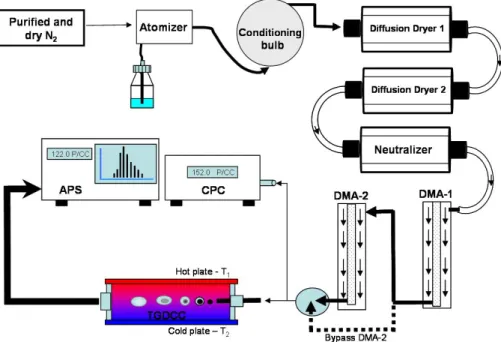
Figure 1. A schematic presentation of the experimental setup. The dashed line presents the bypass of DMA-2; this pathway is used at low particle concentrations. Between DMA-1 and DMA-2, a diluter apparatus (not shown) was used to control particle number concentration and flow rates. 15 40 60 80 100 120 0 20 40 60 80 100 No rmal iz ed CCN (%) Dry Diameter (nm) SS (%) D50 0.2 - 79.8 ± 6.9 0.40 - 53.9 ± 2.3 0.52 - 46.4 ± 1.1 0.8 - 34.5 ± 1.5 1.03 - 31.3 ± 0.4
Figure 2. Activation curves of ammonium sulfate particles. The activation diameter (D50) is
indicated in the legend for all SS measured. The error bars represent the standard deviation for each point of 6-14 experiments, conducted on different days.
23
Fig. 1. A schematic presentation of the experimental setup. The dashed line represents the bypass of DMA-2; this pathway is used at low particle concentrations. Between DMA-1 and DMA-2, a diluter apparatus (not shown) was used to control particle number concentration and flow rates.
nation-wide wood burning event, with average PM10 mass concentration near the sampling location of 300–400 µg m−3 of smoke, 2) slightly aged wood burning smoke particles (called hereafter LBO-day) were sampled during the morn-ing and early afternoon hours immediately followmorn-ing the nighttime fires (27 May 2005), with PM10 mass concentra-tions of 60–180 (µg m−3). The LBO-day sample is domi-nated by smoke particles (as can be concluded from the high aerosol mass concentrations and the dark color of the col-lected particles), but could have undergone moderate pro-cessing via photochemical reactions. 3) The third sample (called 3WSFA) was collected during daytime hours over a three week period (26 July to 16 August 2005), with average PM10 mass concentration of about 25 µg m−3. The sample contains the prevailing local photochemical pollution aerosol particles, and is assumed to represent aged particles. The atmospheric conditions during the 3 week period were rela-tively constant. All mass concentrations were determined by the Israel Ministry of Environment.
HULIS of the fulvic acid type (FA-HULIS) were extracted from the filters and separated from other aerosol compo-nents by an isolation procedure developed on the basis of the scheme used by the International Humic Substances So-ciety (IHSS) for separating aquatic humic acid and FA (http: //www.ihss.gatech.edu), and adapted by us for air-borne par-ticulate matter collected on quartz fiber filters. Briefly, fil-ters are subjected to consecutive water and water-base ex-tractions; FA-HULIS, by definition soluble at any pH, were separated from other water soluble and base-soluble aerosol
organic and inorganic species by preferential absorption onto an intensively pre-cleaned XAD-8 resin (Supelco Inc.), fol-lowed by elution in a basic solution. The eluant was cation-exchanged on an H+-saturated cation-exchange resin (AG MP-50, Bio-Rad Laboratories) to produce protonated acids, and then freeze-dried. The freeze-dried samples are stored at room temperature in darkness under vacuum. 18 M Ohm Mill-Q water was used for all solutions throughout the study.
2.2 Molecular weight fractionation of Suwannee River Ful-vic Acid
Suwannee River Fulvic Acid (SRFA, IHSS code 1R101F) of reference grade was obtained from the International Hu-mics Substances Society (IHSS) and used as a model for at-mospheric HULIS. SRFA was chosen because several previ-ous laboratory studies referred to it as representative of at-mospheric HULIS (Fuzzi et al., 2001; Haiber et al., 2001; Mircea et al., 2002; Nenes et al., 2002; Chan and Chan, 2003; Abdul-Razzak and Ghan, 2004; Brooks et al., 2004; Rissman et al., 2004; Kiss et al., 2005; Samburova et al., 2005; Svenningsson et al., 2006). The SRFA was de-ashed and cleaned from low molecular weight organic acids and in-organic species by the procedure described above. This was verified by ion chromatography analysis of the samples.
Molecular weight fractionation of SRFA was performed using a diafiltration protocol, providing a coarse subdivi-sion of initially polydisperse material according to an effec-tive size of molecules in solution. The nominal pore sizes of the ultrafiltration membranes do not correspond to the
2468 E. Dinar et al.: CCN properties of HULIS
actual molecular mass of the fractionated fulvic material, due mainly to molecular conformation and molecule-membrane charge interactions (Schafer et al., 2002), and further analy-sis is needed for molecular mass determination. The filtration protocol yielded five size fractions of water-soluble material with nominal molecular weight ranges of 0.2–0.5 kDa, 0.5– 1.0 kDa, 1–3 kDa, 3–10 kDa, and 10–30 kDa, denoted F1, F2, F3, F4, and F5, respectively. We estimated the mean molecular weight (MW) of each fraction utilizing correla-tions available in the literature (see Sect. 2.6). A detailed description of the equipment and procedures used is given in Appendix A.
2.3 Atomized solutions
All compounds under investigation were prepared as aque-ous solutions: 20–50 mg/L for ammonium sulfate (AS) and SRFA samples (bulk and fractions), and 10–20 mg/L for at-mospheric HULIS samples. The solutions were atomized using a TSI constant output atomizer (TSI-3076) operating at 20 PSI (∼2 Standard Liters per Minute (SLM)) with dry particle-free pure nitrogen, generating a polydisperse distri-bution of droplets (mean diameter ∼0.3 µm).
2.4 Activation experiments
A schematic illustration of the experimental setup is shown in Fig. 1. The atomizer flow (0.6 SLM) entered a 10 L condi-tioning bulb (the rest of the flow was pumped out) resulting in a conditioning time of ∼16 min before entering 3 silica gel column dryers (RH<3%). The dry polydisperse aerosol passed through a neutralizer (TSI 3012A) to obtain equi-librium charge distribution on the particles. The polydis-perse charged dry particle flow entered a home-built Differ-ential Mobility Analyzer (DMA-1) operating with 6 SLM dry (RH<3%) clean sheath flow and fixed at an applied voltage resulting in an output of 0.6 SLM of size selected monodis-perse aerosol flow. A second DMA (DMA-2, TSI-3080) was operated either as scanning mobility particle sizer (SMPS, coupled with a condensation particle counter (CPC, TSI-3022)) to verify the size distributions, or as an additional size selection step.
The size-selected monodisperse aerosol flow was then di-rected through a dilution apparatus for precise control of par-ticle number concentration and flow rate. Following dilution, the monodisperse flow was further separated; 0.3 SLM was directed to the CPC for determination of condensation nu-clei (CN) number concentration, while the remainder (0.03– 0.2 SLM) entered a home-built Thermal Gradient Diffusion Cloud Chamber (TGDCC) (Kumar et al., 2003).
The TGDCC’s top and bottom plates are held at 100%
RH by wet 3mm thick Whatman filter papers. By
adjust-ing a temperature gradient between the plates (the average temperature, at the center of TGDCC, was always 26.2◦C), effective humidity conditions exceeding 100% RH were
se-lected (Raymond and Pandis, 2002). The SS at the center of the chamber, where the selected particles (D<350 nm) are injected, can be varied between 0.05 to 2%. The aerosol flow was confined to the center of the TGDCC using a humidi-fied nitrogen flow of 0.8–0.97 SLM (RH −100%), bringing the entire flow (aerosol + sheath) to 1 SLM. The TGDCC is almost identical to that described by Kumar et al. (2003), the only difference being in the number and position of the in-jector holes. The original design had ten holes of 0.16 cm in diameter equally spread along the injector tube. We de-duced that an injector with 16 holes of the same diameter, concentrated around the center of the tube, results in lower loss of activated particles due to the direct trajectory to the exit. This setup resulted in lower water vapor depletion (the RH of the entering aerosol flow is <3%) for the same injec-tor distance, and thus higher SS stability. At the exit of the TGDCC, the total flow was directed to an Aerodynamic Par-ticle Sizer (APS, TSI-3321) which counted and sized parti-cles above 0.3 µm, thus counting only partiparti-cles that activated to droplets. To reduce droplet loss and evaporation, the APS was placed very close to the chamber’s exit, and the RH in the APS was monitored.
The CN activation efficiency is the ratio between the CN number concentration entering the TGDCC (determined by the CPC) to the droplet number concentration measured by the APS. By changing the particles’ dry size, a plot of the percent of activated particles versus dry diameter is pro-duced. It was previously shown that a sigmoidal fit ade-quately simulates these experiments and that the critical ac-tivation diameter (Dc)for a symmetric distribution of parti-cles, is the diameter where half of the particles activate, or D50 (Cruz and Pandis, 1997). In all our experiments, the
number density of particles in the TGDCC was between 10 and 100 particles cm−3. Activation experiments for all SRFA
samples (5 fractions and bulk) and airborne HULIS were car-ried out at three different SS condition: 0.2, 0.52 and 1.03%. For each SS and sample, the injector position was adjusted to give 100% activation at large diameters, with the narrow-est droplet size distribution. In general, the injector was set further back with decreasing SS setting, to allow a longer res-idence time (up to 31 s) in which particles could be activated. The room temperature was always 3–5◦C below the average TGDCC temperature.
2.5 Surface tension measurements
Surface tension was measured using a Rame-Hart pendant drop tensiometer. Surface tension is derived from image analysis of the drop shape. The time scale of the experi-ments ranged from a few seconds to a few hours. The advan-tages of the pendant drop method are that there is minimal contact of the solution with any surface, and that very little material is required (1 ml of solution). To increase repro-ducibility and reliability, the instrument was isolated from vibrations and the droplet was held in a temperature and
humidity controlled compartment. Surface tension measure-ments were taken automatically over a preset period of time at a chosen frequency. Mill-Q water was used as a reference sample for all measurements. Three droplets were measured for each concentration.
2.6 UV/VIS spectroscopy for molecular weight and aro-maticity estimation
Correlations between absorbance and molecular weight of fulvic acids and aromaticity available in the literature were used for estimating the molecular weight and aromaticity of the SRFA size fractions and HULIS extracted from the col-lected samples (Chin et al., 1994; Peuravuori and Pihlaja, 1997; Schafer et al., 2002). Sample absorbance was mea-sured with a single-beam UV-VIS Spectrometer (Ultrospec 2100 Pro, Biochrom Ltd.). Sample concentrations ranged from 0.010 to 0.014 gC/L, determined on the basis of ele-mental analysis. Eleele-mental analysis of dry and ash-free sam-ples was performed with a Carbo Erba EA-1108 Elemental Analyzer.
Absorbance values at 280 nm and 254 nm were used for calculating the molar absorptivities (ε). The wavelength of 280 nm was chosen by Peuravuori and Pihlaja (1997) and by Chin et al. (1994) because the π −π ∗ electron transi-tion for most aromatic hydrocarbons, thought to be structural sub-units in humic substances, occurs in the region of 270– 280 nm (Traina et al., 1990). However, 280 nm is not the peak wavelength, as the UV/VIS spectra of humic matter are broad. As a result, Schafer et al. (2002) worked at 254 nm.
Molar absorptivities at 254 and 280 nm for SRFA and air-borne FA fractions ranged from 156 to 507 Lmol−1cm−1 of organic carbon and appeared to fall within the range re-ported by others for isolated humic fractions (Chin et al., 1994; Peuravuori and Pihlaja, 1997; Schafer et al., 2002). Additional details on the derivation of the correlations and the definitions of number-averaged molecular weight (MN) and weight-averaged molecular weight (MW) are given in Appendix B.
2.7 Determination of acidity content of SRFA
The amount of carboxylic groups in the bulk SRFA and in the fractionated samples was determined by potentiometric titrations of aqueous solutions with KOH using a Metler Toledo Automatic Titration instrument. Sample solutions in 0.05 M KCL (used to maintain a constant ionic strength) were stored under nitrogen. During titration to pH 10.0 in a nitrogen atmosphere, solutions were continuously de-aerated to eliminate dissolution of carbon dioxide and oxygen. The equivalence point of the carboxylic groups was set at pH 8.0 (Swift, 1996).
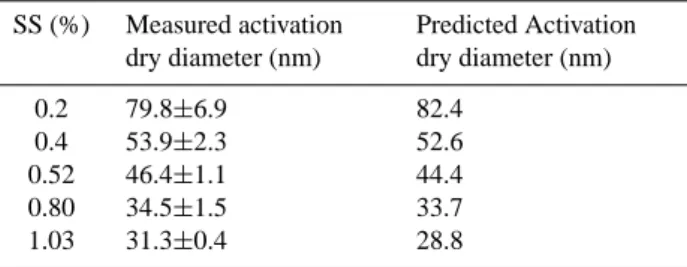
Table 1. Comparison of ammonium sulfate activation diameters (mean ± standard deviation of 6–14 experiments, conducted on dif-ferent days) under difdif-ferent SS conditions with predictions using the classical K¨ohler equation. The Van’t Hoff factor was calcu-lated using a concentration-dependent parameterization by Young and Warren (1992). SS (%) Measured activation dry diameter (nm) Predicted Activation dry diameter (nm) 0.2 79.8±6.9 82.4 0.4 53.9±2.3 52.6 0.52 46.4±1.1 44.4 0.80 34.5±1.5 33.7 1.03 31.3±0.4 28.8 3 Results 3.1 System validation
Ammonium sulfate (AS) was used for validating the sys-tem’s performance since its CCN activation at different SS conditions is well known (Tang et al., 1995; Cruz and Pan-dis, 1997; Corrigan and Novakov, 1999; Brechtel and Krei-denweis, 2000; Raymond and Pandis, 2002; Kumar et al., 2003; Kreidenweis et al., 2005). The system was validated using AS at five different SS conditions: 0.2, 0.4, 0.52, 0.8 and 1.03%. The obtained activation curves are presented in Fig. 2. A summary and comparison between our experimen-tal results for activation diameters (D50)of AS to calculated
activation diameters using the K¨ohler equation are given in Table 1. It is concluded that our measured D50for all tested
SS conditions are in good agreement with predicted and mea-sured diameters.
While some studies with TGDCC employed large normal-ization factors (∼1.4) to correct for 100% activation (Cruz and Pandis, 1997; Corrigan and Novakov, 1999; Brechtel and Kreidenweis, 2000; Kumar et al., 2003), our system does not require such high normalization factors. The normalization factor applied in all of our experiments did not exceed 1.06 in the lower limit and 0.98 in the upper limit. This correc-tion results from loss of large droplets in the TGDCC (in the lower limit) and deviation error between the CPC and the APS (mostly in the upper limit).
While the system is reliable and steady, there is a devia-tion from the sigmoidal fit at 10–30% activadevia-tion in the low SS experiments (see Fig. 2 experimental curves of 0.2 and 0.4% SS). We attribute the activation bias at low SS and at small particle sizes to the non-ideal monodisperse size distribution produced by the DMA, as also invoked by Ku-mar et al. (2003). This conclusion is further supported by the observation of a slight broadening of the distribution to-wards larger particle sizes in the monodisperse size spectra, which leads to faster activation of the “leaked” large particles
2470 E. Dinar et al.: CCN properties of HULIS
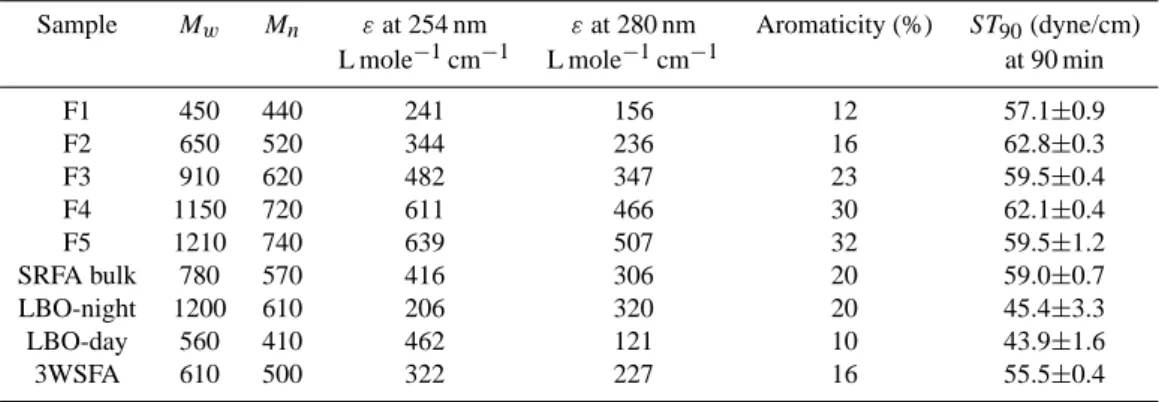
Table 2. Molecular weight and aromaticity estimates for the different samples. MWand MNwere estimated based on correlations given by
Schafer et al. (2002). Aromaticity estimates are based upon correlation results of Peuravuori and Pihlaja (1997). The absorbativity at 254 and 280 nm as well as the surface tension of 1 gr/L solutions at 90 min are also given (mean ± standard deviation).
Sample Mw Mn εat 254 nm εat 280 nm Aromaticity (%) ST90(dyne/cm)
L mole−1cm−1 L mole−1cm−1 at 90 min
F1 450 440 241 156 12 57.1±0.9 F2 650 520 344 236 16 62.8±0.3 F3 910 620 482 347 23 59.5±0.4 F4 1150 720 611 466 30 62.1±0.4 F5 1210 740 639 507 32 59.5±1.2 SRFA bulk 780 570 416 306 20 59.0±0.7 LBO-night 1200 610 206 320 20 45.4±3.3 LBO-day 560 410 462 121 10 43.9±1.6 3WSFA 610 500 322 227 16 55.5±0.4
Table 3. Elemental composition of the SRFA fractions. Due to the small quantities, the elemental composition of extracted FA-HULIS could not be measured. Sample N C H S O O/C H/C % % % % % mole/mole mole/mole F1 0.54 54.78 5.24 n/a 39.44 0.54 1.15 F2 0.63 50.86 4.71 0.44 43.37 0.64 1.11 F3 0.67 50.63 4.33 0.31 44.07 0.65 1.03 F4 0.77 52.17 4.56 0.31 42.20 0.61 1.05 F5 0.73 49.71 4.01 0.40 45.16 0.68 0.97 SRFA bulk 0.68 53.36 4.88 0.26 40.82 0.57 1.10
Figure 1. A schematic presentation of the experimental setup. The dashed line presents the bypass of DMA-2; this pathway is used at low particle concentrations. Between DMA-1 and DMA-2, a diluter apparatus (not shown) was used to control particle number concentration and flow rates. 15 40 60 80 100 120 0 20 40 60 80 100 No rmal iz ed CCN (%) Dry Diameter (nm) SS (%) D50 0.2 - 79.8 ± 6.9 0.40 - 53.9 ± 2.3 0.52 - 46.4 ± 1.1 0.8 - 34.5 ± 1.5 1.03 - 31.3 ± 0.4
Figure 2. Activation curves of ammonium sulfate particles. The activation diameter (D50) is indicated in the legend for all SS measured. The error bars represent the standard deviation for each point of 6-14 experiments, conducted on different days.
23
Fig. 2. Activation curves of ammonium sulfate particles. The acti-vation diameter (D50)is indicated in the legend for all SS measured.
The error bars represent the standard deviation for each point of 6– 14 experiments, conducted on different days.
compared to the majority of the size-selected particles. It is expected that this effect will be more severe at low SS condi-tions, where activation is lower. This effect was diminished when two size selection steps were used. A tandem size-selection setup was used when a sufficient number of parti-cles remained after the first size selection.
3.2 Molecular weight, aromaticity and elemental composi-tion
The SRFA samples and aerosol-derived FA average molec-ular weight and aromaticity (as percent of total weight car-bon) were estimated using the correlations available in the literature for UV/VIS spectroscopy for aquatic and terres-trial fulvic and humic acids. It should be kept in mind that such correlations have not been used previously for at-mospheric HULIS. The results of UV/VIS absorption spec-troscopy of the size fractionated samples are given in Table 2. The resulting average MN of the SRFA fractions, estimated by the correlation provided by Schafer et al. (2002) ranged from 450 AMU to 740 AMU, with the bulk SRFA giving 570 AMU. The average MN of the FA-HULIS aerosol ex-tracts are 610, 410 and 500 AMU for the night,
LBO-day and 3WSFA samples, respectively. The number and av-erage molecular size estimates based on UV spectroscopy of the extracted HULIS are larger than previous estimates of the molecular sizes of atmospheric HULIS (Kiss et al., 2003).
A correlation between the nominal molecular weight cut-offs of the membranes used for SRFA fractionation with the estimated MNand MW was observed. Likewise, aromaticity was seen to increase with increasing molecular weight, and with it, the brown color of the sample. The bulk SRFA had a color similar to that of F4.
The results of the elemental analysis are shown in Table 3. In general, the oxygen to carbon molar ratio is above 0.5, with increasing O/C ratio as molecular weight increases. The obtained elemental content is consistent with values provided for bulk SRFA (www.ihss.gatech.edu). The H/C ratio de-creases with molecular weight, which is consistent with the higher aromaticity estimated from the UV absorbance. Due to the small amounts of extracted HULIS, we were not able to conduct this analysis for the aerosol extracts.
3.3 Surface tension
Surface tension of 1 g/L aqueous solutions of the size frac-tionated SRFA samples and the HULIS extracts after 90 min (ST90)are reported in Table 2. We treat 90 min values as
equilibrium surface tension, although our time dependent measurements (not published) suggest that even at this long time, some solutions do not reach equilibrium with respect to surface tension . The most surface active of the SRFA frac-tions is F1 (lowest average MN of 440 AMU), with a ST90
of 57 dyne/cm. ST90of the other fractions varies from a high
of 63 for F2 (average MN of 520 AMU), to 60 for both F3 and F5 (average MN of 620 and 740 AMU, respectively). There was no clear relationship between ST90and MN. The HULIS samples were substantially more surface active at the same 1 g/L concentration than even the smallest of the SRFA fractions, with ST90values for HULIS extracted from fresh
and aged smoke particles of 45 and 44 dyne/cm (LBO-night and LBO-day, respectively), and 56 dyne/cm for the 3 week photochemical pollution samples (3WSFA). Greater surface activity for HULIS as compared with aquatic fulvic acids has been previously reported by Kiss et al. (2005) and Facchini et al. (2000).
3.4 SRFA acidity
The results of the titrations of SRFA are given in Table 4. It is concluded that the acidity content per carbon gener-ally decreases with increase of molecular weight with the exception of the lowest average MN fraction (F1). From the titration curves we conclude that SRFA is a weak acid, and at atmospherically relevant concentrations (Facchini et al., 2000), dissociation in aqueous solution will be low. The average number of carboxylic groups per molecule in each fraction can be estimated to range between ∼2 for F1 to ∼3
Table 4. Acidity content of SRFA samples. Sample Titration until pH=8
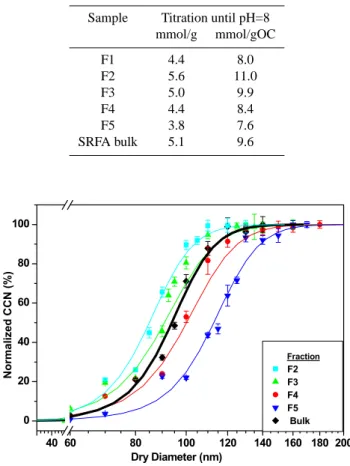
mmol/g mmol/gOC F1 4.4 8.0 F2 5.6 11.0 F3 5.0 9.9 F4 4.4 8.4 F5 3.8 7.6 SRFA bulk 5.1 9.6 40 60 80 100 120 140 160 180 200 0 20 40 60 80 100 N o rma liz ed CC N (%) Dry Diameter (nm) Fraction F2 F3 F4 F5 Bulk
Figure 3. An example for activation curves for SRFA fractions at SS=0.52% (F1 is not shown). The bulk sample (black line) lies between the F3 and the F4 activation. This behavior is repeatable in all SS measured for these samples. A clear correlation between the mass and activation diameter exists. The error bars represent the standard deviation for each point of 6-14 experiments, conducted on different days.
10 10 25 50 75 100 250 0 20 40 60 80 100 Normal ize d CC N (%) Dry Diameter (nm) Sample SS(%) LBO-Night 1.03 LBO-Day 1.03 3WSFA 1.03 LBO-Night 0.2 LBO-Day 0.2 3WSFA 0.2
Figure 4. Activation experiments with extracted FA HULIS under SS conditions of 0.2 and 1.03%. Experiments were carried out by atomizing solution of FA extracted from collected wood burning smoke particles. Refer to the text for explanation of the samples. Activation experiments under SS of 0.52% exhibit same behavior (see Table 5).
24
Fig. 3. An example for activation curves for all SRFA fractions at SS=0.52%. The bulk sample (black line) lies between the 1–3 kDa to the 3–10 kDa. This behavior is repeatable in all SS measured for these samples. A clear correlation between the mass and activation diameter exists. The error bars represent the standard deviation for each point of 6–14 experiments, conducted on different days.
for F5, and ∼2.7 carboxylic groups per molecule for the bulk SRFA. These values are in the range obtained also by Ritchie and Perdue (2003) for SRFA and Tagliavini et al. (2006) for HULIS extracted from smoke particles in Brazil. Due to scarce amount of extracted and purified material, we were not able to repeat the acidity measurements and elemental analysis measurements for the aerosol extracts.
3.5 CCN activity of size-fractionated SRFA
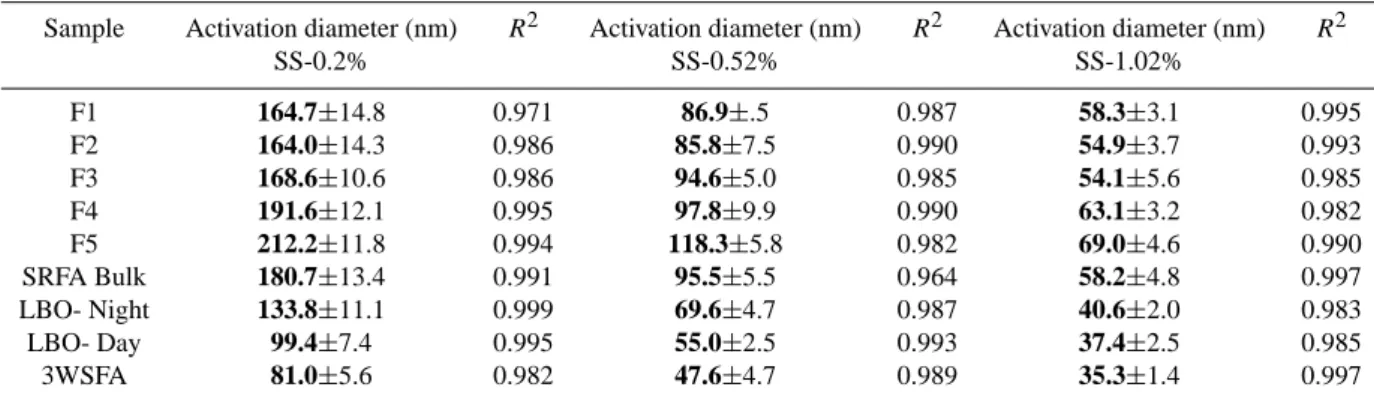
Table 5 shows the activation diameters of the SRFA frac-tions at three different super saturation condifrac-tions. Fig-ure 3 presents the results of activation experiments carried out on SRFA fractions and bulk at a SS of 0.52%. Acti-vation curves are qualitatively similar to those of AS, and can be fit with a sigmoidal growth curve. It can be seen that the lower molecular weight fractions activate more effi-ciently than higher molecular weight fractions (i.e.; F1 com-pared with F5), and that the activation diameter increases as
2472 E. Dinar et al.: CCN properties of HULIS
Table 5. Summary of all measured activation diameters for fractionated, bulk SRFA samples and HULIS samples. The error bars represent the standard deviation for an average of 3–5 experiments.
Sample Activation diameter (nm) R2 Activation diameter (nm) R2 Activation diameter (nm) R2
SS-0.2% SS-0.52% SS-1.02% F1 164.7±14.8 0.971 86.9±.5 0.987 58.3±3.1 0.995 F2 164.0±14.3 0.986 85.8±7.5 0.990 54.9±3.7 0.993 F3 168.6±10.6 0.986 94.6±5.0 0.985 54.1±5.6 0.985 F4 191.6±12.1 0.995 97.8±9.9 0.990 63.1±3.2 0.982 F5 212.2±11.8 0.994 118.3±5.8 0.982 69.0±4.6 0.990 SRFA Bulk 180.7±13.4 0.991 95.5±5.5 0.964 58.2±4.8 0.997 LBO- Night 133.8±11.1 0.999 69.6±4.7 0.987 40.6±2.0 0.983 LBO- Day 99.4±7.4 0.995 55.0±2.5 0.993 37.4±2.5 0.985 3WSFA 81.0±5.6 0.982 47.6±4.7 0.989 35.3±1.4 0.997 40 60 80 100 120 140 160 180 200 0 20 40 60 80 100 N o rma liz ed CC N (%) Dry Diameter (nm) Fraction F2 F3 F4 F5 Bulk
Figure 3. An example for activation curves for SRFA fractions at SS=0.52% (F1 is not shown). The bulk sample (black line) lies between the F3 and the F4 activation. This behavior is repeatable in all SS measured for these samples. A clear correlation between the mass and activation diameter exists. The error bars represent the standard deviation for each point of 6-14 experiments, conducted on different days.
10 10 25 50 75 100 250 0 20 40 60 80 100 Normal ize d CC N (%) Dry Diameter (nm) Sample SS(%) LBO-Night 1.03 LBO-Day 1.03 3WSFA 1.03 LBO-Night 0.2 LBO-Day 0.2 3WSFA 0.2
Figure 4. Activation experiments with extracted FA HULIS under SS conditions of 0.2 and 1.03%. Experiments were carried out by atomizing solution of FA extracted from collected wood burning smoke particles. Refer to the text for explanation of the samples. Activation experiments under SS of 0.52% exhibit same behavior (see Table 5).
24
Fig. 4. Activation experiments with extracted FA HULIS under SS conditions of 0.2 and 1.03%. Experiments were carried out by at-omizing solution of FA extracted from collected smoke particles. Refer to the text for explanation of the samples. Activation experi-ments under SS of 0.52% exhibit same behavior (see Table 5).
MN increases. Activation of bulk SRFA is interim between F3 and F4, consistent with results for estimated molecular weight, and the knowledge that SRFA is dominated by rela-tively small molecular weight species (Piccolo, 2001; Simp-son et al., 2001; Sutton et al., 2005). The same behavior is seen at all supersaturations (see Table 5). Fractions 1 and 2 (MN of 440 and 520 AMU) exhibit almost identical growth and critical activation diameters under the same conditions. Considering that aromaticity is inversely related to molecular weight, it can be stated that as aromaticity increases, activa-tion decreases. The aromaticity trend is also consistent with the sample visible color (discussed above). The emergent general pattern relating activation efficiency to chemical
na-ture is that the browner the fraction, the higher the molecular weight and aromaticity, and the poorer the activation.
3.6 Activation of aerosol-extracted FA-HULIS
Activation experiments were carried out for the three aerosol extracts under the same SS conditions as for SRFA samples (0.2, 0.52 and 1.03%). Due to the small dry mass of samples obtained for each of these samples (<6 mg), no size frac-tionation was possible for these samples. It was verified by ion chromatography (Falkovich et al., 2004; Falkovich et al., 2005) that the samples did not contain low molecular weight organic acids. Activation diameters, obtained from a sig-moidal fit to the activation curves, are tabulated in Table 5. Figure 4 shows the activation curves of the three samples at SS of 0.2% and 1.03%. It can be seen that the daytime smoke sample (LBO-day) is more CCN-active than the extracts of the fresh nighttime smoke particles (LBO-night). This may suggest possible photochemical processing during day time, mainly by OH-radicals, ozone and possibly UV which leads to enhanced degradation of FA and a decrease of its aver-age molecular weight (Table 2). It is also conceivable that this sample contains some of the prevailing pollution parti-cles. However, given the daily PM loadings at the site, and the dark color of the collected particles, it is unlikely that there was a major contribution of pollution particles to the collected smoke particles. This behavior is also supported by the MN estimated for these samples: 610 AMU for the fresh smoke sample, and 410 AMU for the slightly aged sam-ple, and by the lower aromaticity of the daytime sample. The observed lower aromaticity may imply some process-ing by ozone and OH radicals. The day-time pollution par-ticles sample (3WSFA) was significantly more CCN-active than the extracts from both of the smoke samples. However, the estimated molecular weight (500 AMU) and aromaticity (15%) are higher than the day smoke sample. This may sug-gest that the HULIS formed in the photochemical pollution particles are different than those in the smoke particles and
direct comparison between them is not straightforward. It may also be that the correlations used to estimate the molecu-lar weight and the aromaticity, based as they are on terrestrial and aquatic FA, are not appropriate for HULIS. Activation experiments for these HULIS samples at SS of 0.52% were also performed, resulting with the same pattern (see Table 5).
4 Discussion
4.1 Activation of model compounds in comparison to au-thentic HULIS
We have attempted to learn how the activation of aerosol-derived HULIS and model aquatic FA depends on their molecular weight, chemical properties and surface activity. There is a clear positive correlation between activation diam-eter of SRFA fractions and number average molecular weight (MN)of the fraction. Because fulvic acids do not dissoci-ate significantly in dilute aqueous solution at the estimdissoci-ated droplet concentrations (1–2 mmol/L; Kiss et al., 2005), this activation trend can be explained by the simple fact that the lower the molecular weight, the greater the number of solute species in the droplet.
The three aerosol-extracted FA-HULIS samples activate at a lower diameter than any of the size-fractionated or bulk SRFA. At 1.03% SS, there is a 20 nm difference in the acti-vation diameter between the most active SRFA and the most CCN-active extract (Table 5). At SS more relevant to ambi-ent SS, there is an even larger difference in activation proper-ties between the aerosol HULIS samples and the most CCN-active fraction (F1). For example, at SS=0.2%, SRFA frac-tions 1–3 (MN=440, 520 and 600 AMU) activate at between 170 and 160 nm, while aerosol HULIS extracts (MN=410, 500, and 610 AMU) activate at 80, 100, and 135 nm, respec-tively. The difference in the activation efficiencies of the ex-tracts may be attributed to lower molecular weight estimated by the UV correlations.
4.2 Modeling of activation based on the K¨ohler theory
The aim of the modeling efforts was to test if CCN activity of HULIS could be predicted from by the K¨ohler equation using measured physical-chemical properties and whether surface tension reduction affects activation. The following form of the K¨ohler equation was applied (Seinfeld and Pandis, 1998; Kreidenweis et al., 2005): ln(Swat) = DAp−DB3 p , A = 4MWwσsol RT ρw , B = 6insMWw πρw . (1)
Here Swatis the saturation ratio of water over a droplet having
a diameter Dp, MWwis the molecular weight of water, σsol
is the droplet surface tension, R is the universal gas constant,
T is the temperature, ρw is the water density, i is the van’t Hoff factor which accounts for a non-ideal behavior of the solution (Pruppacher and Klett, 1980), and ns is the number of solute molecules in the droplet. The last quantity can be written as ns=ms/MWs, where ms and MWs are the solute dry mass and its molecular weight, respectively. It should be noted that various individual compounds dissolved in the droplets are treated here as a single solute, and that parti-tion of the compounds to the surface is not treated explic-itly. It is also implicitly assumed here that the compounds are infinitely soluble, based on previous experiments which showed that fulvic acid is highly water soluble. Hence, in the current experiments, we believe that the SRFA particles acti-vate to droplets with no solid core. So far, probably due to the difficulty in sampling and extracting sufficient experimental material, water solubility of HULIS has not been tested to our knowledge.
Given that the values of the required parameters are known, Eq. (1) can be differentiated to obtain the number of solute molecules needed for droplet activation at a certain water saturation ratio S (Seinfeld and Pandis, 1998). Sub-stituting the saturation ratios applied in the CCN measure-ments for S and converting the resulting numbers of moles to particle size, we obtain the so-called dry activation diam-eters which can be compared with the measured activation diameters D50(given in Table 5). The choice of the required
parameters is discussed in the following.
The titration results show that the investigated FAs are weak acids, hence are not expected to dissociate significantly in aqueous solution at atmospherically-relevant concentra-tions. We neglect also other deviations from a non-ideal be-havior. Accordingly, the value of i in Eq. (1) is set equal to unity, or was varied to check the sensitivity of activation to possible dissociation. To investigate whether FAs are suffi-ciently surface-active to influence CCN activation, calcula-tions were performed using two different values for the solu-tion phase surface tension: that of water and that measured at the concentration of 1 g/L after 90 min of equilibration. This concentration is within the range of HULIS concentrations calculated for a droplet after activation (Kiss et al., 2005). Particle dry density ρdryis set equal to 1.5 g cm−3(De Wit et
al., 1993). The choice of the remaining parameter, MWs, is discussed in the next paragraph.
Individual compounds comprising a FA sample can be de-scribed with a continuous distribution and thus the total num-ber of molecules in a sample, ntot, and its mass, mtot, are
obtained by integrating over the size distribution:
ntot= MW+ Z MW− n(MW ) dMW , mtot= MW+ Z MW− n(MW )MW dMW , (2)
2474 E. Dinar et al.: CCN properties of HULIS 0.0 0.2 0.4 0.6 0.8 1.0 1.2 D ry ac tiva tion di am et er (μ m ) 0.03 0.07 0.11 0.15 0.19 0.23 0.27 0.31 0.0 0.2 0.4 0.6 0.8 1.0 1.2 D ry ac tiva tion di am e ter (μ m ) 0.03 0.07 0.11 0.15 0.19 0.23 0.27 0.31 Measurements Peuravuori and Pihlaja Chin et al.
Schafer et al.
Supersaturation (%)
Measurements Peuravuori and Pihlaja Chin et al. Schafer et al. Water ST Water ST 0.0 0.2 0.4 0.6 0.8 1.0 1.2 D ry ac tivation diam eter (μ m) 0.03 0.07 0.11 0.15 0.19 0.23 0.27 0.31 Measurements Peuravuori and Pihlaja Chin et al. Schafer et al. Measured ST i =1.25 A B C
Figure 5. The measured (solid symbols) and calculated (hollow symbols) dry diameters needed
for particle activation for the bulk SRFA samples. The correlation used in estimating Mn is displayed in the legend. The particle surface tension is assumed to be either that of water (A and B) or taken from the measurements (C). The Van’t Hoff factor is set equal to unity (A and C) or to 1.25 (B).
1 Fig. 5. The measured (solid symbols) and calculated (hollow sym-bols) dry diameters needed for particle activation for the bulk SRFA sample. The correlation used in estimating Mnis displayed in the
legend. The particle surface tension is assumed to be either that of water (a and b) or taken from the measurements (c). The Van’t Hoff factor is set equal to unity (a and c) or to 1.25 (b).
where n(MW) is the distribution function and (MW−, MW+) is the molecule size range in the sample. In the K¨ohler equation given by Eq. (1), all individual species in the sample are described by a single compound. Therefore
400 500 600 700 800 Dr y act ivat ion di ameter (μ m) 0.04 0.08 0.12 0.16 0.20 0.24 400 500 600 700 800 0.04 0.08 0.12 0.16 0.20 0.24 MN (g/mol) Measured ST Water ST 1.03% 0.52% 0.2% 1.03% 0.52% 0.2% B (a) 400 500 600 700 800 Dr y act ivat ion di ameter (μ m) 0.04 0.08 0.12 0.16 0.20 0.24 Water ST 1.03% 0.52% 0.2% (b) Dry acti vati on di amet er (μ m) (c) Measured ST i=1.25
Figure 6. The measured (solid symbols) and calculated (hollow symbols) dry diameters needed
for particle activation for the size-fractionated SRFA samples. Circles, squares and triangles indicate the activation diameters at supersaturations 0.2, 0.52 and 1.03%, respectively. The correlation of Schafer et al. is used in estimating Mn. The particle surface tension is assumed to be either that of water (A and B) or taken from the measurements (C). The Van’t Hoff factor is set equal to unity (A and C) or to 1.25 (B).
26
Fig. 6. The measured (solid symbols) and calculated (hollow sym-bols) dry diameters needed for particle activation for the size-fractionated SRFA samples. Circles, squares and triangles indicate the activation diameters at supersaturations 0.2, 0.52 and 1.03%, respectively. The correlation of Schafer et al. (2002) is used in esti-mating Mn. The particle surface tension is assumed to be either that
of water (a and b) or taken from the measurements (c). The Van’t Hoff factor is set equal to unity (a and c) or to 1.25 (b).
MWs is an “effective” mole weight which relates the num-ber of molecules present in the sample with the sample total mass, i.e. ntot=mtot/MWs. Combining this equation with
Eq. (2) yields: MWs = MW+ R MW− n(MW )MW dMW MW+ R MW− n(MW ) dMW (3)
Using the correlations (Chin et al., 1994; Peuravuori and Pih-laja, 1997; Schafer et al., 2002), it is possible to estimate the molecular weight, as described above. This is done by relating the UV peak absorbance, h, to the mass. Assum-ing that the proportionality constant does not depend signif-icantly on the molecular size, we obtain the following equa-tion for MWs: MWs ≈ MW+ R MW− h(MW ) dMW MW+ R MW− (h(MW )/MW ) dMW =MWn, (4)
where h(MW) is the absorbance of species having a mo-lar weight MW and MN is the number-averaged molecular weight. Equation (4) shows that MN serves as a proxy for MWs in Eq. (1) when droplets contain a number of individ-ual weakly or non-dissociating compounds.
4.2.1 Model calculations versus measurements
The dry activation diameters (Dcalc)were calculated using
the above-described approach and compared with the exper-imentally determined activation diameters D50. Results are
shown separately for the bulk- and size-fractionated samples in Figs. 5–6, respectively. Several correlations between ab-sorbance and MN were employed in this study to estimate the number-averaged molecular weights for both the bulk and size-fractionated samples (see Sect. 3.2). In order to find the one most consistent with CCN measurements, the K¨ohler calculations were initially repeated using the molec-ular weight estimates from each of the correlations. Figure 5a shows the calculated activation diameter for the bulk sample using the three different UV absorbance-molecular weight correlations and assuming no dissociation of the acids (i.e. the van’t Hoff factor (i) is unity), and a surface tension of water. It can be seen that the calculations over-predict the ac-tivation diameter by 10–100%, and that the correlation that most closely reproduces the observed activation diameters for the bulk sample is that of Schafer et al. (2002), with that of Chin et al. (1994) being about 20%–30% less accurate. The correlation of Peuravuori and Pihalja (1997) yields sig-nificantly larger dry activation diameters, i.e. the molecular weight estimates for the bulk samples and the size-fractions are too high to be commensurable with the CCN measure-ments. The discrepancies increase with the increasing molec-ular weight and supersaturation. This behavior is repeated in all calculations, hence we conclude that the molecular weight
estimates from the correlation of Schafer et al. (2002) are most suitable for our samples.
In Fig. 5b, the calculations are repeated, using the same correlations for molecular weight estimates, and again set-ting the surface tension to that of water. In these calcula-tions, however, it is also assumed that some dissociation of the FA occurs. Hence, i was varied to reach best agreement between the estimation based on the Schafer et al. (2002) correlation and the observations. It was found that i=1.25 re-produces a good agreement with the observations. This van’t Hoff factor is consistent with the 20% dissociation which can be estimated from the titrations performed. In Fig. 5c, i was set to unity, and the surface tension as set to the values mea-sured in the laboratory. This figure shows that the meamea-sured lower surface tensions can account for the overestimation of the activation diameter presented in Fig. 5a.
In Fig. 6, the same calculations are repeated for the dif-ferent SRFA fractions, and for the three difdif-ferent supersatu-rations. In general, one can again conclude that setting the van’t Hoff factor to 1.25, or setting surface tension equal to measured values can better explain the observed activation diameters. Comparison of D50for the fraction with average
MN of 620 AMU and those for bulk samples shows that the latter size range is the closest to the bulk sample in terms of the CCN activation, in agreement with the activation mea-surements.
With the behavior observed for the SRFA bulk and the fractions, it is possible to conclude that the surface tension does not play a major role in the activation of SRFA samples and that the activation is dominated by the concentration and the slight dissociation of the SRFA. It should be noted that the surface tensions measured at equilibrium might be sub-stantially different compared with the instantaneous surface tension close to activation. This is due to possible higher concentrations and to kinetic effects observed in the surface tension measurements which, considering the short timescale of the CCN activation may have prevented the droplets from reaching an equilibrium surface tension value during activa-tion. The HULIS concentrations in the droplets at the onset of activation may exceed that of 1 g/L used for equilibrium surface tension measurements.
We performed an additional sensitivity study investigating the effect of the particle dry density ρdry to the CCN
activ-ity predictions. The calculations (not illustrated by a figure) showed that changing ρdryfrom 1.5 to 1.0 g cm−3increases
Dcalc by approximately 10% and consequently, ρdry is of a
secondary importance compared to MNand σsol.
To summarize, the SRFA calculation results show that the CCN activation behavior of SRFA particles can be success-fully predicted using the traditional K¨ohler theory provided that the relevant physico-chemical properties are well char-acterized, especially surface activity, degree of dissociation, and statistical properties of the molecular weight distribu-tion. However, we cannot uniquely determine the relative
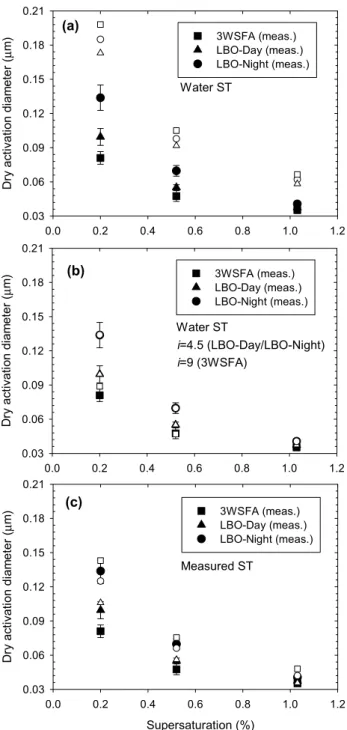
2476 E. Dinar et al.: CCN properties of HULIS 0.0 0.2 0.4 0.6 0.8 1.0 1.2 D ry ac tivati on di am et er (μ m) 0.03 0.06 0.09 0.12 0.15 0.18 0.21 0.0 0.2 0.4 0.6 0.8 1.0 1.2 D ry ac tivati on di am eter (μ m) 0.03 0.06 0.09 0.12 0.15 0.18 0.21 Water ST Measured ST (a) 0.0 0.2 0.4 0.6 0.8 1.0 1.2 D ry ac tivati on di am et er (μ m) 0.03 0.06 0.09 0.12 0.15 0.18 0.21 3WSFA (meas.) LBO-Day (meas.) LBO-Night (meas.) (b) Measured ST (c) Water ST i=4.5 (LBO-Day/LBO-Night) i=9 (3WSFA) Supersaturation (%) 3WSFA (meas.) LBO-Day (meas.) LBO-Night (meas.) 3WSFA (meas.) LBO-Day (meas.) LBO-Night (meas.)
Figure 7.
The measured (solid symbols) and calculated (hollow symbols) dry diameters needed
for particle activation for the extracted FA HULIS samples. The correlation of Schafer et al. is
used in estimating M
n. The particle surface tension is assumed to be either that of water (A and
B) or taken from the measurements (C). The Van’t Hoff factor is set equal to unity (A and C) or
varied (B). It is found that i=4.5 can account for the LBO samples, and i=9 can account for the
behavior of the 3WSFA sample. 2WS
27
Fig. 7. The measured (solid symbols) and calculated (hollow sym-bols) dry diameters needed for particle activation for the extracted FA HULIS samples. The correlation of Schafer et al. (2002) is used in estimating Mn. The particle surface tension is assumed to beei-ther that of water (a and b) or taken from the measurements (c). The Van’t Hoff factor is set equal to unity (a and c) or varied (b). It is found that i=4.5 can account for the LBO samples, and i=9 can account for the behavior of the 3WSFA sample.
contribution of dissociation versus surface tension in the case of SRFA activation.
4.2.2 K¨ohler calculations for FA extracted from aerosol particles
Figures 7a, b and c show the results of CCN activation cal-culations based on the K¨ohler theory together with variations in van’t Hoff factor and with surface tension measurements for the sample extracts. The same approach is applied as for the SRFA samples. The calculations are performed for num-ber molecular weights (MN)assuming that the correlations of Schafer et al. (2002) hold also for the atmospheric FA. In Fig. 7a, surface tension of water and i=1 were assumed. In Fig. 7b, the van’t Hoff factor was varied to obtain the best agreement between the predicted and measured activation di-ameters, while surface tension was set to that of water. For the FA extracts from smoke samples (night and LBO-day) best agreement was achieved with a van’t Hoff factor equal to 4.5 and for the pollution-derived FA (3WSFA), a van’t Hoff factor of 9 had to be assumed in order to achieve a good agreement between calculated measured activation di-ameters. In Fig. 7c, a van’t Hoff factor of 1, and the measured surface tension values were used. It can seen that using the measured surface tension values, activation diameters can be very well predicted, even if i=1 is assumed. Considering that HULIS molecules may consist of 3 or more carboxylic groups per molecule (Tagliavini et al., 2006), then a van’t Hoff factor of 4.5 could be reasonable if the HULIS was fully dissociated. Unfortunately, we did not have enough material to determine an acid titration curve for the HULIS extracts, and therefore cannot estimate either pKa or degree of
dis-sociation for atmospherically relevant concentrations. How-ever, it is extremely unlikely that a van’t Hoff factor could be as high as 9. Therefore, at least for the 3WSFA sample (and to smaller extant the LBO samples), surface tension may play an important role, or possibly, our molecular weight es-timates are inadequate.
A dry density of 1.5 g/cm−3 was assumed in all calcula-tions. Changing the dry density to 1.0 g cm−3increases the predicted activation diameters by 13%, resulting in a worse fit to the data (analysis not shown).
4.3 Atmospheric implications
To our knowledge, this is the first study on the CCN activity of HULIS extracted from sampled particles. We can, how-ever, compare the CCN activity of the bulk SRFA measured here with those obtained by Svenningsson et al. (2006), who measured the activation diameters of bulk SRFA. The activa-tion experiments carried out by Svenningsson et al. (2006) were conducted by selecting a particular aerosol size and scanning super saturation conditions in the CCN spectrom-eter. As a result, their experiments can not be directly com-pared with this work. However, for atmospherically relevant SS conditions of 0.2% and 0.5%, the activation diameters of bulk SRFA (180 and 90 nm, respectively) obtained in both studies agree very well.
While we have found that the fractions of SRFA with the lower molecular size activate to droplets at smaller diameters than the bulk SRFA, water soluble FA-HULIS extracted from fresh and slightly aged smoke particles and from air pollution particles activate to cloud droplets more effectively than even the SRFA fraction with the lowest molecular weight. For these water soluble organic molecules, activation can be rea-sonably well predicted by the K¨ohler model, provided that the molecular weight, the amount of dissociation and the surface tension can be estimated. The calculations suggest that surface tension is more important than dissociation for the activation of the extracted HULIS (assuming the inferred molecular weight estimates). It can also be concluded from Fig. 7c, that the 3WSFA sample behaves differently than the smoke samples, and as a result the calculation of its activa-tion diameters gives the worst result, compared to that of the LBO-Night and LBO-Day samples.
The activation of the airborne HULIS is qualitatively sim-ilar to that of fulvic acid from an aquatic source often used as a model system in laboratory studies, i.e.; Suwannee River fulvic acid. However, we found that HULIS derived from 3 different aerosol sources (fresh smoke, aged smoke, and pho-tochemical pollution) are more CCN active, more surface ac-tive than SRFA and generally less aromatic. The measured activation diameters also suggest that chemical aging of these organic species may improve their CCN abilities due to oxi-dation of larger molecular species to smaller ones (compare LBO-day with LBO-night). It is still unclear whether the FA-HULIS from smoke aerosols can be directly compared with those from pollution particles, such that more samples and studies of this sort are needed. It is also clear that standard isolation and chemical characterization methods of HULIS must be adopted for enabling future interpretation and com-parison of results from different studies.
The surface tension measurements reported here examined only one concentration, representative of the concentrations of HULIS found in atmospheric samples of fog and rainwa-ter. Surface activity controlled by large HULIS molecules will be a function of concentration and of time in a growing droplet. Hence it is conceivable that at the onset of activa-tion, the concentrations of HULIS may actually be higher than those studied here. Yet, for the SRFA fractions, the cal-culations above using the K¨ohler equation (Sect. 4.2) demon-strate that there is no need to invoke surface activity to ac-count or the observed activation. Therefore, concentration and time dependent surface tension were not considered for these samples. For the HULIS samples, where surface ten-sion does appear to play a role in activation, the extracted amounts were unfortunately too small for us to test the con-centration dependence.
By size-fractionating the SRFA sample and measuring the surface tension of the samples, we demonstrated that the acti-vation of SRFA to droplets depends on the physico-chemical parameters (molecular weight, surface tension) of these com-plex organic species, but we were not always able to show
this to the same extent for the aerosol-derived HULIS, as there was not enough material for detailed chemical analy-sis. However, it seems plausible to conclude from the results shown here that surface tension does not play an important role in activation of SRFA, but plays a certain role in promot-ing activation of the aerosol-derived FA. Finally, the differ-ences in CCN activation behavior between even the smallest FA fractions and HULIS extracted from aerosol suggest that the materials are not as similar as previously believed.
A major knowledge gap that still remains open concerns the physical-chemical and hygroscopic properties of non-water soluble species. Synergetic hygroscopic effects with salts such as ammonium sulfate also need to be studied to assess the role of these species in real atmospheric aerosol particles.
Appendix A Materials and equipment for fractionation procedure
Membranes: YM series Millipore membranes from
re-generated cellulose of nominal molecular weight cutoffs (NMWCO) of 0.5, 1, 3, 10 and 30 kDa were used. A mem-brane of 200 Da nominal molecular weight cutoff obtained from KOCH membrane systems was also employed (KOCH: MPF-34). Prior to use, the membranes were flushed by 800 ml of water to remove preservative. When not in use, they were stored in 20% ethanol.
Filtration Equipment: The set up consists of a feed cell
(volume of 800 mL) and magnetically stirred filtration cell (Amicon, volume of 180 mL, membrane diameter 63 mm) pressurized with nitrogen to 3 kg cm−2. Filtration was
carried out at 23±2◦C.
Filtration Protocol: Sequential filtration beginning with the
largest NMWCO membrane (30 kDa) and continuing to the smallest (0.2 kDa) was carried out. A diafitration proto-col (constant cell volume) was employed to avoid excessive aggregation in solution during the course of filtration. A 150 mL bulk solution at 5 g/L was placed in the filtration cell and the feed cell filled with water and pressurized. During each filtration stage, more than tenfold volume (1800 mL) of water passed the filtration cell, washing it from species which could pass through the membrane. The filtrate was collected and concentrated to 150 mL in the filtration cell on the mem-brane with the next (smaller) NMWCO, followed by wash-ing with 1800 mL water. The retentate was freeze-dried and stored in the dark under vacuum. The filtrate with species of NMW<200 Da was discharged. Obtained fractions were periodically tested by ion chromatography to assure absence of low molecular weight organic acids and inorganic ions.
2478 E. Dinar et al.: CCN properties of HULIS
Appendix B
Chin et al. (1994) reported a molar absorptivity (ε) of 389 Lmol−1cm−1of OC for bulk SRFA at 280 nm. We mea-sured an absorptivity of 306 Lmol−1cm−1of OC at 280 nm, which, considering batch diversity and differences in instru-mentation, is not substantially different from the previous re-sult.
Additionally, Chin et al. (1994) correlated absorbance at 280 nm for a variety of different humic and fulvic acids with aromaticity (measured as % of carbon in aro-matic structures) determined by 13C NMR spectroscopy, and number-averaged molecular weight (MN) determined by size exclusion chromatography (SEC) and vapor-pressure osmometry. The relationship between aromaticity and ab-sorbance obtained was:
Aromaticity(%)=0.05 × ε + 6.74, R2=0.90) (B1) A later study correlating absorbance at 280 nm with aro-maticity determined by13C NMR for various humic samples and size fractionated humic samples, reported a similar equa-tion (Peuravuori and Pihlaja, 1997):
Aromaticity(%)=0.057 × ε + 3.001, R2=0.84 (B2) The maximum difference between the estimations does not exceed 30% for HS where absorptivities range between 100 and 500 Lmol−1cm−1of OC.
A good correlation (R2=0.97) between weight-averaged molecular weight and molar absorptivity at 280 nm was found by Chin et al. (1994). They did not develop an equa-tion for number-averaged molecular weight (MN), and we used their data (Table 1, p. 1856) for regression analysis. The resulting relationship is not as good (R2=0.83) as that for weight-averaged molecular weight (MW)but is a useful, semi-predictive tool:
MN(Da) =1.33 × ε + 534, R2=0.83 (B3)
Peuravuori and Pihlaja (1997) suggested a logarithmic equation:
Log10(MN)=0.003 × ε + 2.452, R2=0.77 (B4) No correlation was proposed by Schafer et al. (2002), but using their published data (five samples), a relationship be-tween molar absorptivity at 254 nm and MN (evaluated on the basis of SEC analysis) can be obtained:
MN =92.1 × ε + 253, R2=0.72, n = 5 (B5) Our absorptivities (ranging from 2.0 to 5.3 L mg−1m−1 of OC) are partially outside the narrow range of data (3.05– 3.99 L mg−1m−1of OC) in the study of Schafer et al. (2002). The number average molecular weight, MN, represents the total weight of the molecules present divided by the total number of molecules. Most thermodynamic measurements are based on number-average molecular weight, including
the colligative properties such as osmotic pressure and freez-ing point depression. It is calculated by:
MN = ∞ P i=0 NiMi ∞ P j =0 Nj (B6)
where the number of molecules having a given molecular weight (Mi)is given by Ni, and Nj is the total number of molecules present.
An alternative measure for the molecular weight of a poly-mer is the weight average molecular weight (MW). MW is a weighted average considering the mass of the molecules, so that heavier molecules have relatively more importance than lighter molecules. MW is calculated by:
MW = ∞ P i=0 NiMi2 ∞ P j =0 NjMj (B7)
The ratio of weight average to the number average molec-ular weight is MW/MN known as the polydispersity, an in-dex of the distribution of molecular weights in the mixture. Knowledge of the molecular weight is essential for activa-tion growth modeling, and we have used the three correlaactiva-tion equations in our modeling studies.
Acknowledgements. This work was supported by a grant from the
Israel Academy of Sciences (grant #162/05). Aerosol ambient concentrations were provided by the Israel Ministry of Environ-ment. T. Anttila acknowledges financial support from the Helsingin Sanomat Centennial Foundation. Valuable help from J. Abbatt in the design of the cloud chamber is highly appreciated.
Edited by: A. Laaksonen
References
Abbatt, J. P. D., Broekhuizen, K., and Kumal, P. P.: Cloud con-densation nucleus activity of internally mixed ammonium sul-fate/organic acid aerosol particles, Atmos. Environ., 39(26), 4767–4778, 2005.
Abdul-Razzak, H. and Ghan, S. J.: Parameterization of the influ-ence of organic surfactants on aerosol activation, J. Geophys. Res., 109, D03205, doi:03210.01029/02003JD004043, 2004. Abdul-Razzak, H. and Ghan, S. J.: Influence of slightly soluble
organics on aerosol activation, J. Geophys. Res., 110, D06206, doi:06210.01029/02004JD005324, 2005.
Andreae, M. O., Jones, C. D., and Cox, P. M.: Strong present-day aerosol cooling implies a hot future, Nature, 435(7046), 1187– 1190, 2005.
Ansari, A. S. and Pandis, S. N.: Prediction of multicomponent in-organic atmospheric aerosol behavior, Atmos. Environ., 33(5), 745–757, 1999.