Publisher’s version / Version de l'éditeur:
Technical Translation (National Research Council of Canada), 1960
READ THESE TERMS AND CONDITIONS CAREFULLY BEFORE USING THIS WEBSITE.
https://nrc-publications.canada.ca/eng/copyright
Vous avez des questions? Nous pouvons vous aider. Pour communiquer directement avec un auteur, consultez la
première page de la revue dans laquelle son article a été publié afin de trouver ses coordonnées. Si vous n’arrivez pas à les repérer, communiquez avec nous à [email protected].
Questions? Contact the NRC Publications Archive team at
[email protected]. If you wish to email the authors directly, please see the first page of the publication for their contact information.
Archives des publications du CNRC
For the publisher’s version, please access the DOI link below./ Pour consulter la version de l’éditeur, utilisez le lien DOI ci-dessous.
https://doi.org/10.4224/20386712
Access and use of this website and the material on it are subject to the Terms and Conditions set forth at
Tests on Mortars for Free-Standing Chimneys
Hummel, A.; National Research Council of Canada. Division of Building Research
https://publications-cnrc.canada.ca/fra/droits
L’accès à ce site Web et l’utilisation de son contenu sont assujettis aux conditions présentées dans le site LISEZ CES CONDITIONS ATTENTIVEMENT AVANT D’UTILISER CE SITE WEB.
NRC Publications Record / Notice d'Archives des publications de CNRC:
https://nrc-publications.canada.ca/eng/view/object/?id=96b3899f-8e25-484b-bad9-5dfd42ccfa70 https://publications-cnrc.canada.ca/fra/voir/objet/?id=96b3899f-8e25-484b-bad9-5dfd42ccfa70
Unit masonry used in chimneys is required to resist additional stresses to those which masonry in walls must withstand, and an understanding of the properties of mortars required for these
special conditions of use is therefore necessary. A contribution from Germany to the technical
literature on this subject , 'IVi th particular reference to the influence of various types· of mortars on the elasticity and strength of unit masonry, is provided by the paper for which this translation has been prepared.
The paper was translated by Mr. D.A. Sinclair of the Translations Section of the National
Research Council Library, to whom the Division of Building Research Wishes to record its thanks. Ottawa,
April 1960
R.F. Legget, Director
Technical Translation 886
Title: Tests on mortars for ヲイ・・Mウエセョ、ゥョァ chimneys
(Versuche an Morteln fur freistehende Schornsteine)
Author: A. Hummel
Reference: fッイエウ」ィイNセN Forschungen im Bauwesen, ser. D, (24):
5-14, 1956.
1. Occasion for and Purpose of Tests
In dイイセ 1056, "Principles for the Construction of Free Standing
Chimneys", section 7 d, the following is laid down :
"Suitable mortars for warm and hot chimneys (cf. section 16) are:
1. Lime mortar from 1 part by vol. hydraulic lime and 3 to 4
parts by vol. sand;
2. Lime cement mortar from 1 part by vol. cement, 3 to 4
parts by vol. hydraulic lime and 10 to 12 parts by vol. sand.
Pressure hydrated lime is not suitable. Mortars of greater
cement; content are not' permissible for warm and hot chimneys (section 16)".
These regulations were based on the experience gained with the earlier building lime standard DIN 1060, in which - from tests on
moist standard lime セッイエ。イセ - the strengths of the different limes
varied to a much greater extent and in general showed a much greater range of strengths than are obtained with the soft mortar test
employed today.
Furthermore, since in the case of chimney mortars not only the strength but also the elastic ductibi1ity is important, doubts
arose concerning the aptness of the above specifications for mortar composition, and especially whether it was right to reject pressure
hydrated lime.,
The North-Rhine Westphalian Minister for Reconstruction charged the Institute of Building Research at the Poly technical Institute of Aachen with the investigation of these problems in March 1952.
With the' assistance of lng. Weishaar, Aachen, then chairman of the Committee on Free-Standing Chimneys, a testing program was
drawn up for the comparative testing of masonry mortars with respect to セエイ・ョァエィ and elasticity under low, medium and high temperature
storage condi ti ons , an d the compres s i ve st rengths of assemblies built with these mortars.
During the execution of the tests this plan, which had been approved by the above-mentioned Minister, inspired the chairman of
the Committee for Uniform Building Codes, Ministerialrat Prof.
Dr.-Ing. esh , 1}ledler, Berlin, to initiate compressive tests as well
as some flexural tests, where possible, on masonry assem'Jlies from various mortars, as had already been planned earlier, but not
executed, by Prof. Dr. Gehler of Dresden.
Whereas Prof. Gehler at first intended to load the flexural test bodies perpendicularly to the bed joints, in the plan drawn up with the cooperation of Mr. Heishaar it was deemed more appro-priate, in view of the loads encountered in practice, to apply the
flexural loads in the direction of the bed joints. The plan also
called for flexural tests in which at the same time a uniformly
distributed compressive stress of 10 kg/cm2 was to be applied
per-pendicularly to the bed Joints. The details of the experiments
and their results are given in two separate reports which could
not be printed in full. The present report, which has been revised
for printing, is a condensation of the material, leaving out individual values.
2. ScoQe of the Tests
The tests are divided into preliminary, main and supplementary series.
2.1 Preliminary tests
In the preliminary tests the materials employed were tested
according to the appropriate standards. The materials employed
were:
(a) Blast furnace cement Rh delivered in brown bags and referred to as cement of quality class Z 225;
(b) Pressure hydrated lime from lime plant 0, referred to as ultra-hydrated lime;
(c) Hydraulic lime·, referred to as IN-hydraulic lime, ground, slaked;
(d) High calcium lime·· in powdered form, referred to as white hydrate of lime;
(e) Mortar sand composed of grain sizes 0/0.2, 0.2/1 and 1/3
by weight;
(f) Brick, referred to as Ra-clinker.
Materials (a) to (d) were selected by Mr. Weishaar and sent
on his ordeps to the Institute of Building Research. The sand (e)
was taken from the Institute's stock.
2.2 Main tests
2.2.1 Mortar tests
Six different mortar compositions were chosen and are referred
to hereinafter as M1 to Ms. M2 is a mortar according to DIN 1056
and serves as a basic and comparison mortar. The mortar
composi-tions are given in Table II. After being stored under various
conditions (see Table III) up to 90 days they were tested for
flexural strength, compressive strength and compressive elasticity.
2.2.2 Masonry tests
Cubic masonry assemblies were built (38 cm side) from the
clinkers according to 2.1 f) and mortars M1 to M6 according to 2.2.1.
After standing for 28 days at +20oC and +5°C they were tested for
compressive strength and unit weight.
2.3 SU")Qlementary tests on masonry
Masonry assemblies 118 cm long, 25 cm thick and 38 cm high
were built in English cross bond from clinkers according to 2.1 f)
and mortars M to M , four examples being provided for each of the
1 4
mortars. After aging for 42 days under standard conditions they
•
••
Translator's note: German 11v'asserkalk" = lime containing more
than 10% silicic acid, alumina and iron; slakes on addition of
water (cf. 3rockhaus der Wissenschaft und der Technik,
Leipzig, 1955) •
Translator's note: German "Weisskalk"
=
lime containing morewere tested for flexural strength with and without lateral pre-compression.
3. セ Procedure and Results
3.1 Results of the preliminary tests セョ the building materials
employed
3.1.1 Properties of bla.st furnace ce:nent determined according
to DIN 1164
Weight per litre loose poured: 0.95 kg;
Fineness of grinding: residue on screen 0.9 DIN 1171: 0.91%;
Volume stability: satisfactory;
Hardening: initial 4 hours and 20 min.
full 7 hours and 10 min.
Strength values for w/z
=
0.6, slump 18.3 em:flexural 'after 3 days 50 kg/cm2;
after 7 days 85 kg/cm2;
after 28 days 105 kg/cm2;
c ompr-e's s , after 3 days 201 kg/cm2;
after 7 days 329 kg/cm2;
after 28 days 450 kg/em2.
The cement was delivered as quality Z 225 and found to have quality Z 325.
In view of its intended application the blast furnace cement was tested for the corresponding strengtb values when stored in
water at +5°C. The results were as follows:
flexural after 3 days 19 kg/cm2; '
after 7 days 48 kg/cm2;
after 28 days 72 kg/em2;
compress. after 3 days 66 kg/cm2;
after 7 days 203 l<g/cm 2;
after 29 days 336 kg/em2.
The ratio of 28-day compressive strengths for storage at +5°
and +200C
3.1.2 Properties of building ャゥセ
Since change is under way in the 3ppraisal of limes and this is a period of transition, the pressure hydrated, hydraulic and high calcium limes employed were tested according to both the
earlier building lime standard DIN 1060 and the new draft DIN 1060,
version of June 1952, especially with a view to comparlng the
respective strengths of the earlier moist lime standard mortar and
the new soft lime standard mortar. The strengths were tested
beyond the requirements of the standard sheets up to the age of
90 days. As indicated in Table I, the results correspond
sub-stantially to the former and the new lime standards.
3.1.3 Properties of the brick
Determined from 10 bricks DIN 105, earlier version.
Average dimensions: 24.9· 12.2 • 6.3 cm;
Mean weight per unit vol., air dry: 2.13 kg/dm3
Mean compressive strength: 667 kg/cm2 (range of 523 to 782 kg/cm2) .
On the basis of DIN 105, earlier version, therefore, these are
clinkers. According to DIN 1056 "Principles for the construction
of free-standing chimneys II section 6" only bricks with at least
150 kg/cm2 compressive strength may be used.
3.2 Procedures for main tests and their results
3.2.1 Mortar tests
The compositions of masonry mortars M1 to M6 and their fresh
mortar propert ies are gi ven in Tab Le 11. The san d for all the
mortars consisted
of:-15% by wt. fine sand 0/0.2 mm
75% by wt. fine sand 0.2/1 mm
10% by wt. sand 1/3 mm.
Weight per litre of dry sand mixture, loose poured, 1.55 kg.
The chosen compositions cover a broad range of mixing ratios including some extending into the fat range hitherto not permitted.
Mortar prisms 4 • 4 • 16 cm were prepared for flexural and
compressive tests and prisms 10 • 10 • 25 cm for compressive
Since chimneys are built at moderate temperatures, but the mortars may be subjected to rather high and even fluctuating
temperatures in operation, the tests were conducted under various
temperature conditions. The storage conditions selected for the
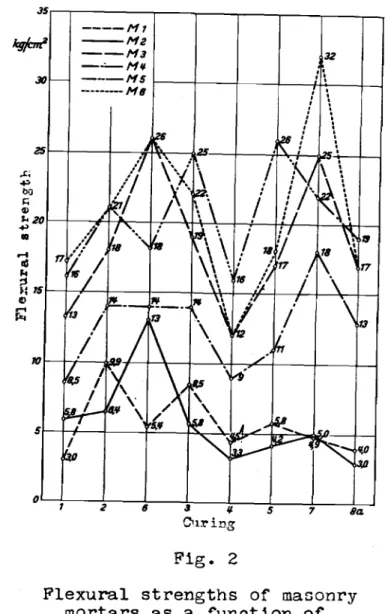
4 • 4 • 16 em and the 10 • 10 • 25 em prisms are shown in Table III. The mean strength values of ,the masonry mortars under the
storage conditions of Table III are represented in Fig. 1 and 2. The elasticity tests were carried Qut with the aid of Martens
mirrors. Each different ャセ。、 was applied repeatedly until a
constant value €elast. fqr the elastic compressive strain was
obtained. The moduli of elasticity E were computed from the
stresses and the elastic compressive strains.
Because of .t.he r r importance for the present investigation, the
mean values of the mOduli of elasticity are given numerically in
Table IV.
From Table IV the moduli of elasticity for a test age of
28 days are plotted in Fig. 3 against the mortar strength for
con-stant live load and normal storage. Similarly in Fig. 4 for a
test age of 90 days as a function of standard storage and thermal
treatment.
For clarification and subsequent interpretation of the
remark-able phenomena revealed in Fig. 4 the weight per unit volume and
the compressive strengths of the masonry mortars are represented
in Fig. 5 and 6 under the same storage conditions as in Fig. 4.
3.2.2 Tests on masonry cubes of 38 em side'
The assemblies of bricks and mortars N1 to セQV were built by
hand from 3/4 bricks in the manner illustrated by Fig. 7 and 8.
They were kept 7 days under moist cloths and then in air. Half the
assemblies were kept at +20° from the start, and the other half
at +5°C.
The mean weights per unit volume and compressive strengths of
the assemblies after aging 28 days are shown in Fig. 9, compared
3.3 Sunplementary masonry tests 118 • 25 • 38 em
The assemblies of bricks and mortars M1 to M4 were constructed
in English cross bond as illustrated in Fig. 10. They were kept
at room エ・セー・イ。エオイ・ for 7 days under moist cloths and then in the
room air.
At the age of 42 days the specimens were tested for flexural
strength by being placed as a beam on two supports at a spacing
of s
=
100 em and applying a single load at the centre of the beam.The bed joints in this test stood vertical in the room, so that the height of the beam was equal to the thickness of the wall
(25 em).
3.3.1 Tests on masonry specimens without precompression
The flexural strength of the masonry beam which was fitted with cement mortar battens at the points of support and load
application, was computed from the load セエ break P plus the dead
bh2
load, substituting the moment of イ・ウゥウエ。ョ」・セN For the results
see Fig. 13.
3.3.2 Tests on masonry specimens with precompression
In order to ensure uniform'application of the precompression
of 10 kg/cm2 perpendicular to the bed joints the masonry beams first
received flat coatings of mortar on the sides parallel to the bed
joints. The precompression was applied in the manner shown in
Fig. 11, using steel plates and tie bolts.
The correct compression forces were ensured by measuring the
elastic elongation of each separate bolt. The required steel
elongation in the elastic range was not only calculated, but also tested in a pull-test machine.
In order to avoid obstructing the bending of the beam
per-pendicularly to the precomnression forces, i.e., in the plane of
the bed joints, gaps of 2 em width were left open between the steel compression plates.
The testing of the precompressed masonry beam is illustrated in Fig. 12.
and that of the precompression appqratus were taken into account at the breaking load P.
Fig. 13 shows the mean values of the weight per unit volume and the flexural strength of the beams in comparison with the flexural strengths of the mortars.
The 10 kg/em 2 precompression perpendicular to the bending
forces has obviously imparted homogeneity to the masonry. The
breaking surfaces were more laminar instead of staggered (cf. Fig.14 and 15) and the scatters in the individual flexural strength values were reduced.
4. eカ。ャオ。エゥッョNセヲ Results
The blast furnace cement
Z 325. (From experience
definitely Z 225 quality
it is only an accident.)
employed was found to be of quality it may be said that if a cement of is obtained nowadays from the trade
See SE;ro,.3-.1.1.
4.2 The pressure hydrated lime employed is a highly effective
product even in the soft mortar and has a marked secondary
hardening (Table I). Its high-grade nature is of advantage
within the framework of the present investigation.
4.3 The hydraulic lime eillployed, with a compressive strength of
11 kg/cm2 after 28 days just satisfied the standard requirement
of 10 kg/crn2 for soft mortars (Table I). For the purposes of
the present problem the low strength value is also an advantage.
4.4 The brick used is a heavy, very strong clinker with a unit
weight of 2.13 kg/dm3 and a mean compressive strength of
667 kg/cm2 (Sec. 3.1.3).
4.5 Compressive strengths of the 6 mortars employed as a function
of the curing
The mean compressive strengths of the masonry mortars cured
at +20oC (standard curing) vary between 29 and 97 kg/cm2 after
28 days, and between 28 and 116 kg/crn2 after 90 days (cf. Fig. 1).
mortar compressive strengths.
Compared with standard curing at +20°, curing at +5°C lowered the compressive strengths of the mortars only in the cases of M
1
(mortar from pressure hydrated lime) and M
5 (high calcium lime
cement mortar). In the other cases it was increased (Fig. 1).
Heat treatment (four hours daily in the electric furnace at 200°C and twenty hours in the room atmosphere, repeated 25 times) resulted in a reduction of compressive strength when it WaS begun
after 28 days, but gave either an insignificant reduction or in some cases an increase of compressive strength when the heat
エイ・。エセ・ョエ was applied only after 60 days' curing (Fig. 1).
In practice, chimney heat will always be applied to the older mortars, so that the latter case will be involved.
According to the compressive strengths given in Fig. 1, the 6 mortars fall into two distinct groups, namely those of lower compressive strength, M
1 (from pressure hydrated lime), M2 (from
hydraulic lime and 'cement, as the comparison ュッセエ。イ according to DIN 1056), and M4 (high calcium Llne cement mortar) and the group M3 (from pressure hydrated 11:11e and cement), M5 (fat high calcium lime cement mortar) and M6 (fat hydraulic lime cement mortar) with decidedly higher compressive strengths.
Even from these mortar tests it is noteworthy that the compari-Gon mortar according to DIN 1056 (mortar M
2) has higher strength
values than the mortar from pressure hydrated lime Hセッイエ。イ M ) even
1
though the latter is a high-quality hydraulic lime.
4.6 Moduli of elqsticity of エィセ 6 mortars used, as a function Qf
the curing
Except for a few variations, Fig. 3 shows the known tendency for the moduli of compressive elasticity to increase with increasing compressive strength, while decreasing, at constant compressive
strength, with increasing live load.
The heat treatment, on the other hand, was found to have a very definite influence on the moduli of elasticity of all the
s t and ar-d curing3.nd qt live loads of 10 and 20 kg/cm2 the moduli of elasticity of the different mortars cover the very wide range
of 11570 to 102500 1{g/cm2 , whe rea s after thermal treatment (curine,
5) not merely is the range narrower, between the limits of 6420
and 27700 kg/cm2, but the values are reduced to a fraction of their
former ones.
This reduction in the moduli of elasticity, which is important for the purposes of the present study, is evidently associated with the reduction of unit weights of the mortars, which shows a similar course (cf. Fig. 5) and which results chiefly from the moisture
changes due to the different curing conditions*. In this
connec-tion it is important to note at the same time the compressive strengths of the mortars in practice change but little under the three most important curing regimes (L3 , lセL Lea).
Especially where ィゥセゥ strength clinkers are used, the elastic properties of brick masonry are e s serrtLal.Ly a function of the
elastic ')roperties of the mortar, as the weake't' component. But since in chimneys the flue gases produce t.her-nal stresses of a kind similar to those chosen in the reported tests, the definitely reduced moduli of elasticity due to the heat treatment of the
mortar becomes of decisive importance in answering the question raised at the beginning of the report. It a;·mears no longer: 」ッイイセ」エ
to exclude medium stron,g-12-very ウエイッョセU _m£3.sonr:£ ュッイエセNNᆪNNャセィ。ウ
hitherto been done, from use in セィ・⦅アァョウエイオ」エゥッョ of ヲイ・・Mウエアョ、ゥョセ
warm and hot 」ィゥュョ・セウセ⦅エィ・ grounns of .inadeggate elasticity.
Elasticity tests on chimney masonry from various mortars cured under ordinary air conditions only will not, at any rate, enable us to choose the yroper mortar for this purpose.
The compressive strengths of the masonry specimens of approxi-mately 38 em edge length ma1e from 6 different masonry mortars
*
A further research project on this discovery of considerableimportance for the building trades is now under way at the Institut fUr 3auforschung, Aachen.
showed the following variations (Fig. 9):
Curing at +20oC, from 238 to 299 kg/cm2 (mean value 274 kg/cm2 )
Curing at + 5°C, from 200 to 314 kg/cm2 (mean value 275 kg/cm2 ) .
Curing at +5°C, compared with that at +20oC, reduced the compressive
strengths of the masonry made with mortars M1 to M , but increased
, 3
the others somewhat.
The scatters of the masonry compressive strength values around
the means (274 and 275 kg/cm2, respectively)
are:-Curing at +20oC: + 2.9, ±O,
Curing at + 5°C: -27.2, +5.1,
+9.1, -13.1, +0.7, + 1.1% +6.2, - 6.2, +8.4, +14.1%. Thus mortars M
1, M2 and M4 , with compressive strengths of 29
to 43 kg/cm2 gave practically the same masonry values as mortars
M3 , mセL and M
6 with compressive strengths of 83 to 97 kg/cm
2 •
This unexpected result is explained by the fact that the masonry compressive strength expresses a slab strength value of the mortar,
not its cubic compressive strength. The slab strength increases
compared with the cube strength more in the case of mortars of low compressive strength than for those of higher compressive cube strength, thus tending to equalize the slab strengths, so that, especially where high grade clinkers are used, the range of masonry strength values is also narrowed.
4.8 Flexural strengths of the masonry beams from different masonry
mortars
The flexural strengths of masonry specimens from four different
mortars at the age of 42 days (Fig. 13) are 21 to 27 kg/cm2 without
precompression and. 28 to 34 kg/cm2 wi th precompression.
Thus the flexural strengths of the precompressed beams for the respective series were 1.39, 1.15, 1.26 and 1.33 times, or an average of 1.28 times, that of the none-precompressed specimens.
No clear relationship could be established between the flexural strength of the masonry and that of the mortar.
Toe precompression of 10 kg/cm2 imparted homogeneity to the
4.9 The rat10 of compress1ve strength to flexqral strength-lg the masonry assemb11es
The rat10 of compressive strength of the masonry after 28 days to the flexural strength after 42 days 1s calculated 1n Table V.
5. Conclus1ons
The pr1nc1pal results of the 1nvest1gat1ons are as follows: The fact that the modu11 ofelast1c1ty of mortars of d1fferent strength are reduced by heat treatment to a fract10n of the1r value for cur1ng at room temperature and that the1r range is cons1derably narrowed renders it no longer justifiable to exclude the use of stronger mortars from mixtures of higher cement content and with additions of pressure hydrated lime for warm and hot chimneys. This is all the more true in view of the fact that according to recent experience the strengths of commercial hydraulic limes vary
widely and narrow strength limits cannot be guaranteed. Whether
looked at from the standpo1nt of the elastic propert1es of the mortar or from that of the strength values of the masonry, all mortar compositions fal11ng within the limits considered in the present paper can be regarded as suitable for ch1mneys.
A 10 kg/cm2 precompression app11ed perpend1cularly to the
plane of bending increased the flexural strength of the masonry beam, within the scope of the present experiments, by 1.28 times the value for the non-compressed specimen.
Table I
Mean values of the most important results of the standard tests on building limes
Kind of lime
Properties Pressure High
hydrated Hydraulic (powder)calcium
1 2 3 4
Weight per litre kg 0.82 0.76 0.53
Fineness of grain
%
by wt. residue on 0.09 DIN 1171 3.1 30.0 4.90.20 DIN 1171 0.02 11.2 0.1
Constancy of volume O.K. partly O.K. O.K.
--Compressive strength kg/cm2
according to DIN 1060 age
(moist standard mortar)
7 days 152 39
-28 days 258 69
-90 days* 393 140
-Soft standard mortar according
to DIN 1060 new
Flexural strength kg/cm2 7 days 18 2
-28 days 37 6
-90 days* 50 6
-Compressive str. kg/cm2 7 days 58 6
-28 days 164 11
-90 days* 266 29
Mixing proportions, stiffness and weight per unit volume of masonry mortars
1 Mixing proportions Mean slump in TNt. per
Mortar
.Grts
by volume
I
em according unit vol.
Parts by weight to DIN 1164 kg/dm3
1
-1
2 3 4 51 pressure hyd , lime 1 pressure hyde lime
M1 3.5 sand 6.6 sand 17.5 2.11
1.2 water 1.46 water
1 cement 1 cement
t12 3
hydraulic lime 2.43 hydraulic lime
16.3 2.00
10 sand 16.3 sand
3.73 wate r 3.92 water
-1 cement 1 cement
M3 2 pressure hyde lime 1.73 pressure hyde lime 16.1 2.01
8 sand 13.0 sand
2.62 water 2.76 water
1 cement 1 cement
M4 2 high calc. lime
1.12 high calc. lime
16.4 2.02
8 sand 13.0 sand
2 .60 1AJat e r 2.74 water
1 cement 1 cement
f15 1 high calc. lime 0.56 high calc. lime 16.7 2.04
5 sand 8.2 sand
1.65 water 1.74 Nater
1 cement 1 ce:nent
Ms 1 hydraulic lime 0.81 hydraulic lime 16.6 2.02
5 sand 8.2 sand 1.67 water 1.76 water I r-' en I
Curtng cunditions and test age of 4 • 4 • 16 cm and 10 • 10 • 25 cm
ーセゥウュウ of masonry mortar
Curing successively in Type of
curing
Humid box I, Room air dry Fluctu'3.tingtemp.* Room air dry 4 • 4 . 16Prisms
Test age in days Prisms cm f 10 • 10 . 25 cm - : I I ! I I 1 2 3 4 5 6 7 L, L2 7 days 20° 7 days 20° 21 days 20° 7 28 28 and 90 L 3 L4 7 days 20° 7 days 20° 83 days 20° -- I 90 90
._---lセ 7 days 20° 90 90 I セ --J I L6-
L 7 7 days 5° 7 days 5° 20° 28 90 28 and 90 90 90 5 days 20° 5 days 20° 25 days 25 days 53 days 5° 21 days 5° +32 days 20° 5° 5° days days Lab Laa----+:
-I- I I I -NMMMMMMMセM
* The prisms were cured every day for four hours at 200°C in the electric bOX, then 20 hours in the
Mean values of the moduli of elasticity of the masonry mortars
Hoduli of elasttcity E
=
€ dke/cm
2 ,--..I-t セL e Las b.
a5 I
-At s br-es s d 90 days 90
dar
セ・NNNL
I I-t 0c""'--'"r--!CJ 28 」NpBセGs 28 days 0(\ days 90 d ay s 90 day::; Repeated on "Rep€'ate on
nrisms prisms
;:: ,.c' GセBャイ '.ne 2 Cnrin3 h Cu r tng 3 Curing .5 Curing 8b
!'3 kg/cm 2 accord. to 。」ᄋZZッイエセ .• セッ [-< Curing '2 Cuセ in'" 1 2 3 4 5 6 7 8 9 4 - 31100 - - - - -5 57400 24000 57600 16600 12800 - 38400 M1 10 50700 - 53000 16200 12900 34700 34700 15 42700 - 47800 16300 12300 31600 26800 20 - - 40100 16200 - 28900 -5 47600 48100 11723 4920 3737 11550 48100 M2 10 34300 41400 11570 6420 4565 9900 41300 15 23300 33900 12870 7097 - 11010 36770 20 - - 14450 - - 12425 33170 10 85200 1:<2900 72200 12300 24800 74000 120600 M 3 20 69800 115300 64400 16300 29500 68400 115600 30 62500 106700 63800 19900 33300 65700 110800 40 55900 96600 62600 22200 35900 64400 104700 5 70900 78300 68900 15300 14700 69200 73000 M4 10 62400 67800 63400 16200 16100 64100 68000 15 48000 53500 54900 16900 17300 58000 60900 20 35100 41500 48900 18200 16600 41400 51600 10 129100 151400 92700 23800 33000 86300 106300 M 5 20 78500 117900 79100 27700 37900 80100 95300 30 64900 90400 71500 30100 39500 74100 88600 40 - - 63600 31100 41300 67200 85300 10 113700 106200 102600 21300 24800 110300 102900 M6 20 103300 96200 86900 26300 29000 98300 92600 30 89400 86800 82450 28ROO 29800 91800 88700 40 75900 79900 80200 28600 27300 88000 37600 I セ CP I
Table
y.
Ratio of compressive strength to flexural strength of
masonry specimen
-
-Masonry Ratio of compressive strength to flexural strength
speclmen
-from Beam セBQャ thout Beam with
mortar precompresslon precompression
-
-1 2 3 -M1 282 12.2 RXセ=
8.823
=
32 -M2 274 10.1 274=
8.8 27=
31 M3 セ :: 11.0 299=
8.8 27 34 M4 238=
11.3 238=
8.5 21 28 Mean = 11.2=
8.7I N o I 32 セ
,
ゥセ\
.
\
\ - - M 3 ----MI# - - - 1 ' 15 1 I ---M8 30 251 I I ..ZiセN Q 101 I -] .;prI I)\ I \ I / ' I. .' I '1 51 I': I tセᄋ F'" |Nセ ...「LセMセッ I I Nlセ..
eo f:; Qj r..201I
J'I"
I - \d
i \I
i I i II
"w
I I
セ ,'1. I'. : セセNN ; ! I•
...
III'"
,
:; 151 I,' 1_ 1__ I \\, // I / I \ I I....
rz. kgfcnrZ ----1'1, - - I ' 1 Z 1 I - - 1 ' 1 3 1 --1'11#_m_
1'15 I I --- 1'1.I 1_ ォ。Mᄋセ 110 o UPQMMMMMMMvMMKMMセ]⦅KセK⦅⦅⦅K⦅NNLlMゥ⦅⦅⦅⦅⦅⦅⦅K l1f 1 z•
s 7 8a. 2 6 a セ Cnring 5 7 1Ja. Fig. 1 Fig. 2Compressive strengths of mortars as a function of the
curing conditions
Flexural strengths of maGonry mortars as a function of
"d 110 of03kgj 72, I I'J ... I ".6 5 ab Curir:e 20
In.,
10 I ! !oU
3 セセ\
L __
---+ 90 , • or' - - - M1 - - H 2 - - M 3 _ . - 1'111 - · · · - M 5 •••••••-.-- 1'16 o (J10..
セi|\
'I; • (120 If 70 \ \ \\ \ イMMセMᄋMMMMM c.-- ,.\' '.., l
60セセエセ
\ \\\ 1---.--'\
'.. セZ i \ \,\, '1 USLッセ \ '\; l 50セ||
セエMMM
--- -_. ,
::. BXェスGセ| ' \ \ ' \ \ 6 I \ ' , 'J I ' \ セ , e.., "0 "0.7; \\\J
--!---l { i \\ I \ '\ c. I \ セ ;:J I \ セ 30 I \ ' n c H6 YWセOcQQAR 1'15 M3 83 ell str<>!;fth H2 H/I 35 /13 Ccnnressive H7 29 20 30 50 11 v: -' c. Eft) :> .,...: 1.'. c. 'I.' 71 H 8 861 y"> +' fa, 0" l ' r ' ..., CI 9, .c::' セ Q".
( Fig. 3 Fig. 4Moduli of elasticity as a function
of mortar strength (28 days'
standard curing L 2)
Moduli of elasticity as a function
of standard curing L3 and heat
treatments lセ and Lab
I l"J N I 8a -5 Cur;r:? 3 OセZ 7r- ./ L116 •. / '• セZZNNN
-,
' 1 - -;^セ セU
" , \102./ "r..::,
'0 セ0...
•..ᄋセYPM 10 ". lJ6 セo ---1'11 - - 1 ' 1 2 , - - 1'13 - - - r - - , 10 ---1'1'1 ---1'15 ----"--.-- 1'16 イッlMャMMMMセiMMMョ ;0 セ _ ...·{!L·_-_W 1 0-r-.
w セセ セセ 2,... - : : - - - 23 , ... 16 ,L. I 1 10 30 20 '10 100 111 G.J 71 セ on II: ec CJ61,.
p, e o tJ50 .s;::90 .p L) セ Cl; 1- III +" U. 121 lib 5 Curine 3 ----1'11 .!l - 1 ' 1 2}.
- - 1 ' 1 3 - _-_MIJ \ \ ----1'15 1\ \'\ ---.---1'16 11\\\ \.
...セ\\
....
1\ \.\ .... \\\.
\,\ "1\ ...
/
\,\.\
<, セ \,. i\':.
\····.L
I \\\ セ ..セZB1\
セR \\\
/"\..-.
セQ\
':./
",
\
... I\
'11 \ 17 \ r <, s <, セ -1.'" F' 1,7 1,71 1,8 1,1/, 1,7; 1.90 ..., 1,113....
.£ 1,112 ..-1,92 1,93 1,7, 1,91 1,1/9 1,118 1,87 += 1,1/6 .c:l
1,1/5 IVセ 1,11· 1,9'1 Fig. 5 Fig. 6Un1t weights of mortar for standard
curing L3 and thermal treatments
Ls and Lab (gO-day values)
Mortar compressive strength at standard
curing L3 and heat treatments
セ セ 1st and 3rd course 2nd 」ッオセウ・ Fig. 7 Masonry bond . "J QGQセ 1'15 Mortar designation Masonrv"" ウセ・」ゥュ・ョ... after 28 、。ケウセ ... +----+ Mor tpr after 28 na.ys0-_-<> +_..._+ I : /"2 I N セ I 0 - - - _ - 0 day s+__••• _.+ unit wt. after 28 セYNウcAQイv Fig. 8 Masonry specimen Fig. 9
Unit weights and compressive strengths of masonry specimens aged 28 days,
Fig. 10
Masonry specimen for flexural testing
Application of precompression to masonry beam
Fig. 12
Flexural testing of pre-compressed beam
5 Z 32
J
»:
セN
セGMGMヲGNO-,
017
-,
28/ "
BセV
セセQ
/.;,- , I " / ...11i / I I MNセ / セ 'Ii},'/
Irq/<-'.
' ....NZ[セiゥ セ -,,
セ 2.13 1'13セ "''1\, 11••••»>" 4 o /'11 r/2AA /'13 /'111 Mortar designation 5 3 10 3Jc#m
+---+ Mortar after 28 、。ケセ0 - - - 0 Masonry assembly after 42 days with precompression
i . - - - . X Masonry assembly after 42 days without precompression
0,···0 Unit weight of masonry after 42 da.ys
Fig. 13
Unit weights and flexural strengths of masonry beams without and with precompression at age of 42 days compared with
" ' - - - 1 1 7 , 2 - - - . - 1
Remark: without cocpression
Fig. 14
Break path in beam from mortar M3
without precompression
" " 1 7 7 , 7 '
-Remark: with 10 kg/cm2 precompression
Fig. 15
Break path in beam from mortar M3