Publisher’s version / Version de l'éditeur:
Vous avez des questions? Nous pouvons vous aider. Pour communiquer directement avec un auteur, consultez la
première page de la revue dans laquelle son article a été publié afin de trouver ses coordonnées. Si vous n’arrivez pas à les repérer, communiquez avec nous à [email protected].
Questions? Contact the NRC Publications Archive team at
[email protected]. If you wish to email the authors directly, please see the first page of the publication for their contact information.
https://publications-cnrc.canada.ca/fra/droits
L’accès à ce site Web et l’utilisation de son contenu sont assujettis aux conditions présentées dans le site LISEZ CES CONDITIONS ATTENTIVEMENT AVANT D’UTILISER CE SITE WEB.
Fugendichtung in Verkehrsflachen mit heissverarbeiteten Fugenmassen
(Hot-Applied Crack Sealants Workshop) [Proceedings], pp. 51-54, 2005-02-01
READ THESE TERMS AND CONDITIONS CAREFULLY BEFORE USING THIS WEBSITE. https://nrc-publications.canada.ca/eng/copyright
NRC Publications Archive Record / Notice des Archives des publications du CNRC :
https://nrc-publications.canada.ca/eng/view/object/?id=a9d8e218-06b6-4ed1-abe9-fbc867c871be https://publications-cnrc.canada.ca/fra/voir/objet/?id=a9d8e218-06b6-4ed1-abe9-fbc867c871be
NRC Publications Archive
Archives des publications du CNRC
This publication could be one of several versions: author’s original, accepted manuscript or the publisher’s version. / La version de cette publication peut être l’une des suivantes : la version prépublication de l’auteur, la version acceptée du manuscrit ou la version de l’éditeur.
Access and use of this website and the material on it are subject to the Terms and Conditions set forth at
Bituminous crack sealants in Canada: research and performance
specifications
Bituminous crack sealants in Canada: research and
performance specifications
Masson, J-F.
NRCC-47641
A version of this document is published in / Une version de ce document se trouve dans: Fugendichtung in Verkehrsflachen mit heissverarbeiteten Fugenmassen Duberdorf, Switzerland,
Feb. 4, 2005, pp. 51-54
Performance specifications in Canada
Bituminous Crack Sealants in Canada: Research and
Performance Specifications.
Dr Jean-François Masson
Abstract
0.5 mmµ
Twelve bituminous sealants were installed and their performance monitored. Performance did not correlate to standard test result. This was related to the effect of installation on performance and to an inappropriate material specification. Installation issues were addressed by the publication of the state-of-the-art practice. Specification issues are being addressed by the development of performance specifications that account for sealant aging, rheology, and adhesion.
1. Introduction
In Canada, bituminous sealants are mainly used in pavements. They are applied to joints in Portland cement concrete at airports and on some roadways, but their greatest use is in the preventive maintenance of pavements made with bituminous concrete. Sealants are applied to cracks to prevent the ingress of water, brine, and grit into the pavement structure, the effect being a reduced pavement deterioration rate and a longer pavement service life. National guidelines for sealant installation are available for roadway jurisdictions [1].
1.1 Bituminous
sealants
Bituminous sealants are mixtures reminiscent of polymer modified bitumens. Sealants contain a bitumen, a polymer, which is most often a styrene-butadiene copolymer [2], and filler(s) that can be finely ground tire rubber and/or a mineral filler such as calcium carbonate. Processing oils and other additives can also be found in sealants. The microstructure of multi-component sealants is visible with ultraviolet light optical microscopy (Figure 1).
Figure 1: sealant microstructure
2.
Field work
2.1
Sealant installation methods
The crack sealing procedure used in Canada has evolved over the last decades. Cracks can be simply cleared of debris with pressurized air and then filled with sealant, but this method often leads to poor sealant performance. It is now more common to prepare cracks prior to sealing. A short description of the crack preparation method is available [3], along with a detailed description [1]. The method consists of several steps :
1) Rout (enlarge) cracks to create a sealant reservoir with a regular predefined shape. 2) Clean the pavement surface; clean the
routed crack with pressurized air; heat the crack with pressurized heated air.
3) Verify crack cleanliness
4) Heat and pour bituminous sealant.
5) Shape sealant. Either flush-fill or bridge the rout with sealant.
2.2 Field
trials
In 1990, twelve sealants were installed in routed cracks [4]. Installations were in Montreal, a large Canadian city. Sealants were supplied by Canadian, American, French, and Dutch manufacturers, and they were purported to meet the then current ASTM D3405 specification. After installation, the performance of the sealants were monitored and they were sampled after 1, 3, 5 and 9 years of weathering. Sealant failure rates were found to be non-linear [4].
After 4 years of weathering, half of the sealants had failed, i.e., had shown more than 25% debonding or had pulled-out. The monitoring of performance was discontinued after it was estimated that only one sealant had a service-life longer than 8 years. The required service life of sealants is 12-15 years.
A significant finding of the field work was that 60% of the sealants did not meet the intended specification and that no correlation existed between the field performance and standard test results. Sealants that failed to meet the specification could still show good field performance. The lack of correlation was related to the effect of installation on sealant performance and to inappropriate material specifications. Further field work helped improve installation methods. The state-of-the art is now documented and widely available [1].
3.
Research
Crack sealants commonly fail in adhesion. Possible adhesion and failure mechanisms in sealants were reviewed [5]. The effect of sealant installation methods and equipment on sealant adhesion was also investigated [5, 6]. The routing of cracks sometimes leads to microcracks at the interface, whereas the treatment of the routed cracks with heated air can lead to a 50% reduction in bond strength if the rout is overheated. Lance temperatures must not exceed about 500°C.
Current North American sealant specifications are empirical. They lack aging tests that account for aging during installation [7] and service [8], and they disregard the importance of interfacial aspects on performance and the effect of aggregate composition on adhesion in particular [5].
The basis for a performance specification that accounts for the shortcomings of the current specification was published [8, 9] after installation methods were reviewed. Based on this premise, a Canada-USA consortium of sealant users and producers was established in 2002, the technical objectives being to 1) validate sealant aging tests, 2) develop rheological methods to assess sealant performance, 3) account for sealant viscosity and aggregate types in an adhesion test.
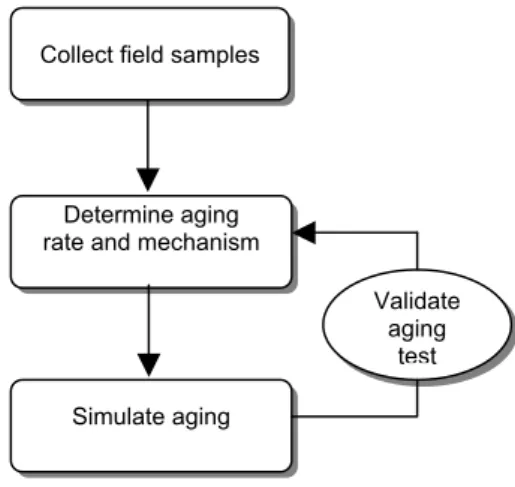
The development of aging tests is based on the protocol illustrated in Figure 2, the use of sealants weathered 1 to 9 years being a key element of the protocol.
Collect field samples
Determine aging rate and mechanism
Simulate aging
Validate aging
test
Figure 2. Scheme to develop aging tests.
The physico-chemical analysis of sealants aged during installation and weathered in service has indicated that field performance depends on several factors, including sealant stiffness and relaxation, resistance to oxidation of the bituminous binder, and resistance to thermal degradation of the sealant polymer. It has been determined that sealants often fail in service after they lose mass, the mechanism of mass loss being one where oxidized materials are emulsified and washed away.
Performance specifications in Canada
The results of accelerated aging on sealant rheology and chemistry was compared to that obtained after the aging of sealants during installation and service. The methods investigated include non-oxidative heating in an oil bath, microwave aging, pressure aging, and oven aging. It is now possible to mimic the effect of weathering on sealant rheology (Figure 3).
Figure 3. Viscosity of sealants weathered up to 9 years and aged in the laboratory.
To provide quality control tools that assess sealant rheology at temperatuers typical of those in service, methods developed during the Strategic Highway Research Program in the USA are being investigated. The aim is to use current equipment where possible and thus allow for rapid implementation of the guidelines when they become available. Already the bending beam rheometer has been used to measure sealant stiffness [10].
4. Performance
guidelines
The goal of the consortium on bituminous sealants is to provide performance guidelines, i.e. allow for the selection of durable sealants based on aging methods that mimic true aging, and fundamental rheology principles. The guidelines will contain detailed test methods along with performance criteria. Implementation of the guidelines in North
America is expected in 2007, with the guidelines becoming national standards at a later date.
References:
A more extensive list of references on crack sealing and sealants can be found at http://irc.nrc-cnrc.gc.ca/uir/ur/guidelines.html and http://irc.nrc-cnrc.gc.ca/uir/ur/trb/bibliography.html.
[1] J-F Masson, S. Boudreau, C. Girard. Guidelines for sealing and filling cracks in asphalt concrete pavements. National Guide to Sustainable Municipal Infrastructure, Ottawa, Canada 2003. Available in French and English at http://www.infraguide.ca.
[2] J-F. Masson, P. Collins, J. Margeson, G. Polomark, Analysis of bituminous crack sealants by physico-chemical methods: relationship to field performance. Transportation Research Record 1795 (2002) 33-39.
[3] J-F. Masson. Sealing cracks in asphalt concrete pavements. Construction Technology Update No. 49, Institute for Research in Construction, National Research Council Canada, 2001. Available at http://irc.nrc-cnrc.gc.ca/catalogue/ctu.html.
[4] J-F. Masson, P. Collins and P-P. Légaré. Per-formance of pavement crack sealants in cold urban conditions. Canadian Journal of Civil Engineering 26 (1999) 395-401.
[5] J-F. Masson, M.A. Lacasse. A review of adhe-sion mechanisms at the crack sealant/asphalt con-crete interface. 3rd International Symposium on Durability of Building and Construction Sealants, RILEM Proceedings PRO 10, A.T. Wolf Ed. 2000, pp. 259-274.
[6] J-F. Masson and M.A. Lacasse. Effect of hot-air lance on crack sealant adhesion. Journal of Transportation Engineering 125(1999) 357-363. [7] J-F. Masson, C. Lauzier, P. Collins, M. A. Lacasse. Sealant degradation during crack sealing of pavements. Journal of Materials in Civil Engineering 10 (1998) 250-255.
[8] J-F. Masson. Bituminous sealants for pave-ment joints and cracks : building the basis for a performance-based specification. 3rd International Symposium on Durability of Building and Construc-tion Sealants, RILEM Proceedings PRO 10, A.T. Wolf Ed. 2000, pp. 315-328.
[9] J-F. Masson, M.A. Lacasse. Considerations for a performance-based specification for bituminous crack sealants. In Flexible Pavement Rehabilitation and Maintenance, ASTM STP1348, P.S. Kandhal and M. Stroup-Gardiner, Eds, American Society for Testing and Materials, 1998.
[10] I. L. Al-Qadi, A. Loulizi, S. Aref, J-F. Masson, K. M. McGhee. Modification of bending beam rheometer specimen for low-temperature evaluation of bituminous crack sealants. 84th Annual Meeting of the Transportation Research Board, Washington, D.C., USA, 2005.