Computer Science and Artificial Intelligence Laboratory
Technical Report
MIT-CSAIL-TR-2014-021
October 2, 2014
Automatic Error Elimination by
Multi-Application Code Transfer
Stelios Sidiroglou-Douskos , Eric Lahtinen , and
Martin Rinard
Automatic Error Elimination by Multi-Application Code Transfer
Stelios Sidiroglou-Douskos
Eric Lahtinen
Martin Rinard
October 2, 2014
A
BSTRACTWe present Code Phage (CP), a system for automatically transferring correct code from donor applications into re-cipient applications to successfully eliminate errors in the recipient. Experimental results using six donor applica-tions to eliminate nine errors in six recipient applicaapplica-tions highlight the ability of CP to transfer code across applica-tions to eliminate otherwise fatal integer and buffer over-flow errors. Because CP works with binary donors with no need for source code or symbolic information, it supports a wide range of use cases. To the best of our knowledge, CP is the first system to eliminate software errors via the successful transfer of correct code across applications.
1 I
NTRODUCTIONOver the last decade, the software development commu-nity, both open-source and proprietary, has implemented multiple systems with similar functionality (for example, systems that process standard image and video files). In effect, the software development community is now en-gaged in a spontaneous N-version programming exercise. But despite the effort invested in these projects, errors and security vulnerabilities still remain a significant concern. Many of these errors are caused by an uncommon case that the developers of one (or more) of the systems did not anticipate. A key motivation for our research is the empiri-cal observation that different systems often have different errors — an input that will trigger an error in one system can often be processed successfully by another system.
1.1 The Code Phage (CP) Code Transfer
Sys-tem
We present CP, a system that automatically eliminates errors in recipient software systems by finding correct logic in donor systems, then transferring that logic from the donor into the recipient to enable the recipient to correctly process inputs that would otherwise trigger fatal errors. The result is a software hybrid that productively combines beneficial logic from multiple systems:
• Error Discovery: CP works with a seed input that does not trigger the error and a related input that
does trigger the error. CP currently uses the DIODE integer overflow discovery tool, which starts with a seed input, then uses instrumented executions of the recipient program to find related inputs that trigger integer overflow errors at critical memory allocation sites.
• Donor Selection: CP next uses instrumented exe-cutions of other systems that can process the same inputs to find a donor that processes both the seed and error-triggering inputs successfully. The hypothesis is that the donor contains a check, missing in the re-cipient, that enables it to process the error-triggering input correctly. The goal is to transfer that check from the donor into the recipient (thereby eliminating the error in the recipient).
• Candidate Check Discovery: To identify the check that enables the donor to survive the error-triggering input, CP analyzes the executed conditional branches in the donor program to find branches that 1) are affected by input values involved in the overflow and 2) take different directions for the seed and error-triggering inputs. The hypothesis is that if the check eliminates the error, the seed input will pass the check but the error-triggering input will fail the check (and therefore change the branch direction).
• Patch Transfer: CP next transfers the check from the donor into the recipient. There are two primary (and related) challenges: expressing the check in the name space of the recipient and finding an appropriate location to insert the check.
CP first uses an instrumented execution of the donor on the error-triggering input to express the branch condition as a symbolic expression over the input bytes that determine the value of the branch condition — in effect, excising the check from the donor to obtain
a system-independent representation of the check. CP then uses an instrumented execution of the re-cipient on the seed input to find candidate insertion points at which all of the input bytes in the branch condition are available in recipient program expres-sions. At these points, CP can generate a patch that expresses the condition as a function of these recipi-ent expressions. This translation, in effect, implants the excised check into the recipient. CP tries each
candidate insertion point in turn until it finds one that validates.
• Patch Validation: CP first uses regression testing to verify that the patch preserves correct behavior on the regression suite. It then checks that the patch enables the patched recipient to correctly process the error-triggering input.
CP next uses DIODE to verify that the check actually eliminates the error. Specifically, CP processes the symbolic check condition, the symbolic expression for the size of the allocated memory block, and other existing checks in the recipient that are relevant to the error to verify that there is no input that 1) satisfies the checks but also 2) generates an overflow in the computation of the size of the allocated block. If the patch validation fails, CP continues on to try other candidate insertion points, other candidate checks, and other donors.
The current CP implementation generates source-level recipient patches (given appropriate binary patching ca-pability, it would also be straightforward to generate bi-nary patches). But the donor analysis operates directly on stripped binaries with no need for source code or symbolic information of any kind. CP can therefore, for example, use closed-source proprietary binaries to obtain patches for open-source systems. It can also leverage binary donors in any other way that makes sense in a given situation.
1.2 Experimental Results
We evaluate CP on nine errors in six recipient applications (CWebP 0.31 [2], Dillo 2.1 [3], swfplay 0.55 [12], Display 6.5.2-8 [7], JasPer 1.9 [8] and gif2tiff 4.0.3 [9]). The donor applications are FEH-2.9.3 [4], mtpaint 3.4 [10], ViewNoir 1.4 [13], , gnash 0.8.11 [5], OpenJpeg 1.5.2 [11] and Dis-play 6.5.2-9 [7]. For all of the 12 possible donor/recipient pairs (the donor and recipient must process inputs in the same format), CP was able to successfully generate a patch that eliminated the error.
To fully appreciate the significance of these results, con-sider that the donor and recipient applications were devel-oped in independent development efforts with no shared source code base relevant to the error. This is not a sit-uation in which CP is simply propagating patches from one version of a shared code base to a previous version — the patched code is instead excised from an indepen-dently developed alien donor and successfully implanted into the recipient. CP’s ability to obtain an application-independent representation of the check (by expressing the check as a function of the input bytes) is critical to the success of the transfer.
We also note that the recipient and donor applications do not need to implement the same functionality. Many of the errors occur in the code that parses the input, constructs the internal data structures that hold the input, and reads the input into those data structures. Even when the applications have different goals and functionality, the fact that they both read the same input files is often enough to enable a successful transfer.
1.3 Enabled Use Scenarios
A core technique in CP is the ability to extract function-ality expressed in machine code, obtain an application-independent representation of that functionality, then trans-fer the functionality into a source-code patch expressed in the name space of the recipient application. In this techni-cal report we focus on using this core technique to transfer patches for security vulnerabilities into otherwise vulnera-ble applications. But there are, of course, many other ways to deploy this core technique to solve a variety of software engineering problems.
1.3.1 Multi-Application, Multi-Lingual Copy and
Paste
Developers often copy code from one application, paste the code into another application under development, and manually adjust the code for the new context. This ad-justment typically includes adapting the code to use the variable names from the new context and and modifying the accessed data structures. Both of these are time con-suming, error prone development tasks. If the applications are written in different languages the task is complicated even further by the need to translate the code from the donor language into the recipient language.
CP’s code transfer techniques make it possible to auto-matically transfer copy and paste code between tions. Because CP works with binary donors, the applica-tions can be written in different languages. The developer would simply highlight or otherwise identify code in the donor, then CP would automatically extract the code for insertion at a specified point in the recipient. This sce-nario anticipates source code access to the donor, with the extraction taking place from the compiled binary after extraction.
1.3.2 Interactive Functionality Identification and
Extraction
In some cases a developer may wish to transfer function-ality from a donor application even though the developer does not have source code available (because, for exam-ple, the source code was lost or the application is a closed-source application). Because CP works with binary donors,
all it needs is some identification of the desired function-ality. While techniques such as identifying functions or procedures to extract may be helpful for some developers, it would be good to have an approach that does not rely on any understanding of the specific implementation details of the binary.
It would be possible to interactively guide CP’s basic functionality extraction technique. Specifically, the devel-oper could execute the donor application in a harness that would enable the developer to press a start button, exer-cise the desired functionality, then press a stop button. CP could then extract the exercised functionality and place it at an identified point in the donor (or even just produce a readable application-independent form suitable for later insertion). This technique could enable developers to very quickly extract and reuse functionality present in other applications (including applications written in a different language than the recipient application.
1.3.3 Binary Understanding
We note that there are many situations in which developers need to better understand binaries. It would be possible to apply the functionality extraction capabilities of CP to help developers understand the implementation and behavior of a given binary. The identification of the desired functionality could be interactive, guided by developer identification of the specific part of the binary to extract, or any other means of guiding CP to the desired part of the binary.
1.3.4 Binary Recipient
In this technical report we focus on the generation of source code patches. It is, of course, possible for CP to generate binary patches (given an appropriate binary patching sys-tem such as DynamoRIO [15]). Such a capability could be especially useful for applications whose source code is not available, either because the source code is lost or because the application is a closed-source application (for example).
1.4 Contributions
This paper makes the following contributions:
• Basic Concept: CP automatically eliminates soft-ware errors by identifying and transferring correct logic from donor systems into incorrect recipient sys-tems. In this way CP can automatically harness the combined knowledge and labor invested across mul-tiple systems to improve each system.
To the best of our knowledge, CP is the first system to demonstrate that it is possible to automatically
transfer logic between software systems to eliminate errors.
• Logic Identification Technique: CP identifies the correct donor logic to transfer into the recipient by analyzing two instrumented executions of the donor: one on the seed input and one on the error-triggering input (which the donor, but not the recipient, can successfully process). A comparison of the paths that these two inputs take through the donor enables CP to isolate a single check (present in the donor but missing in the recipient) that enables systems to correctly process inputs that would otherwise trigger (usually fatal) errors.
• Transfer Technique: CP excises the check from the donor by expressing the check in a system-independent way as a function of the input bytes that determine the value of the check. It implants the check into the recipient by analyzing an instrumented execu-tion of the recipient to discover program expressions that contain the required input values. Specifically, it uses the availability of these expressions to iden-tify an appropriate check insertion point and translate the check into the name space of the recipient at that point. It then validates the transfer using regression testing and directed input space exploration to verify that there is no input that 1) satisfies the check and relevant enforced DIODE branch conditions but also 2) triggers the error.
• Experimental Results: We present experimental re-sults that characterize the ability of CP to eliminate seven otherwise fatal errors in four recipient applica-tions by transferring correct logic from three donor applications. For all of the 10 possible donor/recipi-ent pairs, CP was able to obtain a successful validated transfer that eliminated the error.
The remainder of the paper is structured as follows. Section2presents an example that illustrates how CP eliminates an error in CWebp (with FEH as the donor). Section3discusses the CP design and implementation. We present experimental results in Section4, related work in Section5, and conclude in Section6.
2 E
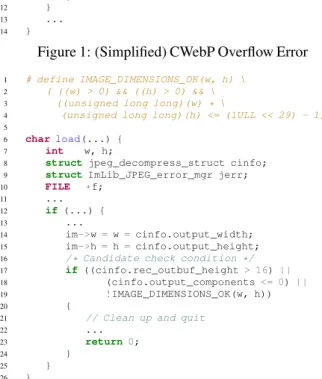
XAMPLEWe next present an example that illustrates how CP au-tomatically patches an integer overflow error in CWebP, Google’s conversion program for the WepP image format. Figure1presents (simplified) CWebP source code that contains an integer overflow error. CWebP uses the lib-jpeg library to read JPG images before converting them to the CWebP format. It uses the ReadJPEG function to parse the JPG files. There is a potential overflow at line
9 where CWebP calculates the size of the allocated im-age as stride * height, where stride is: width * output_components * sizeof(rgb).
On a 32-bit machine, inputs with large width and height fields can cause the image buffer size calculation at line 9 to overflow. In this case CWebP allocates an image buffer that is smaller than required and eventually writes beyond the end of the allocated buffer.
Error Discovery: Starting with a seed input that CWebP processes correctly, CP uses the DIODE integer overflow discovery tool to obtain a related input that triggers the integer overflow error. DIODE first executes CWebP on the seed input. At each executed memory allocation site, the DIODE instrumentation records a symbolic expression for the size of the allocated memory. The variables in this symbolic expression are the values of the JPG input fields. The symbolic expressions therefore capture the complete computation that CWebP performs on the input fields to obtain the sizes of the allocated memory blocks.
DIODE next leverages branch conditions and the recorded symbolic expressions to efficiently search the input space to find an input that triggers an integer over-flow at one (or more) of the memory allocation sites. In the error-triggering input in our example, the JPG /start_frame/content/height field is 62848 and the /start_frame/content/width field is 23200.
Donor Selection: CP next searches a database of appli-cations that process JPG files to find candidate donor ap-plications that successfully process both the seed and the error-triggering inputs. In this example CP finds the FEH image viewer application. CP will attempt to find a check in FEH that eliminates the integer overflow, then transfer that check from FEH into CWebP to eliminate the overflow in CWebP.
Candidate Check Discovery: CP next runs an instru-mented version of the FEH donor application on the seed and error-triggering inputs. At each conditional branch that is influenced by the relevant input field values (in this case the /start_frame/content/height and /start_frame/content/width fields), it records the direction taken at the branch and a symbolic expression for the value of the branch condition (the free variables in these expressions are the values of input fields).
CP operates under the hypothesis that one of the FEH branch conditions implements a check designed to detect inputs that trigger the overflow. Under this hypothesis, the seed input and error-triggering inputs take different directions at this branch (because the seed input would satisfy the branch condition and the error-triggering input would not). CP therefore considers the condition at each
1 intReadJPEG(...) { 2 ... 3 dth = dinfo.output_width; 4 height = dinfo.output_height; 5 stride = dinfo.output_width* 6 dinfo.output_components* 7 sizeof(*rgb); 8 /* the overflow error */
9 rgb= (uint8_t*)malloc(stride*height);
10 if(rgb==NULL) {
11 gotoEnd;
12 }
13 ...
14 }
Figure 1: (Simplified) CWebP Overflow Error
1 # define IMAGE_DIMENSIONS_OK(w, h) \ 2 ( ((w) > 0) && ((h) > 0) && \ 3 ((unsigned long long)(w) * \
4 (unsigned long long)(h) <= (1ULL << 29) - 1) ) 5
6 char load(...) {
7 int w, h;
8 structjpeg_decompress_struct cinfo; 9 structImLib_JPEG_error_mgr jerr;
10 FILE *f; 11 ... 12 if(...) { 13 ... 14 im->w=w =cinfo.output_width; 15 im->h=h =cinfo.output_height;
16 /* Candidate check condition */ 17 if((cinfo.rec_outbuf_height> 16)|| 18 (cinfo.output_components<= 0) || 19 !IMAGE_DIMENSIONS_OK(w, h))
20 {
21 // Clean up and quit
22 ...
23 return0;
24 }
25 }
26 }
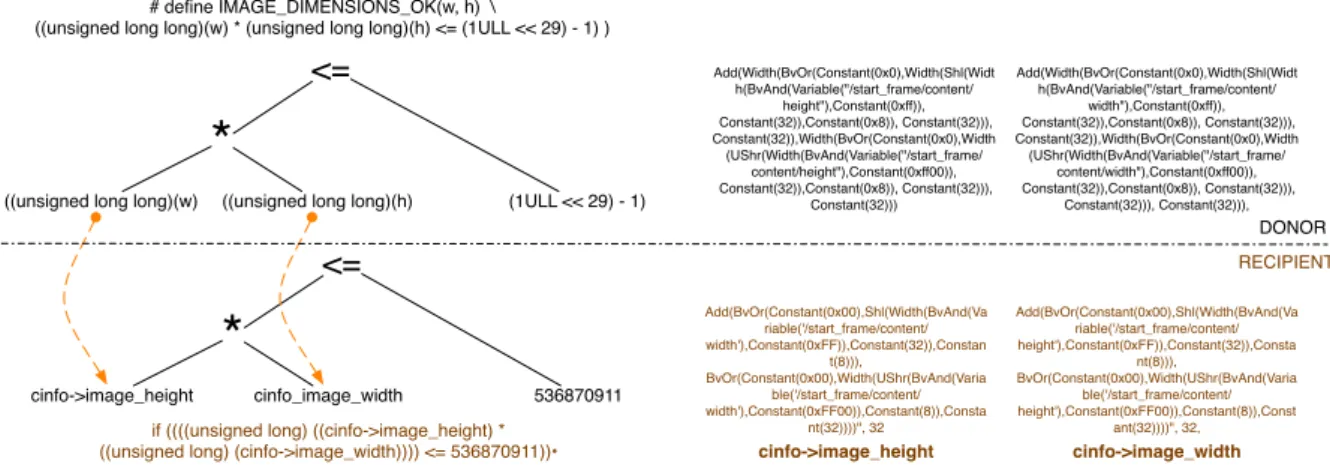
Figure 2: (Simplified) FEH Overflow Check branch at which the seed and error-triggering inputs take different directions to be a candidate check condition.
In our example, CP discovers a candidate check con-dition in the imlib library that FEH uses to load and process JPG files. Figure2presents the (simplified) source code for this condition.1The IMAGE_DIMENSIONS_OK
macro (line 19), performs an overflow check on the compu-tation of output_width * output_height. This check enables FEH to detect and correctly process the error-triggering input without overflow.
CP next excises the candidate check condition from the donor by expressing the condition as a function of the input bytes that determine the value of the condition. This excision uses an instrumented execution of the donor that dynamically tracks the flow of input bytes through program to record the bytes that appear in the output_width and
1Because CP operates on binaries, information about the source code for the donor patch is, in general, not available. So that we can present the FEH source code for the check in our example, we used the symbolic debugging information in FEH to manually locate the source code for the check.
((unsigned long long)(w) ((unsigned long long)(h)
*
<=
(1ULL << 29) - 1) Add(Width(BvOr(Constant(0x0),Width(Shl(Widt h(BvAnd(Variable("/start_frame/content/ height"),Constant(0xff)), Constant(32)),Constant(0x8)), Constant(32))), Constant(32)),Width(BvOr(Constant(0x0),Width (UShr(Width(BvAnd(Variable("/start_frame/ content/height"),Constant(0xff00)), Constant(32)),Constant(0x8)), Constant(32))), Constant(32))) Add(Width(BvOr(Constant(0x0),Width(Shl(Widt h(BvAnd(Variable("/start_frame/content/ width"),Constant(0xff)), Constant(32)),Constant(0x8)), Constant(32))), Constant(32)),Width(BvOr(Constant(0x0),Width (UShr(Width(BvAnd(Variable("/start_frame/ content/width"),Constant(0xff00)), Constant(32)),Constant(0x8)), Constant(32))), Constant(32))), Constant(32))), Add(BvOr(Constant(0x00),Shl(Width(BvAnd(Va riable('/start_frame/content/ width'),Constant(0xFF)),Constant(32)),Constan t(8))), BvOr(Constant(0x00),Width(UShr(BvAnd(Varia ble('/start_frame/content/ width'),Constant(0xFF00)),Constant(8)),Consta nt(32))))", 32 Add(BvOr(Constant(0x00),Shl(Width(BvAnd(Va riable('/start_frame/content/ height'),Constant(0xFF)),Constant(32)),Consta nt(8))), BvOr(Constant(0x00),Width(UShr(BvAnd(Varia ble('/start_frame/content/ height'),Constant(0xFF00)),Constant(8)),Const ant(32))))", 32, cinfo->image_height cinfo->image_width cinfo->image_height cinfo_image_width*
<=
536870911 if ((((unsigned long) ((cinfo->image_height) *((unsigned long) (cinfo->image_width)))) <= 536870911))• # define IMAGE_DIMENSIONS_OK(w, h) \
((unsigned long long)(w) * (unsigned long long)(h) <= (1ULL << 29) - 1) )
DONOR RECIPIENT
Figure 3: Patch Transfer output_height variables. In our example the excised
condition is as follows: ULessEqual(Width(Mul(Width(BvOr(Width(Shl(Width(SRemainder (BvOr(BvOr(Constant(0x00),Width(Sub(Add(Constant(8), Shl(Add(BvOr(Constant(0x00),Shl(BvAnd(Variable(’/start_frame/content/height’), Constant(0xFF)),Constant(8))),BvOr(Constant(0x00), UShr(BvAnd(Variable(’/start_frame/content/height’),Constant(0xFF00)), Constant(8)))),Constant(3))),Constant(1)),Constant(64))), Shl(Width(SShr(Sub(Add(Constant(8),Shl(Add(BvOr(Constant(0x00), Shl(Width(BvAnd(Variable(’/start_frame/content/height’), Constant(0xFF)),Constant(32)),Constant(8))),BvOr(Constant(0x00), UShr(BvAnd(Variable(’/start_frame/content/height’),Constant(0xFF00)), Constant(8)))),Constant(3))),Constant(1)),Constant(31)),Constant(64)), Constant(32))),Constant(8)),Constant(64)),Constant(32)),Constant(64)), SDiv(BvOr(BvOr(Constant(0x00),Width(Sub(Add(Constant(8), Shl(Add(BvOr(Constant(0x00), Shl(BvAnd(Variable(’/start_frame/content/height’), Constant(0xFF)),Constant(8))),BvOr(Constant(0x00), UShr(BvAnd(Variable(’/start_frame/content/height’),Constant(0xFF00)), Constant(8)))),Constant(3))),Constant(1)),Constant(64))), Shl(Width(SShr(Sub(Add(Constant(8), Shl(Add(BvOr(Constant(0x00), Shl(BvAnd(Variable(’/start_frame/content/height’), Constant(0xFF)),Constant(8))),BvOr(Constant(0x00), UShr(BvAnd(Variable(’/start_frame/content/height’),Constant(0xFF00)), Constant(8)))),Constant(3))),Constant(1)),Constant(31)),Constant(64)), Constant(32))),Constant(8))),Constant(64)), Width(BvOr(Width(Shl(Width(SRemainder(BvOr(BvOr(Constant(0x00), Width(Sub(Add(Constant(8),Shl(Add(BvOr(Constant(0x00), Shl(BvAnd(Variable(’/start_frame/content/width’),Constant(0xFF)), Constant(8))),BvOr(Constant(0x00), UShr(BvAnd(Variable(’/start_frame/content/width’), Constant(0xFF00)),Constant(8)))),Constant(3))),Constant(1)),Constant(64))), Shl(Width(SShr(Sub(Add(Constant(8),Shl(Add(BvOr(Constant(0x00), Shl(BvAnd(Variable(’/start_frame/content/width’),Constant(0xFF)), Constant(8))),BvOr(Constant(0x00), UShr(BvAnd(Variable(’/start_frame/content/width’),Constant(0xFF00)), Constant(8)))),Constant(3))),Constant(1)),Constant(31)),Constant(64)), Constant(32))), Constant(8)),Constant(64)),Constant(32)),Constant(64)), SDiv(BvOr(BvOr(Constant(0x00), Width(Sub(Add(Constant(8),Shl(Add(BvOr(Constant(0x00), Shl(BvAnd(Variable(’/start_frame/content/width’),Constant(0xFF)),Constant(8))), BvOr(Constant(0x00),UShr(BvAnd(Variable(’/start_frame/content/width’), Constant(0xFF00)),Constant(8)))),Constant(3))),Constant(1)), Constant(64))),Shl(Width(SShr(Sub(Add(Constant(8), Shl(Add(BvOr(Constant(0x00),Shl(BvAnd(Variable(’/start_frame/content/width’), Constant(0xFF)),Constant(8))),BvOr(Constant(0x00), UShr(BvAnd(Variable(’/start_frame/content/width’), Constant(0xFF00)),Constant(8)))),Constant(3))),Constant(1)), Constant(31)),Constant(64)),Constant(32))),Constant(8))), Constant(64))),Constant(64)),Constant(536870911))
There are two primary reasons for the complexity of this excised condition. First, it correctly captures how FEH manipulates the input fields to convert from big-endian (in the input file) to little-endian (in the FEH application) representation. Second, FEH also casts the 16-bit input fields to long integers before it performs the overflow check. The excised condition correctly captures the shifts and masks that are performed as part of this conversion.
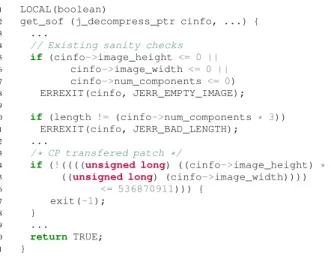
Patch Transfer: CP next attempts to transfer the candi-date check condition from the donor FEH application to the recipient CWebP application, then use the transferred condition to insert a check into CWebP that eliminates the integer overflow error. Two key challenges are translating the condition into the name space of the CWebP application (i.e., expressing the condition in terms of the variables of the CWebP application) and finding a successful insertion point for the generated check.
CP runs CWebP (the recipient) on the seed input. Af-ter every assignment that reads a program expression that contains one of the input fields in the candidate check con-dition, the CP instrumentation computes the input field values that are available in CWebP program expressions at that point. If all of the input field values in the condition are available at a given point, CP can express the candidate check condition in terms of the available CWebP expres-sions (Figure3illustrates the translation). Each such point is a candidate insertion point.
CP iterates over the candidate insertion points (sorted by the CWebP execution order). At each point CP generates a candidate patch and attempts to validate the patch to deter-mine if it 1) eliminates the error and 2) does not introduce a new error. The iteration continues until the patch validates. For CWebP, CP identifies 16 candidate insertion points. The first point occurs in jdmarker.c:267, which is part of the jpeg-6b library. At this point CP (using the cinfo− >image_height and cinfo− >image_width expressions available in the CWepP source code at that point) generates the following patch:
if (!((((unsigned long) ((cinfo->image_height) * ((unsigned long) (cinfo->image_width))))
<= 536870911))) { exit(-1);
}
com-plex application-independent excised condition into this simple form — CP was able to detect that CWebP, even though developed independently, performs the same en-dianess conversion, shifts, and masks on the input values as FEH. CP therefore realizes that the input values are available in the same format in both the CWebP and FEH internal data structures, enabling CP to generate a sim-ple patch that accesses the CWebP data structures directly with no complex format conversion. The generated patch checks the candidate check condition and, if the condition is true, exits the application. The rationale is to exit the application before the integer overflow (and any ensuing error or vulnerabilities) can occur.
Figure4, lines 14-18, shows where CP inserts the gener-ated patch into CWebP. A quick inspection of the surround-ing code, which also performs a number of input checks, indicates that CP selected an appropriate patch insertion point.
1 LOCAL(boolean)
2 get_sof (j_decompress_ptr cinfo, ...) {
3 ...
4 // Existing sanity checks 5 if(cinfo->image_height<= 0 || 6 cinfo->image_width<= 0 || 7 cinfo->num_components<= 0) 8 ERREXIT(cinfo, JERR_EMPTY_IMAGE); 9
10 if(length!=(cinfo->num_components* 3)) 11 ERREXIT(cinfo, JERR_BAD_LENGTH);
12 ...
13 /* CP transfered patch */
14 if(!((((unsigned long) ((cinfo->image_height)*
15 ((unsigned long) (cinfo->image_width))))
16 <= 536870911))) { 17 exit(-1); 18 } 19 ... 20 returnTRUE; 21 }
Figure 4: Transfered Patch In CWebP (from FEH) Patch Validation: Finally, CP rebuilds CWebP, which now includes the generated patch, and subjects the patch to a number of tests. First, it ensures the compilation process finished correctly. Second, it executes the patched version of CWebP on the error-triggering input and checks that the input no longer triggers the error (CP runs CWebP under Valgrind memcheck to detect any errors that do not manifest in crashes). Third, it runs a regression test that compares the output of the patched application to the output of the original application, on a pre-selected set of inputs that the application is known to process correctly. Fourth, CP runs the patched version of the application through the DIODE error discovery tool to ensure that no more error-triggering inputs can be generated. The end result, in this example, is a version of CWebP that contains a check that eliminates the integer overflow error in the original version.
3 D
ESIGN ANDI
MPLEMENTATIONWe next discuss how CP deals with the many technical issues it must overcome to successfully generate source-level patches for discovered errors. CP consists of approx-imately 10,000 lines of C (most of this code implements the taint and symbolic expression tracking) and 4,000 lines of Python (code for rewriting donor expressions into ex-pressions that can be inserted into the recipient, code that generates patches from the bitvector representation, code that interfaces with Z3, and the code that manages the database of relevant experimental results).
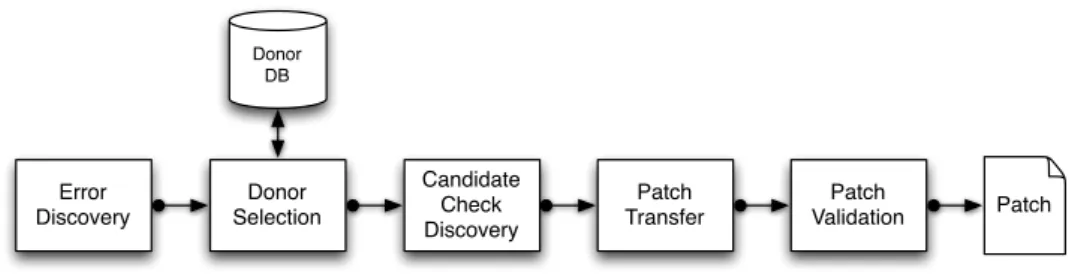
Figure5presents an overview of the CP components. First, we describe our techniques for error discovery. Sec-ond, we describe our methodology for selecting donors. Third, we describe our techniques for selecting candidate checks from donor applications. Fourth, we describe our patch transfer algorithms. Finally, we discuss our tech-niques for patch validation.
3.1 Error Discovery
CP uses DIODE [1], a tool that we have previously devel-oped, to automatically generate inputs that trigger integer overflows at memory allocation sites. DIODE is designed to identify relevant checks that inputs must satisfy to trigger overflows at target memory allocation sites, then generate inputs that satisfy these checks to successfully trigger the overflow.
Starting with a seed input that causes one or more target memory allocation sites to execute, DIODE performs the following steps:
• Target Allocation Site Identification: Using a fine-grained dynamic taint analysis on the application run-ning on the seed input, DIODE identifies all memory allocation sites that are influenced by values from the seed input. These sites are the target sites.
• Target Constraint Extraction: Based on instru-mented executions of the application, DIODE ex-tracts a symbolic target expression that characterizes how the application computes the target value (the size of the allocated memory block) at each target memory allocation site from input values. The input bytes that influence this expression are the relevant input bytes. Using the target expression, DIODE generates a target constraint that characterizes all in-puts that would cause the computation of the target value to overflow (as long as the input also causes the application to compute the target value).
• Branch Constraint Extraction: Again based on in-strumented executions of the application, DIODE extracts the sequence of conditional branch
instruc-Error Discovery Donor Selection Candidate Check Discovery Patch Transfer Patch Validation Donor DB Patch
Figure 5: High-level overview of CP’s components tions that the application executes to generate the path
to the target memory allocation site.
To ensure that DIODE productively considers only relevant conditional branches, DIODE discards 1) all conditional branches whose condition is not influ-enced by relevant input bytes and 2) all conditional branches that implement loop back edges.
For each remaining conditional branch, DIODE gen-erates a branch constraint that characterizes all input values that cause the execution to take the same path at that branch as the seed input. DIODE will use these branch constraints to generate candidate test inputs that force the application to follow the same path as the seed input at selected conditional branches. • Target Constraint Solution: DIODE invokes the Z3
SMT solver [19] to obtain input values that satisfy the target constraint. If the application follows a path that evaluates the target expression at the target memory allocation site, DIODE has successfully generated an input that triggers the overflow. If the application performs no checks on the generated values, this step typically delivers an input that triggers the overflow. • Goal-Directed Conditional Branch Enforcement:
If the previous step failed to deliver an input that trig-gers an overflow, DIODE compares the path that the seed input followed with the path that the generated input followed. These two paths must differ (oth-erwise the generated input would have triggered an overflow).
DIODE then finds the first (in the execution order) rel-evant conditional branch where the two paths diverge (i.e., where the generated input takes a different path than the seed input). We call this conditional branch the first flipped branch.
DIODE adds the branch constraint from the first flipped branch to the constraint that it passes to the solver, forcing the solver to generate a new input that takes the same path as the seed input at the first flipped branch. DIODE then runs the application on this new generated input to see if it triggers the overflow. DIODE continues this goal-directed branch
enforce-ment algorithm, increenforce-mentally adding the branch con-straints from first flipped branches, until either 1) it generates an input that triggers the overflow or 2) it generates an unsatisfiable constraint.
3.2 Donor Selection
For each input file format, CP works with a set of appli-cations that process that format. Note that the donor and recipient applications do not have to implement identical functionality — many of the errors that CP eliminates oc-cur in the initial input processing phase. Given seed and error-triggering inputs, CP considers applications that can successfully process both inputs as potential donors.
3.3 Candidate Check Discovery
To extract candidate checks from donor applications, CP contains a fine-grained dynamic taint analysis built on top of the Valgrind [33] binary analysis framework. Our analysis takes as input a specified taint source, such as a filename or a network connection, and marks all data read from the taint source as tainted. Each input byte is assigned a unique label and is tracked by the execution monitor as it propagates through the application until it reaches a poten-tial sink in the target application (e.g., branch conditions and memory allocation sites). To track the data-flow de-pendencies from source to sink, our analysis instruments arithmetic instructions (e.g., ADD, SUB), data movement instructions (e.g., MOV, PUSH) and logic instructions (e.g., AND, XOR). Our analysis also supports additional instru-mentation to reconstruct the full symbolic expression of the value at a sink, which represents how the application computes the value from input bytes.
Identify Candidate Check: CP runs the dynamic taint analysis on the donor application twice, once with a seed input and once with the bug-triggering input that DIODE generates from the seed input. For each execution, CP extracts the conditional branch statements in the execution path that relevant input bytes influence. For each such branch statement, CP records which branch direction the execution takes. CP then compares the two execution paths to find the flipped conditional branch statements that cause
the two executions diverge.
CP empirically transfers the condition of the first flipped branch statement into the recipient application. We call the condition of the first flipped branch statement the candidate check. If the generated patch does not pass the validation (see Section3.5), CP will transfer the second flipped branch statement to generate a new patch, etc.,.
Generate Target Symbolic Condition: Next, CP re-runs the application with additional instrumentation that enables CP to reconstruct the full target symbolic condition for the candidate check, which characterizes how the donor application computes the condition of the candidate check from the input byte values. Conceptually, CP generates a symbolic record of all calculations that the application performs. Obviously, attempting to record all calculations would produce an unmanageable volume of information. CP reduces the volume of recorded information with the following optimizations:
• Relevant Input Bytes: CP only records calculations that involve the relevant input bytes. Specifically, CP maintains an expression tree of relevant calculations that only tracks calculations that operate on tainted data (i.e., relevant input bytes). This optimization drastically reduces the amount of recorded informa-tion.
• Simplify Expressions: CP further reduces the amount of recorded information by simplifying recorded expressions at runtime. Specifically, CP identifies and simplifies resize, move and arithmetic operations. For example, CP can convert the follow-ing sequence of VEX IR instructions:
t15 = Add32(t10, 0x1:I32) t16 = Add32(t15,0x1:I32) t17 = Add32(t16,0x1:I32)
that would result in:
Add32(Add32(Add32(t10, 0x1), 0x1),0x1)
into:
Add32(t10, 0x3)
To convert relevant input bytes to symbolic represen-tations of the input format, CP uses the Hachoir [6] tool to convert byte ranges into input fields (e.g., in the PNG format, bytes 0-3 represent /header/height). If Hachoir does not support a particular input format or is otherwise unable to perform this conversion, CP also supports a raw mode in which all input bytes are represented as offsets.
3.4 Patch Transfer
Next, CP determines if the symbolic representation of the candidate check can eliminate the error from the recipient. In other words, CP verifies that the target constraint so-lution and relevant branches generated by DIODE, along
with the constraints introduced by the candidate check, can no longer be used to generate an input that can cause an integer overflow.
To transfer the candidate check to an insertion point in the recipient application, CP rewrites the target symbolic condition with active variables at the insertion point. There-fore, CP first needs to track how a recipient application computes the values of program variables that are derived from input bytes.
Specifically, CP performs its dynamic taint analysis on the recipient application with the bug-triggering input. For each variable assignment statement that involves relevant input bytes, the analysis records the symbolic expression of the assigned value, which characterizes how the recipient application computes the value from the input bytes.
If all of the required input bytes are available in program expressions after the assignment, CP currently considers the program point after each variable assignment statement that involves relevant input bytes to be a candidate check insertion point. For each such insertion point, CP identifies active program variables at the insertion point that CP can use to construct the patch. CP then invokes a rewrite algorithm to synthesize the patch.
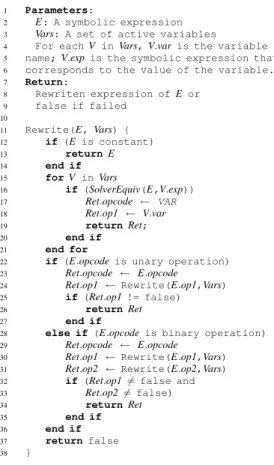
Figure6presents CP’s expression rewrite algorithm. The algorithm takes as input a symbolic expression E and a set of variables Vars as inputs and rewrites the expres-sion E using variables in Vars. The key insight behind the rewrite algorithm is that the synthesized condition in the recipient application should be semantically equivalent to the candidate check in the donor application at least on the error-triggering input. Therefore the symbolic representa-tion of the synthesized patch condirepresenta-tion should match the target symbolic condition CP obtains using the dynamic analysis on the donor application.
Constant expressions (lines 12-14) are directly used and do not require a rewrite pass. Next, the algorithm attempts to find a single variable to represent the whole expression (lines 15-21). If unsuccessful, the algorithm decomposes the expression and attempts to rewrite each subexpression recursively (lines 22-27 for expressions with unary opera-tions, lines 28-36 for expressions with binary operations). Note that at line 16, the algorithm queries the SMT solver to determine whether two symbolic expressions are equivalent. The CP implementation has two optimizations to reduce the number of invocations to the solver. First, if two symbolic expressions depend on different sets of input bytes, CP does not need to invoke the solver because these two expressions cannot be equivalent. Second, CP caches all queries to the SMT solver so that it can retrieve results from the cache for future duplicate queries.
1 Parameters:
2 E: A symbolic expression 3 Vars: A set of active variables
4 For each V in Vars, V.var is the variable 5 name; V.exp is the symbolic expression that 6 corresponds to the value of the variable. 7 Return: 8 Rewriten expression of E or 9 false if failed 10 11 Rewrite(E, Vars) { 12 if (E is constant) 13 return E 14 end if 15 for V in Vars 16 if (SolverEquiv(E,V.exp)) 17 Ret.opcode ← VAR 18 Ret.op1 ← V.var 19 return Ret; 20 end if 21 end for
22 if (E.opcode is unary operation) 23 Ret.opcode ← E.opcode
24 Ret.op1 ← Rewrite(E.op1,Vars) 25 if (Ret.op1 != false) 26 return Ret 27 end if
28 else if (E.opcode is binary operation)
29 Ret.opcode ← E.opcode 30 Ret.op1 ← Rewrite(E.op1,Vars) 31 Ret.op2 ← Rewrite(E.op2,Vars) 32 if (Ret.op1 6= false and 33 Ret.op2 6= false) 34 return Ret 35 end if 36 end if 37 return false 38 }
Figure 6: CP Rewrite algorithm
algorithm successfully constructs the new condition, CP generates a candidate patch as an if statement inserted at the insertion point. In the current implementation, CP transforms the constructed bitvector condition into a C expression as the if condition (appropriately generating the casts, shifts, and masks required to preserve the semantics of the transferred check). If the condition is satisfied, the patch exits the application with anexit(-1).
3.5 Patch Validation
CP first recompiles the patched recipient application. It then executes the patched application on the bug-triggering input to verify that the patch successfully eliminates the error for that input. CP also runs the patched build on a set of regression suite inputs to validate that the patch does not break the core functionality of the application. CP finally runs DIODE on the patched recipient application with the seed input. This validates that after the recipient applica-tion is patched, DIODE is not able to find another input that triggers the same error. In other words, CP validates that there is no input that satisfies the patch condition and the relevant branch conditions that DIODE generates while also triggering an overflow at the target allocation site.
4 E
XPERIMENTALR
ESULTSWe evaluate CP on seven integer overflow errors that DIODE previously detected in four applications: CWebP 0.31 [2], Dillo 2.1 [3], swfplay 0.55 [12], and Display 6.5.2-8 [7]. Two of these errors were listed in the CVE database; one was first discovered by BuzzFuzz [21]; the other four were, to the best of our knowledge, first discov-ered by DIODE. The errors are triggdiscov-ered by JPG image files (CWebP), PNG image files (Dillo), SWF video files (swf-play), and TIFF image files (Display). For JPG and PNG files our set of donor applications includes FEH-2.9.3 [4] and mtpaint 3.4 [10]. For TIFF files our donor application is ViewNoir 1.4 [13]. For SWF our donor application is gnash 0.8.11 [5].
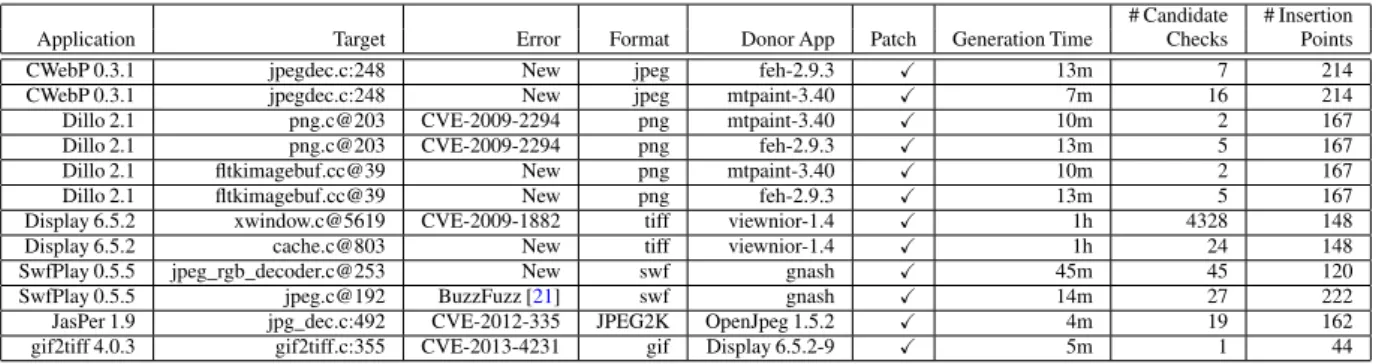
We also evaluate CP on two buffer overflow errors for applications: JasPer 1.9 [8] and gif2tiff 4.0.3 [9]. Both buffer overflow errors were listed in the CVE database. The error are triggered by JPEG2K images (JasPer) and gif (gif2tiff). For JPEG2K images we used OpenJPEG [11] as the donor and for gif images we used Display 6.5.2-9 [7]. For each error we started with seed and corresponding error-triggering inputs previously identified by DIODE. We then deployed CP in an attempt to generate validated patches to eliminate each of the errors. Figure7 summa-rizes the results of these experiments. There is a row in the table for each combination of error and donor application. The first column (Application) identifies the application. The second column (Target) identifies the source code file and line where the error occurs. The third column (Error) presents either the CVE identifier (if the error was previ-ously known) or new (if the error was first discovered by DIODE). The fourth column identifies the input file format. The fifth column identifies the donor application. The sixth column indicates (with a check mark) if CP was able to generate a validated patch for that recipient/donor pair (CP succeeded for all pairs). The seventh column presents the amount of time CP required to generate and validate the patch.
The eighth column presents the number of candidate checks that CP found in the donor. To improve the effi-ciency of the search, our current CP implementation uses the DIODE target overflow constraint from the allocation site, the conditions on the branches the DIODE enforced, and the patch condition to check if any input can simultane-ously satisfy all of these conditions. If so, there may be an input that can satisfy the check and still cause an overflow. In this case CP immediately filters the candidate check and moves on to the next check. For all of our benchmark errors, the first candidate check that passes this DIODE test eventually validates.
# Candidate # Insertion Application Target Error Format Donor App Patch Generation Time Checks Points
CWebP 0.3.1 jpegdec.c:248 New jpeg feh-2.9.3 X 13m 7 214
CWebP 0.3.1 jpegdec.c:248 New jpeg mtpaint-3.40 X 7m 16 214
Dillo 2.1 png.c@203 CVE-2009-2294 png mtpaint-3.40 X 10m 2 167
Dillo 2.1 png.c@203 CVE-2009-2294 png feh-2.9.3 X 13m 5 167
Dillo 2.1 fltkimagebuf.cc@39 New png mtpaint-3.40 X 10m 2 167
Dillo 2.1 fltkimagebuf.cc@39 New png feh-2.9.3 X 13m 5 167
Display 6.5.2 xwindow.c@5619 CVE-2009-1882 tiff viewnior-1.4 X 1h 4328 148
Display 6.5.2 cache.c@803 New tiff viewnior-1.4 X 1h 24 148
SwfPlay 0.5.5 jpeg_rgb_decoder.c@253 New swf gnash X 45m 45 120
SwfPlay 0.5.5 jpeg.c@192 BuzzFuzz [21] swf gnash X 14m 27 222
JasPer 1.9 jpg_dec.c:492 CVE-2012-335 JPEG2K OpenJpeg 1.5.2 X 4m 19 162 gif2tiff 4.0.3 gif2tiff.c:355 CVE-2013-4231 gif Display 6.5.2-9 X 5m 1 44
Figure 7: CP Experimental Results points that CP found in the recipient. For all of our
bench-mark errors, the first insertion point validates as expected.
4.1 Dillo
Dillo is a lightweight graphical web browser. Dillo 2.1 is vulnerable to an integer overflow when decoding the PNG file format. Dillo computes the size as a 32-bit product of width, height, and pixel depth. An overflow check is present, but the overflow check is itself vulnerable to an overflow. When the buffer size calculation overflows, the allocation at png.c line 203 returns a buffer that is too small to hold the decompressed image (CVE-2009-2294). Both FEH and mtpaint are successful donors for this error. The transferred check appears in FEH as a subexpression generated as part of the following macro invocation:2
if(!IMAGE\_DIMENSIONS\_OK(w32, h32))
After the transfer, the check appears in Dillo (libpng-1.2.50/pngrutil.c:497) as:
if (!((((unsigned int) (((unsigned int) (((unsigned int) ((unsigned int)
((width) * 0))) + ((unsigned int) ((unsigned int) ((unsigned int) ((height) *0)))))) + ((unsigned int) ((unsigned int) ((unsigned int) (((unsigned long long) ((height) * ((unsigned long long) (width)))) >> 32)))))) <= 0)))
{exit(-1);}
In this patch the repeated casts to unsigned int and unsigned long long are required to correctly reflect the varying bi-nary representations at which the FEH bibi-nary performs the check. The patch eliminates the error by checking that the
widthandheightvalues will never generate an overflow.
CP inserted the patch atlibpng-1.2.50/pngrutil.c:497.
The mtpaint patch uses the following check:
if ((pwidth > MAX\_WIDTH) || (pheight > MAX\_HEIGHT))
whereMAX_WIDTHis equal to 16384. This check generates
the following patch:
2Because CP operates on binaries, information about the source code for the donor patch is, in general, not available. To present the source code for the checks in this section, we used the symbolic debugging information in the binary (when available) to locate this source code.
if (!(((i) <= 16384))) {exit(-1);}
which CP inserts intolibpng-1.2.50/pngrutil.c:65. Two
things are of interest. First, the patch checks only the width field, but this check is enough to eliminate the overflow. Second, the check constrains the width to be small enough (no greater than 16384) so that Dillo may reject some valid input files. But this is consistent with the behavior of the mtpaint donor, which will also reject these same input files. We note that Dillo 2.1 has an additional overflow vul-nerability after the initial allocation. The same function initializes a cache for the image starting at png.c line 212, which leads to an allocation inside the FLTK library at fltkimgbuf.cc line 62 which computes a buffer size as a product of improperly checked variables. If the calculation of the buffer size overflows, the write of the image into the cache will overrun the allocated space. Because the buffer size computation involves the samewidthandheight
values, the previous patches also eliminate this error.
4.2 Display
ImageMagick Display is an image viewing and formatting utility released as part of the ImageMagick suite. Display 6.5.2 is vulnerable to an integer overflow for TIFF files. Display computes the length in bytes needed for a pixel buffer as a product of several values from the input file such as width, height, and bytes per pixel. With no over-flow checking at all in this version, this length calculation easily overflows its 32-bit size, resulting in an incorrect size passed to malloc at xwindow.c line 5619 (CVE-2009-1882).
CP successfully created a patch for this error using viewnior as the donor application. The transfered check appears in viewnoir as:
bytes = height * rowstride; if (bytes / rowstride != height)
This check was translated into the following patch for Display (cache.c:2056) as:
long long) ((unsigned long long) (((unsigned long long) (((unsigned int) (((unsigned int) ((unsigned int) (0 | ((unsigned long long) ((image->rows) * ((unsigned long long) ((unsigned int) ((unsigned int) ((image->columns) << 2))))))))) | ((unsigned int) ((unsigned int)
((unsigned int) (((unsigned long long) ((unsigned long long) (((unsigned int) ((image->rows) * ((unsigned int) ((unsigned int) ((unsigned int) ((image->columns) << 2)))))) >> 31))) << 32))))))
% ((unsigned long long) ((unsigned int) ((unsigned int) ((image->columns) << 2)))))) << 32))) | ((unsigned int) ((unsigned int) (((unsigned int) (((unsigned int) ((unsigned int) (0 | ((unsigned long long)
((image->rows) * ((unsigned long long) ((unsigned int) ((unsigned int) ((image->columns) << 2))))))))) | ((unsigned int) ((unsigned int) ((unsigned int) (((unsigned long long) ((unsigned long long) (((unsigned int) ((image->rows) * ((unsigned int) ((unsigned int) ((unsigned int) ((image->columns) << 2)))))) >> 31))) << 32)))))) / ((unsigned int) ((unsigned int) ((unsigned int) ((image->columns) << 2)))))))))))) {exit(-1);}
The multiple casts, shifts, and mask operations are re-quired to correctly reflect the different integer represen-tations at which the viewnoir binary performs the check. This patch eliminates the error by performing an overflow check onheight,width, and the number ofcolumns(used to
computerowstride)
Display also contains overflow errors when creating a resized version of the image for display within the GUI window (starting at display.c line 4393), and when creating a cache buffer for the image during TIFF decompression (a request for pixel space at tiff.c line 1044 eventually results in an allocation at cache.c line 3717). When the computation of any of these buffer sizes overflows, the allocated memory blocks are too small, causing Display to write beyond the end of the block.
CP generated a patch for this error, again using viewnior as the donor. The transfered check appears in viewnoir as:
rowstride = width * 4; if (rowstride / 4 != width)
CP transfers this check into Display as (tif_dirread.c:400):
if (!((((unsigned int) ((*(value)) | ((unsigned int) ((unsigned int) ((unsigned int) (((unsigned int) ((unsigned int) (((unsigned int) ((unsigned int) ((m) & 65280))) >> 8))) << 8)))))) == ((unsigned int)
(((unsigned long long) ((unsigned long long) (((unsigned long long) (((unsigned int) (((unsigned int) ((unsigned int) (0 | ((unsigned long long) (((unsigned int) ((*(value)) | ((unsigned int) ((unsigned int) ((unsigned int) (((unsigned int) ((unsigned int) (((unsigned int) ((unsigned int) ((m) & 65280))) >> 8))) << 8)))))) * ((unsigned long long) ((unsigned int) (( unsigned int) (((unsigned int) ((*(value)) | ((unsigned int) ((unsigned int) ((unsigned int) (((unsigned int) ((unsigned int) (((unsigned int) ((unsigned int) ((m) & 65280))) >> 8))) << 8)))))) << 2))))))))) | ((unsigned int) ((unsigned int) ((unsigned int) (((unsigned long long) ((uns igned long long) (((unsigned int) (((unsigned int) ((*(value)) | ((unsigned int) ((unsigned int) ((unsigned int) (((unsigned int) ((unsigned int)
(((unsigned int) ((unsigned int) ((m) & 65280))) >> 8))) << 8)))))) * ((unsigned int) ((unsigned int) ((unsigned int) (((unsigned int) ((*(value)) | ((unsigned int) ((unsigned int) ((unsigned int) (((unsigned int) ((unsigned int) (((unsigned int) ((unsigned int) ((m) & 65280))) >> 8))) << 8)))))) << 2)))))) >> 31))) << 32)))))) % ((unsigned long long) ((unsigned int) ((unsigned int) (((unsigned int) ((*(value)) | ((unsigned int) ((unsigned int) ((unsigned int) (((unsigned int) ((unsigned int) (((unsigned int) ((unsigned int) ((m) & 65280))) >> 8))) << 8)))))) << 2)))))) << 32))) | ((unsigned int) ((unsigned int) (((unsigned int) (((unsigned int) ((unsigned int) (0 | ((unsigned long long) (((unsigned int) ((*(value)) | ((unsigned int) ((unsigned int) ((unsigned int) (((unsigned int) ((unsigned int) (((unsigned int) ((unsigned int) ((m) & 65280))) >> 8))) << 8)))))) * ((unsigned long long) ((unsigned int) ((unsigned int) (((unsigned int) ((*(value)) |
((unsigned int) ((unsigned int) (( unsigned int) (((unsigned int) ((unsigned int) (((unsigned int) ((unsigned int) ((m) & 65280))) >> 8))) << 8)))))) << 2))))))))) | ((unsigned int) ((unsigned int) ((unsigned int) (((unsigned long long) ((unsigned long long) (((unsigned int) (((unsigned int) ((*(value)) | ((unsigned int) ((unsigned int) ((unsigned int) (((unsigned int) ((unsigned int) (((unsigned int) ((unsigned int) ((m) & 65280))) >> 8))) << 8)))))) * ((unsigned int) ((unsigned int) ((unsigned int) (((unsigned int) ((*(value)) | ((unsigned int) ((unsigned int) ((unsigned int) (((unsigned int) ((uns igned int) (((unsigned int) ((unsigned int) ((m) & 65280))) >> 8))) << 8)))))) << 2)))))) >> 31))) << 32)))))) / ((unsigned int) ((unsigned int) ((unsigned int) (((unsigned int) ((*(value)) | ((unsigned int) ((unsigned int) ((unsigned int) (((unsigned int) ((unsigned int) (((unsigned int) ((unsigned int) ((m) & 65280))) >> 8))) << 8)))))) << 2)))))))))))) {exit(-1);}
This patch successfully protects against the integer over-flow error with the added overover-flow check onwidth * 4.
Once again, the patch reflects the conversion of the ana-lyzed viewnoir VEX binary operations into C source code.
4.3 Swfplay
Swfplay is an Adobe Flash player that is released as part of the open source Swfdec library. Swfplay 0.5.5 is vulner-able to an integer overflow for SWF files when decoding embedded JPEG data. When initially allocating buffers for the individual YUVA components of the image, swf-play computes the buffer size for each component buffer as the 32-bit product of width, height, and various sam-pling factors without sufficient overflow checking (jpeg.c line 192). If the computation overflows, then the decom-pression procedure will write beyond the allocated space. Even if the computations of individual component buffer sizes do not overflow, there is a potential overflow when merging the individual YUVA components of the image into a single RGBA buffer. Swfplay computes the size of the combined buffer as a 32-bit product of width, height and 4 without performing any overflow checking. This computation is used twice in close succession: once for the allocation of a temporary buffer (jpeg_rgb_decoder.c line 253), and then for the allocation of the image buffer
(jpeg_rgb_decoder.c line 257). When this computation overflows, the merge procedure will write beyond the al-located space and ultimately result in a SIGSEGV on an invalid write. CP generated a patch for this error, again using Gnash as the donor. Because symbolic information that would allow us to locate the Gnash source code for this patch is not available, we present only the patch in the swfplay recipient:
if (!(((image->height) <= 65500))) {exit(-1);}
This patch protects the application by limiting height to a 16 bit value, which when used in the product of width, height, and a small constant, cannot generate an overflow on 32 bit machines.
For the error at (jpeg_rgb_decoder.c line 253), CP gen-erates the following patch at jpeg_bits.c line 60:
if (!((((unsigned int) (((unsigned long long)
((unsigned long long) (((unsigned long long) ((unsigned long long) (((unsigned int) (((unsigned int) ((unsigned int) (0 | ((unsigned long long) ((unsigned long long) (8 * ((unsigned int) ((unsigned int) (((unsigned int) ((unsigned int) (0 | (*(b->ptr))))) & 15))))))))) | ((unsigned int) ((unsigned int) ((unsigned int) (((unsigned long long) ((unsigned long long)
(((unsigned int) ((unsigned int) (8 * ((unsigned int) ((unsigned int) (((unsigned int) ((unsigned int) (0 | (*(b->ptr))))) & 15)))))) >> 31))) << 32)))))) % 8))) << 32))) | ((unsigned int) ((unsigned int) ((unsigned int) (((unsigned int) (((unsigned int) ((unsigned int) (0 | ((unsigned long long) ((unsigned long long) (8 * ((unsigned int) ((unsigned int) (((unsigned int) ((unsigned int) (0 | (*(b->ptr))))) & 15))))))))) | ((unsigned int) ((unsigned int) ((unsigned int) (((unsigned long long) ((unsigned long long)
(((unsigned int) ((unsigned int) (8 * ((unsigned int) ((unsigned int) (((unsigned int) ((unsigned int) (0 | (*(b->ptr))))) & 15)))))) >> 31))) << 32)))))) / 8)))))) == ((unsigned int) ((unsigned int) (((unsigned int) ((unsigned int) (0 | (*(b->ptr))))) & 15)))))) {exit(-1);}
4.4 gif2tiff
gif2tiff is a utility in the libtiff-4.0.3 library which converts gif images to the tif format. gif2tiff is vulnerable to a buffer overflow attack when processing gif images. gif2tiff iterates over the size of the law code size, which under the gif specification should be limited to a size of 12. Without a check to constrain the code size to 12, the loop over the code size ingif2tif.c:355can be forced to overwrite over
a set of statically allocated buffers.
CP successfully created a patch for this error using ImageMagick-6.5.2-9 as the donor. The transfered check appears in ImageMagick-6.5.2-9 as:
#define MaximumLZWBits 12 if (data\_size > MaximumLZWBits) { ThrowBinaryException(CorruptImageError, "CorruptImage", image.filename); }
This check was translated into the following patch for gif2tiff (gif2tiff.c:357) as:
if (!(((unsigned char) (((unsigned int) datasize) <= ((unsigned int) 12))))) {exit(-1);}
The check correctly enforces the gif specification that the code size should have a maximum size of 12 and pro-tects gif2tiff from the buffer overflow vulnerability.
4.5 Jasper
JasPer is an open-source image viewing and image process-ing utility. It is specifically known for its implementation of the JPEG-2000 standard. JasPer is vulnerable to an off-by-one vulnerability when processing the JPEG-2000 images. JPEG-2000 images may be composed of several tiles. Tiles are identified in the input format using a num-ber. JasPer includes code to check that the number of tiles present in the image correspond to the number specified in the input format but that code is vulnerable to a off-by-one bug at (jpc_dec.c:492); it uses a>check instead of a>=
check.
CP created a patch for this error using OpenJPEG 1.5.2 as the donor application. The transfered check appears in OpenJPEG (j2k.c:1394) as:
if ((tileno < 0) || (tileno >= (cp->tw * cp->th))) { opj_event_msg(j2k->cinfo, EVT_ERROR,
"JPWL: bad tile number (%d out of a maximum of %d)", tileno, (cp->tw * cp->th));
return; }
This check was translated into the following patch for JasPer (jpc_dec.c:492) as:
if (!(!(dec->numtiles <= sot->tileno))) {exit(-1);}
This patch successfully protects against the off-by-one error with the proper checkdec->numtiles <= sot->tileno
that includes a less than equal rather than a less than check.
5 R
ELATEDW
ORKWe discuss related work in program repair (static and dynamic), N-version programming, and horizontal gene transfer.
Static Program Repair: GenProg [41,27] is an auto-matic program repair tool that uses a genetic algorithm to synthesize program patches. GenProg first copies an existing code snippet from another location in the program, then randomly applies a set of mutation rules based on the genetic algorithm in an attempt to find a patch that generates correct results on a set of sample inputs. CP, in constrast, eliminates errors by transferring correct code across multiple applications (including stripped binary donor applications).
PAR [24] is a program repair tool that applies a set of ten predefined repair templates that the authors manually
summarized from legacy human-written patches. These templates correspond to the structures of common human patches (e.g, inserting null checker, adding a method call, inserting a bound check, etc.). PAR uses a search algorithm to fill in details in the templates (e.g., the variable to be checked, the method to be called.)
In contrast, CP transfers correct checks across appli-cations. Instead of random mutations, CP uses dynamic analysis techniques to obtain an application-independent representation of the check, then implant the check into the recipient at an appropriate insertion point where the required values are available in program expressions.
Khmelevsky et al. [23] present a source-to-source repair tool for missing return value checks after system library calls (e.g., fopen()). The tool scans through the source code for these library calls. For each of these calls, if the source code misses the corresponding check after the call, the tool will automatically add one.
Logozzo and Ball [28] have proposed a program repair technique that provides the guarantee of verified program repair in the form that the repaired program has more good executions and less bad executions than the original pro-gram. However, it relies on developer-supplied contracts (i.e., preconditions, postconditions, and object invariants) for scalability, which makes the technique less practical. In contrast, CP is fully automatic — it does not require any human annotations to transfer patches from the donor application to the recipient application.
SJava [20] is a Java type system that exploits common it-erative structures in applications. When a developer writes program in SJava, the compiler can prove that the effects of any error will be flushed from the system state after a fixed number of iterations.
Runtime Program Repair: Failure-Oblivious Comput-ing [36] enables an application to survive common memory error. It recompiles the application to discard out of bounds writes, manufacture values for out of bounds reads, and enable the application to continue along their normal exe-cution path. RCV [31] enables an application to recover from divide-by-zero and null-dereference errors on the fly. When such an error occurs, RCV attaches the application, applies fix strategy that typically ignores the offending instruction, forces the application to continue along the normal execution path, contains the error repair effect, and detaches from the application once the repair succeeds. SRS [32] enables server applications to survive memory corruption errors. When such an error occurs, it enters a crash suppression mode to skip any instructions that may access corrupted values. It backs to normal mode once the server moves to the next request.
Jolt [16] and Bolt [25] enable applications to survive
in-finite loop errors. When such an error occurs, they control the execution of the application to jump out of the loop or the enclosing function to escape the error.
ClearView [34] first learns a set of invariants from train-ing runs. When a learned invariant is violated durtrain-ing the runtime execution, it generates repairs that enforce the violated invariant via binary instrumentation.
Rx [35] and ARMOR [17] are runtime recovery sys-tems based on periodic checkpoints. When an error occurs, Rx [35] reverts back to a previous checkpoint and makes system-level changes (e.g, thread scheduling, memory allo-cations, etc.) to search for executions that do not trigger the error. ARMOR [17] reverts back to a previous checkpoint and finds semantically equivalent workarounds for the failed component based on user-provided specifications.
Error Virtualization [37,38,40,39] is a general error recovery technique that retrofits exception-handing capa-bilities to legacy software. Failures that would otherwise cause a program to crash are turned into transactions that use a program’s existing error handling routines to survive from unanticipated faults.
Input rectification [29] empirically learns input con-straints from benign training inputs and then enforces learned constraints on incoming inputs to nullify potential errors. SIFT [30] can generate sound input filter constraints for integer overflow errors at critical program points (i.e., memory allocation and block copy sites)
All of the above techniques aim to repair the application at runtime to recover from or nullify the error. In contrast, CP is designed to transfer correct code from donors to recipients to directly eliminate the error. The final patched application then executes with no dynamic instrumentation overhead.
N-Version Programming: N-version programming [18] aims to improve software reliability by independently de-veloping multiple implementations of the same specifi-cation. All implementations execute and the results are compared to detect faulty versions. The expense of N-version programming and a perception that the multiple implementations may suffer from common errors and spec-ification misinterpretations has limited the popularity of this approach [26].
Rather than running multiple versions and comparing the results, CP transfers correct logic to obtain a single improved hybrid system. In comparison with traditional N-version programming, CP therefore has a simpler execu-tion model (run a single hybrid system instead of multiple systems) and can leverage applications with overlapping but not identical functionality. Also unlike traditional N-version programming, CP is designed to work with applications that are produced by multiple global,
sponta-neous, and uncoordinated development efforts performed by different organizations. Our results indicate that these development efforts can deliver enough diversity to enable CP to find and transfer correct error checks.
Horizontal Gene Transfer: Horizontal gene transfer is the transfer of genetic material between individual cells [14]. Examples include plasmid transfer (which plays a major role in acquired antibiotic resistance [14]) and virally-mediated gene therapy [22]. There are strong analo-gies between CP’s logic transfer mechanism and horizontal gene transfer — in both cases functionality is transferred from a donor to a recipient, with significant potential bene-fits to the recipient. The fact that horizontal gene transfer is recognized as significant factor in the evolution of many forms of life hints at the potential that multi-application code transfer may offer for software systems.
6 C
ONCLUSIONIn recent years the increasing scope and volume of soft-ware development efforts has produced a broad range of systems with similar or overlapping goals. Together, these systems capture the knowledge and labor of many develop-ers. But each individual system largely reflects the effort of a single team and, like essentially all software systems, still contains errors.
We present a new and, to the best of our knowledge, the first, technique for automatically transferring logic between systems to eliminate errors. The system that im-plements this technique, CP, makes it possible to automati-cally harness the combined efforts of multiple potentially independent development efforts to improve them all re-gardless of the relationships that may or may not exist across development organizations. In the long run we hope this research will inspire other techniques that identify and combine the best aspects of multiple systems. The ideal result will be significantly more reliable and functional software systems that better serve the needs of our society.
R
EFERENCES[1] Anonymized reference.
[2] Cwebp. https://developers.google.
com/speed/webp/docs/cwebp.
[3] Dillo.http://www.dillo.org/.
[4] Feh - a fast and light Imlib2-based image viewer.
http://feh.finalrewind.org/.
[5] Gnu gnash. https://www.gnu.org/
software/gnash/.
[6] Hachoir. http://bitbucket.org/haypo/
hachoir/wiki/Home.
[7] Imagemagick. http://www.imagemagick.
org/script/index.php.
[8] The jasper project home page.http://www.ece.
uvic.ca/~frodo/jasper/. [9] Libtiff.http://www.remotesensing.org/ libtiff/. [10] mtpaint. http://mtpaint.sourceforge. net/. [11] Openjpeg.http://www.openjpeg.org. [12] Swfdec. http://swfdec.freedesktop. org/wiki/.
[13] Viewnoir - the elegant image viewer. http://
xsisqox.github.io/Viewnior/.
[14] M. Barlow. What Antimicrobial Resistance Has Taught Us About Horizontal Gene Transfer. Methods in Molecular Biology, 532:397–411, 2009.
[15] D. Bruening, T. Garnett, and S. Amarasinghe. An infrastructure for adaptive dynamic optimization. In Code Generation and Optimization, 2003. CGO 2003. International Symposium on, pages 265–275. IEEE, 2003.
[16] M. Carbin, S. Misailovic, M. Kling, and M. C. Ri-nard. Detecting and escaping infinite loops with jolt. In Proceedings of the 25th European conference on Object-oriented programming, ECOOP’11, pages 609–633. Springer-Verlag, 2011.
[17] A. Carzaniga, A. Gorla, A. Mattavelli, N. Perino, and M. Pezzè. Automatic recovery from runtime failures. In Proceedings of the 2013 International Conference on Software Engineering, pages 782–791.
[18] L. Chen and A. Avizienis. N-version programming: A Fault-tolerance approach to reliability of software operation. In The Twenty-Fifth International Sympo-sium on Fault-Tolerant Computing Highlights from Twenty-Five Years. IEEE, 1995.
[19] L. De Moura and N. Bjørner. Z3: an efficient smt solver. In Proceedings of the Theory and practice of software, 14th international conference on Tools and algorithms for the construction and analysis of systems, TACAS’08/ETAPS’08, pages 337–340, Berlin, Heidelberg, 2008. Springer-Verlag.