HAL Id: hal-00297517
https://hal.archives-ouvertes.fr/hal-00297517
Submitted on 17 Jun 2005
HAL is a multi-disciplinary open access
archive for the deposit and dissemination of
sci-entific research documents, whether they are
pub-lished or not. The documents may come from
teaching and research institutions in France or
abroad, or from public or private research centers.
L’archive ouverte pluridisciplinaire HAL, est
destinée au dépôt et à la diffusion de documents
scientifiques de niveau recherche, publiés ou non,
émanant des établissements d’enseignement et de
recherche français ou étrangers, des laboratoires
publics ou privés.
Non-invasive diagnostics in fossils - Magnetic Resonance
Imaging of pathological belemnites
D. Mietchen, H. Keupp, B. Manz, F. Volke
To cite this version:
D. Mietchen, H. Keupp, B. Manz, F. Volke. Non-invasive diagnostics in fossils - Magnetic Resonance
Imaging of pathological belemnites. Biogeosciences, European Geosciences Union, 2005, 2 (2),
pp.133-140. �hal-00297517�
www.biogeosciences.net/bg/2/133/ SRef-ID: 1726-4189/bg/2005-2-133 European Geosciences Union
Biogeosciences
Non-invasive diagnostics in fossils – Magnetic Resonance Imaging of
pathological belemnites
D. Mietchen1,2, H. Keupp3, B. Manz1, and F. Volke1
1Fraunhofer-Institute for Biomedical Engineering (IBMT), St. Ingbert, Germany
2Faculty of Physics and Mechatronics, University of the Saarland, Saarbr¨ucken, Germany 3Institute of Geological Sciences, Freie Universit¨at Berlin, Germany
Received: 21 February 2005 – Published in Biogeosciences Discussions: 14 March 2005 Revised: 12 May 2005 – Accepted: 27 May 2005 – Published: 17 June 2005
Abstract. For more than a decade, Magnetic Resonance
Imaging (MRI) has been routinely employed in clinical diag-nostics because it allows non-invasive studies of anatomical structures and physiological processes in vivo and to differ-entiate between healthy and pathological states, particularly of soft tissue. Here, we demonstrate that MRI can likewise be applied to fossilized biological samples and help in eluci-dating paleopathological and paleoecological questions: Five anomalous guards of Jurassic and Cretaceous belemnites are presented along with putative paleopathological diagnoses directly derived from 3D MR images with microscopic reso-lution. Syn vivo deformities of both the mineralized internal rostrum and the surrounding former soft tissue can be traced back in part to traumatic events of predator-prey-interactions, and partly to parasitism. Besides, evidence is presented that the frequently observed anomalous apical collar might be in-dicative of an inflammatory disease. These findings highlight the potential of Magnetic Resonance techniques for further paleontological applications.
1 Introduction
Paleopathological studies can shed light on the ecology of ancient life forms, and they are helpful to evaluate the func-tional significance of morphological traits (Keupp, 1984, 1985). Most of the described paleopathological phenomena of fossil hard parts have a synecologial origin, i.e. they arose from interactions between different species (e.g. through pre-dation, parasitism, epizoism). The specific reaction of the or-ganism under attack lead to a characteristic syndrome whose symptoms often include anomalous growth patterns that can still be observed in fossil remains. The resulting degree of alterations in morphology always ranges within specific tol-Correspondence to: D. Mietchen
erance limits and allows to estimate the functional relevance of distinct morphological features.
Within a wealth of paleopathological studies, most focus on vertebrates (cf. Tasn´adi-Kubacska, 1962) but consider-able efforts have also been directed towards pathological as-pects of invertebrates – namely ectocochleate cephalopods, and ammonites in particular, research on which has a long scientific tradition (e.g. Engel, 1894; H¨older, 1956; Guex, 1967; Bayer, 1970; Keupp, 2000; Hengsbach, 1996; Kr¨oger, 2000; Keupp, 1984, 1985). Descriptions and interpretations of anomalies in skeletons of endocochleate cephalopods, in contrast, appear only sporadically (for modern sepiids, see Ruggiero, 1980; Battiato, 1983; Ward and von Boletzky, 1984; von Boletzky and Overath, 1989; Bello and Paparella, 2002; for fossil squids, see Dietl and Schweigert, 2001). No-table exception are healed fractures in belemnite guards (see references in Keupp, 2002) which were seen as a proof of the endocochleate nature of the belemnite skeletons and gave rise to speculations about their function being, amongst other suggestions, a pushing weapon (Naef, 1922) or a digging tool (Abel, 1916). The reason for the different treatment of endo-and ectocochleate specimens has a very practical nature: The shells of ectocochleate cephalopods allow sublethal injuries and other growth disturbances as well as the subsequent for-mation of characteristic syndromes of the attacked animal to be diagnosed immediately from anywhere in their posterior parts. Conventional investigations of anomalous belemnite guards, though, require to damage the rostrum in which for-mer growth stages are surrounded by the later calcitic layers. Similar accessibility constraints apply to other types of spec-imens whose analysis by such invasive methodology, con-sequently, leads to considerable damage or even loss of the sample (Siveter et al., 2004). Our study, therefore, was de-signed to evaluate the potential of a non-invasive technique – Magnetic Resonance Imaging (MRI) – for paleontological applications, particularly in cases of rare anomalous fossils where it is especially desirable to avoid specimen
destruc-134 D. Mietchen et al.: Non-invasive diagnostics in fossils tion or to make informed decisions about how to sample
in-vasively, where and how much. 1.1 Magnetic resonance imaging
The concept of Magnetic Resonance techniques and their ap-plications in materials science and biomedical research have elsewhere been described in detail (e.g. Callaghan, 1991; Bl¨umich and Kuhn, 1992; Boesch, 1999; Glover and Mans-field, 2002). In biomineralized samples, they have been em-ployed for bone trabecular structure determinations in osteo-porosis patients (Borah et al., 2001), for comparative studies on skeletal evolution (Spoor et al., 2000) as well as for indi-rect imaging of mouldic fossils after artificial filling with wa-ter as a contrast agent (Clark et al., 2004), and a short review on their potential for archeological investigations including resins, wood and semi-fossil bones is available (Lambert et al., 2000). Briefly, the spin of the nucleus of each atom pos-sesses an isotope-specific resonance frequency directly pro-portional to the magnetic field strength it experiences. Thus, if irradiated by radiowaves at or very close to this frequency, a subpopulation of such an isotope can be excited. In a highly homogeneous field, subtle differences between the chemi-cal bonds of different nuclei of the same species will trans-late into shifts of their resonance frequency, the recording of which is the basis of MR Spectroscopy. If, moreover, uni-form magnetic field gradients are superimposed to the static field after excitation, the signal response which relaxes with two major time constants, T1and T2, will contain
frequency-encoded information about the spatial distribution of the ex-cited nuclei, which allows for MR Imaging. In our study, only the signal of hydrogen nuclei (protons) within the fossils was detected. Depending on the chemical composition of a sample, on the gradient strengths and on the excitation pulse sequences used for data acquisition, the chemical and spatial information can be separated in MR images. The achiev-able image resolution depends on the relaxation constants, proton concentration and other MR parameters (Callaghan, 1991). Sample dimensions, moreover, depend on the type of spectrometer and on the dimensions of the gradient system as well as the probe, and structures – including cavities or pores – can be visualized as long as they result in changes of MR parameters. However, for the solid state samples investigated here, the signal intensity obtained for each volume element (voxel) mainly reflects its hydrogen content and is insensi-tive to properties of the chemical bonds that the protons in this voxel are engaged in. Therefore, a clear distinction of signals originating from organic or inorganic compounds of these belemnites is not possible.
1.2 Architecture and normal growth pattern of belemnite guards
The belemnite guard formed part of the endoskeleton of a squid-like decabrachiate coleoid and consists primarily
of low-Mg calcite (Sælen, 1989). Its distal part (ros-trum solidum or orthoros(ros-trum) is massive, the proximal part (rostrum cavum) surrounds the chambered aragonitic shell (phragmocone) that served as a buoyancy apparatus. The ros-trum solidum is sometimes distally covered by an epirosros-trum that often appears hollow due to a presumably high primary content of organic or aragonitic material (Bandel and Spaeth, 1988). The guard is generally thought to have served as a counterweight to the soft body and was situated at the poste-rior portion of the orthoconic phragmocone, allowing the ani-mal to maintain a horizontal swimming posture (Naef, 1922; Fischer, 1947; Stevens, 1965). The primary anlage of the rostrum was the cone-shaped “primordial guard” within the egg (Hanai, 1953; Jeletzky, 1966; Bandel et al., 1984). Dur-ing ontogenesis, the rostrum thickened concentrically, and sometimes allometrically, by periodic accretions of radially arranged calcite prisms. The resulting microstructure is char-acterised by dominating radial calcite fibres with numerous relatively distinct growth lamellae that transverse the calcite prisms and become more closely spaced towards the outer margin of the guard. The original texture of the orthorostrum was solid, with an inner porosity of only 10% maximum (Veizer, 1974). Distinct concentric growth rings that cut the radially arranged crystals reflect phases of episodically re-duced mineralisation that temporarily allowed integration of higher percentages of organic matter (Sælen, 1989), most of which has later been replaced by diagenetic calcite, as evi-denced by data of stable isotopes (δ18O, δ13C ) and cathodo-luminescence (Podlaha et al., 1998; O’Neill et al., 2002). 1.3 Paleopathological phenomena
Deformations of belemnite guards can result either from di-agenetic, tectonic and impact events after the death of the or-ganism or, during its life time, from illness or antibiotic inter-actions (predator-pray relationships, parasitism). Specimens of the latter group are collectively referred to as “patholog-ical” (Keupp, 2002), and growth anomalies in juveniles are the focus of this study.
Pathological guards were described and interpreted for the first time by Duval-Jouve (1841) in sliced rostra with frac-tures. First attempts to extract evidence for behavioural traits of belemnoid animals from pathologic guards were made by Abel (1916) who attributed Duval-Jouve’s rostral fractures to damage experienced when the animal used its posterior end as a digging tool, rather than to an unsuccessful attack by a predator. Consequently, he postulated a benthic way of life for these specimens. However, cuttlebone growth dis-turbances in modern cuttlefish living in their natural habi-tat are mostly triggered by repair of sublethal injuries as a consequence of unsuccessful attacks by predators – includ-ing human divers (von Boletzky and Overath, 1989). Corre-spondingly, it may be expected that many anomalous guards of belemnites reflect the repair of similar damages to the preadult rostrum or its muscular mantle. Nonetheless, it has
D. Mietchen et al.: Non-invasive diagnostics in fossils 135 been shown that – besides such exogenous traumatic events
– remarkable anomalies also resulted from endogenous dis-turbances of the mantle tissue, including presumed cases of parasitism (Radwa´nska and Radwa´nski, 2004).
2 Sample description and method
Five belemnite guards from the collection Keupp (PB), housed at the Institut of Geological Sciences, Freie Univer-sit¨at Berlin, Germany, were investigated. Hereafter, they will be referred to by their respective catalogue numbers. PB246, PB248 and PB249 are Gonioteuthis quadrata (Blainville, 1827) guards from the Late Cretaceous (Upper Campanian, ca. 75 Myr) marl pit “Alemannia”, H¨over near Hannover, Germany. PB264 is a cast of a Neoclavibelus subclavatus (Voltz, 1830) rostrum from the Late Toarcian (Upper Lias-sic, ca. 182 Myr) of Mistelgau near Bayreuth, Germany. Our study has been performed on the original sample which is with V. Kriegisch, Schonungen, Germany. PB251 is a Hi-bolithes jaculoides (Swinnerton, 1937) rostrum of the Lower Cretaceous (Late Hauterivian, ca. 118 Myr) from the coast of Helgoland Island, Germany. None of the samples were glued nor, to our knowledge, otherwise chemically conserved after excavation.
The MRI experiments were performed on a BRUKER Avance NMR spectrometer (Bruker, Rheinstetten, Germany) operating at a 1H resonance frequency of 400 MHz with standard Micro2.5 microimaging equipment and a maximum gradient strength of 0.4 T/m. Images were recorded us-ing a standard 3D spin-echo imagus-ing sequence (echo time
Te=1.3 ms, repetition time Tr=1 s if not mentioned
other-wise; for details, see Ernst et al., 1997). Each image consists of 128×128×256 voxels. With typical sample dimensions of the order 10×10×30 mm3, this normally resulted in spa-tial resolutions around 100 µm. The total acquisition time (Ta)ranges between 18 and 93 h per image, depending on
each sample’s signal strength. Details are given in the figure legends.
In the image slices, occasional single pixels with high sig-nal intensity but no morphological context are an artifact originating from the Fourier transformation of frequency into spatial information. The apparent loss of signal intensity to-wards the edges of the Field of View (FOV) is due to the coil geometry employed to send and receive the radiofrequency signals. The images were visualized and processed with the help of ImageJ (available at http://rsb.info.nih.gov/ij; de-veloped by Wayne Rasband, National Institutes of Health, Bethesda, MD).
3 Results and discussion
All five belemnite guards described here exhibit anomalous growth patterns, the beginning of which – as well as their pre-sumptive endogenous or exogenous origins – are not
observ-Figures
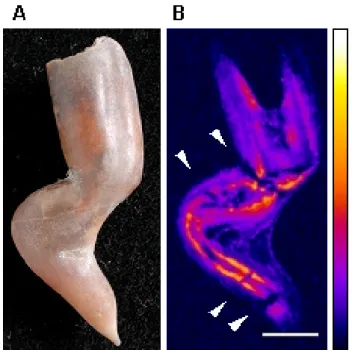
Fig. 1.
Sublethal injury with fracture of the rostrum.
Fig. 1. Sublethal injury with fracture of the rostrum. Gonioteuthisquadrata (Blainville, 1827) guard with a zigzag-like deformation.
(A): lateral view (photomicrograph). (B): median MR section.
Ar-row heads indicate fractures. The corresponding slice series (in steps of 125 µm) with this orientation is given in Movie 1. Acquisi-tion parameters: Field of view (FOV): 15×15×32 mm3. Number of averages (NA): 2. Total acquisition time (Ta): 18 h. Colour scale:
MR signal intensity in arbitrary units (identical for all MR images). Scale bar: 5 mm for all MR image slices.
able externally, since subsequent calcitic lamellae cover the original disruption and obstruct the cause for its existence. In contrast, the presumed origins of the pathologies and their subsequent development of growth anomalies could be ex-tracted non-invasively from the specimens by means of MR image series. The following anomalies have been recognised and their causality interpreted:
3.1 Sublethal injury with fracture of the rostrum (Cat.-No. PB246)
The complete, 33 mm long and up to 9 mm broad guard of Gonioteuthis quadrata shows a zigzag-like deformation (Fig. 1A). The MR image (Fig. 1B) revealed multiple inter-nal fractures of the juvenile guard (Ø 5.1 mm in maximum) distally of the intact alveole. We conclude that, as the re-sult of a probably sublethal bite of an unknown predator, the second fragment has been dislocated ventrally almost per-pendicularly to the two neighbouring fragments, while the small final fragment of the distal tip of the rostrum shows only a tiny kink. A presumed fourth fracture cutting the small fragment near the distal tip produced no dislocation. The fractures healed after the dislocated fragments were fixed by the surrounding soft body which mainly consisted of
136 D. Mietchen et al.: Non-invasive diagnostics in fossils
17
Fig. 2. Sublethal injury of the muscle mantle.
Fig. 2. Sublethal injury of the muscle mantle. Gonioteuthis quadrata (Blainville, 1827) guard with a twin apex. (A): lateral
view (photomicrograph). (B): longitudinal MR section. Arrow heads indicate positions of the slices depicted in (C)–(E). (C): trans-verse MR section through the beginning of the anomaly exhibiting the preceding injury of the interimistic guard’s surface. (D): trans-verse MR section through the initial bulg. (E): transtrans-verse MR sec-tion through the double rostrum at the posterior part. The corre-sponding slice series (proximal to distal in steps of 109 µm) with transverse orientation is given in Movie 2. Acquisition parameters: FOV: 10×12×28 mm3. NA: 4. Ta: 36 h.
cles and tendons (Abel, 1916) and was then consecutively covered with several calcareous layers. The interim surface of the guard’s fragments at the time of the traumatic attack is marked by sharp lines of high signal intensity, interpreted as representing a temporary interruption of the mineraliza-tion which triggered a higher incorporamineraliza-tion of organic ma-terial. During regeneration, the secretion of new calcareous layers was partly asymmetrical. Inside the knee-like arrange-ment of the rostral fragarrange-ments (i.e. dorsally), in particular, the thickness of single growth lines is enlarged, and accreted post-traumatic calcitic layers add up to 6.2 mm in thickness, whereas they are reduced on the convex part – only a 0.8 mm thick post-traumatic calcitic coating was added at the ventral part of the “knee”. A very similar anomalous guard of Hi-bolithes subfusiformis, described by Douval-Jouve (1841, cf. pl. 10, Fig. 17 in there) had recovered from a double-fracture by forming such a double-kinked rostrum.
3.2 Sublethal injury which only affected the muscle mantle around the guard (Cat.-No. PB248)
Two anomalous rostra of Gonioteuthis quadrata exhibit an apparent doubling of their pointed apexes. The 60 mm long and up to 9 mm wide guard PB248 developed, along the final 25 mm of the main guard, a second rostral element laterally, beginning with a bubble-like bulge of 9 mm length (Fig. 2A). The phenomenon corresponds with an apparent bifurcation of the rostrum in which the two branches – that originally de-veloped separately and ran subparallel to each other – have in fact been connected in a later phase by common growth layers. The MR image (Figs. 2B–2E) shows very clearly that the surface of the juvenile guard inside (Ø 7.6 mm) was prob-ably undamaged at the beginning of the anomaly. The irreg-ular growth pattern from which the bulge arose at the onset of anomalous growth through subsequent thickening by new calcite layers can be interpreted as a disturbance of the cal-cite secreting mantle, most probably initiated by a traumatic event. The muscular mantle had in part been torn off, thereby isolating a small piece of it. Similar to the formation of a free pearl in mussels where an isolated fragment of the se-creting epithelium provides the basis for the construction of the pearl sac (G¨otting, 1974; Keupp, 1987), this small piece was then the starting point for a second mantle fold during regeneration of the mantle tissue in which an additional ros-trum could develop. The moment of the traumatic event is marked by a sharp growth line inside the entire guard, docu-menting again the phase of regeneration in which the min-eralization process was temporarily interrupted and a dis-tinct layer rich in organic matter inserted. Similar anomalous rostra with proliferate growth phenomena – by formation of separated mineralisation centres – have been described of a Jurassic Hibolithes (Keupp, 2002), while guards with two or multiple tips have repeatedly been reported (Keupp, 2002; Wundt, 1883; Schwegler, 1939; Finzel, 1963; Schmid, 1963; Miertzsch, 1964; Ladwig, 1993).
3.3 Apical collar as a result of inflammation (Cat.-No. PB-249)
Another phenomenon frequently observed in Late Creta-ceous belemnite guards of different taxa but not yet described is the development of a small collar-like rim in dorsal posi-tion above the rostral tip. The 75 mm long and up to 11 mm broad guard PB249 appears to have a double tip, owing to the close position of the anomalous dorsal collar to the nor-mal tip of the rostrum (Fig. 3A). Yet it differs significantly from the real double tips described above. The MR image (Figs. 3B and 3C) reveals that the growth of the anomalous collar starts at the former surface of the guard with no visible damage and continues into a small hollow tunnel with an api-cal opening. The small tunnel resembles drainage channels for organic fluids of inflamed portions of tissue. Therefore, this characteristic anomaly of belemnite guards is presumed
Fig. 3. Apical collar.
Fig. 3. Apical collar. Gonioteuthis quadrata (Blainville, 1827)
guard with a collar-like dorsal anomaly. (A): lateral view (photomi-crograph). (B): median MR section. (C): transverse MR section through the anomalous dorsal lip. The corresponding slice series (proximal to distal in steps of 109 µm) with transverse orientation is given in Movie 3. FOV: 12×12×28 mm3. Tr: 852 ms. NA: 12. Ta: 93 h.
to have been initiated by a local infection or other inflam-matory disturbances of the muscular mantle, perhaps also by settlement of a tiny parasite (see below).
3.4 Disturbance of the guard secreting mantle by presumed parasitism (Cat.-No. PB264)
Bubble-like protuberances of guards as depicted in Figs. 4 and 5 were very probably initiated by implantation of para-sites. The 32 mm long rostrum of Neoclavibelus subclava-tus exhibits a drop-sized bubble elevated up to 5 mm above the guard’s normal surface and shows a growth direction to-wards the anterior part of the animal (Fig. 4A). The verti-cal and horizontal MR image sequences (Figs. 4B–4D) show a prominent growth line surrounding the juvenile guard at about 2.9 mm diameter. During subsequent thickening of the guard, the successive formation of an irregularly bordered cavity can be observed immediately above the tip of the in-terimistic surface of the guard. At the beginning and end of the increasing bubble-like anomaly, no signs of a preceding damage of the rostrum are recognisable (cf. Fig. 4D). The sharp concentric growth line circumscribing the undisturbed
19 Fig. 4. Disturbance of the guard secreting mantle.
Fig. 4. Disturbance of the guard secreting mantle. Neoclavi-belus subclavatus (Voltz, 1830) guard (collection of V. Kriegisch)
with an anomalous protuberance, presumably caused by parasitism.
(A): lateral view (photomicrograph). (B): median longitudinal MR
section. Arrow heads indicate positions of the slices depicted in (C) and (D). (C): transverse MR section through the bubble-like anomaly. (D): more distal transverse MR section through normal tissue. The corresponding slice series (proximal to distal in steps of 117 µm) with transverse orientation is given in Movie 4. The radial lines are indicative of the direction of calcite crystal growth.
(E): 3D model of the guard, directly obtained from the MR images.
FOV: 8×8×30 mm3. Tr: 952 ms. NA: 10. Ta: 87 h.
juvenile guard is therefore presumed to mark the temporary interruption of an otherwise rather continuous secreting ac-tivity of the muscular mantle in response to the infection by an unknown parasite. The protuberance of the guard proba-bly results from the successively increasing proliferation of the endoparasite. A 3D model of the guard, as obtained from the MR images, is depicted in Fig. 4E.
3.5 Early disturbance of the guard secreting mantle by pre-sumed parasitism (Cat.-No. PB251)
A similar growth disturbance, probably also due to para-sitism, is shown in Fig. 5. The surface of the 43 mm long and 7 mm wide rostrum (not including the anomaly) of Hi-bolithes jaculoides is slightly corroded. An ovoid bubble el-evates about 6.5 mm above the normal surface near the prox-imal part of the guard (Fig. 5A). The MR images (Figs. 5B and C) suggest that the formation of the anomalous bubble began during an early ontogenetic stage and lead to the for-mation of an internal irregularly bordered cavity which en-larged the middle axis of the rostrum up to 7 mm. The anomaly starts close to the empty alveole from which only the distal part is preserved, probably situated immediately af-ter the primordial rostrum (invisible here). The inaf-ternal cav-ernous structure seems to be divided into a proximal ovoid chamber of ca. 2 mm by 5 mm, potentially reflecting the
138 D. Mietchen et al.: Non-invasive diagnostics in fossils
20
Fig. 5. Early disturbance of the guard secreting mantle.
Fig. 5. Early disturbance of the guard secreting mantle.
Anoma-lous rostrum of Hibolithes jaculoides (Swinnerton, 1937). (A): lat-eral view (photomicrograph). (B): median longitudinal MR section.
(C): dorsal longitudinal MR section. The corresponding slice series
(proximal to distal in steps of 113 µm) with transverse orientation is given in Movie 5. FOV: 13×11×29 mm3. NA: 4. Ta: 36 h.
original size of the encysted parasite itself, and a larger dis-tal portion characterised by proliferous growth of irregular tissue without or with only slight calcitic mineralization.
4 Conclusions
Our study has shown that MR techniques allow to visualize structural details in fossils non-invasively. This is perhaps surprising on its own – fossils notoriously lack typical MRI contrast generators, namely water and soft tissue – but more striking is the observation that ordinary liquid state pulse se-quences lead to reasonable image contrast in rock-solid min-eralized materials. What is more, solid state techniques, at least in the belemnite samples we investigated, do not reach a comparable signal-to-noise ratio (data not shown). So the question is where the signal comes from. Fortunately, the anomalous samples already give some hints: First, signal intensity in the pathological regions is usually higher (cf. Figs. 2B and D) and rarely lower (cracks in Fig. 1B) than in the normal ones, thereby indicating that syn vivo reactions to the pathological incident laid the ground for the uneven signal distribution. This corresponds well with previous re-ports of higher organic contents in pathologically affected areas (Sælen, 1989). Second, the frequent observations of a hollow (as in PB264 and PB251) rostrum cavum have led to the suggestion that its primary content may have been organic (Bandel and Spaeth, 1988). Third, in cases where the innermost layer of the rostrum is not hollow, it gives a higher signal than its immediate surrounding (cf. Figs. 1 and 2). While this might equally point at taxonomic differences,
it is compatible with the assumption that the image contrast in the belemnite MRI data mainly stems from differences in primary content of organic matter which was, perhaps, later partly replaced by diagenetic calcite. Fourth, the compact concentric layering of separate organic and inorganic layers in belemnites could provide an explanation for the presumed good conservation of organic matter within these structures. However, with the imaging parameters used, hydrogen nuclei of crystal water in inorganic materials can not usually be dis-tinguished from hydrogen nuclei in organic molecules. This distinction would require additional experiments with differ-ent MR parameterization or complemdiffer-entary methods, and for the samples discussed here, the indication of catalogue num-bers will facilitate such future comparative methodological studies.
The MR image data obtained from belemnite guards al-lowed to observe their small-scale three-dimensional growth lamellae and to consistently interpret origins and develop-ments of internal structures in rostra experiencing ontoge-netic or anomalous anatomical and physiological alterations. Furthermore, the notion that the apical collar might be in-dicative of an inflammatory disease illustrates that MR imag-ing can contribute to the generation or validation of hypothe-ses on belemnite pathologies. Finally, all traditional paleon-tological investigations still remain possible after MR scan-ning, which is not necessarily true in the reverse case. Pre-liminary studies suggest that MRI can successfully be ap-plied to brachiure visualisation in brachiopod taxonomy, and based on the assumption that the contrast mainly stems from differences in organic matter contents, we estimate that many other types of samples will behave similarly when subjected to MR, provided that they exhibit structures where organic and inorganic are arranged in closely intertwined but separate layers – e.g. the complex septal configurations in ammonites or internal structures of fossil wood, bones and teeth. Taken together, the microscopic resolution currently achieved with Magnetic Resonance techniques, their non-invasiveness, the possibility to obtain spectroscopic and 3D spatial informa-tion, their potentially broad applicability and the multitude of ongoing efforts to further improve them (Glover and Mans-field, 2002) all suggest they could provide helpful insights into a wide range of paleobiological issues, with the precious samples remaining intact.
Supplementary information
Movie 1: Sublethal injury with fracture of the rostrum in Gonioteuthis quadrata (Blainville, 1827).
Movie 2: Sublethal injury of the muscle mantle in Gonio-teuthis quadrata (Blainville, 1827).
Movie 3: Apical collar in Gonioteuthis quadrata (Blainville, 1827).
Movie 4: Disturbance of the guard secreting mantle in Neo-clavibelus subclavatus (Voltz, 1830).
Movie 5: Early disturbance of the guard secreting mantle in Hibolithes jaculoides (Swinnerton, 1937).
Acknowledgements. We thank A. Schaeffer (Bickenbach,
Ger-many), G. Gruber (Darmstadt, GerGer-many), K. Engel (Frankfurt am Main, Germany), M. Aberhan (Berlin, Germany) and O. Hampe (Berlin, Germany) for helpful discussions during the preparation of this study. Furtheron, we thank C. Spaeth (Hamburg, Germany) and the private collectors, particularly V. Kriegisch (Schonungen, Germany) and D. Weise (Berg, Germany), for providing us with the anomalous guards.
Edited by: W. Kiessling
References
Abel, O.: Pal¨aobiologie der Cephalopoden aus der Gruppe der Di-branchiaten, Jena, Gustav Fischer Verlag, 281 p., 1916. Bandel, K., Engeser, T., and Reitner, J.: Die Embryonalentwicklung
von Hibolites (Belemnitida, Cephalopoda), N. Jb. Geol. Pal¨aont. Abh., 167, 275–303, 1984.
Bandel, K. and Spaeth, C.: Structural differences in the ontogeny of some belemnite rostra, in: Cephalopods present and past, edited by: Wiedmann, J. and Kullmann, J., Stuttgart, Schweizerbart Verlag, 247–271, 1988.
Battiato, A.: Su un sepiostario aberrante di Sepia officinalis L. (Cephalopoda, Sepiidae), Thalassia Sal., 12–13, 152–153, doi:10.1285/i15910725v12-13p152, 1983.
Bayer, U.: Anomalien bei Ammoniten des Aaleniums und Bajoci-ums und ihre Beziehung zur Lebensweise, N. Jb. Geol. Pal¨aont. Abh., 135, 19–41, 1970.
Bello, G. and Paparella, P.: The “woundrous” cuttlebone of Sepia
orbignyana, Berliner Pal¨aobiol. Abh., 1, 10–11, 2002.
Bl¨umich, B. and Kuhn., W. (eds.): Magnetic resonance microscopy: methods and applications in materials science, agriculture and biomedicine, Weinheim, Basel, Cambridge, New York, VCH, 604 p., 1992.
Boesch, C.: Molecular aspects of magnetic resonance imag-ing and spectroscopy, Mol. Aspects Med., 20, 185–318, doi:10.1016/S0098-2997(99)00007-2, 1999.
Borah, B., Gross, G. J., Dufresne, T. E., Smith, T. S., Cockman, M. D., Chmielewski, P. A., Lundy, M. W., Hartke, J. R., and Sod, E. W.: Three-dimensional microimaging (MRmicroI and microCT), finite element modeling, and rapid prototyping pro-vide unique insights into bone architecture in osteoporosis, Anat. Rec., 265, 2, 101–110, doi:10.1002/ar.1060, 2001.
Callaghan, P. T.: Principles of Nuclear Magnetic Resonance Mi-croscopy. Clarendon, Oxford University Press, 492 p., 1991. Clark, N. D., Adams, C., Lawton, T., Cruickshank, A. R., and
Woods, K.: The Elgin marvel: using magnetic resonance imaging to look at a mouldic fossil from the Permian of El-gin, Scotland, UK, Magn. Reson. Imaging, 22, 2, 269–273, doi:10.1016/j.mri.2003.09.006, 2004.
Dietl, G. and Schweigert, G.: Im Reich der Meerengel. M¨unchen, Verlag Dr. Friedrich Pfeil, 144 pp., 2001.
Duval-Jouve, J.: B´elemnites des terraines inf´erieures des environs de Castellane, Paris, Basses Alpes, 1841.
Engel, T.: ¨Uber kranke Ammonitenformen im schw¨abischen Jura, Nova Acta Abh, K. Leop. Deutsch. Akad. Naturf., 61, 5, 326–
384 + Taf. XV-XVII, Halle, Kaiserlich Leopoldinische Deutsche Akademie der Naturforscher zu Halle, 1894.
Ernst, R. R., Bodenhausen, G., and Wokaun, A.: Principles of Nu-clear Magnetic Resonance in One and Two Dimensions, Claren-don, Oxford University Press, 610 p., 1997.
Finzel, E.: Ein Zweispitz-Belemnit von Misburg – ein Unikum, Der Aufschluss, 14, 47, 1963.
Fischer, A. G.: A belemnoid from the Late Permian of Greenland, Medd. Grønl., 135, 5, 1–25, 1947.
Glover, P. and Mansfield, P.: Limits to magnetic resonance mi-croscopy, Rep. Prog. Phys., 65, 1489–1511, doi:10.1088/0034-4885/65/10/203, 2002.
G¨otting, K.-J.: Malakozoologie, Stuttgart, Gustav Fischer Verlag, 320 pp., 1974.
Guex, J.: Contribution `a l’´etude des blessures chez les ammonites, Bull. Lab. G´eol. Univ. Lausanne, 165, 1–16, 1967.
Hanai, T.: Lower Cretaceous Belemnites from Miyako District, Japan, Japan. J. Geol. Geogr., 23, 63–80, 1953.
Hengsbach, R.: Ammonoid Pathology, in: Ammonoid Paleobio-logy (Topics in GeobioPaleobio-logy 13), edited by: Landman, N. H., New York, Plenum Press, 581–605, 1996.
H¨older, H.: ¨Uber Anomalien an jurassischen Ammoniten, Pal¨aont. Z., 30, 95–107, 1956.
Jeletzky, J. A.: Comparative morphology, phylogeny, and classi-fication of fossil Coleoidea, Univ. Kansas Paleontol. Contr., 7, 1–162, 1966.
Keupp, H.: Pathologische Ammoniten, Kuriosit¨aten oder pal¨aobiologische Dokumente, Teil 1, Fossilien, 1984, 6, 258–262 and 267–275, 1984.
Keupp, H.: Pathologische Ammoniten, Kuriosit¨aten oder pal¨aobiologische Dokumente, Teil 2, Fossilien, 1985, 1, 23–35, 1985.
Keupp, H.: Perlen (Schalenkonkretionen) bei Dactylioceraten aus dem fr¨ankischen Lias, Natur u. Mensch, Jahresmitt. Naturhistor. Ges. N¨urnberg, 1986, 97–102, 1987.
Keupp, H.: Ammoniten – Pal¨aobiologische Erfolgsspiralen. Stuttgart, Thorbecke Verlag, 165 p., 2000.
Keupp, H.: Pathologische Belemniten – Schein und Wirklichkeit, Fossilien, 2002, 2, 85–92, 2002.
Kr¨oger, B.: Schalenverletzungen an jurassischen Ammoniten – ihre pal¨aobiologische und pal¨ao¨okologische Aussagef¨ahigkeit, Berliner Geowiss. Abh. E, 33, 1–97, 2000.
Ladwig, J.: Pathologischer Belemnit aus der Oberkreide, Fossilien, 1993, 6, 332, 1993.
Lambert, J. B., Shawl, C. E., and Stearns, J. A.: Nuclear mag-netic resonance in archaeology, Chem. Soc. Rev., 29, 175–182, doi:10.1039/a908378b, 2000.
Miertzsch, E.: Ein Belemnit mit f¨unf Spitzen, Der Aufschluss, 15, 3, 74, 1964.
Naef, A.: Die fossilen Tintenfische. Jena, Gustav Fischer Verlag, 322 pp., 1922.
O’Neill, B. R., Alakkam, A. A., Hays, P. D., and Manger, W. L.: Petrography of Jurassic belemnoid rostra, Utah, United States: Insights into rostrum secretion, Berliner Pal¨aobiol. Abh. 1, 89, 2002.
Podlaha, O. G., Mutterlose, J., and Veizer, J.: Preservation of δ18O and δ13C in belemnite rostra from the Jurassic/Early Cretaceous successions, American J. Science, 298, 324–347, 1998. Radwa´nska, U. and Radwa´nski, A.: Disease and trauma in Jurassic
140 D. Mietchen et al.: Non-invasive diagnostics in fossils invertebrate aminals of Poland – an updated review, Tomy
Jura-jskie (Warszawa) 2, 99–111, 2004.
Ruggiero, L.: Un esemplare aberrante di Sepia officinalis L. (Cephalopoda, Sepiidae), Thalassia Sal. 10, 131–132, doi:10.1285/i15910725v10p131, 1980.
Sælen, G.: Diagenesis and construction of the belemnite rostrum, Palaeontol., 32, 4, 765–798, 1989.
Schmid, F.: Ein Nachtrag zum “Zweispitz-Belemnit” aus dem Un-tercampan von Misburg bei Hannover, pathologische Ausbildung an Gonioteuthis quadrata (Blainville), Der Aufschluss, 14, 294– 296, 1963.
Schwegler, E.: Eine merkw¨urdige Krankheitserscheinung bei einem Belemniten aus dem Braunen Jura epsilon Schwabens und ihre Deutung, Zentralbl. Min. Geol. Pal., Abt. B, 74–80, 1939. Siveter, D. J., Sutton, M. D., Briggs, D. E., and Siveter,
D. J.: A Silurian sea spider, Nature, 431, 978–980, doi:10.1038/nature02928, 2004.
Spoor, F., Jeffery, N., and Zonneveld, F.: Imaging skeletal growth and evolution, in: Development, Growth and Evolution: Im-plications for the Study of the Hominid Skeleton, edited by: O’Higgins, P. and Cohn, M., London, Academic Press, 123–161, 2000.
Stevens, G. R.: The Jurassic and Cretaceous belemnites of New Zealand and a review of the Jurassic and Cretaceous belemnites of the Indo-Pacific Region, Paleontol. Bull. NZ Geol. Surv., 36, 1–283, 1965.
Tasn´adi-Kubacska, A.: Pal¨aopathologie, Jena, VEB Gustav Fischer Verlag, 269 pp., 1962.
Veizer, J.: Chemical diagenesis of belemnite shells and possible consequences of paleotemperature determinations, N. Jb. Geol. Pal¨aont Abh., 147, 1, 91–111, 1974.
von Boletzky, S. and Overath, H.: Shell fracture and repair in the cuttlefish Sepia officinalis, in: La seiche, the cuttlefish, edited by: Boucaud-Camou, E., Caen, Centre de Publications, Universit´e de Caen, 69–78, 1989.
Ward, P. and von Boletzky, S.: Shell implosion depth and implosion morphologies in three species of Sepia (Cephalopoda) from the Mediterranean Sea, J. mar. biol. Ass. UK, 64, 955–966, 1984. Wundt, G.: ¨Uber die Vertretung der Zone des Ammonites
transver-sarius im schw¨abischen Weißen Jura, Jahrb. Ver. vaterl. Naturk.
W¨urtt., p. 96, 1883.