Publisher’s version / Version de l'éditeur:
OPTICS LETTERS, 36, 11, pp. 1990-1992, 2011-05-23
READ THESE TERMS AND CONDITIONS CAREFULLY BEFORE USING THIS WEBSITE. https://nrc-publications.canada.ca/eng/copyright
Vous avez des questions? Nous pouvons vous aider. Pour communiquer directement avec un auteur, consultez la
première page de la revue dans laquelle son article a été publié afin de trouver ses coordonnées. Si vous n’arrivez pas à les repérer, communiquez avec nous à [email protected].
Questions? Contact the NRC Publications Archive team at
[email protected]. If you wish to email the authors directly, please see the first page of the publication for their contact information.
NRC Publications Archive
Archives des publications du CNRC
This publication could be one of several versions: author’s original, accepted manuscript or the publisher’s version. / La version de cette publication peut être l’une des suivantes : la version prépublication de l’auteur, la version acceptée du manuscrit ou la version de l’éditeur.
For the publisher’s version, please access the DOI link below./ Pour consulter la version de l’éditeur, utilisez le lien DOI ci-dessous.
https://doi.org/10.1364/OL.36.001990
Access and use of this website and the material on it are subject to the Terms and Conditions set forth at
Simultaneous dual-wavelength-band common-path swept-source
optical coherence tomography with single polygon mirror scanner
Mao, Youxin; Chang, Shoude; Murdock, Erroll; Flueraru, Costel
https://publications-cnrc.canada.ca/fra/droits
L’accès à ce site Web et l’utilisation de son contenu sont assujettis aux conditions présentées dans le site LISEZ CES CONDITIONS ATTENTIVEMENT AVANT D’UTILISER CE SITE WEB.
NRC Publications Record / Notice d'Archives des publications de CNRC:
https://nrc-publications.canada.ca/eng/view/object/?id=db095d06-4f48-4453-97a9-81dbba34cdd5 https://publications-cnrc.canada.ca/fra/voir/objet/?id=db095d06-4f48-4453-97a9-81dbba34cdd5
Simultaneous dual-wavelength-band common-path
swept-source optical coherence
tomography with single polygon mirror scanner
Youxin Mao,* Shoude Chang, Erroll Murdock, and Costel Flueraru
Institute for Microstructural Sciences, National Research Council Canada, 1200 Montreal Road, Ottawa, ON K1A 0R6, Canada *Corresponding author: linda.mao@nrc‐cnrc.gc.ca
Received February 28, 2011; revised April 21, 2011; accepted April 22, 2011; posted April 25, 2011 (Doc. ID 143323); published May 23, 2011
We report a novel (to the best of our knowledge) simultaneous 1310=1550 two-wavelength band swept laser source and band common-path swept-source optical coherence tomography (SS-OCT). Synchronized dual-wavelength tuning is performed by using two laser cavities and narrowband dual-wavelength filters with a single dual-window polygonal scanner. Measured average output powers of 60 and 27 mW have been achieved for the 1310 and 1550 nm bands, respectively, while the two wavelengths were swept simultaneously from 1227 to 1387nmfor the 1310 nm band and from 1519 to 1581 nm for the 1550 nm band at an A-scan rate of 65 kHz. Broadband wavelength-division multiplexing is used for coupling two wavelengths into a common-path single-mode GRIN-lensed fiber probe to form dual-band common-path SS-OCT. Simultaneous OCT imaging at 1310 and 1550 nm is achieved. This technique allows for in vivo high-speed OCT imaging with potential application in functional (spectroscopic) investigations.
OCIS codes: 110.4500, 170.4500, 140.3600, 060.3510.
Optical coherence tomography (OCT) is an emerging noninvasive imaging modality for visualizing tissue de-tails in vivo at spatial resolutions approaching histology. OCT uses light, so a variety of functional and spectro-scopic techniques are available to expand its capabilities [1]. In terms of improving the classification of different tissue types and pathology, the analysis of spectroscopic properties has shown to be a simple and powerful tool for achieving additional imaging contrast [2]. The conven-tional methods of extracting spectroscopic information are computationally expensive and rely on wavelength dependency of the scattering and absorption coefficients within one wavelength band only [3]. Simultaneously imaging at two distinct spectral regions has been demon-strated by time-domain [4], full-field [5], and spectral-domain [6] OCT. However, several limitations, such as slow imaging speed or free-space optical probing config-uration restrict them in many real-time, in vivo, and endoscope applications.
Swept-source OCT (SS-OCT) has received much atten-tion in recent years not only because of its higher signal-to-noise ratio (SNR) at high imaging speeds but also for its imaging possibilities to collect a signal from deeper structures using a longer wavelength. Two designs of wavelength swept laser sources have been demonstrated based on the polygonal mirror filter [7] and piezotunable Fabry–Perot (FP) filter at 1300 [8] and 1550 nm [9]. In the polygonal mirror scheme, the angular wavelength disper-sion resulting from a diffraction grating was directed to match the facet size and angular sweep of the high-speed polygon scanner with [7] and without [10] a telescope. In the piezotunable FP filter scheme, resonant operation of the filter results in high-speed turning with a sinusoidal and bidirectional scan. Both swept sources published so far produce sweeping in only a single wavelength band, to the best of our knowledge.
In this Letter, we report a simultaneous 1310=1550 two-wavelength-band swept laser source and a dual-band common-path SS-OCT system. Simultaneous imaging at
the 1310 and 1550 nm wavelength bands is achieved. Using an ultrasmall fiber probe allows in vivo endoscope and interstitial noninvasive diagnostics with high-quality spectroscopic contrast. On the other hand, the com-mon-path configuration is able to reject common mode noise and implement high-stability quantitative phase measurement [11].
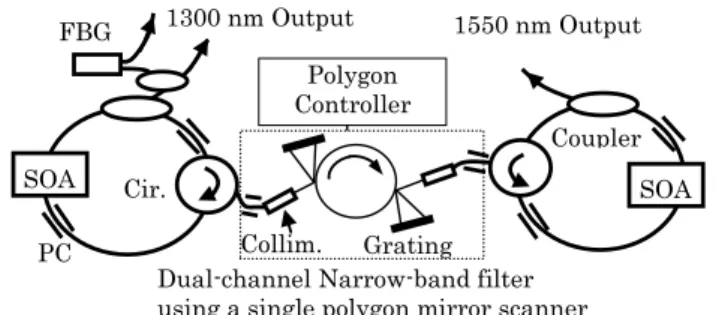
The schematic of the 1310=1550 dual-band swept laser is presented in Fig.1. The dual-band swept source com-prises two extended ring cavity semiconductor lasers and two narrowband intracavity wavelength filters with a single high-speed polygonal scanner. Tuning of the la-ser with two wavelength bands is accomplished by spin-ning the polygon with two opened windows, enabling synchronized sweeping of two wavelength bands. Two broadband semiconductor optical amplifiers (SOAs) at 1310 (Covega, BOA1132) and 1550nm (Covega, BOA1004SXL) central wavelengths were used as the cav-ity gain medium. A customized two-window 72-facet polygon scanner with four adjustable repetition rates (SA34, Lincoln Laser) was employed. For increasing the free spectral range (FSR) of the polygonal narrow-band filter, Littrow configurations were utilized for both bands. The reflected light from the polygon scanner fa-cets illuminate the diffraction gratings at Littrow’s angle
Fig. 1. Schematic diagram of the dual-band swept laser source: PC, polarization controllers; FBG, fiber Bragg grating; Cir, circulator.
and retrace the path back to the collimators. Two com-plete wavelength sweeps are produced simultaneously for each partial rotation of the polygon through an angle of 2π=N in the two windows, where Nð¼ 72Þ is the num-ber of mirror facets. The sweeping angles of the reflected light for the two bands double the polygon’s rotation an-gle. Two Newport gratings (33009BK02-540R and 53015BK01-530R) with the same groove frequency (T ) of 1200 lines=mm were used in the filter for the 1310 and 1550 nm bands, respectively. The calculated Lit-trow’s angles (θlitt) are 52° and 68° at the center
wave-length of 1310 and 1550 nm, respectively. The two diffraction gratings are placed close to their polygon scanner facets to decrease beam displacement on the dif-fraction gratings and reduce the cavity lengths. Three in-line miniature polarization controllers (PCs) were used in both cavities for individually aligning the related polari-zation states. About 1:5 m of cavity lengths were obtained for both bands. An output coupler with a 60=40 ratio was used (60% of the power is coupled out) for both cavities. The 10% output power of the 1310 nm band was con-nected to a fiber Bragg grating (FBG) for a swept laser start trigger [12]. Assuming there is no beam clipping, the FSR and FWHM instantaneous linewidth of a Littrow configuration are given by [10]
FSR¼ 2 ·1 T· 4π N · cosðθlittÞ; ð1Þ δλ¼2 ffiffiffiffiffiffiffiffiffiffiffi 2ln 2 p ·λ0· cosðθlittÞ π ·T · W ; ð2Þ whereW is the 1=e2
width of the Gaussian beam at the fiber-optic collimator. The FSR of 179 and 109 nm and δλ of 0.18 and 0:13 nm are calculated at the center wave-length of 1310 and 1550 nm, respectively, by assuming W ¼ 2:8 mm in our system.
The normalized time-averaged spectra emitted from our dual-band swept laser, measured by an optical spec-trum analyzer (OSA) in peak-hold mode with a resolution of 1 nm, is shown in Fig.2(a). Full sweeping wavelength ranges of 160 and 62 nm centered at 1307 and 1550 nm for the two bands were obtained, respectively, which are 91% and 51% of the theoretical FSR values. Figure 2(b)
shows the measured related output power of our dual-band swept laser over two wavelength scans using an oscilloscope. The observed scan duration of 15:34 μs cor-responds to a repetition rate of 65:19 kHz. The duty
cy-cles are 91% and 51% for the 1310 and 1550 bands, respectively, which match their percentages of the theo-retical FSR values. The lower duty cycle at the 1550 band could be caused by the beam clipping on the polygon fa-cet or the lower efficiency of the grating at the longer wavelength near 1600 nm. Figure 2(c) shows output power versus the injection current of the SOA. Measured average output power of 60.2 and 26:9 mW was obtained in the 1310 and 1550 nm bands, respectively, at an injec-tive current of 0:6 A on both SOAs. Laser threshold cur-rents were 80 and 130 mA for the 1310 and 1550 bands, respectively.
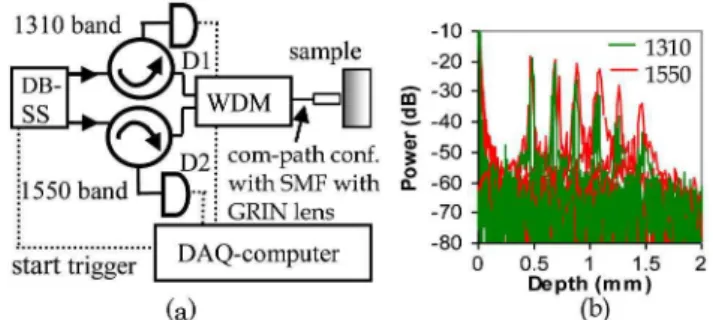
Figure3(a)shows the setup of the dual-band common-path SS-OCT system. The simultaneous swept laser out-puts of the 1310 and 1550 nm bands are connected to two matched optical circulators. The appropriate output is then connected to a broadband 1310=1550 WDM output-ting into a single-mode optical fiber (SMF). The SMF is fusion spliced with a GRIN fiber lens [13]. The light re-flected from the glass–air surface of the GRIN lens is used as a reference reflection, which is combined with the light reflected from inside the sample to form a com-mon-path configuration. This comcom-mon-path interferom-eter can pass both bands of light and overcomes the difficulty of bandwidth limitation in fiber circulators used in conventional fiber-based OCT systems. In addition, the common-path interferometric topology has the advan-tage of running highly stable phase measurement [11], and it has the drawback of limited adjustment of the op-tical power in the reference arm for SNR optimization. The GRIN lens used in this Letter has a diameter of 0:14 mm and a beam profile working distance of 0:7 mm, depth of field of 0:4 mm, and lateral OCT image resolu-tion of 19 μm. Detector (PDB120C, Thorlabs) outputs of each wavelength band are digitized using a two channels data acquisition card (ATS 9440, Alazartech, Montreal) with 14 bit resolution and sampling speed of 100Ms=s. The start trigger signal is used to initiate the function generator for the galvo scanner and initiate the data acquisition process for each A scan. K-linear sam-pling is implemented by using precalibrated tables for each wavelength. Color encoded images are then processed after inverse Fourier transformation [6]. Figure3(b)shows the point spread functions of the two wavelength bands at different depths measured using a partial reflector and the GRIN-lensed probe. SNRs of 50:5 dB for 1310 nm and 50:9 dB for 1550 nm are obtained
Fig. 2. (a) Measured normalized spectra, (b) oscilloscope traces (1550 band, solid curve; 1310 band, dotted curve) with start trigger (dashed curve) at a repetition rate of 65:19 kHz, and (c) output powers versus injection current of the SOA of our dual-band swept laser.
Fig. 3. (Color online) (a) Schematic diagram of our dual-band common-path SS-OCT system: D, detector; WDM, wavelength-division multiplex; solid and dotted curves, optical and electro-nic paths, respectively. (b) Point spread function of the two wavelength bands at different depths.
in the focusing depth range of 0:5–0:8 mm when optical power illuminating on the sample with approximately 13 and 8 mW for 1310 and 1550 nm, respectively. The two bands have a similar sensitivity of 95 dB. Obviously, 1550nm penetrates the air deeper than 1310 nm. Measured axial resolutions are 9 and 19 μm for 1310 and 1550 nm, respectively.
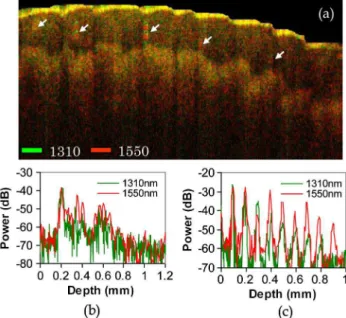
The demonstration of our technique to biological ima-ging is shown in Fig. 4(a), representing a human finger measured in vivo. The image depths are scaled by an average refractive index of human skin and calibrated by depth measurements in air. The morphologies in two band images appear identical, except there is a shift and a change in reflectivity of the helix-shaped sweat gland duct of 7 dB visible on the depth profiles shown in Fig. 4(b). These differences are similar and visible for several locations of the sweat glands shown as white arrows in Fig.4(a). The different dispersion property be-tween the 1310 and 1550 nm bands of sweat gland ducts
could be caused by the local water amount, collagen, and muscles. Penetration depth in the 1550 nm long wave-length band is not outrange of the 1310 nm band in hu-man skin as shown in Fig. 4(b) due to the higher water absorption at 1550 than that at 1310 nm. Deeper penetration in the 1550 nm band is demonstrated in a stacked thin glass profile as a sample with low water con-tent, as shown in Fig.4(c).
In conclusion, a high-speed simultaneous dual-wave-length-band swept laser source based on a single two-window polygon scanner was demonstrated. A dual-band common-path SS-OCT system was implemented to de-monstrate the advantage of a second wavelength band for high-quality OCT spectroscopic analysis with low computational costs. Using an ultrasmall fiber probe en-ables potential in vivo endoscope and interstitial nonin-vasive diagnostics with improved spectroscopic imaging contrast.
References
1. W. Drexler and J. Fujimoto, Optical Coherence Tomogra-phy: Technology and Application(Springer, 2008). 2. U. Morgner, W. Drexler, F. X. Kärtner, X. D. Li, C. Pitris,
E. P. Ippen, and J. G. Fujimoto, Opt. Lett. 25, 111 (2000). 3. C. Xu, P. Carney, and S. Boppart, Opt. Express 13,
5450 (2005).
4. F. Spöler, S. Kray, P. Grychtol, B. Hermes, J. Bornemann, M. Först, and H. Kurz, Opt. Express 15, 10832 (2007). 5. D. Sacchet, J. Moreau, P. Georges, and A. Dubois, Opt.
Express 16, 19434 (2008).
6. S. Kray, F. Spöler, M. Först, and H. Kurz, Opt. Lett. 34, 1970 (2009).
7. S. H. Yun, G. J. Tearney, J. F. de Boer, N. Iftimia, and B. E. Bouma, Opt. Express 11, 2953 (2003).
8. R. Huber, M. Wojtkowski, J. G. Fujimoto, J. Y. Jiang, and A. E. Cable, Opt. Express 13, 10523 (2005).
9. R. Biedermann, W. Wieser, C. M. Eigenwillig, and R. Huber, J. Biophoton. 2, 357 (2009).
10. S. M. R. M. Nezam, Opt. Lett. 33, 1741 (2008).
11. J. Zhang, B. Rao, L. Yu, and Z. Chen, Opt. Lett. 34, 3442 (2009).
12. Y. Mao, C. Flueraru, S. Sherif, and S. Chang, Opt. Commun. 282, 88 (2009).
13. Y. Mao, S. Chang, S. Sherif, and C. Flueraru, Appl. Opt. 46, 5887 (2007).
Fig. 4. (Color online) (a) In vivo color-encoded OCT image (3 mm × 1:2 mm) of a human finger. Depth profiles: (b) human finger (c) eight stacked 0:1 mm microscope cover glasses. 1992 OPTICS LETTERS / Vol. 36, No. 11 / June 1, 2011