HAL Id: hal-01137921
https://hal.archives-ouvertes.fr/hal-01137921
Submitted on 31 Mar 2015
HAL is a multi-disciplinary open access
archive for the deposit and dissemination of
sci-entific research documents, whether they are
pub-lished or not. The documents may come from
teaching and research institutions in France or
abroad, or from public or private research centers.
L’archive ouverte pluridisciplinaire HAL, est
destinée au dépôt et à la diffusion de documents
scientifiques de niveau recherche, publiés ou non,
émanant des établissements d’enseignement et de
recherche français ou étrangers, des laboratoires
publics ou privés.
Deliberation for autonomous robots: A survey
Félix Ingrand, Malik Ghallab
To cite this version:
Félix Ingrand, Malik Ghallab. Deliberation for autonomous robots: A survey. Artificial Intelligence,
Elsevier, 2017, 247 pp.10-44. �10.1016/j.artint.2014.11.003�. �hal-01137921�
Deliberation for Autonomous Robots:
A Survey
F´elix Ingranda,∗, Malik Ghallaba
aLAAS-CNRS, University of Toulouse, France
Abstract
Autonomous robots facing a diversity of open environments and performing a variety of tasks and interactions need explicit deliberation in order to fulfill their missions. Deliberation is meant to endow a robotic system with extended, more adaptable and robust functionalities, as well as reduce its deployment cost.
The ambition of this survey is to present a global overview of deliberation functions in robotics and to discuss the state of the art in this area. The following five deliberation functions are identified and analyzed: planning, acting, monitoring, observing, and learning. The paper introduces a global perspective on these deliberation functions and discusses their main characteristics, design choices and constraints. The reviewed contributions are discussed with respect to this perspective. The survey focuses as much as possible on papers with a clear robotics content and with a concern on integrating several deliberation functions.
Keywords: Robotics; deliberation; planning; acting; monitoring; observing; learning.
1. Introduction
We are interested here in autonomous robots in industrial, service or field applications, and in robotized systems such as spacecrafts, AUVs, UAVs or self-driving cars. These systems interact autonomously with their environment through sensory-motor capabilities and may have to act deliberately in order to fulfill their mission. Acting delib-erately means performing actions that are motivated by some intended objectives and that are justifiable by sound reasoning with respect to these objectives. Deliberation is any computational function required to act deliberately. From the perspective of robotics, the interest is not on deliberation per se but on acting deliberately.
Robots without autonomy do not need much deliberation. These robots extend the acting capabilities of human operators who are in charge of decision making, possibly with the support of advice and planning tools, e.g., as in surgical robotics and other teleoperated applications. Autonomous robots may or may not require explicit deliberation. Deliberation is not needed for autonomous robots working in fixed, well-modeled environments, as for most fixed manipulators in manufacturing applications. Neither would deliberation be required if all feasible missions consist of repeating a single task, e.g., as for a vacuum cleaning or a lawn-mowing robot. In these and similar cases, deliberation takes place at the design stage. Its results are directly implemented in the robot controller.
Autonomous robots facing a diversity of environments, a variety of tasks and a range of interactions cannot be preprogrammed by foreseeing at the design stage all possible courses of actions they may require. These robots need to perform some explicit deliberation. In short: autonomy plus diversity entail the need for deliberation.
Deliberative robots are desirable in applications where the environment is open-ended and largely unknown and teleoperation is constrained, as in most exploration robotics. They are needed in service applications in dynamic and changing environments with semantically rich tasks and human interactions. Domestic and personal robots are de-manding in deliberation capabilities. Even for applications in closed and well structured environments with a reduced range of tasks, where engineered robotics operations are feasible and have been demonstrated successfully (e.g., in
∗Principal corresponding author.
automated warehouses), deployment and adaptation costs can be reduced by deliberation capabilities. Deliberation can endow a robotic system with extended, more flexible and robust functionalities; it can reduce its deployment cost. Deliberation is a very active and critical research field in intelligent robotics. It covers a wide spectrum of problems and techniques at the intersection of Robotics and Artificial Intelligence. Deliberation has to closely interact with sensing and actuating. It does not stop at planning and is not reducible to a single function. It critically requires the coherent integration of several deliberation functions. It involves numerous open problems ranging from knowledge representation, acquisition and verification, to scalable reasoning algorithms and architecture issues.
This research field is of interest to several communities in Robotics and Artificial Intelligence. It is covered by a vast literature. Several books and survey papers review the state of the art for a few focused deliberation functions, e.g., planning [91], monitoring [169], goal reasoning [213], recognition of actions and plans [129], architectures [127], or human–aware navigation [130]. A historical perspective of the links between Robotics and AI, from which this survey paper stems, is sketched in [107]. However, to our knowledge there is no global overview of deliberation functions in robotics, of the challenges they pose and the techniques needed for their design and implementation. The lack of a global vision hinders progress in the field toward coherent and more integrated contributions.
The ambition of this paper is to contribute to such an overview. It undertakes this objective by surveying some of the contributions to deliberation functions and putting them into perspective with respect to a global understanding of deliberate action and its integrative requirements. To keep a reasonable scope, we will not survey human–robot and multi-robot interaction and cooperation issues (but of few references relevant beyond interaction issues). Despite this focus, the covered field is not easily amenable to a unifying perspective. It remains excessively broad, fragmented in topics and approaches, but also in time: often, the same line of research spans and matures over a dozen years and as many publications. We believe that taking a global view to deliberation in robotics is a useful step for understanding the state of the art and permitting further advances.
This paper does not propose a unifying theory of deliberation. It presents a comprehensive view of deliberation functions in robotics. It discusses their main characteristics, design choices and constraints for achieving them. The surveyed literature for each deliberation function is discussed with respect to this global perspective.
Given the breadth of the field, this survey cannot exhaustively cover all relevant contributions. We restricted ourselves to papers on deliberation functions with a clear robotics content, and, whenever possible, with a concern for the integration of several deliberation functions. Some of the reviewed contributions are only briefly mentioned, while representations and techniques for a few typical approaches are informally presented.
The next section presents a global view of deliberation functions and their requirements for various robotics applications; it outlines the main options faced by a designer of a deliberation system. The rest of the survey develops an analysis of several contributions to deliberation functions (Sec. 3 to 7). Two main functions, namely planning and acting, are extensively discussed, while the survey is more illustrative for the monitoring, observing and model acquisition functions. However the corresponding sections are essential to the global view advocated for here. This analysis is followed by a discussion and synthesis section (8), then a conclusion with a perspective on future research.
Beyond the wealth and variety of approaches, the take-home message of this survey can be sketched as follow:
• deliberation in robotics does not reduce to task planning,
• acting is a context and task dependent reaction to events and refinement of planned actions into commands,
• hierarchy of action refinements over several levels of state and action spaces is essential,
• monitoring needs strong links to prediction in planning and acting,
• observing requires significant deliberation, it does not reduce to signal processing,
• integrated and consistent representations and the acquisition of corresponding models are a clear bottleneck.
2. Design of a robotics deliberation system 2.1. Deliberation functions
Let us first clarify our terminology. An action is a process that changes the state of the robot and its environment; this includes perception and information gathering actions. An action can be viewed at different levels of abstraction hierarchy. It is primitive at some level and compound at the next level. E.g., open(door) is a primitive action at an abstract level and a compound task to be refined, when needed, into a collection of concrete actions. A command is a primitive action at the lowest level of the hierarchy. Commands can be directly executed by the robot platform. The
platformis a collection of devices and sensory-motor functions integrating sensing and closed-loop actuation. Choos-ing the appropriate command and monitorChoos-ing that the context remains within a command functionChoos-ing envelope is part of deliberation. The execution of a command does not need deliberation capabilities. For example, grasp(handle) is a command which, under appropriate conditions, can be directly executed by a robot platform. A plan is an organized collection of actions. A policy is universal plan, i.e., a mapping from states to actions. A skill is also an organized col-lection of actions. It differs from a plan in the following: its actions are at a lower level; its primitives are commands; its control structure can be richer than that of a plan. A skill is retrieved from a library of skills (hand-programmed or learned) while a plan is synthesized by a planner. A task is the specification of a mission or objectives to be achieved by the robot, in possibly different forms and abstractions levels, e.g., as goal states. An event is an occurrence of a change in the state of the robot and its environment; it can be controlled or exogenous, expected or unexpected.
Most of the literature on deliberate action is focused on planning. However, planning alone is not sufficient for achieving deliberate action. Acting is accomplished by exerting controlled forces on the environment. It is imple-mented at the lowest level by online processing of streams of signals, from sensors to actuators. These streams achieve feedback loops robust to the discrepancies between the world and its models. Planning, on the other hand, implements a mapping of its input, a predictive model and a problem, into an output plan expressed in some representation. Be-cause of the limitation of predictive models and complexity constraints, planning has to admit several simplifying assumptions. As a result, a synthesized plan provides a projected course of action in some abstract representation. It is useful but rarely sufficient for acting deliberately.
Monitoring Goal reasoning
Acting Observing Learning
Models, data & knowledge bases Environment Mission Criteria Objectives Monitoring actions Control variables Signals Sensing actions Feedback Feedback Users Planning Robot’s platform (a) Environment
Inner deliberation loop Robot’s platform Outer deliberation loop
(b)
Figure 1: (a) Schematic view of deliberation functions (interactions between functions is oversimplified; more complex architectures are briefly discussed in Section 2.3); (b) Nested closed-loops implementing these functions.
There is more to deliberate action than just planning in an abstract space. Several distinct functions can be required for acting deliberately. The borderlines between these functions are blurry and depend on specific representations, implementations, and architectures. However, it is conceptually clarifying to distinguish the following six deliberation functions(Fig. 1(a)):
• Planning: combines prediction and search to synthesize a trajectory in some abstract action space based on predic-tive models of the environment and feasible actions in order to achieve some purpose.
• Acting: refines planned actions into commands appropriate for the current context and reacts to events; both refine-ment and reaction may rely on skills, i.e., a collection of closed-loop functions. A skill processes a sequence (or a continuous stream) of stimulus input from sensors and generates output to actuators, in order to trigger motor forces and control the correct achievement of chosen actions.
• Observing: Detects and recognizes features and relations characterizing the state of the world, as well as events, actions and plans relevant for the task. Observing combines bottom-up processes, from sensors to meaningful data,
with top-down activities such as focus mechanisms, sensing actions and planning for information gathering.
• Monitoring: Compares what is predicted regarding the robot activities to what is observed in the world. It detects and interprets discrepancies, performs diagnosis and triggers recovery actions when needed.
• Goal reasoning is monitoring at the mission level. It keeps commitments and goals in perspective; it assesses their relevance from the observed evolutions from new opportunities, constraints or failures; it entails from this assessment whether some commitments should be abandoned, and when and how to update the current goals.
• Learning: allows a robot to acquire, adapt and improve through experience the models needed for deliberation. Active learning induces a robot to act deliberately in order to better learn.
These deliberation functions are interfaced with the robot’s platform. The frontier between sensory-motor func-tions and deliberation funcfunc-tions varies widely depending on the complexity of the planned acfunc-tions and the variability of the environment. For example, in a navigation task, motion control along a path is a sensory-motor function as long as the ground is nominal (i.e., firm, stable). When the robot gets out of the envelope of a nominal control mode, delib-eration is needed. Sensory-motor functions should not be perceived in a reductionist view as simple feedback control loops. They often require feedforward prediction and monitoring of their functioning conditions (e.g., checking that the control state remains in the envelope), and complex interactions with deliberation functions.This is illustrated in neuroscience models of human and primate motion, e.g., [195]. Furthermore, learning capabilities change the frontier of when and where explicit deliberation is needed. E.g., in a well-known environment, a navigation skill to the same usual destination can be compiled down into a low-level control with pre-cached parameters.
Deliberation is necessarily confined within bounded computational resources. A metareasoning function can be needed for trading off deliberation time for action time, given current constraints and objectives at stake. Critical activities require careful deliberation, while less important or more urgent tasks may not need, or allow for, more than fast approximate solutions, at least for a first reaction.
Finally, note that Fig. 1(a) is not complete: Interaction, in particular human-robot interaction, is clearly a delibera-tion funcdelibera-tion. This is illustrated in the capabilities integrated in several systems, e.g., [193]. In some cases interacdelibera-tion can be used to get human help in deliberation problems, e.g., as in [187]. To keep a reasonable scope, interaction is not covered in this survey.
2.2. Characteristics and deliberation requirements of robotics applications
Deliberation is entailed by autonomy and diversity; but these are not binary properties, either true or false. When deliberation is needed, it may have different characteristics depending on the requirements of the robotics application at hand. Let us look at a few typical classes of applications.
(a) (b) (c)
Figure 2: (a) An intervention robot (LAAS), (b) A rescue UAV (ONERA), (c) A user’s assistant robot (LAAS).
An autonomous satellite has a fairly stable and predictable environment. It has a well focused set of tasks, e.g., to use its imaging devices efficiently to respond to received queries given expected or perceived cloud coverage, and to manage its communication, processing and energy resources. It can plan and execute stable plans over long horizons. Its deployment is costly, which justifies extensive engineering for an optimized behavior, with diagnosis and self repair.
An autonomous space exploration robot, e.g., Curiosity, faces a wider diversity of tasks (navigation, observation, sampling, communication). Its environment is variable but fairly predictable; it has a low semantic complexity. The robot controls its sensory-motor devices according to its own plans. It monitors its activity, adapts and repairs its plan in unforeseen situations. It considers opportunities (e.g., an interesting rock) and manages its mission. All these deliberation functions are integrated on board and properly scheduled with respect to limited computational resources. They share models (perception models, action models, skill models, monitoring models, etc.), which need to be consistent with respect to each others. Here also the mission can afford extensive engineering and development. A field robot for surveillance and rescue missions (Fig. 2(a)) has similar features, but it faces richer and more variable environments, less predictable and less easily modeled. Cooperation and interaction with human and other robots is an important feature in these applications. Similar remarks hold for UAVs (Fig. 2(b)) in rescue missions. Further, a UAV may have to face faster dynamics in its tasks and environments.
A self-driving car has also to deal with high dynamics, but for a very focused task in well structured environments. Critical safety issues are a strong constraint on the deliberation functions.
A service or domestic robot (Fig. 2(c)) does not have to cope with high dynamics. It is faced with very rich environments and a broad diversity of tasks. Its deliberation functions should allow it to reason about its mission (e.g., assisting the user), to plan its tasks (e.g., to serve a simple meal), to act according to its plan, refining actions into closed loop commands and reacting to events, to perceive its environment for building and maintaining its mod-els. Engineering costs should remain low. Learning is important (e.g., adapting its skills to the particulars of the environment). Finally, man-robot interaction is essential for service and domestic robots.
Manufacturing robotsused to be in protected unchanging environments, without much need for deliberation. This is progressively changing. There is a demand for very flexible robots that are easily adapted to a broad range of tasks and seamlessly integrated in any working environment. This is the more true for industrial mobile robots viewed as a worker’s assistant in his daily chores. This class of applications is in many aspects similar to service and domestic robots, with more emphasis on cooperation and a more focused set of environment and tasks.
(i) Environment Variability (ii) Task Diversity (iii) Semantics (iv) Dynamics (v) Partial Observability (vi) Cost & Criticality (vii) Interaction & Cooperation (viii) Level of Autonomy Manufacturing robots l l l h l m l l
Industrial mobile robots m m m m m m h l
Exploration & rescue robots h m l m h h h h
Service and domestic robots h h h l h l h m-h
Autonomous spacecraft l l l l h l l m
Autonomous aerial vehicles m m m h h h m m-h
Autonomous cars m l l h m h m l
Table 1: Features of a few classes of robotics applications (l: low, m: medium, h: high).
We can analyze the deliberation requirements of a robotics application through eight main features: (i) how variable is the environment, (ii) how diverse is the set of tasks, (iii) how rich are the semantics, (iv) how fast are the dynamics of the environments and tasks, (v) how partially observable is the environment (vi) how high is the cost or criticality of the system, (vii) how important are interaction and cooperation with people and/or other robots, and (viii) how autonomous is the robot in carrying out its mission, e.g., choosing and committing to goals. These requirements are summarized in Table 1, considering three qualitative levels for each feature in typical applications for each class.
Application features entail constraints and requirements on deliberation functions. For example, monitoring de-pends on the environment variability; goal reasoning is desirable for generic missions and high degree of autonomy; safety critical applications demand formal methods and tools for the specification and verification of some of the functions to be implemented. The above table is useful for analyzing and characterizing known deliberation systems. The surveyed systems will be characterized with respect to these features; in particular we’ll refer to applications marked “h” in one or a few columns. However, most of these systems aim at being generic over a range of application classes. Even if they are motivated by and experimented with in a particular class, they propose ideas and techniques that can be relevant beyond their motivating applications. Furthermore, application features constrain deliberation functions, but they leave room for several design choices, e.g., with respect to knowledge representations used and
how deliberation functions are organized. Let us discuss these options. 2.3. Design options of a deliberation system
The integration of planning and acting functions is a critical issues in the design of a deliberation system. To clarify the range of design options, let us oppose two main views emphasizing respectively planning and acting. Emphasis on planning. This option assumes full predictive, possibly nondeterministic models of the world, including its dynamics and possible effects of exogenous events. It needs reversible models of the sensing capabilities of the robot, i.e., how reality is mapped into percepts, as well as reversible models of its actuating capabilities, i.e., how commands are mapped into forces and motion. Inverse kinematic models map desired configurations into commands achieving them; inverse sensing models map sensed features into world objects. It requires a planner that takes as input these global predictive models together with the specifications of the mission, and provides as output a plan or a policy, mapping perceived states (or beliefs) into lower level commands, possibly with some guarantee of achieving the mission or meeting some optimality criteria. Under this view, acting is a simple triggering of commands given by the planned policy: at each step the robot senses, i.e., reads the current observation variables, applying the corresponding commands specified by the policy. Note that a discrete unit time approach has to be further extended for dealing with domains involving rich temporal and real-time constraints.
This principled view inspired the design of a few early deliberation systems. It had the merit of clarifying, at the conceptual level, what was desired and how far from the ideal target the achievements were. However, the applica-bility of this idealistic view is limited by the low predictaapplica-bility of most environments, the tremendous difficulties of specifying the needed models, and the computational complexity of planning.
Emphasis on acting. Designers addressed the previous issues by the usual decomposition strategy, i.e., decompose the deliberation burden between a planning phase and an acting phase, and rely on restrictive assumptions at one end or the other. In the spectrum of possible decompositions and assumptions, classical planning is the most restrictive. It assumes an open-loop robot in a deterministic, static environment (no exogenous events), which is fully observable (for the initial state, the other states being entirely predictable). Consequently, acting has to handle nondeterministic, partially observable and dynamic environment models through closed-loop control. This option puts most of the burden of deliberating with the real world constraints (noisy sensors and actuators, imperfect models) on acting.
This view drove the design of several implementations. It remains popular (admittedly in the automated planning community, but much less in the robotics community). It led to the development of scalable classical planning tech-niques. But its usefulness proved to be limited by the complexity of the acting system, the narrow effectiveness of planning and the weakness of the produced plans.
Balanced decomposition. In summary, the first view relies entirely on planning, the second one depends mostly on acting without much efficient help from planning. A major design option is how to better decompose the complex deliberation problem between planning and acting, how to balance the process of choosing and undertaking actions between different levels of abstraction and granularity, from the mission level to the sensing and command level. At least three levels are needed (including the platform level in charge of executing the commands, outside of the scope of deliberation). In principle, more than three levels can be considered. Most approaches consider just three levels, corresponding to the functions we labeled as planning and acting, in addition to the platform.
Planning techniques in action refinement
Acting Mission 〈 ..., action, ... 〉 〈 ..., skill, ... 〉 〈 ..., command, ... 〉 Robot’s platform Planning
Figure 3: From actions to skills and commands.
Planning synthesizes a trajectory in an abstract action space predicted to achieve (part of) the mission. Acting further refines each abstract action into one or several steps, called skills. Skills are plans with possibly concurrent steps whose primitives are commands (Fig. 3). Planning requires descriptive models giving the requirements and possible effects of actions (know-what). Acting requires operational models: how to refine actions, which skill to choose and when, how to react to events (know-how). This view is further developed in [92].
A balanced decomposition should supply predictive capabilities to planning as well as to acting. Both may perform look-ahead operations, with various planning techniques. It is important to keep in mind that planning and acting may work in distinct state spaces and action spaces. However, they may both use the same representation and possibly a unified model. One may characterize ideas and approaches for specifying deliberation models for planning and acting into the following categories:
• Single modelapproaches rely on a unified domain model merging the know-what specification of descriptive models and the know-how specification of operational models. Abstraction and hierarchical methods are the usual tools for decomposing the problem. Planning is performed down to some level of abstraction. Abstract actions in plans are further refined into primitive commands. Techniques such as Hierarchical Task Networks, Angelic Hierarchical Planning, or Hierarchical MDPs may support these approaches.
• Multiple modelapproaches use distinct models: an abstract descriptive model for planning and one or several opera-tional models for acting to refine each plan step into skills. These approaches may use either (i) a uniform knowledge representationfor specifying planning and acting problems at different levels of granularity, e.g., formal action lan-guages, or (ii) heterogeneous knowledge representations at various levels, e.g., precondition-effect operators for planning, procedures or rules for acting.
The refinement from plan steps into skills involves several other considerations:
• How close to the platformare the synthesized plan steps. This property is context dependent: the same action, e.g., moveto, can be a directly executable command in some context and may require further deliberation in another one.
• Are the skills hand-programmed vs automatically synthesized. The synthesis of skills from the specification of sensory-motor function and/or with machine learning techniques allows for easier engineering design, for verified properties and improved integration between planning and acting.
• How specific to the current mission and environmentare the skills. Their adaptation may range from the choice of parameters in generic skills, to the online synthesis of skills needed for the task.
• How flexibleis the generated plan. A partially specified plan leaves freedom for handling some level of uncertainty and nondeterminism and adapting to the execution context.
Architectures. The choice of an appropriate architecture is another major design issue. A robot implements its deliberation online. Hence all approaches have to interleave deliberation functions through some form of nested closed loops(Fig. 1(b)): acting is performed at an inner loop level while planning is processed at an outer loop level. Various architectural paradigms have been proposed to address the integration issue (see survey [127]):
• Hierarchical architecturesare probably the most widely used in robotics [108, 161, 63, 37, 85, 126]. They organize the software into a few layers with different temporal requirements and abstraction levels: a platform layer contain-ing the sensory-motor modules, and one or several layers for deliberation functions. Often, different representations are used in these layers, which makes global consistency checking quite difficult. Their benefit is that they clearly identify and organize the sensory-motor components and the deliberation components. However, these architectures are not easily adapted to functions distributed over several layers (e.g., perception, motion planning, etc.).
• Reactive architecturesare composed of input/output automata implementing loops from sensors to effectors. These automata can be organized hierarchically and can inhibit or weight each other. Initial instances of reactive ar-chitectures, e.g., the subsumption architecture [32], were mostly at the platform level without much concern for deliberation. More recent extensions have added deliberation functions (e.g., [134, 170]).
• Teleo-reactive architecturesare more recent [156, 74, 147]. They propose an integrated paradigm based on planning– acting components distributed at different levels, using different horizons and time quanta. They use a single repre-sentation and provide a continuum between the components (from the high level planner dealing with mission state variables, to the low level reactor modeling the physical state variables). They offer a clear advantage with respect to the consistency of the system, but their scaling up to complex and highly dynamic environment remains an issue.
• Open architectureshave recently appeared to fulfill the new needs of service and personal robots in open environ-ments with rich semantics. Their distinctive characteristic is to allow a robot to draw data and models over the web, using in particular semantic web techniques. Several example are covered in Section 3.4, e.g., the RoboEarth, [218], KnowRob [208] and CRAM [18] systems, which rely on OWL, the standard Web Ontology Language.
It is important to note that the above integration and architecture design issues are relevant for all deliberation functions. Monitoring and observing, performed at an inner loop level, can benefit from automated synthesis and adaptation to the context. Goal reasoning and learning, at the outer levels, are heavily conditioned by the representa-tions used in other funcrepresenta-tions. These issues will be further discussed in the remainder of the paper.
2.4. Global view of surveyed systems
Systems Associated components Delibe-ration Functions Knowledge Representation Robotic
Domains Architecture Main Additional Features
DS1/RAX [157] PS [110] EXEC Livingstone [227] PAMGO State Variables time-points Qualitative model Transition automata with probabilities and costs
Autonomous Spacecraft
Layered (RA)
Time management Resource management Diagnostic and recovery
IxTeT/PRS [108] IxTeT [90] Exec [137] Reco [65] PRS [106] GenoM [76] PAMO
State Variables, time-points Chronicles Procedures Exploration & rescue robots Layered (LAAS) Time management Resource management Verification and validation (functional layer)
IDEA [155] IDEA
EUROPA [79] PA State Variables, intervals
Exploration
robots Agent-based(IDEA)
Time management
Integrated knowledge representation Refinement with lookahead
T-REX
T-REX [147] EUROPA [79] APSI[81]
PA State Variables, intervals AUV Service and domestic robots
Teleo reactive
Time management
Integrated knowledge representation Refinement with lookahead
RMPL[225] Titan [226] Burton [228] Kirk [224] Drake [52] Pike [140] PAM
Probabilistic Timed hier-archical automata Temporal Plan Networks Probabilistic TPNs, TPNs with Uncertainty Exploration & rescue robots Autonomous Spacecraft Specific Time management Diagnostic and recovery Integrated knowledge representation Refinement with lookahead Handling of uncertainty
WITAS [63] TALPlanner [133]
DyKnow [101] PAMO
Temporal Action Logic Stream, policy Chronicles Autonomous aerial vehicles Layered [62] Time management Resource management
Integrated knowledge representation Explicit handling of uncertainty Verification and validation
ASPEN/ CASPER ASPEN [178] CASPER [43] TCA [200] TDL [201] Plexil [216] PA State Variables Intervals Programs Exploration & rescue robots
Layered Time management Resources management XFRM XFRM [16] RPL [15] SRC [14] SRP [17] CRAM [18]
PAL RPL, CRAM Plan
Language Prolog Service and domestic robots
Open world (CRAM)
Integrated knowledge representation Refinement with lookahead Open models
Cypress [223]
Sipe [222] PRS [158] CPEF [159]
PAG ACT Formalism Military
Time management Resource management
Integrated knowledge representation Refinement with lookahead
Table 2: Analyzed systems, clustered into approaches and associated components, with their main deliberation functions (P: planning, A: acting, M: monitoring, O: observing, G: goal reasoning, L: learning) and other features.
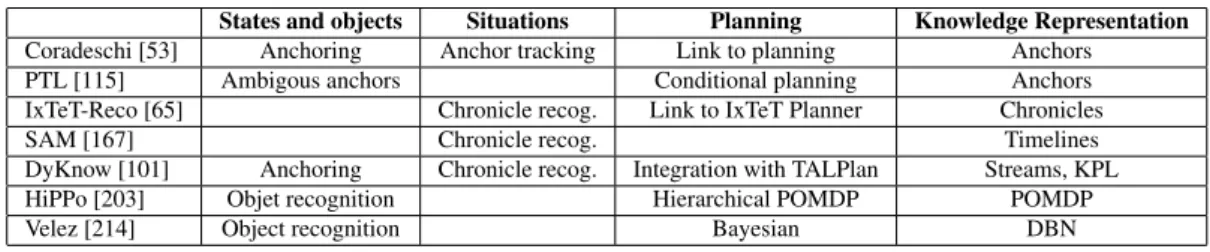
Numerous contributions fit into the scope of this survey. A uniform level of discussion of all of them would be too long and too shallow. To present a meaningful view of the entire field (“perceiving the forest from the trees”) we organized the surveyed systems into the following three clusters:
Deliberation Functions
Knowledge
Representation Robotics Domains Additional Main Features
SSP [146] PA Factorized MDP Handling of uncertainty
MDP [29] PA Factorized MDP Handling of uncertainty
MAPL [31] PA State Variables
Belief Variables Assertions
Service robots Multi-robot integration
DL/HTN [96] PA DL and HTN Service robots
RACE [186] P HTN Service and domestic
robots
Open models
Petri-Net [221] A Petri Net
SMACH [24] A Automata Service robots ROS
Readylog [71] PA Situation
Calculus Logical Framework
Pearl [171] PA MDP Service robots Handling of uncertainty
Ressac [207] PA MDP UAV Handling of uncertainty
Coradeschi [53] PO Perceptual
an-choring Service robots, UAV Tracking and reacquiring anchors
integrated to planning
PTL [115] PO Ambigous
anchors with con-ditional planning in belief space
Service robots Partial matching properties -
fea-tures, definite and indefinite de-scriptions
HiPPo [203] PO Hierarchical
POMDP
Object manipulation Sensor and manipulation planning
Velez [214] PO Bayes network Service robots Observation planning and
naviga-tion
Elvira [84] POL Semantic Maps Service robots Hierarchical environment models
Astrid [83] POL Semantic Maps Service robots Integration to planning & acting
Table 3: Discussed systems.
• Analyzed systems(Table 2): these systems or groups of systems cover several deliberation functions; they often span over a long line of contributions, implementations and experiments that we group together; they are presented with some level of details often in several of the following sections.
• Discussed systems(Table 3): these systems are more focused on a single or a few contributions; they often have narrower integration scope and experimental validation; they will be discussed briefly in a single section.
• Cited systems: papers in this cluster bring interesting ideas or techniques, relevant to deliberation in robotics, but they have not been necessarily integrated or experimented with on a robot, or seem to be too close to other systems in the previous two categories to be referred to along with the discussion of other systems.
It is important to underline that no ranking is intended through this clustering, which is introduced solely for the commodity of the presentation, to help surveying a broad field into a readable picture. Tables 2 and 3 summarize the main characteristics of the analyzed and discussed systems: the deliberation functions integrated, their knowledge representations, their type of robotics applications, the architectures used and additional features when relevant.
In what follows, we’ll review contributions that have an emphasis on, successively, planning, acting, monitoring, observing and modeling (Sec. 3 to 7). In each of these sections, an introduction gives an overview of the corresponding function within integrated deliberation systems; a summary outlines the main features of surveyed work. A synthesis (Sec. 8) reviews the analyzed deliberation systems with respect to their main properties and application requirements.
3. Planning
Planning is a core deliberation function for an autonomous robot. It can be viewed as the coupling of a prediction problemand a search problem. The former refers to the capability to predict the effects of an action in some context. The latter searches through all possibilities in order to choose feasible actions and to organize them into a plan, which is foreseen, at planning time, to be feasible and to achieve a desired goal or optimize a performance criterion.
Predictive models specific to a particular type of action can be quite precise. For example, physics models with good parameter identification and state observation systems can predict precisely the effects of an action. Conversely, abstract models of the form “precondition–effect” are general enough to represent a variety of tasks but quite shallow in their predictive capabilities. Usually, abstract models are easily specified and developed, while specific models demand significant engineering efforts. This is the issue of domain-specific versus domain-independent planning, for which there is no final tradeoff.1 The realistic option is to integrate both: domain-specific planning for the essential
actions of a robot, i.e., mobility and manipulation, and domain-independent task planning to handle adaptation to a variety of tasks at a more abstract level. A few approaches, surveyed next, have been proposed to make this integration. Some models acquisition approaches (Sec. 7) further extend the scope of domain-specific techniques with reduced engineering efforts. Two considerations are particularly relevant in robotics:
• Plan revision, repair and reuse: these planning modalities are often more important in practice than the synthesis of new plans from an empty agenda. Complexity considerations in classical task planning would favor replanning to repair and reuse [160]. But this is not supported by other considerations such as acting costs, ongoing commitments of a robot and plan stability issues [77, 210, 212].
• Simulation and sampling: “precondition–effect” representation of actions tends to be shallow. Simulation systems of robots and environments, when available, can be used to achieve reliable predictions, in particular with sampling techniques. This is illustrated in the integration of motion planning to task planning, e.g., [33, 4], in probabilistic planning techniques, and in reinforcement learning (Sec. 7.2).
Several other options arise for the design of a robot planner:
• open-loopversus closed-loop plans: the latter are conditional plans involving perception (i.e., do this, then, depend-ing on the perceived state of the world, do that or this), while the former are unconditional plans. In the open-loop case, the designer is generally aware that the predictions of a deterministic model and the assumption of a static environment do not hold. But the designer trusts the monitoring and acting functions to deal with and correct small variations between predicted and observed states, and replanning to handle more significant ones.
• plan horizon: it can be an indefinite horizon of a one-shot plan that achieves the objectives, a receding horizon partial plan that will be further progressed while acting, or an infinite horizon policy that optimizes the robot behavior. In many cases, the application domain determines the choice. For example, an infinite horizon approach is adequate for maintaining a property in a dynamic environment, e.g., keeping a room clean; while a moving target mission is better addressed with a receding horizon method.
• deterministicversus nondeterministic models: the latter predict alternative effects of an action and, in the proba-bilistic case, take into account their likelihood. Nondeterministic planning generates policies, which are conditional closed-loop plans.
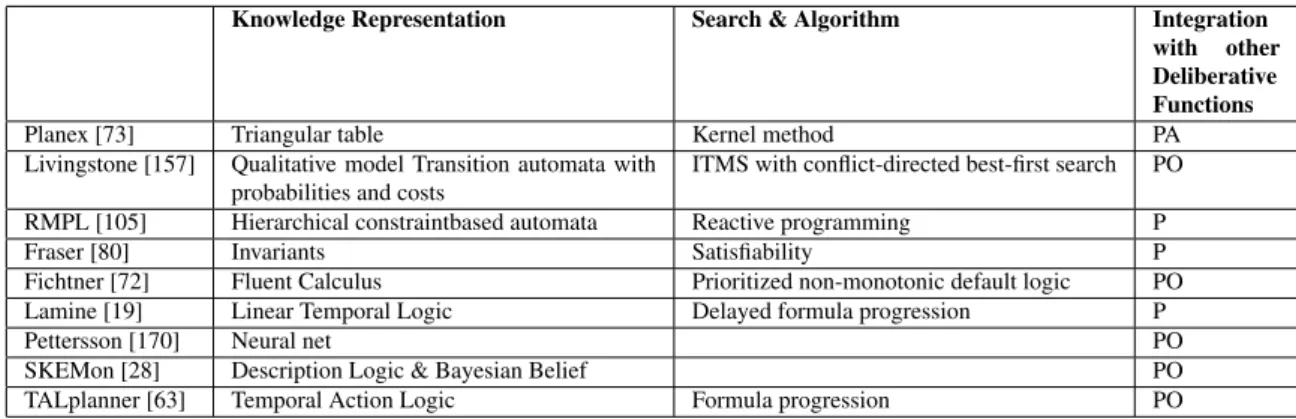
Over the past decades, domain-independent task planning has achieved tremendous progress, mostly on the search problem while keeping the prediction problem quite simple with the precondition–effect model. A speed up of a few orders of magnitude in the performance of classical planners has been achieved; numerous extensions to relational representations and improvements in algorithms for non-deterministic, probabilistic and other non-classical planning have been developed. A survey of task planning is not the purpose of this section (see [86, 91, 222, 234]). We will focus instead on problems and approaches for the integration of planning in a robot deliberation system. In addition to the integration of motion and manipulation planning to task planning, robotics stresses particular issues such as handling time and resources, uncertainty, partial knowledge and open domains. The rest of the section surveys a few approaches to these problems, summarized in Table 4.
3.1. Motion and Task Planning
Robots have to plan precise movements of their wheels, legs, arms, and joints. Motion planning and task planning are different problems that use distinct representations and search techniques. The latter has been mostly considered by the AI community, while the former has been studied by the robotics and computational geometry communities. In simple cases one can decouple the two problems: task planning produces a high level plan whose steps requiring motions can be handled by a specific motion planner. Most of the systems in Table 2 embed a motion planner used in
Approaches Systems Open or Closed Loop
Horizon Nondeterminism
Concur-rency Solution Plan Knowledge Represen-tation Search Algorithm Integration with other deliberation functions Temporal planning IxTeT [89]
Open Indefinite Deterministic yes Flexible State
vari-ables, time-points Temporal in plan space Acting with IxTeT-eXeC monitor-ing with IxTeT-Reco PS [110]
Open Indefinite Deterministic yes Flexible State
vari-ables, intervals Temporal in plan space Acting, monitoring and goal reasoning EUROPA [79]
Open Indefinite Deterministic yes Flexible State
vari-ables, intervals Temporal in plan space Acting (see IDEA & T-REX) APSI [81]
Open Indefinite Deterministic yes Flexible State
vari-ables, intervals Temporal in plan space Acting with T-REX ASPEN [178]
Open Indefinite Deterministic yes Completely
instantiated State vari-ables, intervals Local search Acting (see CASPER) Probabilistic Planning SSP [146]
Closed Indefinite Nondeterministic no Partial pol-icy MDP Heuristic and sam-pling Acting RFF [206]
Closed Receding Nondeterministic no Partial
pol-icy
MDP Heuristic Acting
MCP [141]
Closed Mixed no Partial
pol-icy Factorized MDP Compressed determin-istic part Acting Open World Planning MAPL [31]
Closed Indefinite Delayed no Assertions
to be refined
State vari-ables, belief variables, assertions
Classical Mixed plan-ning/acting
Hartanto
[96] Open Indefinite Deterministic no Completely
instantiated HTN, DL DL rea-soning, HTN Race [186]
Open Indefinite Deterministic no Completely
instanciated
HTN HTN
Commu-nication using Black-Board Table 4: Surveyed planning systems: main features, knowledge representations, algorithms and links with other deliberation functions.
this decoupled approach. When the mission is more complex or the environment more constrained, this decomposition is no longer possible: the motion constraints must be taken into account early in the task planning phase. Let us briefly present the state of the art in motion and manipulation planning and review a few approaches (listed in Table 5) integrating it with task planning.
Feasible motions
Search Planned Estimated Both
State space Asymov [36] CPMP [44] I-TMP* [97] CTAMP [22] SamplSGD [238]
Hierarchical AHP [231] Kaelbling [113]
Motion and manipulation planning are key capabilities for a robot, requiring specific representations for geometry, kinematics and dynamics. Probabilistic Roadmaps (PRM) and Rapidly-Exploring Random Trees (RRT) are well de-veloped and mature techniques for motion planners that scale up efficiently and allow for numerous extensions [136]. The basic idea is to randomly sample the configuration space (C-space) of the robot (i.e., the vector space of the robot’s kinematics parameters) into a graph where each vertex is a point in the space denoted Cfof free configurations
(away from obstacles), and each edge a direct link in the free space between two free configurations. Initial and goal configurations are added to this graph, between which a path is computed. This path is then transformed into a smooth trajectory. Manipulation planning requires finding feasible sequences of grasping positions, each of which is a partial constraint on the robot configuration that changes its kinematics [198]. Many other open problems remain in motion and manipulation planning, such as dynamics and stability constraints, e.g., for a humanoid robot [114], or visibility constraints, e.g., to allow for visual servoing [41].
Task planning and motion/manipulation planning have been brought together in a few approaches. The CPMP planner [44] builds a task planner domain from a tree constructed by a motion planner in the robot C-space. It then plans symbolically with a state space planner and converts back the found plans into the C-space.
The Asymov planner [36] combines a state-space task planner with a search in the motion planner configuration space. It defines places which are both a state in the task planner space, and cover a range of free configurations in Cf.
These places define bridges between the two search spaces. These two spaces are not explicitly constructed, but for each generated state of the task plan, the system checks that at least one configuration Cfis reachable. The state-space
search prunes a state whose corresponding set of free configurations does not meet current reachability conditions. This approach has also been extended to manipulation planning and to multi-robot planning for joint activities such as two robots assembling a table in a cluttered environment.
The integration of motion to task planning is also explored in [231] with Angelic Hierarchical Planning (AHP). AHP plans over sets of states with the notion of reachable sets of states. These sets are not computed exactly, but bounded, e.g., by a subset and a superset, or by an upper and a lower bound cost function. These costs are obtained by simulations of the basic activities, including motion activities, for random values of the state variables. A high-level task has several possible decompositions into primitives. The set of possible decompositions of a plan containing several high-level tasks is the Cartesien product of all possible decompositions of its actions. It is not necessary to ensure that all decompositions are feasible. A plan is acceptable if it has at least one feasible decomposition. Decomposition of a task can be postponed, e.g., until the acting time for the achievement of that task. At that point, the robot chooses a feasible decomposition (hence the reference to an angelic semantics of nondeterminism).
A different coupling of a hierarchical task planner to fast geometric suggesters is developed in [113]. These suggesters are triggered when the search in the decomposition tree requires geometric information. They do not completely solve the geometric problem, but they provide information that allows the symbolic search to continue up to a leaf of the tree. The system alternates between symbolic planning phases and the real execution of geometric actions in the environment. Planning proceeds while acting. This allows the task planner to call the geometric planner (not the suggesters) in a fully known state. Thus, this approach relies on two strong assumptions: the geometric preconditions of the tasks can be calculated quickly and efficiently (by the suggesters), the subgoals resulting from a task decomposition must be executed in sequence (no parallelism). The authors acknowledge that their system is not complete, and that the subgoals sequencing assumption requires actions to be reversible at a reasonable cost. Yet, for problems where these assumptions are satisfied, the system is able to quickly produce correct plans.
The geometric backtracking approach of [22] and subsequent work on a system called CTAMP relies on the automated synthesis of geometric constraints from the task plan and their propagation, as linear programs, to filter out samples in the configuration space. Remaining configurations, if any, are further searched with respect to sufficient conditions of inverse kinematics, collision detection and motion planning to make sure that each step specifies collision free and kinematically achievable poses with respect to the previous ones. The approach has been developed for manipulation problems and experimented with the dual arm Justin robot.
PRM and RRT motion planners used in cited approaches solve feasible queries very efficiently, but they handle infeasible queries with a cutoff time that can be a serious drawback in constrained environments. The incremental algorithm I-TMP [97] integrates closely task and motion planning with adaptive allocation of computational time where it can be most useful. It has been tested on multi leg robots navigating on rough terrain.
Let us also mention the physics-based technique of [238] which couples a physics engine simulator with RRT-like search methods for planning the interactions of a robot with non actuated bodies with varying degrees of controllability
in order to reach some goals. The approach was tested in minigolf and robot soccer domains. Similarly, the SamplSGD system [172] adds differential constraints to the symbolic and geometric specifications of a planning domain. It relies on sampling techniques to selectively explore the continuous configuration and dynamics space. Task planning provides discrete actions and regions of the continuous space that sampling based motion planning can explore. The two planners interact through estimates on the utility of each action, which are computed by reinforcement learning techniques. SamplSGD was tested on simulated manipulation tasks.
3.2. Temporal Planning
Most robotics applications require explicit time models to handle durative actions, concurrency, synchronization with exogenous events and other robots, and temporal constraints, possibly with flexible lower and upper bounds.
Various approaches manage explicit time representations for planning. Several planners extend state-based rep-resentations with durative actions (e.g., TGP [202], VHPOP [237] or Crickey [48]). A few of them can manage concurrency, or even linear continuous change (COLIN [50]), or can plan and repair in real-time [188] . However, temporal planners that rely on timelines, i.e., partially specified evolution of state variables over time, are more flexible in the integration of planning and acting and, in most cases, more expressive, e.g., allowing the reference to instants beyond starting and ending time of actions. These planners implement plan-space search algorithms more often then state-space techniques. Their usual representation ingredients are:
• temporal primitives: time-points or intervals (tokens),
• state variables, possibly parametrized, e.g., position(object32), and rigid relations, e.g., connected(loc3, room5), invariant over time,
• assertions on the persistence of the value of a state variable over time, or the discrete or continuous change of values,
• temporal constraints: Allen interval relations [5] or Simple Temporal Networks [58] over time-points,
• atemporal constraints on the values and parameters of state-variables.
task FIX_DINER(?meal)(t_start,t_end){ ?meal in MEALS; hold(ROBOT_POS():refrigerator,(t_start,t_re)); event(REFR_DOOR():(close,open),t_ros); hold(REFR_DOOR():open, (t_ros,t_roe)); event(REFR_DOOR():(open,close),t_roe); hold(HOLD_ROBOT():?meal, (t_shm,t_ehm)); hold(ROBOT_POS():micro_wave, (t_mws,t_mwe)); event(MW_DOOR():(close,open),t_mwo); hold(MW_DOOR():open, (t_mwos,t_mwoe)); event(MW_DOOR():(open,close),t_mwoe); hold(MEAL_IN_MW():?meal, (t_smimw,t_emimw)); event(COOKED(?meal):(no,cooking),t_cs); hold(COOKED(?meal):cooking,(t_cs,t_ce)); event(COOKED(meal):(cooking,done),t_cs); .... use(LEFT_ARM():1,(t_start,t_end)); use(RIGHT_ARM():1,(t_start,t_end)); (t_end - t_start) in ]0,600]; }nonPreemptive t_end t_start ROBOT_POS REFR_DOOR MW_DOOR COOKED LEFT_ARM refrigerator Open Close Close Close Close Open Close Open moving micro wave cooking no done RIGHT_ARM used idle used used idle idle idle used
idle idle used idle used idle .... HOLD_ROBOT ?meal none ?meal none idle
Figure 4: Example of an IxTeT chronicle modeling an action for a service robot.
The chronicles of the IxTeT planner [89] illustrate such a representation. A chronicle defines time-points, temporal constraints between its time-points, changes in the values of state variables (denoted event), persistence of these values over time (denoted hold), and atemporal constraints over state variables parameters and values (see Fig. 4).
Other planners such as PS, the DS1/RAX planner [110], EUROPA [79] and APSI [81], rely on a similar represen-tation with timelines and tokens representing changes and persistences of state variables values over time intervals. Some of these timelines are directly connected to actions and percepts (to integrate perception). Temporal constraints in planning operators use the symbolic interval algebra [5] (see Fig. 5). Simple atemporal constraints over state vari-ables are also allowed. Goals are expressed as an unexplained assertions, i.e., required state-variable values to be
2
Idle Idle PickUp Untuck Approach Open Clo sing Plan Idle Idle Retract Closed Plan Idle Contained-by Before Ends Manipulation Planner Gripper Right_ArmFigure 5: Model of a PickUp action with three state variables: Gripper, Right Arm, Manipulation Planner.
accounted for by the planner through actions. Preconditions and predicted effects are expressed as assertions con-strained with respect to the duration of actions.
Planning proceeds in the plan-space by detecting flaws, i.e., unexplained changes and possible inconsistencies, and repairing them through additional actions and constraints. It makes use of various heuristics, constraint propagation and backtrack mechanisms. It produces partially specified plans, that have no more flaws but still contain constrained but non-instantiated temporal and atemporal variables. This least commitment approach allows for some flexibility to adapt to the execution context. Some planners can handle bounded planning time and take it into account together with the execution horizon during the planning process.
3.3. Probabilistic Planning
Markov Decision Processes (MDPs) offer a classical framework for planning with uncertainties and probabilistic effects. A planner computes an optimal policy, i.e., a universal plan mapping states into applicable actions. The classical framework considers infinite horizon problems, e.g., to maintain a property in dynamic environment. It can be extended to partially observable systems (POMDPs). It is effective as long as the state space and the cost and probability parameters can be entirely acquired and made explicite, and, for POMDPs, remains of small size.2
However, most deliberation problems in robotics do not allow for an explicit enumeration of their state space, and hence cannot afford a universal plan. Fortunately, many problems are focused on reaching a goal from some initial state. Heuristic search algorithms for Stochastic Shortest Path (SSP) problems [146] with factorized and hierarchical representations [29] address this class of problems. They offer probabilistic approaches to robotics deliberation that still need to be developed and deployed on robots, beyond classical test problems.
An SSP problem focuses on a partial policy, closed for the initial state s0(i.e., a policy π defined on all states
reachable from s0by π), terminating at goal states. An SSP is the equivalent for And/Or graphs to path search problems
in deterministic graphs. For very large implicit search spaces with sparse models (few applicable actions per state, few nondeterministic effects per action, including deterministic actions), a significant scaling up with respect to classical dynamic programming methods can be achieved with heuristics and sampling techniques [146].
Most heuristic search algorithms for SSPs are based on a two steps schema, called Find&Revise: (i) Find a pending state s among the descendant of s0reachable with current policy, and (ii) Revise the estimated value and policy of s
with the so-called Bellman update. A state s is pending when it needs to be expanded or when its value and policy need to be updated towards the best (or good) policy from s. That framework can be implemented in different ways, e.g., with a best-first search, as in AO*, LAO* [95] and their extensions, with a depth-first iterative deepening search, as in LDFS [27], or with a random walk search, as in RTDP [13], LRTDP [26] and their extensions.
These algorithms assume SSP problems with a proper policy closed for s0 (i.e., one that reaches a goal with
probability 1), and any improper policy has infinite cost. A generalization of SSPs to relax this last assumption allows to seek a policy that maximizes the probability of reaching a goal state, a very useful and desirable criteria [124]. Other issues, such as dead-ends (states from which it is not possible to reach a goal) have to be taken care of, in particular in
critical domains [122]. Heuristic search algorithms in SSPs are more scalable than dynamic programming, but they still cannot address large domains, unless these domains are carefully engineered and decomposed.
Various sampling and approximation techniques offer alternative approaches to further scale up probabilistic plan-ning. Among these approaches, determinization techniques transform each non-deterministic action into several de-terministic ones (the most likely or all possible ones), then it plans dede-terministically with these actions, online and/or offline. For example, SSiP [211] combines replanning when needed with planning over a parametrized horizon of at least k steps to be guaranteed without replanning. RFF [206] generates an initial deterministic plan, then it considers a fringe state along a non-deterministic branch of that plan and, as long as the probability to reach that state is above some threshold, it extends it with another deterministic plan toward a goal or an already solved state. Similar ideas are developed in sampling approaches. One of their advantages is the capability to work without a priori estimates of the probability distributions, as long as the sampling is drawn from these same distributions. Several strategies have been designed for the control of the search, e.g., sample more sparsely at the deeper level of the look-ahead tree. Bounds on the approximation quality and the complexity of the search have been obtained, with good results on various adaptations and extensions of the LRTDP and UCT algorithms, e.g., [117, 35, 123].
Although MDPs are often used in robotics at the sensory-motor level, in particular within reinforcement learning approaches (Sec. 7.2), SSP techniques are not as widely disseminated at the deliberative planning and acting level. An interesting example is the sparse MDP planner of [141] that couples SSP with classical planning: when most actions are deterministic but of a few that are probabilistic, it searches through and reduces the deterministic parts of the planning space into a compressed MDP. The approach has been tested in a robotics exploration problem.
3.4. Planning in Open Domains
Most classical planners rely on the closed-world assumption: a fact not explicitly stated is false.3This assumption
allows for a concise description of states and efficient computation of state-transitions. But it is too restrictive and sel-dom acceptable in robotics. A few techniques relax this assumption, e.g., planning with state-variables and timelines allows for partially specified instances of a domain. But other issues remain open, among them the following:
• Planning with respect to domain objects and properties that are unknown when planning starts but that can be discovered at acting time, in particular through planned information gathering actions. These new facts will be used to further refine the remainder of the plan.
• Allow the planner to query databases for facts it needs specifically to address a given planning problem, or to query knowledge bases for additional models of its environment that are relevant to the task at hand.
The former issue of planning with information gathering is studied by several authors with conditional plan ap-proaches, as in the PKS [168] system. The continual planning approach of MAPL [31] postpones part of the planning process. In its place, it introduces information gathering actions to later develop the missing parts of the plan. To this end, the planner uses assertions that abstract actions to be refined later, after information gathering. This mixed planning/acting approach is well adapted to dynamic environments where planning for subgoals that depend of yet unknown states can be delayed until the required information is available (through properly planned information gathering actions). The approach has been extended to multi-robot distributed planning/acting. It has been tested in simulated navigation problems.
The latter issue of acquiring additional models and data at planning time is being addressed by a growing number of projects. The driving idea is to enrich a robot deliberation system with functionalities akin to semantic web, using a domain ontology associated to some reasoning capabilities. For example, the ObjectEval system of [190] acquires from the web statistics about possible locations of objects of different classes. It uses them in a utility function for finding and delivering objects in an office environment. Other approaches use Description Logic (DL), a fragment of first-order logic, to handle statements about objects, properties, relations and their instances with inference algorithms for querying large stores of data and models over the web. Most implementations rely on OWL, the standard Web Ontology Language. OWL handles an open-world representation where facts can be true, false or unknown.
The approach of [96] couples DL with an HTN planner. A robot requires a large store of knowledge about its environment, only a small part of which is relevant to a given planning problem. DL allows the planner to synthesize a compact equivalent HTN problem focused on this relevant part. The corresponding ontology includes HTN planning
concepts (i.e., tasks, methods, states, etc.) as well as domain concepts. The approach was tested on navigation problems. The RACE project [186] designs a service robot with learning capabilities whose entire architecture is built around an open DL database, akin to a “Blackboard” architecture [100]. This feature is used to combine data about low-level robot activities, needed in particular for learning, with higher-level semantic descriptions provided by the ontology. The system supports a PR2 platform performing the tasks of a waiter.
The Open Robot Ontology (ORO) system of [138] was motivated more by extending the robot’s knowledge base then by improving the performance of its planners. ORO is built with the same OWL representation and reasoner as the previous systems. It offers queries and updates of a knowledge base about the environment. ORO services are used by various components of the robot, in particular by a situated dialogue management system and a planner. ORO has been tested with a few platforms for service robotics tasks (illustrated in Fig. 2(c)).
The RoboEarth and KnowRob projects [218, 208] aim at allowing robots having different platforms to share and reuse knowledge over the network for the purpose of performing new tasks and speeding up learning and adaptation. An OWL open source library stores shared models of objects (e.g., images, CAD models), environments (e.g., maps and object locations), and actions (e.g., action recipes and skills) together with their relations and properties in a general ontology. Each robot is endowed with means for querying and updating this database, as well as adapting its models. The concept was tested on a few demonstrators for exploring a maze using different platforms sharing maps and path information, for serving a drink or opening drawers without a priori knowledge of the environment setting. 3.5. Summary
Motion planners are essential in robotics; they are available in most of the surveyed systems. Task planning is also needed for deliberation. The assumption of independence between task and motion planning does not hold in tightly coupled problems. The state of the art for integrating task planning to motion planning, and more generally to other domain-specific planners, is progressing significantly.
In addition to space, time plays an important role in planning; it allows for concurrent activities and synchroniza-tion. Most of the task planners in our analyzed systems take into account time, often with an explicit representation with state variables over timelines. Constraint programming and plan space search are also quite popular in reviewed systems. As we will see next, they offer some advantages in the integration of planning and acting and in plan repair. The state of the art in nondeterministic and probabilistic planning has progressed. These approaches are appealing for addressing the uncertainty in knowledge and world variability. For the moment, they are mostly developed at the sensory-motor level and, to some extent, at the acting level (see Sec. 4.6). The bottleneck for their deployment in deliberation planning mainly is the modeling effort and the complication of integrating space and time.
We described planning as the coupling of a prediction problem and a search problem. Significant research efforts are devoted to the latter. More investigation in the former is needed for improving the predictive capabilities of models used by planners. Simulation-based planning appears to be a promising option. Open domain planning also has a large potential and should be more widely deployed in robotics deliberation systems.
4. Acting
Planning is easily specified as an offline predictive function, decoupled from the intricacies of the executing platform. In contrast, acting is more difficult to define as a deliberation function. The frequent reference to execution controlis often too reductive. There is much more to it than triggering abstract actions prescribed by a plan. Acting has to handle noisy sensors, unreliable actuators and imperfect models. It requires nondeterministic, partially observable and dynamic environment models, dealt with through closed-loop commands. Acting has often a central role in deliberation. It has to carry out in particular the following functions:
• Refinement: plan steps (i.e., actions) given by a task planner are seldom directly executable as robot commands. An action like open(door1) is a primitive step for a planner but requires significant deliberation for its achievement. The refinement process is context dependent. It relies on lower-level models, that we called skills, appropriate for the context. Skills can be chosen and adapted from a library or synthesized online. The skill into which an action is refined may change during execution. For example several navigation skills may offer different localization or motion control capabilities adapted to different context; hence the goto(room1) action can be refined into a sequence of several navigation skills. Acting also has to consider alternative refinements in case of failure.