
Publisher’s version / Version de l'éditeur:
Journal of Testing and Evaluation, 10, 3, pp. 81-82, 1982-05
READ THESE TERMS AND CONDITIONS CAREFULLY BEFORE USING THIS WEBSITE. https://nrc-publications.canada.ca/eng/copyright
Vous avez des questions? Nous pouvons vous aider. Pour communiquer directement avec un auteur, consultez la première page de la revue dans laquelle son article a été publié afin de trouver ses coordonnées. Si vous n’arrivez pas à les repérer, communiquez avec nous à [email protected].
Questions? Contact the NRC Publications Archive team at
[email protected]. If you wish to email the authors directly, please see the first page of the publication for their contact information.
NRC Publications Archive
Archives des publications du CNRC
This publication could be one of several versions: author’s original, accepted manuscript or the publisher’s version. / La version de cette publication peut être l’une des suivantes : la version prépublication de l’auteur, la version acceptée du manuscrit ou la version de l’éditeur.
Access and use of this website and the material on it are subject to the Terms and Conditions set forth at
Effect of temperature on brick suction
Davison, J. I.
https://publications-cnrc.canada.ca/fra/droits
L’accès à ce site Web et l’utilisation de son contenu sont assujettis aux conditions présentées dans le site LISEZ CES CONDITIONS ATTENTIVEMENT AVANT D’UTILISER CE SITE WEB.
NRC Publications Record / Notice d'Archives des publications de CNRC:
https://nrc-publications.canada.ca/eng/view/object/?id=ae805921-279b-4632-8d53-5f7cd2b953f5 https://publications-cnrc.canada.ca/fra/voir/objet/?id=ae805921-279b-4632-8d53-5f7cd2b953f5Ser
Tm
National Research
Conseil national
c. 2'Ow
b?
Council Canada
de
recherches Canada
BLDG
'
EFFECT OF TEMPERATURE ON BRICK SUCTION
by J.I. Davison
Reprinted from
American Society for Testing and Materials Journacrl of Testing and Evaluation
Vol.
10,
No.3,
May19EEa
DBR Paper No. 1054
Division of Building Research
Price
$1 .W
OTTAWAM R C
-
e # e T If
BhDG.
RES.
I!SOMMAIRE On a e f f e c t u e une b r e v e e t u d e d e l ' e f f e t d e l a t e m p e r a t u r e s u r l ' a b s o r p t i o n d e s b r i q u e s e t notamment s u r l e t a u x i n i t i a l d ' a b s o r p t i o n , f a c t e u r q u i s e r t B d e t e r m i n e r l a q u a n t i t e d ' e a u du m o r t i e r a b s o r b e e p a r l e s b r i q u e s a d j a c e n t e s . C e t t e c o n s i d e r a t i o n e s t i m p o r t a n t e pour l a c o n s t r u c t i o n p a r temps f r o i d s l o r s q u e l a q u a n t i t ' e d ' e a u e x t r a i t e du m o r t i e r permet d e d e t e r m i n e r l ' e s p a c e r e s t a n t pour les f o r c e s d ' e x p a n s i o n q u i a g i s s e n t s i l ' e a u r e s i d u e l l e g S l e B un s t a d e avancd. L'Ctude p o r t e s u r l e s b r i q u e s e x t r u d e e s e n a r g i l e e t e n s c h i s t e , e n a r g i l e s'echee e t compress&, s i l i c o - c a l c a i r e s , e t e n b e t o n c h o i s i e s s p e c i a l e m e n t pour l e u r s d i f f ' e r e n t e s v a l e u r s d u t a u x i n i t i a l d ' a b s o r p t i o n . L e s v a l e u r s o n t 5 t 6 d6terminBes B 20, 10, -1.5, e t -lO°C a v e c d e l ' e a u B 20°C, e t B 20°C a v e c d e l ' e a u 2 10°C. Les r d s u l t a t s i n d i q u e n t une l e g e r e d i m i n u t i o n du t a u x a v e c l e s t e m p e r a t u r e s d d c r o i s s a n t e s pour l e s b r i q u e s B f a i b l e a b s o r p t i o n e t une d i m i n u t i o n p l u s n e t t e pour l e s b r i q u e s B f o r t e a b s o r p t i o n ( b r i q u e s e x t r u d e e s e t b r i q u e s e n a r g i l e s e c h e e e t compress'ee) 3 d e s t e m p e r a t u r e s i n f ' e r i e u r e s B 0°C. On e n c o n c l u t q u e l e s b r i q u e s d e v a i e n t 3 t r e Zi d e s t e m p e r a t u r e s s u p e r i e u r e s 3 O°C pour o b t e n i r une r e d u c t i o n maximale d e l ' h u m i d i t ' e du m o r t i e r pendant l a c o n s t r u c t i o n e n h i v e r .
Authwlzsd Rsprint Imm
J w m a l
of
Testlng and EvaliWJon, May 1982 CoW*l%ltA m d a n Soekty for Testing mnd Mmtdmk 1916 Ram S-, Philadelphia, Pa. 19103
1982
J. I.
Davison
'
Effect of Temperature on Brick
Suction
REFERENCE: Davison, J. I., "EffscC of TcmperrtPrc oa Brick Suc- fined as the amount of water absorbed in 1 min by 193.55 cm2 (30
tba," lournal of Testing and Ewluation. JTEVA. Vol. 10. No. 3, May in.2) of bedding surface when a dry brick is immersed to a depth of 1982, pp. 81-82.
3.175 mm ('/a in.) in water. This is considered to be a good indica-
ABSTRACT: A brief study has been carried out on the effect of tem- perature on brick suction or initial rate of absorption (IRA), which is a factor in determining the amount of water extracted from mortar placed between bricks. This is important during cold weather construction when the amount of water extracted determines the pore space avail- able for expansive forces if the remaining water freezes at an early age. The study included extruded clay and shale, dry-press clay, sand- lime, and concRte bricks selected to include a range of control IRA (suction) values. Values were determined at 20, 10,
-
1.5, and - 10°C with water at 20°C and at 20°C with water at 10°C.Results indicate a small reduction in suction with dropping temperature for low absorption bricks and a substantial drop for high absomtion extruded and dm-~ress clav bricks at temueratures below
tion of the ability of the brick to extract water from mortar when there is contact between the two in a masonry wall. IRA was deter- mined, using procedures contained in Canadian Standards Associ- ation Methods of Sampling and Testing Brick (CSA A82.21, on a sampling of 33 bricks, including shale and clay extruded, clay dry- press, concrete, and sand-lime units, successively at temperature levels of 20, 10,
-
1.5, and -10°C with water at 20°C and at a temperature of 20°C with water at 10°C. Between tests the bricks were redried for 72 h at 1 10°C, then cooled, sealed in polyethylene, and left in the cooling chamber overnight.O°C. it is concluded that brick: should
be
at temperatuks above 0°C to ensure maximum potential for reducing the moisture content of mortar during winter construction.Brick Temperature KEYWORDS: bricks, clays, shales, concretes, sand-lime, extruding,
dry pressing, initial rate of absorption, suction, cold weather masonry Suction values for bricks at temperatures of 4-20 and
-
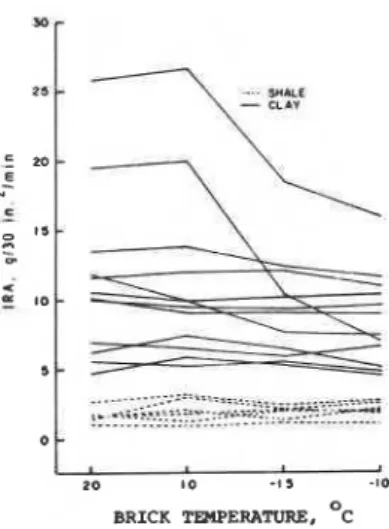
10°C construction with a water temperature of 20°C, are shown graphically in Figs. 1to 3. Average values (g/193.55 cm2 [g/30 in.2] per minute) are One of the condiions, identified in Scandinavian studies [1.2], given in Table 1. Increased suction at the low temperature is in- that enables plastic masonry mortars to survive early freezing is dicated for the extruded shale and concrete bricks. Their low suc- that "the moisture content should be reduced to 6 percent by the tion values coupled with possible experimental error suggest that suction of the masonry units" before freezing occurs. This is based the increase is not significant. There was a definite reduction in on data by Sneck et al [I] showing the virtual elimination of freez- suction at the low temperature for the other three p u p s , the ing expansions in plastic mortar in which the moisture content has
been reduced to the 6% level. These findings have been substan- tiated by the author [3] under ideal ambient laboratory conditions
in which mortar moisture content levels were reduced under the in- fluence of the suction of dry masonry units (bricks). Problems in reaching the low 6% level have prompted questions regarding the probability of achieving similar reductions under the less than ideal condiions gf winter construction, where bricks may contain some moisture and may be laid up in freezing temperatures. The moisture problem has been addressed by one of the cardinal rules for traditional cold weather masonry construction, the requirement that bricks must be dry. This paper reports the results of a brief study of the effect of temperat- on brick suction.
Suction was determined by initial rate of absorption (IRA), de-
This paper is a contribution from the Division of Building Research. Na- tional Research Council of Canada, and is published with the approval of
the Director of the Division.
'Research officer (retired). National Research Council of Canada, Divi- sion of Building Research, 1411 Oxford St., Halifax B3H 321 Canada. Member of ASTM.
el982 by t h e American Society for Testing a n d Materials
81
1 .
20 10 - 1 a -10 BRICK TEMPERATURE, OC
FIG. l-Extruded clay and shale bricks. g/30 in.2 per min = v193.55
82 JOURNAL OF TESTING AND EVALUATION
TABLE 2-Average suction d u e s (gl193.55 cm2 [ g / N in.2] per minute) for bricks (+20°C) at two water temperatures.
Bricka +20°C
+
10°C Shale, extruded ( 6 ) 1.6 2.1 Clay, extruded ( 12) 11.3 8.6 Clay, dry-pres ( 7 ) 64.0 61.7 C o n m e ( 2 ) 2.0 2.2 Sand-lime (6) 23.0 19.9"Number of specimens in parentheses.
largest in the high absorption clay dry-press bricks (Fig. 2) where the average loss was more than 50% of the control value. Suction loss in the clay extruded bricks was greatest in samples with the highest control values (Fig. 1). Losses for the sand-lime bricks (Fig. 3) were not as substantial as those for comparable clay bricks. 2 0 10 - 1 I -10
BRICK TEMPERATURE, OC
Water Temperature
FIG. 2-Dry-press cloy bricks. g/30 in. per min = g/J93.55 cm2 per min.
I a 1
20 10 -I J -10
BRICK TEMPERATURE, OC
FIG. 3-Sand-lime and concrete bricks, g/30 in.2 per min = g493.55 cm2 per min.
TABLE 1-Average suction d u e s (g/J93.55 cm2 [g/30 in.2] per minute)
for bricks at temperatures of +20 and - JO°C with a water temperature
o j
mOc.
Shale, extruded (6) 1.6 2.1 Clay, extruded (12) 11.3 8.6 Clay, dry-press (7) 64.0 31.5 Concrete ( 2 ) 2.0 2.2 Sand-lime ( 6 ) 23.0 19.9"Number of specimens in parentheses.
Average suction values (g/193.55 cm2 [g/30 in.2] per minute) for bricks (+20°C) at two water temperatures are given in Table 2. There was a minor increase in suction values for low absorption
shale and concrete bricks at the low water temperature, with small decreases in clay extruded, dry-press, and sand-lime bricks. Al- though the trend towards lower suction values with dropping water temperature appears to be similar to that for dropping brick temperature, no determinations were made at lower temperatures because it was unlikely that there would be serious reductions when water temperature dropped from
+lo
to O°C and because water below O°C would not, in any case, be used in cold weather masonry construction.It is possible that IRA values may vary when individual units are successively tested under the same temperature conditions. Al- though the results at each data point were not checked against values for a control unit at 20°C, in water at 20°C, the results are considered significant.
Suction values for clay and sand-lime bricks decline as the tem- perature of the bricks drops. The decline is significant in extruded and dry-press clay bricks with high suction values and is most sub- stantial when brick temperatures drop below O°C. This suggests that bricks should be at temperatures above O°C to ensure max; imum potential for reducing the moisture content in plastic mor- tars during cold weather masonry construction.
[I] Sneck, T., Koski, L., Oinonen. H., Svendsen, S., Waldum, A., DUhr- kop, H., and Helander, E., "Winter Masonry." Publication 1. Build- ing Technology and Community Development, Technical Research Center of Finland, Helsinki, 1972.
[ 2 ] Sneck, T., "Winter Masonry Construction," in Proceedings of the
First Canadian Masonry Symposium. University of Calgary, Calgary,
Alberta, Canada. 1976, pp. 238-246.
[ 3 ] Davison, J . I . , "Volume Change Due to Freezing in Masonry Mortar," presented at Symposium on Masonry: Materials, Roperties and Per- formance, sponsored by American Society for Testing and Materials, Philadelphia, Dec. 1980.
This publication is being d i s t r i b u t e d by the Division of Building R e s e a r c h of the National R e s e a r c h Council of Canada. I t should not be reproduced in whole o r in p a r t without p e r m i s s i o n of the original publisher. The Di- vision would be glad to b e of a s s i s t a n c e in obtaining s u c h p e r m i s s i o n .
Publications of the Division m a y be obtained by m a i l - ing the a p p r o p r i a t e r e m i t t a n c e (a Bank, E x p r e s s , o r P o s t Office Money O r d e r , o r a cheque, m a d e payable t o the R e c e i v e r G e n e r a l of Canada, c r e d i t NRC) t o the National R e s e a r c h Council of Canada, Ottawa. KIA 0R6. Stamps a r e not acceptable.
A l i s t of a l l publications of the Division i s available and m a y b e obtained f r o m the Publications Section, Division of Building R e s e a r c h , National R e s e a r c h Council of Canada, Ottawa. KIA OR6.
![TABLE 1-Average suction d u e s (g/J93.55 cm2 [g/30 in.2] per minute) for bricks at temperatures of +20 and - JO°C with a water temperature](https://thumb-eu.123doks.com/thumbv2/123doknet/14325909.497807/5.892.156.361.518.774/table-average-suction-minute-bricks-temperatures-water-temperature.webp)
