Publisher’s version / Version de l'éditeur:
BioTechniques, 32, 3, pp. 480-482, 2002-03-01
READ THESE TERMS AND CONDITIONS CAREFULLY BEFORE USING THIS WEBSITE. https://nrc-publications.canada.ca/eng/copyright
Vous avez des questions? Nous pouvons vous aider. Pour communiquer directement avec un auteur, consultez la première page de la revue dans laquelle son article a été publié afin de trouver ses coordonnées. Si vous n’arrivez pas à les repérer, communiquez avec nous à [email protected].
Questions? Contact the NRC Publications Archive team at
[email protected]. If you wish to email the authors directly, please see the first page of the publication for their contact information.
NRC Publications Archive
Archives des publications du CNRC
This publication could be one of several versions: author’s original, accepted manuscript or the publisher’s version. / La version de cette publication peut être l’une des suivantes : la version prépublication de l’auteur, la version acceptée du manuscrit ou la version de l’éditeur.
For the publisher’s version, please access the DOI link below./ Pour consulter la version de l’éditeur, utilisez le lien DOI ci-dessous.
https://doi.org/10.2144/02323bm01
Access and use of this website and the material on it are subject to the Terms and Conditions set forth at
5’-RACEing across a bridging oligonucleotide
Shi, X.; Karkut, T.; Chahmanhkah, M.; Alting-Mees, M.; Hemmingsen, Sean;
Hegedus, D.
https://publications-cnrc.canada.ca/fra/droits
L’accès à ce site Web et l’utilisation de son contenu sont assujettis aux conditions présentées dans le site LISEZ CES CONDITIONS ATTENTIVEMENT AVANT D’UTILISER CE SITE WEB.
NRC Publications Record / Notice d'Archives des publications de CNRC:
https://nrc-publications.canada.ca/eng/view/object/?id=72c670b9-672f-48dd-8df3-7aba23ad2e3a https://publications-cnrc.canada.ca/fra/voir/objet/?id=72c670b9-672f-48dd-8df3-7aba23ad2e3a5
′
-RACEing Across a
Bridging Oligonucleotide
BioTechniques 32:480-482 (March 2002)Rapid amplification of cDNA 5′ ends (5′-RACE) is a convenient way to retrieve information about the 5′ termi-ni of mRNAs because entire open read-ing frames are difficult to predict from genomic information and expressed se-quence tag libraries generally lack full 5′termini. To achieve this, numerous methods have been developed, each of which has been successful in specific situations (3–5,11–14,17). However, two major generic drawbacks are asso-ciated with these procedures. First, a general non-gene-specific primer is in-troduced for PCR amplification that can lead to nonspecific amplification products (3,5,11–14,17). Second, the methods used to introduce the non-gene-specific primer sequence into the cDNA can be problematic. Some proto-cols involve ligation of ssDNA by T4 RNA ligase, the efficiency of this reac-tion being quite low (4,11). Others use terminal deoxynucleotidyl transferase (TdT) to tail the first-strand cDNA (5,11,12) and require additional steps, such as cDNA purification before and after tailing, which reduces the recov-ery of cDNA. Furthermore, the TdT tailing itself can be inefficient and diffi-cult to control. To circumvent these drawbacks, we have devised a novel and effective method to amplify cDNA 5′ ends, termed BO-5′RACE, for 5′ -RACEing across a bridging oligonu-cleotide (BO).
During an examination of the struc-tural proteins residing within the peritrophic matrix, a structure lining the insect midgut of Mamestra configu-rata (Bertha armyworm), we isolated a
1.8-kb clone from a midgut cDNA li-brary that bore a high degree of similar-ity to the Trichoplusia ni mucin (16).
Northern blot studies revealed that the full-length transcript was approximate-ly 3.5 kb. To obtain the complete mucin cDNA sequence, we developed the BO-5′RACE protocol described below. To-tal RNA was isolated from midgut tis-sues of fourth instar larvae using TRIZOL® Reagent (Invitrogen, Carls-bad, CA, USA). The partial sequence
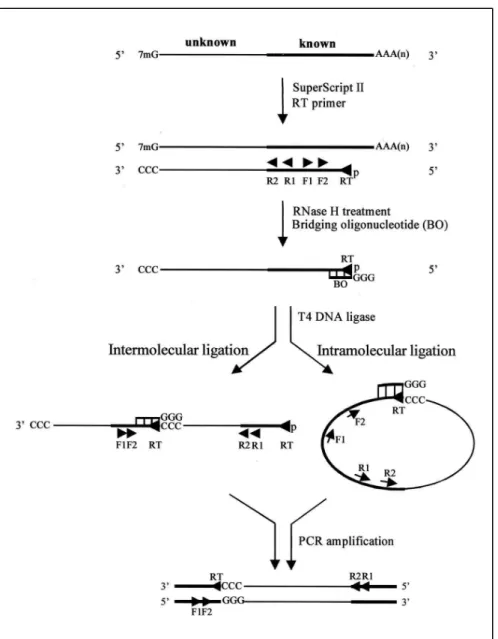
of the mucin cDNA was used to design oligonucleotides (Table 1) for reverse transcription (RT), the BO, and PCR (F1, F2, R1, and R2) to test the BO-5′ RACE protocol (Figure 1). Notably, the RT primer is 5′-phosphorylated to al-low for the head-to-tail ligation of the first-strand cDNA. A restriction en-donuclease recognition site can also be introduced into the 5′ end of the RT primer if cloning of the cDNA 5′ termi-nus is required. The standard first strand cDNA synthesis reaction
con-sisted of 5 µg total RNA, 2 pmol RT primer, first-strand buffer (50 mM Tris-HCl, pH 8.3, 75 mM KCl, 3 mM MgCl2), 10 mM DTT, 6 mM MgCl2, 0.5 mM each dNTP, and 200 U SUPERSCRIPTII(Invitrogen) in a
20-µL reaction. This mixture was incubat-ed at 42°C for 60 min, and the reverse transcriptase was inactivated by incu-bation at 70°C for 15 min. The remain-ing mRNA was eliminated with the ad-dition of 1 µL RNase H (Invitrogen) and incubation at 37°C for 1 h to
pre-Benchmarks
Figure 1. BO-5′RACE protocol.Flowchart outlining the events involved in BO-5′RACE. An internal RT primer is used to catalyze first-strand cDNA synthesis. At elevated dGTP concentrations, SUPER
-SCRIPTII adds non-template-encoded C residues to the 3′termini of first-strand cDNA molecules derived from mRNA possessing intact 7-methylguanosine cap structures. The poly-C tail anneals to the three Gs of the BO that tether the 5′and 3′termini of the first-strand cDNA. The RT primer for cDNA synthesis is phosphorylated to facilitate inter- or intramolecular ligation of the first-strand cDNA, as directed by the BO. Two gene-specific primers are then used to amplify the unknown 5′terminus.
vent possible interference with the sub-sequent BO-assisted ligation. Anneal-ing of the BO to the first-strand cDNA was achieved by adding 10 pmol BO to the cDNA reaction, incubating at 95°C for 5 min, and then cooling to room temperature for 30 min. A 1-µL aliquot of the BO-annealed cDNA was then ligated in a 20-µL reaction containing ligation buffer (50 mM Tris-HCl, pH 7.5, 10 mM MgCl2, 10 mM DTT, 1 mM rATP, 25 µg/mL BSA) and 0.4 U T4 DNA ligase (New England Biolabs, Beverly, MA, USA) at 16°C overnight. If the target mRNA is present in low quantities, then the entire BO-annealed
first-strand cDNA can be precipitated with ethanol before ligation.
To examine the effects of elevated dCTP or dGTP relative to the other dNTPs on BO-5′RACE efficiency, a skewed ratio of dNTPs was used. The dNTP concentration was lowered to 5–50 µM, this being sufficient for cDNA synthesis, and the concentration of dGTP (or dCTP) was increased to 5 mM, resulting in a 100–1000 times ex-cess. PCR amplification was performed using 1 µL ligated cDNA with R1 and F1 primers under the following reaction conditions: 5 min of incubation at 94°C, followed by 35 cycles of 1 min at 94°C, 1 min at 63°C, and 2 min at 70°C, and a final 10-min extension at 72°C. A 100-µL PCR consisted of 2.5 U Pfu DNA polymerase (Stratagene, La
Jolla, CA, USA), buffer (20 mM Tris-HCl, pH 8.8, 2 mM MgSO4, 10 mM KCl, 10 mM (NH4)2S O4, 0.1% Triton®
X-100, 0.1 mg/mL nuclease-free BSA), 0.1 µM each primer, 0.2 mM each dNTP, and 1 µL ligated cDNA. Ampli-fied DNA was separated by agarose gel electrophoresis; when used as the DNA template, an internal region of the 1.2-kbp DNA band was amplified by a sec-ond set of gene-specific primers, R2 and F2, which confirmed the derivation from the mucin cDNA. Sequencing of the 1.2-kbp fragments from each reac-tion revealed a common 5′termini with the characteristic three Gs associated with the BO, which suggested that we had obtained the 5′end of the mucin cDNA. The full-length M. configurata
mucin cDNA was determined to be 2960 bp long (not including the poly A tail), closely matching the size estimat-ed by Northern analysis, and encoding a
protein of 811 amino acids. The se-quence of M. configurata mucin has
been deposited in GenBank®
(acces-sion no. AY057052).
BO-5′RACE is based on the TdT-like activity of reverse transcriptases (i.e., the ability to add non-template-en-coded nucleotides to the 3′termini of their products). The normal preference of nucleotides for this addition is A > G >> T ≈ C (2). However, when 5′ 7-methylguanosine-capped mRNA was used as the substrate, C was added pref-erentially (6,10,13,15,17) because re-verse transcriptases rere-verse-transcribe the 7-methylguanosine cap nucleotide into a 3′-terminal C residue (6,15). It has been demonstrated that reverse transcribing capped mRNA with avian myeloblastosis virus (AMV) reverse transcriptase resulted in 88% of the first-strand cDNA possessing a single additional C, while 6% had two Cs and 6% had an additional A residue (10). Normally, the addition of a second or third non-template-encoded nucleotide is less common (1,7,10,13); however, under specific cDNA synthesis condi-tions, such as elevated Mg2+levels (17) or the addition of Mn2+ (13), longer
stretches of extra nucleotides are incor-porated (13,17).
In BO-5′RACE, a BO is introduced that possesses three Gs at its 3′ end. The three-G tail is designed to hy-bridize with the non-template-encoded Cs added to the first-strand cDNA— three Gs being chosen to increase hy-brid stability. Another property of the BO is that it encompasses the region complementary to the RT primer used for cDNA synthesis. As such, the BO tethers the “head” and “tail” of the first-strand cDNA and coordinates the intra-and intermolecular ligation events, al-though the frequency of the latter will be relatively low because of the limited abundance of full-length mRNAs. Two gene-specific primers are then used to amplify the 5′terminus of the cDNA. The results showed that the BO-5′RACE worked well when cDNA syn-thesis was carried out with elevated Mg2+levels and an equal molar ratio of dNTPs (0.5 mM each) (Figure 2, lane 1). Other studies have shown that under biased ratios of dNTPs, reverse tran-scriptases preferentially incorporate the nucleotide whose complementary
Primer Sequence (5′→3′) RTa CTTGTCGCAGTCAGATTC B O CATGAATCTGACTGCGACAAGGGG F1 CTCCTACTACCGAAGCAGACAGCG F2 ATACCTCTCCCCAATGACCCTGAC R1 CCTCTCGATCTTCTTACCAGCG R2 TCGTGGGGGAGGTGGTGAATG
aRT primer must be 5′-phosphorylated. Table 1. Primers Used for BO-5′RACE of M. configurata Mucin cDNA
Figure 2. Amplification of M. configurata mucin 5′terminus using primers F1 and R1 by BO-5′RACE.The amplification conditions were as described in the text. The arrowhead indicates the position of the expected DNA fragment. Lane M, DNA molecular weight markers (Gene-Ruler; MBI Fermentas, Hanover, MD, USA); lane 1, products amplified from cDNA synthe-sized using equal molar amounts of dNTPs (0.5 mM each); lane 2, products amplified from cDNA synthesized using excess dGTP (5 mM dGTP and 5 µM each dNTP); lane 3, tion with primer F1 alone; and lane 4, amplifica-tion with primer R1 alone.
dNTP is present in higher relative con-centrations in the reaction (8,9). In-deed, when cDNA was synthesized us-ing higher levels of dGTP relative to the other dNTPs, the BO-5′RACE often generated stronger and more specific products (Figure 2, lane 2). This is like-ly due to a higher proportion of cDNAs with elongated non-template-encoded C tails able to hybridize to the BO. As predicted, synthesis of cDNA under higher dCTP conditions reduced the yield of BO-5′RACE product because this will reduce the length of the C-tail addition (8,9). To determine whether increasing dGTP relative to other dNTPs leads to the introduction of mu-tations in the first-strand cDNA, we se-quenced the fragments generated under normal cDNA synthesis conditions, at elevated dCTP and dGTP levels. Analysis of the sequencing results showed no base substitutions, inser-tions, or deleinser-tions, which suggested that, in the presence of sufficient dNTPs, increasing one dNTP relative to other three does not lead to elevated mutation rates.
In comparison to other 5′-RACE methods, the BO-5′RACE protocol preferentially amplifies full-length cDNAs in a simple manner with no need for complicated cap-capturing methods. Also, specificity and efficien-cy are increased because of certain in-herent properties. The BO-assisted lig-ation occurs only with the cDNA molecules with 3′-protruding C termi-ni, reducing possible contamination from genomic DNA. The PCR amplifi-cation is carried out with two gene-spe-cific primers rather than the single primer normally used in other 5′-RACE methods. Also, the two gene-specific primers in BO-5′RACE oppose one an-other, making amplification from ge-nomic DNA impossible. Finally, de-graded mRNA does not possess the 5′ 7-methylguanosine cap structure and is not a suitable substrate for BO-assisted first-strand cDNA ligation.
While no 5′-RACE method is techni-cally generic enough to allow for high-throughput isolation of full-length cDNAs, the BO-5′RACE method is proving to be relatively robust, as we have been able to amplify other difficult mRNA templates containing highly repetitive regions, such as those found
in mucin. Simplicity and reliability be-come especially important when a rare mRNA is the subject of investigation.
REFERENCES
1.Brownstein, M.J., J.D. Carpten, and J.R. Smith.1996. Modulation of non-templated nucleotide addition by Taq DNA polymerase:
primer modifications that facilitate genotyp-ing. BioTechniques 20:1004-1010.
2.Chen, D. and J.T. Patton. 2001. Reverse tran-scriptase adds nontemplated nucleotides to cDNAs during 5′-RACE and primer exten-sion. BioTechniques 30:574-582.
3.Chenchik, A., L. Diachenko, F. Moqadam, V. Tarabykin, S. Lukyanov, and P.D. Siebert. 1996. Full length cDNA cloning and determination of mRNA 5′- and 3′-ends by amplification of adaptor-ligated cDNA. BioTechniques 21:526-534.
4.Eyal, Y., H. Neumann, E. Or, and A. Fryd-man. 1999. Inverse single-strand RACE: an adaptor-independent method of 5′ RACE. BioTechniques 27:656-658.
5.Fehr, C., M. Fickova, C. Hiemke, and N. Dahmen.1999. Rapid cloning of cDNA ends polymerase chain reaction of G-protein-cou-pled receptor kinase 6: an improved method to determine 5′- and 3′- cDNA ends. Brain Res. Protocols 3:242-251.
6.Hirzmann, J., D. Luo, J. Hahnen, and G. Hobom.1993. Determination of messenger RNA 5′-ends by reverse transcription of the cap structure. Nucleic Acids Res.
21:3597-3598.
7.Magnuson, V.L., D.S. Ally, S.J. Nylund, Z.E. Karanjawala, J.B. Rayman, J.I. Knapp, A.L. Lowe, S. Ghosh, and F.S. Collins. 1996. Substrate nucleotide-determined non-templated addition of adenine by Taq DNA
polymerase: implications for PCR-based genotyping and cloning. BioTechniques
21:700-709.
8.Martinez, M.A., M. Sala, J.-P. Vartanian, and S. Wain-Hobson.1994. Hypermutagen-esis of RNA using human immunodeficiency virus type 1 reverse transcriptase and biased dNTP concentrations. Proc. Natl. Acad. Sci. USA 91:11787-11791.
9.Martinez, M.A., M. Sala, J.-P. Vartanian, and S. Wain-Hobson. 1995. Reverse tran-scriptase and substrate dependence of the RNA hypermutagenesis reaction. Nucleic Acids Res. 23:2573-2578.
10.Mules, E.H., O. Uzun, and A. Gabriel. 1998. In vitro Ty1 reverse transcription can
generate replication intermediates with untidy ends. J. Virol. 72:6490-6503.
11.Schafer, B.C. 1995. Revolutions in rapid am-plification of cDNA ends: new strategies for polymerase chain reaction cloning of full-length cDNA ends. Anal. Biochem.
227:255-273.
12.Schmidt, W.M. and M.W. Mueller. 1996. Controlled ribonucleotide tailing of cDNA ends (CRTC) by terminal deoxynucleotidyl transferase: a new approach in PCR-mediated analysis of mRNA sequences. Nucleic Acids Res. 24:1789-1791.
13.Schmidt, W.M. and M.W. Mueller. 1999. CapSelect: a highly sensitive method for 5′ ca-dependent enrichment of full-length cDNA in PCR-mediated analysis of mRNAs. Nucleic Acids Res. 27:e31.
14.Shi, X. and S.G.W. Kaminskyj. 2000. 5′ RACE by tailing a general template-switching oligonucleotide. BioTechniques 29:1192-1195.
15.Volloch, V.Z., B. Schweitzer, and S. Rits. 1995. Transcription of the 5′-terminal cap nu-cleotide by RNA-dependent DNA poly-merase: possible involvement in retroviral re-verse transcription. DNA Cell Biol.
14:991-996.
16.Wang, P. and R.R. Granados. 1997. Molecu-lar cloning and sequencing of a novel inverte-brate intestinal mucin cDNA. J. Biol. Chem.
272:16663-16669.
17.Zhu, Y., A. Chenchik, and P.D. Siebert. 1996. Synthesis of high-quality cDNA from nanograms of total polyA+ RNA with the CapFinder PCR cDNA library construction kit. CLONTECHniques 11:12-13.
This work is supported by an NSERC Strategic Projects grant no. 215742-98 to S.M.H. and D.D.H. We are grateful to M. O’Grady and S. Shah, who did the funda-mental work on mucin. Technical assistance and advice from Dr. Janet Hill and Brenda Haug is also appreciated. Sequencing and oligonucleotide synthesis were performed by the DNA Technology Unit, NRCC-PBI, Saskatoon. Address correspondence to Dr. Dwayne H. Hegedus, Molecular Plant Pro-tection, Saskatoon Research Center, Agri-culture and Agri-Food Canada, 107 Science Place, Saskatoon, SK, S7N 0X2, Canada. e-mail: [email protected]
Received 1 October 2001; accepted 29 November 2001.
X. Shi
1,2, T. Karkut
1,2,3, M.
Chahmanhkah
1,3, M.
Alting-Mees
2, S.M. Hemmingsen
2,3,
and D. Hegedus
1,31
Agriculture and Agri-Food
Canada
2
National Research Council
3University of Saskatchewan
Saskatoon, SK, Canada
Benchmarks
For reprints of this or any other article, contact