unrelated carbon sources in metabolically engineered E. coli
The MIT Faculty has made this article openly available. Please sharehow this access benefits you. Your story matters.
Citation Tseng, Hsien-Chung et al. “Biosynthesis of chiral 3-hydroxyvalerate from single propionate-unrelated carbon sources in metabolically engineered E. coli.” Microbial Cell Factories 9.1 (2010): 96.
As Published http://dx.doi.org/10.1186/1475-2859-9-96
Publisher BioMed Central Ltd.
Version Author's final manuscript
Citable link http://hdl.handle.net/1721.1/68691
Terms of Use Creative Commons Attribution-Noncommercial-Share Alike 3.0 Detailed Terms http://creativecommons.org/licenses/by-nc-sa/3.0/
Manuscript version 2
1
Biosynthesis of chiral 3-hydroxyvalerate from single
2
propionate-unrelated carbon sources in metabolically
3
engineered E. coli
4
Hsien-Chung Tseng1, Catey L. Harwell1, Collin H. Martin1,2†, Kristala L. J. Prather1, 2,* 5
6 1
Department of Chemical Engineering, Massachusetts Institute of Technology, 7
Cambridge, MA 02139 8
2
Synthetic Biology Engineering Research Center (SynBERC), Massachusetts Institute of 9
Technology, Cambridge, MA 02139 10
†
Current address: Dow Chemical Company, Spring House, PA 19477 11
12
* Corresponding author: Department of Chemical Engineering 13
77 Massachusetts Avenue, Room 66-454, Cambridge, MA 02139 14 Phone: 617.253.1950 15 Fax: 617.258.5042 16 Email addresses: 17 HCT: [email protected] 18 CLH: [email protected] 19 CHM: [email protected] 20 KLJP: [email protected] 21 22
Abstract
23
Background 24
The ability to synthesize chiral building block molecules with high optical purity is of 25
considerable importance to the fine chemical and pharmaceutical industries. Production 26
of one such compound, 3-hydroxyvalerate (3HV), has previously been studied with 27
respect to the in vivo or in vitro enzymatic depolymerization of biologically-derived co-28
polymers of poly(3-hydroxybutyrate-co-3-hydroxyvalerate). However, production of this 29
biopolymeric precursor typically necessitates the supplementation of a secondary carbon 30
source (e.g., propionate) into the culture medium. In addition, previous approaches for 31
producing 3HV have not focused on its enantiopure synthesis, and thus suffer from 32
increased costs for product purification. 33
Results 34
Here, we report the selective biosynthesis of each 3HV stereoisomer from a single, 35
renewable carbon source using synthetic metabolic pathways in recombinant strains of 36
Escherichia coli. The product chirality was controlled by utilizing two reductases of 37
opposing stereoselectivity. Improvement of the biosynthetic pathway activity and host 38
background was carried out to elevate both the 3HV titers and 3HV/3HB ratios. Overall, 39
shake-flask titers as high as 0.31 g/L and 0.50 g/L of (S)-3HV and (R)-3HV, respectively, 40
were achieved in glucose-fed cultures, whereas glycerol-fed cultures yielded up to 0.19 41
g/L and 0.96 g/L of (S)-3HV and (R)-3HV, respectively. 42
Conclusions 43
Our work represents the first report of direct microbial production of enantiomerically 44
pure 3HV from a single carbon source. Continued engineering of host strains and 45
pathway enzymes will ultimately lead to more economical production of chiral 3HV. 46
Background
47
The efficient production of enantiomerically pure chemicals from renewable 48
resources has gained considerable attention especially in the fine 49
chemical/pharmaceutical industry. Stereo-selective chemical processes generally employ 50
expensive chiral catalysts, require harsh physical conditions and solvents, and suffer from 51
extensive byproduct formation. In contrast, enzyme-catalyzed reactions are highly stereo-52
selective and can be performed in aqueous solutions under mild conditions [1]. As a 53
result, replacing chemical processes by biological ones for the synthesis of chiral 54
compounds has been extensively investigated not only due to superior stereo-selectivity 55
of enzymatic reactions but also due to sustainability as an implementation of green 56
chemistry [2-5]. One example is the production of hydroxyacids, a family of versatile 57
chiral molecules containing one hydroxyl group and one carboxyl group [6]. These 58
molecules have the potential to serve as useful chiral building blocks for a diverse range 59
of products, including polyhydroxyalkanoates (PHAs) (biodegradable polymers) and 60
optically-active fine chemicals, such as pharmaceuticals, vitamins, antibiotics, and flavor 61
compounds [7-10]. Naturally, hydroxyacids are primarily found to be polymerized as 62
PHAs where they serve as intracellular storage materials for numerous microbes. Those 63
PHAs consist mostly of monomers with 3-hydroxy, 4-hydroxy, and 5-hydroxy groups 64
with different lengths of main and side chains [11]. 65
Among the hydroxyacid monomers, 3-hydroxybutyrate (3HB) is the most prolific, 66
with several reports on engineering E. coli for its production from renewable feedstocks 67
[5, 12-15]. Biosynthesis of 3HB begins with the condensation of two acetyl-CoA 68
molecules, a commonly found cellular metabolite regardless of carbon source (Fig. 1). 69
However, economically-feasible production of longer-chain hydroxyacids is complicated 70
by issues such as low yields and high prices of feedstocks due to the need to supplement 71
a second carbon source. One example of such hydroxyacids is 3-hydroxyvalerate (3HV). 72
The production of 3HV has been realized by the hydroxylation of valeric acid through 73
fermentation of Candida rugosa [16]. It has also been reported that 3-74
hydroxyvaleronitrile can be converted into 3HV using the nitrilase activity of 75
Comamonas testosteroni [17]. More recently, direct biological production of 3HV was 76
demonstrated using recombinant P. putida KT2440 and levulinic acid as substrate, 77
although the levulinic acid metabolism pathway in P. putida KT2440 has not yet been 78
fully elucidated [18]. In the aforementioned cases, valeric acid, 3-hydroxyvaleronitrile, 79
and levulinic acid were supplied as secondary carbon sources (in addition to glucose). 80
Additionally, the chirality and/or enantiopurity of the 3HV produced in the above-81
mentioned studies is unclear as they did not report whether the synthesized 3HV was in 82
the R, S, or racemic form. Alternatively, 3HV can be obtained through either the in vivo 83
or in vitro enzymatic depolymerization of synthesized poly(3-hydroxybutyrate-co-3-84
hydroxyvalerate) (PHBV), a well known biodegradable polymer marketed as Biopol™ 85
which is produced by the natural PHA accumulating bacterium Ralstonia eutropha when 86
grown on glucose and propionate [19]. The production of PHBV has also been reported 87
in recombinant E. coli upon introduction of the PHA biosynthesis genes of R. eutropha 88
and when grown in glucose medium supplemented with valine or threonine [20]. 89
Regardless of whether the end product is 3HV or PHBV, it can be generally concluded 90
that supplementation of a second carbon source, such as valeric acid, 3-91
hydroxyvaleronitrile, levulinic acid, propionate, valine, or threonine in addition to 92
glucose, is necessary to provide the 5-carbon unit precursor of 3HV. Unfortunately, the 93
high price and/or toxicity of the added second carbon sources could limit industrial 94
production of 3HV [21]. Therefore, synthesis of 3HV from a single carbon source has 95
been proposed as an efficient and sustainable avenue in contrast to the above-mentioned 96
systems. 97
A novel pathway for the production of PHBV solely from glycerol has been 98
established in recombinant Salmonella enterica Serovar Typhimurium, containing a 99
heterologous pathway that converts succinyl-CoA to propionyl-CoA, the essential 100
precursor molecule of 3HV-CoA in PHBV synthesis [22]. However, expensive 101
cyanocobalamin (CN-B12) was supplemented to the medium to provide the precursor of 102
coenzyme B12 required for the activity of one of the enzymes in the B12-dependent 103
biosynthetic pathway. It should also be noted that the pathway only functioned in S. 104
enterica, a pathogen, but not E. coli, thus limiting its applicability to other industrially-105
relevant host organisms. In this study, we proposed an alternative biosynthetic pathway 106
that does not require coenzyme B12 for its functionality to synthesize 3HV from glucose 107
or glycerol. Specifically, we metabolically engineered E. coli to exploit its native 108
metabolism for endogenous supply of propionyl-CoA via the threonine biosynthesis 109
pathway, and introduced a heterologous pathway for chiral 3HV biosynthesis using 110
acetyl-CoA and propionyl-CoA as precursor molecules. As stated above, several previous 111
methods for producing 3HV did not focus on enantiopure synthesis. Similarly, due to the 112
stereospecific constraints of PHBV synthesis, in which polymers are composed 113
exclusively of (R)-3HB and (R)-3HV monomer units, the synthesis of (S)-3HV from 114
PHBV remains effectively impossible. On the contrary, our proposed pathway makes 115
possible the direct synthesis of both enantiomerically pure (R)-3HV and (S)-3HV. 116
We have identified a pathway which combines elements of our previously 117
developed chiral 3HB biosynthesis pathway together with the natural threonine 118
biosynthesis pathway of E. coli for direct biosynthesis of chiral 3HV (Fig. 1). In the 119
proposed pathway, chiral 3HV is produced from direct hydrolysis of 3HV-CoA catalyzed 120
by a thioesterase II (encoded by tesB) where 3HV-CoA is obtained from condensation of 121
one acetyl-CoA and one propionyl-CoA to form 3-ketovaleryl-CoA catalyzed by a 122
thiolase (encoded by bktB), followed by a reduction of the 3-ketovaleryl-CoA to 3HV-123
CoA catalyzed by a 3-hydroxybutyryl-CoA dehydrogenase. Here, two enantio-selective 124
3-hydroxybutyryl-CoA dehydrogenases were utilized to control the chirality of 3HV-125
CoA produced. The NADPH-dependent dehydrogenase encoded by phaB produces (R)-126
3HV-CoA while the NADH-dependent dehydrogenase encoded by hbd produces (S)-127
3HV-CoA. It should be noted that in order to yield the highest 3HV titers and 3HV/3HB 128
ratios, BktB was used as the thiolase in this study as opposed to other thiolases such as 129
PhaA from R. eutropha H16 or Thil from C. acetobutylicum ATCC 824 because BktB 130
has been shown to have highest in vitro enzyme activity towards the C5 substrate while 131
PhaA and Thil were specific towards the C4 substrate [19]. Next, a pathway allowing for 132
endogenous propionyl-CoA synthesis from glucose or glycerol, through the threonine 133
metabolic pathway intermediate 2-ketobutyrate, was introduced to circumvent the need 134
for feeding propionate. To examine the upstream pathway for endogenous supply of 135
propionyl-CoA, we used a bottom-up approach where 2-ketobutyrate and threonine were, 136
at first, fed to provide propionyl-CoA, in addition to glucose, to support 3HV production. 137
In the final stage, a single carbon source of glucose or glycerol was used to provide both 138
acetyl-CoA and propionyl-CoA to support 3HV biosynthesis in our metabolically 139
engineered E. coli. 140
Overall, in this study we successfully demonstrated the direct biological 141
production of enantiomerically pure (R)-3HV and (S)-3HV from a single carbon source. 142
Improvements of the biosynthetic pathway and E. coli host strains have also been carried 143
out to elevate 3HV titers and 3HV/3HB ratios. 144
Results
146
3HV Synthesis from Glucose and propionate 147
Acetyl-CoA is an obligate central intermediate occurring in any organism and 148
under any physiological condition; however, this is not the case for propionyl-CoA, 149
which is only synthesized under special physiological conditions and from only few 150
substrates [23]. Therefore, synthesis of 3HV-CoA requires propionyl-CoA biosynthesis. 151
To validate our 3HV biosynthesis pathway, propionate was initially fed to provide 152
propionyl-CoA as a precursor molecule to ensure the downstream pathway was capable 153
of making chiral 3HV. It has been reported that the R. eutropha PHA biosynthesis genes 154
can be functionally expressed in E. coli, resulting in homopolymer PHB production from 155
glucose [24]. However, low levels of 3HV monomer within the synthesized co-polymer 156
PHBV was observed in recombinant E. coli when propionate was co-fed with glucose in 157
a way analogous to the procedure used for R. eutropha [24]. One explanation for the low 158
content of 3HV monomer is that E. coli does not possess an efficient system for 159
importing and/or converting propionate to propionyl-CoA. Therefore, to address the 160
propionate utilization problem, a CoA-activation mechanism (encoded by the ptb-buk 161
operon [25]) was incorporated into our previously developed 3HB pathway to investigate 162
the substrate elasticity of the pathway for 3HV production. 163
Our results show that, in the absence of the CoA-activation mechanism, i.e. Ptb-164
Buk, only trace amount of 3HV was produced (Fig. 2). On the contrary, introducing Ptb-165
Buk into the pathway yielded up to 2 g/L of both enantiomers of 3HV. It was noted that 166
for strains expressing Ptb-Buk but leaving out TesB, only (R)-hydroxyacids (when PhaB 167
was employed) were produced, consistent with a previous report that Ptb-Buk forms a 168
reversible, stereo-seletive enzyme system [13]. Overall, these results indicate that CoA-169
activation was crucial for propionate utilization and, most importantly, all enzymes 170
originally utilized for 3HB biosynthesis were able to catalyze synthesis of C5 molecules. 171
172
3HV Synthesis from Glucose and 2-Ketobutyrate 173
Propionyl-CoA can also be produced from 2-ketobutyrate, a common keto-acid 174
intermediate for isoleucine biosynthesis, by the action of the endogenous pyruvate 175
dehydrogenase complex enzyme (encoded by PDHc) (Fig. 1) [26]. We first compared 176
3HV production from glucose and 2-ketobutyrate using pathways with and without over-177
expression of the ptb-buk operon. The results showed that the presence of Ptb-Buk 178
reduced production of propionate (only observed in the R-isomer construct) and 3HB 179
while increasing production of acetate and 3HV, yielding (S)-3HV and (R)-3HV with 180
titers up to 0.38 g/L and 1.02 g/L, respectively (Fig. 3). The increased production of 181
acetate and 3HV was presumably due to the promiscuous activity of Ptb-Buk on cleaving 182
excess acetyl-CoA and activating excess propionate. Given that 3HB production is a 183
second-order reaction should have a rate proportional to the square of the concentration 184
of acetyl-CoA, a reduced acetyl-CoA pool resulting from the promiscuous activity of Ptb-185
Buk likely caused a significant decrease in 3HB production. In addition, propionyl-CoA 186
is a competing substrate for BktB, so an increase in propionyl-CoA concentration may 187
also reduce 3HB production. 188
In an effort to decrease acetate and increase 3HV production, several genes, 189
including atoDA (encoding acetoacetyl-CoA transferase), poxB (encoding pyruvate 190
oxidase), and ackA-pta (encoding acetate kinase and phosphate acetyltransferase) were 191
deleted, and the resulting strain was designated as HCT 20. The production of (S)-3HV 192
and (R)-3HV was further boosted to titers of 0.60 g/L and 2.04 g/L, respectively, in the 193
recombinant acetate pathway knockout strains (HCT 20). In general, those strains 194
produced less acetate and propionate and yielded more 3HB and 3HV compared to 195
strains without these mutations (based on HCT 10), probably due to preserved acetyl-196
CoA and propionyl-CoA pools as a result of the introduced mutations. An empty-plasmid 197
control experiment has also been conducted in the strain HCT 20 (that was not introduced 198
with the 3HV pathway), yielding only trace amounts of acetate and propionate when 199
grown in LB supplemented with glucose and 2-ketobutyrate (data not shown). This 200
indicates that the production of acetate and propionate in the recombinant HCT 20 was 201
attributed to the introduced CoA-cleaving activity conferred by ptb-buk and tesB. 202
203
3HV Synthesis from Glucose and Threonine 204
The metabolic intermediate 2-ketobutyrate can be produced from threonine by the 205
action of threonine deaminase. Co-feeding of threonine with glucose, together with over-206
expression of E. coli threonine deaminase (encoded by ilvA), was able to achieve 207
production of (S)-3HV and (R)-3HV with titers up to 0.11 g/L and 0.22 g/L, respectively 208
(Fig. 4). Given that E. coli threonine deaminase is subject to feedback inhibition by 209
isoleucine, a feedback resistant gene from Corynebacterium glutamicum [27] was also 210
used, and the production of (S)-3HV and (R)-3HV was further boosted to titers of 0.27 211
g/L and 0.91 g/L, respectively, under the same culture conditions. This experiment has 212
also been conducted in the recombinant acetate pathway knockout strains (HCT 20); 213
however, no improvement in production of 3HB and 3HV was observed (data not 214
shown). 215
3HV Synthesis from Glucose
217
We have demonstrated the production of chiral 3HV from glucose supplemented 218
with propionate, 2-ketobutyrate, or threonine, in recombinant E. coli. The next step is to 219
construct a threonine over-producing strain in an attempt to achieve 3HV biosynthesis 220
from a single carbon source. To do so, we up-regulated the threonine biosynthesis 221
pathway by over-expressing the thrABC opeon, cloned from the wild type E. coli or the 222
threonine producer E. coli ATCC 21277 that has a single amino acid alteration in the 223
homoserine dehydrogenase (encoded by thrAG1297A) for relieved feedback-inhibition [28]. 224
Transcriptional attenuation of those genes was removed by replacing the native promoter 225
with a T7lac promoter, allowing for IPTG-inducible expression. In addition, the 226
pathways that compete with threonine formation as well as degrade threonine were 227
eliminated by knocking out metA (encoding homoserine O-succinyltransferase) and tdh 228
(encoding threonine dehydrogenase) genes, yielding strain HCT 21. 229
Our results showed that there was essentially no difference in 3HV production 230
between strains expressing the wild type and feedback resistant thrA (data not shown) 231
probably because threonine did not accumulate or its level was not high enough to exert a 232
feedback inhibition to ThrA. We also compared 3HV production across three different E. 233
coli strains, including HCT 10, HCT 20, and HCT 21. The mutants HCT 20 and HCT 21 234
carrying only empty plasmids significantly reduced acetate production to 0.22 g/L as 235
opposed to 1.85 g/L by HCT 10 (Fig. 5); however, recombinant mutant HCT 20 or HCT 236
21 containing the 3HV pathway produced as much acetate as the recombinant HCT 10, a 237
counterintuitive finding (see Discussion). The deletions of metA and tdh enhanced (S)-238
3HV production by 41% (recombinant HCT 21 relative to recombinant HCT 20), but 239
essentially had no effect on (R)-3HV production. Nevertheless, those mutations were able 240
to boost the ratios of 3HV/3HB by decreasing the 3HB titers and/or increase the 3HV 241
titers. Overall, titers as high as 0.31 g/L and 0.50 g/L of (S)-3HV and (R)-3HV were 242
achieved in the recombinant HCT 21 with 3HV/3HB ratios up to 0.35 and 0.24, 243
respectively (Fig. 5). 244
245
3HV Synthesis from Glycerol 246
Glycerol has become a promising and abundant carbon source due to its 247
generation as an inevitable byproduct of biodiesel production from vegetable oils or 248
animal fats through a transesterification reaction [29]. There have been several reports on 249
converting glycerol to more valuable compounds such as thymidine, ethanol, and 1,3-250
propanediol [30-32]. Glycerol is also more reduced than glucose, leading to a higher 251
reduced cofactor pool in the cytoplasm [32]. Therefore, in addition to glucose, we 252
investigated the ability of our recombinant E. coli to convert glycerol to chiral 3HV. 253
Titers of 0.08 g/L and 0.96 g/L of (S)-3HV and (R)-3HV, respectively, were achieved in 254
recombinant HCT 10, while recombinant HCT 21 produced 0.19 g/L and 0.60 g/L of (S)-255
3HV and (R)-3HV, respectively (Fig. 6). As mentioned in the Materials and Methods 256
section, in this specific experiment, concentration of 3HB was quantified by DAD at 210 257
nm that had a detection limit at around 0.08 g/L. As a result, the amounts of (S)-3HB 258
produced in both recombinant HCT 10 and HCT 21 strains were too low to be quantified 259
so that we could not report the 3HV/3HB ratios. Nonetheless, in the case of (R)-isomers, 260
3HV/3HB ratios could be as high as 0.88 and 1.10, respectively, in recombinant HCT 10 261
and HCT 21 strains. The high 3HV/3HB ratios can be beneficial in terms of product 262
264
Confirmation of 3HV Stereochemistry 265
The stereochemistry of the resulting 3HV in the media from these cultures was 266
determined by methyl esterification of the 3HV present followed by chiral HPLC analysis 267
using our previously developed method [15]. However, we could not assign an absolute 268
stereochemistry to each sample due to the unavailability of enantiopure 3HV standards. 269
However, based on our previous results regarding the product stereochemistry of phaB 270
and hbd and the observation that (R)-3HB has a faster retention time relative to Me-271
(S)-3HB, we expect Me-(R)-3HV to have a faster retention time than Me-(S)-3HV when 272
analyzed by the same method. Thus, the 6.9 and 9.2 min peaks likely represent Me-(R)-273
3HV and Me-(S)-3HV, respectively (Fig. 7). These results confirm the enantiopurity of 274 biosynthesized 3HV. 275 276
Discussion
277In general, two approaches can be taken to engineer E. coli for direct 3HV 278
production via the threonine biosynthesis pathway. The first is to utilize an existing 279
threonine producer, such as E. coli ATCC 21277 [33], followed by further engineering to 280
introduce our constructed 3HV pathway. However, this and other available threonine 281
producing strains have typically been developed through multiple rounds of random 282
mutagenesis and selection due to the difficulty of engineering this highly regulated and 283
complex metabolic network. Although there are several successful cases in developing 284
industrial threonine producers by such approaches, resultant strains usually also suffer 285
from undesired phenotypes including, for example, growth retardation, low 286
transformation efficiency, and by-product formation as a result of random mutations [34]. 287
In addition, other uncharacterized mutations may hinder further strain development as 288
often needed. Fortunately, recent advances in computational genomics have allowed for 289
rational development of production strains [34]. Therefore, as a second approach, a 290
genetically-defined threonine producing strain was established and introduced with the 291
3HV pathway to achieve direct microbial production of chiral 3HV from glucose or 292
glycerol. 293
As seen in Fig 5, acetate is the major byproduct to the production of hydroxyacids 294
(3HB and 3HV). In an effort to decrease acetate and increase 3HV production, a mutant 295
strain HCT 20 with deletions on atoDA, poxB, and ackA-pta genes was developed. 296
Counter-intuitively, the recombinant acetate pathway knockout strains of HCT 20 and 297
HCT 21 produced slightly more acetate and less 3HB than recombinant HCT 10. We 298
suspected that the enzymatic activity responsible for acetate production was restored by 299
Ptb-Buk and TesB in the recombinant HCT 20 and HCT 21. In fact, in a separate 300
experiment, both enzymes were found to have CoA-removing activities on acetyl-CoA 301
and propionyl-CoA (data not shown), so an introduction of TesB and/or Ptb-Buk to 302
strains HCT 20 or HCT 21 would likely restore the ability to produce acetate. 303
Apparently, knocking out enzymes responsible for acetate production failed to 304
reduce acetate synthesis. Alternatively, to alleviate the substrate promiscuity of TesB and 305
Ptb-Buk on acetyl-CoA, and thus reduce acetate production, one approach called enzyme 306
co-localization could be implemented to allow substrate channeling between enzymes 307
[35]. For example, pathway enzymes of Hbd and TesB, catalyzing successive reactions, 308
can be co-localized in an attempt to reduce the amount of freely floating TesB that may 309
hydrolyze acetyl-CoA as well as to increase accessibility of 3HV-CoA by TesB. The 310
spatial organization of the enzymes can be achieved using either the leucine zipper, a 311
dimer resulting from interaction between leucine residues [36], or the synthetic scaffolds, 312
constructed from protein–protein interaction domains [37]. Furthermore, expressing 313
enzymes that would assimilate produced acetate is another way to reduce acetate 314
accumulation. For example, acetyl-CoA synthetase (encoded by acs) from E. coli can be 315
over-expressed to convert acetate to acetyl-CoA with the use of one ATP. While 316
successfully demonstrated in one work [38], in our case, over-expression of acs was 317
found to have essentially no effect on acetate reduction (data not shown). Additionally, to 318
overcome the hurdle of acetate reduction, approaches like protein engineering of TesB 319
and/or Ptb-Buk to alleviate their substrate promiscuity, or utilization of better isozymes 320
with more stringent substrate specificity could also mitigate the carbon loss in the form of 321
acetate. 322
Among microbes, NADH and NADPH play a central role in energy metabolism 323
by providing the cell with the reducing power for a variety of cellular redox reactions. 324
The availability of such cofactors could impose a huge impact on the functionality of 325
introduced biosynthetic pathways. In fact, we have previously shown that the 326
NADPH/NADP+ ratio was two- to three-fold higher than the NADH/NAD+ ratio under 327
the culture conditions examined, presumably affecting in vivo activities of PhaB and Hbd 328
and resulting in greater production of (R)-3HB than (S)-3HB [15]. Given that our 329
proposed 3HV pathway was based on the previously established 3HB pathway, it was 330
also expected to see the same trend of greater production of (R)-3HV than (S)-3HV, even 331
though the cofactor dependency of 3HV synthesis may be complicated by the 332
energetically expensive threonine biosynthesis pathway with utilization of both ATP and 333
NADPH. In an effort to perturb the cofactor balance within the cells, thereby tuning the 334
production of (R)-3HV and (S)-3HV, we attempted to used glycerol, a promising, 335
abundant, and highly-reduced carbon source, to support 3HV production. Based on our 336
calculation of reducing equivalents (e-) of glucose and glycerol, on the same basis of 2 337
moles of phosphoenolpyruvate synthesized, glucose and glycerol possess, respectively, 338
24 and 28 reducing equivalents. Potentially, the additional four reducing equivalents can 339
be utilized to generate two NADPH or equivalent amount of ATP. In fact, it has been 340
experimentally confirmed that a higher intracellular NADPH/NADP+ ratio was observed 341
when glycerol was used as a carbon source than glucose, and this higher ratio was also 342
reflected in boosted production of thymidine as its biosynthesis requires NADPH as a 343
cofactor [32]. Given that both NADPH and ATP play a central role in threonine 344
biosynthesis, we hypothesized that the use of glycerol, which could generate more 345
NADPH and ATP (Fig. 1) relative to glucose, may favor threonine biosynthesis by 346
directing more carbon flux towards production of propionyl-CoA, thus favoring the 347
formation of 3HV relative to 3HB. In agreement with our hypothesis, a higher 3HV/3HB 348
ratio was obtained in the (R)-3HV production when glycerol was used as the carbon 349
source (Fig. 6). In addition, much larger ratios of the total (R)-hydroxyacids (summation 350
of (R)-3HB and (R)-3HV titers) to the total (S)-hydroxyacids (summation of (S)-3HB and 351
(S)-3HV titers) were observed in glycerol-fed cultures (Fig. 6) compared to glucose-fed 352
cultures (Fig. 5). We hypothesize that the higher intracellular NADPH/NADP+ ratio as a 353
result of the use of glycerol would favor (R)-hydroxyacid biosynthesis compared to the 354
use of glucose, thus yielding the larger ratios of total (R)-hydroxyacids to total (S)-355
hydroxyacids. 356
As mentioned previously, BktB was chosen as the primary thiolase due to its high 357
enzymatic specificity towards the C5 substrate. Given that E. coli has an endogenous 358
thiolase (encoded by atoB), a deletion of atoB was expected to increase the ratio of 359
3HV/3HB as AtoB has been shown to prefer to condense two molecules of acetyl-CoA 360
instead of one propionyl-CoA and one acetyl-CoA [19]. However, our preliminary result 361
showed that the recombinant HCT 11 with an atoB deletion behaved exactly as the 362
recombinant HCT 10, and the deletion in atoB had essentially no effect on 3HV 363
production (data not shown), implying that atoB may not be a constitutively expressed 364
gene. In addition, it is noteworthy that increased 3HV production in the recombinant 365
HCT 20 relative to the recombinant HCT 10 was observed only with 2-ketobutyrate 366
supplementation (Fig. 3) but not with the threonine supplementation, solely glucose, or 367
solely glycerol experiments (Fig. 4-6); similarly, an accumulation of propionate only 368
occurred in the 2-ketobutyrate supplementation experiment (Fig. 3), altogether, indicating 369
that 3HV biosynthesis from glucose or glycerol is most likely limited by the precursor 370
propionyl-CoA. Therefore, approaches to increase the availability of propionyl-CoA 371
could enhance the 3HV production. 372
373
Conclusions
374
Carbon skeletons with even-chain number are naturally found in fatty acid 375
metabolism, but those with odd-chain number are pretty novel. As a result, there is a 376
good deal of interest in making odd-carbon chain molecules such as 3HV (C5) and 377
propionate (C3) because they are so much harder to get to than even-carbon chain ones 378
such as acetate (C2) and butyrate/butanol (C4). This paper opens the way for biosynthesis 379
of the odd-carbon chain molecules from renewable feedstocks. Taking together, our work 380
represents the first report of direct microbial production of enantiomerically pure 3HV 381
from a single carbon source. In addition, we have explored the production of each 382
stereoisomer of 3HV across different genetically altered E. coli strains, along with 383
various enzyme homologs, for enhanced chiral 3HV production. Further engineering of 384
host strains and pathway enzymes should lead to higher 3HV titers and a more 385
economical bioprocess for the production of chiral 3HV. 386 387
Methods
388 Microorganisms 389The bacterial strains used are listed in Table 1. C. acetobutylicum ATCC 824, C. 390
glutamicum ATCC 13032, and a threonine hyper-producer E. coli ATCC 21277 were 391
purchased from the American Type Culture Collection (ATCC, Manassas, VA). R. 392
eutropha H16 was provided by Professor Anthony Sinskey of the Department of Biology 393
at the Massachusetts Institute of Technology (Cambridge, MA, USA). E. coli DH10B 394
(Invitrogen, Carlsbad, CA) and ElectroTen-Blue (Stratagene, La Jolla, CA) were used for 395
transformation of cloning reactions and propagation of all plasmids. MG1655 (kindly 396
donated by Professor Gregory Stephanopoulos of the Department of Chemical 397
Engineering at the Massachusetts Institute of Technology, USA) was used as the parental 398
strain for genetic modification. Host gene deletions of endA, recA, atoDA, ackA-pta, 399
poxB, tdh, metA, and atoB were achieved with P1 transduction using the Keio collection 400
strains as donor cells [39]. The kanamycin cassette was removed using plasmid pCP20 as 401
described by Datsenko and Wanner [40] and the successfully constructed mutant strains 402
were verified by colony PCR using appropriate primers. Strains carrying a λDE3 lysogen 403
were constructed using a λDE3 Lysogenization Kit (Novagen, Darmstadt, Germany) for 404
site-specific integration of λDE3 prophage into each host. 405
406
Plasmid Construction 407
Genes derived from C. acetobutylicum ATCC 824 (hbd and ptb-buk operon), R. 408
eutropha H16 (bktB and phaB), C. glutamicum ATCC 13032 (ilvA), E. coli MG1655 409
(tesB, ilvA, and thrABC opeon), and E. coli ATCC 21277 (thrAG1297ABC opeon) were 410
obtained by polymerase chain reaction (PCR) using genomic DNA (gDNA) templates. 411
All gDNAs were prepared using the Wizard Genomic DNA Purification Kit (Promega, 412
Madison, WI). Custom oligonucleotides (primers) were purchased for all PCR 413
amplifications (Sigma-Genosys, St. Louis, MO) as listed in Table 1. In all cases, Phusion 414
High Fidelity DNA polymerase (Finnzymes, Espoo, Finland) was used for DNA 415
amplification. Restriction enzymes and T4 DNA ligase were purchased from New 416
England Biolabs (Ipswich, MA). Recombinant DNA techniques were performed 417
according to standard procedures [41]. Three co-replicable vectors, pETDuet-1, 418
pCDFDuet-1, and pCOLADuet-1 (Novagen, Darmstadt, Germany), were used for 419
construction of chiral 3HV biosynthetic pathways [42]. All vectors contain two multiple 420
cloning sites (MCS), each of which is preceded by a T7lac promoter and a ribosome 421
binding site (RBS), affording high-level expression of each individual gene. 422
Plasmids constructed in the present work are listed in Table 1. For cloning genes, 423
PCR products incorporated with desired restriction sites within the 5' and 3' primers were 424
digested, and the resulting DNA fragments were then cloned into pETDuet-1, 425
pCDFDuet-1, or pCOLADuet-1. The bktB gene was inserted in between the MfeI and 426
XhoI sites (MCS II) of pETDuet-1 to create pET-B. The ptb-buk gene, digested from 427
pCDF-PB with EcoRI and NotI [15], was inserted between the EcoRI and NotI sites 428
(MCS I) of pET-B to create pET-PB-B. Plasmid pCDF-H was created by inserting the 429
hbd gene between the NdeI and AvrII sites (MCS II) of pCDFDuet-1. Cloning the tesB 430
gene between the NcoI and NotI sites (MCS I) of pCDFDuet-1 resulted in plasmid pCDF-431
T. Plasmid pCDF-T-H was then created by inserting the hbd gene between the NdeI and 432
AvrII sites (MCS II) of pCDF-T. In a similar manner, plasmid pCDF-P was created by 433
inserting the phaB gene between the MfeI and AvrII sites (MCS II) of pCDFDuet-1. 434
Plasmid pCDF-T-P was created by inserting the phaB gene between the MfeI and AvrII 435
sites (MCS II) of pCDF-T. Plasmids of pCOLA-Iec and pCOLA-Icg were constructed by 436
inserting the E. coli ilvA and C. glutamicum ilvA, respectively, between the NdeI and 437
AvrII sites (MCS II) of pCOLADuet-1. The thrABC operon from MG1655 was inserted 438
in between the NcoI and SalI sites (MCS I) of pCOLADuet-1 to create pCOLA-Tec. 439
Plasmid pCOLA-Tec-Icg was then created by inserting the C. glutamicum ilvA gene 440
between the NdeI and AvrII sites (MCS II) of pCOLA-Tec. To construct plasmid 441
pCOLA-Tecm-Icg, the thrAG1997ABC operon from E. coli ATCC 21277 was inserted in 442
between the BamHI and SalI sites (MCS I) of pCOLA-Icg. All constructs were confirmed 443
to be correct by restriction enzyme digestion and nucleotide sequencing. 444
445
Culture Conditions 446
Seed cultures of the recombinant strains were grown in LB medium at 30°C 447
cultures were used to inoculate 50 mL LB medium supplemented with 20 g/L glucose or 449
20 g/L glycerol at an inoculation volume of 2% in 250 mL flasks. Cultures were then 450
incubated at 30°C on a rotary shaker until OD600 reached 0.8~1.0. At this point, 1 mM 451
IPTG was added to the cultures to induce recombinant protein expression. Following 452
induction, cells were cultivated at 30°C and sampled at 24 h intervals for up to 72 h post-453
induction for HPLC analysis. We found that both 3HB and 3HV titers did not reach a 454
plateau until 48 h and that there was essentially no difference in the titers between 48 h 455
and 72 h. Accordingly, only the peak titers observed at 48 h were reported in this study. 456
In some experiments as indicated, 20 mM (~1.92 g/L) sodium propionate, 3 g/L sodium 457
2-ketobutyrate, or 3 g/L threonine was added into the cultures at the same time of 458
induction. In all cases, LB medium was supplemented with 50 mg/L ampicillin, 50 mg/L 459
streptomycin, and 30 mg/L kanamycin, as appropriate. In general, experiments were 460
performed in triplicates, and data are presented as the averages and standard deviations of 461 the results. 462 463 Metabolite Analysis 464
Samples were centrifuged to pellet cells while the aqueous supernatant was 465
collected for HPLC analysis. Products of interest, including 3HB, 3HV, glucose, 466
glycerol, 2-ketobutyrate, acetate, and propionate, were analyzed via HPLC using an 467
Agilent 1100 series instrument equipped with a refractive index detector (RID) and a 468
diode array detector (DAD). Given that the 3HB peak is overlapped with the glycerol 469
peak in the RID chromatogram, detection of 3HB in the glycerol-fed cultures was 470
achieved using the DAD at 210 nm. Analyte separation was achieved using an Aminex® 471
HPX-87H anion exchange column (Bio-Rad Laboratories, Hercules, CA) with 5 mM 472
H2SO4 as the mobile phase. The mobile phase was pumped at a constant rate of 0.6 473
mL/min, and the column and detector temperatures were each set at 35°C throughout. 474
Concentrations were determined by linear extrapolation from calibration of external 475 standards. 476 477 Chiral Analysis of 3HV 478
The stereochemistry of 3HV produced was determined by methyl esterification of 479
the 3HV present in the medium followed by chiral HPLC analysis as described in a 480
previously reported method [15]. The chiral analysis was performed on an Agilent 1100 481
Series instrument equipped with a Chiralcel OD-H column (0.46 cm φ x 25 cm) 482
purchased from Daicel Chemical Industries (West Chester, PA). Methyl-3HV was 483
detected on a DAD at 210 nm. The mobile phase was 9:1 n-hexane:isopropanol and the 484
flow rate through the column was 0.7 mL/min. Due to unavailability of standards of 485
Methyl-(R)-3HV and Methyl-(S)-3HV, these spectra were compared to a racemic 3HV 486
standard (Epsilon Chimie, Brest, France) derivatized by methyl esterification. 487
488
Competing interests
489
The authors declare that they have no competing interests. 490
491
Authors' contributions
492
HCT and KLJP initiated and coordinated the project. HCT performed experiments. CLH 493
assisted HCT with gene cloning, cell culture, and data analysis. CHM performed the 494
chiral analysis. HCT wrote and KLJP edited the paper. All authors approved the final 495
version of the manuscript. 496
497
Acknowledgments
498
We acknowledge financial support by the Synthetic Biology Engineering Research 499
Center (SynBERC) funded by the National Science Foundation (Grant EEC-0540879), 500
the MIT Energy Initiative (MITEI), and Shell Global Solutions (US) Inc. 501
502
References
503
1. Patel RN: Stereoselective Biocatalysis. Boca Raton, FL.: CRC Press; 2000. 504
2. Tokiwa Y, Calabia BP: Biological production of functional chemicals from 505
renewable resources. Can J Chem 2008, 86:548-555.
506
3. Shiraki M, Endo T, Saito T: Fermentative production of (R)-(-)-3-507
hydroxybutyrate using 3-hydroxybutyrate dehydrogenase null mutant of
508
Ralstonia eutropha and recombinant Escherichia coli. J Biosci Bioeng 2006, 509
102:529-534.
510
4. Chen GQ, Wu Q: Microbial production and applications of chiral 511
hydroxyalkanoates. Appl Microbiol Biotechnol 2005, 67:592-599.
512
5. Zhao K, Tian G, Zheng Z, Chen JC, Chen GQ: Production of D-(-)-3-513
hydroxyalkanoic acid by recombinant Escherichia coli. FEMS Microbiol Lett
514
2003, 218:59-64. 515
6. Ren Q, Ruth K, Th?ny-Meyer L, Zinn M: Enatiomerically pure 516
hydroxycarboxylic acids: current approaches and future perspectives. 2010. 517
7. Chiba T, Nakai T: A new synthetic approach to the carbapenem antibiotic PS-518
5 from ethyl(S)-3-hydroxybutanoate. Chem Lett 1987, 11:2187-2188.
519
8. Seebach D, Chow HF, Jackson RFW, Sutter MA, Thaisrivongs S, Zimmermann J: 520
(+)-11,11′-di-O-methylelaiophylidene-preparation from Elaiophylin and
521
total synthesis from (R)-3-hydroxybutyrate and (S)-malate. Liebigs Ann Chem
522
1986, 1986:1281-1308. 523
9. Chiba T, Nakai TA: Synthetic approach to (1)-thienamycin from methyl (R)-524
(2)-3-hydroxybutanoate. A new entry to
(3R,4R)-3-[(R)-1-hydroxyethyl]-4-525
acetoxy-2-azetidinone. Chem Lett 1985, 161:651-654.
526
10. Mori K: A simple synthesis of (S)-(+)-sulcatol, the pheromone of 527
Gnathotrichus tetusus employing baker’s yeast for asymmetric reduction. 528
Tetrahedron 1981, 37:1341-1342. 529
11. Steinbuchel A, Valentin HE: Diversity of bacterial polyhydroxyalkanoic acids. 530
FEMS Microbiology Letters 1995, 128:219-228. 531
12. Liu Q, Ouyang SP, Chung A, Wu Q, Chen GQ: Microbial production of R-3-532
hydroxybutyric acid by recombinant E. coli harboring genes of phbA, phbB,
533
and tesB. Appl Microbiol Biotechnol 2007, 76:811-818.
534
13. Lee SH, Park SJ, Lee SY, Hong SH: Biosynthesis of enantiopure (S)-3-535
hydroxybutyric acid in metabolically engineered Escherichia coli. Appl
536
Microbiol Biotechnol 2008, 79:633-641. 537
14. Lee SY, Lee Y: Metabolic engineering of Escherichia coli for production of 538
enantiomerically pure (R)-(-)-hydroxycarboxylic acids. Appl Environ
539
Microbiol 2003, 69:3421-3426. 540
15. Tseng HC, Martin CH, Nielsen DR, Prather KL: Metabolic engineering of 541
Escherichia coli for enhanced production of (R)- and (S)-3-hydroxybutyrate.
542
Appl Environ Microbiol 2009, 75:3137-3145. 543
16. Hasegawa J HS, Ogura M, Watanabe K.: Production of beta-hydroxycarboxylic 544
acids from aliphatic carboxylic acids by microorganisms. J Ferment Technol
545
1981, 59:257-262. 546
17. Bramucci MG, Dicosimo, Robert , Fallon, Robert , Gavagan, John E., Herkes, 547
Frank , Wilczek, Lech 3-Hydroxycarboxylic acid production and use in 548
branched polymers. United States Patent 7138480 2006.
549
18. Martin CH, Prather KLJ: High-titer production of monomeric 550
hydroxyvalerates from levulinic acid in Pseudomonas putida. Journal of
551
Biotechnology 2009, 139:61-67. 552
19. Slater S, Houmiel KL, Tran M, Mitsky TA, Taylor NB, Padgette SR, Gruys KJ: 553
Multiple beta-ketothiolases mediate poly(beta-hydroxyalkanoate) copolymer
554
synthesis in Ralstonia eutropha. J Bacteriol 1998, 180:1979-1987.
555
20. Eschenlauer AC, Stoup SK, Srienc F, Somers DA: Production of 556
heteropolymeric polyhydroxyalkanoate in Escherichia coli from a single
557
carbon source. Int J Biol Macromol 1996, 19:121-130.
558
21. Poirier Y, Nawrath C, Somerville C: Production of polyhydroxyalkanoates, a 559
family of biodegradable plastics and elastomers, in bacteria and plants.
560
Biotechnology (N Y) 1995, 13:142-150. 561
22. Aldor IS, Kim SW, Prather KL, Keasling JD: Metabolic engineering of a novel 562
propionate-independent pathway for the production of
hydroxybutyrate-co-3-hydroxyvalerate) in recombinant Salmonella enterica
564
serovar typhimurium. Appl Environ Microbiol 2002, 68:3848-3854.
565
23. Madison LL, Huisman GW: Metabolic engineering of poly(3-566
hydroxyalkanoates): from DNA to plastic. Microbiol Mol Biol Rev 1999,
567
63:21-53.
568
24. Slater S, Gallaher T, Dennis D: Production of poly-(3-hydroxybutyrate-co-3-569
hydroxyvalerate) in a recombinant Escherichia coli strain. Appl Environ
570
Microbiol 1992, 58:1089-1094. 571
25. Liu SJ, Steinbuchel A: Exploitation of butyrate kinase and 572
phosphotransbutyrylase from Clostridium acetobutylicum for the in vitro
573
biosynthesis of poly(hydroxyalkanoic acid). Appl Microbiol Biotechnol 2000,
574
53:545-552.
575
26. Bisswanger H: Substrate specificity of the pyruvate dehydrogenase complex 576
from Escherichia coli. J Biol Chem 1981, 256:815-822.
577
27. Morbach S, Sahm H, Eggeling L: l-Isoleucine Production with 578
Corynebacterium glutamicum: Further Flux Increase and Limitation of
579
Export. Appl Environ Microbiol 1996, 62:4345-4351.
580
28. Lee JH, Sung BH, Kim MS, Blattner FR, Yoon BH, Kim JH, Kim SC: Metabolic 581
engineering of a reduced-genome strain of Escherichia coli for L-threonine
582
production. Microb Cell Fact 2009, 8:2.
583
29. Murarka A, Dharmadi Y, Yazdani SS, Gonzalez R: Fermentative utilization of 584
glycerol by Escherichia coli and its implications for the production of fuels
585
and chemicals. Appl Environ Microbiol 2008, 74:1124-1135.
30. Gonzalez-Pajuelo M, Andrade JC, Vasconcelos I: Production of 1,3-587
propanediol by Clostridium butyricum VPI 3266 using a synthetic medium
588
and raw glycerol. J Ind Microbiol Biotechnol 2004, 31:442-446.
589
31. Shams Yazdani S, Gonzalez R: Engineering Escherichia coli for the efficient 590
conversion of glycerol to ethanol and co-products. Metab Eng 2008,
10:340-591
351. 592
32. Lee HC, Kim JS, Jang W, Kim SY: Thymidine production by overexpressing 593
NAD+ kinase in an Escherichia coli recombinant strain. Biotechnol Lett 2009,
594
31:1929-1936.
595
33. Debabov VG: The threonine story. Adv Biochem Eng Biotechnol 2003, 79:113-596
136. 597
34. Lee KH, Park JH, Kim TY, Kim HU, Lee SY: Systems metabolic engineering of 598
Escherichia coli for L-threonine production. Mol Syst Biol 2007, 3:149.
599
35. Conrado RJ, Varner JD, DeLisa MP: Engineering the spatial organization of 600
metabolic enzymes: mimicking nature's synergy. Curr Opin Biotechnol 2008,
601
19:492-499.
602
36. Moll JR, Ruvinov SB, Pastan I, Vinson C: Designed heterodimerizing leucine 603
zippers with a ranger of pIs and stabilities up to 10(-15) M. Protein Sci 2001,
604
10:649-655.
605
37. Dueber JE, Wu GC, Malmirchegini GR, Moon TS, Petzold CJ, Ullal AV, Prather 606
KL, Keasling JD: Synthetic protein scaffolds provide modular control over 607
metabolic flux. Nat Biotechnol 2009, 27:753-759.
38. Terpe K: Overview of bacterial expression systems for heterologous protein 609
production: from molecular and biochemical fundamentals to commercial
610
systems. Appl Microbiol Biotechnol 2006, 72:211-222.
611
39. Baba T, Ara T, Hasegawa M, Takai Y, Okumura Y, Baba M, Datsenko KA, 612
Tomita M, Wanner BL, Mori H: Construction of Escherichia coli K-12 in-613
frame, single-gene knockout mutants: the Keio collection. Mol Syst Biol 2006,
614
2:2006 0008.
615
40. Datsenko KA, Wanner BL: One-step inactivation of chromosomal genes in 616
Escherichia coli K-12 using PCR products. Proc Natl Acad Sci USA 2000, 617
97:6640-6645.
618
41. Sambrook J, Russell D: Molecular Cloning: A Laboratory Manual. Third edn. 619
Cold Spring Harbor, NY.: Cold Spring Harbor Laboratory Press; 2001. 620
42. Tolia NH, Joshua-Tor L: Strategies for protein coexpression in Escherichia 621
coli. Nat Methods 2006, 3:55-64.
622
43. Abramson J, Riistama S, Larsson G, Jasaitis A, Svensson-Ek M, Laakkonen L, 623
Puustinen A, Iwata S, Wikstrom M: The structure of the ubiquinol oxidase 624
from Escherichia coli and its ubiquinone binding site. Nat Struct Biol 2000,
625
7:910-917.
626
44. Yeh JI, Chinte U, Du S: Structure of glycerol-3-phosphate dehydrogenase, an 627
essential monotopic membrane enzyme involved in respiration and
628
metabolism. Proc Natl Acad Sci U S A 2008, 105:3280-3285.
629 630 631
Figures
633
Figure 1 - Schematic representation of chiral 3HV production via the threonine 634
biosynthesis pathway in metabolically engineered E. coli 635
Genes in bold are overexpressed while disrupted pathway steps are indicted by the “no” 636
symbols. The carbon sources and main metabolic products in the system are enclosed by 637
rectangular boxes with thick and thin lines, respectively. For glycerol utilization [43, 44], 638
a glycerol kinase (GK) phosphorylates glycerol to glycerol-3-phosphate, followed by 639
oxidation to dihydroxyacetone phosphate that enters glycolysis. The oxidation reaction is 640
catalyzed by a membrane enzyme called glycerol-3-phosphate dehydrogenase (GlpD) 641
with concomitant production of ubiquinol (UQH2) from ubiquinone (UQ). Electrons 642
stored in the ubiquinol are then transferred through the aerobic respiratory chain coupled 643
with proton translocation from cytoplasm to periplasm. Both ATP and NADPH can be 644
synthesized by an H+-driven proton movement from periplasm to cytoplasm, catalyzed by 645
an ATP synthase and a membrane-bound transhydrogenase (PntAB), respectively. 646
647
Figure 2 - 3HV biosynthesis from glucose and propionate 648
This figure shows shake-flask production of chiral 3HV by recombinant E. coli strain 649
HCT 10 grown in LB supplemented with 20 g/L glucose and 20 mM sodium propionate. 650
Over-expressed genes are indicated in the table below the graph. 651
652
Figure 3 - 3HV biosynthesis from glucose and 2-ketobutyrate 653
This figure shows shake-flask production of chiral 3HV by recombinant E. coli grown in 654
LB supplemented with 20 g/L glucose and 3 g/L sodium 2-ketobutyrate. Effects of 655
overexpressing ptb-buk and using acetate pathway knockout strain HCT 20 (with 656
additional deletions of ackA-pta. poxB, and atoDA genes compared to HCT 10) on 3HV 657
production are compared. All strains contained the same set of plasmids pET-PB-B, and 658
pCDF-T-H (for (S)-3HV synthesis) or pCDF-T-P (for (R)-3HV synthesis). 659
660
Figure 4 - 3HV biosynthesis from glucose and threonine 661
This figure shows shake-flask production of chiral 3HV by recombinant E. coli strain 662
HCT 10 grown in LB supplemented with 20 g/L glucose and 3g/L threonine. Chiral 3HV 663
production using alternative threonine deaminases (encoded by ilvA) from E. coli and C. 664
glutamicum is compared. All strains contained the same set of plasmids pET-PB-B, 665
pCOLA-Icg or pCOLA-Iec as indicated, and pCDF-T-H (for (S)-3HV synthesis) or 666
pCDF-T-P (for (R)-3HV synthesis). 667
668
Figure 5 - 3HV biosynthesis solely from glucose 669
This figure shows shake-flask production of chiral 3HV in various knock-out strains as 670
described in Table 1. Cells were grown in LB supplemented with 20 g/L glucose. The top 671
and bottom dashed lines represent the acetate titers produced from E. coli strain HCT 10 672
and HCT 20 harboring empty plasmids, respectively. All strains contained the same set of 673
plasmids pET-PB-B, pCOLA-Tecm-Icg, and pCDF-T-H (for (S)-3HV synthesis) or 674
pCDF-T-P (for (R)-3HV synthesis). The recombinant HCT 10 strains carrying an empty 675
pCOLAduet-1 in place of pCOLA-Tecm-Icg, as control strains, produced essentially no 676
3HV (data not shown). 677
Figure 6 - 3HV biosynthesis solely from glycerol 679
This figure shows shake-flask production of chiral 3HV in various knock-out strains as 680
described in Table 1. Cells were grown in LB supplemented with 20 g/L glycerol. The 681
amounts of (S)-3HB produced in both recombinant HCT 10 and HCT 21 strains were too 682
low to be quantified due to a low detection limit by DAD at 210 nm; therefore, the 683
3HV/3HB ratios were not applicable (NA) to the (S)-isomer. All strains contained the 684
same set of plasmids pET-PB-B, pCOLA-Tecm-Icg, and pCDF-T-H (for (S)-3HV 685
synthesis) or pCDF-T-P (for (R)-3HV synthesis). 686
687
Figure 7 - Determination of the stereochemistry of 3HV 688
HPLC spectra of (A) racemic 3HV standards after boiling in methanol, (B) culture 689
medium from the recombinant strain HCT 10 expressing bktB, phaB, tesB, and ptb-buk 690
after boiling in methanol, and (C) culture medium from the recombinant strain HCT 10 691
expressing bktB, hbd, tesB, and ptb-buk after boiling in methanol are shown. 692
693 694
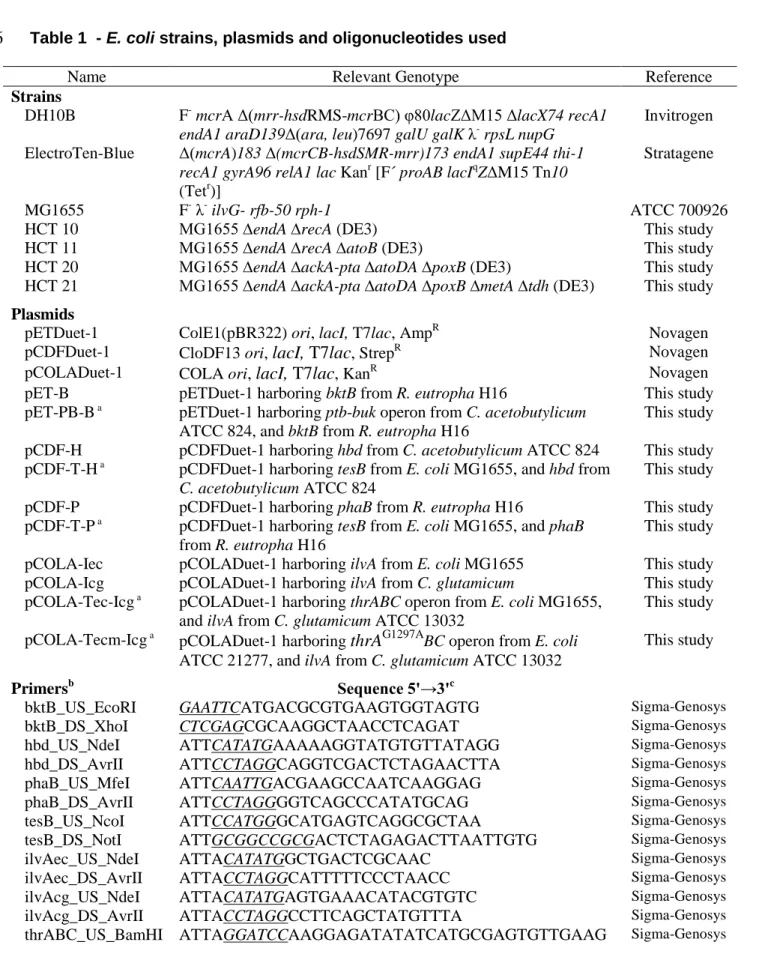
Tables
695
Table 1 - E. coli strains, plasmids and oligonucleotides used 696
Name Relevant Genotype Reference
Strains
DH10B F- mcrA Δ(mrr-hsdRMS-mcrBC) φ80lacZΔM15 ΔlacX74 recA1
endA1 araD139Δ(ara, leu)7697 galU galK λ- rpsL nupG
Invitrogen
ElectroTen-Blue Δ(mcrA)183 Δ(mcrCB-hsdSMR-mrr)173 endA1 supE44 thi-1
recA1 gyrA96 relA1 lac Kanr [F´ proAB lacIqZΔM15 Tn10
(Tetr)]
Stratagene
MG1655 F- λ- ilvG- rfb-50 rph-1 ATCC 700926
HCT 10 MG1655 ∆endA ∆recA (DE3) This study
HCT 11 MG1655 ∆endA ∆recA ∆atoB (DE3) This study
HCT 20 MG1655 ∆endA ∆ackA-pta ∆atoDA ∆poxB (DE3) This study
HCT 21 MG1655 ∆endA ∆ackA-pta ∆atoDA ∆poxB ∆metA ∆tdh (DE3) This study
Plasmids
pETDuet-1 ColE1(pBR322) ori, lacI, T7lac, AmpR Novagen
pCDFDuet-1 CloDF13 ori, lacI, T7lac, StrepR Novagen
pCOLADuet-1 COLA ori, lacI, T7lac, KanR Novagen
pET-B pETDuet-1 harboringbktB from R. eutropha H16 This study
pET-PB-B a pETDuet-1 harboring ptb-buk operon from C. acetobutylicum
ATCC 824, and bktB from R. eutropha H16
This study
pCDF-H pCDFDuet-1 harboring hbd from C. acetobutylicum ATCC 824 This study
pCDF-T-H a pCDFDuet-1 harboring tesB from E. coli MG1655, and hbd from
C. acetobutylicum ATCC 824
This study
pCDF-P pCDFDuet-1 harboring phaB from R. eutropha H16 This study
pCDF-T-P a pCDFDuet-1 harboring tesB from E. coli MG1655, and phaB
from R. eutropha H16
This study
pCOLA-Iec pCOLADuet-1 harboring ilvA from E. coli MG1655 This study
pCOLA-Icg pCOLADuet-1 harboring ilvA from C. glutamicum This study
pCOLA-Tec-Icg a pCOLADuet-1 harboring thrABC operon from E. coli MG1655,
and ilvA from C. glutamicum ATCC 13032
This study
pCOLA-Tecm-Icg a
pCOLADuet-1 harboring thrAG1297ABC operon from E. coli
ATCC 21277, and ilvA from C. glutamicum ATCC 13032
This study
Primersb Sequence 5'→3'c
bktB_US_EcoRI GAATTCATGACGCGTGAAGTGGTAGTG Sigma-Genosys
bktB_DS_XhoI CTCGAGCGCAAGGCTAACCTCAGAT Sigma-Genosys
hbd_US_NdeI ATTCATATGAAAAAGGTATGTGTTATAGG Sigma-Genosys
hbd_DS_AvrII ATTCCTAGGCAGGTCGACTCTAGAACTTA Sigma-Genosys
phaB_US_MfeI ATTCAATTGACGAAGCCAATCAAGGAG Sigma-Genosys
phaB_DS_AvrII ATTCCTAGGGGTCAGCCCATATGCAG Sigma-Genosys
tesB_US_NcoI ATTCCATGGGCATGAGTCAGGCGCTAA Sigma-Genosys
tesB_DS_NotI ATTGCGGCCGCGACTCTAGAGACTTAATTGTG Sigma-Genosys
ilvAec_US_NdeI ATTACATATGGCTGACTCGCAAC Sigma-Genosys
ilvAec_DS_AvrII ATTACCTAGGCATTTTTCCCTAACC Sigma-Genosys
ilvAcg_US_NdeI ATTACATATGAGTGAAACATACGTGTC Sigma-Genosys
thrABC_US_NcoI ATTACCATGGGCATGCGAGTGTTGAAG Sigma-Genosys
thrABC_DS_SalI ATTAGTCGACGATAATGAATAGATTTTACTGATG Sigma-Genosys
a Each gene is under the control of the T7lac promoter with a ribosome binding site. b
Primers were synthesized at Sigma-Genosys, St. Louis, MO.
c
Restriction enzyme sites used in the cloning are shown in underlined italics. 697