CONSTRUCTION INDUSTRY
IN FRANCE
by
Isabelle Louise Perkins
Submitted to the department of Civil Engineering in partial fulfillement of the requirements for the degree of
Master of Science in Civil Engineering at the
Massachusetts Institute of Technology June 1987
@ Massachusetts Institute of Technology 1987
Signature of the Author
Department of Civil Engineering May 15, 1987 Certified by
Professor Dr. Fred Moavenzadeh Director of the Center for Construction Research and Education Accepted by
Professor Ole Madsen Chairman, Department Committee
CONSTRUCTION INDUSTRY IN FRANCE by
Isabelle Louise Perkins
Submitted to the Department of Civil Engineering on May 15, 1987 in partial fulfillement of the requirements for the Degree of
Master of Science in Civil Engineering
Abstract
This thesis examines the French construction industry and its various characteristics.
First, the situation of the construction industry in France is described. This involves a short description of the general economic background and a look at the role and influence of the
government. A look from the eighteenth century forward explains the historical evolution of the construction industry in France and its influence on the current situation.
The characteristics of the construction industry itself focus on the structure of the construction firms and their mode of operation. The description of the construction industry includes the situation of various inputs to the industry such as labor, material, equipment and financing. Also investigated is the area of R&D as France has been known for its technological advance. Second, the international position of the French construction industry is discussed. After looking at the importance of this part of the activity, it is described in more detail according to various geographical locations. An area of special interest is the situation of French
construction related firms within the US market as this appears to be the future developing area for them. Trade statistics for basic construction materials are included.
Thesis Supervisor: Professor Dr. Fred Moavenzadeh Title: Professor of Civil Engineering
Aknowledgement
This thesis, as well as my work at M.I.T. has been made possible by many individuals, organizations and companies.
My thesis advisor, Professor Dr. Fred Moavenzadeh should be thanked for giving me the opportunity to work on the subject of the French construction industry and as well as for his guidance through the year.
I would also like to thank all the companies and individuals that have provided me with various important information for the completion of the thesis.
This would not be complete without mentionning the city of Strasbourg (France) whose Sister City relationship with Boston made M.I.T. a little bit closer.
I also thank all the people at M.I.T. and E.N.S.A.I.S. that have helped me, and I will not try to name them all to not risk to omit anyone.
TABLE OF CONTENTS
List of tables ... p.6 List of figures ... p.8
1. Introduction
1.1. Presentation of the subject and scope ... p.9 1.2. Outline of the thesis ... p.10
2. French construction industry ... p.11 2.1. General background ... p.11
2.1.1. Role of the construction industry within the
economy... p.11 2.1.2. Role and influence of the government ... p.14 2.2. History of the construction industry in France ... p.19
2.2.1. Early history of construction activity ... p.20 2.2.2. Creation of the academies and engineering schools... p.23 2.2.3. Development of the use of iron ... p.27 2.2.4. Discovery of cement and its impact on construction ... p.31 2.2.5. Recent evolution ... p.33 2.3. Characteristics of the construction industry ... p.37 2.3.1. Structure of the firms ... p.44 2.3.2. Mode of operation ... p.50 2.3.3. Productivity ... p.54 2.4. Supply to the construction industry ... p.56 2.4.1. Labor ... p.56 2.4.2. Material ... p.64
2.4.3. Equipment ... p.69 2.4.4. Financing ... p.72 2.5. Research and development ... p.76 2.5.1. Comparaison with other sectors of industry ... p.82 2.5.2. Evolution within the construction industry ... p.88 2.5.3. How easy is it to use new technologies ... p.93 2.6. Major issues facing the construction industry ... p.94
3. French international construction industry ... ... p.95 3.1. Importance of the international market ... ... p.96 3.2. History of the French international construction industry ... p.103
3.2.1. France in former colonies ... p.103 3.2.2. France in Europe and the role of the EEC ... p.113 3.2.3. Other presence of France ... p.118 3.3. Current situation and trend for the future ... p.120 4. Presence of France in the US... p.123 4.1. General contractors and A/E activity ... p.124 4.2. Construction manufacturing ... p.132 4.3. Conclusions ... p.136 5. France - US trade in construction materials ... p.137 6. Conclusions
6.1. Summary of the French construction industry ... ... p.141 6.2. Conclusions ... p.143 6.3. Future studies ... p.144 Appendix 1 ... .. p.145 References ... ... p.183
List of tables
Chapter 2 Table 2.1.1.1 Table Table Table Table Table Table 2.1.2.1 2.1.2.2 2.3.1 2.3.2 2.3.1.1 2.3.1.2 Table 2.3.1.3 Table Table Table 2.3.3.1 2.4.2.1. 2.4.2.2. Table 2.4.2.3. Table 2.4.2.4. Table 2.4.3.1. Table 2.4.3.2 Table 2.4.4.1 Table 2.4.4.2 Table 2.4.4.3 Table 2.5.1 Table 2.5.2Share of GDP for agriculture, construction and manufacturing (percent of total)
Breakdown of civil government spending by activity Public sector by type of activity. January 1st, 1985 Size of the firms and their turnover (percentage)
Evolution of GDP and construction production 1970=base 100 Characteristics of the construction industry in 1983 (percent of total) Value of construction put in place in current billion Francs and constant billion Francs (base 100 in 1970)
Output of construction fims according to their size and to the state of the work (Million Francs)
Evolution of labor productivity (percentage) Production of building materials
Production imports and exports of construction materials 1980 and 1983
Consumption, imports and exports for steel products (1000 tons) Evolution of imports, exports and production of cement
(in thousand tons)
Evolution of aquisition of equipment Top construction equipment manufacturers
Source of financing in 1985. Billion Francs and percentage Dwellings completed by type of investors
Bank shares of major French construction firms (1985) Information about R&D for 5 industrialized countries R&D financing in 1983 p.12 p.15 p.18 p.3 9 p.40 p.46 p.47 p.4 9 p.5 5 p.64 p.66 p.67 p.68 p.69 p.7 1 p.7 3 p.7 4 p.7 5 p.76 p.7 7
Table Table Table Table Table Table Table 2.5.3 2.5.4 2.5.5 2.5.1.1 2.5.1.2 2.5.1.3 2.5.2.1 Chapter 3 Table 3.1.1 Table Table Table Table
3.2.1.1
3.2.1.2.
3.2.2.1.
3.2.3.1.
Chapter 4 Table 4.1.1 Table 4.1.2 Table 4.2.1 Table 4.2.2Evolution of R&D financing (million Francs)
R&D concentration according to the size of the firm in 1983 R&D budget for non military research
Financing of R&D in million Francs (percent). Situation in 1983 Firms with R&D activities. Situation in 1983
Distribution of R&D. Situation in 1983 in million Francs Summary of research in the construction industry - 1983 values
Evolution in the award of foreign contracts to French firms from 1982 to 1985 (million dollars and percentage)
Information about French colonies Foreign contracts won in Africa
Foreign contracts won in Europe in 1985
Foreign contracts won by France outside of Africa and Europe
North American foreign contract awards in 1985
US subsidiaries and affiliates of French general contractors US subsidiaries and affiliates of French construction manufacturer First six French cement manufacturer
Chapter 5 Table 5.1 Table 5.2
Summary of trade statistics in 1984
Level of imports into the US from various countries (% of total imports) p.78 p.79 p.81 p.84 p.85 p.87 p.90 p.1 0 1 p.1 0 5 p.1 1 0 p.1 14 p.119 p.124 p.128 p.133 p.135 p.139 p.140
List of figures
Chapter 2 Fig. 2.1.1.1 Fig. 2.2.1. Fig. 2.3.1 Fig. 2.3.2 Fig. 2.3.3 a Fig. 2.3.3 b Fig. 2.4.1.1 Fig. 2.4.1.2 Fig. 2.4.1.3. Fig. 2.4.1.4 Fig. 2.4.1.5 Fig. 2.4.4.1 Chapter 3 Fig. 3.1.1. Fig. 3.1.1 Fig. 3.2.2.1.Share of GDP by economic activity in 1984
Evolution of the total output in million Francs from 1964 to 1982 Distribution of firms by economic activity -Situation in 1985 Evolution of GDP and construction production
Building industry in 1985 (values in billion Francs) Civil work industry in 1985 (values in billion Francs) Evolution of number of employees and persons engaged Number of workers by type of activity. Situation in 1981 Number of workers by type of activity. Situation in 1983 Working week duration
Evolution of number of employees and their salary (yearly) Dwellings completed by type of investor
p.13 p.36 p.37 p.41 p.42 p.4 3 p.5 7 p.59 p.59 p.62 p.63 p.74
French construction industry exportations for 1985 in billion Francs p.98 Evolution of the construction market in constant billion Francs
base 1984 p.10 0
Chapter 1: Introduction
1.1 Presentation of the subject and scope
The French construction industry has existed and maintained a vital presence in the economic life of the country for many years. It has had years of large success and has carried its technological resources and capabilities outside its home boundaries. Today, even if the situation is not as glorious as in the past, the construction industry is still an important part of the economic life of the country as it contributes about 7% to the GNP, provides employment for 12% of the working population and includes about 18% of the firms.
Internationally, the French construction industry has also been very active and has done work in most of the geographical areas of the globe. In 1985, foreign activity represented about 13% of the total construction activity.
Through time, the nature of the construction industry has been changing due to both effects from within and outside the industry. Internal effects are such events as technological changes, market changes and organizational changes. Outside effects that can have an influence on the construction industry are the general economic situation and major "relationship" changes such as the creation and expansion of the European Economic Community (EEC).
The purpose of this thesis is to describe the French construction industry in all its various activities, past, present and future, to create a better understanding of its current situation.
1.2. Outline of the thesis
The first part of this thesis will describe the situation of the French construction industry at home. For this, it is necessary to lay out the general background of the industry and to look
at the past history of the construction industry. The characteristics of the construction industry will be discussed, including the structure of the firms, their mode of operation (i.e. relation between owner, contractors, subcontractors,etc...) and their impact on the industry.
To better define the construction industry, it is important to look at the inputs required such as labor, material, equipment and financing. These are all points strongly related to the situation of the construction industry itself as they have a significant impact on it.
This will be followed by a presentation and discussion about R&D which in a way can be said to represent the future of the industry. Current R&D activities will be described , as will the applicability of new technologies and the facilities given to the development. In
conclusion of this will be a discussion on the major issues facing the construction industry in France today.
Next, the international involvement of the construction industry will be presented. After looking at the importance of this segment of the construction industry, a more detailed study of the historical involvement in different geographical areas will be conducted.
This leads then to the current situation and also to the trend that can be found for the future development of this segment of the industry.
This study will then be concluded with a look at the French involvement in the US construction market, with its importance, evolution, structure and mode of operation.
Chapter 2. French Construction Industry
The construction industry in France represents an important economic activity both nationally and internationally. Throughout this chapter, the emphasis will be put on the description of the activity and situation within the national borders.
2.1 General background
2.1.1 Role of the construction industry within the economy
In 1980, the construction industry occupied about 1/10 of the working population and, through its impact in other industries, created the same amount of jobs.
The major component of the construction industry is the building sector which employes 3/4
to 4/5 of the workers.
The production of the industry for 1980 was 338 billion Francs before taxes and the value added was 7% of the GNP for France.
The recent share of the GDP for the construction industry has varied from 7% to 5%,
regressing from 1970 to 1984. The construction industry has had a peak share of GDP in the 1970's.
The fluctuation of the share of GDP for construction follows, to some extent, that of the manufacturing industry. Both dropped in 1979 relative to 1970, then increased again in 1980
and fell in 1984. Although the movements are similar, the value of the fluctuations are much more important in the manufacturing industry than the construction industry.
The agriculture sector fluctuates opposite the two previous industries, decreasing its share when manufacturing is increasing its share and vice-versa.
For its value, the share of GDP of the construction industry can be compared to that of the transport & communication or mining industry and is equivalent to one-third to one-fourth of the share of the manufacturing industry.
Table 2.1.1.1 shows the evolution of the construction share of GDP from 1960 to 1984 and compares it to the agricultural and the manufacturing sectors. Fig. 2.1.1.1 shows a detail of the GDP share according to economic activities for 1984.
Table 2.1.1.1
Agriculture Construction Manufacturing Source : 6 & 1
Share of GDP for agriculture. (percent of total) 1960 1970 9.85 6.46 5.64 7.45 S 28.86 28.75 10
construction and manufacturinE
1980 4.15 6.63 26.19 1984 8.50 5.60 18.30
Fig. 2.1.1.1 Share of GDP by 8.50%
1984
Agriculture Mining Manufacturing Construction Wholesale & Transport & Other services retail trade communication 5.10/%o Io.V-/o Source: 613
43.40% economic activity in 1984 )%2.1.2. Role and influence of the government
The government plays an important role in the construction industry since it represents at the same time the financial partner, the legislator, the owner and, sometimes, the initiator of research and development. Approximately 10% of the GDP in any given year is from government civil spending. In 1973, 35% of this total government civil spending was in the construction industry. This share dropped to 30% in 1980, having a value of 62.6 billion
Francs.
In 1973, the government spending for the construction industry was equally divided among building and civil work. This 50/50 split changed in 1980 as building activity dropped to a share of a little over 30% of the government spending in the construction industry. The civil work firms slightly increased their share of total government spending during this time, up to 18.6% from 17% of total spending in 1973. This gave them a lead over building firms within the construction industry as a whole. This represents the major change from 1973 to
1980, and can be explained by the public housing activity that, after a boom in the 70's, slowed down considerably.
Table 2.1.2.1. shows the importance of the different economic activities showing their percentage of civil government spending. (Note that 70% of the research spending in table 2.1.2.1 is for the following sectors: mechanical, electronic, electrical, space and
Table 2.1.2.1 Breakdown of government civil spending by activity
1973 1980
% of total government spending
Agricultural products and food
Energy
Mechanical machines Electrical and electronic machines, computers Aeronautics and space Other industrial supplies Building
Civil work
Research and studies Service and transportation Total 8.2 16.9 11.0 17.6 17.0 6.4 0.7 12.9 11.0 13.8 11.1 12.0 10.8 18.6 4.0 5.1 100.0 1980 Value (billion FF) 1.5 27.4 23.5 29.3 23.7 25.4 22.9 39.7 8.6 10.8 212.8 Source : 3 & 4
In the last few years, the government has continued its involvement with the construction industry and has largely exercised its role of owner/developer. Since 1981 and the election of Frangois Mitterand as president, Paris has seen six major projects started or expanded. Most of these are large scale projects and are under tight schedules. They also tend to be a
showplace for new and innovative technologies -a prime example being the geosphere containing France's first Omnimax theater at La Villette in Paris.
Some further examples are:
- The renovation of the Paris train station Gare d'Orsay that has been transformed into a museum. The project cost was $154 million for 484,000 sq ft and involved 100 different companies. It was completed in December 1986 (27)
- The construction of a new Opera, at La Bastille, started in 1982. The Opera includes a 2,700 seat main auditorium (377,000sq ft) and an adjacent building with offices, restaurants, rehearsal and shopping areas (54,000 sq ft). The estimated cost is $257 million. Demolition began in 1985.
- The Museum of Science and Technique of La Villette, part of a larger project that includes the construction of the Geode, the renovation of a great hall and the creation of a music complex. The total complex is estimated at $561 million. The museum itself represents 2.2 million sq ft.
These projects have both a direct and indirect effect on the construction industry: the direct aspect is large contracts for major firms, the indirect is that such major projects require improvement work in such areas as transportation, infrastructure, roads, etc...
Also, the projects could almost be considered as practice for the engineering and construction firms which, if well carried out, using appropriate solutions and techniques, will provide strong references for them, as much nationally as internationally.
The government influence lies not only in the market that it generates by ordering various products, but also in its direct involvement within the industry through the creation and development of a sector of government owned firms.
After the 1982 nationalization, the government largely increased its influence in industry. Most notably, its influence in the industry exposed to international competition expanded. Prior to 1982, Renault was the only government owned industry involved in international competition.
In 1985, the largest area of government involvement is in energy related industries. With only 0.7% of the total energy firms, government owned firms employ almost 80% of the total
employees in this sector. Other largely nationalized sectors are: the financial sector with 47% of the employees of the sector and the transportation and telecommunication with 29% (table 2.1.2.2)
For the construction industry, this type of government involvement is rather small since only 0.02% of the firms are nationalized and they represent only 4.85% of the total number of employees working for the construction industry.
It can therefore be concluded that the major direct influence of the government within the construction industry at this time, is that of supplier of public projects to the industry rather than through the ownership of construction firms.
Table 2.1.2.2 Public sector by type of activity, January 1st, 1985
Number of firms Number of employees
Gov't Total % Gov't Total %
Agricultural and food industry Energy Manufacturing Construction Trade Transportation and telecommunication Service
Finance and insurance
33 40 650 77 216 163 810 553 195,696 5,632 229,363 348,030 652,028 86,459 1,257,519 85,523 0.02 0.7 0.3 0.02 0.03 0.2 0.06 0.65 11,365 233,305 786,744 58,124 203,19 377,208 106,067 311,687 807,300 292,100 4,263,200 1,197,300 2,090,900 1,297,400 7,414,700 659,400 1.41 79.9 1.85 4.85 0.97 29.0 1.43 47.3 % of annual volume (1.) 54.8 3.5 Source : 8 & 14
(1): data relative to the volume of work has been found only for the energy public sector. The construction value has been estimated based on the energy value
2.2. History of the French construction industry
Often, some of the reasons for todays situation can be found in the past. This can apply to the construction industry in France as some of the happenings, strengths and weaknesses can be explained or better understood by earlier decisions and actions.
The French construction industry was wide spread throughout the eighteenth century, when canals and harbors created by French civil engineers where used as models by Britain and the Netherlands, and through the nineteenth century when French engineers were the first to use reinforced concrete.
To find out how it came to be a leader, it is of interest to analyse the influence of such happenings as the early regroupment of craftsmen as "compagnon" and how they increased their knowledge, the creation of Royal academies and the later evolution to technical schools. It is also interesting to look at the effects that the introduction of new materials and methods has had and how the willingness to adopt them has had dramatic effects on the industry.
2.2.1. Early history of construction activity
Construction in France has been considered an important activity and has had an important position for the country's political, cultural and economic life for nearly 2000 years. However, it is not necessary to go back quite that far to understand the current situation.
In Europe, the Middle Age is the era of cathedral and temple building, as well as of bridges and fortress building. It was at this time that the "Compagnons" started. "Compagnons" are groups of craftsmen composed of carpenters, carvers and stone workers. They were
employed by the military of the crusades to build bridges, defense places and temples. It appears that inside the group there was a hierarchy based on achievement, the best workers being "Chevalier du Temple" and allowed to use a cane, a distinctive sign which they kept throughout history.
The crusades bring back the notion of geometry and lines, an important point for the development of construction technology. This knowledge was eventually developed into
architectural drawing with the help of the monks who were the guardians of instruction and already knew about Euclide's plane geometry. This corresponds to a major step toward thinner and more elegant structures as now the draftsman could draw details precisaly before the carver started his job. The crusades also established an "international" relation between France and the Middle East.
The "Compagnonnage", which still exists today, had another important aspect : that of teaching the trade. It can be considered the first architecture and construction university. They were developing technical skills and aspects of construction made possible by the knowledge of geometry and they ensured that improvements were known by others. The
group was also subject to a moral conduct and had strong ties, this helped for steady progress although they could only go up to a certain point since they didn't yet know anything about resistance and acceleration. Therefore, their "calculations" were based essentially on
previous experience and geometry.
The evolution of construction was at this time strongly related to the political situation of the country and the need for defense.
In the XVI and the XVII century, the French Kings, aware of the importance of good defense for their wars, hired the best constructors. They didn't hesitate to gratify if the job was done well or dismiss if they were not satisfied. Vauban (1633-1704), who developed the star-shaped fortifications, had important impacts on the construction activity. He "endeavoured to improve the material and social standing of the Genie officer" (20). He also suggested the creation of the "Corps des Ing6nieurs du Genie Militaire" in 1675 which protected the engineers from the moods of their superiors. This was a first step toward the creation of the "Corps des Ponts et Chaus6es" in 1715. It was during this time that the word "Ing6nieur" was used as a professional title and represented a technician in the public service,
scientifically trained.
With Vauban as an ally, the "Corps des Ponts et Chaussees" increased its power and type of activities. Its original task was to help the movement of the army and to build fortifications. Their work had become so valuable to the State that they soon became involved in civilian work. This is when a period of large projects began such as the construction of Versailles. Vauban also laid out the first type of contracts to be used for the relation between the State and its contractors. It contained all information regarding the execution of the work, the quality of the materials to be used, the contractors responsibility and his duties, the costs,... Many of the items listed are still used in contracts today. The need to regulate the relation
between the State and contractors can be said to come from the scientific and rationalist mentality of the French military engineers.
It is at this time also that the tradition of government involvement began, first with the royal construction work of Louis XIV during the second half of the seventeenth century. It was Colbert who directed all the works. The time of the kings Louis XIV and Louis XV saw an increase of castle and public building construction. This situation changed as the revolution came and a wider interest in military and economic strength became prevalent. This marks the beginning of an increasing activity in roads, canals, and bridges construction.
At this time, France was considered a leader in Europe for exact sciences and their technical applications. Mathematicians and engineers continued their work and were developing theories then applied for design and construction. It was a period of close relation between engineers and mathematicians, often times engineers being mathematecians themselves or vice versa.
This close relation between government and construction continued through the Monarchy, the Empire and the Republics, each of them favoring the construction activity by ordering the construction of public buildings, harbors, universities, and later airports, hospitals and low income housing.
2.2.2. Creation of the academies and engineering schools.
Todays education system in France is largely based on the creation of the academies in the seventeenth century and the opening of the engineering schools in the early eighteenth
century. It is also one of the rare countries where high level professional training is not given by the universities but rather by separate schools.
The understanding of the creation and the evolution of the education system is important in many ways to explain the competitive situation of the construction industry through the years.
It shows the original role of the engineer as an instrument of the government, the emphasis on mathematic studies and the distinction of a technical elite.
Facts that assess the importance of the education system for the construction industry, or any industrial or decision making position, is that most of the persons holding key positions graduate from a few dominant schools. Also, when looking at the progress in science and construction techniques or construction theories, one realizes that much of it was done by former students or teachers of the "Ecole Polytechnique" and the "Ecole Nationale des Ponts et Chauss6s". It is therefore interesting to go back to their creation and understand the reasons of such a development.
The mid seventeenth century corresponded to a vast academic movement and in a matter of 40 years, most areas of arts and sciences were covered.
In 1666, the academy of science was founded which could be regarded as todays mathematics and physics classes. 1671 saw the opening of the Royal Academy of Architecture.
Universities in France had existed through the Middle Age and had enjoyed a good
reputation. But later years brought a strong decline which eventually led to the development of engineering schools. The sixteenth and the seventeenth century had no will to rehabilitate
those universities and rather relied on private instruction or church sponsored institutions. This became a general trend and when the need for higher education became wider, this trend was continued and smaller specialized institutions were opened rather than reviving the universities.
It is through the eighteenth century that a strong need for higher education was felt, especially in scientific and technological areas. The central power decided the creation of schools that had a definite professional orientation to them was necessary. The "Ecole des Ponts et Chauss6s" was created in 1715, followed by the "Ecole d'Artillerie" in 1720, the "Ecole des Mines" in 1783, etc ... Those school's primary objectives were to train officers in precise technical areas to fulfill the growing need of the nation for such individuals.
The end of the Monarchy saw the need of highly trained professionals and created the first engineering schools, but it is the revolution and its new government that expanded and eventually made the education system what it is today.
The first action of the revolution was to close all existing universities and stop all subsidies to the schools on the grounds that they had been created under the Monarchy and were favoring an elite. It is true that the acceptance into one of the schools had been more dependent on the social rank than on the quality of the student, but the revolution eventually defined a new type of elite since the entrance to the reopened schools became subject to a competitive
examination and only the best could access them. ( This system of selection is still true today, especially for the first schools created.) The urgent need for qualified personnel and also the
support of the bourgeoisie to the school system, as the entrance into one of them had always meant a guarantied access to high level jobs, led to the reopening of the schools and the creation of the new ones. This is when the "Ecole Polytechnique" (1794) and the
A major ambition of Napoleon was to raise prosperity in France. He favored the development of industry by different measures such as low interest rates and national exhibitions and strongly supported the development of the schools. To meet his goals, he needed what he called his elite, in various sectors ranging from medicine to engineering. But this elite had to agree with the government actions and be faithful to the power. Therefore, the government control over the schools increased greatly during this period. This is how the "Ecole Polytechnique" eventually became the supplier of army officers. This new system had the double interest of serving the power and pleasing the bourgeoisie and became very popular. To reinforce the control of the government over the schools in order to avoid having bodies standing against the government, the last measures that were taken were to require tuition for certain schools, to designate the direction of the establishment, and to have them dependent on various ministries.
The evolution of the education system from then to today follows two main ideas :
1. Most of the graduates from the schools found jobs as State employees or working for the State. This was due to the economic situation and the level of development of the country. Industry at this time had no massive need for highly qualified personel, a situation that changed through the second half of the nineteenth century. The number of graduates going toward private industry and coming out of Polytechnique, Centrale and Les Mines multiplied by nine from 1850 to 1920.
2. When created, the schools were strictly public and constituted the only real higher education system. It was essentially based on utilitarian matters. Today, there is a coexistance between the university system and the "Grandes Ecoles" but the latter have kept this specificity of teaching primarly utilitarian material.
The first opening of schools was dictated by a need for qualified personel in specific fields. Construction was the first area in which such a need was felt and was therefore the first area to have its school. This can probably explain some of the importance of construction at this
time and also the rapid advances that were made as numerous engineers were taught the state-of-the-art and were then able to remain at the cutting edge. The "Ecole des Ponts et
Chauss6es" is the school that helped secure in the eighteenth century the knowledge and technical skills of French engineers in such areas as road and bridge construction which was widely recognized in Europe. One also has to keep in mind that their primary concern was civil work as they depended on the State.
2.2.3. Development of the use of iron and steel
Today, as will be mentioned later, the use of steel for construction work is very restricted in France and only represents 10 to 20% of the construction work. This situation may have its origin in the early development of iron fabrication and use in spite of a short period where iron and steel structures became popular in France.
The British developed the iron industry and France followed using their technology. The first real use of iron as a construction material appeared for the construction of buildings. The use for bridges had been studied and proposals had been made but their construction was too expensive due to the high cost of iron. In the case of buildings, the use of iron was made progressively, replacing the traditional masonry structures. Eventually, by the end of the eighteenth century, it was common practice to at least use iron as reinforcement.
The use of iron for construction started in France under the influence of Napoleon who was a firm believer in this material which represented for him the triple symbol of strength,
durability and progress. Because of his beliefs, Napoleon chose cast iron for monuments of his time. The "Pont des Arts " over the Seine was an early example of cast iron construction. The beginning of the use of iron was slow in France because of the high cost and the lack of
technology of the iron industry. The eighteenth century had shown to builders a new material and forced them to reconsider their habits.
After Napol6on's defeats , the country entered a difficult economic situation and the following monarchy was faced with high debt. To reduce it, they imposed tariffs on
imported goods. Iron, being an import, became an uneconomical material compared to wood and therefore iron construction did not progress until a carpenters' strike in 1845 . The strike
lasted several months and this pushed contractors to look for alternative methods rather than stop construction. They then turned to iron and used it for the construction of floors. The Second Empire brought social changes and corresponded to the end of the depression. This marked a boom in the building industry and many construction projects were sponsored by the government. But the only innovating structures of this time were the greenhouses.
With the appearance of rails, the iron industry grew and developed much more. The iron and rail industries were complementary to each other as the rail allowed easier transportation of material which enabled the industry to increase its production and develop new technologies for the rolling of rails. Again , France was following and copying the British and had a much slower development because of iron cost and the reluctance of the industry to modify their production technics. This accounts for the continuing high cost of iron.
The result of the development of the rail was the need for train stations . This became a first extended use of iron for construction as large open and high structures were needed to allow undisturb traffic. Between the 1840's and the 1870's , many train stations were built using cast iron.
Another type of structure that became a prime candidate for the use of iron was the market structure. The first step was the use of iron for the roofs, and eventually columns were made of iron. The result was a large success and many of those structures were built in France and Belgium between 1850 and 1900. Also with industrial and economic progress through the nineteenth century, the need for commercial structures appeared and many department strores were built in the 1880's using cast iron.
The nineteenth century also marks the beginning of prefabrication using cast iron, but this was mainly developed in England. France did not see the need for turning to this aspect of construction, at least at the early stage of prefabrication. There were many reasons for this :
- cast iron was still an expensive material
- it was felt that they were too many disadvantages to use iron for construction; frequent painting, high transmission of sound and heat compared to stone and wood, rapid heat propagation.
- France's number of colonies was lower than England's and one of the application of the prefabrication technic was in the colonies where skilled labor was rare. The prefabrication enabled all the work to be done in advance, in England, by British labor that did not have to be moved.
Eventually France entered the prefabrication area and exported skeletons of all kinds of buildings ranging from churches (Peru) to royal pavillons (Cairo), but the demand was not large enough to allow mass production. Another area that used prefabrication was the erection of temporary structures for international expositions held in Paris.
The high cost of iron in France pushed for further studies on improving the quality of the material but also on new construction technics and shape of elements to reduce the total cost.
This is when "I", "T" and inverted "T" beams came out of the French mills and were used for the construction of lower cost floors. France then established a lead in the floor
techniques which were shown at the 1855 exposition in Paris and admired by the British.
It is interesting to note that even if France was behind in the iron industry, it stayed very competitive in the use of iron in construction, being even the first to consider it for building construction. This was due not only to the contributions of engineers and mathematicians but also to the strong encouragement of all the political regimes. Political support came through financing of public buildings using iron, through the stand of leaders such as Napoleon I and Napol6on I that promoted bridges and buildings using this material and through the
sponsorship of national and international expositions. The first international exposition took place in 1798 and was followed by ten others where industries could exhibit their products. They eventually became the showroom for French technology.
France then used its lead in technology and exported its talent throughout the world. In 1878, "three fourths of the bridges and metal structures in Spain, Portugal and Italy and nearly half of those in Australia, Rumania, and Egypt were built by French constructors." (22)
2.2.4. Discovery of cement and its impact on the construction
Concrete has its origin in the evolution of mortar used for brick construction.
As iron became more and more used as a construction material, the need of a fast setting and strong binding agent appeared. Detailed study on existing binding agents was done by Vicat, a French engineer (1786-1861). But Portland cement was patented by an English mason and building contractor, Joseph Aspdin.
This technique was imported to France in 1840 when the first Portland cement factory was constructed in Boulogne.
The idea of reinforced concrete came at the end of the nineteenth century and various patents were granted to Frenchmen in the 1850's and 1860's. But it was through Monier (1823-1906) that this new method became well-known. Later improvements in concrete techniques such as "b6ton frett6" (intensive reinforcement at beam-column connections) and prestressed concrete were introduced by French engineers (Considbre and Freyssinet)
The beginning of the twentieth century marks the start of an increasing competition between concrete and steel construction, especially for structures such as medium span bridges. The French influence in the construction area was of two types at this time : first, through the work and the publications of people such as Belidor, Coulomb or Navier, second through Napoleon's war which helped propagate the French style and techniques to Europe and Russia.
The USA was also somewhat influenced by the situation in France as it created the Corps of Engineers on the model of the "Corps des Ponts et Chaussees" and in 1815 was still using French reference books.
France's earlier leadership in the construction industry was probably due to a respect instilled in the eighteenth century for civil engineers and a strong technical education. It was also due
to powerful government involvement which was probably the biggest client and also a strong financial supporter.
2.2.5. Recent evolution
The most recent development of the construction activity in France can be broken down into different stages throughout the years.
Between 1924 and 1950, there was a major government effort to develop hydro-electric infrastructure and also to modernize the road network. At this time, many dams, pipelines, stations, bridges and roads were constructed. It is also at this time that the construction of the first highway took place.
After WWII, and roughly between 1950 and 1965, there was an important need for housing and reconstruction. The government started a program of massive housing construction
(500,000 units/year). This required the development of new technologies to allow such a production rate. Therefore this stable and guaranteed demand was an excellent opportunity for the development of prefabrication.
The period of 1959 to 1968 correponds to one where investments in material was increasing and at the same time the qualification of the workers was decreasing.
After 1965, although the housing activity was still growing, the demand for construction became more and more diversified, including projects such as hospitals, telephone centers,
schools and public utilities. Also the economy was growing fast enough to require more and more office space. Therefore, this period, up to 1974-1975, saw large investments from both the private sector and the government.
Another phenomenon that took place during this period and more specifically from 1965 to 1968, was the increasing number of craftsmen that appeared. This followed the growing
need for repair work since new construction was becoming more and more expensive. This also slowed productivity.
The building industry increased its volume of work until 1974 corresponding to a major change in activity. Housing projects shifted from large scale to much smaller ones, this necessitating a change in construction methods. The prefabrication industry was especially hurt.
The principal direct causes of the decline (550,000 dwellings in 1974 - 400,000 in 1980) of building construction were:
- insolvency of households
- reduction of government financing for housing and community projects to monitor the budget deficit
- shift of private companies' investment strategies, away from capacity expansion to reorganising organization and increasing efficiency.
After 1975 and up to the early 80's, the demand for construction became both more
diversified and more constraining as a result of the oil crisis. This was again a favorable time for the development of new products and technologies with objectives to reduce costs.
Another major impact of the oil crisis has been the large development of nuclear power plants which brought important contracts to the construction industry.
One of the major changes from 1960 to 1985 in the structure of the industry is the
consolidation of companies, with a resulting increase in the concentration of the industry. This situation applies not only to the construction industry, but to all industry in general. A systematic external growth is achieved by buying out other companies. One example for the construction sector is CGE which combines Alsthom, Chantiers de l'Atlantique and CEM. There is also the example of Bouygues which, with it's last purchase, becomes the largest
French construction firm. This consolidation phenomenon was encouraged by the government and was said to give more strength to the companies.
From 1960 to 1985 the size of the construction firm increased. In 1960 there were no construction companies among the top 50 French firms, but in 1984 there were three
(SCREG, Bouygues and SAE). Those firms have been able to use an excellent market over the years with the housing boom in 1973 and the development of the Middle East.
In terms of output, as defined by the OECD (value of construction put in place + value of sales of products + sales value of goods sold in the same conditions as purchased), the results of the construction industry in France have been increasing regularly up to 1975.
There were then two years when outputs stayed stable and in 1978 they peaked. This corresponds to both an important increase for that year's residential construction and a high level of repair and maintenance. The following year, the output fell close to the 1977 level, to slightly increase in 1980 and peak again in 1981. The reasons for this second peak are the same as those for the 1978 peak. In 1982, the level of output went back to a lower level, but still higher than that of 1980. (Fig. 2.2.1)
Fig. 2.2.1. Evolution of the total output in million Francs from 1964 to 1982 40000UUU 300000 o . 200000 100000 -0- I 1960 1970 1980 1990 Years Source : 7 I
2.3. Characteristics of the construction industry
The construction industry employs about 12.3% of the working force to arrive at 6.2% of the turnover. It accounts for 17.6% of the total number of the firms. This large number is explained by the quantity of small firms that exist within the construction industry as will be seen later. Otherwise stated, 1,435,485 workers are part of 290,118 firms and produce 378,847,000 Francs (1981).
As a comparison, the situation of manufacturing is opposite: it has less firms and employees for a larger turnover. (Fig.2.3.1)
Fig. 2.3.1 Distribution of firms by economic activity - Situation in 1985
Number of firms by sectors
5.40"' 1.10% 33.80 4. 1 Agriculture * Energy S17.60%Manufacturing E Construction 0 Trade
E Transp. & Comm.
l Services
28.40%
Number of employees by sector 5.0 00/
2.30%/
36.20% Agriculture Energy Manufacturing Construction TradeTransp. & Comm. Services
17
12.30%
Percentage of turnover by sector
6.10% _5 4.40% Agriculture Energy Manufacturing Construction Trade
Transp. & Comm. Services %i0 Source : 2 6.60% 4.20% 26.00% ,.=L /0
There hasn't been any change in industry structure since 1975 as shown by table 2.3.1. The distribution of the number of firms, the number of their employees and their turnover has been stable.
Interesting to note is that the majority of these firms employ less than 20 people. Yet, while these small firms account for 95% of the total firms, they only represent 1/4 of the employees and 1/4 of the turnover.
One of the reason which can be put forward for the large number of small firms is that over 10 employees a company has increased financial burden in that it has to pay a 1%
contribution to the state which is put toward housing, professional education and it also has to contribute to public transportation for its employees.
Table 2.3.1 Size of the firms and their turnover (percentage)
1975 1977 1979 1981 1 2 3 1 2 3 1 2 3 1 2 3 Size <19 94.9 20.5 26 95.3 22.7 25.8 95.5 21.9 24.9 95.5 23.8 25.2 20-99 4.2 19.7 19.4 3.8 19.2 18.9 3.8 19.1 18.9 3.7 20.1 13.9 100-499 0.7 17.9 15.6 0.7 17.4 15.2 0.6 17.3 15.2 0.6 17.7 15.1 >500 0.2 41.9 38.9 0.2 40.7 40.2 0.1 41.7 41 0.2 38.4 41.0 1 = percentage of firms 2 = percentage of employees
3 = percentage of turnover before taxes
Source: 2
Note: the size of the firms is given by number of employees
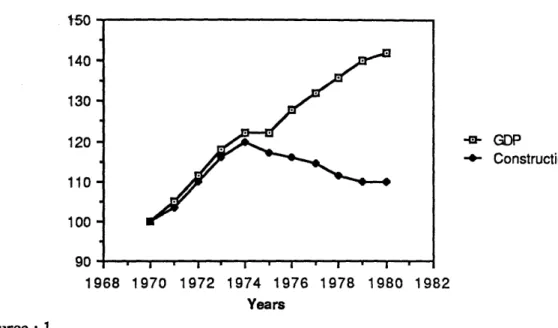
The evolution of construction output and GDP have been parallel from 1970 until 1974, when a split between the two evolutions began, GDP going up and construction down. This divergence begins right after the oil crisis during which the GDP (from 1974 to 1975)
remained constant, and the construction production slowed. (table 2.3.2) The continuing shrinkage of the construction activity is closely related to building activity which is the most important activity within the construction industry and which, since 1973, has been regularly decreasing.
Table 2.3.2 Evolution of GDP and construction production 1970=base 100 Years GDP Construction 1970 100 100 1971 105 103.5 1972 111.5 111 1973 118 116 1974 122 120 1975 122 117 1977 132 114.5 1978 136 111.5 1979 140 110 1980 142 110 Source: 1
Fig. 2.3.2 Evolution of GDP and construction production I. I*'I*I*'I * • GDP - Construction 1968 1970 1972 1974 1976 1978 1980 1982 Years Source : 1
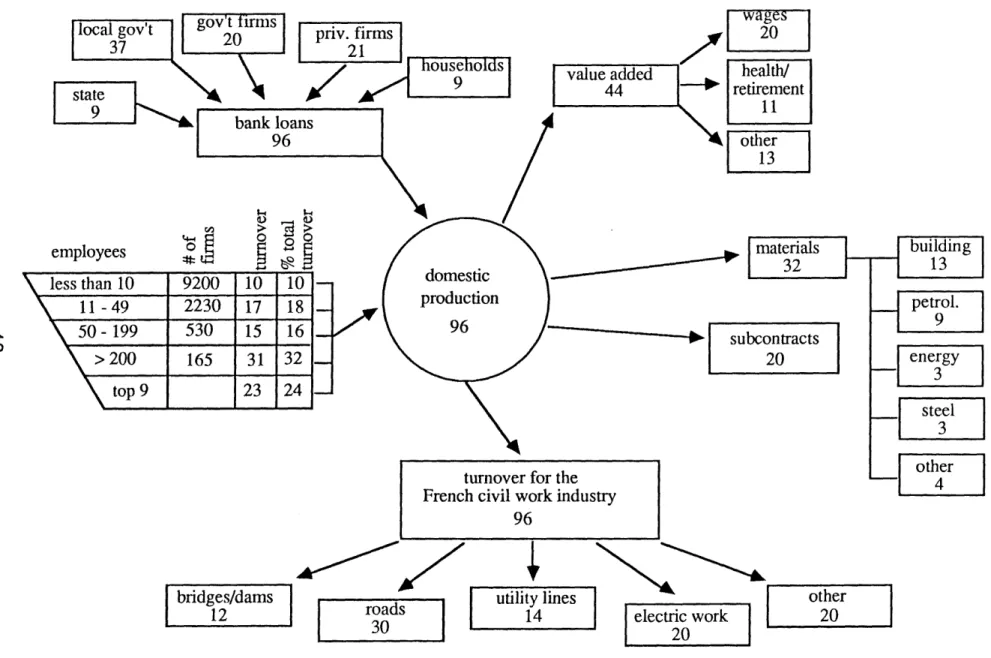
General statistics for the construction industry for the year 1985 can be seen in fig.2.3.3a&b. It gives an overview of the structure of the construction industry in France and points out the important differences between the building industry and the civil work industry.
This chart is a good summary of the situation in 1985 for both industries and their national production. The first point to be made is that the building industry is dominant in France as
its production is over three times that of civil work. Also, the two figures represent inputs and outputs relative to the building industry and civil work industry respectively. The domestic production, or amount of work performed in France, is related to the structure of the firms that are involved, to the origin of financing, to the type of work produced and to the costs that are incured.
41 150-140 130 120 - 110-100 90-I I
state local gov't govt firms
S28
v't7
fhouseholds
government
pvate firm
165 42 53 wages
95L
Sbank
loans
I L I employees less than 10 \ 11 - 49 \ 50 - 199 >200 top 9 295000 14700 1950280
75 24health
retirement50
other20
middlemen"150
1
turnover for the French building industry
315
new non-residential 60
rig. 2.3.3a: Building ind 5
(values in billion Francs)
I i
41
6 ~
v
u
1
atenance
mm er55
'55
r\
single family75,
Smulti-familyS25
140 =I
I
I,Z
/ iwages 20
health/
retirement otherLULJ
employeesless than 10
11 -49 50- 199 > 200 top 99
14 18 domestic production 96 materialssubcontracts
20turnover for the French civil work industry
96
b 12 roads 14 electric work 20
Fig. 2.3.3b: Civil work industry in 1985 (values in billion Francs)
F
building 13petrol.
9
energy steel3
other
- 4
A-"-ýý
--'L---S9
-2I 512.3.1. Structure of the firms
Size of the firms:
The small firms (<=10 employees) conduct 44% of the total work done for the building industry while firms of this size account for only 10% of the civil work industry. The difference is less significant when looking at the percentage of the work done by major companies (9 largest) which for building is 10% and civil work 24%.
Financing:
The private sector largely finances the building industry, 64% coming from individuals and 20% from privately held firms (nonresidential building). The government share is only 16%. For civil work, the situation is opposite as government or government dependent agencies finance 69% of the work.
The national companies are investing essentially in public works such as power plants, public transportation, communications, etc..., the private companies represent the major client for building construction while -denartmental government and town government are concerned with community projects, roads, bridges,....
When breaking down the various activities of the construction industry and looking at the number of firms, the number of employees and their production as seen in figure 2.3.1.1, one can notice that, except in two cases, the firms with less than 10 employees largely outnumber those with more than 10 employees. The two exceptions are the construction of electrical lines and framing other than steel. But, although the small firms are predominant, a little over half (56%) of the construction workers are employed by larger firms who also account for 66% of the total production. There are three exceptions to this situation and those are: the metal work, roofing and plumbing and finish work activities that not only have a
majority of small firms, but those firms also employ the majority of the workers and produce over 50% of the total production of their activity. It is important to notice that those activities produce about 30% of the total combined output.
The largest activity within the construction industry is that of masonry and ordinary
reinforced concrete which by itself represents 24% of the total production, employs almost 29% of the construction workers and contains 26% of the construction firms. The health of this sector corresponds to the health of the building activity and especially that of residential and non-residential construction.
That same argument holds for other building activities that produce each about 10% of the total output such as finish work, metal work and electrical installation.
The largest civil work activities are that of infrastructure work and earth and water work. They have shares of respectively 9.5% and 7.8% of the total production and are more
important than other civil work activities that vary from 1 to 4%. This is again a result of the dominance of the building industry as both the activities mentioned above are closely related to building construction. (Table 2.3.1.1)
Table 2.3.1.1 Characteristics of the construction industry in 1983 (percent of total)
number of firms # of employees production (million francs) Size of firms
earth and water work, parks and gardens" construction of electrical lines infrastructure work
road construction
drilling and testing special foundations framing other than steel
conveying
electrical installation
industrialized construction 1184
masonry and ordinary 75220 reinforced concrete
HVAC
metal work
roofing and plumbing
finish work total <10 >10 Total 10213 1633 11846 3.75 86 234 320 .10 1360 582 1942 .62 182 165 347 0.11 228 57 285 0.09 12 82 94 0.03 508 105 613 0.19 26122 1608 27730 8.79 229 1413 0.45 6794 82014 25.98 14727 1250 15977 5.06 52971 2569 55540 17.6 38179 1629 39808 12.61 74357 3335 77692 24.62 295349 20272 315621 <10 >10 Total 27964 94288 122252 7.18 573 29838 30411 1.78 6885 70097 76982 452 714 46092 46806 2.75 843 8875 9718 057 117 26817 26934 158 1485 7203 8688 051 60964 97354 158318 93 4423 26939 31356 1.84 224158 268189 492347 28.9 37085 47725 84810 498 131437 70378 201815 11.85 94931 51758 146689 8.62 158700 107254 265954 15.62 750279 9528011703080 <10 >10 Total 5416 28873 34289 7.79 121 7861 7982 1.82 2014 39973 41987 953 376 16671 17047 3.87 299 4628 4927 1.12 22 10465 10487 238 405 2047 2452 056 13714 30501 44215 10.04 1046 10855 11901 2.7 40978 66449 107427 2439 9602 15382 24984 5.67 26943 19250 46193 10.49 20593 14290 34883 7.92 27303 24302 51605 11.72 148832 296607 442439 Source: 8
Relating the structure of the construction firms to the actual output (Table 2.3.1.2) shows that the demand for new construction as a whole over the years has been rather stable with the decrease of the building component being compensated by the increase of the civil work component. The major change has been within the repair and maintenance area that started its increase in 1977, to peak in 1981.
The distribution of work helps to explain the importance of finish work, masonry &
reinforced concrete, electrical installation and metal work that has been noticed previously, as those are areas of construction directly related to new construction, especially buildings.
Table 2.3.1.2 Value of construction put in place in current billion Francs and ocnstant billion Francs (base 100 in 1970)
New construction Building Residential Non residential Civil Current repair and maintenance Total 1972 130 129 106 105 66 65 40 40 24 24 14 14 1973 134 131 109 107 67 66 41 41 25 24 18 18 1974 128 129 102 103 61 62 41 41 26 26 22 22 1975 149 143 117 112 69 66 47 46 32 31 19 18 1976 141 135 101 97 56 54 44 43 40 38 15 14 1977 104 98 71 66 39 37 31 29 34 32 35 33 1978 157 141 122 110 77 70 45 40 35 31 93 84 1979 112 100 98 76 45 41 39 35 27 24 67 69 1980 129 119 97 89 52 48 45 41 32 30 82 74 1981 195 179 156 143 100 92 56 51 39 36 137 126 1982 147 128 107 93 59 51 48 42 40 35 85 74 144 134 128 149 156 140 250 179 211 332 231
143 150 151 162 149 131 225 169 193 305 202
Source : 7 47The structure of firms is not only related to their job classification as seen previously, but also to the type of work (new or maintenance & improvement). The division of the firms
according to the state of the work and their output appears very stable, most of the time increasing slightly from one year to the other, probably following inflation.
Table 2.3.1.3 gives us some more information concerning the allocation of new work compared to maintenance and improvement. It appears that firms that have less than 10 employees are doing more maintenance and improvement, although the lead is not extremely important since in percentage it represents about 55% compare to 45% for new work. As the firms increase in size, the proportion of new versus maintenance and improvement increasa from 55% for 11 to 19 employees, to about 60% for 20 to 49 employees and almost 75% for firms over 200 employees.
The total amount of maintenance and improvement work is not negligeable, since it represents from 40 to 45% of the total amount of work.
Table 2.3.1.3 Output of construction fims according to their work (Million Francs)
Size of the firms 1978 1979 1980 1981 1982 1983 1984
0 to 10 employees
New
Maintenance & improvement 11 to 19 employees
New
Maintenance & improvement 20 to 49 employees
New
Maintenance & improvement 50 to 199 employees
New
Maintenance & improvement Over 200 employees
New
Maintenance & improvement
All firms over 10 employees New
Maintenance & improvement
Total
New
Maintenance & improvement
37937 44887 55814 65736 66605 76900 11599 10750 11783 13610 14055 13473 15327 9248 8641 11068 11738 13565 14837 14195 22026 23903 30344 29878 32957 32847 35416 14999 16151 19203 22522 25421 27985 28706 23202 26248 31057 32907 34884 33912 36514 10447 11314 13542 15327 17626 19455 19623 46995 50672 55475 62781 64818 59893 56492 13165 15192 19522 21621 28187 28274 32388 103822 111573 128659 139176 146714 140126 143740 47859 51298 63335 71208 84799 90552 94891 141759 92746 194990 136944 202731 167452 Source : 8
49
'2.3.2. Mode of operation
The way of operating in the construction industry is different between France and the US. In France, work is rarely done with a general contractor, except in a few cases when the project is especially large and involves many subcontractors. However, most international French firms have experience in general contracting as they use this method for overseas contracts. The general contracting method is used mainly for projects where the drawings and the actual building is done at the same time and when the project is complex. For example, this method has been used recently by the government for the construction of the Museum of Science and Technique at La Vilette, Paris where GTM was named general contractor. It is also following that method that several of the towers of La Defense have been built. Only the large firms have experience in that way of working and we will not detail it as its use is restricted in France and it is well known in the US.
The more common method of proceeding in France is done according to the following basic scheme, subject of course to modifications:
Who can be the owner and what is his role?
- The state or any local government. They are responsible for example for all the roads and for public buildings such as town halls,...
- All the public institutions such as the SNCF (trains), EDF (electricity), GDF (natural gas) and the PTT (post offices)
- Companies with public and private funds such as HLM (low income housing ), some banks and insurance group
In the case of private work, the owner is very often a company,or sometimes an individual.
The owner has to hire the "Maitre d'oeuvre" and define what he wants. All along the construction process, he can either rely entirely on the "maitre d'oeuvre" or follow the work progress. He will, at the end, accept or refuse the work, more often accepting the work with
reservation.
The role of the owner and the "maitre d'oeuvre" involved in public projects has been defined in detail in the law 85-704. Even though this relates to the relation of public owner with private "maitre d'oeuvre", the general guidelines are used throughout the construction industry.
Who is the "maitre d'oeuvre" and what does he do?
The "maitre d'oeuvre" is the designer/coordinator of the work to be done.
In case of a public or semi-public owner, they have their own "maitre d'oeuvre" who are the DDE (public works department), the DDA (environmental department) for the state and SNCF (trains) and EDF (natural gas) have their consulting people within their group. For private work, they are represented by a team of architects, counsulting engineers and construction firms. They are responsible for the drawings, calculation of the structure, surveying and coordination of the work.
Following are two examples that illustrate the case of a private construction project and the case of a public construction project.
a. Construction of a manufacturing plant
Owner = manufacturing company
V
"maitre d'oeuvre" = consulting firm or an architect --- > bids
The architect and consulting firm were chosen by the owner according to the results of a competition. It is then their job to prepare the bids and determine the firms that will be involved with the construction, establish a schedule of the work, monitor the progress and verify the work.
b. Construction of a prison
Owner = ministry of justice
V DDE
regional office in charge of public work --- > bids
architects consulting firm
In this case, the DDE chooses the architects and the consulting firm as well as the firms that will be involved on the site. They also propose a schedule to be followed by the firms.
Another important aspect of the mode of operation of the construction industry is the recent development of the importance of security at the work place.
This has a major influence on the work to be done, as all construction sites are closely followed by an agent who is responsible for checking the security aspect of the site, such as guard rails, crane movements, etc... A firm working in spite of earlier violations can be severly fined.
This is rather new and a lot of improvements and research is being done. The first issue was the mandatory use of the hard hat. It is also an issue that causes many problems as security devices are often contradictory with higher productivity which means that the construction sector has been rather reluctant to enforce them. The evolution of this aspect of the construction industry is more difficult and slower than in other industries such as manufacturing. As it develops, it is sure to have a continued influence on attitudes and
worker's productivity on construction sites