Publisher’s version / Version de l'éditeur:
Vous avez des questions? Nous pouvons vous aider. Pour communiquer directement avec un auteur, consultez la
première page de la revue dans laquelle son article a été publié afin de trouver ses coordonnées. Si vous n’arrivez pas à les repérer, communiquez avec nous à [email protected].
Questions? Contact the NRC Publications Archive team at
[email protected]. If you wish to email the authors directly, please see the first page of the publication for their contact information.
https://publications-cnrc.canada.ca/fra/droits
L’accès à ce site Web et l’utilisation de son contenu sont assujettis aux conditions présentées dans le site LISEZ CES CONDITIONS ATTENTIVEMENT AVANT D’UTILISER CE SITE WEB.
Technical Note (National Research Council of Canada. Division of Building
Research), 1963-04-01
READ THESE TERMS AND CONDITIONS CAREFULLY BEFORE USING THIS WEBSITE. https://nrc-publications.canada.ca/eng/copyright
NRC Publications Archive Record / Notice des Archives des publications du CNRC :
https://nrc-publications.canada.ca/eng/view/object/?id=faba6f54-958d-4155-a9d5-7d77d6f5e220 https://publications-cnrc.canada.ca/fra/voir/objet/?id=faba6f54-958d-4155-a9d5-7d77d6f5e220
Archives des publications du CNRC
For the publisher’s version, please access the DOI link below./ Pour consulter la version de l’éditeur, utilisez le lien DOI ci-dessous.
https://doi.org/10.4224/20355057
Access and use of this website and the material on it are subject to the Terms and Conditions set forth at
Snow loads and strength of house roofs
DIVISION OF BUILDING RESEARCH / 395
NOTJE
TECHNJICAIL
RESTRICTED CIRCULAfiuN
PREPARED BY The Housing and CHECKED BY
Building Structures Sections APPROVED BY
R.F.L.
DATE April 1963
PREPARED FOR Advisory Housing Group of the As sociate Committee on the
National Building Code
SUBJECT SNOW LOADS AND STRENGTH OF HOUSE ROOFS
The question of roof snow loads for residential construction has again been under review by the Associate Committee on the National Building Code and has been referred to the Advisory Housing Group for consideration. As the subject of house roof construction and the factor s affecting its strength are inevitably a part of this whole question. the Division of Building Research has prepared the following review paper on these aspects to assist the
Advisory Housing Group in their consideration of the matter. Mr. A. T. Hansen
is the author of the paper, which represents the joint views of the Housing and Building Structures Sections.
Factors Affecting Roof Strength
Conventional roof framing, consisting of sloping rafters, horizontal ceiling joists. and collar beams, relies on two factors to provide adequate roof
strength: the bending strength of the rafters, and the tying action provided by
nailing the rafters to adjacent ceiling joists to prevent the rafters from spreading
under an applied roof load. Both factors are of equal importance, because the
failure of either the members or the nailed connections will cause roof collapse. Rafter sizes are at present determined on the basis of standard engineering formulae, using accepted timber design stresses and assuming
certain design roof loads. The nailing requirements for conventionally framed
house roofs, unlike the requirements for rafters, are not established by standard engineering principals but are more or less arbitrarily selected.
HISTORY OF ROOF FRAMING REQUIREMENTS FOR HOUSES Design Loads
The 1947 version of the "Building Standards", published by Central Mortgage and Housing Corporation as minimum requirements for houses built under the National Housing Act, included span tables for roof joists and rafters based on a design snow load of 40 psf as a
univer-sal requirement for all areas in Canada. When these Standards were
re-published by the National Research Council in 1958 under the new title
of "Housing StandardsII a span table for universal application was included
based on a design snow load assumption of 40 psi. It was not until the
issuing of the 1962 Housing Standards under the auspices of the Associate Committee on the National Building Code that these design requirements were changed, the loads being increased in certain areas and decreased in others.
The 1941 edition of the National Building Code included a rafter span table based on a 40 psf snow load which could be used for housing in
any part of Canada. The 1953 edition of the National Building Code also
provided a rafter span table based on a 40 psf snow load; in addition, it contained a clause to the effect that the rafter spacings in the span table must be adjusted in those areas where the computed ground snow load
exceeded the 40 psf limit. The snow loads were computed in this case
on the basis of the maximum ground snow load that would occur once in ten years, increased by the maximum one-day rainfall that can occur
when the ground load is at a maximum. It is not known how many (if any)
municipalities enforced this requirement.
Span tables in the 1962 and 1963 Housing Standards are pro-vided for 30, 40 and 50 psf roof loads, and there is a further requirement that the rafter spacings be adjusted in those areas with snow loads greater
than 50 psi. The design loads to be used in given areas are specified in
Supplement No.1 of the National Building Code of Canada. These loads
are computed on the basis of 80 per cent of the maximum ground snow load that will occur once in thirty years increased by the one-day rainfall
mentioned above. Design Stresses
In the establishment of basic design stresses for clear wood specimens, allowable stresses are reduced by various factors to take into
account such things as variability of the wood and long term loading. When
design stresses are aSSigned to grade marked lumber, the basic design
stresses are further reduced to take into account the possibility of the largest knot permitted in the particular grade occurring at mid-span
and at the lower edge of the member. These adjusted values are used in
preparing the span tables. The net result is that a wooden member has
an average factor of safety of between 3 and 4. Nailing
In 1950 the CMHC "Building Standards" introduced a nailing schedule that regulated the nailing of roof framing members for the first
time. This schedule, as it affected roof strength, was as follows:
Rafter to ceiling joist Rafter to wall plate
Ceiling joist to wall plate Ceiling joist to ceiling joist
3 - 3-Z-ln.1 ' 3 - SセMゥョN 1 2 - 3-Z-in. 3 - SセMゥョN nails toe nails toe nails nails
There were no requirements that rafter s should be tied to joists, however, and it was permis sible to locate the joists between rafters so that there would only be indirect ties via the toe nailing into
the wall plate. Itwas also stated that the rafter could be supported by a
plate resting on top of the ceiling joists. These nailing details were
unchanged in the 1955 edition of the "Building Standards", except that the
nailing schedule was recommended, not mandatory. It was made
manda-tory again in the 1959 amendment. In no case did these requirements
specify that the rafters had to be adjacent to the ceiling joists; they could, it so desired, be supported on a plate on top of the joists.
The 1953 edition of the National Building Code had basically
the same requirements. The nailing in all these cases was the same for
all roof slopes, spans and rafter spacings, and for use in all parts of Canada, regardless of snow loads.
Nailing requirements were considerably changed with the
issuing of the 1962 Housing Standards, which included Table 1. This
table was adopted from the one used in the Minimum Property Standards of the Federal Housing Administration (U. S. ).
When the Standards were revised in 1963, the table was further changed to permit a reduction in nailing in those areas with snow
Load Tests of Common Roof Constructions
A survey by the Division of Building Research in 1956- 57 of construction practice across the country revealed that the most commOn type of roof constructions consisted of 5/12 slope roofs of 24- or 26-ft
span using 2- by 4-in. or 2- by 6-in. rafter. At the time of the survey
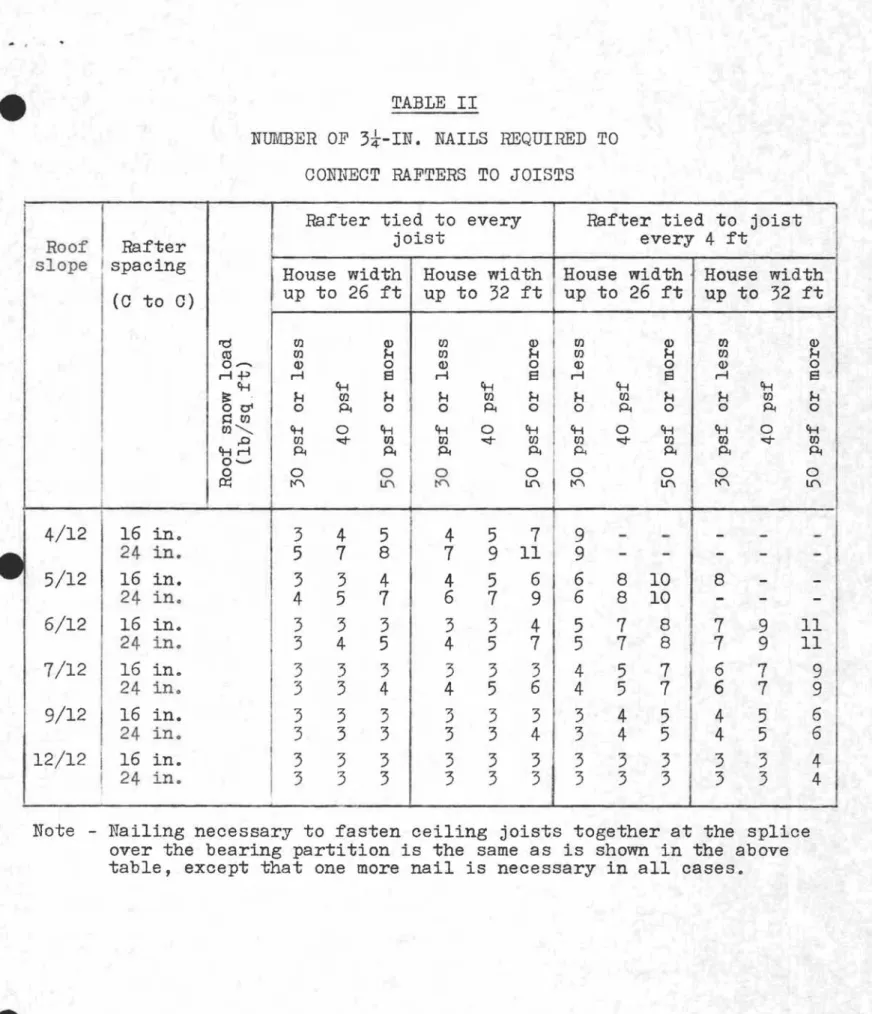
it was found that it was commOn practice to tie rafters to joists with only one 3i-in. nail where the rafters and joists lapped or where joists were
spliced uver the bearing partition. In many case s, however, joists and
rafters did not line up and a substantial percentage of houses, in the Ottawa area at least, were built with the rafter s supported On a plate on top of the joists.
A number of tests were carried out at DBR on a variety of
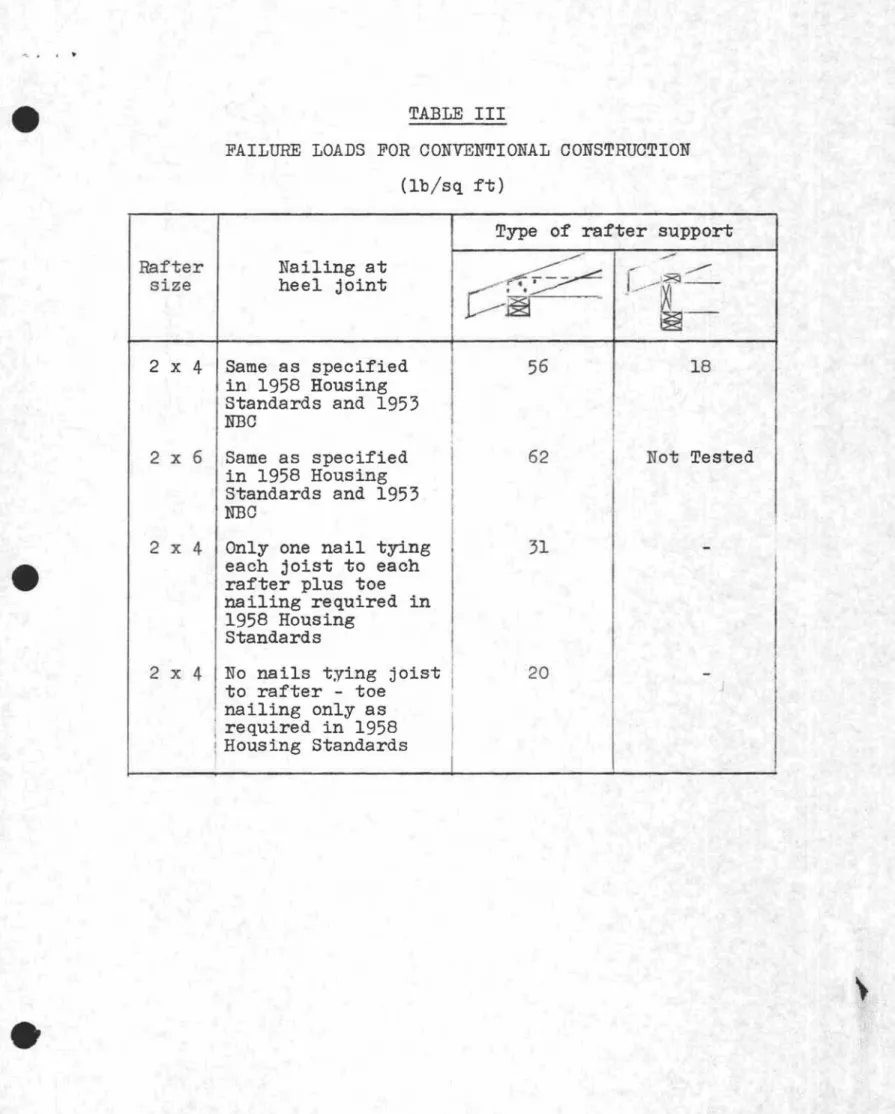
constructions of the type being built. Table III gives a brief summary of
some of the tests conducted On these conventional constructions of 24-ft span, 5/12 slope roofs with 2-by 4-in. collar ties at mid-span of rafters.
Although no tests were made using the exact nailing required for roof framing as specified in the 1963 Housing Standards, it is estimated that the present nailing requirements would ensure a failure load of about 70 lb/sq ft under short-term loading, for houses built with a specified
design snow load of 50 lb/sq ft. This wwld provide a factor of safety of
about 1. 4.
Requirements for such nailing are fairly recent, however, (1962 and 1963) and there are a great many houses in Canada built with much reduced nailing that should theoretically fail (because of nailing) at a roof load of from 20 to 40 lb per sq it (see Table III).
SNOW LOAD SURVEY
At the request of the Associate Committee on the National Building Code, the Division of Building Research in 1956 began a program of measuring actual snow loads on roofs and comparing them with the
snow loads on the ground. The observations to date are for six winter s;
they are made at three different types of reporting stations. At "A"
stations the snow loads are measured at weekly intervals by observing the depth of snow on the roof (by installed depth gauges) and measuring
the snow density. The same records are made regarding the snow on the
ground. At "B" stations periodic observations are made of the depth of
installed in these cases and the weight of snow is calculated by applying
a suitable density factor. At "C" stations measurements are made in
the same manner as for "A" stations, but these stations are concerned with special building shapes such as aircraft hangar s and have no direct application to house s.
Observations at "B" stations are not as precise as the others and there is some question as to the reliability of some of the observations
in this series. Survey results from "A" stations only, plus some
obser-vations taken on groups of exposed and sheltered houses, will be dealt with in this discussion.
The "A" stations (44 roofs at 17 cities and towns from British
Columbia to Newfoundland) include both flat and pitched roofs. Some are
of the type incorporating parapet walls, which are not typical of house
construction, and are, therefore, not applicable to this discussion. The
results of the observations were analysed by calculating the ratio of the average roof load to average ground load for the time of maximum snow
during the winter. With the exception of roofs noted at Revelstoke and
Glacier, British Columbia, there were no maximum average loads exceeding 32 lb/sq ft and the majority of the average roof to ground load ratios are
Ie ss than 0.6. It must be kept in mind, however, that these ratios refer
not to the maximum load recorded at a particular gauge, which would
occur with ャッ」。ャゥセ・、 drifting, but to the averages for each roof. It is
difficult to apply the localized concentrated drift loads in terms of an
equivalent uniform design load. If such concentrated load measurements
are applied directly as a uniform design load, a further factor of safety will be introduced.
Ratios of roof loads to ground loads are lower in exposed
locations than in sheltered locations. The average of the ratios for all
the "A" station gable roofs is reported in DBR Report No. 260 to be 0.31
for exposed locations and O. 50 for sheltered locations. The snow load in
this case was taken as the average load on the roof. If the maximum, or
drift loads, are considered, the two averages become 0.48 and 0.64 for
exposed and for sheltered conditions respectively. Thus the average
for exposed conditions is either 60 or 75 per cent of the average for sheltered conditions, depending on whether average or drift loads are considered.
A less significant but nevertheless interesting comparison was made of the average ratios obtained during two "B" station surveys. The first was taken in 1962 of exposed houses and the second was made in
1963 of sheltered houses, both in the Ottawa area. The ten houses in the
from the same general area. The average roof to ground ratio, based on average loads, was 0.12 for exposed and 0.70 for sheltered conditions. The average based on drift loads was 0.50 for exposed and 0.97 for
sheltered conditions. This example shows the possibility of having
sub-stantially lower loads for houses with good exposure than is at present
assumed in specifying snow loads for the National Building Code. It
should be pointed out that the houses used in the 1963 Ottawa study were more sheltered than the houses classed as sheltered in the "A" station survey.
In summary, then, it can be stated that shelter is one of the
most important factor s to consider. Ordinary exposed cot:rl itions lead
to large reduction of loads. It would appear reasonable to state that
exposed conditions result in a reduction of the roof to ground load ratio of at least 25 per cent.
Records of Roof Failures
DBR subscribes to a press clipping service on the subject of
roof failures. An examination of these clippings for the years 1958 to
1962 and of additional reports of failures collected before this date
pro-vides accounts of about 154 specific roof failures in Canada attributable to
snow loads. These reports include accounts of failures in many different
types of roofs and are summarized as follows: Type of Building
Arenas
Cur ling Rinks Barns
Garages
Sheds and Warehouses Industrial Buildings Cottages Boat Houses Community centres Camps Residential
All others including lodges, restaurants, theatres, hotels, bowling alleys, dance halls, ice houses, schools, greenhouses, etc.
-rotal
No. of Reported Failures 15 5 11 8 18 9
19 (general mention is made of an
additional 20 to 50 failures)
24 (23 of these occurred at one location) 5 7 6 27 154
It is of interest to note that of the 154 failures reported, only
six involved houses. Of these six failures, five involved the separation
of a verandah from the house wall because of insufficient anchorage. In
the sixth case, the house was unoccupied and no specific details of the failure were provided.
Of the 154 cases of reported failures only one true house roof failure was brought to light, and the construction involved in this lone failure is unknown.
DISCUSSION AND CONCLUSIONS
The record of performance of house roofs appears quite good, even though many existing roofs have an apparent failure load of 20 to
40 psf. There are a number of factor s one could list in an attempt to
explain why there are so few failures reported.
1. The possibility that actual roof snow loads are not as large as
calculated roof loads. This may be because the majority
of house roofs are built in exposed locations where the possibility of snow accumulation is not as great as in sheltered locations such as wooded areas.
2. There may be additional failures that have not been reported in the
newspapers.
3. A number of failures may be prevented by people who clear the snow
off their roofs before excessive accumulation.
4. A number of roofs are built whose actual strength may be greater
than that indicated in laboratory tests. The failure loads
shown in Table III are based on tests of pairs of rafters and
the failures occurred at the nailed connections. In a
com-plete roof additional strength may be provided by such things as soffit details, the continuity of the ceiling finish, and the fact that posts are sometimes provided to support the ridge
during construction and are left in place.. When plywood
sheathing is used the roof acts as a diaphragm and transfers
some of the rafter thrust load to the end gables. Tests on
full- size roofs have shown that this effect is negligible with board sheathed roofs, but in the case of plywood sheathing the roof strength may be increased from 8 to 50 per cent. The presence of dwarf walls may also increase the failure load of the roof.
5. The majority of houses built in Canada are built in areas where the design roof load is les s than 50 psf.
6. With equivalent nailing, the strength of the roof will increase as the
pitch is increased. Since the use of lower slope roofs is a
relatively recent trend, there may be a number of such roofs built that have not yet been subjected to the maximum load that can be expected once in thirty years.
7. Newer houses ar e well insulated and becsuse of this may collect more
snow than older uninsulated houses.
Nevertheless, the number of reports of house roof failures is negligible even in those areas with snow loads in excess of 50 psf
that have experienced record snowfalls in recent years. Thus, the
strength of the rafters in bending, when designed for a 40 psf snow load as has been the practice in the past, seems satisfactory in the light of the lack of repor ted failur es.
As mentioned previously, there is a considerable discrepancy between the factor of safety inherent in the design of rafters and that
provided by the specified nailing. The currant nailing requi.rements are
in general more stringent than former requirements and ensure stronger
roofs than was previously the case. On the basis of past experience, a
further up- grading in nailing does not appear justified. To achieve a
more balanced design, the failure strength of the rafters should be reduced and brought closer to the failure strength of the nailed
connec-tions. This can be done without reducing the over -all strength of the
roof.
One method of achieving this would be to apply any future reduction in design snow load to the design of the rafters only and to
leave the nailing requirements as they are. Reduction of the roof load
from 0.8 to 0.6 of the ground snow load has been indicated as reasonable for roofs in exposed locations, and the application of this new load to the design of rafters only would do much towards reducing in those locations
the present imbalance in design of the roof. It would also satisfy the
complaints that have been registered by house builders in areas where the present roof load is above 50 psf regarding the increase in rafter sizes that are required compared with the sizes in the 1958 Housing Standards.
TABLE I
NUMBER OF 3t-IN. NAILS REQUIRED TO
CONlTECT RAFTERS TO CEILING JOISTS
Rafter tied to every
Rafter tied to joist
Roof
Rafter
joist
every 4 ft
slope
spacing
House width
House width
House width
House width
up to 26 ft
up to 32 ft
up to 26 ft
up to 32 ft
4/12
I If:)tn. o.c.
5
7
-
-I
24 in. o.c.
811
-
-5/12
116 in. o.c.
4
6
10
-6/
12
124 in. o.c.
7
9
-
-16 in. o.c.
3
4
811
24 in. o.c.
5
7
-
-7/12
I
16 in. o.c.
3
3
7
9
!24
in.o.c.
4
6
-
-:3/12
16
in.o.c.
3
3
5
4
24 in. o.c.
3
4
-
-112/12
16 in. o.c.
3
3
3
4
I
I
24
in. o.c.
3
3
-
-
I
Note - Nailing necessary to fasten ceiling joists together at the
splice over the bearing partition is the same as is shown in
the above table, except that one more nail is necessary in
all cases.
TABLE II
NUMBER OF 3t-IN. NAILS REQUIRED TO
CONllECT RAFTERS TO JOISTS
Rafter tied to every
Rafter tied to joist
Roof
Rafter
joist
every 4 ft
slope
spacing
House width
House width
House width
House width
(0
to C)
up to 26 ft
up to 32 ft
up to 26 ft
up to 32 ft
'"d (/) Q) (/) Q) (/) Q) ttl Q) ro (/) H (/) H (/) H (/) H 0 - 0> 0 Q) 0 Q) 0 Q) 0 MOP M S M S M S Me
tH tH tH tH tH !!: H (/) H H (/) H H (/) H H (/) H 001 0 Pi 0 0 Pi 0 0 Pi 0 0 Pi 0 S::to t o " tH 0 tH tH 0 tH tH 0 tH tH 0 tH .0 (/) ""'"" (/) (/) ""'"" to (/) ""'"" (/) to ""'"" (/) tHM Pi Pi Pi Pi PI Pi Pi Pi 0 ... 0 0 0 0 0 0 0 0 0セ t<'\ If\ t<'\ If\ t<'\ If\ t<'\ If\