Active Duplicate Detection with Bayesian Nonparametric
Models
by
Nicholas Elias Matsakis
Submitted to the Department of
Electrical Engineering and Computer Science
in partial fulfillment of the requirements for the degree of
Doctor of Philosophy in Computer Science
at the
MASSACHUSETTS INSTITUTE OF TECHNOLOGY
February 2010
© Massachusetts Institute of Technology 2010. All rights reserved.
Author ... ... .... ...
Department of
Electrical Engineering and Computer Science
September 17, 2009
Certified by ...
...
Leslie Pack aelbling
Professor
Thesis Supervisor
<2
Accepted by...
Terry P. Orlando
Chairman, Department Committee on Graduate Students
OF TECHNOLOGY
FEB 2
3
2010
LIBRARIES
Active Duplicate Detection with Bayesian Nonparametric Models
by
Nicholas Elias Matsakis
Submitted to the Department of Electrical Engineering and Computer Science on September 17, 2009, in partial fulfillment of the
requirements for the degree of Doctor of Philosophy in Computer Science
Abstract
When multiple databases are merged, an essential step is identifying sets of records that re-fer to the same entity. Called duplicate detection, this task is typically tedious to perform manually, and so a variety of automated methods have been developed for partitioning a collection of records into coreference sets. This task is complicated by ambiguous or noisy field values, so systems are typically domain-specific and often fitted to a representative la-beled training corpus. Once fitted, such systems can estimate a partition of a similar corpus
without human intervention.
While this approach has many applications, it is often infeasible to encode the appropri-ate domain knowledge a priori or to identify suitable training data. To address such cases, this thesis uses an active framework for duplicate detection, wherein the system initially es-timates a partition of a test corpus without training, but is then allowed to query a human user about the coreference labeling of a portion of the corpus. The responses to these queries are used to guide the system in producing improved partition estimates and further queries of interest.
This thesis describes a complete implementation of this framework with three technical contributions: a domain-independent Bayesian model expressing the relationship between the unobserved partition and the observed field values of a set of database records; a criterion for picking informative queries based on the mutual information between the response and the unobserved partition; and an algorithm for estimating a minimum-error partition under a Bayesian model through a reduction to the well-studied problem of correlation clustering. It also present experimental results demonstrating the effectiveness of this method in a variety of data domains.
Thesis Supervisor: Leslie Pack Kaelbling Title: Professor
Dedication
This thesis is dedicated to my wife Terri, who has taught me the virtue of patience through her example. Without her tireless support and sacrifice over the winding and frequently bumpy road that has led to this point, this work would never have gotten off the ground,
much less been completed.
Acknowledgments
I am greatly indebted to so many people who have provided me unwavering aide and sup-port in this pursuit. In particular to my mother and father, Joanne and Elias Matsakis, and Terri's parents, Carlyn and Harold luzzolino, for their encouragement and financial support throughout my graduate career. I am also forever grateful to my advisor and mentor, Leslie, who was willing to take a chance on me and has seen this work through to the very end. It was only with her guidance and support that I was able to turn a disordered collection of half-baked ideas into a doctoral thesis.
I also owe thanks to my committee, Michael Collins, Tomas Lozano-Prez, and Andrew McCallum; for their ability to tell me when I wasn't making sense, their encouragement when I was, and the thoughtful and considered feedback they provided in preparation for my defense and during the writing of this thesis. To Dan Roy, for his willingness to share his knowledge of Bayesian nonparametrics and to understand what I was trying to do better than myself at times. To David Karger, for sparking my interest in this problem and his support during my early years of graduate school.
To my friends Mike Ross and Victor Luchangco, for their many years of friendship and especially for their willingness to read this document in development and suggest innumer-able improvements. Also to my friends Mark6ta and Joe Foley, for keeping me sane. To all the wonderful students in CSAIL and US, especially John Barnett, Jenny Barry, Emma Brun-skill, Sam Davies, Sarah Finney, Natalia Hernandez Gardiol, Kaijen Hsiao, Meg Aycinena Lippow, James McLurkin and Luke Zettlemoyer. They have been my friends and teachers, providing many hours of delightful conversation and insightful critique. I only wish I could have been as helpful to them as they have been to me.
Contents
1 Introduction
1.1 Motivation and Problem Description . . . . 1.2 Active Duplicate Detection . . . . 1.3 Summary of Contributions . . . . 1.3.1 Domain-Independent Bayesian Model . . . . 1.3.2 Correlation Clustering for Minimizing Error . . 1.3.3 Mutual Information Ranking for Active Queries 1.4 Overview of Experimental Results . . . . 2 Background
2.1 Data Environments ...
2.2 Duplicate Detection Architectures 2.2.1 Pairwise Methods ... 2.2.2 Partition-based Methods . 2.2.3 Other Methods ... 2.3 Model-Constructing Frameworks 2.4 Evaluation Metrics ... 2.5 Related Problems . . . . 2.6 Context for the Work . . . .
13 . . . . 13 . . . . 16 . . . . 17 . . . . 17 . . . . 19 . . . . 19 . . . 20 23 . . . . 2 4 . . . . 2 5 . . . . 2 6 . . . . 2 9 . . . . 3 2 . . . . 3 2 . . . . 3 6 . . . . 3 9 . . . . 4 0
3 Bayesian Nonparametric Model
3.1 Motivation ... 3.2 M odel Overview ...
3.3 Bayesian Nonparametric Processes . . . . 3.3.1 The Ewens Distribution . . . . 3.3.2 The Chinese Restaurant Process . . . . 3.3.3 The Pitman-Yor Process . . . . 3.3.4 Exchangeability . . . . 3.4 Model Description . . . . 3.4.1 Coreference Partition Prior . . . . 3.4.2 Individual Value Distributions Likelihood Model 3.4.3 Shared Value Distributions Likelihood Model . . . 3.4.4 Hyperpriors . . . . 3.5 Related M odels . . . . 4 Inference and Estimation
4.1 Markov Chain Monte Carlo Sampling . . . . 4.1.1 Sampling Block Memberships . . . . 4.1.2 Sampling Parameters . . . . 4.2 Conditional Inference and Blocking . . . . 4.3 Estimating a Partition from Samples . . . . 4.3.1 Minimum Expected Pairwise Error Partition . . . 4.3.2 Minimizing Error with Correlation Clustering . .
. . . . . . . . . . . 47 . . . . 48 . . . 50 . . . 50 . . . 52 . . . 53 . . . 53 . . . 55 . . . 57 . . . 60 . . 61 65 . . . 65 . . . 67 . . . . . 69 . . . . . 69 . . . . . 71 . . . 72 . . . . . 73 5 Query Ranking
5.1 Maximizing Query Information ... 5.2 Connections to Query By Committee ... 5.3 Limitations of the Approach ...
6 Experimental Evaluation
6.1 Implem entation Details ... 6.2 Modeling Active Queries ... 6.3 Experim ental Domains ... 6.4 Experim ental Results ...
6.4.1 6.4.2 6.4.3 6.4.4 6.4.5 6.4.6
Effect of Source Constraints . . . . Comparison to Baseline Algorithms Effect of Sharing Value Distributions Effect of Query Reranking Frequency Examples of MMI Queries . . . . Comparison to Related Work . . . .
7 Conclusions and Future Directions
7.1 Improved Value Modeling . . . .
7.2 Relational Value Modeling . . . . 7.3 Termination Criteria . . . . . . . . 95 . . . . 96 . . . 105 . . . . . ... . . . 113 . . . 119 . . . 12 1 125 125 127 128
List of Figures
1-1 Domain-independent active duplicate detection ... 2-1
2-2 2-3 2-4
A simple linkage graph ... Fixed model framework ... Learned model framework ... Active model framework ...
3-1 A portion of a flat file database . . . . 3-2 Abstract representation of the model dependency structure 3-3 Some data sets exhibiting preferential attachment statistics . 3-4 Individual value distributions model . . . . 3-5 IVD model with marginalized Dirichlet Process priors . . . . 3-6 Shared value distributions model . . . . 3-7 SVD model with marginalized Dirichlet Process priors . . . 5-1 A query as an event on the space of partitions . . . .
5-2 An example of independent coreference uncertainty . . . .
6-1 Evaluation data sets . . . . 6-2 The effect of applying negative constraints . . . . 6-3 Comparison to baseline algorithms on learning-authors . . . 6-4 Comparison to baseline algorithms on cora . . . . 6-5 Comparison to baseline algorithms on games . . . . 6-6 Comparison to baseline algorithms on karpathos . . . . 6-7 Comparison to baseline algorithms on restaurant . . . .
. . . . . . . 45 . . . . 47 . . . . 54 . . . . 56 . . . . 58 . . . . 59 . . . . 60 . . . . 79 . . . . 85 . . . 94 . . . 96 . . . 99 . . . 100 . . . 101 . . . 102 . . . 103
Comparison to baseline algorithms on vauniv . . . 104
Comparison between individual and shared value variants on learning-authors 107 Comparison between individual and shared value variants on cora . . . 108
6-11 Comparison between individual and shared value variants Comparison between individual and shared value variants Comparison between individual and shared value variants Comparison between individual and shared value variants Effect of inference frequency on learning-authors . . . . . Effect of inference frequency on cora . . . . Effect of inference frequency on karpathos . . . . Effect of inference frequency on restaurant . . . . Effect of inference frequency on vauniv . . . . Precision-recall curve for cora from Bilenko & Mooney. . on games ... .109 on karpathos ... 110 on restaurant . . 111 on vauniv . . . 112 . . . 114 . . . 115 . . . 116 . . . 117 . . . 118 . . . 122 6-12 6-13 6-14 6-15 6-16 6-17 6-18 6-19 6-20 6-21 6-22 6-8 6-9 6-10 Precision-recall curve for restaurant from Bilenko & Mooney . . . 122
Chapter 1
Introduction
Most of us really aren't horribly unique. There are 6 billion of us. Put 'em all in one room and very few would stand out as individuals.
Herbert Simon
1.1
Motivation and Problem Description
Managers of large data repositories have long been familiar with the problem of duplicate detection. Database software is typically designed under the assumption that there is a single record for each entity of in-terest. The presence of duplicate, or coreferent, records violates this as-sumption and can result in problems when using the data. For example, duplicates may displace canonical records in search results, result in mis-leading computed statistics, and use system resources unnecessarily.
In some cases it is possible to avoid creating duplicates in the first place. For example, library catalogers use the Library of Congress and other authority services to provide canonical records of works [39]. How-ever, such services are of limited use when a library is cataloging a new work or author, as is frequently the case in academic libraries [82]. In such cases, judicious inference by the cataloger can reduce the incidence of duplicate records.
be avoided, such as when merging multiple databases, when authority services don't exist, or when identifying traits of entities are inaccessible at record creation time. For example, the use of data-mining algorithms to extract structured data from unstructured text is increasingly com-mon. In this case, the records are created automatically and thus some manner of duplicate detection must be employed.
Even for modest-sized databases, it is typically impractical to manu-ally review each record to find coreferents. For this reason, a variety of automated methods have been developed to address this problem. The earliest systems used hand-tuned linkage rules that specified conditions under which a pair of records should be declared coreferent [65]. In these early systems, resources were limited and record access had high latency, so even applying simple pairwise rules was challenging.
Duplicate detection was first formalized in a decision-theoretic frame-work by Fellegi and Sunter [37], who treated the problem in the statisti-cal hypothesis testing framework, developing a binary classifier that used the agreement of a record pair's field values to identify coreferent pairs
or matches. This framework modeled the common application of finding
matched pairs from two clean sources.
problem In general, there may be many sources and many coreferent records
statement within a source, and the problem is that of finding a partition of a set of
records into a set of coreference blocks, or disjoint record sets that refer to the same entity.' For methods that describe a class of models for finding partitions, such as supervised methods that fit a model to training data, we refer to a particular instance of that class as a partitioner, analogous to a classifier in the classification problem.
A broad variety of approaches have been taken to finding a suitable partitioner for a data environment. We can categorizes these broadly into two groups. Pairwise methods have been developed based on su-pervised classifiers such as the Naive Bayes model [93], support vector machines [19], and decision trees [88]. Partition-based methods include
'Some authors use the terms partitioning and partition for what we define here as a
generative Bayesian models [67, 14], conditional random fields [59, 66], constraint propagation models [34], and heuristic algorithms [54].
One aspect common to these approaches is that the partitioner must be tailored to the data to which it is applied. In the case of hand-tuned rules, a human expert must determine which rules are appropriate. Even with machine-learning methods, optimal performance typically requires either encoding knowledge into a domain-specific model or choosing appropriate preprocessing steps, domain-specific features and functions, and hand-labeling training examples.
Bilenko and Mooney [20] provide an insightful look into the impor-tance of choosing appropriate training data for duplicate detection al-gorithms. They compared a supervised model trained on data from the test domain (publications) to one trained on a disparate domain (restau-rants), and also to a generic similarity model based on string edit dis-tance. While the appropriately trained model performed best, the generic model outperformed the one trained on inappropriate data.
One explanation for these results is that there is an ambiguity in ex-plaining the presence of variation in a data corpus. One source, which we
call population variation, reflects the true variation in the underlying
en-tities and should be used as evidence for coreference decisions. Another source of variation, which we call observation variation, is an artifact of the data collection process, and should be disregarded as noise. When faced with a generic collection of data, it cannot be known a priori how to account for the observed variation. Domain-specific models and/or training examples serve as constraints that resolve this ambiguity.
An example of this phenomenon is found in the well-studied case of duplicate detection using personal names. In this case, the frequency of particular names and the prevalence of name changes may be considered part of the population variation, while data entry errors, spelling incon-sistencies, and the use of nicknames factor into the observation varia-tion. This distinction between signal and noise is not always clear. For example, when an individual with a common name adopts an uncom-mon nickname as a means of distinction, an algorithm that normalizes known nicknames in preprocessing will eliminate a distinguishing
fea-sources of data variation
ture. Thus, a variety of rich statistical models have been developed to account for the intricacies of personal names [92, 67, 26, 23, 14].
Another aspect of the problem highlighted by the work of Bilenko and Mooney is that generic similarity models are capable of correctly la-beling most of a problem instance, as superficial similarity is often a good indicator of coreference. The problem's difficulty lies along the margin of "somewhat similar" records, which may or may not be duplicates. It is here where the use of domain-specific models and appropriate training examples can significantly improve performance by taking advantage of the characteristics of a particular domain or even the particular data set within that domain.
1.2 Active Duplicate Detection
While it is clear that domain-specific knowledge is required for optimal performance, it is not always feasible to encode such knowledge a priori, either through building domain-specific models or through providing labeled training examples, because the necessary work cannot be amor-tized across a large data corpus. This is particularly true for personal information databases, where users unskilled in database management informally collect information according to their own idiosyncrasies, of-ten without adherence to a particular schema. Such data may also have peculiar statistics; for instance, we expect the distribution of names in a personal contact database to have a very different distribution from that in the population at large.
To address such data environments, this thesis develops a domain-independent active framework for duplicate detection. In this frame-work, there is no distinction between training and evaluation data: the system is presented with an unlabeled data corpus from an unknown do-main, but is allowed to query a human supervisor about the coreference labels of portions of the data. The goal is to find the best coreference labeling for a given amount of supervisor effort.
Ideally, the query responses serve both to label the "hard" portion of the corpus and to simultaneously resolve ambiguities specific to the
corpus in order to improve performance on the remainder of the cor-pus. Although the supervisor may be labeling the difficult portion of the corpus, the system is still tasked with identifying this region and distin-guishing between informative and uninformative queries. Note that hu-man labeling does not require an expertise in data modeling or machine learning, but rather the domain knowledge of whether a pair of records is coreferent.
1.3
Summary of Contributions
The method described in this thesis divides active duplicate detection into three stages: inference, partition estimation, and query ranking. In the inference stage, a model of the uncertainty in the coreference par-tition is generated. This uncertainty model is used both in generating a single best estimate of the coreference partition and also in ranking queries to the supervisor. Labels provided by the supervisor may then be fed back into the inference stage to produce an updated uncertainty model. Figure 1-1 provides a diagram of the system.
This thesis describes an implementation of this framework with three technical contributions: a domain-independent Bayesian model of coref-erence, a criterion for picking informative queries based on maximizing mutual information, and an algorithm for estimating a minimum-error partition under a Bayesian model based on minimizing expected pair-wise error. It also present experimental results demonstrating the effec-tiveness of this method in a variety of data domains.
1.3.1
Domain-Independent Bayesian Model
Chapter 3 presents a domain-independent generative Bayesian model of the coreference relation of a data corpus: a distribution over observed record values conditioned on the coreference partition of the corpus. Unlike many other Bayesian models for duplicate detection, it uses no schema-specific distributions or structures. Instead, it provides a generic model of record generation based on Bayesian nonparametric
distribu-unlabeled data query labels queries partition uncertainty model estimate partition
Figure 1-1: Domain-independent active duplicate detection
tions, which allow the model to be used in a variety of different domains without modification.
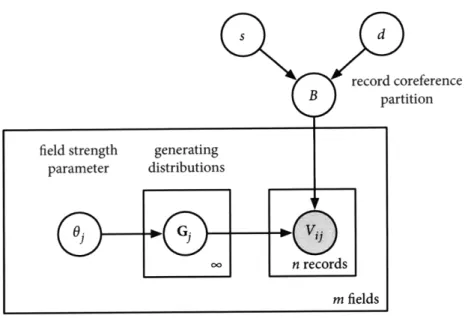
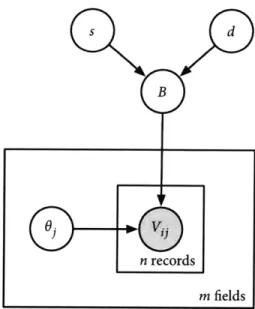
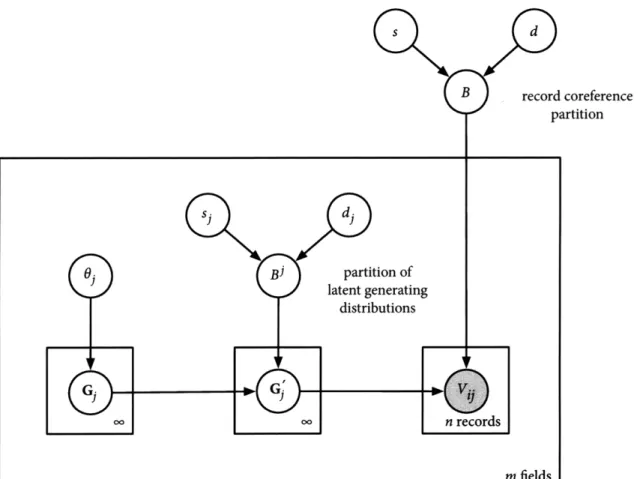
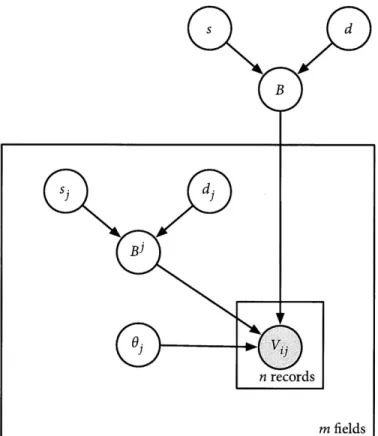
Two different variations of the model are presented: an individual
value distributions (IVD) model in which each coreference block has a
unique distribution over its field values and a shared value distributions (SVD) model in which the field-value generating distributions may be shared between coreference blocks. The distinction between these two models is discussed in detail in section 3.4.
Chpater 4 provides an efficient inference procedure for the model based on Markov Chain Monte Carlo (MCMC) sampling. The sampling procedure generates approximate samples of the posterior distribution over partitions given observed record labels. This sampling procedure
can be used completely unsupervised, when no coreference labels are known, and also in the case in which the partition is subject to binary constraints; In the latter case, additional modifications are provided to
meet the ergodicity condition of MCMC sampling.
1.3.2
Correlation Clustering for Minimizing Error
While a Bayesian model provides a model of the uncertainty associated with a hypothesis, it is still useful in many applications to produce a gle estimate of an unobserved quantity; for instance, producing a sin-gle estimate partition from a Bayesian distribution over partitions. The
maximum a posteriori (MAP) estimator is commonly used in Bayesian
modeling.
This thesis proposes an alternative to the MAP estimate for duplicate detection: the estimate partition that minimizes the expected pairwise error under the model. Chapter 4 demonstrates that optimizing this ob-jective under a Bayesian model reduces to correlation clustering, an
NP-hard problem with a number of known approximation algorithms [33]. The minimum expected error objective function is used both because it provides a more direct measure of the error of an estimate partition and also because it works well in conjunction with the query ranking measure proposed in chapter 5: With this objective function, the same inference computation is used both to provide weights for correlation clustering and also to rank pairwise queries. Both of these depend on an estimate of the marginal probability that a pair of records is coreferent.
Though correlation clustering iS NP-hard, the practical running time of a problem instance depends on the amount of ambiguity in the data; thus it may be solved exactly for practical data sets with small corefer-ence blocks and chapter 4 provides a heuristic algorithm for estimating a partition from samples under this objective that runs quickly in practice.
1.3.3
Mutual Information Ranking for Active Queries
While the model may be used for unsupervised inference, it is intended to be used in conjunction with a human supervisor in an active
label-ing framework. However, in a typical duplicate detection application, an arbitrary pair of records is likely to be a trivial nonmatch and therefore not strong evidence about the true partition. We might expect that such weak evidence would not alter the results of inference and indeed this is one of the empirical findings presented in chapter 6. Therefore, in this framework it is necessary to use the model to pick informative queries.
Chapter 5 develops a formal framework for ranking queries in a Bayes-ian, partition-based framework. In this formalism, query responses are treated as unobserved variables and queries are ranked according to the
mutual information between the query response and the partition as a
whole. A derivation is given which shows that the query that optimizes mutual information is that with the highest posterior entropy in its label value.
This result leads to an estimate of query effectiveness that can be com-puted efficiently from McMc samples. Query responses can then be in-corporated into the model as observations, and additional inference con-ditions on these observations may produce improved partition estimates and further informative queries. This result also provides a theoretical connection between active approaches based on pairwise classifiers and those based on partition search.
1.4 Overview of Experimental Results
Chapter 6 presents experimental results from using this method in six different data domains. These experiments look at four practical con-siderations: the importance of incorporating negative constraints when merging data from multiple sources; the performance of the proposed query ranking criterion compared to baseline algorithms; the perfor-mance characteristics of the individual and shared distributions mod-els; and the effect of periodically reranking queries through additional rounds of inference.
These results demonstrate the effectiveness of the proposed query ranking in improving the performance of the system over its unsuper-vised performance or with queries ranked using baseline algorithms. They
also demonstrate the significance of feedback in the process: periodi-cally reranking queries through additional inference, improves the per-formance of the system for a given number of queries.
These experiments also reveal limitations of the model, including its unsupervised performance on certain data sets and ability to scale to large data sets, discussed in section ??. These limitations are used as a basis for the suggestions of future research directions provided in chapter 7, in-cluding improved value distribution modeling, extending the model to handle relational data, and other issues involved in scaling the method to large data sets.
Chapter 2
Background
Automated duplicate detection has long history in the research literature. The problem was first called record linkage, since the intent was to link vi-tal records-such as birth and death certficates and marriage licenses-in order to create a more comprehensive understanding of the data [65, 37]. Researchers have since introduced a seemingly combinatorial number of names for this problem including:'
instance identification [91], semantic integration [2], data cleansing [36], authority work [39], the merge/purge problem[47], data integration [24], citation matching [54],
instance matching [75], reference matching [60], database hardening [251, entity-name clustering and matching [27], object identification [88], fuzzy duplicate elimination [7], deduplication [79], object consolidation [61, 58], identity uncertainty [67], object co-identification [44], robust
reading [56], reference reconciliation [34], entity
resolution [ 12], author disambiguation [30], and coreference
resolution [45].
This profusion of names is due in part to interest from different research communities, but also from a desire to highlight aspects of a particular
'This list is derived in part from similar ones compiled by William Winkler [94] and Mikhail Bilenko [16].
schema structure
data environment or method. We use duplicate detection for its dissoci-ation with any particular data environment and its alliterative quality.
This chapter provides a high-level overview of various approaches to the problem, categorized according to architecture, model-constructing framework, and data environment. These distinctions emphasize the contributions of this thesis by motivate the scenarios best suited to the domain-independent, active model presented in later chapters.
2.1
Data Environments
The need for duplicate detection typically arises in data collected to ex-press knowledge about a real-world domain of entities and their rela-tionships. One example is that of a library database, which contains records for the books and other works curated by the library. It may also contain records for the authors and publishers of the works, and for the library's patrons. In addition to the ubiquitous example of publica-tions [39, 54,67, 76, 13], the problem has been explored for such domains as vital records [65, 93], corporations [24, 87], films [24, 5], music [44], product listings [17], and biological data [53].
To be effectively processed by a computer, the information of the domain must be expressed in a data model, a machine-understandable format for data storage and retrieval. Common data models include re-lational databases (SQL), object databases [52], document-object mod-els (e.g., xML), and graph databases [55, 29]. Such modmod-els are domain-independent: they provide features applicable to a wide variety of do-mains, such as primitive data types and text encodings.
It is frequently desirable to restrict the data to conform to a schema, a formal description of the types and ranges of valid field values. Con-tinuing the library example, a schema might dictate that library patron records must contain a field for the the patron's phone number, and re-strict the field's value to a valid phone number. Schemas are used to val-idate the database, facilitate data interchange, and prevent application errors due to invalid data. Such data is often called structured data.
allow data conforming to disparate schemas, or to no schemas at all, to intermingle. Such data is often called semi-structured [55]. Schemas may also vary in the strictness of their typing. For example, most per-sonal information applications allow users to enter free-form text strings as values and typically do not require a value for every field. Conse-quently, such data is subject to a greater degree of variation than data that is strictly validated, as is common in business applications.
Another aspect in which data environments vary is in the degree relational
of relational structure present in the data. Inflat databases, each record structure represents the same type of entity and the field values are primitive types
such as text strings or numbers. For example, most personal address databases contain records corresponding to individual people, with tex-tual fields for the person's contact information.
Flat databases hinder the sharing of information between records. In a flat address database, for example, there is no means to express that an address is shared by multiple people, and therefore the street address, city, and zip code values should be the same. Likewise, it may not be possible to model situations in which an individual is associated with multiple addresses. To handle these and many other use cases, many data models admit some form of relational values, wherein records are permitted to have fields referring to other records. With relational val-ues, it is possible to explicitly model the many-to-many relation between people and addresses.
Simple relational data environments have a small fixed number of record types, but deeply relational models may allow for an arbitrary number of types with an arbitrary number of relations. This poses a chal-lenge to duplicate detection in these environments because coreference
decisions between records must be propagated to all related records.
2.2
Duplicate Detection Architectures
Duplicate detection methods can be broadly categorized into pairwise
methods, which develop a coreference classifier for pairs of records, and partition-based methods, which optimize a scoring function over
par-pairwisefeatures
titions of the records. However, this distinction is not firm and many methods incorporate aspects of both architectures, for example by using a pairwise classifier as a component in a partition score.
2.2.1
Pairwise Methods
Pairwise methods were first developed to model the application of find-ing matches between two files or data sources. In this situation, each record is associated with a source that is presumed to be free of erents, as is often the case when databases must be merged. Thus coref-erence blocks consist of either a single record or a pair of records, one from each source. These methods may be extended to data without such a constraint through the use of a linkage algorithm, which combines the possibly inconsistent pairwise decisions into a final partition.
A common approach is to partition the records in three stages. First, a similarity function is used to score pairs of records along a real-valued scale indicating the level of confidence in a match. Next, a threshold is used to decide which pairs are matched. Finally, a linkage algorithm is applied to generate a final partition. These stages are not always per-formed sequentially; an iterative approach may be taken where the simi-larity function, threshold, and linkage algorithm are adjusted until a ter-mination condition is reached [13].
Typical pairwise classifiers require record pairs to be represented in a feature space. A basic representation would be a vector of binary values, one per field, indicating whether the field values match in the pair, but more elaborate features are typically used. These may combine attributes of multiple fields into a real number. Domain-dependent features are one way of incorporating domain knowledge regarding relevant fields. Parametric features with learned parameters may also be used [18].
Once a pair of records (i,
j)
is expressed as a feature vector xij, super-vised learning techniques can be applied to generate a classifier from la-beled examples (xij, yij), with yij indicating whether the pair is a match. Some techniques applied to duplicate detection include decision trees [88], maximum entropy classifiers [27], support vector machines [19], rulein-duction [53], and voted perceptron [17]. Supervised learning theory may also be applied to problems such as feature selection and classifier over-fitting.
In their classic presentation, Fellegi and Sunter [37] cast the classifi-cation problem as a likelihood ratio test of the form,
P(x; Y) match
P(x; Y) nonmatch
which requires estimating the two likelihood functions as well as a suit-able threshold T for the decision boundary. Fellegi and Sunter addi-tionally show that by using two thresholds, between which records were classified for manual review, the amount of manual review for a given error rate could be minimized. Winkler [93] presents an Expectation-Maximization algorithm for learning the likelihood parameters in a naive Bayes likelihood model.
The threshold value, or margin in the case of a discriminative clas-sifier, must be tuned to the number of coreferent pairs in a test set. If the threshold is set too high or too low, there will be many misclassified pairs. An appropriate setting can be found using a training corpus, pro-vided that the frequency of coreference is representative of an evaluation corpus; otherwise, it may need to be tuned when the classifier is applied to new data.
Since a pairwise classifier operates on pairs of records, it may produce inconsistent (i.e., nontransitive) decisions. Consider the simple example of three records, u, v, and w. A classifier might decide that pairs (u, v) and (v, w) are matches, but that pair (u, w) is a nonmatch, producing a linkage graph as in Figure 2-1. A linkage algorithm is used to resolve this inconsistency. Often, the classifier scores are used directly by the linkage algorithm and thresholding is applied as part of linkage.
The simplest algorithm, called single linkage, computes the transitive closure of the match decisions. In the case of the previous example, sin-gle linkage would declare u, v, and w coreferent. Sinsin-gle linkage may be viewed as a greedy hierarchical agglomerative clustering algorithm [17],
thresholding and linkage hypothesis testing framework
yvw= [match]
yuw= [nonmatch]
Figure 2-1: A simple linkage graph
blocking
pairwise relational models
in which each record is initialized in its own block and then blocks are greedily merged until some termination condition is met. In single link-age, blocks are merged according to the maximum value the classifier produced for a pair of records that spans the blocks.
One obvious problem with single linkage is that it doesn't take into account the overall connectivity between the blocks: If the classifier con-siders most of the pairs between two blocks to be strong nonmatches, they may still be joined by a spurious high match. Average linkage recti-fies this by joining blocks according the the average value of the classifier across all pairs that span the blocks. A still more conservative approach is to use the minimum classifier value between the blocks. Nongreedy approaches have also been used, in which the similarity function and linkage thresholds are iteratively updated [13].
Applying pairwise classifiers to n records requires n(n - 1)/2 fea-ture vectors to be computed and classified. This 0(n 2) computation may be intractable in large data sets, so many practical systems use
block-ing techniques to identify (possibly overlappblock-ing) subsets of the data that
are likely to contain coreferent pairs. For publication records, a sim-ple blocking technique might be to group publications by their copy-right year field; publications with distinct years are assumed to be non-matches without the need for classification. In practice, effective block-ing requires a linear-time algorithm that clusters potential matches into relatively small subsets.
The pairwise architecture presented thus far is primarily suited for
flat databases. Consider the problem of duplicate detection in a relational setting, for example merging multiple library databases with publication and author records in a relational structure. An obvious constraint would be to require that declaring publication records coreferent would imply that their related author(s) record(s) would also be coreferent. There is no obvious extension to the pairwise architecture that embodies this con-straint.
Despite these difficulties, there are some approaches that combined pairwise decisions with relational data. Dong et al. [34] describe a method for defining a dependency graph on pairwise coreference decisions in a publications domain, allowing coreference decisions to be propagated between record pairs. Bhattacharya and Getoor [13] describe a method for partitioning author records using co-authorship relations as an addi-tional source of disambiguating information.
Although the pairwise architecture has the advantage of allowing a variety of classification techniques to be used "off the shelf"' there are a number of significant limitations to pairwise methods. Milch et al. [62] note that pairwise features cannot capture certain global constraints. For example, it may be likely for an entity to have a small number of dis-tinct values for a field (e.g., email address) but unlikely for there to be dozens. Another problem is the difficulty of applying domain knowledge and constraints in a principled way across blocking, classifier construc-tion, threshold choice, and linkage algorithm. Finally, in some domains, there may arise identical records for distinct entities or disparate records for the same entity; pairwise methods may have trouble training on such outlying examples.
2.2.2
Partition-based Methods
Partition-based methods mitigate some of these limitations of pairwise methods, though typically at the expense of additional computation. A partition-based method provides a measure over the space of possible partitions of a data corpus. This measure serves to score candidate par-titions by their estimated closeness to the true partition. Because the
limitations of pairwise models
generative Bayesian models
relational Bayesian models
number of possible partitions grows combinatorially with the number of records,2 nontrivial measures must be combined with an effective opti-mization technique.
Generative Bayesian models, including the one described in this the-sis, are ones means of providing a measure over partitions. In Bayesian models, conditional probability distributions are used to model the un-certainty in unobserved quantities. In Bayesian coreference models, the primary quantity of concern is the coreference partition but other un-known values may be incorporated into the model as well. One advan-tage of these models is that these unknown values may be inferred from data, for example a "clean" version of a publication title may be inferred from noisy representations.
A generative model provides aprior distribution over partitions P(B) and a likelihood distribution over observed record values P(V IB). We may think of the value of the coreference partition as hypothesis, with the prior specifying our belief about the hypothesis in the absent of data and the likelihood distribution specifying the likelihood of any particular observation under any particular hypothesis. Bayesian inference, then, provides a means of updating posterior belief P(B V) of a hypothesis in light of observations using Bayes Rule:
P(B V) P(V|IB) P(B)
P(V)
For a fixed set of observations V the posterior probability is propor-tional to the prior multiplied by the likelihood. Thus, the posterior pro-vides a score for each partition given the evidence. However, optimizing this function over the space of all partitions is challenging. Monte Carlo sampling techniques are commonly used. In these techniques, described further in chapter 4, the defined distributions guide a stochastic search through partition space.
Another advantage of Bayesian methods is they allow relational data to be modeled in a principled way, combining evidence from multiple
2
The number of partitions of n items is commonly known as the nth Bell num-ber [77]; the Bell numbers grow faster than any exponential function.
types of records to make simultaneous coreference decisions. Pasula et al. use the language of relational probability models (RPMS) [69] to model a relational citation domain [67]. Milch et al. develop BLOG, a language for describing domains with identity uncertainty, and provide BLOG models for aircraft observations and citation matching [62]. Carbonetto et al. extend BLOG to a nonparametric setting and also model citation genera-tion [22].
These models are domain-dependent in that they provides explicit descriptions of the dependencies between the entities, relations, and field values specific to the domain of citation coreference. For instance, they each describe a model of citation generation with distinct string distribu-tions for a publication's title versus an author's name. Adapting them to a new domain would require a modeler to chose different distributions appropriate to that domain.
An alternative to generative models are discriminative models, which score partitions without requiring the strict conditional independence assumptions of Bayesian modeling. McCallum and Wellner [58] intro-duce a Conditional Random Field (CRF) model of noun phrase corefer-ence, in which the distribution P(B V) is modeled directly. One advan-tage of this model is that non-independent and overlapping features of the data may be included as evidence.
In the CRF model of McCallum and Wellner, pairwise features are used as evidence for the coreference decisions. The training procedure for the model weights is partition-based, however, maximizing the like-lihood of the coreference decisions of the training data as a whole. Max-imum likelihood inference in this model is equivalent to the graph parti-tioning problem known as correlation clustering [10, 33]. The CRF model was extended to multiple field citation records by Parag and Domin-gos [66] and Culotta and McCallum [31].
Discriminative partition-based models may also incorporate block-level features. Culotta et al. [30] present a feature representation in which the score of a partition is a weighted sum of block-level features. Effi-cient training procedures for the features weights based on minimizing errors are presented, and greedy agglomerative clustering is used to apply
discriminative models
model construction
learned models to test corpuses. Though not strictly required, the fea-tures used in this approach were also specific to the evaluation domain of citation coreference.
2.2.3
Other Methods
This review of methods is far from exhaustive; a recent survey is pro-vided by Winkler [94]. The categorization of methods into pairwise and partition-based is intended to be illustrative, but there is not always a clear distinction, particularly when linkage algorithms take the form of a partition search.
There are also models which don't fall into either category. For ex-ample, the Discriminant Descriptions model of Guha [44] finds a feature function for each entity, called a key, that distinguishes records referenc-ing that entity from those that do not. We may call this an entity-based
or key-based model.
2.3
Model-Constructing Frameworks
Most duplicate detection methods use structures that depend on the data environment in which they will be applied. These structures may be cho-sen by the modeler during a modeling phase (e.g., feature functions) or they may be estimated from data during a learningphase (e.g., model pa-rameters). A particular choice of parameters defines a partitioner, which can then be applied to new data in the evaluation phase. Different meth-ods take different approaches to constructing a partitioner; we consider three such frameworks here, which we callfixed, learned, and active, and
discuss their suitability to various data environments.
Many methods depend on a substantial modeling effort. In genera-tive Bayesian models, the partitioner is tasked with defining the domain variables and specifying their conditional independence relations and probability distributions. In discriminative models, appropriate features must be chosen. Even when structure learning or feature selection algo-rithms are used, the modeler is still responsible with defining the space of
features from which to choose. Effective modeling requires both knowl-edge about the particular method being used and also domain knowlknowl-edge about the data to which it is being applied.
However they are constructed, most models incorporate some form of domain or schema-dependent knowledge. As discussed in the pre-vious chapter, domain-specific features can be essential to achieving ac-ceptable performance in practice. Domain-specific knowledge may be as simple as normalizing common abbreviations [63] or it may involve con-structing an entire Bayesian description of a relational domain [67, 62]. Still, there remains interest in designing more flexible models that re-quire less modeling up front by using machine-learning techniques to adapt domain-independent features to a particular domain [88, 5, 19]
The most basic duplicate detection method is to construct, by hand, linkage rules that determine whether a record pair should be classified as coreferent. Once specified, such rules define a unique partitioner which may be evaluated on a test corpus. In this fixed model framework, il-lustrated in Figure 2-2, a partitioner is produced directly by the modeler. Though no training is required, such models need not be trivial to imple-ment: a fully specified Bayesian model may require advanced techniques to perform effective inference.
testing data
Figure 2-2: Fixed model framework
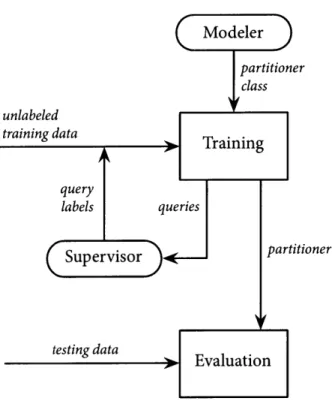
Most of the methods discussed previously involve some form of fit-ting models to data. In the learned modelframework, depicted in figure 2-3, we may think of the modeler as defining a class of partitioners, with the particular partitioner chosen by a learning algorithm during
train-learned model fixed model
ing. Training may take two forms: supervised algorithms are commonly trained on a hand-partitioned corpus, but unsupervised algorithms may be used either separately or in conjunction to estimate parameters from an unlabeled corpus. For example, Pasula et al. used a census name file to estimate parameters in a generative model for author names [67].
(un)labeled training data
testing data
Figure 2-3: Learned model framework
active-learned model
The learned model framework may be extended with an active com-ponent. In this active-learned modelframework, the training algorithm is able to take advantage of unlabeled or partially labeled data to generate a partitioner, but is also augmented by a querying algorithm that identi-fies interesting portions of the training corpus for a human supervisor to label. These labels are then fed back into the system to produce further partitioners and queries. The process may terminate when a particular condition is met or when the results are deemed satisfactory. A diagram of this framework is given in figure 2-4.
Both Tejada et al. [87] and Sarawagi and Bhamidipaty [79] have pro-posed active approaches to partitioner training. These works use sim-ilar architectures, in which a pairwise classifier is first trained using a small portion of the records in a corpus, then used along with a query-by-committee [81] approach to identify additional training pairs.
Addi-partitioner
Figure 2-4: Active model framework
tional classifiers and queries are then generated iteratively. Bilenko [16] uses a "static" active approach, where a schema-generic heuristic is used to suggest likely-positive examples for training a pairwise classifier. An active approach has also been applied to clustering documents by Basu et al. [11]; In this model, binary match constraints were incorporated into
a k-means clustering algorithm.
The choice of model construction framework comes with tradeoffs. Fixed models are human-designed and so may be easier to introspect and correct; however they are also unable to take advantage of unanticipated features of the data that may improve performance. Learned models may provide better performance, but they too require judicious design and an appropriate choice of training data. When the work of model design and labeling training data can be amortized across a sufficient amount of evaluation data, a learned model may be the best choice.
The active approach is suited to applications where the work of label-ing a trainlabel-ing corpus cannot be amortized to a large amount of evaluation
framework properties
pairwise metrics
data. One compelling application is duplicate detection in personal in-formation databases: these may have characteristic statistics not found in a generic training corpus and may be semi-structured, with an ad hoc schema determined by the user; such data may have novel fields and val-ues that cannot be anticipated during the modeling phase.
Another use case may be data generated by a process with frequently changing statistics. For example, in a web commerce application there may be a large amount of unsupervised data but the characteristics of duplicate records may vary with market conditions. In this case, active queries could be used to keep a partitioner performing well while mini-mizing human involvement.
Finally, even if the statistics of the data are relatively static, an active approach may be useful in minimizing the amount of human labeling necessary to achieve an acceptable level of performance. Sarawagi and Bhamidipaty have shown that selecting a training corpus using an ac-tive learning technique can produce better classifiers than an arbitrarily selected training corpus [79].
2.4 Evaluation Metrics
During the evaluation phase, a partitioner produces an estimate partition of a data corpus. For nontrivial data, it is unlikely that a partitioner will estimate the true partition perfectly, so evaluating performance quanti-tatively requires defining a difference metric between the estimated and true partitions. We discuss the most commonly used metrics here, along with their properties.
Like the methods themselves, these metrics can be broadly catego-rized as either pairwise or partition-based. Pairwise metrics treat item pairs as independent points of comparison. The error rate is the per-centage of pairs for which the estimate and true partition disagree on the match/nonmatch labeling. The recall is the percentage of true matches that are correctly labeled in the estimate, while the precision is the per-centage of estimated matches that are true matches. When the true par-tition has no matches, we define the recall to be 100% and when the
es-timated partition has no matches, we define the precision to be 100%. Precision and recall are often preferred to error rate since they do not credit a partitioner for accepting the strong null hypothesis that two records are distinct'. There is also a natural tradeoff between these met-rics: perfect recall is trivially obtained by the single-block partition, with all items in a single block, while perfect precision is obtained by the
sin-gleton partition, with each item in its own block. The harmonic mean of
precision p and recall r is called the
f-measure:
f
= p+r.P. The f-measure ranges from zero, when either precision or recall is zero, to 1 when the estimate is the true partition.While pairwise metrics fit neatly into the framework of statistical hy-pothesis testing, they disregard the fact that coreference decisions are transitive. Consider a partitioner that leaves one record out of an other-wise correct block. In this case, the pairother-wise recall will vary with the size of the block; larger blocks will accrue greater recall error than smaller ones. An analogous situation may occur with pairwise precision. This penalizes a partitioner repeatedly for what may be regarded as a single error.
For this reason, many researchers prefer partition-based metrics, which directly compare the generated partition to the true partition. One commonly used metric is a block-based variant of f-measure called MuC, developed for scoring the noun-phrase coreference task at the 6th DARPA Message Understanding Conference [89].
The MUC metrics may be understood by considering how the true partition may be constructed through a series of link operations that con-nect coreferent elements. Starting from the singleton partition, a block b from the true partition can be constructed with
|bI
- 1 link operations (a block of size 1 requires no links). This is an upper bound; it can be shown that at most |b| - 1 links are requires to join the elements from b starting from any partition, including an estimate partition.MUC recall for an estimate partition is one minus the Muc recall
er-'this is considered either a strength or a weakness of the precision-recall framework, depending on one's point of view
partition-based metrics
ror, which is the ratio of the number of link operations required to join coreferent elements starting from the estimate partition with the num-ber of such operations required starting from the singleton partition. As in pairwise recall, the single-block partition has zero error and thus
per-fect recall. MUC precision is computed in the same way as MUC recall, but
with the roles of the estimate and true partitions reversed. MUcf-measure is the harmonic mean of precision and recall, as before. When the true partition has blocks of size no larger than two, then pairwise and mUc precision and recall are identical. A thorough description of the MUC metrics is provided by Bagga and Baldwin [9].
The Muc metrics has the desired property of linear dependence on the size of the blocks, rather than quadratic dependence as in pairwise metrics. However, this property has a flaw, noted by Popescu-Belis and Robba [74], that makes it unsuitable for data sets with large blocks in the true partition: as block size grows, the penalty in precision for spuriously joining two blocks becomes proportionally smaller. For example, merg-ing two block of size 20 is interpreted as 19 correct links per block and 1 incorrect link, for a precision of 1 - 1/39 ~ 0.97.
Like pairwise precision and recall, the Muc metrics do not credit for correctly placing records in singleton blocks. An alternative partition-based metric that takes singleton blocks into account is the percentage of blocks in the true partition that are also in the estimate partition (i.e., labelled completely correct) [54, 67]. This strict measure is easy to un-derstand and compute, but does not distinguish between false matches and false nonmatches nor does it weight blocks by their size or provide partial credit for large blocks that are "almost correct".
evaluating active Although machine learning techniques are typically evaluated on
approaches an independent evaluation corpus, in active approaches the training and
test sets are often the same, which leads to the question of whether to ex-clude labeled queries from reported results. This is complicated further by evaluation sets with blocks of size 3 or greater, where the labels of query pairs may imply the label of non-query pairs through transitivity.
In the case of data from paired sources, Tejada et al. include results from labeled pairs [87], while Sarawagi & Bhamidipaty exclude labeled
pairs [79]. There is some justification for either choice. Including the labeled pairs models the scenario in which active fitting is used for each new evaluation corpus. This is the approach we take in this thesis. Ex-cluding labels models the scenario in which actively selected data are used to train a partitioner that will be applied to many corpora without active fitting.
In practice there is no universally accepted evaluation metric or frame-work. It has been noted that the variety of error metrics hinder side-by-side comparisons between methods, even when standard data sets are used [20]. While agreeing with this sentiment, we note also that the choice of architecture, model-construction framework, or applica-tion may lead to different choices of metric.
2.5
Related Problems
Some practical problems in artificial intelligence are closely related to du-plicate detection, so much so that similar methods are often applied. This section serves to briefly review these problems while highlighting their additional constraints and structures that have no direct analog in dupli-cate detection.
Clustering is the problem of grouping a set of data points into
clus-ters, either disjoint or overlapping, based on some measure of similarity. A common application is to automatically organize documents by their contents into topic groups. From one perspective, duplicate detection may be thought of as a special case of clustering, since matched records will generally be more similar than unmatched records.
However, there is a fundamental distinction between these problems in that clustering is primarily concerned with modeling similarity while duplicate detection is concerned with modeling identity. In a cluster-ing problem, identical points are usually considered maximally similar, while in duplicate detection they may still represent distinct entities. Un-supervised methods are more commonly used in clustering whereas su-pervised methods are more common in duplicate detection, perhaps be-cause in clustering the choice of similarity metric space serves the role of
labeled coreference examples.
Noun phrase coreference is the problem in natural language
process-ing of identifyprocess-ing coreferent noun phrases in a corpus of text [59,45]. For example, in a news story the same person may be referred to alternately as "Mr. Obama", "the president" or "he", with the context of the phrase determining the most likely referent. This problem may be viewed as a special case of the duplicate detection problem in which the records con-sist of a single plain-text field. However this disregards the important role of phrase context, which has no analog in duplicate detection. Without some model of context, it is impossible to effectively resolve pronouns.
Image correspondence and segmentation are problems in machine
vi-sion. In image correspondence, different views of the same scene are put into correspondence by finding points in the images that correspond to the same point in the scene. In image segmentation, the task is to par-tition an image into related regions, for example, by parpar-titioning a fore-ground subject from the backfore-ground. As in noun phrase coreference, modeling context using methods specific to vision is essential to these problems.
Schema mapping is the data-mining problem of identifying
corre-sponding fields in different schemas. For example, one address database might have a single address field, while another may have separate fields for the street address, city, and zip code. Such correspondences can be in-ferred from data and, like duplicate detection, this problem is particularly challenging in highly relational, semi-structured data environments.
2.6 Context for the Work
The distinctions presented in this chapter provide the context for this work. The technique presented in the following chapters is intended for estimating a coreference partition in situations where little can be as-sumed a priori about the data, perhaps because it comes from an un-known schema or source, and it is not practical to build an explicit model of the data, either through Bayesian modeling or by choosing domain-specific feature functions and labeling a training corpus.
Using a partition-based model, the technique is able to take advan-tage of features of the data involving entire blocks of records, rather than just pairs. Also, as a Bayesian model, it provides a formal methodol-ogy for incorporating additional constraints as Bayesian evidence, so that blocking, thresholding, and linkage decisions are computed in a unified manner.
Finally, the proposed technique operates in an active learning frame-work, able both to estimate a partition of unlabeled data, but also to adjust its estimate by requesting labels for the ambiguous portions of the data. By combining these three components, we hope to reduce the human ef-fort required to address duplicate detection in novel data environments.
Chapter 3
Bayesian Nonparametric Model
All models are wrong. Some models are useful.
George Box
This chapter presents a domain-independent Bayesian nonparametric model of the coreference relation of a data corpus. This model consists of two probability distributions: a prior over the coreference partition and a likelihood model for the distribution over observed record values given a particular coreference partition. The following chapter presents an in-ference procedure for this model based on MCMC sampling, which gen-erates approximate samples from the posterior distribution over corefer-ence partitions conditioned on a data corpus. These samples serve as a model of the partition uncertainty.
We begin here with the motivation for the model and a high-level description of its dependency structure, then continue with an introduc-tion to some Bayesian nonparametric distribuintroduc-tions before describing the complete model. Two variations of the model are presented: the
individ-ual value distributions (IVD) variant, in which each coreference block has
its own distribution over field values, and the shared value distributions (SVD) variant, in which value distributions may be shared by multiple coreference blocks. The chapter concludes with a qualitative description of the model as well as connections to related models from the literature.