Publisher’s version / Version de l'éditeur:
American Journal of Science, 257, 7, pp. 481-490, 1959-11-01
READ THESE TERMS AND CONDITIONS CAREFULLY BEFORE USING THIS WEBSITE. https://nrc-publications.canada.ca/eng/copyright
Vous avez des questions? Nous pouvons vous aider. Pour communiquer directement avec un auteur, consultez la première page de la revue dans laquelle son article a été publié afin de trouver ses coordonnées. Si vous n’arrivez pas à les repérer, communiquez avec nous à [email protected].
Questions? Contact the NRC Publications Archive team at
[email protected]. If you wish to email the authors directly, please see the first page of the publication for their contact information.
NRC Publications Archive
Archives des publications du CNRC
This publication could be one of several versions: author’s original, accepted manuscript or the publisher’s version. / La version de cette publication peut être l’une des suivantes : la version prépublication de l’auteur, la version acceptée du manuscrit ou la version de l’éditeur.
Access and use of this website and the material on it are subject to the Terms and Conditions set forth at
An investigation into processes occurring in solifluction
Williams, P. J.
https://publications-cnrc.canada.ca/fra/droits
L’accès à ce site Web et l’utilisation de son contenu sont assujettis aux conditions présentées dans le site LISEZ CES CONDITIONS ATTENTIVEMENT AVANT D’UTILISER CE SITE WEB.
NRC Publications Record / Notice d'Archives des publications de CNRC:
https://nrc-publications.canada.ca/eng/view/object/?id=1995de21-625b-453a-8713-a7c252594bb2 https://publications-cnrc.canada.ca/fra/voir/objet/?id=1995de21-625b-453a-8713-a7c252594bb2I
Ser
TH1
N21r
2no.
84
c . 2BLDG
NATIONAL
RESEARCH
COUNCIL
C A N A D A
DIVISION OF BUILDING RESEARCH
AN INVESTIGATION
INTO PROCESSES OCCURRING
IN
SOLIFLUCTION
BY P. J. WILLIAMS R E P R I N T E D FROM A M E R I C A N J O U R N A L O F S C I E N C E VOL. 257. N O . 7, 1959, P.481 -490. R E S E A R C H P A P E R N O 84 O F T H E
/- -- DLVlSlON OF BUILDING RESEARCH
2-I! L J - " > I _ I . ' 1 N A T I O N A L P C , . A v ~ n C u u u , : &L- -- NOVEMBER 1959 PRICE 25 C E N T S NRC 5223
This publicat ion is being distributed by t h e Division of Building Research of t h e National Research Council a s a contribution towards b e t t e r
building
in
Canada. It should not be reproducedi n whole o r i n part, without permission of t h e ori-
g i n a l publisher. The Division would be glad t o be
of assistance i n obtaining such permission.
Publications of the Division of Building Research may be obtained by mailing the appropriate
remittance, (a Bank, Express, o r Post Office Money
Order o r a cheque made payable a t par i n Ottawa, t o t h e Receiver General of Canada, credit National Research Council) t o t h e Natioral Research Council,
Ottawa. Stamps a r e not acceptable.
A coupon system has been introduced t o
make payments f o r publications r e l a t i v e l y simple.
Coupons a r e available i n denominations of
5,
25,and cents, and may be obtained by making a re-
mittance a s indicated abwe. These coupons may be
used f o r the purchase of a l l National Research
C ounc il publicat ions including s p e c i f i c a t ions of
AN INVESTIGATION INTO PROCESSES
OCCURRING IN SOLIFLUCTION
P.
J. WILLIAMSDivision o i Building Research, National Rescarch Council, Ollawa, Canada ABSTRACT. [I'lle mecllanics of solifluction dolvnslope of a l a t e snow patch llas beell in- vestigated usiug instrumental tecl~uiqucs new in this ficld, l o r the d e l e r n ~ i n a t i o l ~ of soil pore-water pressures, density and movement. Sul~stantial cliaiiges in walcr content nlld con- siderable sub-surface \traler flow occur togethcr \\,it11 clianges in slate of stress. Low a l ~ d sub-atmosplieric p o t e - w a ~ e r presslires were ol)sen#ed. T o e x l ~ l a i n s o l i f l u c t i o ~ ~ a s I~cing allalogous to soil movement induced by impeded drainage over an impermeal~le layer is an over-simplification, wllicli ignores fundamental c1iarac:teris~ics oi nelvly-tlia\\~ctl a n d Irozel~ soils. I t is doubtful to ~ v l i a t extciit concepts of soil strc!ngll~ applical~le ~ m t l c r nornlal con- clitioiis apply [luring frceze-thalv p~.occ?ssrs.
INTRODUCTION AND \CI<NOWI.GDGI:i\lE>TS
Preliminary invesligations of solilluclion lealures wele made in 1953: 1954 a n d 1955 in cenlral Norway. These involved several new techniques a n d repeated observa~ions (Williams 1957a: 1 9 5 7 b ) . T h e importance o l cletailerl instrumental sludies ol processes in solifluction was 01)vious. Accordir~gly, during five weeks in June, July a n d late August. 195G a team avilh a n average strength of five maintained a n instrument layou1 and recol.dec1 reaclings and 01)servations on solifluction I~clow a late snow patch. A cycloslpled report (Williams, et al., 1957) detailed these methods, a n d s~imulated discussion. Subsequently, furlher field ohservations were made in March, J u n e and A u g ~ ~ s t , 1957.
T h e field work was par1 of a program supported b y the Royal Geographi- cal Society, Norwegian Kansen Fund a ~ ~ d others. Willing Cambridge a n d Oslo sludents, of whom Mrs. Kari Williams was the most persistent, were field as- sistants during the work. Mr.
J.
A. Pihlainen, Natiorlal Research Council, Canada, carried out the stalistical analyses. To these, thanks a r e eslendecl.SITUATION AND GENERtI. DESCRIPTION
T h e occurrence of solifluc~ion inveqtigated (pl. l ) , on the 1)ank of the Eincavling slream near Svaanalegrel, about 8 kilomclers southeast o l Sri0liet~a, is similar to many others in Dovrefjell, Trollheimen, Roiidane, and else~vhere above the tree line. Permafrost is absent and the mean anilual temperature is -0.9OC (Det Norske Metcorologiske Insti'tutt 1949-1955). In this example, the snow patch persists only on the upper part of the 3 0 - m e ~ e r high valley side. Solifluction of t h e same ~ y p e occurs f o r some 4,00 melers along tlie valley side and there is a conspicuous break of slope about two-thirds of the way up (see pl. 1 and fig. 1 ) . This break of slope might b e interpreted a s remains ol a glacio-fluvial terrace of the type commonly found in this area (Strcam, 1952). However, the rate of soil movement is great enough a t present that it alone could be suflicient to produce the break of slope. T h e soil is till, with inany stones a n d boulders, clay and s a n d lenses, in a silly-clay matrix. Depth to bed- rock is not known but is greater than 2 meters.
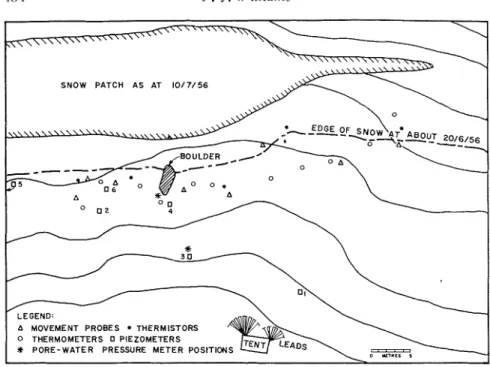
Six resistance thermometers consisting of glass-encased thermistors built into simple probes of 1 to 2 meters lengtll were placed at various depths in
A. Site of tlie solifluction i n v e s t i g a t i o ~ ~ s drscrihed. (photo: D.R.M. Lillistotlc)
B. The leads from t h ~ tllermistors and soil movement prol~es were r u n to the tent seen a t riglit center left, ( p l ~ o t o : Kari Williams)
AIL lnvestigntion into Processes Occz~rrirzg irz Soli/lz~ctiorz 4183
P L A T E A U
7
FROZEN S O I L 1 APPROX L I M I T S ONLY 1 7 N O T O E T E R M I N E O OF P O R E WATER PRESSURE ---
A N 0 SOIL M O V E M E N T APPROX L I N E O F S O I L SURFACE O E T E R M I N A T I O N S 4-
+-.bSSUUEO D I R E C T I O N O F SHEAR
I Fig. 1. Sectior~ tl ~ r o u g l ~ slope s l ~ o w i ~ ~ g site illvestigated, late June col~ditiol~. The ex- ternal soil and sl~ow surface is a true protile surveyed by Abney level, ahout J u n e 20, 1957. 1'11(: other data are hased or1 variol~s o l ~ s e r r a t i o ~ ~ s ill 1956-1957.
holes drilled in the still-frozen slope (fig. 2 ) . Eigh,teen mercury soil tempera- ture thermometers were placed a t various positions u p to 4'0 centimeters deep in the soil. Rejults of the temperature recordings were limited I ~ u t together with some probing, the general shape of the still-frozen soil mass was estab- lishecl (see fig. 1 ) . T h e temperature of the still-frozen layer was virtually con- stant throughout (the thermistor probe sensitivity being aboul
-+
0.05OC).The snow accumulates in the winlrr because of wind hlowing it from the plateau at the lop of the slope. T h i s plateau was o1)served to be free of snow in hlarch, and the presence of stony earlh circles-a form of patterned ground developing only where thcre i s n o snow colrer-(Williams, in press) verify its geiieral absence here.
INVESTIGATIONS I N T O F ZCTORS INFLUENCING S O I L ST:\BILITY
Theoreticc~l bnc1cgrou1zd.-General explanations of solifluction involving concepts such a s "luhrication of soil particles b y water" are incomplete and often misleading. Terzaghi ( 1 9 5 0 ) citing Hardy ( 1 9 1 9 ) points out t h a t water acling on quartz is not a lubricant. The study of processes in solifluclion phenomena is a study of soil mechanics, and such special conditions a r e met wilh under freezing and hawing as to demand investigation of m a n y basic soil properties.
According to soil mechanics theory, movement i n soil occurs when the forces tending to produce shear (shear stress) exceed the strength of the soil (its resistance to s h e a r ) . T h e latter i s assumed to consist of two components, lhat due t o internal friction a n d that due to cohesion. Cohesion i n soils i s ascribed severally to the properlies of the adsorbed water in close proximity with the soil grains, the mutual a'ttraction of particles, a grain structure in- herent in clay soils, apparent cohesion which i s due to the capillary forces in the pore-water i n unsaturated soil, etc. According t o the work of Bjerrum (1954), based on that of Hvorslev (1937) a n d others, in saturated soils the
4184
P.
J.
WilliamsFig. 2. M a p of i n s t ~ u m e n t layout on s o l i f l ~ ~ c t i o n slope below late-lying snow (drawn from compass slIl\.ey and field s k r t r h r s ) . C o n t o ~ ~ r i~~tc.~val--2 m.
magnitude o l cohesion is tlependen~ on water content a n d therefore on void vol. voids
ratio = T h e internal friction developed depends on the pres-
vol. solid
sure a t the intergranular contacts, F. which varies with
U,,,
the pore-water pressure, according to the relations F = a -U ,
where u i s the total weight ofwet soil a l ~ o v e . Pore-water pressure, therefore. also directly affects soil strength.
Soil movement.-Soil movemen1 was rerordecl directly b y thr use of
special electrical probes descril)ed I d l y elsewhere (Williams, 1 9 5 7 b ) . Move- men1 was also apparent through visil~le distortion of he probes ancl tliermistor probes. I n a n y one pear, soil movemenl o n the slope is largely reslricted to several patches oC a lelv s q u a r e meters i n area, although a l a r g e par1 of the slope is in a n unstal>le condition. Maximum surlace movement during tlie spring o l 1956 was aboul 2 5 centimeters downslope. It i s not possible to clis- t i n g ~ ~ i s h those parts actively moving. escepl 1)y repeated observations. T h e movements occur at 1)rogressively grealer depth as the season advances, a n d to a depth o l at least 7 5 centimeters. At a n y given position, movements occur gradually, taking place over several weeks during the spring. Other than up- slope from the snow patch, no distinct shear planes were visible. The move- ments recorded showed no regular or periodic varialions o l a diurnal o r similar nature.
Effect of snow patch.-The late-lying snow patch i n s u m m e r to some ex-
tent loads t h e slope, and the possibility of this increasing the shear stress must be considered. The initial solifluction movements will tend LO remove this in-
crenlent of 111e shear stress from he soil clownslope of the snow (see fig. 1 ) . It will only persial or b e reapplied if there is also downslope m o l e m e n t of the still-frozen soil, whicli is ulilikcly. In other words, the weight of he snow patch is s rob ably s u p ~ ) o ~ ~ e c l a l ~ n o s ~ entirely by h e slill-frozen soil a1 least after the inilia1 soil movemenls have occurred a n d has, therefore, liltle significance in causir~g rnovemenl. T h c movemenl is also substanlially independelit of the size of he slio~v palch whicli is sleaclily decreasing during thaw. T h e eflects of the snow ill cauair~g movement a r e probably indirect.
I'ore-wa~er prewcre de~ermir~c~~ior~s.-Pore-watcr pressure was deler- mined at localions in the slope (fig. 2 ) wilh piezometers using simple mercury marlometers a t l a c l ~ e d to lengths of brass ~ u l ) i n g with a n internal diameter of a l ) o u ~ 7 mm, whose lower ends were a1 a clepth of 5 0 to 115 cm. T h e brass ~u1)e was pushed into d ~ e thawed soil ( i n two cases, partially inlo holes drilled into s~ill-frozen soil) while a rod was held in position inside the tube to pre- \en1 the enlry of mud. Before attaching the filled manometer, the tube was filled wfth boiled water. Dificulty was experienced because of the rapid drain- age from the tube into the soil. An electrical apparatus was also used, ancl confirmed the general nature of the pore-water pressures, although being f a r less sensitive.
Since water could be seen on he soil surface around m o d of the tubes ancl h e soil was apparenlly saturated, it would be expected that the pressure oC waler ( i n cenlimelers of water) in the soil a t any deplh w o d d equal ap- p r o \ i m a ~ e l y he depth Lo which the tubes wcle inserled, at leas1 a1 [hose points.
If complele drainage of elcess waler (above saturation point) did not occur, il mighl 1)c grealer than this. This latler col~dition (hyclroslatic eacess pressnre it1 soil mcchal~ica ~erminology) follows ~11e ~ r a n s f e r of some par1 of he weight of mineral soil to tlie enlrapped pole-waler. A s explained above he grealer
lie pore-water pressuie, the smaller he component of soil strenglh clue LO in-
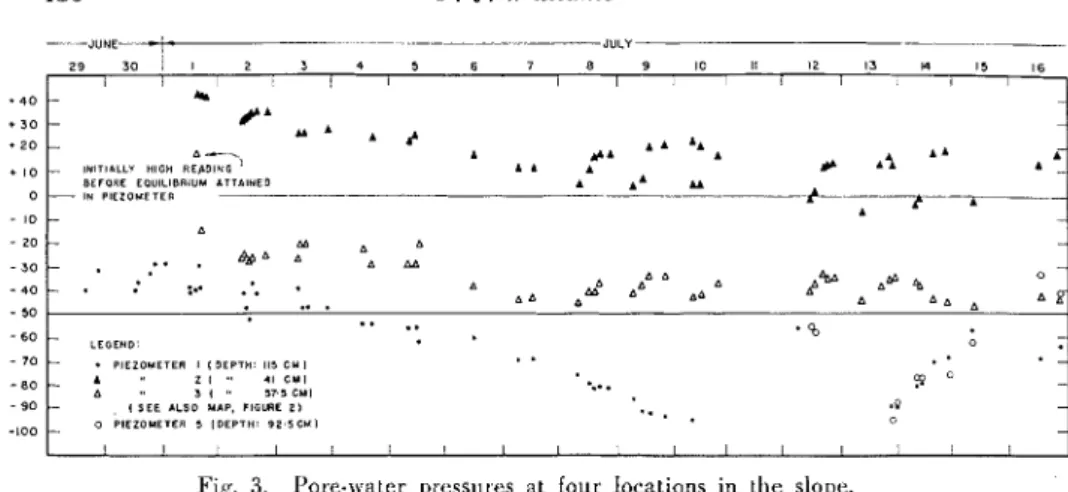
ternal friction. T h c pressures found, however, wele considerably lower than expec~ed, vaij-ing between -103 c m of water at 90 cm clep~h (sub-atmospheric pressures being expressed as negative) to +4bl cm of water a t 44 cm depth. Al,out 250 readings, well distributed between these extremes, were taken at seven points, at intervals of half to several hours for periods up to three weeks.
r 7
l l i e lowest pressures (i.e. with the numerically highest, negative value) were recordecl from depths in the proximity of the boundary between the thawed and frozen soil; surface water was also visible at these locations. Rhythmic diurnal changes of about 1 0 cm of water pressure were commollly observed. A gladual trend tolvarcls a rni~iimum pressure ancl a subsequent rise was ob- servecl at mosl points during tlie three weeks, the total range a t a single point being n b o u ~ 3 0 to 6 0 ctm (see fig. 3 ; a i r Lemperatures for the period a r e shown ill Willianls, 1957b, fig. 3 ) . Sexera1 more weeks elapsed before the soil had rcdchcd iLs clrieal summer collclilio~~. There was IIO clear relationship of pres-
sure v a r i a ~ i o n s lo rainfall.
These u ~ ~ e ~ p e c t e d o~bservations a r e of co~isiderable significa~ice a n d their causes are cliscussed below. ' h e resulLing effects a r e not easily interpreted. I n general, lower pressures give greater strengrh b y increasing internal friction,
- --JUNE-- , . ~~ JULY- -- 2 9 3 0 , 1 2 3 4 5 6 7 8 9 10 !I 12 13 14 15 1 6 8 / 1 1 ! I I I I I 1 I I I I - Z - ..A
,
', - - A-
+ A A A A' - _. I H I T I I \ L L I H I G H R E A D I N ? A*
A% " A A A I A _ BLFOriL EQUILIBRIUM L T T A I H F D - IH P I C I O Y E T L R A .A Y ---,
)--T-- - - - - - -. . .. .
6 " A A u " ' n gh A Abb B-
.
::.
. .
. ..
.
A h A A& A X A d d.-
..
-.
-
' 0 L E G T H O.
.
-.
P I E Z O Y E T E R I I DEPTH II3 C Y I. .
- A " Z 1 . I * I C Y 1 d 11 3 1 , , 3 7 3 C Y I-..
.
9 - I S E E A L S O Y I P . fIGLRE 2 1..
. .
P - 0 P I E Z O U E T E R I IO L P T H 9 2 l C Y 1 - - ! I 1 1 ! t I 1 I I l l I l l IFig. 3. I'ore-water pressures at four Iocations in the slope.
(see Aitchison. 1 9 5 7 ) , so thal the spring condition is to b e interpreted as olie of relatively high pore-water pressures.
I t is often tacitly assumed that, in thawing of soil where considerable water accumulation has occurred a t freezing, condictions of hydrostatic excess pressure. or a t least a significant positive pressure, will arise generally and contribute in considerable measure to the instability. This is shown not to be the case. I t is particularly tempting to helieve that spontaneous liquefaction might occur (Terzaghi, 1950) where there is a sudden collapse o r settlement of the soil grains with a transfer of a considerable part of their weight to the pore-water. However, failure to detect such high pore-water pressures in this slope indicates this to be of little significance in causing movement.
Frost heave.-Soils within the fine-sand-clay range, provided that suffi-
cient water is available, show expansion a t freezing several times greater thail could be explained on t h e basis of the conversion to ice of 'the initial water content. T h e subject of much recent research, rhis expansion is due to accumu- lation of water during freezing, producing discrete ice layers, o r individual crystals a n d masses which a r e often, but not always, visible to t h e naked eye (see for example, Beskow, 1 9 3 5 ; Johnson, 1 9 5 2 ) . Such accumulation occurs a s long a s there is a suficient supply of tvater available i n 'the soil. The exact relation of frost heave to water availability i s not fully understood but substan- tial heave occurs i n he zone of capillary saturation. Recent work shows that heave may be caused by migration of water in soils that a r e only partly satu- rated (Penner, 1 9 5 6 ) . Most tlieories of frost heave attach great significance to the observed depression of the freezing point in soils ~ h i c h is generally sup- posed LO be 1.elatec1 to a consiclerable exlent to effects of the surface forces of
the parlicles, and hence LO pore size.
E x p a n s i o ~ l per uniL volurrle of the soil on this slope was calculated fro111 density (grns. wet soil per cc) clete~nlined on soil sanlples from a depth of 5 to 2 0 cm. Using a modifiecl form of rhe sand replacement method (West, 1953) cleterminations were m a d e in the field i n the spring (still-frozen a n d newly-thawed condition) a n d late summer, spread over two week periods. S u b - sequently, water contents were determined i n the laboratory, permitting cal- culation of in, situ d r y densities (grams of mineral and o r g a n i c soil per cc).
r 3
I h e ratio of a l e r a g e d r y density f o r the spring serics to that l o r the late sum-
lrler serics gives the contraction occurring d u r i n g he sunlnler, a n d i s hellce
d measure of exl)al~sioli due to frost Ilea\ c.
Since the soil is heterogetleous, analysis of a 11um1)er of sainples from
Loth pcriotls is necessary. A maximum error of 6 percell1 is assumed possible
irl a single determillation. The observatiorls a r e summarized i n the following
table :
Avcragc Avcrilgc Avcrage
Wet Dcr~sity Dry Density Water C o ~ l t c ~ l t
No. of (grams wet (grams dry (grams water
D e t c r n ~ i ~ ~ a ~ i o ~ ~ s soil per cc) soil per c c ) I J ( : ~ cc wet soil)
~- . .. . - Year: 1956 Spring 14 1.37 0.37* -- - 1.74 - - Late Summer 13 1.74 Late S u n ~ ~ u c r 7 1.77 1.52 0.25 I - -
Tllc low \vator c o ~ l t c ~ ~ t s rcsult from sclc:c.ti~rg soulc si~mples from tllc thazued soil, whicl~ had to bc sullicic~~tly drained lo permit use of the s;u~tl rcplaccrnent method.
The following conclusions can be drawn:
( a ) Frosl h e a \ e occurs ill this slopc. This is sho~vrl by the significantly cliflercllt a l e r a g e values for s p r i n g a n d late summer tlry clelisities a n d l y the occasiollal olservatiorl of ice layers in the frozen soil. Tlle slope is rather dry ill late summer but the iiicomplele drailiage d u e to a frozen layer a t some centimeters depth d u r i n g a u t u m n freeze-thaw cycles, of rain or melt water liberated from early snow on the slope, map provide a source of water for the ice formation a n d frost heave.
(11) I t is also established statistically that the heaved condition persists
illto the newly thawed state. A significance test o n the difference between dry
dcllsity i n the spring (thawed soils only) and late summer of 1957, was based on the following data:
11
= saiilples =2 (average)
,
S
(saniple variaticc)Spring Late S u m m e r
7 7 (total samples takell)
1.32 1.52
0.0f1'51 0.0188
7 7
I l l c riulilber of salnples, l ~ o ~ i e v t r . is insuflcielit to clcrite a value for the per- cellla6.e expatisioll with any certainty.
( c ) Tlle it1 sitlc wet tlellsities ( u n i t ~ o l u r n c wcigllt) for spring a n d late
sunlriier periods a r e l e r y similar. I t is often statcd that increased water con- tent increases the likelihood of molement, because its weight a d d s to the sliear- i n g stress. In this case of heavcd soil, there is little general increase in soil \vciglit during the thaw period.
4 8
P.
J .
Williams(d) In spite of the high water content, air filled some of the voids.' This was shown by specific weight determinations made on solid masterial Irom many of the Irosen samples, enabling calculation of volume of voids per unit volume of soil. 'f'he labter is compared with water (ice) content.
An increase in the void ratio has several results in the thawed soil. Per- meability is increased substantially; for example, Taylor (1948, p. 116) cites
a 15 percent increase in void ratio of a cohesive soil, which increased perme- I
ability by ten times. Where ice-layer f o r m a t i o ~ ~ has occurred, the increase in permeability is likely to be primarily in a direction parallel to the ice layers, and hence parallel to &c surface. It is not possible to get a quantitative value of permeability changes from calculations ol void ratio in this case.
EFFECTS OF FROST HEAVE ON PORE-WATER PRESSURE AT THAW That this increased permeability persists after thawing (although to an unknown degree) and is effective in a diredion likely to be followed by melt water flow, partly explains the unexpectedly low pore-water pressures observed in this slope. Consolidation of ,the soil (the packing closer of grains) and liberation of water by thawing takes place only slowly and drainage of the water occurs sufficiently rapidly lor pore-water pressures io remain low. Entry of air or surface water which would dissipate negative pressures is thought to he prevented because of the low permeability assumed to e x i s normal to the surface and the partial closure of capillaries by the snow mass or frozen soil higher up the slope.
A
funther explanation is supported '11y the work of Nersessova, as de- scribed by Tsytovich (1957). In her laboratory experiments, she found thaw-ing of soil takes place progrmsively as the temperature approach- O°C. Water
is liberated aocording ro temperature and
he
manner in which it is held in the soil, the most firmly held (bound) water thawing aft the lowest tempera- ture. The percentage of nnlrozen water at a given negative temperature also varies with grain size composition.Obviously the most firmly held water is that least likely to drain, but ac- cording to Tsytovich (1947) migrations of unfrozen water in frozen soil occur. The writer suggests that during the several weeks when the frozen layer in this slope has a temperature approaching O°C it has a definite permeability, so that some drainage occurs over a long period prior to complete thaw. This will tend to lower the pressure in the water. It is well known that suh- atmospheric pore-water pressures are developed in the soil below the frozen layer, during freezing (see Penner, 1956). Water may then be drawn down from the frozen layer during partial thawing. The pressures may be further lowered hy the volume decrease of the water (ice) taking place on the melting of some of the ice, wllile the expanded (heaved condition) of the soil is main- tained by ale longest remaining ice structures. These effects are likely to he accentuated by the hcterogeneoos nature of the soil and the range of pore sizes present. The existence of sub-atmospheric pressures in the unfrozen water of frozen soils was pointed out by Lovell (1957), and it is probable that these persist Irom the time when freezing occurred. To what extent the low pore-
'
The term "void'' includes all pores filled cither with water or air.An Inuestigation inlo Processes Occurring in Soliflwtwn 439
water pressures observed should he related to each of these possible causes is not clear.
During the most active thaw period, therefore, the soil is in a unique condition. The water content is extremely high, and far above the normal saturation level, hut because of phenomena associated with the thawing and frost-heaved soil, the pore-water is under low or suh-atmospheric pressures in much of the soil. Relatively high pnre-water pressures must occur near the surface where water flows over it, and necessarily where upward flow is evi. denced hy soil particles washed out from the soil (see below).
EFFECT OF FROST HEAVE ON COHESIVE STRENGTH
The distribution of void space is unusual in .thawing soils. It is clear that the numerous planes of discontinuity left by ice layers and the disruption caused by small ice masses and crystals represent a very severe disturbance and a n increase in void ratio, that would greatly reduce cohesion phenomena. The complex phenomenon of strength loss following frost heave is as yet little studied.
It
is also possithle, for example, that the desiccation of clay layers he- tween discrete ice layers caused by the suction of the developing layer pro. duces high shearing strengths within these layers (because of the extremely low pore-water pressures), but in most cases, the effect of such strength in- creases must be Iar outweighedby
the loss of strength due to discontinuities in the soil mass.Melt-water flow.-The evidence lor high permeahili'ty introduces the
possihility of melt-water flow within the slope omurring with emugh speed as to introduce considerable movement of soil grains. Fine sand and silt particles were also observed being carried downslope in surface water.
GENERAL CONCLUSIOKS
Solifluction of this type cannot he considered analogous to soil failures due solely to increase in water content over an impermeable layer.
1. The pore-water pressures in the thaswed layer are generally far lower than would occur, could the soil he saturated to sthe same degree in an un- heaved condition.
This results partly from the drainage and void ratio characteristics of the soil in the newly thawed condition; tensions are also characteristic of unlrozen water existing in the frozen layer.
2. A considerable part of the loss of strength at thaw in frost-heaved soil is due to the reduction in bhe cohesion component following the separation of particles by frost heave.
3. The shear stresses are not increased proportionately ,to toe weight of excess water present under thawing conditions, since this is counteracted by the decreased dry density of rhe soil.
RLI+EBENCES
Aitehison, G. D., 1957, 1l1c strength of quasi-saturated ilnd ~rl~ilturailled oil^ in miation to the pressure deficiency in the pore.water: Fourth Jnternat. Coni. Soil Mech. Found. Eng. Proc., Loadon, p. 135.139.
Beskow, G., 1935, Tjiibildningen oeh Tjillyftningen (with English summary) : Sver. Geol. 'Unders., ser. C., no. 375, Stockholm, 242 p. Also available translated-Soil freezing and frost heaving, with special application to roads and railroads: Northwesteln Univ., Evan~ton, Illinois, 1947.
490
P. J .
WilliamsBjcrrum, L., 1954, Theoretical and experimental investigations on the shear strength 01 sods: Norrvegian Geotech. Inst., Pub!. no. 5, Oslo, 113 p.
Det Norske Meteorologlske Institutt. Arsbok, 1949-1955 (modified average vaiucs for Yokstua).
Hardy, W. B. and Hardy, T. V., 1919, Note on static Irietion and on the lubricating proper- ties of certain chemical substances: Philos. Mag., London, v. 39, no. 223, p. 32-35. Huorslev, M. J., 1937, Uber die Festigkeitseigensehaften gestiirter bindiger Boden: In-
geni#midenskabelige Skrifter A, Nr. 45, K6benhavn.
Johnson. A. W.. 1952. Frost action in roads and ailbelds-a review of tho literature: High-
way Reseaich Board, Special Report no. 1,287 p.
Lovell, C. W., Jr., 1957, Temperature effects on phaso composition and strcngth of par- tially-frozen soil: Highway Research Board, Bull. 168, Fundamental and practical con- cepts of soil freezing, p. 74-95.
Penner, E., 1956, Soil moisture movement during ice segregation: Building Research, Nat. Research Council, Res. Paper no. 32, Reprinted from Highway Research Board Bull. 135, p. 109-118.
Sti#m, Kaare, 1952, Landskap og Istider: Norsk Turistforenings Arb., p. 48-52, Taylor, D. W., 1948, Fundamentals of soil mechanics: John Wiley, New York, 700 p. Terzaehi. K.. 1950, Mechanism of landslides: Eng. Geol. Berkey v., Geal. Sac. America,
py 83.123.
Tsytovich, N. A,, 1957, The iundameetals of frozen ground mechanics (new investiga- lions) : Fourth Internat. Conf. Soil Meeh. Found. Eng. Proc., London, p. 116-119. Tsytovich, N. A., 1947, The unfrozen watcr in pomus strata: Izveatia of Academy of S o i ~
ences, Geol. Ser. no. 3, p. 39-48.
West, L., 1953, Determination of the dry density of compacted layers of coarse granular materials: Surveyor, London, v. 112 (3205), p. 531-532.
Williams, P. J., 19'57a, Some investigations into solifluction features in Noway: Geog.
Jour., u. 123, pt. 1, p. 42-58.
, 1957b, l'he direct recording of salifluction movements: AM. Jom. SCI., v. 255, p. 705-714.
, in press, The development and significance of stony earth circles.
Williams, P. J., et al., 1957, N.E.AT.: Second report of investigations into cerlain solifluc- lion and patterned ground fealures in Norway: Oslo, Bihliotekkontorot, Universitet, Blindem, 41 p. (eyclostyled and privately distributed).