C E N T R E D' ÉT U D E S E T D E R E C H E R C H E S S U R L E D E V E L O P P E M E N T I N T E R N A T I O N A L
SÉRIE ÉTUDES ET DOCUMENTS
Can fiscal rules curb income inequality? Evidence from developing countries
Jean-Louis Combes
Alexandru Minea
Pegdéwendé Nestor Sawadogo
Cezara Vinturis
Études et Documents n° 25
December 2019
[First version: March 2019 ; This version: revised December 2019]
To cite this document:
Combes J.-L., Minea A., Sawadogo P. N., Vinturis C. (2019) “Can fiscal rules curb income
inequality? Evidence from developing countries”, Études et Documents, n° 25, CERDI.
CERDI POLE TERTIAIRE 26 AVENUE LÉON BLUM F-63000 CLERMONT FERRAND TEL.+33473177400 FAX +33473177428 http://cerdi.uca.fr/
2
The authorsJean-Louis Combes
Université Clermont Auvergne, CNRS, CERDI, F-63000 Clermont-Ferrand, France.
Email address: [email protected]
Alexandru Minea
Université Clermont Auvergne, CNRS, CERDI, F-63000 Clermont-Ferrand, France, and Department of Economics, Carleton University, Canada.
Email address: [email protected]
Pegdéwendé Nestor Sawadogo
Université Clermont Auvergne, CNRS, CERDI, F-63000 Clermont-Ferrand, France.
Email address: [email protected]
Cezara Vinturis
Université Clermont Auvergne, CNRS, CERDI, F-63000 Clermont-Ferrand, France, and West University of Timisoara, Romania.
Email address: [email protected]
Corresponding author: Alexandru Minea
Études et Documents are available online at: https://cerdi.uca.fr/etudes-et-documents/
Director of Publication: Grégoire Rota-Graziosi
Editor: Catherine Araujo-Bonjean
Publisher: Mariannick Cornec
ISSN: 2114 - 7957
Disclaimer:
Études et Documents is a working papers series. Working Papers are not refereed, they constitute
research in progress. Responsibility for the contents and opinions expressed in the working papers rests solely with the authors. Comments and suggestions are welcome and should be addressed to the authors.
3
Abstract
Despite a large literature linking fiscal policy and income inequality (IQ), the relationship
between fiscal rules (FR) and IQ is severely underexplored. In a large panel of developing
countries, propensity score matching estimations reveal that countries that adopted FR
experience a significant decrease in their IQ with respect to countries that did not.
Economically meaningful, this favorable effect is robust to a wide set of alternative
measurement, methodology, and modeling specifications. Moreover, we unveil significant
differences among FR: balanced budget and debt rules robustly decrease IQ, contrary to
expenditure rules that increase it. Finally, the effect of FR on IQ is subject to heterogeneity
related to structural factors. Given the current global IQ trends, our results showing that the
FR are not neutral for IQ may provide insightful evidence for governments of countries aiming
at adopting FR.
Keywords
Fiscal rules, Income inequality, Developing countries, Impact analysis.
JEL Codes
I. Introduction
Income inequality (IQ) trends are periodically scrutinized by economists (see e.g. Anand and
Segal, 2008; Piketty, 2014; Alvaredo et al., 2017), probably due to the large consequences of
IQ—see e.g. Wilkinson and Pickett (2009) The Spirit Level: Why More Equal Societies
Almost Always Do Better?, Stiglitz (2012) The Price of Inequality: How Today’s Divided
Society Endangers Our Future, or Atkinson (2015) Inequality: What Can Be Done?. From a
macroeconomic perspective, the literature devoted to IQ focuses on mainly three issues.
A first strand of literature, capitalizing on the pioneering work of Kuznets (1955),
looks at the determinants of IQ; prominent determinants include international factors, such as
globalization or trade (e.g. Dollar and Kraay, 2004; Goldberg and Pavcnik, 2007; Dreher and
Gaston, 2008; Ezcurra and Rodriguez-Pose, 2013; Kanbur, 2015), financial factors (e.g.
Claessens and Perotti, 2007; Demirguc-Kunt and Levine, 2009; Kim and Lin, 2011),
technological change (e.g. Galor and Moav, 2000; Acemoglu, 2002; Jovanovic, 2009),
institutions (e.g. Chong and Gradstein, 2007; Acemoglu et al., 2015; Lin and Fu, 2016),
inflation (e.g. Romer and Romer, 1999; Bulir, 2001; Albanesi, 2007); or natural resources
(e.g. Gylfason and Zoega, 2002; Fum and Hodler, 2010; Parcero and Papyrakis, 2016).
Second, IQ is regularly pointed out as a major source of various macroeconomic
imbalances; for example, IQ is found to reduce economic growth
1(e.g. Alesina and Rodrik,
1994; Persson and Tabellini, 1994; Ostry et al., 2014; Berg et al., 2018; and possibly
contribute to the secular stagnation, see Auclert and Rognlie, 2018) or the quality of the
institutions (Alesina and Perotti, 1996), to increase inflation (Beetsma and van der Ploeg,
1996) and poverty (Ravallion, 1997), and to contribute to underdevelopment (Easterly, 2007)
and even crises, including the recent Great Recession (Rajan, 2010; Reich, 2010).
Third, given these detrimental effects, a wide variety of policies were imagined to
bring down IQ. Such policies may be related with e.g. trade (UNCTAD, 2019), FDI (Figini
and Gorg, 2011), human capital (Goldin and Katz, 2009), finance (Brei et al., 2018),
technology (UNESCAP, 2018, chapter 4), or the labor market (Berg, 2015).
Belonging to the latter strand of literature, this paper asks the following question: can
fiscal rules (FR) curb income inequality (IQ)?
2Such a question is legitimate since FR affect
1 However, some early 2000s studies reported that IQ may sometimes increase growth (e.g. Forbes, 2000).
2 Nowadays, FR—defined as permanent constraints on fiscal policy, expressed in terms of a summary indicator
of fiscal performance (Kopits and Symansky, 1998)—became a popular tool for conducting fiscal policy (in more than 90 countries according to the 2015 IMF Fiscal Rules Dataset), despite a certain lack of consensus regarding their macroeconomic performances, with mostly pros—FR may e.g. improve fiscal discipline (Debrun et al., 2008), make fiscal policy more countercyclical (Combes et al., 2017), or reduce inflation (Combes et al.,
various dimensions of the fiscal policy, which received by far the greatest attention among all
policies aiming at reducing IQ both from international institutions (e.g. OECD, 2015, chapters
3 and 7; or IMF, 2017) and academia—for recent surveys, see e.g. Bastagli et al. (2012),
Heshmati and Kim (2014), Clements et al. (2015), or Anderson et al. (2017). In light of this
literature, the potential effect of FR on IQ can transit through at least three channels.
First, and most importantly, by affecting the fiscal balance (e.g. Debrun et al., 2008;
Tapsoba, 2012; Combes et al., 2018), FR most likely influence both government spending and
revenues. While more recently e.g. Joumard et al. (2012), Martinez-Vazquez et al. (2012), or
Higgins and Lustig (2016) discuss the effect of taxes on IQ, the meta-analysis of Anderson et
al. (2017) performed on 84 studies reports mitigated findings for the government spending-IQ
link: while total government spending present a moderate positive relationship with IQ, some
types of government spending, including social or consumption spending, present a moderate
negative relationship with IQ.
Second, following the Great Recession many countries enacted FR together with fiscal
consolidation programs, in accordance with previous evidence supporting a key role of FR for
fiscal consolidations (e.g. Guichard et al., 2007). In turn, recent studies suggest that fiscal
consolidations may be associated with higher IQ particularly when based on spending cuts
(e.g. Ball et al., 2013; Woo et al., 2013; Agnello and Sousa, 2014), while the opposite may
arise for tax-based fiscal consolidations (Ciminelli et al., 2019).
Third, by affecting in particular fiscal policy cyclicality (e.g. Debrun et. al. 2008;
Bova et al., 2014; Combes et al., 2017; Guerguil et. al., 2017) and government borrowing
costs (e.g. Badinger and Reuter, 2017; Thornton and Vasilakis, 2018), FR are likely to
influence fiscal policy equally in the medium-run, for example in terms of public debt
dynamics and fiscal policy credibility. In turn, credibility may affect IQ for example through
capital flows (Jaumotte et al., 2013), while there seems to be a positive link between public
debt and IQ, particularly in OECD (e.g. Azzimonti et al., 2014; Arawatari and Ono, 2017).
To explore the relationship between FR and IQ, we draw upon the propensity
scores-matching (PSM) method that properly overcomes the selection bias related with the adoption
of FR.
3We aim at estimating potential differences in IQ between countries that adopted FR
and that did not adopt FR but present a comparable probability of adopting FR conditional on
a set of covariates, i.e. comparable propensity scores (Rosenbaum and Rubin, 1983).
3 Initially employed in macroeconomics to analyze inflation targeting adoption (e.g. Lin and Ye, 2007; Minea
Our analysis conducted on wide panel of 84 developing countries over the period
1990-2015 reveals the following. First, countries that adopted FR experience a significant
decrease in their IQ with respect to comparable countries that did not adopt FR. All the more
that IQ is most likely not the primary goal that motivates the adoption of FR, this favorable
effect is economically meaningful as it ranges between 18% and 30% of the standard
deviation of our measure of IQ. The strength of our finding is confirmed by a rich robustness
analysis that includes an alternative IQ measure, additional control variables, the entropy
balancing method as an alternative to the PSM method, or different samples—and in
particular the inclusion of developed countries.
Second, since not all FR are alike, we explore possible heterogeneities in their effect
on IQ. On the one hand, we find that contrary to the favorable effect of balanced budget rules
(BBR) and debt rules (DR) on IQ, the presence of expenditure rules (ER) strongly increases
IQ; a possible explanation is related to the fact that ER may constrain government expenditure
(e.g. Tapsoba, 2012; Dahan and Strawczinski, 2013), including spending that may contribute
to reduce IQ. On the other hand, when combining these rules two by two, we reveal
complementarities in the favorable effect of BBR and DR on IQ, as well as a neutralization of
the unfavorable effect of ER on IQ in the presence of BBR or DR.
Third, switching to the control function regression method, we explore possible
heterogeneities driven by various economic and structural factors in the relationship between
FR and IQ. On the one hand, considering FR altogether, we reveal that the favorable effect of
FR alone on IQ can be amplified in a context of deteriorated fiscal space (for example, a
higher public debt); when combined with FR, higher trade further supports the favorable
effect of FR on IQ; better political stability reduces IQ when combined with FR; and that
education (economic growth or mineral rents) reduces (increase) IQ when combined with FR.
On the other hand, combining various FR and various economic and structural variables
reveals additional heterogeneities. Compared with findings for all FR, the interactive effect
may become significant or—on the contrary—turn into not significant; the interactive effect
of some variables may differ across the various types of FR; and some variables may weaken
the unfavorable effect of ER on IQ illustrated in the benchmark estimations.
Consequently, in light of our analysis, the adoption of FR mostly reduces IQ.
However, not only the magnitude of this effect may vary with the precise type of FR, but
some FR—and in particular ER—are found to significantly increase IQ. In addition, the
effect of various types of FR on IQ may be subject to important heterogeneities, related to a
wide set of fiscal, monetary, international, political, or structural factors. Given the
importance of IQ in developing countries and its upward trend in many advanced countries
(see e.g. IMF, 2017), our results showing not only that FR are not neutral for IQ, but also
identifying cases in which various FR may curb or on the contrary increase IQ, may provide
insightful evidence for governments aiming at adopting FR.
The paper is organized as follows. Section 2 presents the data and the methodology,
section 3 reports our main results, section 4 assesses their robustness, section 5 investigates
the impact of various types of FR on IQ, section 6 explores heterogeneities in the effect of FR
on IQ related with various economic and structural factors, and section 7 concludes.
II. Data and methodology
2.1. Data
We explore the effect of FR on IQ using a yearly panel of 84 developing countries over the
period 1990-2015, selected mainly on two grounds. On the one hand, in the developing world
the presence of trustworthy fiscal data begins in the 1990s. On the other hand, to ensure the
comparability between the groups of FR and non-FR countries, i.e. for the control group to be
a good counterfactual for the treatment group, we exclude from the group of non-FR countries
those with a real per capita GDP lower than that of the poorest FR country, and a smaller
population than that of the smallest FR country.
Our main variables are IQ and FR. Following previous studies (e.g. Afesorgbor and
Mahadevan, 2016), we measure IQ by the Gini index of the disposable net income extracted
from the Standardized World Income Inequality Database (SWIID) developed by Solt (2016),
which provides comparable data across countries. We capture FR by a dummy variable equal
to 1 if for a given country in a given year a fiscal rule is at work and to 0 otherwise, using the
IMF Fiscal Rules Dataset. Appendix A in the Online Supplementary Material presents the list
of countries and the year of FR adoption.
2.2. Methodology
The presentation of the methodology is standard, and follows the existing work (e.g. Lin and
Ye, 2007; Tapsoba, 2012). The average treatment effect of the treated (ATT) equals the
average difference between IQ in countries that adopted FR (
FR
=
1
), namely
IQ
1, and the
IQ they would have had in the absence of FR, namely
IQ
0(
)
1−
0=
1
=
1=
1
−
0=
1
=
E
IQ
iIQ
iFR
iE
IQ
iFR
iE
IQ
iFR
iUnfortunately, the latter term is not observable, and a solution would be to simply compare
the average IQ in countries that adopted FR and countries that did not. However, this would
lead to biased results, given that the adoption of FR (i.e. the treatment) is most likely not
random but correlated with a set of observable variables that may equally affect IQ (i.e. the
“self-section” problem, see e.g. Heckman et al., 1998, and Dehejia and Wahba, 2002).
Instead, under the conditional independence assumption (namely, conditional to a set of
observed variables
X ,
IQ
1and
IQ
0are independent of the FR adoption), we can replace the
last term of (1) by the IQ in countries that did not adopt FR but present comparable values of
the variables
X
IQ
iFR
iX
i
E
IQ
iFR
iX
i
E
ATT
=
1=
1
,
−
0=
0
,
.
(2)
Although the last term of (2) is observable, matching countries on a large set of variables
could raise practical issues. Therefore, we follow Rosenbaum and Rubin (1983), and
concentrate the information from set
X into the variable
p
Xi=
Pr
FR
i=
1
X
i
, which
provides, conditional on the set
X , the probability of adopting FR. Assuming, for each
country that adopted FR, the existence of comparable countries that did not adopt FR (i.e. the
common support assumption), the ATT finally rewrites as
IQ
iFR
ip
Xi
E
IQ
iFR
ip
Xi
E
ATT
=
1=
1
,
−
0=
0
,
.
(3)
When estimating (3), we follow the existing literature (e.g. Lin and Ye 2007; Minea &
Tapsoba, 2014), and draw upon a large variety of propensity scores-matching methods.
III. Results
3.1. The estimation of the propensity scores
We estimate the propensity scores using a probit model with the FR dummy as the dependent
variable. To account for macroeconomic and political factors related to the adoption of FR,
we draw upon the existing literature on FR (e.g. Debrun and Kumar, 2007; Tapsoba, 2012;
Combes et al., 2017; or Eyraud et al., 2018), and use a wide range of control variables (see
Appendix A for the description and sources of variables, and for descriptive statistics).
First, since FR are most likely to be introduced in countries with good macroeconomic
performances (e.g. IMF, 2009; Tapsoba, 2012), higher economic growth (measured by the
real GDP per capita growth) is expected to increase the probability of FR adoption. Although
the same may hold for external debt (in ratio of GDP), FR may equally be adopted to stabilize
a large indebtedness, making uncertain the overall effect of debt on the likelihood of FR
adoption. Second, given their higher demand for social spending, countries with higher
population dependency ratio will have a lower likelihood of FR adoption, facing more
difficulties to introduce fiscal discipline (Calderón and Schmidt-Hebbel, 2008). Third, as
emphasized by e.g. Kose et al. (2009), a larger capital openness (that we measure using the
Chinn and Ito, 2008, index) fosters a more efficient allocation of capital, which may stimulate
economic growth and constitute a prerequisite for the adoption of FR. Fourth, since the
adoption of inflation targeting often went along with the establishment of FR and other fiscal
reforms (e.g. fiscal responsibility laws, fiscal transparency, fiscal accountability) to ensure
fiscal discipline (e.g. Minea and Tapsoba, 2014; Combes et al., 2018), we expect a positive
link with FR adoption. At the same time, a higher inflation—measured as log(1+inflation)—
may signal a poor quality of monetary institutions, and is expected to negatively affect the
likelihood of FR. Fifth, following e.g. Tapsoba (2012), we account for political factors. On
the one hand, a high political risk usually signals poor institutions (including fiscal institutions
that should guarantee the respect of FR), and should negatively affect the probability of FR
adoption. On the other hand, since the government fractionalization may raise public spending
pressures (e.g. Perotti and Kontopoulos, 2002), voters may support the establishment of
strengthened fiscal frameworks to offset them, thereby increasing the need for FR.
Table 1 reports the probit estimates of the PS. As shown by column [1], coefficients of
most variables are significant and confirm our expectations. Among the significant effects,
GDP per capita growth, the presence of an inflation targeting regime, and government
fractionalization increase the probability of FR adoption, with opposite effects for the
dependency ratio, inflation, and political risks.
Table 1: The estimation of propensity scores [1] [2] [3] [4] [5] [6] [7] [8] L.Real gdppc growth 0.00815* 0.00811* 0.00816* 0.00880* 0.00917* 0.0115** 0.00874* 0.00817* (0.00478) (0.00480) (0.00480) (0.00489) (0.00493) (0.00561) (0.00481) (0.00478) L.Debt 0.00154 0.00154 0.00154 0.00216* 0.00226* 0.00388*** 0.00192 0.00155 (0.00116) (0.00116) (0.00116) (0.00118) (0.00118) (0.00119) (0.00118) (0.00116) L.Dependency ratio -0.00619** -0.00619** -0.00619** -0.00667** -0.00654** -0.00685** -0.00669*** -0.00626** (0.00259) (0.00259) (0.00259) (0.00268) (0.00270) (0.00283) (0.00259) (0.00259) L.Capital openness 0.0971*** 0.0968*** 0.0971*** 0.0748** 0.0755** 0.0921*** 0.0865*** 0.0967*** (0.0292) (0.0292) (0.0292) (0.0296) (0.0296) (0.0310) (0.0290) (0.0292) L.Inflation -5.574*** -5.551*** -5.580*** -5.389*** -5.417*** -5.588*** -5.938*** -5.603*** (0.914) (0.947) (0.943) (0.915) (0.922) (1.062) (0.926) (0.917) IT_conservative 0.636*** 0.635*** 0.636*** 0.629*** 0.635*** 0.641*** 0.567*** (0.116) (0.116) (0.116) (0.118) (0.118) (0.122) (0.116) L.Political risk -0.0164*** -0.0163*** -0.0164*** -0.0159*** -0.0159*** -0.0212*** -0.0133** -0.0164*** (0.00568) (0.00569) (0.00569) (0.00572) (0.00572) (0.00600) (0.00578) (0.00568) L.Gov fractionalization 0.430*** 0.430*** 0.430*** 0.422*** 0.426*** 0.452*** 0.452*** 0.432*** (0.152) (0.152) (0.152) (0.155) (0.155) (0.159) (0.153) (0.152) Fix regime 0.0564 (0.302) Floating regime 0.0147 (0.309) CBI_regular -0.0982 (0.234) CBI_irregular 0.137 (0.124) Debt default -0.658*** (0.162) Resource-Rich 0.368*** (0.0893) IT_default 0.625*** (0.115) Observations/Pseudo-R2 1234/0.141 1234/0.141 1234/0.141 1189/0.134 1189/0.135 1151/0.170 1234/0.152 1234/0.141
3.2. The results of matching on propensity scores
Using estimated PS, we match countries that adopted FR with comparable countries that did
not, drawing upon four popular matching methods. First, the nearest-neighbor matches each
FR country with the non-FR countries with the closest PS (we retain up to
n
=
3
neighbors).
Second, the radius matches each FR with all non-FR countries with PS within a radius (we
retain a small
R
=
0
.
005
, a medium
R
=
0
.
01
, and a large
R
=
0
.
05
radius). Third, the local
linear regression (Heckman et al., 1998) matches covariates-adjusted outcomes of each FR
country with the corresponding ones of non-FR countries. Fourth, Kernel matches each FR
country with a weighted-average of all non-FR countries (weights are inversely proportional
to the gap between the PS of the FR and non-FR countries). Since the matching estimator has
no analytical variance, we compute bootstrapped standard errors (Dehejia and Wahba, 2002).
Before discussing the main results, we report that statistical tests support the quality of
our estimations. First, following Sianesi (2004), the pseudo-R2 test analyzes the common
support assumption by estimating the PS on matched and non-matched observations to
contrast their fit before and after matching. Pseudo-R2 reported in Table 2 are fairly close to
zero (i.e. always below 0.01), suggesting that the matching provided balanced scores.
Consequently, our estimations are robust with regard to the common support hypothesis.
Second, we explore the conditional independence assumption in two ways. Regarding
unobservables, the lower bound of the Rosenbaum (2002) sensitivity test, conducted at the
usual 5% significance level under the assumption of an underestimated ATT, is around 1.4
(see Table 2), comparable with existing studies (e.g. around 1.2 in Guerguil et al., 2017).
Regarding observables (see Rosenbaum, 2002), the p-values of the equality test of the mean
difference (standardized bias) between the characteristics of countries that adopted and did
not adopt FR supports the absence of statistical differences after matching (see Table 2).
Thus, estimations are equally robust with respect to the conditional independence assumption.
Given these diagnostic tests, using estimated PS from column [1] of Table 1, our
benchmark results are reported on line [1] of Table 2. Irrespective of the matching method,
the estimated ATT is negative and statistically significant: with respect to comparable
countries that did not adopt FR, countries that adopted FR experience a significant IQ
reduction. In absolute value, the estimated decrease in IQ ranges between 0.0135 (radius
01
.
0
=
r
) and 0.0217 (neighbor
n
=
2
), depending on the retained specification. Since they
represent between 18% and 30% of the standard deviation of our IQ variable (equal to 0.073,
see Appendix A), these numbers are economically meaningful, all the more that IQ is most
likely not the primary goal that motivates the adoption of FR.
Table 2: Matching results
1-Nearest 2-Nearest 3-Nearest
Radius Matching Local Linear
Treatment Variable: FR Neighbor Neighbor Neighbor Regression Kernel
Matching Matching Matching r=0.005 r=0.01 r=0.05 Matching Matching
Dependent variable: Gini Index
[1] ATT: Differences in Inequality -0.0195** -0.0217*** -0.0211*** -0.0135** -0.0144** -0.0174*** -0.0171*** -0.0175***
(0.00916) (0.00778) (0.00731) (0.00681) (0.00615) (0.00534) (0.00540) (0.00570)
Number of observations, of which: 1192 1192 1192 1192 1192 1192 1192 1192
- treated observations 291 291 291 291 291 291 291 291
- control observations 901 901 901 901 901 901 901 901
Quality of the matching
Pseudo-R2 0.004 0.005 0.005 0.003 0.002 0.002 0.004 0.002
Rosenbaum bounds sensitivity test 1.8 1.5 1.5 1.1 1.4 1.5 1.3 1.5
Standardized bias (p-value) 0.88 0.79 0.80 0.96 0.86 0.98 0.88 0.98
IV. Robustness
This section investigates the robustness of the favorable effect of FR adoption on IQ.
4.1. An alternative measure of inequality
Our main IQ measure is the Gini index based on the net income from Solt (2016). We
consider an alternative IQ measure, from the United Nation University World Institute for
Development Economics Research (UNU-WIDER). Given data availability and for
consistency with our main measure, we focus on IQ based on equivalized household
disposable (post-tax, post-transfer) income. The results of the matching using PS from column
[1] in Table 1 are reported in Table 3. Our usual tests support the quality of the matching.
Moreover, all ATTs are negative and significant, suggesting that the decrease in IQ following
the adoption of FR does not change with the IQ measure. Finally, the estimated decrease in IQ
varies in absolute value between 0.0236 and 0.0458 (namely, between 25% and 48% of the
standard deviation), a magnitude somewhat higher compared with our benchmark findings.
4.2. Additional controls
We augment the benchmark probit model (column [1] in Table 1) with several additional
variables, namely: the exchange rate regime (we distinguish corner, i.e. fixed and floating
regimes); the central bank independence (the regular and irregular change in central banks’
governor turnover); debt default experiences; natural resources endowment (signaling
resource-rich countries); and the presence of a default (instead of a conservative) inflation
targeting regime (Appendix A provides definitions, sources, and descriptive statistics).
According to columns [2]-[8] in Table 1, most additional variables do not have a
significant effect, confirming the robustness of our benchmark model. Whenever significant,
their effect is consistent with what one may expect; in particular, countries with a history of
debt default are less likely to adopt FR, which requires fiscal institutions inconsistent with
default, while being a resource-rich country may generate additional fiscal revenues that relax
the government’s budget constraint and may support its capacity to respect the FR.
Based on PS computed using Table 1, lines [1]-[7] in Table 4 report the ATT.
Corroborating our benchmark results, the ATTs are significant and negative irrespective of
the considered specification. In addition, the size of the effect is equally consistent with our
benchmark findings, ranging (in absolute value) between 0.0140 (neighbor
n
=
1
, line [5]) and
0.0257 (neighbor
n
=
1
, line [7]). Overall, accounting for additional control variables confirms
the significant reduction of IQ in countries that adopted FR.
Table 3: Matching results: Robustness—Inequality measured using the UNU-WIDER database
1-Nearest 2-Nearest 3-Nearest
Radius Matching Local Linear
Treatment Variable: FR Neighbor Neighbor Neighbor Regression Kernel
Matching Matching Matching r=0.005 r=0.01 r=0.05 Matching Matching
Dependent variable: Gini Index
[1] ATT: Differences in Inequality -0.0427*** -0.0362** -0.0305** -0.0458*** -0.0378*** -0.0236** -0.0250** -0.0244**
(0.0162) (0.0145) (0.0141) (0.0161) (0.0143) (0.0115) (0.0121) (0.0116)
Observations/treated observations 447/125
Quality of the matching
Pseudo-R2 0.02 0.02 0.02 0.01 0.01 0.01 0.02 0.01
Rosenbaum bounds sensitivity test 1.7 1.6 1.4 2 1.8 1.4 1.5 1.5
Standardized bias (p-value) 0.46 0.46 0.45 0.97 0.90 0.84 0.46 0.84
Note: standard errors in parentheses. *p<0.10, **p<0.05, ***p<0.01.
Table 4: Matching results: Robustness—Additional controls
1-Nearest 2-Nearest 3-Nearest
Radius Matching Local Linear
Treatment Variable: FR Neighbor Neighbor Neighbor Regression Kernel
ATT: Differences in Inequality Matching Matching Matching r=0.005 r=0.01 r=0.05 Matching Matching
Robustness checks
[1] Adding Fix exchange regime -0.0206** -0.0156** -0.0173** -0.0186*** -0.0165*** -0.0171*** -0.0167*** -0.0170***
(0.00853) (0.00791) (0.00718) (0.00691) (0.00591) (0.00511) (0.00549) (0.00538)
[2] Adding Floating exchange regime -0.0197** -0.0164** -0.0188*** -0.0179*** -0.0165*** -0.0158*** -0.0158*** -0.0156***
(0.00870) (0.00767) (0.00713) (0.00643) (0.00611) (0.00566) (0.00536) (0.00549)
[3] Adding CBI regular turnover -0.0163* -0.0185** -0.0162** -0.0190*** -0.0179*** -0.0183*** -0.0186*** -0.0185***
(0.00922) (0.00815) (0.00766) (0.00678) (0.00618) (0.00551) (0.00548) (0.00577)
[4] Adding CBI irregular turnover -0.0169* -0.0162** -0.0167** -0.0184*** -0.0165*** -0.0172*** -0.0179*** -0.0170***
(0.00874) (0.00752) (0.00726) (0.00679) (0.00621) (0.00558) (0.00548) (0.00558)
[5] Adding Debt default dummy -0.0140* -0.0146* -0.0143** -0.0180*** -0.0166*** -0.0172*** -0.0176*** -0.0173***
(0.00848) (0.00750) (0.00721) (0.00656) (0.00627) (0.00554) (0.00505) (0.00539)
[6] Adding Resource-Rich country dummy -0.0249*** -0.0192** -0.0221*** -0.0245*** -0.0223*** -0.0248*** -0.0254*** -0.0247***
(0.00963) (0.00888) (0.00780) (0.00737) (0.00670) (0.00625) (0.00622) (0.00615)
[7] Using IT Default date -0.0257*** -0.0220*** -0.0186*** -0.0161** -0.0169*** -0.0171*** -0.0169*** -0.0171***
(0.00848) (0.00757) (0.00714) (0.00646) (0.00628) (0.00534) (0.00563) (0.00529)
4.3. An alternative estimation method
To check if our main results based on PSM still hold when using an alternative technique, we
draw upon the entropy balancing method of Hainmueller (2012)—see Neuenkirch and
Neumeier (2016) and Balima et al. (2018) for a presentation of the method. Table 5a shows
that a simple comparison of main control variables’ averages in countries that adopted FR
(column [1]) and that did not adopt FR (column [2]) reveals statistically-significant
differences for almost all variables (column [4]). To neutralize the potential influence of such
differences on the treatment effect, we compute a synthetic control group by applying weights
to non-FR observations such as the average of variables in this group (column [5]) is not
statistically different from their average in the FR group (column [2]), as in column [7].
Table 5a: Building the synthetic control group
[1] [2] [3]=[1]-[2] [4] [5] [6]=[5]-[2] [7]
Variables Non-FR FR difference p_value W_Non-FR difference p_value
L.real gdppc growth -7.427 2.319 -9.746 0.000 2.963 0.644 0.738 L.debt 60.867 53.697 7.17 0.034 56.32 2.623 0.873 L.dependency ratio 70.262 66.65 3.611 0.001 66.69 0.04 0.882 L.capital openness -.248 .05 -.297 0.000 .151 0.101 0.928 L.inflation .166 .047 .118 0.000 .0510 0.004 0.347 IT_conservative .058 .226 -.168 0.000 .266 0.04 0.889 L.political risk 60.769 62.652 -1.883 0.001 62.439 -0.213 0.898 L.gov fractionalization .195 .263 -.069 0.000 .273 0.01 0.955 Observations 807 285 285
Table 5b: Robustness—Entropy balancing estimations
[1] [2] [3] [4] [5] [6] [7] [8] Baseline (Only FR) Country-FE (CFE) Time-FE (TFE)
CFE & TFE (CTFE) Main Controls (MC) MC and CFE MC and TFE MC and CTFE FR -0.0162*** -0.0116*** -0.0122*** -0.0069*** -0.0170*** -0.0097*** -0.0074* -0.0069*** (0.00420) (0.00208) (0.00442) (0.00235) (0.00385) (0.00218) (0.00399) (0.00242) Obs. 1142
Note: Unreported constant included. Standard errors in parentheses. *p<0.10, **p<0.05, ***p<0.01.
Using these weights, Table 5b reports weighted least squares estimations. Column [1]
shows that countries that adopted FR present significantly lower IQ with respect to
comparable countries that did not adopt FR (and the magnitude of the estimated coefficient is
close to our findings based on the PSM method). Next, we take advantage of the possibility of
modeling the panel dimension with the entropy balancing method, and include country-fixed
effects (CFE), time-fixed effects (TFE), and both CFE and TFE. According to columns
[2]-[4], the decrease of IQ remains significant in the presence of fixed effects. Moreover, a
significant effect is still at work when we add in column [5] the set of eight main control
variables used in our PSM benchmark estimation. Finally, comparable results arise when
combining the main control variables with different fixed effects in columns [6] -[8].
Consequently, the use of an alternative method, i.e. entropy balancing, allowing controlling
for unobservables through both country and time fixed effects confirms our previous
conclusion based on the PSM of a favorable impact of FR on IQ.
4.4. Alternative samples
We now look at the robustness of our benchmark findings when changing the sample. First,
we drop former Soviet Union countries due to their particular structural characteristics.
Second, we abstract of post-Cold War years (1990-1995) during which many countries
experienced particular dynamics of their economies. Third, we look if our results still hold
when abstracting of fuel exporter countries. Fourth, we drop hyperinflation episodes, defined
by annual inflation rates above 40%. Fifth, we ignore the recent financial crisis years
(2008-2009). Sixth, we extend our sample to include the group of developed countries. As illustrated
by ATTs reported on lines [1]-[6] in Table 6a, the effect of FR adoption on IQ is significant
and in some cases of a higher magnitude compared with our benchmark findings. In addition,
Table 6b shows that these results remain robust in the presence of additional control variables,
since at least 6 out of 8 ATTs are significant (at least at the 10% significance level) in each set
of estimated ATTs (i.e. except for two sets when dropping post-Cold War years), namely in
40 out of the 42 sets of estimated ATTs.
4Altogether, these results support the robustness of
our main findings.
Table 6a: Matching results: Robustness—Alternative samples
1-Nearest 2-Nearest 3-Nearest
Radius Matching Local Linear
Treatment Variable: FR Neighbor Neighbor Neighbor Regression Kernel
ATT: Differences in Inequality Matching Matching Matching r=0.005 r=0.01 r=0.05 Matching Matching
Dependent variable: Gini Index
[1] Dropping former Soviet Union countries -0.0195** -0.0173** -0.0166** -0.0166** -0.0184*** -0.0227*** -0.0233*** -0.0228***
(0.00877) (0.00822) (0.00734) (0.00692) (0.00680) (0.00574) (0.00580) (0.00582)
[2] Dropping post-Cold War years -0.0150* -0.0148* -0.0143* -0.0138** -0.0134** -0.0100* -0.0112** -0.0101*
(0.00856) (0.00827) (0.00764) (0.00667) (0.00624) (0.00528) (0.00560) (0.00557)
[3] Dropping fuel exporters countries -0.0252*** -0.0221*** -0.0267*** -0.0279*** -0.0247*** -0.0235*** -0.0242*** -0.0236***
(0.00879) (0.00770) (0.00769) (0.00692) (0.00630) (0.00559) (0.00530) (0.00563)
[4] Dropping hyperinflation countries -0.0119 -0.0152* -0.0173** -0.0159** -0.0162*** -0.0156*** -0.0157*** -0.0158***
(0.00878) (0.00788) (0.00743) (0.00640) (0.00612) (0.00567) (0.00558) (0.00529)
[5] Dropping financial crisis years -0.0198** -0.0182** -0.0173** -0.0188*** -0.0157** -0.0176*** -0.0177*** -0.0179***
(0.00996) (0.00870) (0.00796) (0.00722) (0.00694) (0.00654) (0.00606) (0.00612)
[6] Including developed countries -0.0392*** -0.0406*** -0.0434*** -0.0396*** -0.0382*** -0.0359*** -0.0354*** -0.0361***
(0.0130) (0.0126) (0.0121) (0.00734) (0.00856) (0.00963) (0.0106) (0.00980)
Note: standard errors in parentheses. *p<0.10, **p<0.05, ***p<0.01.
Table 6b: Matching results: Robustness—Alternative samples & Additional Controls
Fix Floating CBI CBI Debt Resource IT
Treatment Variable: FR Exchange Exchange Regular Irregular Default Rich Default
Number of significant ATT coefficients (out of 8) Regime Regime Turnover Turnover Dummy Countries Dummy
[1] Dropping former Soviet Union countries 8 8 8 8 8 8 8
[2] Dropping post-Cold War years 2 1 6 6 7 8 7
[3] Dropping fuel exporters countries 8 8 8 8 8 8 8
[4] Dropping hyperinflation countries 7 8 8 7 7 8 6
[5] Dropping financial crisis years 6 8 8 7 8 8 7
[6] Including developed countries 8 8 8 8 8 8 8
V. Heterogeneity: the type of fiscal rule
The previous section confirmed that the favorable effect of FR adoption on IQ is robust. We
now investigate possible sources of heterogeneity in this effect, related to the type of fiscal
rule (this section), and the economic and structural environment (the next section).
As previously emphasized, the effect of FR on IQ transits through the way they affect
government spending and revenues, fiscal consolidations, and fiscal aggregates. However,
these variables may be affected in different ways by different FR; for example, according to
e.g. Tapsoba (2012) or Combes et al. (2018), fiscal aggregates may respond differently in the
presence of balanced budget rules (BBR), debt rules (DR), or expenditure rules (ER).
Therefore, we look in the following if the effect of FR on IQ differs among these FR.
55.1. Balanced budget rules (BBR)
Usually defined in relation with the overall balance, the structural balance, or the balance
“over the cycle”, BBR are aimed to ensure a sound and sustainable public finance by setting a
numerical ceiling or target on the government budget balance.
6Using the dummy variable
BBR equal to 1 if a country has a BBR and to 0 otherwise, based on PS from Table C1a in
Appendix C we report the ATT in Table 7a. ATTs are significant irrespective of the matching
method, and the favorable effect on IQ is estimated to be up to -0.0214 (neighbor
n
=
2
).
We assess the robustness of these findings using the additional control variables from
our benchmark analysis. All ATT in lines [2]-[8] in Table 7a are significant and, consistent
with results on line [1], IQ decreases by up to 0.0294 (neighbor
n
=
1
, line [8]). Consequently,
the favorable effect of BBR on IQ is slightly stronger (in absolute value) compared with that
of all FR taken together. A possible explanation is that BBR may not affect total government
spending (e.g. Dahan & Strawczinski, 2013) but mainly public investment (e.g. Guerguil et
al., 2017), possibly leaving more room for spending that may be used to reduce IQ.
5.2. Debt rules (DR)
By setting an explicit limit on the stock of public debt (for example, the 60% debt/GDP
ceiling of the SGP), DR are designed to ensure the convergence to a debt target. Although DR
should provide an easy-to-communicate anchor to debt sustainability, they do not ensure a
clear short-run operational guidance for policymakers. While BBR and ER are more dominant
5 The low number of countries that adopted revenue rules does not allow investigating their impact.
6 Examples of BBRs include (see e.g. IMF, 2009) the well-known 3% deficit-to-GDP ratio rule embodied in the
Stability and Growth Pact (SGP); limits on structural deficits in line with the “fiscal compact” for EU countries; or the “over-the-cycle” rule that targets the average budget balance over the cycle (e.g. the UK).
in advanced and emerging countries, DR are the prevailing national rules in low-income
countries (Schaechter et al., 2012).
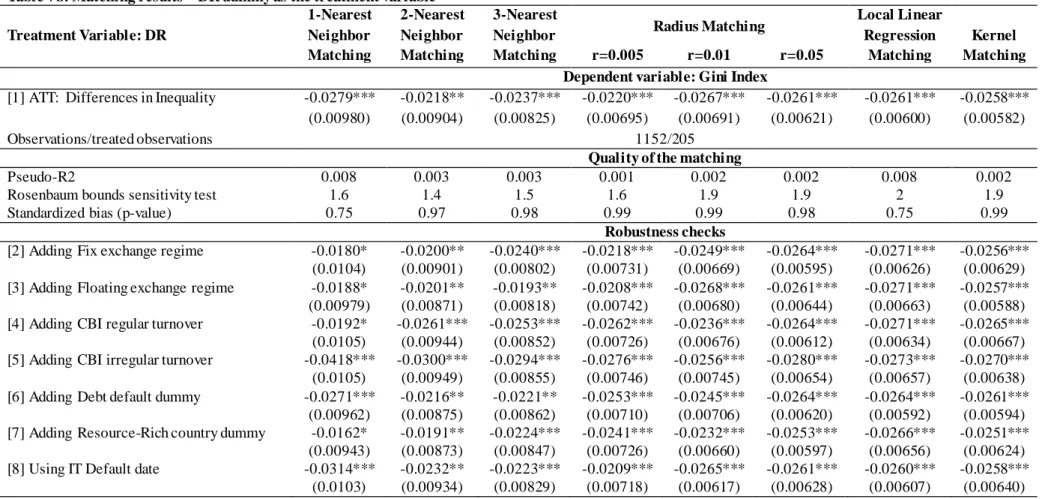
7Based on estimated PS (see Table C1b in Appendix C),
line [1] in Table 7b reports the ATT. Similar to BBR, all eight ATTs are significant, but the
size of the decrease in IQ is higher compared with BBR (up to -0.0279, neighbor
n
=
1
).
These strong effects are confirmed when accounting for additional variables in lines
[2]-[8] of Table 7b: all estimated ATT are significant, and the favorable effect of DR on IQ is
reinforced, namely up to -0.0418 (neighbor
n
=
1
, line [5]). Consequently, the effect of DR on
IQ is of a stronger magnitude than that of BBR or all FR together. This may be because even
if DR place a limit on public finance, this limit is ultimately not that tight and may leave
enough room for public spending that are favorable for reducing IQ, while still providing an
anchor for reducing the probability of fiscal consolidations that may be detrimental for IQ.
5.3. Expenditure rules (ER)
ER are aimed to limit the total, primary, or current spending, by setting a ceiling on their
growth rate or as a ratio of GDP. The most important feature of ER is that they can directly
target the government size (Schaechter et al., 2012).
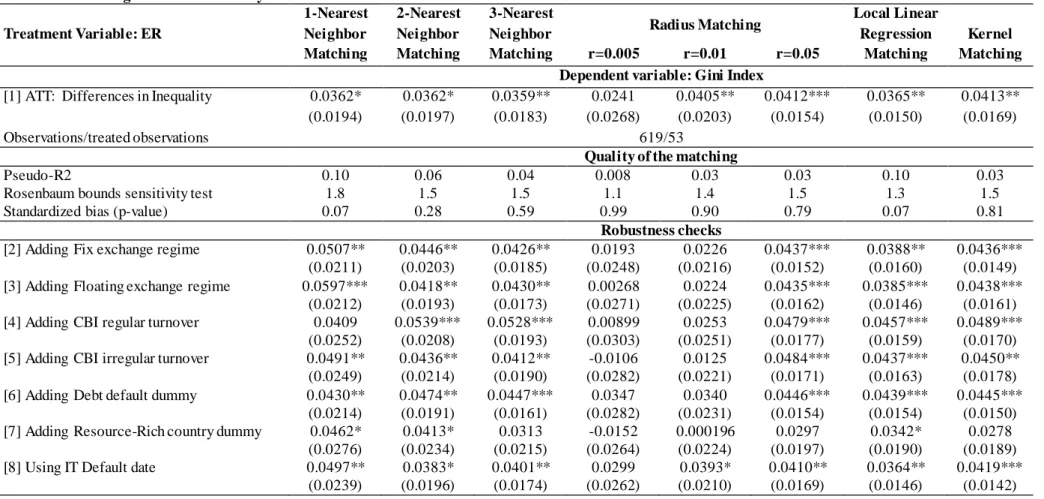
8Using the dummy variable ER, equal to
1 for countries that have adopted ER and to 0 otherwise, we use PS (from Table C1c in
Appendix C) to estimate the ATT of ER adoption on IQ in Table 7c. Contrary to results for all
FR, BBR, and DR, the positive (and significant in 7 out of 8 cases) ATTs suggesting that ER
adoption increases IQ. The magnitude of this effect is fairly strong, between 0.0359 (neighbor
1
.
0
=
n
) and 0.0413 (Kernel matching).
When accounting for additional variables, ATTs in Table 7c are significant in at least
5 out of 8 cases for each of the lines [2]-[8] (except on line [7]), and the detrimental effect of
ER adoption on IQ may climb up to almost 0.06 (neighbor
n
=
1
, line [3]). This harmful
impact may be related to the fact that, not only ER do not affect taxes (which may be
increased under BBR or DR, with favorable effects on IQ in the presence of progressive
taxes), but they directly constrain government spending (Tapsoba, 2012), whose reduction
may directly affect spending designed to reduce IQ.
7 To balance flexibility and sustainability, some countries (e.g. Mauritius) included formal escape clause
provisions that allow for temporary deviations from their debt rule. Furthermore, to avoid missing the target, some countries (e.g. Slovakia) include automatic correction mechanisms that take effect when the debt -to -GDP ratio reaches a certain level below the target.
8 Examples of ER include a nominal expenditure ceiling for the central government (e.g. Sweden), or public
Table 7a: Matching results—BBR dummy as the treatment variable
1-Nearest 2-Nearest 3-Nearest
Radius Matching Local Linear
Treatment Variable: BBR Neighbor Neighbor Neighbor Regression Kernel
Matching Matching Matching r=0.005 r=0.01 r=0.05 Matching Matching
Dependent variable: Gini Index
[1] ATT: Differences in Inequality -0.0183** -0.0214*** -0.0205*** -0.0210*** -0.0196*** -0.0195*** -0.0201*** -0.0195***
(0.00878) (0.00763) (0.00720) (0.00588) (0.00561) (0.00536) (0.00526) (0.00507)
Observations/treated observations 1152/245
Quality of the matching
Pseudo-R2 0.006 0.006 0.005 0.001 0.001 0.001 0.006 0.001
Rosenbaum bounds sensitivity test 1.3 1.5 1.6 1.7 1.6 1.6 1.7 1.6
Standardized bias (p-value) 0.83 0.83 0.89 0.99 0.99 0.99 0.83 0.99
Robustness checks
[2] Adding Fix exchange regime -0.0189** -0.0233*** -0.0240*** -0.0204*** -0.0202*** -0.0196*** -0.0201*** -0.0196***
(0.00926) (0.00821) (0.00750) (0.00652) (0.00537) (0.00501) (0.00550) (0.00512)
[3] Adding Floating exchange regime -0.0156* -0.0164** -0.0202*** -0.0202*** -0.0204*** -0.0196*** -0.0201*** -0.0196***
(0.00855) (0.00753) (0.00735) (0.00606) (0.00554) (0.00548) (0.00539) (0.00511)
[4] Adding CBI regular turnover -0.0200** -0.0233*** -0.0224*** -0.0219*** -0.0217*** -0.0199*** -0.0212*** -0.0202***
(0.00865) (0.00775) (0.00748) (0.00579) (0.00580) (0.00517) (0.00545) (0.00569)
[5] Adding CBI irregular turnover -0.0157* -0.0163** -0.0184** -0.0198*** -0.0213*** -0.0210*** -0.0219*** -0.0211***
(0.00952) (0.00774) (0.00725) (0.00623) (0.00592) (0.00529) (0.00526) (0.00533)
[6] Adding Debt default dummy -0.0247*** -0.0239*** -0.0207*** -0.0216*** -0.0217*** -0.0214*** -0.0212*** -0.0212***
(0.00859) (0.00761) (0.00703) (0.00650) (0.00550) (0.00529) (0.00507) (0.00532)
[7] Adding Resource-Rich country dummy -0.0261*** -0.0220*** -0.0257*** -0.0285*** -0.0277*** -0.0249*** -0.0259*** -0.0253***
(0.00895) (0.00836) (0.00835) (0.00689) (0.00642) (0.00624) (0.00680) (0.00639)
[8] Using IT Default date -0.0294*** -0.0277*** -0.0230*** -0.0186*** -0.0197*** -0.0194*** -0.0201*** -0.0195***
(0.00828) (0.00802) (0.00705) (0.00594) (0.00552) (0.00547) (0.00530) (0.00503)
Table 7b: Matching results—DR dummy as the treatment variable
1-Nearest 2-Nearest 3-Nearest
Radius Matching Local Linear
Treatment Variable: DR Neighbor Neighbor Neighbor Regression Kernel
Matching Matching Matching r=0.005 r=0.01 r=0.05 Matching Matching
Dependent variable: Gini Index
[1] ATT: Differences in Inequality -0.0279*** -0.0218** -0.0237*** -0.0220*** -0.0267*** -0.0261*** -0.0261*** -0.0258***
(0.00980) (0.00904) (0.00825) (0.00695) (0.00691) (0.00621) (0.00600) (0.00582)
Observations/treated observations 1152/205
Quality of the matching
Pseudo-R2 0.008 0.003 0.003 0.001 0.002 0.002 0.008 0.002
Rosenbaum bounds sensitivity test 1.6 1.4 1.5 1.6 1.9 1.9 2 1.9
Standardized bias (p-value) 0.75 0.97 0.98 0.99 0.99 0.98 0.75 0.99
Robustness checks
[2] Adding Fix exchange regime -0.0180* -0.0200** -0.0240*** -0.0218*** -0.0249*** -0.0264*** -0.0271*** -0.0256***
(0.0104) (0.00901) (0.00802) (0.00731) (0.00669) (0.00595) (0.00626) (0.00629)
[3] Adding Floating exchange regime -0.0188* -0.0201** -0.0193** -0.0208*** -0.0268*** -0.0261*** -0.0271*** -0.0257***
(0.00979) (0.00871) (0.00818) (0.00742) (0.00680) (0.00644) (0.00663) (0.00588)
[4] Adding CBI regular turnover -0.0192* -0.0261*** -0.0253*** -0.0262*** -0.0236*** -0.0264*** -0.0271*** -0.0265***
(0.0105) (0.00944) (0.00852) (0.00726) (0.00676) (0.00612) (0.00634) (0.00667)
[5] Adding CBI irregular turnover -0.0418*** -0.0300*** -0.0294*** -0.0276*** -0.0256*** -0.0280*** -0.0273*** -0.0270***
(0.0105) (0.00949) (0.00855) (0.00746) (0.00745) (0.00654) (0.00657) (0.00638)
[6] Adding Debt default dummy -0.0271*** -0.0216** -0.0221** -0.0253*** -0.0245*** -0.0264*** -0.0264*** -0.0261***
(0.00962) (0.00875) (0.00862) (0.00710) (0.00706) (0.00620) (0.00592) (0.00594)
[7] Adding Resource-Rich country dummy -0.0162* -0.0191** -0.0224*** -0.0241*** -0.0232*** -0.0253*** -0.0266*** -0.0251***
(0.00943) (0.00873) (0.00847) (0.00726) (0.00660) (0.00597) (0.00656) (0.00624)
[8] Using IT Default date -0.0314*** -0.0232** -0.0223*** -0.0209*** -0.0265*** -0.0261*** -0.0260*** -0.0258***
(0.0103) (0.00934) (0.00829) (0.00718) (0.00617) (0.00628) (0.00607) (0.00640)
Table 7c: Matching results—ER dummy as the treatment variable
1-Nearest 2-Nearest 3-Nearest
Radius Matching Local Linear
Treatment Variable: ER Neighbor Neighbor Neighbor Regression Kernel
Matching Matching Matching r=0.005 r=0.01 r=0.05 Matching Matching
Dependent variable: Gini Index
[1] ATT: Differences in Inequality 0.0362* 0.0362* 0.0359** 0.0241 0.0405** 0.0412*** 0.0365** 0.0413**
(0.0194) (0.0197) (0.0183) (0.0268) (0.0203) (0.0154) (0.0150) (0.0169)
Observations/treated observations 619/53
Quality of the matching
Pseudo-R2 0.10 0.06 0.04 0.008 0.03 0.03 0.10 0.03
Rosenbaum bounds sensitivity test 1.8 1.5 1.5 1.1 1.4 1.5 1.3 1.5
Standardized bias (p-value) 0.07 0.28 0.59 0.99 0.90 0.79 0.07 0.81
Robustness checks
[2] Adding Fix exchange regime 0.0507** 0.0446** 0.0426** 0.0193 0.0226 0.0437*** 0.0388** 0.0436***
(0.0211) (0.0203) (0.0185) (0.0248) (0.0216) (0.0152) (0.0160) (0.0149)
[3] Adding Floating exchange regime 0.0597*** 0.0418** 0.0430** 0.00268 0.0224 0.0435*** 0.0385*** 0.0438***
(0.0212) (0.0193) (0.0173) (0.0271) (0.0225) (0.0162) (0.0146) (0.0161)
[4] Adding CBI regular turnover 0.0409 0.0539*** 0.0528*** 0.00899 0.0253 0.0479*** 0.0457*** 0.0489***
(0.0252) (0.0208) (0.0193) (0.0303) (0.0251) (0.0177) (0.0159) (0.0170)
[5] Adding CBI irregular turnover 0.0491** 0.0436** 0.0412** -0.0106 0.0125 0.0484*** 0.0437*** 0.0450**
(0.0249) (0.0214) (0.0190) (0.0282) (0.0221) (0.0171) (0.0163) (0.0178)
[6] Adding Debt default dummy 0.0430** 0.0474** 0.0447*** 0.0347 0.0340 0.0446*** 0.0439*** 0.0445***
(0.0214) (0.0191) (0.0161) (0.0282) (0.0231) (0.0154) (0.0154) (0.0150)
[7] Adding Resource-Rich country dummy 0.0462* 0.0413* 0.0313 -0.0152 0.000196 0.0297 0.0342* 0.0278
(0.0276) (0.0234) (0.0215) (0.0264) (0.0224) (0.0197) (0.0190) (0.0189)
[8] Using IT Default date 0.0497** 0.0383* 0.0401** 0.0299 0.0393* 0.0410** 0.0364** 0.0419***
(0.0239) (0.0196) (0.0174) (0.0262) (0.0210) (0.0169) (0.0146) (0.0142)
5.4. Combined types of fiscal rules
The trend of the last decade is for countries to adopt multiple FR, and particularly combine
BBR with DR or ER (Eyraud et al., 2018). We analyze such combined effects of our three FR
on IQ using three combinations of two rules (considering all three rules together leads to too
few—eleven—treated observations for robust statistical inference). In each case, the treatment
variable is a dummy variable equal to 1 if both rules are adopted, and to 0 if not (i.e. if none
or only one rule is adopted). Matching results in Table 8 show the following.
First, the joint presence of BBR and DR significantly reduces IQ (line [1]), confirming
individual results for BBR and DR. The magnitude of this favorable effect is slightly stronger
than that of BBR or DR alone (up to -0.0312), suggesting some complementarities between
them for reducing IQ. Second, the joint effect of DR and ER is not significant (line [2]),
which may reproduce the conflicting effects of DR alone (decrease) and ER alone (increase)
on IQ. Third, the joint influence of BBR and ER is equally mostly not significant (line [3]),
reflecting yet again the conflicting effects of BBR and ER alone.
Altogether, these results (which are robust in the presence of additional control
variables in Tables C2a-b-c in Appendix C) show that combining different FR should be done
with caution in terms of IQ. On the one hand, the detrimental effect of ER adoption on IQ can
be neutralized by the presence of either BBR or DR; and the presence of both BBR and DR
reduces IQ by more compared to their individual effect. However, on the other hand, the
adoption of ER reduces the favorable effects of BBR or DR alone.
Table 8: Matching results—combined types of FR
1-Nearest 2-Nearest 3-Nearest
Radius Matching Local Linear
Neighbor Neighbor Neighbor Regression Kernel
Matching Matching Matching r=0.005 r=0.01 r=0.05 Matching Matching
Dependent variable: Gini index
Treatment Variable: BBR*DR Dummy -0.0231** -0.0312*** -0.0295*** -0.0275*** -0.0260*** -0.0242*** -0.0226*** -0.0239***
[1] ATT: Differences in Inequality (0.0108) (0.00987) (0.00898) (0.00755) (0.00823) (0.00743) (0.00706) (0.00660)
Observations/treated observations 1152/173
Treatment Variable: DR*ER Dummy -0.0359 -0.0130 -0.00410 0.00159 -0.00368 -0.000283 0.00316 0.00121
[2] ATT: Differences in Inequality (0.0279) (0.0252) (0.0226) (0.0337) (0.0291) (0.0171) (0.0154) (0.0178)
Observations/treated observations 979/27
Treatment Variable: BBR*ER Dummy 0.0530 0.0625* 0.0517 -0.0152 0.0168 0.0592* 0.0464 0.0576*
[3] ATT: Differences in Inequality (0.0375) (0.0357) (0.0325) (0.0397) (0.0381) (0.0346) (0.0338) (0.0344)
Observations/treated observations 934/26
VI. Heterogeneity: different economic and structural environments
The previous section revealed that the effect of FR adoption on IQ varies with the type of FR.
At the same time, to account for possible differences among the countries in our sample, we
consider a large set of potential sources of heterogeneity related to fiscal, monetary,
international, political, and other structural variables. We explore such heterogeneities using a
control function regression approach (e.g. Tapsoba, 2012)
it it it it it it it
FR
PScore
X
FR
X
IQ
=
+
+
+
+
+
,
(4)
with PScore the estimated PS from the benchmark model, and X the vector of variables that
may be a source of heterogeneity. A significant coefficient of interest
signals the presence
of heterogeneity in the treatment effect. We look at all FR together and then at each rule.
6.1. All fiscal rules
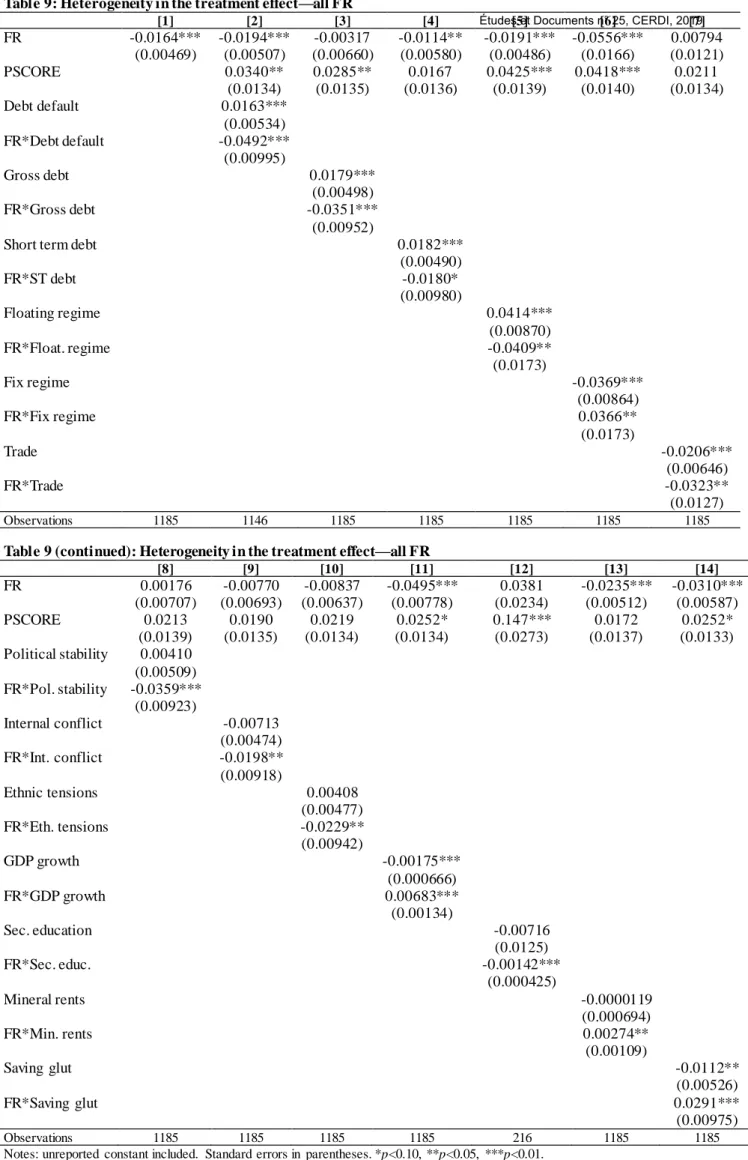
Column [1] in Table 9 shows that FR significantly decrease IQ on average by 0.0164,
comparable with our benchmark results. From column [2] onwards we report only estimations
in which the interactive effect between the considered variables and FR (i.e. the coefficient
) is significant at least at the 10% significance level.
First, columns [2]-[4] show that all fiscal variables significantly reduce IQ when
combined with FR, suggesting that the favorable effects of FR on IQ may be amplified when
FR are in place in a deteriorated fiscal space. Second, regarding monetary variables, columns
[5]-[6] reveal that the favorable effect of FR alone on IQ is enforced in the presence of
floating exchange rates (while mitigated under fixed exchange rates), suggesting that floating
exchange rates may better absorb various types of shocks that could lower the favorable effect
of FR on IQ. Third, among international variables, higher trade combined with FR
significantly reduces IQ (column [7]), as access to international markets for goods and
services may foster the efficiency of spending designed to reduce IQ within FR-based fiscal
policy frameworks. Fourth, all political environment variables, namely the degree of political
stability, the absence of internal conflicts, and the absence of ethnic tensions, reduce IQ when
combined with FR (columns [8]-[10]), possibly because better political conditions may
support more stable fiscal institutions in which the compliance with FR can be combined with
more judicious spending policies, including in terms of distributional goals.
(0.00469) (0.00507) (0.00660) (0.00580) (0.00486) (0.0166) (0.0121) PSCORE 0.0340** 0.0285** 0.0167 0.0425*** 0.0418*** 0.0211 (0.0134) (0.0135) (0.0136) (0.0139) (0.0140) (0.0134) Debt default 0.0163*** (0.00534) FR*Debt default -0.0492*** (0.00995) Gross debt 0.0179*** (0.00498) FR*Gross debt -0.0351*** (0.00952)
Short term debt 0.0182***
(0.00490) FR*ST debt -0.0180* (0.00980) Floating regime 0.0414*** (0.00870) FR*Float. regime -0.0409** (0.0173) Fix regime -0.0369*** (0.00864) FR*Fix regime 0.0366** (0.0173) Trade -0.0206*** (0.00646) FR*Trade -0.0323** (0.0127) Observations 1185 1146 1185 1185 1185 1185 1185
Table 9 (continued): Heterogeneity in the treatment effect—all FR
[8] [9] [10] [11] [12] [13] [14] FR 0.00176 -0.00770 -0.00837 -0.0495*** 0.0381 -0.0235*** -0.0310*** (0.00707) (0.00693) (0.00637) (0.00778) (0.0234) (0.00512) (0.00587) PSCORE 0.0213 0.0190 0.0219 0.0252* 0.147*** 0.0172 0.0252* (0.0139) (0.0135) (0.0134) (0.0134) (0.0273) (0.0137) (0.0133) Political stability 0.00410 (0.00509) FR*Pol. stability -0.0359*** (0.00923) Internal conflict -0.00713 (0.00474) FR*Int. conflict -0.0198** (0.00918) Ethnic tensions 0.00408 (0.00477) FR*Eth. tensions -0.0229** (0.00942) GDP growth -0.00175*** (0.000666) FR*GDP growth 0.00683*** (0.00134) Sec. education -0.00716 (0.0125) FR*Sec. educ. -0.00142*** (0.000425) Mineral rents -0.0000119 (0.000694) FR*Min. rents 0.00274** (0.00109) Saving glut -0.0112** (0.00526) FR*Saving glut 0.0291*** (0.00975)
Finally, our last set of variables captures other structural characteristics. Column [11]
shows that higher economic growth mitigates the favorable effect of FR on IQ, to the point
where above a certain growth rate FR increase IQ probably due to poor redistribution. Next,
despite relatively few available observations, education is found to reduce IQ when combined
with FR (column [12]), since a more educated population could sustain government policies
incorporating public spending designed for combating IQ. Moreover, the interactive term
between mineral rents and FR is positive (column [13]), suggesting that in our sample of
developing countries important mineral rents may increase IQ when combined with FR,
possibly echoing the famous “Dutch disease”. Lastly, column [14] indicates that the favorable
effect of FR on IQ was mitigated during the saving glut (2000-06), possibly due to a shortage
of public spending aimed at reducing IQ.
6.2. Different types of fiscal rules
We now look at heterogeneities for each type of FR. To save space, Table 10 reports only the
coefficient of the interactive term between each variable and each FR, namely significant (at
least at the 10% level) & positive (+), significant & negative (–), or not significant (NS).
Table 10. Heterogeneity by type of fiscal rule
[1] [2] [3] [4]
All FR BBR DR ER
Fiscal variables
Debt default – – NS NS
Gross debt – – NS –
Short term debt – NS – –
Government size NS – – NS Monetary variables Inflation rate NS NS NS NS Broad money NS + + – Floating regime – NS + + Fix regime + NS – – International variables Trade – NS NS – FDI Inflows NS NS NS NS Capital openness NS NS NS – Political variables Political stability – – NS – Internal conflict – NS NS – Ethnic tensions – NS – NS
Other structural variables
Growth rate of GDP + + + + Secondary education – – – – Mineral rents + + – + Post crisis NS NS NS – Saving glut + + NS + Time NS NS NS +
Note: the interaction term between each variable and the corresponding type of fiscal rule can be +, –, or NS, namely significant (at least at the 10% level) & positive, significantly & negative, and not significant.
![Table 1: The estimation of propensity scores [1] [2] [3] [4] [5] [6] [7] [8] L.Real gdppc growth 0.00815* 0.00811* 0.00816* 0.00880* 0.00917* 0.0115** 0.00874* 0.00817* (0.00478) (0.00480) (0.00480) (0.00489) (0.00493) (0.00561) (0.](https://thumb-eu.123doks.com/thumbv2/123doknet/14582861.541100/10.1262.99.1077.120.691/table-estimation-propensity-scores-l-real-gdppc-growth.webp)