READ THESE TERMS AND CONDITIONS CAREFULLY BEFORE USING THIS WEBSITE. https://nrc-publications.canada.ca/eng/copyright
Vous avez des questions? Nous pouvons vous aider. Pour communiquer directement avec un auteur, consultez la première page de la revue dans laquelle son article a été publié afin de trouver ses coordonnées. Si vous n’arrivez pas à les repérer, communiquez avec nous à [email protected].
Questions? Contact the NRC Publications Archive team at
[email protected]. If you wish to email the authors directly, please see the first page of the publication for their contact information.
NRC Publications Archive
Archives des publications du CNRC
This publication could be one of several versions: author’s original, accepted manuscript or the publisher’s version. / La version de cette publication peut être l’une des suivantes : la version prépublication de l’auteur, la version acceptée du manuscrit ou la version de l’éditeur.
Access and use of this website and the material on it are subject to the Terms and Conditions set forth at
Testing Canadian aggregates for alkali expansivity
Grattan-Bellew, P. E.; Litvan, G. G.
https://publications-cnrc.canada.ca/fra/droits
L’accès à ce site Web et l’utilisation de son contenu sont assujettis aux conditions présentées dans le site
LISEZ CES CONDITIONS ATTENTIVEMENT AVANT D’UTILISER CE SITE WEB.
NRC Publications Record / Notice d'Archives des publications de CNRC:
https://nrc-publications.canada.ca/eng/view/object/?id=44e5ed3d-c5c9-4b9e-a733-6b9e69367599
https://publications-cnrc.canada.ca/fra/voir/objet/?id=44e5ed3d-c5c9-4b9e-a733-6b9e69367599
Ser
TH1
~d
ational Research
Conseil national
7 2 3
ouncil Canada
de recherches Canada
2
AN
aNZr'
BLDG
-
- --c ' ~
CANADIAN AGGREGATES FOR
ALKALI EXPANSIVITY
by P.E. Grattan-Bellew and G.G. Litvan
#/m - m
*a
-.
ur%G
Reprinted,
with permission,
from
Proceedings, 1976 Alkali Symposium
held in London, England, in September
p. 227 245
DBR Paper No. 723
Division of Building Research
BUILDING
RESEARCH
-
LIBRARY
-
SEP 6
1977
NATIONAL RESEARCH COUNCIL 1
On d i s c u t e d e s applications d e l l e s s a i chimique ASTM C289, l l e s s a i s u r une b a r r e d e m o r t i e r C227 ( m o r t a r b a r t e s t ) , une modification d e l l e s s a i chimique, l l e s s a i s u r un p r i s m e d e p i e r r e ( r o c k p r i s m t e s t ) , e t l l e s s a i s u r un c y l i n d r e de p i e r r e C 5 8 6 ( r o c k cylinder t e s t ) e n utilisant d e s a g g r 6 g a t s canadiens c h o i s i s . I1 e s t d 6 m o n t r 6 que l l e s s a i chimique C289 e s t in- s a t i s f a i s a n t . L 1 e s s a i s u r un p r i s m e d e c i m e n t a d e m o n t r e q u l i l e t a i t l e plus s a t i s f a i s a n t m a i s deux ann6es s e s o n t 6coulCs avant d l o b t e n i r d e s r 6 s u l t a t s e t s o n usage e s t donc peu p r a t i q u e d a n s bien d e s c a s . Un nouvel e s s a i accCl6rC e s t p r o p o s 6
-
l l e s s a i s u r un p r i s m e d e p i e r r e - une f o r m e modifiCe de l a n o r m e ASTM C586. De p e t i t s p r i s m e s d e p i e r r e sont s a t u r e s s o u s vide d a n s un a l c a l i e t l e changement d e longueur a v e c l e t e m p s e s t e n r e g i s t r e ; l e s r e s u l t a t s s o n t obtenus apr'es e n v i r o n t r o i s mois. L e s e s s a i s s u r d e s p i e r r e s s e m b l a b l e s e n utilisant l a mkthode du c y l i n d r e de p i e r r e C586 ont demand6 jusqul'a deux annCes. Le nouvel e s s a i s e r a i t utile pour l e choix p r g l i m i n a i r e d e s a g g r 6 g a t s afin d e d e t e r - m i n e r ceux qui d e v r a i e n t Gtre m i s 'a l l e s s a i plus longuement e n u t i l i s a n t l e s m6thodes d e l a b a r r e de m o r t i e r ou du p r i s m e d e m o r t i e r .TESTING CANADIAN AGGREGATES FOR ALKALI EXPANSIVITY
I P.E. Grattan-Bellew and G.G. Litvan
Division of Building Research, National Research Council of Canada.
I
Ottawa. Canada. KIA OR6ABSTRACT
The applications of the chemical test ASTM C289, the mortar bar test C227, a modification of it, the rock prism test, and the rock cylinder test C586 to selected Canadian aggregates are discussed. The chemical test C289 is shown to be unsatisfactory. The concrete prism test proved to be the most satisfactory, but it took up to two years to obtain results and its use is therefore impractical in many instances. A new accelerated test is proposed--The Rock Prism Test-- a modified form of ASTM C586. Thin prisms of rock are vacuum
saturated in alkali and the length change with time is recorded;
results are obtained in about three months. Tests on similar rocks by the rock cylinder method C586 took up to two years. The new test would be useful for preliminary screening of potential aggregates to determine which would need further testing by the mortar bar or concrete prism methods.
Introduction
Canadian aggregates generally perform quite satisfactorily but there have been a number of reports of alkali-reactivity from various parts of the country. (The broad physiographic regions of Canada are shown in
FIG. 1.) In the Western Cordilleran Region and on the Prairies cases of
FIG. 1
Map of Canada showing the physiographic regions (from Geology and Economic Minerals of Canada, GSC, 1970)
alkali-silica reactivity due to the presence of cherts and opaline silica in gravels are on record. Some impure dolomitic limestones from the
St. Lawrence lowlands are alkali-carbonate reactive (Dolar-Mantuani ( 1 . 2 1 ,
Swenson and Gillott ( 3 ) . Cillott and Swenson (4)). In the Appalachian and
Shield areas, precambrian granites, volcanics, schists, greywackes and quartzites are the most common rock types. Studies of the alkali reactivity of these rocks have been carried out by Dolar-Mantuani (5).
Duncan et a1 ( 6 ) , and Gillott et a1 (7). This paper deals with the
Appalachian regions.
Glacial and fluvo-glacial gravels and sands are found overlying the bedrock in many regions but the deposits are usually quite localized. These gravels are a major source of aggregate but a variety of crushed
I
rocks are also used.
I
Raw material for cement is found in most regions of Canada and cement plants are located adjacent to large urban centres. The composition of the cement varies but, with the exception of the West Coast region where low alkali cement is manufactured, normal Type I cement is a high alkali type with a total alkali content, expressed as Na20 equivalent of between 0.6 and about I%*.Alkali-Silicate Reaction
In North America the term "alkali-silicate reaction" has come to be used to differentiate between the classical alkali-silica reaction as exhibited by opaline rocks and the reaction that occurs with quartzites, greywackes and phyllites that do not contain opaline or chalcedonic silica
i
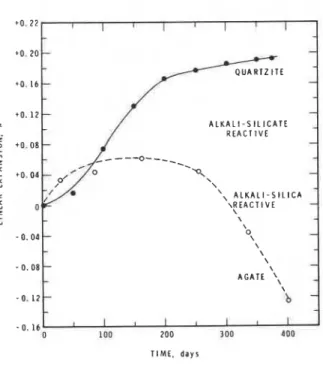
(see Gillott (8)). The expansion mechanism of alkali-silicate reactiverocks is not fully understood and although there is some evidence to the contrary, it is not at present clear that the mechanism is different from that of the classical alkali-silica reaction. The rate of the alkali- silicate reaction is slower than that of alkali-silica and the shapes of the expansion curves of rock cylinders of the two types in alkali may differ (FIG. 2). These differences may be due, however, to variations in the amount of reactive material present in the two rocks. The weight loss of the (alkali-silica) agate after 400 days was 35%; that of the alkali- silica reactive quartzite was less than 1% (9). It has also been suggested (7) that the expansion of some alkali-silicate rocks, e.g.. argillite, may be due to the exfoliation of certain phyllosilicates but it is not clear at present if this is the only cause of expansion.
Test Methods
The following ASTM test methods have been and are used in the
laboratory of the Division of Building Research, NRC, and by most Canadian workers :
C289 Quick Chemical Tcst Modified C227 Concrete Prism Test C227 Mortar Bar Test Modified C586 Rock Cylinder Test *American Society for Testing and Materials, Standard Specification for
FIG. 2 C O N S I D E R E D
4
D E L E T E R I O U S1
5 510 l)0 :5jb
l b 0 Z:O 3;0'1A00
2500 Comparison between t h e expansion and c o n t r a c t i o n o f a l k a l i - s i l i c a and a l k a l i - s i l i c a t e rock prisms immersed i n 2N NaOH a t 20°C. Agate curve p l o t t e d from d a t a from Duncan ( 9 ) . FIG. 3 P l o t o f r e s u l t s o f quick chemical t e s t C289 f o r a r e a c t i v e sand of v o l c a n i c o r i g i n . Samples IA, 2A and 3A and 4A and f o r a q u a r t z i t e , Sample 5. l B , 2B 3B and 4B a r e r e s u l t s o f d u p l i c a t e r u n s .C289 Quick Chemical Test
This test was developed to assess aggregates believed to be susceptible to the classical alkali-silica reaction, although it has been demonstrated that it also works with some alkali-silicate rocks, e.g., a quartzite
sample 5 (FIG. 3). Duncan et a1 ( 6 ) , found only a 50% confidence factor
for tests done on 14 rocks from Nova Scotia and concluded, therefore, that test C289 was inappropriate for rocks from the Appalachian Region.
If the mechanism of the alkali-silicate reaction is different from the classical reaction of alkali-silica, it is to be expected that the amounts of dissolved silica and reduced alkalinity observed in C289 should also be different. For example, a river gravel of volcanic origin which is known to be reactive was submitted to the C289 test. The results of runs on three pairs of samples are shown in FIG. 3, Nos. 1, 2 and 3, all of which
OD 100 ZOO 300 100 500 600 100 800 VOO I000 1100 1200 I I M E , d a y s
FIG. 4
Expansion of mortar bars, made from a reactive gravel of volcanic
origin, with high and low alkali cement (H.A. & L.A.).
*Indicates borderline between reactive and non-reactive aggregates as specified in ASTM Test C227.
plot in the non-reactive part of the diagram. The results of the mortar bar test (C227) on this gravel, shown in FIG. 4, clearly demonstrate that the gravel is expansive. The sand fraction of the material consists mainly of volcanic glass; the gravel-size fraction is composed of fragments of acid to intermediate volcanic rocks.
From tests carried out in the DBR laboratory and elsewhere, Duncan et a1 ( 6 ) , it is evident that considerable caution is necessary in interpreting the results of the quick chemical test C289 when it is applied to potentially alkali-silicate reactive rocks.
Mortar Bar Test C227 and Concrete Prism Test
To overcome the objection to the mortar bar test, i.e.. that mortar and not concrete is being tested, the concrete prism test was devised. It has been used extensively in Canada (6, 10) and in the DBR laboratory. The effective dimensions of the concrete prisms are 7.6 x 7.6 x 25.4 cm (3 x 3 x 10 in.). At DBR concrete prisms and mortar bars are routinely stored at 3S°C and 100% relative humidity to accelerate the expansion. We have found the concrete prism test is the most satisfactory method of testing aggregates for alkali-reactivity but it has one major disadvantage which probably prevents its wider acceptance
-
the large amount of space needed to store the prisms. Only four prisms can be sealed in a container 28 cm in diameter by 47 cm high.In the work at DBR there have been several instances when concrete prisms showed an aggregate to be expansive when the mortar test C227 did not; an example is shown in FIG. 5. The cement used is a normal Type I containing 0.34% Na20 and 1.13% K20 giving an Na20 equivalent of 1.08%. The amount of soluble Na20 and K20 was determined by a modification of ASTM C114. about 30% of the sodium was soluble after ten minutes hydration; virtually all the potassium was soluble. This cement is classed as a high- alkali type according to ASTM Specification C150 but with an Na20 content of 0.34% it.is not very reactive. In future work, a cement with a higher Na20 content will be used as it is known that Na20 is more reactive than K20. A lower expansion for mortar bars than for concrete prisms has also been reported (10). (The work reported in this paper was also done in the DBR laboratories.) The reason for the discrepancy between the results of the mortar bar and concrete prism tests is still being investigated; the possibility that it may be due to the effect of grain size is being considered. Vivian (11) showed that the maximum expansion caused by
C O N C R E T E
---
-0---_--
p'o-od
0. 1 6 / ?3
FIG. 5 Comparison of the amount of expansion of a mortar bar and a concrete prism made from a reactive feldspathic quartzite and high alkali cement.T I M E . d a y s
additions of 5% opal to a non-expansive aggregate occurred where the grain size of the aggregate was in the range of 50 to 300 urn. It might also be expected that the maximum expansion of aggregate exhibiting alkali- silicate reactivity would also occur in the 50 to 300 pm range but Duncan (9) found that the amount of expansion increased as the average particle size was increased. For example, a calcareous argillite expanded 0.077% in 48 weeks when a normal grading (ASTM C227) was used but it expanded by 0.164% when the grading was altered by adding 65% of -9.5 +,4.76 nun material. This addition also increased the amount of the coarser material in the smaller screen sizes to give a total of 65% of coarser fractions compared to the standard grading.
In addition to the discrepancy noted between the expansion of mortar bars and concrete prisms, another problem was encountered. Mortar bars made from both high and low alkali cement showed the same (small) amount of expansion (FIG. 6). There is usually a significant difference in the amount of expansion observed in mortar bars made from reactive aggregate with high alkali and low alkali cement; for example FIG. 4 shows the expansions of mortar bars made from a reactive sand of volcanic origin.
1 1 1 -
-
0 11-
-
FIG. 60 1 4 - - Comparison of the expansion of
mortar bars, of a reactive *
6 0 1 2 - S D N C R E T ~ P R I S M
-
rhyolite, made with high and low alkali cement. For comparison, the expansion of a concrete prism made with high alkali cement is also shown.H.A. High alkali cement L.A. Low alkali cement
The reason why some mortar bars made with high alkali cement did not show more expansion than those made with low alkali cement has so far not been determined, but it may be due to the distribution of the alkalies in the cement
-
0.34% Na20 and 1.13% K20. Na20 equivalent 1.08. Although this would be classed as a high alkali cement based on its Na20 equivalent it may not behave as such in mortar. At DBR, for the past few years, washing the aggregate as specified in ASTM C227 has been omitted. In normal field practice the aggregate is not washed and it was thought that the test would better simulate normal usage if washing were omitted. The effect of omitting the washing of the aggregate is that about 0.8% more finematerial is present, most of it in the 150 to 300
u
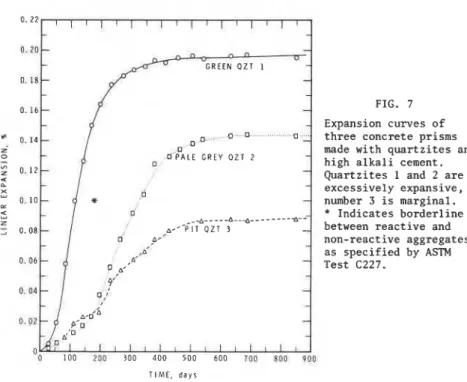
range. Experiments are currently in progress to determine if the small percentage of fines added to the mortar bars as a result of not washing the aggregates could act as a pozzolan and inhibit the expansion.ASTM Test C227 specifies that expansion in excess of 0.1% at six months or 0.05% at three months be considered deleterious. This specification may be satisfactory for aggregates showing the classical alkali-silica reaction but is not reliable for concrete prisms made from aggregates that exhibit the alkali-silicate reaction. FIG. 7 shows the expansions of three concrete prisms made with high alkali cement and quartzites from the Canadian Shield. Samples 1 and 2 are excessively expansive; sample 3 is marginal. Quartzite 1 would be deemed excessively expansive by ASTM C227 specification but quartzite 2 would not, although it expanded more than 0.14% in two years and cracks had appeared in the prisms. Concrete prisms
FIG. 7 Expansion curves of three concrete prisms made with quartzites and high alkali cement. Quartzites 1 and 2 are excessively expansive, number 3 is marginal.
*
Indicates borderline between reactive and non-reactive aggregates as specified by ASTMTest C227.
T I M E , d a y s
and mortar bars made with alkali-silicate reactive aggregates expand more slowly than those made from reactive alkali-silica rocks. Instead of setting a limit of 0.1% at six months as the boundary between reactive and non-reactive aggregates it would be better to specify the maximum
expansion that should have occurred when the slope of the plot of
percentage linear expansion vs time, as shown in FIG. 7, has flattened out. For the quartzites shown in FIG. 7, this occurred after about 600 days. Modified Rock Cylinder Test, ASTM C586
Test C586 is to determine the potential expansivity of carbonate rocks. but Dolar-Mantuani (5) showed it to be applicable to a variety of Canadian alkali-silicate rocks. Duncan et a1 (6) found that the results of mortar bar and rock cylinder tests differed in only 11% of the samples studied, about the same disagreement as they found between the results of mortar bar and concrete prism tests. Recent results ( 6 , 10) supported by DBR studies, show that the modified rock cylinder test is a satisfactory method to determine the potential expansivity of aggregates which may be expected to exhibit alkali-silicate reactivity. The modified rock cylinder test, when applied to potentially alkali-silicate rocks, has the
same drawback as the mortar bar and concrete prism tests applied to these rocks, i.e., the length of time required to obtain results, frequently from one to two years. To be of practical value the rock cylinder test would have to be much more rapid.
Accelerated Test: The Rock Prism Test
Some time ago it was decided to try to develop an accelerated rock
cylinder test. This was achieved by making small rock prisms 20 x 3.175 x
6.35 mm instead of the rock cylinders. The rock prisms were vacuum
saturated with 2N NaOH solution at the start of the experiment. This new method, the Rock Prism test, will be described in more detail in a later publication. The length change of the rock prisms can be measured by one of two methods: (1) by a differential transformer giving a continuous chart readout; or (2) by means of a Huggenberger gauge which is read at
selected intervals. (A rock prism and this gauge are shown in FIG. 8a.
For comparison a regular rock cylinder is shown on a Tesa measuring apparatus in FIG. 8b.) Small metal studs are attached to the rock prisms to permit measurement with the Huggenberger gauge; these are visible in FIG. 8a. The studs are cemented to the rock with epoxy. Some problems
FIG. 8
a) Huggenberger gauge to measure length of rock prism. Note the two studs attached to the prism into which the prongs of the apparatus fit. b) Tesa gauge to measure a rock cylinder.
I I
0 7 0 40 60 90 100 120 140 160 180
TIME. d a y s
FIG. 9
Comparison of expansions measured on prisms of a reactive quartzite in 2N NaOH solution with a Huggenberger gauge and a differential transformer
were encountered due to the studs coming off, particularly on the more expansive samples but nonetheless satisfactory results were obtained. The differential transformer is capable of more accurate measurement, but it has the disadvantage that one apparatus is needed for each sample. In the transformer apparatus the sample is clamped in small jaws so there is no problem with epoxy becoming detached as sometimes happens to the studs on samples when the Huggenberger gauge is used. The results of expansion
experiments with this gauge and transformer apparatus are shown in FIG. 9.
Both curves show about the same slope but the amount of expansion after 100 days measured by the transformer is less than half that measured by the Huggenberger gauge. The discrepancy between the two samples may be due to differences in the two prisms or to friction in the transformer or
T I M E . d a y s ( R O C K C Y L I N D E R T E S T 1
I I h 1 E , d a y s [ R O C K P R I S M T E S T 1
FIG. 10
Comparison of the rate of expansion observed on a rock prism and a rock cylinder of reactive quartzite immersed
in 2N NaOH at 20°C.
both. The use of the differential transformer has been discontinued as the Huggenberger is more convenient.
The rate of expansion of a reactive quartzite measured with a Huggenberger gauge on a 20 x 3.175 x 6.35 mm rock prism and that measured on a rock cylinder 9 mm in diameter by 35 mm long with the Tesa gauge are shown in FIG. 10. The rock prism expanded by 0.08% in 60 days. This amount of expansion was not reached by the rock cylinder until after 500 days. There was almost a tenfold increase in the rate of expansion of rock prisms compared with rock cylinders.
0 2 0 10 60 80 1 0 0 1 2 0 1 4 0 160 180 TIME. d a y s
FIG. 11
Rock prism test on duplicate samples of aggregate immersed in 2N NaOH solution.
Pairs of cylinders, even though cored from the same piece of rock and immersed in alkali frequently show different rates of expansion due to lack of homogeneity in the sample. To try to reduce to a minimum this inhomogeneity in the pairs of rock prisms they were sawn side by side from the same slab of rock. Despite this, however, considerable variation in expansion was found between the pairs. Typical expansion curves for three
pairs of rock prisms are shown in FIG. 11. The uncertainty that may arise
in the interpretation of the rock prism test can be reduced by measuring three or more prisms from each sample. The effect of the lack of homogeneity of the rocks can be minimized by testing sets of prisms from a number of pieces of aggregate.
The problem of determining the dividing line between normal and expansive rocks, which was encountered with the mortar bar and concrete prism tests, also exists with the rock prism method. The two feldspathic quartzites shown in FIG. 11 are known from concrete prism tests to be expansive; the amphibolite is non-expansive. The problem is how to designate rocks that have curves lying between the quartzites and the
amphibolite (FIG. 11). The dividing line between expansive and
non-expansive rocks and the m i n i m duration of expansion experiments cannot be established with certainty until more experiments have been done on rock types that have previously been tested in concrete; work on this project is still in progress.
The rock prism test as outlined in this paper shows promise of providing a relatively rapid method of screening aggregate which may be potentially alkali-silicate reactive.
Discussion
Research on the problem of alkali-reactivity has been carried out for more than a quarter of a century but there is still no clear understanding of the exact mechanism by which the expansion of concrete occurs, even in the case of the classical alkali-silica reaction. The alkali silicate reaction, which was defined recently, presents a more complex problem. There is some evidence that expansion may occur due to several mechanisms.
(For recent discussions on these topics see Diamond (12) and Gillott (8)). In studying the expansion of concrete made with reactive aggregate and high alkali cement there are two major questions to be answered: (1) How do rock prisms expand when immersed in alkali or in concrete, and (2) Why does the concrete itself expand and crack when made with reactive
aggregate.
Gillott et a1 (7) demonstrated that some phyllosilicates expand when immersed in alkaline solution. The alkali dissolved out the interlayer precipitates thus increasing the surface area and allowing the adsorption of water which in turn caused the mineral to swell. This mechanism does not, however, explain the expansion of quartzites observed by the present authors. The quartzites consisted of large grains of quartz surrounded by interstitial fine quartz and silica.
The expansion of limestone and porous 96% silica glass was studied by Feldman and Sereda (13); the mechanism that they proposed to account for the expansion may well also apply to the quartzites. Essentially what
happens is that the alkali reacts with silica or silicate to form an alkali-silicate hydrate which precipitates as a gel in the fine pores of the rock. This material has a high surface area and readily adsorbs water which causes it to expand (13). The characteristics of the adsorption and expansion isotherms confirm that the alkali-silicate hydrate is in the gel form.
The possibility of developing a reliable and rapid test for alkali- silicate reactive aggregates would be greatly enhanced if the mechanism or mechanisms of expansion were understood. Determining the cause of the expansion of concrete made with reactive aggregate and high alkali cement is complicated by three factors, in addition to the alkali-silicate reaction: temperature, moisture content, and hydration reaction. The aim of the test for alkali-expansivity is to determine the effect of the alkali-silicate reaction alone on the expansion of the concrete. This is never a simple.task; it is often an impossible one. In the initial period just subsequent to fabrication all four parameters change simultaneously and feed-back problems arise. As hydration proceeds the temperature rises and the moisture content decreases due to changes of relative humidity. It is very important to keep these facts in mind both in the design and evaluation of test procedures.
Acknowledgements
The authors are indebted to P.J. Sereda for discussions concerning the reaction mechanism, and to J.P. Lefebvre and H. Schultz for the care with which they made and measured the samples.
This paper is a contribution from the Division of Building Research, National Research Council of Canada, and is published with the approval of the Director of the Division.
References
1. L. Dolar-Mantuani, Highway Research Record 45, 178-195 (1964).
2. L. Dolar-Mantuani, Proc. 24th Internat. Geol. Congress, Section 13. 227-334 (1972).
3. E.G. Swenson and J.E. Gillott, Highway Research Record
5,
21-40 (1964). 4. J.E. Gillott and E.G. Swenson, J. Eng. Geol.1,
7-23 (1969).6. M.A.G. Duncan, E.G. Swenson, J.E. Gillott and M.P. Foran, Cement and
Concrete Research
3,
55-70 (1973).7. J.E. Gillott, M.A.G. Duncan and E.G. Swenson, Cement and Concrete
Research
3,
521-535 (1973).8. J.E. Gillott, Eng. Geol.
9,
303-326 (1975).9. M.A.G. Duncan, Ph.D. Thesis, Nova Scotia Technical College, Halifax, Nova Scotia, 544p. (1970).
10. J.E. Gillott, Eng. Geol.
L,
181-195 (1973).11. H.E. Vivian, Australian J. App. Science
2,
4, 488-494 (1951).12. S. Diamond, Cement and Concrete Research
5,
329-346 (1975).13. R.F. Feldman and P.J. Sereda, J. Am. Concrete Inst.
58,
2, 203-214CONTRIBUTIONS TO DISCUSSION M r . B. Mather I suggest t h a t t h e term " a l k a l i - s i l i c a t e r e a c t i o n " b e r e s e r v e d f o r r e a c t i o n s w i t h p h y l l o s i l i c a t e s a s w i l l b e suggested by S. Diamond ( i n p r e s s ) r a t h e r t h a n used f o r r e a c t i o n s t h a t involve t h e c l a s s i c a l a l k a l i - s i l i c a p h y s i c a l chemistry
-
d i f f e r i n g o n l y i n r a t e o f develop-, ment and shape of curve.D r . G.M. I d o r n
I n o r d e r t o d i s t i n g u i s h between t h e d i f f e r e n t t y p e s of r e a c t i v i t y we a r e concerned with one must c o n s i d e r t h e c h a r a c t e r o f t h e r e a c t i v e rock c l o s e l y .
Tense and porous f l i n t s a r e 100 p e r c e n t mono-mineralic s i l i c a rocks. Dense r l i n t p a r t i c l e s o f t e n have i n t e r i o r r e g i o n s l e s s compact t h a n o t h e r p a r t s and a r e t h u s a t t r a c t i v e f o r a l k a l i s i l i c a r e a c t i o n t o s t a r t i n . Expansion t h e r e f o r e o f t e n perform a s sudden c r a c k formation w i t h i n t h e rock p a r t i c l e s and t h e n c o n t i n u i n g out through t h e s u r r - ounding p a s t e . Porous f l i n t p a r t i c l e s o f t e n become completely t r a n s - formed t o g e l , b e f o r e expansive p r e s s u r e from t h e remaining "gel-body" i s e x e r t e d upon t h e surrounding p a s t e and makes it c r a c k ( o r makes t h e g e l escape out a s a d i l u t e d l i q u i d i n t o t h e pores of t h e p a s t e without causing c r a c k i n g ) .
Polymineralic rocks
-
p h y l l i t e s , greyuackes e t c . behave d i f f e r e n t l y . The r e a c t i n g c o n s t i t u e n t s a r e s i l i c a and maybe a l s o s i l i c a t e s occur- r i n g a s i n t e r s t i t i a l m i n e r a l s , and t h e r e a c t i o n with a l k a l i e s a f f e c t only t h e i r a r e a s of t h e rock p a r t i c l e s . Cracking t h e r e f o r e a l s o o r i g - i n a t e s i n r e a c t i v e a r e a s of t h e p a r t i c l e s .Crushing of c o a r s e aggregate specimens i n o r d e r t o make sand f o r s t a n d a r d mortar b a r s w i l l make t h e dense f l i n t sand c o n s i s t of more and l e s s r e a d i l y r e a c t i v e p a r t i c l e s , porous f l i n t t o remain unchanged with r e g a r d t o r e a c t i v i t y , and polymineralic rocks t o c o n s i s t of r e a c t i v e and innocuous sand p a r t i c l e s , r e s p e c t i v e l y . Accordingly t h e mortar b a r t e s t experiments must be i n t e r p r e t a t e d with g r e a t c a r e , i f intended t o r e v e a l information on t h e n a t u r e , c h a r a c t e r i s t i c s and d e s i g n a t i o n o f a l k a l i - r e a c t i v i t y .
D r . G.M. Idorn ( c o n t . )
I do not t h i n k t h i s i s i n o p p o s i t i o n t o P. Gratton-Bellew's d e s i g n a t - i o n . A l k a l i - s i l i c a and a l k a l i - s i l i c a t e r e a c t i o n , b u t t h a t thorough- n e s s and c o n s i s t e n c y i s c a l l e d f o r when such d e s i g n a t i o n i s t o be e s t a b l i s h e d .
Mrs. K. Mather
The p o i n t made by D r . Idorn i s e x c e l l e n t because he reminds us t h a t we should pay a t t e n t i o q t o t h e minute geography o f t h e aggregate p a r t i c l e s . I am a l s o reminded by D r . Gratton-Bellow's comment of t h e aggregate i n Fontana Dam; t h e aggregate graded from coarse-grain- ed greywacke t o fine-grained p h y l l i t e without much change i n composit- i o n . We counted t h e number o f c o a r s e a g g r e g a t e p a r t i c l e s a s s o c i a t e d w i t h g e l p o c k e t s , r e a c t i o n rims, and i n t e r n a l c r a c k i n g , and we s o r t e d t h e s e by l i t h o l o g i c v a r i e t y . We found t h a t t h e r e was more g e l and more i n t e r n a l c r a c k i n g a s s o c i a t e d with t h e coarse-grained rocks r a t h e r t h a n w i t h t h e fine-grained r o c k s . This i s not t h e c o n d i t i o n t h a t e x i s t s w i t h rocks from t h e Canadian s h i e l d .
D r . P. Gratton-Bellew
I n r e p l y t o q u e s t i o n s and comments on our paper.
Mrs. K. Mather and D r . Idorn r a i s e d t h e problem o f t h e e f f e c t of g r a i n s i z e o f rock aggregate on t h e expansion of mortar b a r s and c o n c r e t e prisms, and of pore s i z e and d i s t r i b u t i o n and s u r f a c e a r e a . u n a f f e c t e d by g r a i n s i z e i n t h e range considered (3mm
-
0.lmm). However i n r e a c t i v e q u a r t z i t e s l a r g e g r a i n s a r e surrounded by f i n e r s i l i c e o u s m a t e r i a l and f i n e q u a r t z , p o s s i b l y i n t h e c o a r s e r m a t e r i a l more of t h e f i n e i n t e r s t i t i a l m a t e r i a l (thought t o be t h e r e a c t i v e component) may occur on t h e s u r f a c e o f q u a r t z g r a i n s and s o enhance t h e r e a c t i v i t y of t h e rock.I n d i s c u s s i o n w i t h B. Mather and G. Idorn on use o f t h e term a l k a l i - s i l i c a t e r e a c t i o n . This term I used l o o s e l y t o r e f e r t o a v a r i e t y o f rock t y p e s
-
t h i s usage i s probably misleading and I a g r e e w i t h B. Mather t h a t t h e term a l k a l i - s i l i c a t e r e a c t i o n should be r e s e r v e d f o r t h e e x p l a n a t i o n of p h y l l o s i l i c a t e s r e p o r t e d by G i l l o t i f t h i s i s indeed t h e cause o f expansion of t h e aggregate i n t h e s e c a s e s . The term a l k a l i - s i l i c a t e should a l s o s u r e l y b e a p p l i e d and r e a c t i o n s suchD r . P. Gratton-Bellew (cont
.
)a s t h e one I d e s c r i b e d a s t h e paper concerning t h e expansion of c o n c r e t e made with a sand of volcanic o r i g i n and c o n s i s t i n g l a r g e l y of v o l c a n i c g l a s s