READ THESE TERMS AND CONDITIONS CAREFULLY BEFORE USING THIS WEBSITE. https://nrc-publications.canada.ca/eng/copyright
NRC Publications Archive
Archives des publications du CNRC
This publication could be one of several versions: author’s original, accepted manuscript or the publisher’s version. / La version de cette publication peut être l’une des suivantes : la version prépublication de l’auteur, la version acceptée du manuscrit ou la version de l’éditeur.
Access and use of this website and the material on it are subject to the Terms and Conditions set forth at
Bituminous sealants for pavement joints and cracks: building the basis
for a performance-based specification
Masson, J-F.
NRC Publications Record / Notice d'Archives des publications de CNRC:
https://nrc-publications.canada.ca/eng/view/object/?id=1ef5db34-bb67-4c6d-9f2c-5e8057753fb9 https://publications-cnrc.canada.ca/fra/voir/objet/?id=1ef5db34-bb67-4c6d-9f2c-5e8057753fb9BITUMINOUS SEALANTS FOR PAVEMENT JOINTS AND
CRACKS: BUILDING THE BASIS FOR A
PERFORMANCE-BASED SPECIFICATION
J-F. Masson
Institute for Research in Construction, National Research Council of Canada, Ottawa, Canada
Abstract
Bituminous crack sealants are used to seal cracks and joints in pavements. In Canada and in regions experiencing harsh climates, sealants often fail prematurely, however. This is, in part, because it is difficult to select the best sealants, those that can withstand demanding conditions, based on the existing ASTM D3405 specification. Consequently, users would like to have a performance-based specification that allows for selecting appropriate sealants. The aim of this paper is to serve as a building block in the development of such a specification. For that purpose, sealant failures, field performance in cold climates, standard test results, sealant aging, rheology and adhesion are reviewed. From this exercise, it is anticipated that a performance-based specification would contain a rheological or thermal test that is indicative of the sealant performance in the spectrum of service temperatures; adhesion, viscosity, and solubility tests; and two aging tests, one that simulates installation, the other, weathering in service.
Résumé
Les bouche-fissures sont utilisés pour obturer les fissures et les joints dans les chaussées. Cependant, au Canada et dans les régions qui connaissent des climats rigoureux, il arrive souvent que les bouche-fissures fassent défaut prématurément. Cela est imputable en partie au fait qu’il est difficile de choisir les bouche-fissures les plus performants qui peuvent répondre à des exigences élevées si l’on se fonde sur la norme ASTM 3405 actuelle. Les utilisateurs souhaiteraient donc l’élaboration d’une nouvelle norme qui permette de choisir les bouche-fissures appropriés. La présente étude se veut le fondement de la mise au point d’une telle norme et analyse les dégradations des bouche-fissures, la performance sur le terrain par temps froid, les résultats d’essais normalisés, le vieillissement des bouche-fissures, la rhéologie et l’adhérence. Par suite de ces observations, une norme axée sur la performance comporterait : un essai rhéologique ou thermique qui serait indicatif de la performance du bouche-fissures dans toute l’étendue des températures de service; des essais d’adhérence, de viscosité et de solubilité; deux essais de vieillissement, l’un simulant la pose et l’autre, le vieillissement en service.
1. Introduction
Bituminous sealants are used to seal and fill cracks and joints in bridges, concrete and asphalt pavements [1]. They prevent the infiltration of water, brine, and stones into cracks and joints, thereby extending the service-life of the structure [2]. To perform effi-ciently, a sealant must be durable, in other words, it must not fail adhesively nor cohesively during its expected lifetime. In that time, it is subject to weathering, cyclic tension and compression due to crack or joint opening and closing [1]. At airports, it may be exposed to jet fuel, and on urban roads it is exposed to shear due to contact with tires [3].
Sealants often fail prematurely, either because of inappropriate installation or because of inadequate sealant selection. The latter is difficult because standard laboratory tests do not reproduce service-life conditions and because one-year field tests do not always help in predicting longer-term performance [3]. As a result, there is in Canada a growing consensus that a performance-based specification is required to select sealants suitable for demanding climatic conditions. The aim of this paper is to serve as a building block in developing such a specification. For that purpose, sealant failures and field performance in cold climates are briefly reviewed along with the existing specification, ASTM D3405 [4], and then laboratory tests and studies of crack sealants for cold climates are surveyed and discussed, with emphasis on sealant aging, rheology and adhesion. In the end, this exercise provides some guidance on the development of tests that should be part of a performance-based specification.
2. Sealant failure
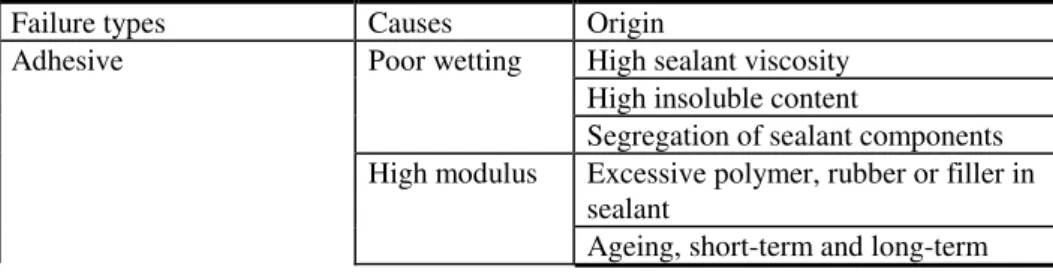
Sealant failure can be adhesive or cohesive, and there can be sealant loss. Adhesive failure occurs when the sealant/asphalt concrete (AC) interface can no longer sustain the shear and tensileforces imposed by the traffic and the pavement contraction that occurs in cold weather. A weak interface stems from poor intrinsic sealant properties (viscosity, adhesion, viscoelasticity, aging resistance) and from extrinsic factors (sealant installation, joint design, substrate properties). A high sealant viscosity during installation can lead to adhesive failure because of the insufficient wetting of AC and the lack of sealant penetration into the irregular aggregate surface (see Figure 4, [5]). At 185°C, sealant viscosity is 5-70 Pa•s [6]. Within 5 minutes, a liquid with viscosity of 90 Pa•s can wet and fill 0.1 mm deep microvoids but it may take several hours for a high viscosity liquid to do the same, if there is wetting at all [7]. The adhesion of a sealant is thus governed not only by its pouring viscosity but also by its cooling rate, i.e., rate of increase in viscosity, which is faster at, say, 7ºC, a common low limit for crack sealing, than at higher temperatures. The content and the size of recycled rubber particles in the sealant, if any (see Figure 3, [5]), may also be of importance as they may prevent good wetting. It is noteworthy, however, that sealants with low application viscosities, relative to others at the same temperature, do not necessarily show the best performance [8], possibly because they contain little of the elastomer that provides elasticity in low temperatures.
Away from the interface, the rheological properties of the sealant bulk, i.e., modulus and stress relaxation, gain importance. Zanzotto [8] demonstrated that sealants with little debonding in cold climates showed significant stress relaxation after sudden extension at
− 30°C, whereas sealants with poor field performance were hard and brittle. Aging can also reduce elasticity and bring adhesive failure. Short-term aging, i.e., the conditions applied to sealant during installation, can embrittle the material and affect its performance [6], whereas long-term aging can reduce elasticity because of the loss of plasticizing oil in the sealant [9]. Aging will be reviewed in more detail later with the laboratory evaluation of sealants.
When sealants fail in cohesion, they split within the bulk of the material. This type of failure occurs mainly in sealants with large aspect ratios (depth/width) [10], and stems mainly from brittle fracture in low temperatures when tensile forces exceed the cohesive strength of the sealant. It is not excluded, however, that cohesive shear failure also occurs during spring thaw when the soft sub-grade allows greater joint deflection.
The other type of sealant failure, sealant loss, is the disappearance of sealant from a crack or rout. This loss can be partial or complete [3], hence, there is more than one cause for sealant loss. At the onset is adhesive failure but it is superimposed onto another, ill understood, failure mechanism. Complete sealant loss likely occurs when the sealant is rubbery, when it can be stretched and pulled-out of the crack by moving vehicles. Casual observation reveals that this occurs in summer and during spring thaw. In summer, sealant may flow excessively under the sudden forward pressure of rolling tires and be pulled-out by vehicles. Failure would then stem from excessive mid-temperature flow (40-70°C). Failure during spring is likely due to the combined exposure to freezing and thawing of the AC/sealant interface and the increased exposure to shear caused by the greater deflection of the subgrade. In contrast, the partial disappearance of sealant likely stems from embrittlement at low temperatures, when it can more easily fracture upon loading. After debonding the sealant can then be freed from the crack. Table 1 summarizes sealant failure modes, as they relate to the material itself, and the associated conditions.
Table 1: Crack sealant failures, their causes, and possible intrinsic origin*
Failure types Causes Origin
Adhesive Poor wetting High sealant viscosity
High insoluble content
Segregation of sealant components High modulus Excessive polymer, rubber or filler in
sealant
Incompatibility Weak aggregate-sealant interaction Cohesive High modulus Excessive polymer, rubber or filler in
sealant Low shear
strength
Short-term ageing
Sealant loss - partial Embrittlement High glass transition temperature Excessive asphalt content in sealant Ageing
- complete Pull-out Excessive flow
Poor freeze-thaw resistance Shear sensitive
*Excludes failures related to construction, e.g., geometry
3. Current specifications
Sealants are typically selected empirically using a standard based on penetration, resilience, flow, and bond to cement concrete briquettes, that is, ASTM D3405. There is, however, no indication of the pertinence of these standard tests to predicting performance [11]. The 25°C penetration test is useful for measuring the consistency or the viscosity of unmodified bitumen but it does not correlate with the properties of polymer modified bitumen [12,13], which include bituminous crack sealants.
The resilience test is also performed at 25°C. The test provides an indication of elasticity, and as such, it is temperature dependent. Considering that the temperature-elastic response of viscoelastic materials is non-linear [14], it is clear that cold temperature performance of sealants cannot be assessed by the resilience test. The data in Table 2 show that the results from the resilience test do not correlate with elongation in winter temperatures, when sealant elasticity is critical.
Table 2: Sealant resilience and elongation in low temperatures [3]
Sealant ∆ L* at – 37°C (%) Resilience** at 25°C (%) E 700 73 F 300 42 C 120 59 D 100 62 A 25 57 M 6 61
G 6 51 * as per ASTM D 638 [15]
** as per ASTM D5329 [16]
The flow test stems from work on neoprene modified bitumen [17]. This work showed that flow could be conveniently measured by heating a sample resting at an angle of 75° to the horizontal. The standard flow test specified for sealants is similar. A sealant resting at an angle of 75° while at 60°C must flow less than 3 mm. It is claimed that flow allows for measuring degradation during heating [4], but no evidence exists to support this claim. In contrast, sealant degradation can be measured by infrared spectroscopy [18] and viscometry [6].
The standard bond test is probably the most controversial test. Crack movement is two orders of magnitude faster than in service. The sample is short, so end-effects can be significant. Temperature is fixed and often higher than the winter minimum temperature where sealant is used. Bond is measured on cementitious briquettes, even if sealant is used on AC. Aggregate type is discounted. This is an important consideration, because adhesion depends on the composition of the aggregate and that of the binder. About 40% of the cross-sectional area is occupied by the binder, bitumen or hydrated Portland cement. As will be discussed later, the existing specification also disregards both the short-term aging that occurs during installation at 170-200°C, and the long-term aging that occurs during service. It also neglects the possible segregation of sealant components during heating, and the effect that insolubles may have on wetting and adhesion.
Because of the lack of correlation between field and standard test conditions, standard test results do not reflect field performance (Table 3).
Table 3: Sealant acceptance based on ASTM D3405 and field tests [6] Sealant 4-year performance ASTM acceptance
H good no B good yes E good no F average no M average yes L average yes D average yes J average no K poor yes
A poor no
C very poor no
G very poor no
4. Laboratory studies
4.1 AgeingSealant ageing can occur during installation (short-term aging) and in service (long-term aging). Studies of short-term aging are few but they all demonstrate that sealants are affected by heating at installation temperatures. Massonet al. [6] measured significant changes in the viscosity of twelve sealants stored for 1-6 h at 185ºC, conditions typical of installation. This change was attributed to thermal degradation of the polymer component of the sealant, and it was demonstrated that heating had a significant effect on sealant performance at low temperatures. Graham and Lynch [19] showed that penetration was reduced by aging. They showed that size exclusion chromatography (SEC) could detect changes in the polymer and the bitumen components of sealants and that those changes were product dependent. They also suggested that SEC coupled with infrared spectroscopy would best determine the type of degradation that may occur in the sealant. Oba [20] used rheometry to study the effect of heat on sealants stored at 175°C for one hour. He showed that sealants respond differently to heat aging. In some sealants, bitumen oxidized, in others, polymer degraded, and in others still, viscosity increased although SEC fails to show any change in sealant structure. These SEC results are noteworthy, as they indicate that degradation may not be chemical but physical, i.e. sealant components segregate upon heating.
Likewise, there are few studies that have been conducted on the long-term aging of bituminous crack sealants. In trying to simulate weathering, Minkarah et al. [21] exposed sealants to 600 h of UV light after which time sealants showed scaling. The same effect was obtained within 300 h by Masson and Lauzier [22] when UV exposure was combined with freezing and thawing. Masson and Lacasse [9] showed that after one year of service a sealant can lose polymer and a significant amount of oil.
4.2 Sealant rheology
Rheology is concerned with the study of flow. It relates to sealant installation, material stiffness and stress relaxation in service. The rheological profile of sealants and bituminous products can be obtained by several methods (Table 4).
Table 4: Rheological and thermal methods of analysis for bituminous materials
Method* Test mode Typical range
(°C)
Sample geometry Dynamic
DMA, DSR tension-compression – 70 to 0 prism or disc
or dynamic shear 0 to 80 disc (5 g)**
80 to 200 enclosed Transient
DTT, Instron tension – 40 to 0 dogbone (5 g)
BBR flexion – 35 to 20 prism (30 g)
Viscometry shear 150 to 200 enclosed (200-500 g)
Thermal
MDSC temperature scan – 170 to 400 enclosed (10-20 mg)
TMA volume expansion – 170 to 80 disc (0.1-1 g)
* DMA, dynamic mechanical analysis; DSR, dynamic shear rheometry; DTT, direct tensile test; BBR, bending beam rheometer; MDSC, modulated differential scanning calorimetry; TMA, thermo-mechanical analysis. ** Approximate sample mass required in specimen preparation.
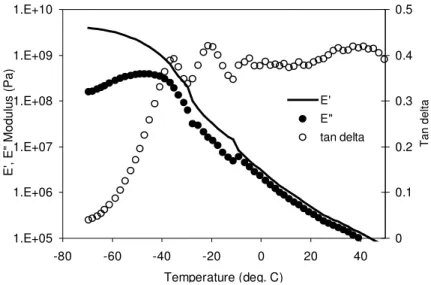
Dynamic mechanical analysis (DMA), applied in the range of – 80 to + 80°C by Goodrich [12], was used to determine the rheology of bitumen and polymer modified bitumen. Figure 1 shows DMA curves for the loss modulus (E”), the storage modulus (E’), and tan δ (E”/E’) obtained on a crack sealant [23]. Both E” and tan delta are measures of the energy dissipation associated with stress relaxation [24]. The maximum in tan δ coincides with the glass transition temperature (Tg), below which a component is rigid and above which it is rubbery.
In Figure 1, the tan δ curve shows a maximum centered at – 35°C and another at – 20°C. From the breadth of the transitions, it can be seen that sealant stiffening begins at – 10°C and that it is complete at about – 40°C. E’ shows that in this temperature range, the modulus increases one hundred fold and reaches about 1GPa at – 40°C.
1.E+05 1.E+06 1.E+07 1.E+08 1.E+09 1.E+10 -80 -60 -40 -20 0 20 40 Temperature (deg. C) E ', E " Modulus ( P a) 0 0.1 0.2 0.3 0.4 0.5 T an delt a E' E" tan delta
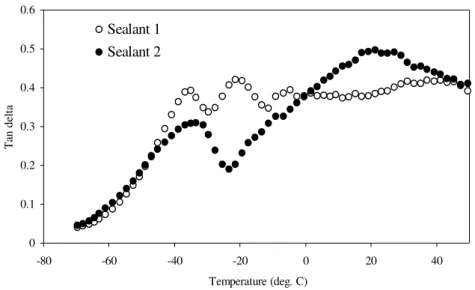
Figure 1: Dynamic mechanical analysis of a bituminous crack sealant. The storage modulus (E’) is useful for obtaining the limiting glassy modulus and assessing temperature susceptibility whereas tan δ is useful for obtaining Tg, below which the sealant is rigid. Figure 2 shows tan δ for two sealants. Sealant 1 is the same as in Figure 1 but Sealant 2 has a single Tg at – 35°C that is lower in amplitude than that for Sealant 1. From the breadth of the transition it is apparent that sealant 2 begins stiffening at – 20°C, and that it has stiffened almost completely at – 50°C. The lower amplitude of the tan δ peak (E”/E’) also indicates that Sealant 2 can more easily dissipate cyclic stresses than Sealant 1, i.e., stress relaxation is greater. DMA thus relates the viscoelastic sealant properties to modulus and stress relaxation, both of which have great practical importance. What is needed for a specification is a correlation between DMA results and field performance so that threshold values for E” and E’ can be established.
0 0.1 0.2 0.3 0.4 0.5 0.6 -80 -60 -40 -20 0 20 40 Temperature (deg. C) Tan del ta Sealant 1 Sealant 2
Figure 2: Tan δ profiles for two bituminous crack sealants. At low temperatures, Sealant 2 shows a single Tg at – 35°C whereas Sealant 1 shows two Tgs associated with its main components.
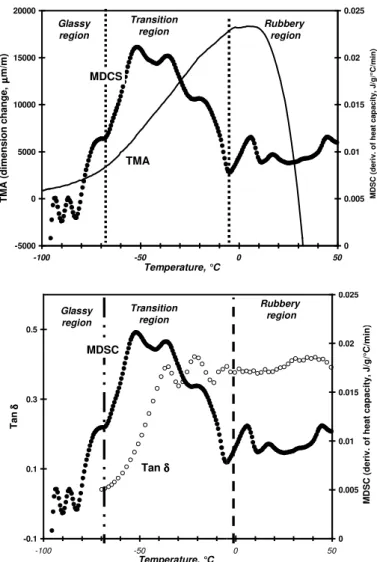
Tg can also be obtained with modulated differential scanning calorimetry (MDSC) and thermo-mechanical analysis (TMA). These methods are more rapid than rheological methods and require less sample preparation. The correspondence between DMA, MDSC, and TMA is illustrated in Figure 3.
Other methods, of more limited temperature range have also been used to obtain information on the rheology of sealants and bituminous products. Working at low temperatures, Zanzotto [8] used the Instron to measure stress relaxation, as mentioned earlier. With a similar instrument, the direct tensile tester (DTT), Bahia [25] measured the strain at break in polymer-modified bitumen, but Ferland [26] could not obtain the same on crack sealants because strain exceeded 10%, the limit of the DTT. Attempts to use the bending beam rheometer (BBR) to measure sealant stress relaxation also failed due to excessive sealant softness and deflection [8,26].
In the range 5-85°C, the dynamic shear rheometer (DSR) can be used to assess sealant modulus and stress relaxation, and indirectly assess sealant degradation due to installation [20]. At 170-200°C, the rheological behavior of sealants is best obtained with a shear viscometer. Both Masson et al. [6], and Zanzotto [8] measured the shear viscosity of crack sealants and suggested the use of an upper viscosity limit to ascertain proper sealant flow during installation. Viscosity has not been related to adhesion or performance, however.
-5000 0 5000 10000 15000 20000 -100 -50 0 50 Temperature, °C TM A (dim ension change, µµµµ m/ m) 0 0.005 0.01 0.015 0.02 0.025 M DS C ( d eri v. o f h eat cap aci ty, J/ g /° C/ m in ) Glassy region Rubbery region Transition region TMA MDCS -0.1 0.1 0.3 0.5 -100 -50 0 50 Temperature, °C Tan δδδδ 0 0.005 0.01 0.015 0.02 0.025 MD S C (d er iv. o f h eat cap acity, J/g /°C /m in ) Tan δδδδ==== Glassy region Transition region Rubbery region MDSC
Figure 3: Tan δ, MDSC and TMA profiles for Sealant 1. All three techniques allow for measuring Tg, the temperature at which the sealant goes from a rubbery to a glassy state. TMA (top) is the most rapid technique and easiest to interpret. The change in slope can be related to modulus. MDSC, for which the heat capacity (Cp) is obtained, shows much details when the derivative is used. It is highest in the Tg region. Tan δ from Figure 2 (bottom), serves as a reference.
4.3 Sealant adhesion
that depends directly on interatomic and intermolecular forces between the adherent and the substrate. It has been shown [27] that sealant adhesion can depend on aggregate composition, with adhesion to siliceous aggregates sometimes half that obtained to limestone. The effect of adhesion on performance is difficult to assess, however, because in practice bond strength is measured. The latter depends not only on adhesion, but also on fracture mechanics and rheology.
This is demonstrated by a comparison of the results from Masson and Lacasse [27], and Zanzotto [8] who independently measured the bond strength of sealants to concrete by bringing sealant-concrete assemblies to tensile failure. In both studies bond strength was taken as the energy required to bring the assemblies to failure. Masson and Lacasse [27] measured energies of 200-500 J/m2 at – 37°C whereas Zanzotto [8] obtained values of 500-1000 J/m2 at – 30°C. The bond strength was greater at – 30°C than at – 37°C but this does not indicate that adhesion was greater. It only indicates that the sealants extended more at higher temperatures and that more energy was spent in stretching the sealant. In an effort to overcome the shortcomings of the tensile adhesion test and those of the standard test, Masson and Collins [28] used electrical resistivity as a measure of adhesion (Figure 4). In this test, the resistance to mass transfer across the sealant/AC interface is measured.
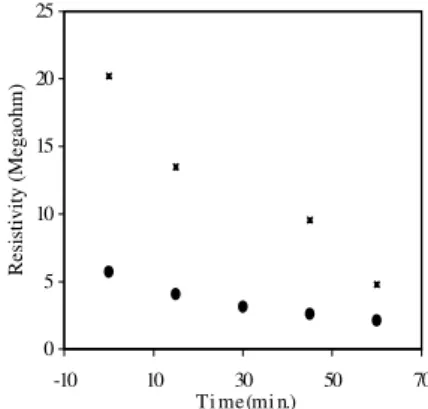
Figure 4: Sketch of the resistivity test. Figure 5: Time dependent resistivity of the crack sealant/AC interface obtained for a high pouring (square) and a low pouring (circle) viscosity sealant.
The test is based on the hypothesis that strong adhesion slows mass transfer along the interface more than weak adhesion. The sealant-substrate assembly is placed in a bath
Ohmmeter Sealant Substrate Water Salt solution electrodes 0 5 10 15 20 25 -10 10 30 50 70 T i m e (m i n.) R e si stivity ( M egaohm)
that contains a salt solution on one side and water on the other. Consequently, the system is not at equilibrium. To attain a steady-state, a thermodynamic process drives the salt through the barrier such that the salt concentration increases on the water side. The preferred path of salt diffusion is along the sealant/substrate interface where resistance to diffusion is lower than through the sealant or the substrate.
Figure 5 shows the rate at which the resistivity changed over time for two sealants, one with a pouring viscosity of 18 Pa•s at 185°C, and the other with a pouring viscosity of 10 Pa•s at 185°C. The absolute resistivity may relate to the strength of adhesion, as provided by a given sealant composition in dry conditions, whereas the rate of change in resistivity may be an indication of water sensitivity. The greater change in resistivity shown by the higher viscosity sealant might indicate a water susceptible bond, but this remains uncertain. For resistivity to be taken as an indicator of adhesion, it must be demonstrated that resistivity relates to wetting. In other words, that resistivity is directly proportional to pouring viscosity, and inversely proportional to substrate roughness.
5. Future perspective
Based on established sealant specifications in Canada, it is difficult to select sealants that provide long-term performance and durability. As seen, this situation stems from the mismatch of field and standard test conditions. A performance-based specification would potentially rectify the situation. To obtain this specification, a number of elements must be brought together. Firstly, the short-term and long-term aging rates and mechanisms for various sealant compositions must be established so that they can be reproduced and accelerated in laboratory tests. The use of the rolling thin-film oven test, oven aging and pressure-aging vessel can be anticipated for this task. It is doubtful that UV aging would be useful in this specification because of the long time it requires to obtain results. Secondly, the relationship between fundamental sealant characteristics and field performance must be established. This implies that field performance is measured over several years, and correlated to rheological behavior in the spectrum of service temperatures obtained before and after aging. Many techniques could be used to obtain the fundamental bulk characteristics of bituminous materials, including, dynamic mechanical analysis, dynamic shear rheometry, direct tensile testing, bending beam rheometry, and thermo-mechanical analysis. None of the techniques have been stan-dardised for use with crack sealants, and no control parameters have been established. It could be expected that selection of a specific method would be based on an assessment of suitability for quality control, reproducibility and repeatability, and ease of use.
Other tests like insolubles content, viscosity and adhesion, more closely related to sealant interfacial properties, must also be part of a performance-based specification. Viscosity and solubility tests are simple, it is the threshold values that would need to be established. The adhesion test is possibly the most difficult one to conceive. It must determine the suitability of sealants to adhere to various pavements components, namely
acidic or alkaline aggregates, bitumen, and hydrated Portland cement. The adhesion test could be a tensile test, but the rheological contribution to bonding would have to be rec-ognised. Alternatively, the electrical conductivity across the sealant/substrate interface might be used to assess adhesion, but much development is required in this case.
6. References
1. Panek, J.R. and Cook, J.P., ‘Construction and Sealant Adhesives’, Third Edition (John Wiley, New York, USA, 1991).
2. Peterson, D.E., ‘Resealing Joints and Cracks in Rigid and Flexible Pavements’, NCHRP Synthesis of Highway Practice 98 (Transportation Research Board, Washington, District of Columbia, USA, 1982).
3. Masson, J-F., Lauzier, C., Collins, P. and Légaré, P-P., ‘Crack sealant performance in cold urban conditions’, Canadian Journal of Civil Engineering 26 (1999), in print.
4. Anonymous, ‘ASTM D3405-96 - Standard Specification for Joint Sealants, Hot-Applied, for Concrete and Asphalt Pavements’ (American Society for Testing and Materials, Philadelphia, USA, 1996).
5. Masson, J-F. and Lacasse, M.A., ‘A review of adhesion mechanisms at the crack/asphalt concrete interface’, in ‘Durability of Building and Construction Sealants’, Proceedings of International RILEM Symposium, A.T. Wolf, ed. (RILEM Publications, Paris, France, 2000).
6. Masson, J-F., Lauzier, C., Collins, P. and Lacasse, M.A., ‘Sealant degradation during the crack sealing of pavements’, Journal of Materials in Civil Engineering
10 (1998) 250-255.
7. Vakula, V.L. and Pritykin, L.M., ‘Polymer Adhesion: Basic Physico-Chemical Principles’ (Ellis Horwood Ed., New York, USA, 1991).
8. Zanzotto, L., ‘Laboratory Testing of Crack Sealant Materials for Flexible Pavements’ (Transportation Association of Canada, Ottawa, Canada, 1996). 9. Masson, J-F. and Lacasse, M.A., ‘Towards a performance-based specification for
bituminous crack sealants used in urban conditions’, in ‘Proceedings of the Pavement Crack and Joint Sealants for Rigid and Flexible Pavements Conference, Vicksburg, USA, May 21-22, 1997’ (US Army Corps of Engineers, Waterways Experiment Station, Airfields and Pavements Division, Vicksburg, USA, 1997) 152-167.
10. Wang, C.P. and Weisgerber, F.E., ‘Effects of seal geometry on adhesive stresses in pavement joint seals’, Transportation Research Record 999 (1993) 64-70.
11. Lynch, L.N. and Janssen, D.J., ‘Sealant specifications: Past, present and future’, in ‘Proceedings of the Pavement Crack and Joint Sealants for Rigid and Flexible Pavements Conference, Vicksburg, USA, May 21-22, 1997’ (US Army Corps of Engineers, Waterways Experiment Station, Airfields and Pavements Division. Vicksburg, USA, 1997) 5-23.
performance of asphalt concrete mixes’, Proceedings of the Association of Asphalt
Paving Technologists 57 (1988) 116-175.
13. Lu, X. and Isacsson, U., ‘Characterization of styrene-butadiene-styrene polymer modified bitumens: Comparison of conventional methods and dynamic mechanical analyses’, Journal of Testing and Evaluation 25 (1997) 383-390.
14. Ketcham, S.A., ‘Sealants and Cold Regions Pavement Seals: A review’, Report 95-11 (U.S. Army Corps of Engineers, Cold Regions Research & Engineering Laboratory, Hanover, USA, 1995).
15. Anonymous, ‘ASTM D-638 - Standard Test Method for Tensile Properties of Plastics’ (American Society for Testing and Materials, Philadelphia, USA, 1987). 16. Anonymous, ‘ASTM D-5329 - Standard Test Method for Sealants and Fillers,
Hot-applied, for Joints and Cracks in Asphaltic and Portland Cement Concrete Pavements’ (American Society for Testing and Materials, Philadelphia, USA, 1996).
17. Hoiberg, A.J., ‘Bituminous Materials: Asphalt, Tars and Pitches, Volume 1: General Aspects’ (Robert E. Krieger Publishing Company, Huntington, USA, 1979).
18. Masson, J-F., Pelletier, C. and Collins, P., ‘A rapid FTIR method for the quantification of SB-type copolymers in bitumen’, Energy and Fuel, submitted for publication.
19. Graham, R.T. and Lynch, L.N., ‘Gel Permeation Chromatography Analysis of Asphalt-Based Joint Sealants’, Report GL-93-13 (US Army Corps of Engineers, Waterways Experimental Station, Vicksburg, USA, 1993).
20. Oba, K., ‘Rheological Measurements of Bituminous Materials Using Dynamic Shear Rheometry: Study on Joint Sealants’, Report FE-156-800 (EMPA, Swiss Federal Laboratories for Materials and Testing and Research, Dübendorf, Switzerland, 1996).
21. Minkarah, I., Cook, J.P. and Rajagopal, A.S., ‘Applicability of artificial weathering tests for performance evaluation of elastomeric sealants’, in ‘Science and Technology of Building Seals, Sealants, Glazing and Waterproofing’, Second Volume, ASTM STP 1200, J.M. Klosowski, ed. (American Society for Testing and Materials, Philadelphia, USA,1992) 201-221.
22. Masson, J-F. and Lauzier, C., ‘Crack Sealant Evaluation: Aging and Performance’ (in French), Report A-2016.4 (Institute for Research in Construction, National Research Council of Canada, Ottawa, Canada, 1993).
23. Masson, J-F., Polomark, G. and Collins, P., in preparation.
24. Ferry, J.D., ‘Viscoelastic Properties of Polymers’, Third Edition (John Wiley, New York, USA, 1980).
25. Bahia, H.U., ‘Critical evaluation of asphalt modification using strategic highway research program concepts’, Transportation Research Record 1488 (1995) 82-88. 26. Ferland, D., private communication (Ministère des Transports du Québec, Québec,
Canada, 1998).
adhesion’, Journal of Transportation Engineering 125 (1999), in print. 28. Masson, J-F. and Collins, P., in preparation.
![Table 2: Sealant resilience and elongation in low temperatures [3]](https://thumb-eu.123doks.com/thumbv2/123doknet/14204625.480643/5.892.129.660.145.353/table-sealant-resilience-elongation-low-temperatures.webp)
![Table 3: Sealant acceptance based on ASTM D3405 and field tests [6]](https://thumb-eu.123doks.com/thumbv2/123doknet/14204625.480643/6.892.130.507.698.909/table-sealant-acceptance-based-astm-d-field-tests.webp)