Publisher’s version / Version de l'éditeur:
Vous avez des questions? Nous pouvons vous aider. Pour communiquer directement avec un auteur, consultez la
première page de la revue dans laquelle son article a été publié afin de trouver ses coordonnées. Si vous n’arrivez pas à les repérer, communiquez avec nous à [email protected].
Questions? Contact the NRC Publications Archive team at
[email protected]. If you wish to email the authors directly, please see the first page of the publication for their contact information.
https://publications-cnrc.canada.ca/fra/droits
L’accès à ce site Web et l’utilisation de son contenu sont assujettis aux conditions présentées dans le site LISEZ CES CONDITIONS ATTENTIVEMENT AVANT D’UTILISER CE SITE WEB.
Symposium on Advance in Fire Suppression Technologies [Proceedings], pp. 1-11, 2005-10-01
READ THESE TERMS AND CONDITIONS CAREFULLY BEFORE USING THIS WEBSITE.
https://nrc-publications.canada.ca/eng/copyright
NRC Publications Archive Record / Notice des Archives des publications du CNRC :
https://nrc-publications.canada.ca/eng/view/object/?id=4507284d-420e-4318-bd80-4ee8bfc1364f https://publications-cnrc.canada.ca/fra/voir/objet/?id=4507284d-420e-4318-bd80-4ee8bfc1364f
NRC Publications Archive
Archives des publications du CNRC
This publication could be one of several versions: author’s original, accepted manuscript or the publisher’s version. / La version de cette publication peut être l’une des suivantes : la version prépublication de l’auteur, la version acceptée du manuscrit ou la version de l’éditeur.
Access and use of this website and the material on it are subject to the Terms and Conditions set forth at Local application of water mist for fire suppression
http://irc.nrc-cnrc.gc.ca
Loc a l a pplic at ion of w at e r m ist for fire
suppre ssion
L i u , Z . G . ; K i m , A . K . ; S u , J . Z . ; C a r p e n t e r , D . W .
N R C C - 4 7 6 7 6
A version of this document is published in / Une version de ce
document se trouve dans: Symposium on Advance in Fire
Suppression Technologies, San Diego, CA., Oct. 18, 2005, pp.
1-11
LOCAL APPLICATION WATER MIST SYSTEMS FOR FIRE SUPPRESSION
Liu, Z.1, Kim, A. K., Su, J. Z. and Carpenter, D. Fire Research Program, Institute for Research in Construction National Research Council of Canada, Ottawa, Canada, K1A 0R6
E-mail: [email protected]
INTRODUCTION
The development of water mist fire suppression technology has made substantial progress over the last decade. It has been used to replace techniques no longer deemed environmentally acceptable, such as halons, or to provide answers to problems where traditional technologies have not been effective [1-6]. Water mist systems, according to their applications, have been distinguished into three types: total compartment application (TCA), local application (LA) and zoned application (ZA) systems [7]. For a TCA system, water is discharged from all nozzles distributed throughout the compartment. A large and enclosed fire can be extinguished by a TCA system as the oxygen concentration in the compartment is quickly dropped due to the consumption by the fire and the displacement by water vapour. However, it is difficult for a TCA system to extinguish small or hidden fires [8], and water damage may result, as a large quantity of water is discharged. An LA water mist system, like a zoned application system, extinguishes a fire mainly by cooling flames or by cooling the fuel surface. It is arranged to discharge directly to an object or hazard in an enclosed, partially enclosed, or open outdoor area. It extinguishes small and hidden fires more effectively than a TCA system. LA water mist systems have been used to provide the protection for engine test cells, bulk conveyors, flammable liquid storage racks, commercial cooking areas and industrial oil cookers [9-12]. However, the requirements for an LA system in water mist characteristics (droplet size distribution, spray momentum, discharge rate), spray pattern and discharge direction are more strict and complex than a TCA system. Their performance in fire suppression is changed not only with the water mist characteristics employed, but also with the fire scenarios encountered (e.g. fuel type, size and location) and the configuration of the LA system around the protected object. Although the fire extinguishing mechanisms of the LA water mist system are generally understood, commonly accepted engineering basis and criteria for spray characteristics do not exist [13]. Tests are required to qualify every use of the water mist system for new applications and extrapolation of system applications is generally not permitted. The requirement of extensive fire testing dramatically increases the cost and time of developing a water mist fire suppression system.
Over the years, the National Research Council Canada (NRCC) has studied LA water mist systems for the protection of electrical/electronic facilities [9], commercial kitchen areas [10] and industrial oil cookers [11], and has developed a multiple-purpose portable water mist fire extinguisher [12]. This paper describes NRC’s research on local application of water mist fire suppression technology. Water mist extinguishing mechanisms in different local applications are discussed and the key parameters required
1
for successful fire suppression are identified. The impact of fire scenario and water mist system characteristics on the effectiveness of local application are also discussed.
LOCAL/ZONE APPLICATION MIST SYSTEMS FOR ELECTRONIC EQUIPMENT ROOM PROTECTION
Available fuels in an electronic equipment room range from cables with plastic coatings, circuit boards and wiring inside cabinets to plywood, paper and tape cartridges. Fires in such spaces are usually small and slow-growing and some of them are located inside the equipment. NRC studies by Mawhinney [9] established the basic design requirements for a local/zoned water mist system to protect a control room underfloor, individual electronic switchgear cabinets and arrays of cable trays. The fires used in the studies included PC board fires inside the cabinet, cable bundle fires on the floor and overhead cable tray fires.
A variety of water mist systems with different spray characteristics in extinguishing a fire in electronic equipment were tested, and some of these systems included very fine (Dv0.9 = 20 μm) and very low momentum mist generated from a
super-heated system to a high flow rate and high momentum mist system with a large spray angle (Dv0.9 = 300 μm, 150 degree). The nozzles of these water mist systems were placed
at different locations in respect to the fire sources to study the effect of the nozzle location, discharge direction and distance on water mist performance.
More than 100 fire suppression tests were conducted. The experimental results showed that water mist was capable of extinguishing small fires in an electronic equipment room. The manner in which the mist was injected to the fire sources and corresponding water mist characteristics were critical to extinguish the fire. Inappropriate selection of nozzles and spray characteristics and inappropriate nozzle locations would either waste water or fail to extinguish fires. Some key findings were as follows:
1. Direct fuel cooling played an important role for water mist in extinguishing small fires in a PC board and in electrical cables. The water vapour generated in such fire suppression was very limited and some quickly dispersed away from the protected object. The vapour concentration was insufficient to affect oxygen concentration to assist fire suppression. Fire tests with a super-heated water system showed that oxygen concentration inside the test cabinet only dropped 0.3%, even though 16 kg of super-heated water were discharged into the cabinet in a 30 s period.
2. Very fine sprays with low momentum and low mass flow rate were ineffective to extinguish small fires occurring in the electronic equipment and in the electric cables. Many of them were suspended in the air and had difficulty penetrating and reaching the fires. The drifting of fine mist throughout the room raised humidity and condensation levels even in areas far from the fire.
3. Coarser sprays (200 < Dv0.9 < 400 μm) demonstrated better performance than very
penetrate through the fire and reach the fuel to produce wetting of surfaces, and water dripped down into recessed areas.
4. Reliable fire suppression could be achieved only by spraying directly to the hazard. The ability of water mist to extinguish fires inside cabinets was not achieved by increasing spray energy, spray velocity, drop size or flux density, but rather by controlling the spray direction relative to the alignment objects inside. 5. Water mist nozzles should be selected and located so that the spray direction and
the flux density distribution could be reasonably well fitted in respect to the fire source.
The water mist fire suppression system needs to be carefully engineered to suppress fires in electrical and electronic equipment. There are some critical requirements for the water droplet size, spray angle, spray momentum, discharge direction, nozzle location as well as flow rate for successful fire suppression with less water damage to electrical and electronic equipment.
LOCAL APPLICATION MIST SYSTEMS FOR COMMERCIAL KITCHEN AREA PROTECTION
A cooking oil fire in a deep fryer presents a severe hazard to the commercial kitchen area and is difficult to extinguish. Cooking oil fires ignite at high temperatures and the bulk of the hot oil in the deep fat fryer is difficult to be cooled to below its ignition point. In addition, the composition of cooking oil is changed during heating and fire suppression, resulting in a new auto-ignition temperature that is lower than its original one [10]. Unless the oil is cooled to below this new auto-ignition temperature, the fire would re-ignite after extinguishment. Many traditional fire suppressants, such as foam, powder and carbon dioxide could not effectively extinguish cooking oil fires due to their limited cooling capacity [14].
The use of an LA water mist system for extinguishing cooking oil fires was studied [10, 15]. The requirements for water mist characteristics (e.g., discharge pressure, flow rate, spray coverage area and nozzle location, etc.) in extinguishing a cooking oil fire over the deep fat fryer with a frying area of 305 mm by 381 mm were investigated. Three water mist fire suppression systems with different mist characteristics were developed and evaluated in full-scale experiments. System #1 had fine droplet size (Dv0.9=120 microns at discharge pressure of 35 bar) but low water flow
rate. It generated a spray with a hollow cone. System #2 generated a solid spray cone (60 degrees) with fine drop sizes (Dv0.9=170 microns at discharge pressure of 21 bar).
System #3 had a solid spray cone at 90 degrees and generated drop sizes of Dv0.9=200
microns at 21 bar of discharge pressure. The water flow rates of both Systems #2 and #3 were higher than System #1.
For each system one nozzle was installed at the top front of the fryer and aimed at the center of the deep fat fryer in the tests. The effect of the discharge pressure, and the distance between the nozzle and the oil surface on water mist performance was investigated in the experiments.
The experimental results demonstrated that water mist was capable of extinguishing the cooking oil fires in a deep fat fryer without burning oil being splashed outside. Water mist also cooled the hot oil to below its ignition temperature and prevented the oil from re-ignition. Fire extinguishing times ranged from 1 to 15 s, depending on the type of water mist system employed, discharge pressure and distance between the nozzle and the oil surface. Some key findings from the experiments were as follows:
1. Flame and fuel cooling, and dilution of fuel vapour by steam were the dominant cooking oil fire extinguishment mechanisms for an LA water mist system, especially the fuel cooling by water mist prevented the hot oil from re-ignition. Water flow flux, spray coverage over the oil surface and spray momentum were considered as the three most important factors for the performance of water mist systems in extinguishing a cooking oil fire.
2. To extinguish a cooking oil fire, the water quantity discharged from an LA system must be sufficient. Raising discharge pressure and reducing discharge distance from the nozzle to the oil surface could reduce extinguishing time and cooling time, as the water quantity reaching the oil surface was increased. Figure 1 shows the reduction in extinguishing time and cooling time with an increase in discharge pressure.
Discharge Pressure (bar)
10 12 14 16 18 20 22 24 26 28 30 Ti me (s) 0 2 4 6 8 10 12 14 16 18 20 22 24 26 Extinguishing Time Cooling Time
Figure 1. Extinguishing time and cooling time versus discharge pressure
cover the entire oil surface to ensure sufficient water density distribution. System #1 generated fine water drops and sufficient water flux as well as spray momentum for fire suppression, but it could not extinguish the fires even under high discharge pressure (48 bar). Its hollow cone spray could not cover the entire oil surface. The oil fire was enlarged during suppression with System #1.
4. To extinguish a cooking oil fire, the water spray should have sufficient momentum to penetrate the fire plume and reach the oil surface. This could be achieved by increasing discharge pressure, reducing discharge distance from the nozzle to the oil surface or employing relatively coarse water drops. Water mist systems #2 and #3 effectively extinguished cooking oil fires with discharge pressure around 13.7 bar (200 psi). System #3 had better performance than System #2 under the same discharge pressure, not only because of its higher water flow rate and larger spray coverage, but also because of its higher spray momentum with coarser drops than System #2.
PORTABLE WATER MIST FIRE EXTINGUISHER
A portable water mist fire extinguisher is a typical LA water mist system. Portable water mist fire extinguishers were studied for extinguishing four types of fires: Class A fire (wood and paper), Class B fire (liquid fuel), Class C fire (electrical fire) and Class K fire (cooking oil) [12, 16]. The performance of two extinguishers with different water mist characteristics, and different discharge approach was investigated.
Extinguisher #1 had a spray angle of 120 degrees at 2 bars. With the increase in discharge pressure, the spray angle was reduced to 75 degrees at 20.4 bar (300 psi). The spray angle of Extinguisher #2 was 60 degrees at 2 bars and had a slight decrease with the increase in discharge pressure. The droplets produced by Extinguisher #1 (Dv0.9=290
micron at 13.6 bar) were coarser than those generated by Extinguisher #2 (Dv0.9=190
micron at 13.6 bar). Droplet sizes became smaller with an increase in discharge pressure for both extinguishers. The water flow rate of Extinguisher #1 (16.8 Lpm at 13.6 bar) was higher than that of Extinguisher #2 (11.6 Lpm at 13.6 bar). This resulted in a short discharge duration for Extinguisher #1 than Extinguisher #2. The water flux density of both extinguishers changed with spray angle and discharge distance.
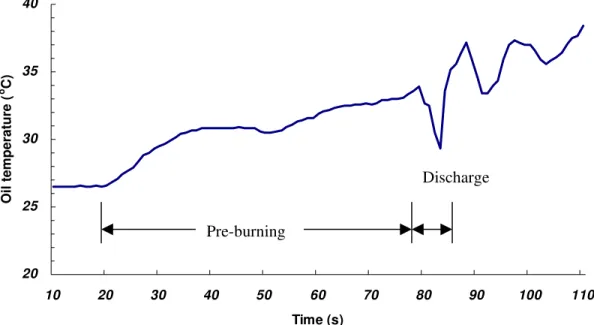
The dominant water mist extinguishing mechanisms and extinguishing process were changed with the fuel type and the water mist characteristics. For Class A, C and K fires that have high flash points, the fuel cooling by water mist is the primary extinguishing mechanism, while for Class B fires that have low flash points, such as a heptane fuel fire, the flame cooling by water mist is the primary extinguishing mechanism. As shown in Figure 2, when water mist was discharged onto a cooking oil fire and extinguished it, the oil was cooled down substantially from its burning temperature (356oC). However, as shown in Figure 3 in a test with heptane fuel, the fuel temperature during fire suppression had only a few degree changes. Water has no substantial cooling effect on the heptane fuel, since its temperature during firing is not high (<40oC).
Time (s) 300 350 400 450 500 550 Te mp era ture ( o C) 0 100 200 300 400 500 600 700 800 oil temperature (25.4 mm deep) oil temperature (50.5 mm deep) fire temperature (50 mm above oil surface) fire temperature
(100 mm above oil surface)
fire free burning period discharge period
Figure 2. Variation of oil and fire temperatures with time in a cooking oil fire test involving a portable water mist extinguisher
A fire flare-up might be generated in suppression, depending on the fuel property. For a Class A fire involving wood crib, the use of a mist extinguisher did not generate a fire flare-up, because a less volatile fuel was generated. The extinguishing time and amount of water required to extinguish a wood crib fire, however, were much longer and larger than those for a liquid fire. The wood crib fire was a three dimensional fire and extinguished mainly by cooling the fuel surface. Water mist must reach every fuel surface to extinguish a wood crib fire. For a liquid fuel fire, water mist could extinguish it quickly with less water quantity.
20 25 30 35 40 10 20 30 40 50 60 70 80 90 100 110 Time (s) Oil temperature ( o C) Discharge Pre-burning
Figure 3. Variation of heptane fuel temperature with time
In order to use a water mist fire extinguisher to extinguish multiple types of fires, appropriate water mist characteristics, spray pattern and discharge approach are critical. Extinguisher #1 was capable of extinguishing the four types of fires, while Extinguisher #2 could extinguish Class A, C and K fires but not Class B fires, because its small spray angle could not effectively separate flames from the fuel surface and prevent flames from flashing back. For the same type and size of fire, Extinguisher #1 was also more effective than Extinguisher #2 due to its large spray angle and high water flow rate.
The discharge manner of an extinguisher in fire suppression was also critical for successful suppression. For liquid fuel fires, such as Class B and K fires, the spray coverage of the extinguisher must be large enough to cover the entire fuel surface, otherwise the fire could not be extinguished. For a Class A fire involving wood crib, the requirement for the size of the spray coverage is less critical. However, the water spray with large spray angle extinguished the wood crib fire more quickly than that with a small spray angle. Also, the water mist spray shall be applied systematically side by side to a crib fire during suppression and to ensure that the limited water quantity supplied from an extinguisher is not wasted.
LA MIST SYSTEMS FOR INDUSTRIAL OIL COOKER PROTECTION
Fire extinguishment in an industrial oil cooker by water mist is similar to that in a deep fat fryer in a commercial kitchen area. However, the industrial oil cooker has a very large oil surface up to several hundred square feet and a large amount of hot oil up to tens
of thousands of litters. A large hood over the oil pan is a part of the cooker, which confines a part of the flame and steam during fire suppression.
The water mist characteristics required for extinguishing large cooking oil pool fires as well as the effect of hood position and oil pan size on the fire suppression performance were studied [11, 17]. Two water mist systems were developed and evaluated in the full-scale fire experiments. System I had a water flow rate per nozzle ranging from 28.2 L/min at 414 kPa to 40.9 L/min at 862 kPa discharge pressure. Under a pressure of 5.52 bar (80 psi), 50 and 90% of the spray volume were in drops smaller than 250 and 380 microns, respectively. The spray angle of the nozzle was 150 degrees and did not change with an increase in discharge pressure. The water droplets generated by water mist system II were relatively coarser. Under a pressure of 5.52 bar (80 psi), 50 and 90% of the spray volume were in drops smaller than 300 and 540 microns, respectively. The water flow rate per nozzle varies from 19.1 L/min at 414 kPa to 24.3L/min at 862 kPa discharge pressure. Its spray angle was substantially decreased with an increase in discharge pressure, 120 degrees at 207 kPa but 80 degrees at 896 kPa.
Full-scale experiments demonstrated that water mist was capable of extinguishing the large oil cooker fires without oil splashing outside. Water mist also effectively cooled a large quantity of the hot oil to below its flashing point (200oC) and prevented the oil from re-ignition. The oil cooling rate was approximately 100oC/min. The fire extinguishing times ranged from 4 to 18 s, depending on the water mist system employed, discharge pressure, hood position and the oil cooker size. The water mist extinguishing mechanisms for large oil pool fires were largely by fuel cooling and flame cooling. The water flow rate (or water density), spray coverage and momentum are three important characteristic parameters required for an LA water mist system to extinguish a large pool oil fire. Theoretical analysis suggested that the water quantity required to extinguish the canola oil fire by cooling the flame and the oil was 6.6 kg/m2.min and 2.48 kg/m2.min, respectively.
The average water density over the oil surface generated by both water mist systems was very close, however, System I had better performance than System II due to its large spray angle and relatively uniform water density distribution. An increase in discharge pressure enhanced the extinguishing performance of System I but worsened System II because its coverage area was reduced with an increase in discharge pressure. As shown in Figures 4 and 5, increasing the discharge pressure resulted in a decrease in gas temperatures under the tip of the nozzle for water mist system I, but led to an increase in the gas temperatures for water mist system II.
Gas Temperature (oC) 100 120 140 160 180 200 220 240 260 280 300 320 340 Ve rt ical Di sta nce abo v e Bo tto m of O il Pan ( c m ) 0 20 40 60 80 100 120 100 psi 60 psi Discharge pressure Gas Temperature (oC) 100 120 140 160 180 200 220 240 260 280 300 320 340 360 380 400 Ve rti c a l Di s tance abo v e Bot to m of Oil Pan (cm ) 0 20 40 60 80 100 120 100 psi 120 psi Discharge Pressure
Figure 4. Variation of gas temperatures along vertical distance (5 s after discharge, system I)
Figure 5. Variation of gas temperatures along vertical distance (5 s after discharge, system II)
Experimental results showed that the spray coverage of the nozzle could be extended when a group of nozzles were employed. The extinguishing time did not increase with an increase in the oil pan size, if the operating conditions of the system, the elevation of the nozzle to the oil surface and spray coverage area per nozzle remained unchanged with the oil pan size. This suggested that a water mist system could give consistent fire suppression performance for pool fires with different sizes if the system met certain requirements. This will reduce a number of tests required to extrapolate the application of a water mist system.
The hood position in the oil cooker also had an impact on the extinguishing performance of water mist. The quantity of the gases and steam confined inside the cooking equipment changed with the hood position. For all tests, the extinguishing time was reduced with the hood being placed from the ‘up’ position to the ‘down’ position, as the clearance between the nozzle tip and the hood ceiling was reduced. The hood down position reduced the amount of hot gases and flames near the ceiling that could not be hit by water mist.
SUMMARY
The applications of the LA water mist system in fire suppression have been studied. The fuel and flame cooling are its dominant extinguishing mechanisms. There are some critical requirements for the water droplet size, spray coverage, spray momentum, discharge direction, nozzle location as well as flow rate for successful fire suppression, based on the fire scenarios encountered. For example, very fine sprays with low momentum and low mass flow rate are ineffective to extinguish small fires occurring in the electronic equipment and in the electric cables. Water mist must be able to penetrate the fire plume and reach the fuel to cool it. It is also required that the water spray covers the entire fuel surface to extinguish an open liquid fire. Qualitative requirements for mist characteristics of an LA system in fire suppression have been
identified. Further work is needed to make quantitative analysis and investigate how to extrapolate an LA system for different applications.
ACKNOWLEDGEMENTS
Mr. J. Mawhinney, formerly with NRC and now with Hughes Associates, conducted studies of water mist application for electronic equipment room protection. The authors would like to acknowledge Mr. Ping-Li Yen of CAFS Unit for his contribution to the studies of water mist systems for commercial kitchen areas, industrial oil cookers protection, and multiple-protection mist extinguishers. The authors would also like to thank Drs. Soonil Nam and H. Z. Yu of FM Global for their input to NRC studies of industrial oil cooker protection.
REFERENCES
1. Liu, Z. and Kim, A. K, “A Review of Water Mist Fire Suppression Systems – Fundamental Studies,” J. of Fire Protection. Engineering, 10 (3), 2000, pp 32-50 2. Notarianni, K. A., “Water Mist Fire Suppression Systems,” Proceedings of Technical
Symposium on Halon Alternatives, Society of Fire Protection Engineers and PLC Education Foundation, Knoxville, TN, 1994.
3. Back, G.G. "An Overview of Water Mist Fire Suppression System Technology," Proceedings: Halon Alternatives Technical Working Conference, Albuquerque, New Mexico, 1994, p. 327.
4. Mawhinney, J.R. and Richardson, J.K., "A Review of Water Mist Fire Suppression Research and Development," Fire Technology, Vol. 33, No. 1, 1997, pp. 54-90. 5. Mawhinney, J.R., "Engineering Criteria for Water Mist Fire Suppression Systems,"
Proceedings: Water Mist Fire Suppression Workshop, NIST, Gaithersburg, MD, 1993, p. 37.
6. Mawhinney, J.R., "Water Mist Fire Suppression Systems: Principles and Limitations," International Conference on Fire Protection in the HVDC Industry, Vancouver, Canada, 1995.
7. Grant, G., Brenton, J., and Drysdale, D., “ Fire Suppression by Water Sprays,” Progress in Energy and Combustion Science, Vol. 26 pp. 79-130, 2000.
8. Liu, Z. and Kim, A. K., “A Review of Water Mist Fire Suppression Systems – Application Studies,” J. of Fire Protection. Engineering, 11 (1), 2001
9. Mawhinney, J. R., “Findings of Experiments Using Water Mist for Fire Suppression in an Electronic Equipment Room,” Proceedings: Halon Options Technical Working
Conference 1996, Albuquerque, New Mexico, USA, 1996
10. Liu, Z., Kim, A. K., Carpenter, D., Kanabus-Kaminska, J. M. and Yen, P. L., “Extinguishment of Cooking Oil Fires by Water Mist Fire Suppression Systems,” Fire Technology, 40, (4), October 2004.
11. Liu, Z., Carpenter, D. and Kim, A. K., “Application of Water Mist to Extinguish Large Oil Pool Fire for Industrial Oil Cooker Protection,” 8th International Symposium for Fire Safety Science, Sept. 2005, Beijing, China.
12. Liu, Z. A. K. Kim, Carpenter, D. and Yen, P. L., “Portable Water Mist Fire Extinguishers as an Alternative for Halon 1211,” Proceedings: Halon Options
Technical Working Conference 2001, Albuquerque, New Mexico, USA, 2001
13. Yu, H. Z, Dobson, P. H., Ferron, R., Barsamian, C., Hanna, M. and Gameiro, V., “An Extrapolation Methodology for Pool Fire Extinguishment by Local Application Water Mist Systems,” 7th International Symposium for Fire Safety Science, May 2002, Worcester, USA.
14. Edwards, N., “A New Class of Fire,” Fire Prevention, Vol. 310, p. 8, June 1998. 15. Liu, Z. G., Kim, A. K., and Carpenter, D.W, “Suppression of cooking oil fires using
water mist technology”, 3rd International Water Mist Conference, Madrid, Spain, 2003-09-22
16. Liu, Z. G.; Kim, A. K.; Carpenter, D. W.; Yen, P. L. "Extinguishment of Liquid Fuel Fires by Local Application of Water Mist" 2001 Combustion Institute/Canadian Section, Spring Technical Meeting, Montreal, Canada, May, 2001
17. Liu, Z. G., Kim, A. K., and Carpenter, D.W, “Extinguishment of large cooking oil
pool fires by the use of water mist systems”, 2004 Combustion Institute/Canadian