subduction system: The Hellenides
The MIT Faculty has made this article openly available. Please share
how this access benefits you. Your story matters.
Citation
Burchfiel, B. C., et al. “Crustal Development within a Retreating
Subduction System: The Hellenides.” Geosphere, vol. 14, no. 3, June
2018, pp. 1119–30. © 2018 The Authors
As Published
http://dx.doi.org/10.1130/GES01573.1
Publisher
Geological Society of America
Version
Final published version
Citable link
http://hdl.handle.net/1721.1/118319
Terms of Use
Creative Commons Attribution-NonCommercial 4.0 International
Crustal development within a retreating subduction system:
The Hellenides
B.C. Burchfiel
1,*, L.H. Royden
1,*, D. Papanikolaou
2, and F.D. Pearce
31Department of Earth, Atmospheric, and Planetary Sciences, Massachusetts Institute of Technology, Cambridge, Massachusetts 02139, USA 2Department of Geology and Geoenvironment, National and Kapodistrian University of Athens, Panepistimioupoli Zografou, 15784 Athens, Greece 3P.O. Box 11960, Portland, Oregon 97211, USA
ABSTRACT
In retreating subduction systems, where the subduction rate is faster than the convergence rate between the upper and lower plates, the processes by which the upper plate crust is constructed have not been well understood. From our studies in the Hellenides, which formed above a retreating slab, we conclude that the external part of the Cenozoic Hellenide orogen was con-structed from rocks derived from the subducting plate at least at two crustal levels. The upper crustal level within the external Hellenides consists of west-vergent thrust sheets emplaced progressively from east to west along a regional décollement from ca. 35 Ma to present. These thrust sheets consist of Mesozoic and Cenozoic strata that have been stripped from their underlying basement to form the Hellenides. The middle and lower crustal layer consists of slices of continental crust detached from the downgoing slab at depth and accreted below the upper crustal thrust sheets. These accreted slices repre-sent ~35% (or less) of the crust belonging to the subducting lithosphere; the remainder of the crust appears to be subducted with the slab. While the pro-cess of slab rollback may be continuous at depth, the episodic detachment of crustal slices guarantees that rollback is step-like in time at the crustal level. As the subducted lithosphere rolled back beneath the Hellenides, it passed progressively from east to west through the region occupied by present-day lower crust and mantle, where there is a well-defined Moho. Any irregulari-ties that may have been present at the base of the accreted slabs have been smoothed by processes that remain to be determined.
INTRODUCTION
Orogenic systems may be associated with either advancing or retreating subduction boundaries (Royden and Burchfiel, 1989). In the former, the rate of subduction is slower than the rate of overall plate convergence, leading to significant shortening of the continental crust within the overriding plate. In the latter, the rate of subduction is greater than the rate of convergence, and, regionally, the overriding plate may be in a state of extension. Within
advanc-ing systems, construction of a crustal edifice on the overridadvanc-ing plate occurs as the crust is thickened through shortening and high mountain ranges are formed. This process may be augmented by a net increase in crustal mass of the overriding plate as some of crustal material from the downgoing plate is transferred to the overriding plate. Because of the high topography typically developed within these systems, they are commonly deeply eroded and ex-pose deeper crustal sections from a few kilometers deep to levels locally near Moho depths (the term deeper crustal sections as used throughout the rest of the paper). The Western Alps, Dinarides, and Anatolides are examples of this style of orogenesis, where they form moderate to high mountains with-out contemporaneous regional extension during their development within the Mediterranean region.
Within retreating subduction systems, the trench moves away from the overriding plate, and the upper plate is generally in regional extension. Never-theless, shortening and thrusting of sedimentary units commonly occur at the leading edge of the upper plate. The Hellenides, Apennines, and Carpathians are Mediterranean examples of such orogenic systems.
Because regional extension leads to overall thinning of the crust in retreat-ing systems, it is not clear how the deeper crust adjacent to the subduction boundary is constructed or maintained under these conditions. Because of the generally low topography of such orogenic systems, erosion is commonly minimal, and the deeper crust is not exposed. Hence, direct observation of deformational processes in the deep crust is not available for study in such systems, and the mechanism by which the deep crust is developed is not well understood.
In this paper, we focus on the process of crustal construction beneath the external Hellenide thrust belt. This retreating orogenic system is relatively well understood, at least in its external (western) part. Thrusting within the orogen involves detachment of sedimentary rocks at depths of 5–10 km along the lead-ing edge of the orogen. As the trench continues to roll back from the overridlead-ing plate during subduction, the way in which crust is added to the overriding plate at greater depth is not clear. As part of our work in the Hellenide region, we have made a series of geological and seismological observations that shed light on how the process of crustal accretion and construction may occur in the Hellenides, as well as in other orogens that have formed in an environment of retreating subduction.
GEOSPHERE
GEOSPHERE; v. 14, no. 3doi:10.1130/GES01573.1 8 figures
CORRESPONDENCE: bcburch@ mit .edu CITATION: Burchfiel, B.C., Royden, L.H., Papani‑ kolaou, D., and Pearce, F.D., 2018, Crustal devel‑ opment within a retreating subduction system: The Hellenides: Geosphere, v. 14, no. 3, p. 1119–1130, doi:10.1130/GES01573.1.
Science Editor: Raymond M. Russo Associate Editor: Gianreto Manatschal Received 14 June 2017
Revision received 29 November 2017 Accepted 13 February 2018 Published online 12 March 2018
OPEN ACCESS GOLD
This paper is published under the terms of the CC‑BY‑NC license.
© 2018 The Authors
THE CENOZOIC HELLENIDE OROGEN
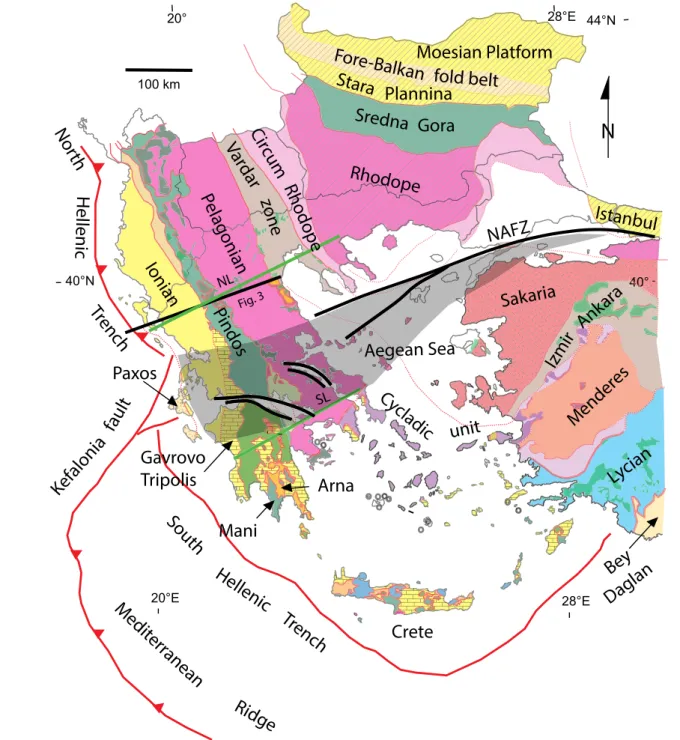
The Hellenide orogen lies between the Aegean Sea and the Adriatic-Ionian seas (Figs. 1 and 2). The Hellenide orogen has been one of the classic areas for understanding orogenic processes within the Alpine system of the Mediterra-nean region. The seminal work of Aubouin (1957, 1977), Aubouin et al. (1963, 1970, 1976), and more recent work by Papanikolaou (summarized in Papaniko-laou, 2009, 2013) emphasizes that deformation of the Hellenides was the result of progressive shortening of upper crust from northeast to southwest from the Eocene to present. This is manifested by NW-trending folds and west-vergent thrust faults (Fig. 1). Extension in the Aegean domain began in Eocene time and is coeval with subduction and thrusting along the retreating Hellenic sys-tem (e.g., Jolivet and Brun, 2010; Le Pichon and Kreemer, 2010).
During the Cenozoic, shortening by thrusting in the northern and southern Hellenides involved mainly similar paleogeographic units, with comparable timing and thrust stacking, until Late Miocene time. The along-strike struc-tures of the external Hellenides have been disrupted in Pliocene time by the ENE-trending central Hellenic shear zone (comprising the Kefalonia-Corinth– North Anatolian fault systems; Fig. 1) separating the Hellenides into northern and southern parts (Papanikolaou and Royden, 2007). The central thrust struc-ture has been generally preserved, from the southern Hellenides, where thrust structure has been modified by significant Late Cenozoic extension. These extensional structures are exposed on the Peloponnese, Crete, and regions beyond (Royden and Papanikolaou, 2011).
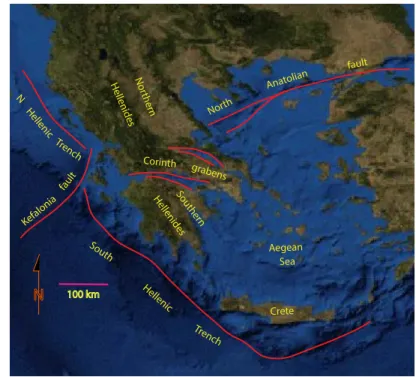
The differences in structure between northern and southern Hellenides are expressed in the topography of the two domains. The northern Hellenides con-sist of NW-trending mountain ranges and valleys, while the southern Hellenides have more irregular and generally lower topography. Extension in the eastern internal southern Hellenides has resulted in the region being largely submerged and exposed only on islands (Figs. 1 and 2). In contrast, analogous units present in the internal northern Hellenides are exposed in a series of northwest-trending ranges that ascend to high elevation. Because the southern Hellenides were sub-jected to superposed extension that has disrupted the original thrust stack, there is considerable uncertainty about how to construct and quantitatively interpret cross sections through the southern Hellenides (Royden and Papanikolaou, 2011). However, the same extensional structures that complicate our understanding of thrust belt structure in the southern Hellenides also expose deeper parts of the crust, providing data that contribute to an understanding of deep crustal defor-mation and construction of the deeper crust (e.g., Jolivet et al., 2010).
In the following sections, we first examine the structure of the northern Hel-lenides where the thrust geometries are best constrained. Here, it is possible to make a quantitative restoration of thrust sheets, which highlights the problems associated with construction of the deeper crust. Later, we discuss how com-parable thrust structures have been disrupted by extensional faulting, compli-cating the structure but also providing a window into the structure and com-position of the deeper Hellenic crust. This offers limited but important data on how the lower crust of the overriding plate is developed during trench rollback.
NORTHERN HELLENIDES
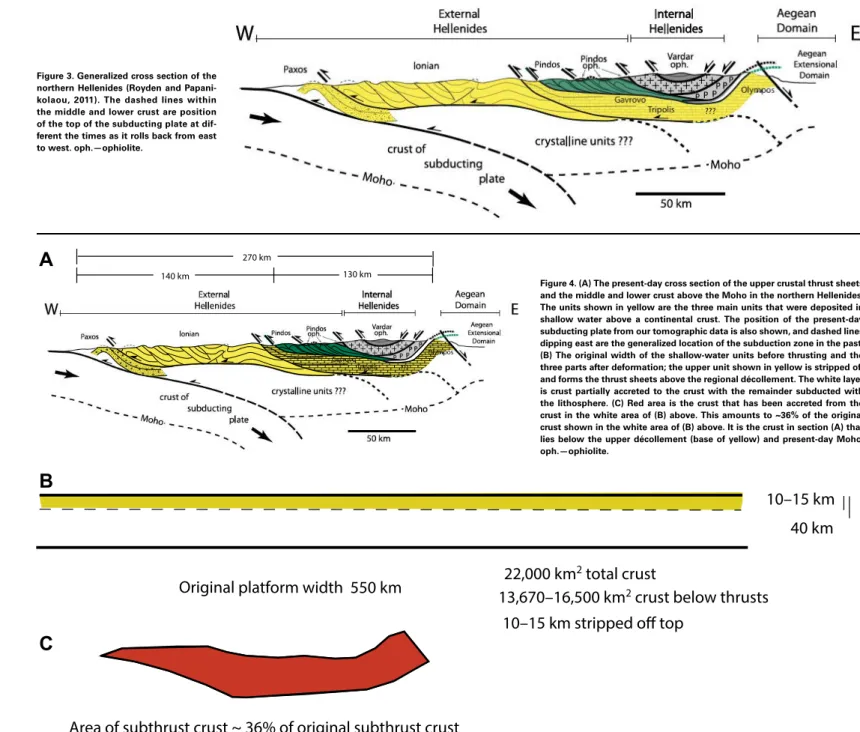
The northern Hellenides expose an upper crust consisting of thin thrust sheets of upper crustal rocks (5–10 km thick). In the east, in the internal Hel-lenides where the structurally highest units are exposed, lithologies are dominated by metamorphic and metasedimentary rocks. In the west, in the external Hellenides, the thrust sheets are dominated by Mesozoic sedimen-tary rocks (Fig. 3). It is in this western part of the thrust complex that res-toration can best take place because there is little section missing from the original paleogeographic units as shown by their lateral continuity across the region.
The paleogeographic units within the thrust sheets consist from east (inter-nal) to west (exter(inter-nal) of: an oceanic terrane (Vardar zone) of ophiolitic rocks thrust westward above the Pelagonian continental crustal unit; the Pelagonian unit in turn was thrust over the Pindos Mesozoic deep-water unit, which may have been deposited on either a thin continental or locally (?) oceanic crust (Aubouin, 1957). Structurally below the Pindos unit are thrust sheets of the external Hellenides that form from a broad platform of shallow-water strata underlain by continental crust of varying thickness. These are made up by the Gavrovo-Tripolis, Ionian, and Paxos units (the external Hellenic platform, Figs. 1 and 3). All these units were developed by early rifting that has added complexity to the details of their stratigraphy and influenced development of subsequent thrusting.
The internal units of the Hellenides were imbricated and thrust westward in Mesozoic and Early Cenozoic time, and at the end of the Early Cenozoic, the internal Hellenide units were thrust westward above the external Hellenide units. Within the external Hellenides, thrusting began in latest Eocene time and progressed westward through time. Today, continental crust below the eastern Adriatic Sea is being subducted eastward beneath the northern Hellenides, and its sedimentary cover is being detached into west-vergent thrust sheets (Papanikolaou, 2009).
Beneath the shallowly derived units of the Hellenides in the Mount Olym-pus area is a thin slice of high-pressure metamorphic rocks that lie above a platform section of Mesozoic rocks. The latter are correlated with the Gavrovo- Tripolis unit exposed to the west in the external Hellenides. West of and be-low the internal units are slices of ophiolitic rocks lying above and probably derived from the Pindos unit. The Pindos unit overlies thrust sheets of the external Hellenides (Fig. 3).
The common interpretation of the external structural units in the north-ern Hellenides is as a series of thrust sheets that involve the Mesozoic and Cenozoic sedimentary rocks that lie above a thrust décollement. This décollement is inferred to extend across the entire width of the northern Hellenides and to separate the Gavrovo-Tripolis, Ionian, and Paxos paleo-geographic units from pre-Mesozoic rocks that have not been involved in Late Cenozoic deformation (Fig. 3). This poses the question as to how the deeper part of the crust has been constructed beneath the external Hellenides.
o o o o o oooooo o oo o o o o o o o o o o o o o o o oo o oo o o o ooooo
100 km
44°N
40
40
40
40°
40
4444 °
0°
00
40
40
-28°E
20°
40°N
20°E
28°E
o o000000
44444444
Nor
th
Helleni
c
Trench
NAFZ
-Moesian Platform
Fore-Balk
an
Stara Plannina
fold belt
Sredna Gora
Rhodope
Sakaria
Va
rdar
zone
Istanbul
Cir
cu
m
Rh
od
op
e
Pelagonian
Pindos
Gavrovo
Tripolis
Ionia
n
Paxos
Arna
Mani
Menderes
Izmir
An
ka
ra
Lycian
Cycladic
unit
Mediterranean
Ridg
e
fault
Kefalonia
Sou
th
Helleni
c
Trench
Be
y
Daglan
Aegean Sea
Fig. 3NL
SL
Crete
N
Figure 1. Tectonic units in the Aegean re-gion. The external Hellenides that are the focus of this paper extend from west of the Vardar zone to the active subduction systems in the northern and southern Hellenic trenches. In Late Miocene time, the external Hellenides were divided into two parts by the central Hellenic shear zone (shaded), the western extension of the North Anatolian fault zone (NAFZ). The line of cross section shown in Figure 3 is located in black as are the two tomo-graphic profiles (NL—northern line; SL— southern line) green lines of Figure 6.
There is a clear issue related to the volume of the deeper crust beneath the Hellenic orogen. The crustal thickness is ~50 km beneath the central part of the northern Hellenides but thins to ~45 km in the east where a large, east-dip-ping normal fault forms the eastern boundary of the northern Hellenides and separates them from the region of thinner Aegean crust to the east (Pearce et al., 2012). On the western side of the Hellenides, the crust thins toward the modern subduction zone (Fig. 3). Because the Gavrovo-Tripolis, Ionian, and Paxos thrust sheets extend across the entire northern Hellenides, the crust be-low must be constructed from rocks bebe-low their décollement. Thus, although the structure of the shallow thrust sheets is fairly clear, the structure of the crust beneath the décollement at the base of these units and its mechanism of construction are not clear.
THE PROBLEM OF THE DEEPER CRUST
Thrust structures exposed at the surface account for the structure of only the upper 5–10 km of crust of the northern Hellenides. These units have been stripped from the downgoing plate and incorporated into the overlying plate
during the process of trench retreat and slab rollback. As the downgoing slab continues to roll back to the west and be subducted into the mantle, are deeper- level rocks, beneath the décollement, transferred from the downgoing to the overriding plate? If not, where does the material come from to build the middle and deep crust of the northern Hellenides? If so, then how much crust is trans-ferred from the lower to the upper plate, at what depth, and what structures accommodate this transfer? Because the Gavrovo-Tripolis, Ionian, and Paxos thrust sheets extend across the entire northern Hellenides, the crust below must be constructed from rocks below their décollement. Because of initial rift-ing durrift-ing their development, the details of the structure of the thrusted units are complex, but do not change the first order interpretation of the structure.
Reconstructions by Royden and Papanikolaou (2011) based on analysis of isostasy, paleogeography, and modeling of subduction rates indicate that, prior to subduction, the continental crust of the shallow-water external Hel-lenic platform was probably ~25–30 km thick and ~550 km wide (Fig. 4). They conclude that 12–18 km of continental crust were stripped from the subducting plate and incorporated into the upper plate crust. Volumetrically, this provides for almost all the crust beneath the northern Hellenides to be derived by accre-tion from the downgoing plate via the following estimates.
A cross-sectional area of ~12–18 km × 550 km2 (or ~7000–10,000 km2) has
been removed from the downgoing plate and added to the overriding plate. The current width of the northern Hellenides is ~270 km, with an average crustal thickness of ~40 km, for a total cross-sectional area of ~10,800 km2. Thus it is
plausible that the crust of the northern Hellenides is composed almost exclu-sively of material scraped off from the subducting Adriatic plate. Moreover, if the Adriatic crust was ~30–35 km thick prior to subduction (see Di Bona et al., 2008), then approximately one third to half of that crust has been incorporated into the northern Hellenides, and the remainder subducted to depth. If correct, then there must be deep levels below the Gavrovo- Tripolis, Ionian, and Paxos detachment, where crust has been transferred from the Adriatic plate to the northern Hellenides during subduction. We assume the entire northern Hel-lenides was built by Paleogene and younger shortening—hence, the volume balance. Reconstruction of sedimentary units in the belt gives a minimum of 550 km. This is consistent with geodynamic modeling with 10–15 km removed from the 550 length of the plate.
MIDDLE AND LOWER CRUST
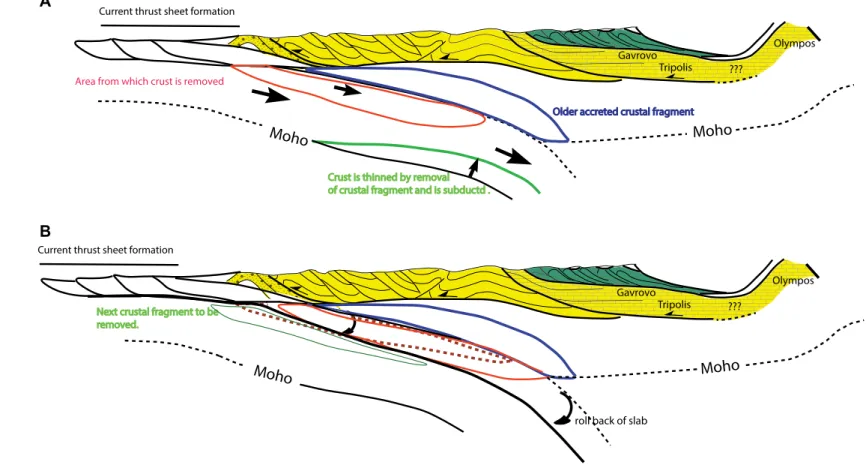
We propose that middle and lower crust of the northern Hellenides may have been formed by slices removed from the Adriatic continental crust as it was subducted. These slices were accreted at depth (below the décollement at the base of the Gavrovo-Tripolis, Ionian, and Paxos units) to form the middle and lower crust (Fig. 5). At the same time, the shallow-level thrust sheets of the Gavrovo-Tripolis, Ionian, and Paxos units, which form the uppermost crust, were detached from the subducting plate at shallower depth and, due to the east dip of the subducting plate, farther to the west.
Nor thern Hellenides So uth ern Hellenides Kefalonia fault Hellenic Sou th Trench Trench Hellenic N Crete Aegean Sea Anatolian North fault
Corinth grabens
100 km
N
Figure 2. Topography within Aegean region showing the topographic expression of the major tectonic elements discussed in the text. Division of northern and southern Hellenides as dis-cussed in the text are highlighted.
Figure 3. Generalized cross section of the northern Hellenides (Royden and Papani-kolaou, 2011). The dashed lines within the middle and lower crust are position of the top of the subducting plate at dif-ferent the times as it rolls back from east to west. oph.—ophiolite.
22,000 km
2total crust
Original platform width 550 km
40 km
10–15 km
13,670–16,500 km
2crust below thrusts
10–15 km stripped off top
Area of subthrust crust ~ 36% of original subthrust crust
A
B
C
l ll l ll ll l l l Gavrovo Tripolis Olympos ??? 140 km 130 km 270 kmFigure 4. (A) The present-day cross section of the upper crustal thrust sheets and the middle and lower crust above the Moho in the northern Hellenides. The units shown in yellow are the three main units that were deposited in shallow water above a continental crust. The position of the present-day subducting plate from our tomographic data is also shown, and dashed lines dipping east are the generalized location of the subduction zone in the past. (B) The original width of the shallow-water units before thrusting and the three parts after deformation; the upper unit shown in yellow is stripped off and forms the thrust sheets above the regional décollement. The white layer is crust partially accreted to the crust with the remainder subducted with the lithosphere. (C) Red area is the crust that has been accreted from the crust in the white area of (B) above. This amounts to ~36% of the original crust shown in the white area of (B) above. It is the crust in section (A) that lies below the upper décollement (base of yellow) and present-day Moho. oph.—ophiolite.
Many of the details of this process remain unclear. Figure 5 is a prelimi-nary and simplified interpretation of how the middle and lower crust might be constructed during subduction. There is little evidence available for a detailed analysis because in a retreating subduction system that has experienced little erosion, complete unreworked crustal sections are rarely exposed except by extension, such as in the southern Hellenides.
Based on the isostatic and subduction models of Royden and Papanikolaou (2011) and seismic profiles presented in the following section, we propose the following. Slices of crust from the downgoing Adriatic plate have sheared off and progressively accreted to the upper plate. In addition to the shallowest level of detachment, a deeper level system has also transferred crust from
the downgoing to the overriding plate, forming deep imbricated structures in the overriding plate. The reminder of the Adriatic crust has subducted with the downgoing slab (Fig. 5).
The seismic data presented below suggest that these deeper level crustal slices are detached at, or move downward to, depths of up to 30 km, before final transfer and accretion to the overlying edifice (Fig. 5). Because of the gen-tle eastward dip of the subducting plate at shallow depth, the subhorizontal décollement at the base of the upper crustal thrust sheets (Gavrovo-Tripolis, Ionian, and Paxos units) extends considerably farther toward the foreland (west) than where the deep slices are detached from the downgoing crust. The base of these deeply accreted slices might be expected to form a very irregular
roll back of slab Gavrovo Tripolis Olympos ??? r o ? Gavr G Gavra G v G rrovo rovo Tripolir o v ro ov Tripoli T pr o ss ??????? Oly Olyyyy ? O yl O yyy ?? ympppm ymmmm y pmmmm
Moho
Moho
Moho
Moho
Area from which crust is removed
Older accreted crustal fragment Current thrust sheet formation
Gavrovo Tripolis Olympos ??? r o ? Gavr G Gavra G v G rrovo rovo Tripolir o v ro ov Tripoli T pr o ss ??????? Oly Olyyyy ?? Ol O yyy ??? ympppm ymmmm y pmmmm
Current thrust sheet formation
A
B
Figure 5. Schematic representation of how the process of sub-thrust crust is constructed in a very recent part of the subducting system. (A) A previously detached slab from the subducting plate is shown in purple. As it is accreted to older slabs, the top of the subducting crust steps to the west at the top of next slab to be detached (red). The subducted plate is thinned (green) after the purple slab has been detached. (B) The original position of the red slab in A is shown dashed (red), and its position after detachment is shown in red. The top of the subducted plate steps from the top to the base of the red slab as it progressively rolls back stepwise. At depth, the rollback may be more uniform. The next crustal slab to be detached from the subducting plate is shown in green.
base to the crust raising the question of how a subhorizontal and well-defined Moho has been formed beneath the northern Hellenides. This Moho must have been formed across the region where the subducted slab carrying both lithospheric mantle and the remainder of the continental crust passed into the mantle during its rollback.
The transition from the pre-orogenic shallow-water carbonate sedimen-tation to the synorogenic flysch occurred throughout the external carbonate platform of the Hellenides in Late Eocene (Priabonian) and lasted until the late stages of the Miocene (except in the most external Paxos unit, where flysch occurred in Late Oligocene and lasted until the Middle-Late Miocene). Thus the period 35–25 Ma is the crucial period when the orogenic migration from Olym-pus to the Ionian and Paxos units took place. This contrasts with the Pindos and inner units, where the transition to flysch occurred in late Maastrichtian and lasted throughout the Paleocene and Early-Middle Eocene, mainly during the period from 64 to 45 Ma. If the present-day geometry of the subduction system is an indication of past subduction geometry, then the subducting slab 35 m.y. ago would have been in the position of Olympus below the eastern-most Gavrovo-Tipolis thrust now at the surface. By rollback, the slab would have migrated westward through the region below the upper crustal thrust sheets to its present position. Therefore the rollback of the subducted slab would have passed through the region of the presently well-developed Moho,
indicating that a relatively smooth Moho has been formed, and perhaps mod-ified, within the region through which the slab rollback took place. Moho for-mation by processes related to magmatic activity can be largely rejected for the northern Hellenides because there is no Late Cenozoic magmatism known in this part of the orogen.
Seismic imaging data across the northern Hellenides (Fig. 6) supports the general structural features as interpreted from the geologic cross section (Fig. 5). Thrust sheets of the Gavrovo-Tripolis, Ionian, and Paxos units are ex-pressed by the low seismic velocities in the upper 10–15 km of the crust. Mi-gration profiles also define a well-developed Moho across most of the image at a maximum depth of ~50 km. The crust thins east and west in a manner sim-ilar to that inferred from the topographic elevation and shown in the geologic cross section (Fig. 3). Importantly, the tomographic image shows an east-dip-ping, imbricate-like character to the lower crust. We interpret this as an imbri-cate structure within the lower crust that does not extend below or through the Moho nor to the shallowest crust, above the shallow-level décollement across the northern Hellenides.
In our interpretation of the geologic and seismological data, the crust must contain at least two structural levels separated by important discontinuities, a shallow upper crust with a basal décollement lying above an imbricated middle and lower crust decoupled from the mantle below. The base of the
A
C
−2
0
50
100
150
−4%
0%
4%
100
200
300
0
100
200
−2
0
50
100
150
−4%
0
4%
300
0
X
NL
(km)
X
NL
(km)
UD
DD
Multiples
NOM
Depth (km)
Depth (km)
100
200
−2
0
50
100
150
−5%
0%
5%
0
Depth (km)
B
X
SL
(km)
100
200
−2
0
50
100
150
−5%
0%
5%
0
Depth (km)
X
SL
(km)
UD
DD
Multiples
SOM
D
Figure 6. Composite images for receiver function migration profiles northern line (NL) and southern line (SL) taken from Figures 5B and 5D and 3B and 3D, re-spectively, from Pearce et al. (2012). They were constructed from delta beta/beta perturbations obtained by 2-D generalized radon transform inversion. They include the structural interpretations (black lines): the up-dip (UD) and down-dip (DD) seg-ments of the subducted crust, the location of the thick subduction channel interface, and the Moho of the overriding plate (NOM and SOM). Black triangles denote the station locations along with 10:1 verti-cal exaggeration in elevation (i.e., negative depth).
lower decoupling zone that is now the Moho must have been generated by processes that postdate the imbrication of the middle and lower crust. Moho formation within the retreating subduction zone has occurred rapidly as indi-cated by the tomographic profile, where most of the Moho must have formed progressively during the past 35 m.y. This smoothly developed Moho extends westward to very close to the position where the downgoing slab currently intersects the base of the overriding crust. The Moho in the migration profiles (Fig. 6) is poorly defined only in its westernmost part where the process of crustal structure formation and modification is active.
The crust below the thrust sheets in the northern Hellenides must be de-rived from part of the continental crust of the Paxos, Ionian, and Gavrovo- Tripolis units because crust originally below the more internal thrust sheets must lie east of Olympus below the Aegean Sea and/or partly or wholly sub-ducted by earlier subduction east of the cross section. This geometry shows that the thrust sheets and the middle and lower crust east of the subducted slab cannot be derived from the present-day slab but must have been derived during successive positions of the slab during its retreat when it lay farther east than the present slab position. Only the parts of the subducted slab that lie within or west of the wedge lying below the developing thrust belt are avail-able to contribute to construction of the middle and lower crust.
The structural elements that appear in the migration profiles are not ex-posed in the northern Hellenides. However, extensional structures that over-print and complicate the regional expression of the thrust structures in the southern Hellenides also expose portions of the crust that lie below the Paxos, Ionian, and Gavrovo-Tripolis décollement. These extensional faults expose deeper units containing geological data that bear on the nature of the forma-tion of the middle and lower crust.
SOUTHERN HELLENIDES
The southern Hellenides are exposed mainly in the Peleponnese south of mainland Greece and display the continuation of Cenozoic tectonic units from the northern Hellenides (Fig. 7). However, these thrusted units were here sub-ject to major extension beginning in Middle Miocene time and continuing to the present (Burchfiel et al., 2008; Papanikolaou and Vassilakis, 2010).
Differences in the structure and evolution of the northern and southern Hellenides became significant by Early to Late Miocene time. Prior to Late Mio-cene time, continental or transitional lithosphere was subducted beneath both the northern and southern Hellenides, resulting in slow rates of subduction and rather limited extension of the upper plate. In Late Miocene time, dense oceanic lithosphere of the Ionian Sea entered the subduction zone south be-neath the southern Hellenides (south of the central Hellenic shear zone), while lower-density continental lithosphere continued to be subducted beneath the northern Hellenides (Royden and Papanikolaou, 2011).
As a result, the rate of subduction increased beneath the southern Helle-nides to 35 mm/yr, ~25–30 mm/yr faster than beneath the northern HelleHelle-nides. The difference in subduction rate beneath northern and southern Hellenides is well expressed by GPS data (McClusky et al., 2000; Reilinger et al., 2006). The increase in subduction rate to the south was accommodated by the increase in the speed of trench rollback and, in part, by extension that disrupted the thrust stack in the southern Hellenides. Other phenomena, such as the westward movement of Anatolia, also may have helped to accommodate the increase rate of trench retreat (i.e., Şengör et al., 2005; Le Pichon and Kreemer, 2010).
As a result, the southern Hellenides in the Peleponnese were subjected to large magnitudes of extension and contain numerous large normal faults,
5 1 2 3 4 6 7 8 9 10 1 2 2 2 3 3 3 4 4 4 5 5 5 6 7 7 8 8 8 9 10 10 10 10 10 décollement décollement décollement
Figure 7. Generalized north-south cross section of Crete compiling data from different parts of major structural units formed during the Oligocene to Middle Miocene. Thrust sheets above the Pin-dos unit are inner Hellenide units. The Pindos unit was emplaced above the Gavrovo and Tripolis units and forms the upper crust above a décollement that separates upper crustal and lower crustal units. The lower crustal units are metamorphosed from lower to medium grade. They were emplaced in Oligocene to Middle Miocene time when they were subjected to extension and cut by normal faults that not only displaced the thrust sequence but also overprinted some of the thrust faults as normal faults. Redrawn from Papaniko-laou and Vassilakis (2010).
some of detachment character (Papanikolaou and Royden, 2007). These faults dip both east and west, cutting the Paxos, Ionian, and Gavrovo-Tripolis décolle-ment, and exposing in their footwalls the rocks below the décollement. Across the Peloponnese, where this basal décollement is exposed in extensional win-dows, it is clear that the upper crust thrust faults of the Paxos, Ionian, and Gavrovo-Tripolis thrust system do not cross the basal décollement and do not involve the metamorphic rocks beneath the décollement (Fig. 1). This is an important observation that can only be inferred, but not directly observed, in the northern Hellenides. However, because the extensional deformation of the southern Hellenides is quite complex, and cannot at present be quantitatively restored, a precise reconstruction of the deeper crust beneath the southern Hellenides is not yet possible.
In our interpretation, the southern Hellenides formed initially by the same process of crustal formation as in the northern Hellenides. However, the struc-ture of the thrust belt in the southern Hellenides differs somewhat from that of the northern Hellenides in that at least some of the shallow-water units have been involved in partial subduction and exhibit a moderate metamorphic grade (Fig. 7). Because of superposed extension during Middle Miocene and later time (ca. 8–12 Ma), there are exposures of the deeper metamorphic rocks, such as the Arna and Mani units. In some papers, these are referred to as the quartzite-phyllite and Plattenkalk units, respectively (Brix et al., 2002; Jolivet et al., 2013).
The Arna unit consists of metamorphic rocks that include Triassic meta-pelite, quartzite, conglomerate, minor limestone, and locally slices of Paleozoic basement rocks (see recent review by Jolivet et al., 2010, and also discussion by Papanikolaou and Vassilakis, 2010). Within the Arna unit are slices that have been metamorphosed under different high-pressure and/or low-temperature (HP/LT) conditions with maximum conditions of 16–18 kbar and 500–550 °C in the Peleponnese (Jolivet et al., 2010). The slices have been juxtaposed so that their P-T conditions vary irregularly both vertically and laterally, suggesting complex relative movement of these rocks during the accretion process (and unlike what is shown on the simplistic cross sections from the northern Hel-lenides) (Fig. 5).
The Mani unit consists of Triassic to Eocene platform and pelagic lime-stone, metamorphosed to greenschist grade but never attained the HP regime of the overlying Arna unit. The Mani unit is commonly interpreted to be a part of the southern Hellenides derived from a location external to the Gavro-vo-Tripolis unit (i.e., part of the Ionian unit). If correct, this suggests that during crustal construction, some fragments of Mesozoic rocks equivalent to those present in the thrust sheets were carried to depth and incorporated into the im-bricate structure below the Paxos, Ionian, and Gavrovo-Tripolis décollement. In contrast, in the northern Hellenides, there is no evidence for section missing from the external paleogeographic elements. There are no exposures of rocks below these metamorphic units, and they represent only the uppermost part of the imbricated crustal section below the Paxos, Ionian, and Gavrovo-Tripolis décollement. There remains more than 20 km of middle and lower crust below them (Pearce et al., 2012).
The process of rollback may not be uniform, and conditions may have only sometimes been favorable for the emplacement of HP/LT rocks into shallower levels as discrete slivers. The thin slices of the HP/LT rocks that form the Arna unit are exposed only within the footwalls of extensional faults (Jolivet et al., 2010). These rocks are not present within the thrust sheets above the décolle-ment and are thus restricted to the sub-décolledécolle-ment crust. These rocks are usu-ally bounded above and below by rocks that never were exposed to the HP/LT conditions, indicating they have moved from deeper to shallower levels while remaining in the subduction channel. These slivers within the Arna unit were redeformed by younger upper crustal extension on low- to high-angle faults. It is at present difficult to determine which kinematic indicators are related to their movement from depth into the imbricated crustal section and which are related to younger reworking by extension. However, it is clear that there has been complex movement of these middle and lower crustal rocks during the accretion process.
CRETE: DEEPER LEVEL EXPOSURE OF THE CRUST
The Island of Crete contains the eastward continuation of structural ele-ments of the Peloponnese with exposures of yet deeper levels of the crust, yielding additional insight into deformation of the Hellenic crust. The upper crust on Crete contains thrust sheets of the inner Hellenides that were em-placed in early Cenozoic time and originated from terrains north of the Pindos unit (Fig. 8; Fig. 7, units 6–10). During Oligocene and Early Miocene time, these were thrust southward onto the Pindos deep-water unit, which in turn was thrust southward onto the external Hellenide units of Gavrovo and Tripolis (Fig. 7, unit 4). As in the northern and southern Hellenides, all of these units are detached from the underlying rocks that form the upper part of the deeper crust (Fig. 7). Unlike on the Peloponnese, where only limited outcrops of the deeper crust lying below the upper crustal detachment are exposed in narrow windows, on Crete, subdetachment units are exposed for lateral distances that demonstrate they are thin sheets for at least 5 km within the crust. Unfortunately, there are no deeper exposures of the lower crustal units. Mapping of the subdetachment units shows they form thin sub-horizontal sheets (Fig. 7, units 1[?], 2, and 3) that were metamorphosed to both lower and medium grade and were interleaved with distinct metamor-phic breaks between them (Papanikolaou and Vassilakis, 2010). On Crete, the Arna unit (Fig. 7, unit 3) was metamorphosed at 400 °C and 8–12 kbar and lies below basal units of the overlying décollement (Tyros beds) metamor-phosed at 300 °C and 2–4 kbar and above the West Crete unit (Fig. 7, unit 2), which was metamorphosed at 350 °C and 3–5 kbar. The Mani unit, the most external unit of the Hellenides exposed on Crete, was metamorphosed at low grade during its thrusting below the Ionian and Gavrovo units (Fig. 7, unit 4). The imbrication of these units shows a complex tectonic interlayering of units during formation of the upper part of the lower crust. Unfortunately, even though deeper levels of the lower crust are exposed in Crete and in
the Peloponnese, there are no exposures anywhere in the Hellenides of the deepest crust, corresponding to perhaps the lower half of the crust that was formed during construction of the Hellenide crust during thrust sheet stack-ing. At present, we can only infer that the style of imbrication in Crete would continue at depth.
In Middle Miocene time, Crete experienced important extension of the thrust sequence. This extension disrupted many of the original thrust contacts by superposing a normal component of slip on original thrust contacts, a struc-tural feature similar to that in the Peleponnese (Fig. 7).
IMBRICATION OF CRUSTAL SLICES AND FORMATION
OF MOHO—DISCUSSION
Geophysical examination of the active subduction geometry shows a well-developed subducted slab to at least 75 or 100 km depth, penetrating below the level of the present-day upper plate Moho (Fig. 6). It also shows a well-developed Moho beneath the southern Hellenides that extends west-ward, without apparent disruption, to within a few tens of kilometers of the subducted slab. There is a similarly well-developed upper plate Moho beneath the northern Hellenides, but here there is an apparent break in the Moho ap-proximately 100 km east of the trench. Both regions show a somewhat irreg-ular nature to the velocity structure in the lowermost westernmost Hellenide crust suggestive of possible east-dipping imbricate character. Unfortunately, interpreting the migration profiles at depths less than 15–20 km is difficult due to a variety of factors including operator aliasing and multiple sources of con-tamination (see Pearce et al., 2012).
No matter how the slices of the crust of the subducting slab are sheared off and incorporated into the overriding plate, rollback of the subducting slab can-not be a continuous process at this deeper level. Instead, the upper surface of the downgoing slab must step back episodically as slices of crust are removed from the slab at depth. This does not imply, however, that deeper subcrustal levels of the subducting plate or those that penetrate into the mantle do not roll back continuously. The detached slices probably remain in the lower and middle crust and do not all extend to the same depth. Some slices may pass to depths below the present-day Moho and form HP/LT rocks, such as in the Arna unit, and later return to shallower depth. The metamorphic conditions of the Arna unit indicate that it must have passed below the depth of the present-day Moho. Therefore, the Moho developed after the slab migrated through the re-gion now forming the middle and lower crust. This implies that the formation of the Moho must be a process that smooths out irregularities in the crust and/or mantle interface. Such processes can only be speculated about but may be related to the problem of mantle flow toward the trench during slab rollback. It is plausible that ductile processes of flow in the mantle and in the lowermost crust are involved in forming a new Moho and in modifying lower crustal structure (see, for example, Jolivet and Brun, 2010; Jolivet et al., 2013).
Tirel et al. (2013) have presented a model based on the metamorphic rocks in the southern Hellenides, including Crete, that interprets the metamorphic rocks in the exposed crust as having been subducted, sheared from the down-going plate, and rising into the upper crust to form an imbricate stack of struc-tural slices that become younger toward the subduction zone. They liken the emplacement of these slices to a “caterpillar walk.” Some slices show they reached depths of more than 50 km (i.e., 17 kb), but Tirel et al. (2013) inter-preted them to have moved upward by space created by the trench retreat,
ex-Figure 8. Paleogeographic cross section of the crust in the Cretan area at 35–45 Ma prior to the subduction that formed the thrust sheets in Crete during Oligocene to Middle Miocene.
tensional exhumation, and positive buoyancy controlled by the velocity of the trench retreat. This model is not unlike what we propose, but differences are significant. They show the faults bounding the slices to have formed during subduction as throughgoing from the surface to depth, whereas we suggest these faults only shear off crustal slices from the downgoing slab below a regional décollement at the base of the thrust belt. Tirel et al. (2013) do not address in more detail the formation of the crust from the décollement to the base of the crust to be made of a small percentage of the subducted continen-tal crust. Additionally they do not address the formation of a new upper plate Moho that must have formed across the subducted crustal fragments. The stacking of the slices in the crust show juxtaposition of different metamorphic grades that suggests there are complex motions in the accretion of these slices into their final positions. For them, as well as for us, the detailed extensional overprint on the accreted slices in the crustal stack remains unresolved in de-tail. Future work needs to focus on the timing and shear sense of boundary shear zones to determine how and when extensional tectonism overprinted earlier convergent activity and the role played by structures formed during initial rifting.
CONCLUSIONS
The process of crustal construction within the retreating subduction sys-tem of the Hellenides takes place at two crustal levels. In the upper crust, Meso zoic and Cenozoic sedimentary rocks are stripped from their basement and lie above a regional décollement. This occurs in the frontal and shallow part of the subduction zone (see, for example, Huguen et al., 2001). The middle and lower crust are formed from detached slices derived from the crust of the subducting slab and accreted to the upper plate. These slices may form the im-bricated structure imaged in our tomographic profiles in both the northern and southern Hellenides.
Paleogeographic reconstructions of the northern Hellenides suggest that perhaps half to one third of the crust of the subducting slab has been accreted into the middle and lower crust; the remaining crust must have been sub-ducted with the lithosphere. The slices of continental crust sheared from the subducting plate appear to have an imbricated and complex internal structure. The upper part of this structure is exposed in the southern Hellenides where sub-décollement crust is exposed by late Cenozoic extensional faulting. Some of the sub-décollement slices of crust were moved to significant depths and affected by HP/LT metamorphic conditions; these slices were subsequently returned to higher structural levels and juxtaposed between slices that never were subjected to such metamorphic conditions. The processes of slice de-tachment and accretion are thus somewhat irregular and complex. This is fur-ther emphasized in the soufur-thern Hellenides by the subduction of part of the upper crustal section in the Mani unit to middle crustal levels.
While the process of rollback may be a continuous process at mantle depths, it is a stepwise process in the accreted lower and middle crust, where
the downgoing lithosphere rolls back in steps as each slice that shears off is left behind in the middle and lower crust. During rollback, the accreted crustal slabs may have had a very irregular base. As the subducted litho-sphere rolled back beneath the Hellenides, it passed through the position of the present well-defined Moho, indicating the formation of the Moho is a geologically rapid process. The Moho beneath the Hellenides formed during the past 35 m.y., and the tomographic images show that the Moho is well developed close to the zone of active subduction. The nature of the smooth-ing process remains unclear, but it may be related to flow and/or shear in the upper mantle; it is probably not related to magmatic underplating be-cause there is no magmatism in the northern Hellenides or the Peloponnese of the southern Hellenides. Such processes of middle and lower crustal construction should be common to all retreating subduction systems. For example, similar relations are present in the Carpathians, where there is a two- layered crust structure and the present-day Moho below the East Car-pathian thrust belt, a belt formed by rollback during Late Miocene to present, shows a similar well-developed Moho with no expression of the subducted crust that must have rolled back beneath the thrust sheets (Knapp et al., 2005; Fillerup et al., 2010).
REFERENCES CITED
Aubouin, J., 1957, Essai de corrélation stratigraphique de la Grèce occidentale: Bulletin of the Geo-logical Society of France, v. 7, p. 281–304.
Aubouin, J., 1977, Alpine tectonics and plate tectonics: Thoughts about the Eastern Mediterranean. Europe from Crust to Core: London, Wiley, p. 143–158.
Aubouin, J., et al., 1963, Esquisse de la geologie de la Grece, Fallot Memorial Volume: Bulletin Geological Society of France, v. 2, p. 583–610.
Aubouin, J., Bonneau, M., Celet, P., Charvet, J., Mania, J., Mansy, J.L., Terry, J., Thiebault, P., Tsofias, P., and Verrieux, J.J., 1970, Contribution à la géologie des Hellenides: LeGavrovo, le Pinde et la Zone Ophiolitique Subpélagonien: Annales de la societé géologique du Nord, v. 90, p. 77–306.
Aubouin, J., et al., 1976, Esquisse structurale de l’arc Egeen å externe: Des dinarides aux Taurides: Bulletin Geological Society of France, v. 7, XVII(2), p. 327–336, https:// doi .org /10 .2113 /gssgfbull .S7 -XVIII .2 .327 .
Brix, M.R., Stöckhert, B., Seidel, E., Theye, T., Thomson, S.N., and Küster, M., 2002, Thermo- baro-metric data from a fossil zircon partial annealing zone in high pressure–low temperature rocks of eastern and central Crete, Greece: Tectonophysics, v. 349, p. 309–326, https:// doi .org /10 .1016 /S0040 -1951 (02)00059 -8 .
Burchfiel, B.C., Nakov, R., Dumurdzanov, N., Papanikolaou, D., Tzankov, T., Serafimovski, T., King, R.W., Kotzev, V., Todosov, A., and Nurce, B., 2008, Evolution and dynamics of the Cenozoic tec-tonics of the Southern Balkan Extensional System: Geosphere, v. 4, no. 6, p. 919–938, https:// doi .org /10 .1130 /GES00169 .1 .
Di Bona, M., Lucente, P.F., and Agostinetti, P.N., 2008, Crustal structure and Moho depth profile crossing the central Apennines (Italy along the N42° parallel): Journal of Geophysical Re-search, v. 113, B12306, https:// doi .org /10 .1029 /2008JB005625 .
Fillerup, M.A., Knapp, J.H., Knapp, C.C., and Raileanu, V., 2010, Mantle earthquakes in the absence of subduction?: Continental delamination in the Romanian Carpathians: Lithosphere, v. 2, p. 333–340, https:// doi .org /10 .1130 /L102 .1 .
Huguen, C., Mascle, J., Chaumillon, E., Woodside, H.M., Benkhelil, J., Kopf, A., and Volkonskaia, A., 2001, Deformational styles of the eastern Mediterranean Ridge and surroundings from combined swath mapping and seismic, reflection profiling: Tectonophysics, v. 343, p. 21–47, https:// doi .org /10 .1016 /S0040 -1951 (01)00185 -8 .
Jolivet, L., and Brun, J-P., 2010, Cenozoic geodynamic evolution of the Aegean: International Jour-nal of Earth Sciences, v. 99, p. 109–138.
Jolivet, L., Trotet, F., Monie, P., Vidal, O., Goffe, B., Labrousse, L., Agard, P., and Ghorbal, B., 2010, Along strike variations of P-T conditions in accretionary wedges and syn-orogenic exten-sion, the HP-LT Phyllite-Quartzite nappe in Crete and Peloponnese: Tectonophysics, v, 480, p. 133–148.
Jolivet, L., Faccenna, C., Huet, B., Labrousse, L., Le Pourhiet, L., Lacombe, O., Lecomte, E., Burov, E., Denèle, Y., Brun, J.-P., Philippon, M., Paul, A., Salaün, G., Karabulut, H., Piromallo, C., Monié, P., Gueydan, F., Okay, A., Oberhänsli, R., Pourteau, A., Augier, R., Gadenne, L., and Driussi, O., 2013, Aegean tectonics: Strain localization, slab tearing and trench retreat: Tectonophysics, v. 597–598, p. 1–33, https:// doi .org /10 .1016 /j .tecto .2012 .06 .011 .
Knapp, J.H., Knapp, C.C., Raileanu, B., Matenco, L., Mocanu, B., and Dinu, C., 2005, Crustal con-straints on the origin of mantle seismicity in the Vranca Zone, Romania: The case for active continental lithospheric delamination: Tectonophysics, v. 410, p. 311–323, https:// doi .org /10 .1016 /j .tecto .2005 .02 .020 .
Le Pichon, X., and Kreemer, C., 2010, The Miocene-to-Present Kinematic Evolution of the Eastern Mediterranean and Middle East and Its Implications for Dynamics: Annual Review of Earth and Planetary Sciences, v. 38, p. 323–351, https:// doi .org /10 .1146 /annurev -earth -040809 -152419 . McClusky, S., et al., 2000, Global Positioning System constraints on plate kinematics and dynamics
in the eastern Mediterranean and Caucasus: Journal of Geophysical Research, v. 105, no. B3, p. 5695–5719, https:// doi .org /10 .1029 /1999JB900351 .
Papanikolaou, D., 2009, Timing of tectonic emplacement of the ophiolites and terrane paleogeog-raphy in the Hellenides: Lithos, v. 108, p. 262–280, https:// doi .org /10 .1016 /j .lithos .2008 .08 .003 . Papanikolaou, D., 2013, Tectonostratigraphic models of the Alpine terranes and subduction history
of the Hellenides: Tectonophysics, v. 595–596, p. 1–24, https:// doi .org /10 .1016 /j .tecto .2012 .08 .008 .
Papanikolaou, D.J., and Royden, L.H., 2007, Disruption of the Hellenic arc: Late Miocene exten-sional detachment faults and steep Pliocene-Quaternary normal faults—Or what happened at Corinth?: Tectonics, v. 26, no. 5, TC5003, https:// doi .org /10 .1029 /2006TC002007 .
Papanikolaou, D., and Vassilakis, E., 2010, Thrust faults and extensional detachment faults in Cretan tectono-stratigraphy: Implications for Middle Miocene extension: Tectonophysics, v. 488, p. 233–247, https:// doi .org /10 .1016 /j .tecto .2009 .06 .024 .
Pearce, F.D., Rondenay, S., Sachpazi, M., Charalampakis, M., and Royden, L.H., 2012, Seismic in-vestigation of the transition from continental to oceanic subduction along the western Hel-lenic subduction zone: Journal of Geophysical Research, v. 117, B07306, https:// doi .org /10 .1029 /2011JB009023 .
Reilinger, R., et al., 2006, GPS constraints on continental deformation in the Africa-Arabia-Eurasia continental collision zone and implications for the dynamics of plate interactions: Journal of Geophysical Research, v. 111, B05411, https:// doi .org /10 .1029 /2005JB004051 .
Royden, L.H., and Burchfiel, B.C., 1989, A comparison between the Alps and the Carpathians: Tec-tonics, v. 8, no. 1, p. 51–61, https:// doi .org /10 .1029 /TC008i001p00051 .
Royden, L.H., and Papanikolaou, D., 2011, Slab segmentation and late Cenozoic disruption of the Hellenic arc: Geochemistry, Geophysics, Geosystems, v. 12, no. 3, p. 1–24, Q03010, doi: 10 .1029 /2010GC003280 .
Şengör, A.M.C., Tuyusz, O., Imren, C., Sakinc, M., Eyidogan, H., et al., 2005, The North Anatolian fault: A new look: Annual Review of Earth and Planetary Sciences, v. 33, p. 37–112, https:// doi .org /10 .1146 /annurev .earth .32 .101802 .120415 .
Tirel, C., Brun, J.-P., Burov, E., Wortel, M.J.R., and Lebedev, S., 2013, A plate tectonics oddity: Cater-pillar-walk exhumation of subducted continental crust: Geology, v. 41, no. 5, p. 555–558, https:// doi .org /10 .1130 /G33862 .1 .