Anomalous physical transport in complex networks
The MIT Faculty has made this article openly available. Please share
how this access benefits you. Your story matters.
Citation
Nicolaides, Christos, Luis Cueto-Felgueroso, and Ruben Juanes.
“Anomalous Physical Transport in Complex Networks.” Physical
Review E 82.5 (2010) © 2010 The American Physical Society
As Published
http://dx.doi.org/10.1103/PhysRevE.82.055101
Publisher
American Physical Society
Version
Final published version
Citable link
http://hdl.handle.net/1721.1/62557
Terms of Use
Article is made available in accordance with the publisher's
policy and may be subject to US copyright law. Please refer to the
publisher's site for terms of use.
Anomalous physical transport in complex networks
Christos Nicolaides, Luis Cueto-Felgueroso, and Ruben Juanes*
Massachusetts Institute of Technology, 77 Massachusetts Avenue, Building 48-319, Cambridge, Massachusetts 02139, USA
共Received 15 June 2010; revised manuscript received 8 October 2010; published 10 November 2010兲
The emergence of scaling in transport through interconnected systems is a consequence of the topological structure of the network and the physical mechanisms underlying the transport dynamics. We study transport by advection and diffusion in scale-free and Erdős-Rényi networks. Velocity distributions derived from a flow
potential exhibit power-law scaling with exponent⬇␥+1, where ␥ is the exponent of network connectivity.
Using stochastic particle simulations, we find anomalous共nonlinear兲 scaling of the mean-square displacement
with time. We show the connection with existing descriptions of anomalous transport in disordered systems, and explain the mean transport behavior from the coupled nature of particle jump lengths and transition times.
DOI:10.1103/PhysRevE.82.055101 PACS number共s兲: 89.75.Hc, 05.40.Fb, 89.75.Da
An overarching challenge in network science is the study of the dynamics of processes that take place on complex networks, which describe the topology of many intercon-nected systems in nature and society关1–5兴. Network theory
provides a framework to understand—and possibly optimize and control—dynamic phenomena as diverse as data ex-change 关6兴, epidemics and spreading of mobile agents 关7兴,
fluxes in metabolic networks关8,9兴, or the spatial dynamics of
humans and goods through transportation systems关10,11兴.
Recent work has led to fundamental advances in our un-derstanding of flow and transport properties of complex net-works. These include the analysis of the conductance be-tween two arbitrarily chosen nodes in scale-free or Erdős and Rényi 共E-R兲 networks 关12兴—an analysis that has been
ex-tended to the case of multiple sources and sinks关13,14兴 and
to weighted networks 关15兴. The dynamics of spreading
through scale-free networks have been studied by means of
diffusive random walks关9,16–19兴, which have led to scalings
for the mean first passage time共MFPT兲 in terms of network centrality 关16兴 and modularity 关9兴. Studies to date leave
open, however, the question of how directional bias impacts transport. Bias or drift occurs naturally in many network sys-tems, including advection from a flow potential 关12兴, agent
spreading in topologies with sources and sinks, such as util-ity networks 关20兴 and freely diffusing molecules in tissue
关21兴, and tracer diffusion in suspensions of swimming
micro-organisms关22兴.
Here, we study the scaling properties of physical transport in scale-free and Erdős-Rényi networks. The fundamental question is whether the topology of the network, the under-lying physical mechanisms, or both, control the scaling prop-erties of transport in complex networks. Transport is physical in the sense that, as observed in most natural settings, the spreading process is conservative and driven by the interplay between advection—which derives from a flow potential— and diffusion, which we model through random walks. We show that advection leads to anomalous共non-Fickian兲 trans-port, as evidenced by the nonlinear time scaling of the mean-square displacement 共MSD兲 of tracer particles migrating through the network. The simulation results suggest that a mean-field theory such as continuous time random walk
共CTRW兲, which describes transport from a joint probability distribution of particle jump lengths and transition times 关23–26兴, may be used to capture the average transport
behav-ior. We show that coupling between space and time关27,28兴 is
essential to describe advective transport in a complex net-work.
We construct scale-free networks, characterized by a power-law connectivity distribution, P共k兲⬃k−␥, where k is
the number of links attached to a node and ␥ is the charac-teristic exponent of the network, with 2ⱕ␥ⱕ4.8. We gener-ate graphs following the Molloy-Reed scheme 关29兴. Given
the size of the network 共N nodes兲, the degree exponent ␥, and fixing the minimum degree to be kmin= 2, we use the
relations from Aiello et al.关30兴 to obtain the degree sequence
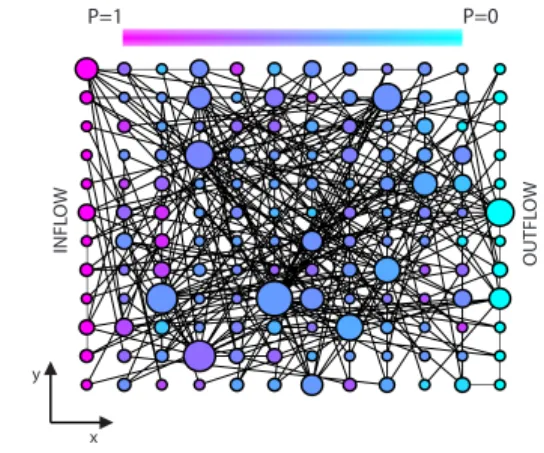
from a power-law distribution. We then produce a list of ki copies of each node i and attach links between nodes by randomly pairing up elements of this list until none remain. We disallow double links, as well as self-linked nodes. This algorithm generates networks of excellent accuracy for arbi-trary exponents␥even for relatively small network sizes. We generate an Erdős-Rényi network by attaching a link to each pair of nodes with probability p = 0.01. We assume for sim-plicity that the nodes in our model network are uniformly spaced in the unit square 共Fig.1兲. The positioning of nodes
on a square lattice is an idealization of networks with spatial
*[email protected] P=1 P=0 x y OU TFL O W INFL OW
FIG. 1. 共Color online兲 Schematic representation of our model
network. Nodes are distributed uniformly on the unit square. Their
connectivity 共represented by node diameter兲 follows a power-law
distribution. Flow through the network derives from a potential P
embedding that exhibit power-law connectivity, including power and distribution networks 关20兴 and transportation and
biological systems 关31兴. Networks embedded in metric
spaces often exhibit a decay of nodal connectivity with dis-tance关32,33兴—we have not included this distance-dependent
connectivity in our study which therefore allows for long-ranged links.
Flow through the network is driven by a scalar共potential兲 field and satisfies conservation of mass. At every node i we impose 兺juij= 0, where uij is the flux through the link con-necting nodes i and j. The fluxes are given by
uij= −ij
Pi− Pj
dij
, 共1兲
where Pi and Pj are the flow potentials at nodes i and j, respectively, and dij is the Euclidean distance between the two nodes. This problem is exactly analogous to the electric conductance model of关12–15兴, except that in our model the
relation between velocity and potential difference is modu-lated by the inverse of link length. Here, we assume that the conductivity is the same for all links and takes a value ij = 1. To elucidate the essential mechanisms governing trans-port, we study a simple setting of flow from left to right by fixing the potential P = 1 at the inflow nodes共left boundary兲, and P = 0 at the outflow nodes共right boundary兲. Flow is con-fined between the top and bottom boundaries. Inserting the flux equation关Eq. 共1兲兴 into the mass conservation condition
at each node, and imposing the boundary conditions, leads to a linear system of algebraic equations to be solved for the flow potential at the nodes,兵Pj其, which are stationary and do not evolve in time. This system of equations is solved with a direct solution method such as Gaussian elimination.
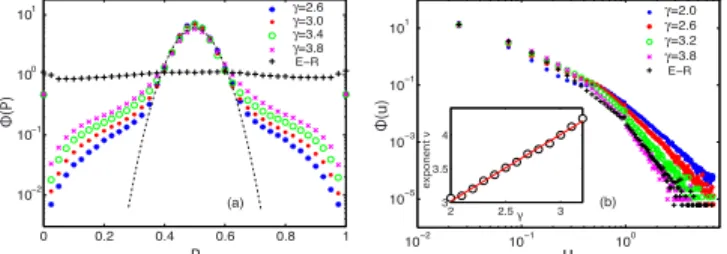
For different values of the degree exponent␥, the distri-butions of nodal potential collapse in the range P 苸共0.4,0.6兲 关Fig.2共a兲兴. Within this range, the flow potential seems to be normally distributed共dashed line兲. The velocity at the links, u, follows a distribution that exhibits a power-law tail关Fig.2共b兲兴. In the range␥苸关2,3.2兴, the exponent of
the velocity power-law distribution is well approximated as
⬇␥+ 1关Fig.2共b兲, inset兴. As a consequence of this behavior,
a slower decay in network connectivity共smaller␥兲 results in increased probability of observing large velocities at the links. Interestingly, the flow potential distribution for a ran-dom共Erdős-Rényi兲 network has a very different shape from that of scale-free networks, yet it also leads to a power-law tail distribution of the link velocities. Note that for a regular lattice, the distribution of flow potentials is uniform, and the distribution of velocities is a double Dirac delta function.
We investigate the scaling properties of transport in scale-free networks through stochastic particle simulations. This allows us to explore the transition between the purely diffu-sive and advective regimes. Particles move along the links of the network according to the local advective velocity field obtained from the steady-state potential solution, together with an additional random diffusive component sampled from a Gaussian distribution:
XN+1= XN+␦XN, 共2兲
␦XN= uij␦t +
冑
2D␦t, 共3兲XN+1ⱖ 0, 共4兲
where X denotes the coordinate along the link, D is the dif-fusion coefficient, and= N共0,1兲. At t=0, we inject particles at random at the inflow nodes. A particle located at node i at a given time step chooses one of the outgoing links to “walk” on it. Link selection is performed at random, with probability that is linearly proportional to the magnitude of the link ve-locity. The term outgoing refers here to links with velocity vectors pointing from the initial position of the particle共node
i兲, to the destination connected nodes. Constraint Eq. 共4兲
forces particles walking on a link ij to stay on it until they reach the destination node j. Particles are removed when they reach the outflow nodes.
The key parameter in this stochastic process is the ratio between advective and diffusive jump lengths, A =冑2D¯u␦t␦t, where u¯ is the characteristic velocity at the links. This
com-putational quantity plays the role of the Péclet number 共Pe = u¯d¯ /D兲 in physical fluid flow, where d¯ is the characteristic
length of the links. The purely advective and diffusive limits correspond to A→⬁ and A=0, respectively. A second com-putational parameter is=u¯␦t/共Ad¯兲, which measures the
ef-fect of the boundary constraint Eq.共4兲. By fixing the value of
, we impose a constant ratio between the number of advec-tive jumps affected by the constraint, and the average num-ber of jumps needed for a particle to move from one node to another. This permits a rigorous interpretation of the results from particle tracking simulations. We analyze the Euclidean MSD, also known as dispersion, or variance of the particle plume, in the direction of the mean flow: 具⌬x2共t兲典=具x2共t兲典
−具x共t兲典2, where 具·典 denotes averaging over all the particles.
In the advective limit共AⰇ1, Ⰶ1兲, the MSD follows a power law at early times, 具⌬x2共t兲典⬃t, and then saturates due to finite size effects共Fig.3, inset兲. We compute the
scal-ing exponent  in the preasymptotic regime for scale-free networks with different exponents ␥, as well as for an E-R network. Our simulations show that advection-dominated transport on scale-free networks is anomalous and exhibits
0 0.2 0.4 0.6 0.8 1 10−2 10−1 100 101 (a) γ=2.6 γ=3.0 γ=3.4 γ=3.8 E−R P Φ(P) 10−2 10−1 100 10−5 10−3 10−1 101 (b) γ=2.0 γ=2.6 γ=3.2 γ=3.8 E−R 2 2.5 3 3 3.5 4 exponent ν γ Φ(u) u
FIG. 2. 共Color online兲 共a兲 Pressure distributions, ⌽共P兲, for
scale-free networks with different degree exponents,␥, as well as
for an E-R network. The dashed line is a Gaussian fit with mean
P
¯ =0.5 and standard deviation P⬇0.08. We use networks of size
N = 8100 nodes, and the results are averaged over 250 realizations.
共b兲 Velocity distributions, ⌽共u兲, for different network types. Inset:
exponent of the velocity distribution power-law tail plotted
against the connectivity exponent␥苸关2,3.2兴; shown also is a
least-squares linear interpolation=共0.99⫾0.02兲␥+共1.03⫾0.05兲.
NICOLAIDES, CUETO-FELGUEROSO, AND JUANES PHYSICAL REVIEW E 82, 055101共R兲 共2010兲
superdiffusive behavior, ⬎1 共Fig. 3兲. The exponent  in-creases monotonically with ␥. For large ␥, it asymptotically reaches the ballistic limit,= 2.
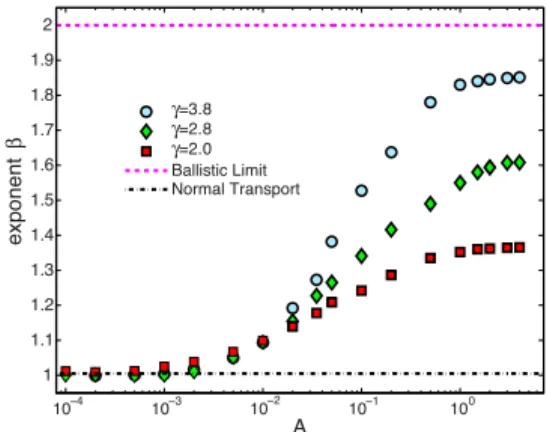
The scaling properties of transport in scale-free networks depend on the relative dominance between advective and diffusive mechanisms共Fig.4兲. We perform simulations
vary-ing the ratio between the advective and diffusive jump lengths by controlling the value of parameter A. For small values of A, transport is governed by diffusion, while for large values advection dominates. The scaling exponent of the MSD increases monotonically with A. This implies a transition from the normal scaling共= 1兲 of purely diffusive transport, to anomalous scaling 共⬎1兲 in the advection-dominated limit. The asymptotic value ofas A→⬁ is con-trolled by the topology of the network共Fig.3兲.
The observed scaling can be understood within the CTRW framework关23,24,34兴. The problem setup is essentially
one-dimensional 共1D兲 because flow is from left to right, so the key question is to ascertain how the topology of the network affects spreading in the direction of mean flow. CTRW as-sumes that the statistics of particle spreading can be fully characterized by a joint probability distribution, 共,兲, of particle jump lengths,, and waiting time between jumps,, whose marginal distributions 共兲 and w共兲, respectively, can be derived by integration. It is well understood that broad distributions of jump lengths or transition times may lead to anomalous transport关23,24,34兴. To test the ability of
CTRW to describe transport in scale-free networks, we
per-form 1D random walks by sampling the empirical joint dis-tributions共,兲 recorded from our network simulations. In the advection limit, the jump length can be represented by the length of the link, d. Since the network is restricted to a finite domain, d is bounded and is found to be well approxi-mated by a Kumaraswamy distribution. In contrast—and due
10−4 10−3 10−2 10−1 100 1 1.1 1.2 1.3 1.4 1.5 1.6 1.7 1.8 1.9 2 A exponent β γ=3.8 γ=2.8 γ=2.0 Ballistic Limit Normal Transport
FIG. 4. 共Color online兲 Purely diffusive transport 共AⰆ1兲 in
scale-free networks leads to linear scaling of the mean-square
dis-placement 共⬇1兲. As A increases, we observe a transition from
normal transport to anomalous transport, with scaling exponents,,
that reach different asymptotic values in the superdiffusive regime,
depending on the network topology共Fig.3兲. We use networks with
N = 8100 nodes, fixed =0.04, and 3000 particles. Simulation
re-sults are averaged over 100 realizations.
10−2 100 102 104 10−4 10−2 100 102 −2 0 2 4 −2 −1 0 −2 0 2 4 −2 −1 0 γ=2.0 γ=2.8 γ=4.0 γ=4.8 γ=4.8 γ=2.0 w(τ ) τ log 10 d log 10 d log10τ log10τ (a) 10−2 100 102 10−4 100 10−1 102 10−5 100 10−1 101 10−5 100 SF Networkγ=4.0 1D RW 1D CTRW data fromγ=2.8 Uncoupled Coupled (b) <(Δx) > <(Δx) > 2 2 t t <(Δx) > 2 t
FIG. 5.共Color online兲 共a兲 Marginal distribution of waiting times
for advection-dominated transport and different scale-free networks.
Insets: joint distribution 共d,兲 for two different scale-free
net-works共␥=2.0 and 4.8兲. Bright red color corresponds to high value
of 共d,兲. Link length and transition time exhibit strong coupling
for ␥=2.0, for which the joint distribution collapses around the
scaling⬃d2. The results are for network size N = 8100 nodes and
over 300 realizations. 共b兲 MSD for coupled and unidirectional
CTRW, using data from different network types. Bottom-right inset: MSD for coupled and uncoupled biased, 1D CTRW. Top-left inset: MSD from network simulations compared with the results from 1D coupled CTRW, and 1D RW with back-flow and linear interpolation along the jumps. By backflow we mean that the velocity along links in the network simulations is predominantly in the positive x direc-tion, but the flow is “backward” for some links. The 1D random-walk simulations with backflow are based on taking a fraction of the jumps in the negative x direction, to better approximate the actual 2D network simulations. In the classical CTRW framework, particles are assumed to ‘wait’ at a given location until they jump to a new one. By interpolation we mean that we post-compute the MSD at a given time as if the particles had experienced a constant velocity between jumps—a behavior that more closely resembles the setting of the 2D particle tracking network simulations.
2 2.5 3 3.5 4 4.5 5 1 1.1 1.2 1.3 1.4 1.5 1.6 1.7 1.8 1.9 2 γ exponent β Scale−Free Networks E−R Network Ballistic Limit Normal Transport 10−1 100 101 10−4 10−3 10−2 10−1 t γ=2.6 γ=4.4 E−R 2 <(Δx) >
FIG. 3.共Color online兲 The particle MSD follows a power law in
time during early times, before it is influenced by boundary effects
共inset兲. The main plot shows the scaling exponent of the particle
MSD, for advection-dominated transport 共AⰇ1兲 in scale-free
net-works, plotted against the connectivity degree exponent ␥.
Trans-port is anomalous and falls in the superdiffusive regime 共⬎1兲.
Shown also are the values of  for an E-R network—for which
transport is also superdiffusive—and a regular lattice–for which
transport is normal,=1. We use networks with N=8100 nodes and
set A = 7 and=0.0014. We use 3000 particles and we average over
100 realizations. Within each realization, we construct the network, solve the flow potential equation, and advance particles by advec-tion and diffusion, according to the flow field from the potential solution. This makes our model significantly more computationally expensive than the diffusive random-walk algorithms of关17,18兴, in which a walker jumps directly from node to node. We have con-firmed that our results are independent of network size for N ⬎6000.
to the broad-ranged velocity distributions—the transition times between connected nodes,= d/u, exhibit a wide range distribution with power-law tail, w共兲⬃−共1+␦兲 关Fig. 5共a兲兴,
where␦⬇1.9 for all degree exponents␥. In the case of de-coupled CTRW关共,兲=共兲w共兲兴 in an infinite lattice un-der a bias, we would expect an asymptotic late-time scaling of the MSD, 具⌬x2共t兲典⬃t1.1 关24,26,35兴, in contrast with the
observed scalings 共Fig. 3兲 关36兴. The lack of quantitative
agreement between decoupled CTRW and the scaling ob-served in our network simulations highlights the importance of the coupling between jump length and waiting time 关Fig.
5共a兲, insets兴 in the MSD, especially at early times 关Fig.5共b兲, bottom-right inset兴. A 1D coupled CTRW qualitatively re-covers the monotonic increasing trend of the scaling expo-nentas a function of␥关Fig.5共b兲兴. Quantitative agreement requires introducing additional information from the network simulations, such as the possibility of backflow, and linear interpolation of the particle positions between jumps 关Fig.
5共b兲, top-left inset兴. The transition to normal transport for small ␥ 共Fig. 3兲 is consistent with the convergence of the
joint distribution of jump lengths and transition times toward the geometric limit⬃d2关Fig.5共a兲, top-left inset兴. This
un-expected diffusionlike scaling, whose origin appears to lie in the existence of very well connected nodes, is responsible for bounding anomalous transport behavior.
The nonlinear scaling of spreading with time suggests that transport processes in complex networks are much faster than previously estimated using purely diffusive random walk models that neglect advective fluxes. In the presence of advection, the topology of the network plays a central role in the spreading dynamics, while for diffusion-dominated pro-cesses the scaling of spreading with time is independent of network connectivity. Our interpretation in terms of transi-tion times links transport in complex networks with well-established models of effective transport through disordered systems, and opens the door to aggregate conceptualizations of biased transport processes in scale-free networks.
Funding for this research was provided by the Vergottis Graduate Foundation 共to C.N.兲, by the U.S. Department of Energy 共Award No. DE-SC0003907兲, and by the ARCO Chair in Energy Studies. This financial support is gratefully acknowledged.
关1兴 A.-L. Barabási and R. Albert,Science 286, 509共1999兲.
关2兴 L. A. N. Amaral, A. Scala, M. Berthélémy, and H. E. Stanley, Proc. Natl. Acad. Sci. U.S.A. 97, 11149共2000兲.
关3兴 R. Albert and A.-L. Barabási,Rev. Mod. Phys. 74, 47共2002兲.
关4兴 M. C. González, H. J. Herrmann, J. Kertész, and T. Vicsek, Physica A 379, 307共2007兲.
关5兴 H. Jeong, B. Tombor, R. Albert, Z. N. Oltvai, and A.-L.
Barabási,Nature共London兲 407, 651 共2000兲.
关6兴 K.-I. Goh, B. Kahng, and D. Kim,Phys. Rev. Lett. 87, 278701
共2001兲.
关7兴 R. Pastor-Satorras and A. Vespignani, Phys. Rev. Lett. 86,
3200共2001兲.
关8兴 E. Almaas, B. Kovács, T. Vicsekand, Z. N. Oltvai, and A.-L.
Barabási,Nature共London兲 427, 839 共2004兲.
关9兴 L. K. Gallos, C. Song, S. Havlin, and H. A. Makse,Proc. Natl.
Acad. Sci. U.S.A. 104, 7746共2007兲.
关10兴 M. C. González, C. A. Hidalgo, and A.-L. Barabási, Nature
共London兲 453, 779 共2008兲.
关11兴 C. Song, T. Koren, P. Wang, and A.-L. Barabási,Nat. Phys. 6,
818共2010兲.
关12兴 E. López, S. V. Buldyrev, S. Havlin, and H. E. Stanley,Phys.
Rev. Lett. 94, 248701共2005兲.
关13兴 S. Carmi, Z. Wu, E. López, S. Havlin, and H. E. Stanley,Eur.
Phys. J. B 57, 165共2007兲.
关14兴 S. Carmi, Z. Wu, S. Havlin, and H. E. Stanley,EPL 84, 28005
共2008兲.
关15兴 G. Li, L. A. Braunstein, S. V. Buldyrev, S. Havlin, and H. E.
Stanley,Phys. Rev. E 75, 045103共2007兲.
关16兴 J. D. Noh and H. Rieger,Phys. Rev. Lett. 92, 118701共2004兲.
关17兴 L. K. Gallos,Phys. Rev. E 70, 046116共2004兲.
关18兴 E. M. Bollt and D. ben Avraham,New J. Phys. 7, 26共2005兲.
关19兴 A. Baronchelli, M. Catanzaro, and R. Pastor-Satorras, Phys.
Rev. E 78, 011114共2008兲.
关20兴 R. Carvalho, L. Buzna, F. Bono, E. Gutiérrez, W. Just, and D.
Arrowsmith,Phys. Rev. E 80, 016106共2009兲.
关21兴 S. R. Yu, M. Burkhardt, M. Nowak, J. Ries, Z. Petrášek, S.
Scholpp, P. Schwille, and M. Brand, Nature 共London兲 461,
533共2009兲.
关22兴 K. C. Leptos, J. S. Guasto, J. P. Gollub, A. I. Pesci, and R. E.
Goldstein,Phys. Rev. Lett. 103, 198103共2009兲.
关23兴 E. W. Montroll and G. H. Weiss,J. Math. Phys. 6, 167共1965兲.
关24兴 H. Scher and E. W. Montroll,Phys. Rev. B 12, 2455共1975兲.
关25兴 J. Klafter and R. Silbey,Phys. Rev. Lett. 44, 55共1980兲.
关26兴 R. Metzler and J. Klafter,Phys. Rep. 339, 1共2000兲.
关27兴 B. Berkowitz and H. Scher,Phys. Rev. Lett. 79, 4038共1997兲.
关28兴 M. Dentz, H. Scher, D. Holder, and B. Berkowitz,Phys. Rev.
E 78, 041110共2008兲.
关29兴 M. Molloy and B. Reed,Random Struct. Algorithms 6, 161
共1995兲.
关30兴 W. Aiello, F. Chung, and L. Lu, in Proceedings of the 32nd
Annual ACM Symposium on Theory of Computing 共ACM,
Portland, OR, 2000兲.
关31兴 A. Tero, S. Takagi, T. Saigusa, K. Ito, D. P. Bebber, M. D.
Fricker, K. Yumiki, R. Kobayashi, and T. Nakagaki, Science
327, 439共2010兲.
关32兴 A. F. Rozenfeld, R. Cohen, D. ben-Avraham, and S. Havlin, Phys. Rev. Lett. 89, 218701共2002兲.
关33兴 G. Li, S. D. S. Reis, A. A. Moreira, S. Havlin, H. E. Stanley,
and J. S. Andrade, Jr.,Phys. Rev. Lett. 104, 018701共2010兲.
关34兴 B. Berkowitz, A. Cortis, M. Dentz, and H. Scher,Rev.
Geo-phys. 44, RG2003共2006兲.
关35兴 M. F. Shlesinger,J. Stat. Phys. 10, 421共1974兲.
关36兴 A reviewer suggested that the scaling w共兲=d−2⌽共d/兲
⬃␥−1关where ⌽共u兲 is the velocity distribution兴 captures the
increasing portion of the waiting time distribution,
correspond-ing to early times 关Fig.5共a兲兴. Indeed, to first approximation, this scaling is consistent with the simulation results.
NICOLAIDES, CUETO-FELGUEROSO, AND JUANES PHYSICAL REVIEW E 82, 055101共R兲 共2010兲