Publisher’s version / Version de l'éditeur:
Il Cemento, 83, July-Sept. 3, pp. 199-210, 1986-07-01
READ THESE TERMS AND CONDITIONS CAREFULLY BEFORE USING THIS WEBSITE. https://nrc-publications.canada.ca/eng/copyright
Vous avez des questions? Nous pouvons vous aider. Pour communiquer directement avec un auteur, consultez la première page de la revue dans laquelle son article a été publié afin de trouver ses coordonnées. Si vous n’arrivez pas à les repérer, communiquez avec nous à [email protected].
Questions? Contact the NRC Publications Archive team at
[email protected]. If you wish to email the authors directly, please see the first page of the publication for their contact information.
NRC Publications Archive
Archives des publications du CNRC
This publication could be one of several versions: author’s original, accepted manuscript or the publisher’s version. / La version de cette publication peut être l’une des suivantes : la version prépublication de l’auteur, la version acceptée du manuscrit ou la version de l’éditeur.
Access and use of this website and the material on it are subject to the Terms and Conditions set forth at
Interaction of aliphatic alcohols with cement systems
Beaudoin, J. J.
https://publications-cnrc.canada.ca/fra/droits
L’accès à ce site Web et l’utilisation de son contenu sont assujettis aux conditions présentées dans le site LISEZ CES CONDITIONS ATTENTIVEMENT AVANT D’UTILISER CE SITE WEB.
NRC Publications Record / Notice d'Archives des publications de CNRC:
https://nrc-publications.canada.ca/eng/view/object/?id=8b5d7d16-6a0f-4a01-8173-77934da2d5e3 https://publications-cnrc.canada.ca/fra/voir/objet/?id=8b5d7d16-6a0f-4a01-8173-77934da2d5e3Ser TH1
N21d
no.
1456
National Research
Consell natlonal
o
1
$
Council
Canada
de
rechmhes Canada
BLDC
. -- -
Institute for
lnstitut de
Research in
recherche en
Construction
construction
Interaction of Aliphatic Alcohols
with Cement Systems
by J.J. Beaudoin
Reprinted from
II
Cemento
Vol. 83, July
-
Sept. 1986
p. 199-210
(IRC Paper No. 1456)
Price $3.50
NRCC 27644
T h i s paper
i s
being d i s t r i b u t e d i n r e p r i n t
form by
t h e I n s t i t u t e f o r R e s e a r c h i n
C o n s t r u c t i o n .
Al i s t of b u i l d i n g p r a c t i c e
and r e s e a r c h p u b l i c a t i o n s a v a i l a b l e from
t h e I n s t i t u t e
may be o b t a i n e d by w r i t i n g t o
t h e P u b l i c a t i o n s S e c t i o n ,
I n s t i t u t e f o r
R e s e a r c h i n C o n s t r u c t i o n , N a t i o n a l Research
C o u n c i l
of
C a n a d a ,
O t t a w a ,
O n t a r i o ,
K1A 0%.
C e
document
est d i s t r i b u 6 s o u s forme d e
t i r 6 - 8 - p a r t
p a r
1'
I n s t i t u t de r e c h e r c h e e n
c o n s t r u c t i o n .
On p e u t o b t e n i r une
l i s t e
d e s p u b l i c a t i o n s de l t I n s t i t u t p o r t a n t s u r
les t e c h n i q u e s
ou
-1es
r e c h e r c h e s -en
matisre
de
' l4sput
1C O !
re
IINTERAZIONE DEGLl ALCOLI ALlFATlCl CON I SlSTEMl CEMENTlZl
INTERACTION OF A LIPHA TIC ALCOHOLS WITH CEMENT SYSTEMS
J.J.
Beaudoin
Negli ultimi anni, per studiare la microstruttura del- la pasta cementizia [ I ] sono state impiegate numerose nuove tecniche, comprendenti metodi di sostituzione con solventi, basate sulla sostituzione con un solvente dell'acqua presente nella struttura degli strati dei cementi idratati [2, 31. Nell'applicazion~e di questo me- todo di determinazione della superficie specifica si suppone che il solvente, ad es. metanolo, sia inerte nei riguardi della fase adsorbente [4].
Mezzi non acquosi sono stati impiegati anche nella determinazione di alcune caratteristiche dei sistemi cementizi, ad es. la porosith, per sostituzione dell'acqua con metanolo
[51
& I il comhortamento allungamento- adsorbimento usando alcoli alifatici come adsorba- to [6]. Nell'interpretazione dei dati dell'isoterma gene- ralmente e stato supposto che l'adsorbato non intera- gisca con l'adsorbente [7] ma questo assunto b stato! messo in discussione [8, 91. I1 presente lavoro riporta
I
i risultati di uno studio rivolto a valutare l'entita del-I
l'eventuale interazione degli alcoli alifatici con i siste- mi cementizi data la sua importanza nell'interpreta- zione della microstruttura, della frattura e dello svi- luppo di resistenza nel cemento e nel calcestruzzo.PARTE SPERIMENTALE Materiali
Cemento portland: l'analisi chimica era la seguente: SiOz = 20,7896, A1203 = 6,2096, Fe203 = 2,2396, CaO =
INTERAZIONE DEGLl ALCOLI ALIFA-
TIC1 CON I SlSTEMl CEMENTlZl
INTERACTION OF ALIPHATIC ALCO-
HOLS WITH CEMENT SYSTEMS
J.J. Beaudoin
INTRODUCTION
I n recent years a number of new techniques have been used t o study cement paste microstructure [I], includ- ing solvent replacement methods that involve replace- ment of water i n the layer structure of hydrated ce- ments w i t h a solvent [2, 31. I n the application of this method of determining surface area it is assumed that the solvent, for example methanol, is inert w i t h respect t o the adsorbent [4].
Non-aqueous media have also been used i n determin- ing certain characteristics of cement systems, for exam- ple, porosity by methanol displacement [5] and length change-adsorption behaviour using aliphatic alcohols as adsorbate [6]. I n interpreting isotherm data it has ge- nerally been assumed that the adsorbate does not in- teract w i t h the adsorbent 171, but this has been que- stioned [8, 91. This paper will report the results of
a
study to assess the extent of the interaction, if any, of aliphatic alcohols w i t h cement systems because of its significance i n interpreting microstructural, crack, and strength development i n cement and concrete.
EXPERIMENTAL Materials
Portland cement: Chemic,al analysis was as follows: SiOz = 20,78%; A1203 = 6,20%; Fez03 = 2,23%; CaO =
ALCOLI ALIFATICI
200
= 64,83%, M'gO = 1,84%, SO3 = 3,17%, Na2O = 0,05%,
K20 = 0,40%. Superficie specifica Blaine = 300 m2/ kg. Composizione di fase secondo Bogue: GAF = 6,70%,
C3A = 12,7%, C31S = 51,4%, C2S = 20,3% e CaSOl =
= 5,4%.
C3S: il silicato tricalcico usato in questo lavoro aveva la seguente composizione: CaO = 73,9?h, SiO2 = 26,2%,
A1203 = Q,O8%; calce libera (Franke) = 0,46%. Super- ficie specifica Blaine = 331 m2/kg.
C S H : 6 differenti preparazioni, siglate
T1
a T6, sono state fornite dalla Lafarge Coppke Recherche, Francia.I rapporti C/S sono 0,87, 0,99, 1,26, 1,49, 0,68, 1,17, quel- li H/S rispettivamente 2,01, 2,49, 6,69, 5,53, 1,91 e 2,58
e le corrispondenti superfici specifiche (per as~sorbi- mento di azoto) erano 56,6, 110,7, 40,2, 30,7, 111,9 e
68,2
x
lo3 m2/kg.Alcoli: nel lavoro sperimentale sono stati impiegati i seguenti alcoli, reagenti puri per analisi: metilico, eti- lico, butilico, amilico. esilico, ottilico e decilico.
Campioni
Le paste cementizie, confezionate con un rapporto acqua/cemento (a/c) di 0,25 e di 0,50, sono state idra- tate per 17 anni. Per la maggior parte del lavoro qui riportato si b fiatto ulso di sezioni spelsse 1 mm. Le paste ,di C3S sono state preparate con un rapporto a/c = 0,50 e idratate per 7 anni. Le paste dilavate di C3S sono state preparate secondo il seguente procedi- mento: la pasta di C3S i: stata tagli'ata in sezioni spesse
0,75 mm ed il CSH b stato dilavato impiegando solu- zioni parzialmente sature .di calce [lo]. I campioni di C-S-H sono stati compattati a 345 MPa in dischi di
31 mm di diametro e 1 mm di spessore.
Superficie specifica
La superficie specifica 6 stata ottenuta con un analiz- zatore di superfici Quantasorb.
Porosita e distribuzione delle dimensioni dei pori
Queste determinazioni sono state eseguite su campioni prescelti usando un porosimetro Aminco in grado di realizzare pressioni di intrusione fino a 407 MPa.
Diffrazione con i raggi X
I dati di6frattometrici dei campioni selezionati sono stati ottenuti con una camera per polveri Guinier-Hagg, Modello XDC-700.
Analisi termica
L'analisi termica (DTA o TGA) e stata eseguita impie- gando un Termo-Analizzatore Dupont 1090 con l'acces- sorio TGA 591. Le misure sono state eseguite sia in atmosfera d'aria che di azoto. In genere un campione di 20 mg
e
stato sottoposto ad un riscaldamento di 20°1C/min.= 64,83%; MgO = 1,84%; So3 = 3,17%; NazO = 0,05%; K2O = 0,40%. Blaine surface area was 300 m 2 / k g . Bo- gue compound composition was ClAF = 6,70%; C3A =
= 12,7%; C3S = 51,4%; C2S = 20,3% and CaS04 =
= 5 4 % .
C3S: Tricalcium silicate used i n this work had the following composition: CaO = 73,9%; SiOz = 26,2%; A1203 = 0,08%; free CaO (Franke) = 0,46%. Blaine sur- face area was 331 m2/kg.
C-S-H: Six different C-S-H preparations, designated T I t o T6, were provided b y Lafarge Coppe'e Recherche, France. C I S ratios were 0,87, 0,99, 1,26, 1,49, 0,68 and 1,17, and H I S ratios were 2,01, 2,49, 6,69, 5,53, 1,91 and 2,58, respectively, and corresponding nitrogen surface areas were 56,6, 110,7, 40,2, 30,7, 111,9 and 68,2
x
l o 3m2/ kg.
Alcohols: Reagent grade methyl, ethyl, butyl, amyl, hexyl, octyl and decyl alcohol were used i n the expe- rimental work.
Specimens
Cement paste was made at waterlcement ratios ( w / c ) of 0,25 and 0,50 and hydrated for 17 years. T h i n slices 1 mm thick were used for m o s t of the work reported here. C3S paste was prepared at w / c = 0,50 and hy- drated for 7 years. Leached C3S paste was prepared according t o t h e following procedure: the C3S paste was sliced into pieces 0,75 mm thick and the CH was leached from t h e m using partially saturated lime so- lutions [ l o ] . C-S-H samples were compacted at 345 MPa into discs 31 mm i n diameter b y I mm thick.
Surface area
Nitrogen surface area was obtained w i t h a Quantasorb surface area analyser.
Porosity and pore size distribution
These determinations were made o n selected samples using a n Aminco porosimeter capable of applying in- trusion pressure u p t o 407 MPa.
X-ray diffraction
X-ray diffraction data for selected samples were ob- tained w i t h a Guinier-Hagg powder camera, Model XDC-700.
Thermal analysis
Thermal analysis (DTA or TGA) was carried out using a 1090 Dupont Thermal Analyser containing a 951 TGA accessory. B o t h air and nitrogen atmospheres were used. Generally, a 20 m g sample was heated at 20°C/ min.
201
ALIPHATIC ALCOHOLSFlusso d'elio
Le misure sono state eseguite con un picnometro ad elio della Beckman. I1 flusso dell'elio & stato rappre- sentato graficamente in funzione del tempo. Le proce- dure seguite sono state descritte altrove [ l l ] .
Trattamento con alcool
I camlpioni sono stati essiccati in recipiente sottovuoto a llOqC per 3 ore. Sono stati quindi saturati sotto vuoto con l'al~co~ol di proiva per i~mmersione per c i x a
72 ore prima ,dell'ulteriore sperimentazione. I1 volume di alcool assorbito e le porosita sono ,state calcolate irnpiegando il procedimento di Archimede.
E' riconosciuto che l'essiccazione & importante nell'ef- fettuazione della misura della superficie specifica [12]. I campioni sono stati essiccati (110°C/3 ore) prima del- la saturazione in alcool e nuovamente per le misure della superficie specifica. I campioni di riferimento (saturati solo con acqua) sono stati essiccati, risatu- rati e di nuovo essiccati. I valori della superficie spe- cifica dei campioni di riferimento sottoposti a due pe- riodi di essiccazione non erano differenti in maniera significativa da quelli dei campioni essiccati una sola volta. La risaturazione dei campioni di riferimento dopo la prima essiccazione non era pertanto neces- saria.
Per allontanare l'alcool si sono impiegati due metodi: l'essiccazione sotto vuoto e il vuoto seguito da riscal- damento. L'allontanamento dell'aoqua dal C-S-H per riscaldamento a ca. 200qC ha slcars80 effetto sullka super- ficie specifica determinata con N2 [3]. I due metodi di essiccazione hanno dato risultati simili: essendo piu conveniente, & stato adottato quello che prevede il vuoto e quindi il riscaldamento (preferibilmente il wun- to di ebollizione dell'alcool).
Superficie specifica
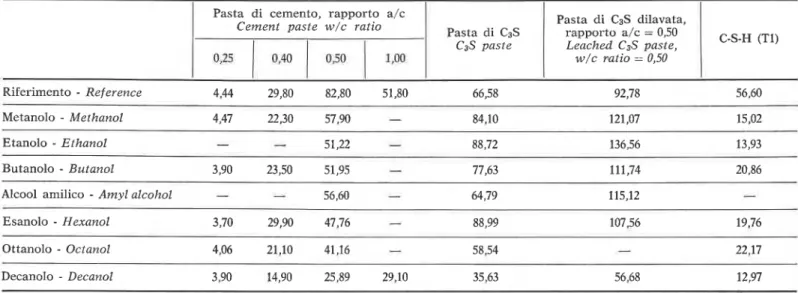
I valori di superficie specifica con N2 di numerosi si- stemi cementizi trattati con vari alcoli sono riportati in Tabella I. In generale la superficie specifica della pasta cementizia decresce, col trattamento con alcool, a seconda del rapport0 a/c. Per a/c = 0,25 la diminu- zione & piccola rispetto a quella che si nota con a/c = 0,50. A 0,50, la superficie specifica diminuisce del 30% per trattamento in metanolo e fino a1 69%
per trattamento in decanolo. Le piu forti riduzioni nel- la superficie specifica si notano per la maggior parte dei vari sistemi dopo il trattamento con decanolo. Ri- sultati analoghi si ottengono per il C-S-H (TI). La su- perficie specifica decresce fino a1 77% per trattamento con decanolo e fino a1 60% come minimo per il trat- tamento con tutti gli altri alcoli.
A1 contrario, i valori di superficie specifica delle paste di CsS e di C3S privo di calce libera aumentano dopo il trattamento con alcool ad eccezione di quelle satu- rate in ottanolo e in decanolo. C'k una diminuzione
Helium inflow
Measurements were obtained w i t h a Beckman helium pycnometer. Helium inflow versus time curves were plotted. Procedures are described elsewhere [ I l l .
Alcohol treatment
Samples were dried i n a vacuum vessel at llO°C for 3 h. T h e y were then vacuum saturated w i t h the test alcohol by submersion i n the alcohol for about 72 h prior t o further testing. V o l u m e of alcohol uptake and porosities were calculated employing Archimedes' pro- cedure.
I t is recognized that drying procedure is a n important consideration i n surface area measurement [ 1 2 ] . Sam- ples were dried (110°C/3 h ) prior t o saturation i n al- cohol and again for surface area measurements. T h e reference samples (saturated w i t h water only) were dried, resaturated, and dried again. Surface area values of reference samples subjected t o t w o drying periods were not significantly different from those for sam- ples dried once. Resaturation of reference samples after first drying was therefore not necessary.
T w o methods of drying were employed t o remove the alcohols: vacuum drying and vacuum followed by heat. Removal of water from C-S-H by heating t o about 200°C has little effect o n Nz surface area [3]. T h e t w o me- thods of drying gave similar results; vacuum plus heat (preferably the boiling point of the alcohol), being more convenient, was therefore adopted.
RESULTS AND DISCUSSION Surface area
Nitrogen surface area values for several cement sy- stems treated w i t h various alcohols are reported i n Table I. I n general, surface area of cement paste de- creases w i t h alcohol treatment, the amount depending o n w / c ratio. At w / c = 0,25 the decrease is small i n comparison w i t h that at w / c = 0,50. At 0,50, surface area decreases by 30% for treatment i n methanol and u p t o 69% for treatment i n decanol. T h e largest reduc- tion i n surface area for m o s t preparations occurs after treatment w i t h decanol. Similar results were obtained for C-S-H ( T I ) . Surface area decreased b y as m u c h as 77% w i t h treatment i n decanol and b y at least 60% w i t h treatment i n all other alcohols.
I n contrast, surface area values of C3S paste and lime- free C3S paste increase after alcohol treatment, w i t h the exception of those saturated i n octanol and deca- nol. There is significant decrease i n surface area fol-
ALCOLI ALIFATICI
202
TABELLA I TABLE I
Superfici specifiche ottenute con N2 (m2/g) per vari sisterni Nitrogen surface areas ,fimZ/g) for various cement systems
cementizi
Riferimento
-
Reference 4,44 29,80 82,80 51,80 66,58 92,78 56,60 Metanolo - Methanol 4,47 22.30 57.90-
84.10 121,07 15.02 Etanolo-
Ethanol-
-
51,22-
88,72 136,56 13,93 Butanolo-
Butanol 3.90 23,50 51,95-
77,63 111,74 20.86Pasta di cemento, rapporto a/c
Cement paste w / c ratio
-
Alcool amilico
-
Amy1 alcohol-
-
56,60-
64,79 115,12-
Esanolo-
Hexanol 3,70 29,90 47,76-
88,99 107.56 19,76 Ottanolo-
Octanol 4,06 21,lO 41.16-
58,54-
22,17 Decanolo - Decanol 3,90 14,90 25.89 29.10 35,63 56,68 12,97Pasta di CBS
C3S paste
significativa della superficie specifica dopo il tratta- mento con decanolo (46 e 37% rispettivamente) che riduce in massima parte la superficie specifica di tutti i sistemi cementizi. Non k chiaro il motivo per cui i risultati forniti dalle paste di CsS siano differenti da quelli delle paste a base di cemento portland.
L'interazione del CH con metanolo comporta un aumen- to della superficie specifica 1131. Le paste di C3S con- tengono ca. 40% di CH mentre quelle a base di cemen- to soltanto il 20% ca. Questa differenza pub essere uno dei fattori responsabili del piu alto valore di super- ficie specifica delle paste di C3S. L'influenza del meta- nolo sul C-S-H non k stata studiata mentre l'effetto del decanolo sulla preparazione del C-S-H & quello di ab- bassare la sua superficie specifica.
In Tabella I1 sono riportati i valori che mostrano l'ef- fetto del trattamento con decanolo sulla superficie specifica delle sei differenti preparazioni del C-S-H; l'abbassamento varia dal 25,2 a1 43,6%. I1 rapporto C / S del C-S-H varia da 0,68 a 1,17 ed il rapporto H / S da 1,91 a 6,69. Non esiste alcuna ohiara correlazione tra questi rapporti e la riduzione della superficie spe- cifica. Si pub asserire per0 che dopo il trattamento con gli alcoli alifatici avvengono significativi cambia- menti nella superficie specifica misurata con N2.
lowing treatment i n decanol (46 and 37%, respectively), which reduces the surface area of all the cement sy- stems t o the greatest extent. I t is not clear w h y the results for C S paste are different from those for port- land cement paste.
Pasta di C3S dilavata, rapport0 a/c = 0,50
Leached C3S paste, W / C ratio = 0,50
T h e interaction of CH w i t h methanol results i n a n increase i n surface area [13]. C3S paste contains about
40% CH, whereas cement paste contains only about
20% CH. This may be one of the factors responsible for higher surface area i n C3S pastes. T h e influence of methanol o n C-S-H has not been studied, b u t the effecf of decanol o n the C-S-H preparation is to decrease its surface area.
C-S-H
Table I1 gives values showing the effect of decanol treatment o n the surface area of six different C-S-H preparations; decrease varies from 25,2 to 43,694. T h e
C / S ratio of C-S-H varies from 0,68 t o 1,17 and the
H I S ratio from 1,91 to 6,69. There is n o apparent cor- relation between these ratios and the reduction in sur- face area. I t can be stated, however, that significant changes i n N2 surface area occur after treatment w i t h
aliphatic alcohols.
TABELLA I1
C-S-H
Superfici specifiche ottenute con N2 (m2/g) per varie prepara- zioni di C-S-H trattate con decanolo
Riferimento
R e f erence 56,68 110,70 40,20 30,70 111,9 68,20
TABLE ZI
Decanolo
Decanol 12,97 15,18 30,13 17,58 54,05 26.03 Nitrogen surface areas ( m 2 / g ) f o r variot~s C-S-H preparations treated i n decanol
203
ALIPHATIC ALCOHOLSTABELLA I11 TABLE I I I
Porosith totale (%) di sistemi cementizi trattati con alcoli Total porosity (%) of cement systems treated i n aliphatic
alifatici alcohols
Sistema cementizio
-
Cement systemPasta di C3S Pasta di C3S
Trattamento
-
Treatment Pasta a/c = 0,50 Pasta a/c = 0,25 a/c = 0,50 dilavata C-S-HPaste w / c = 0,50 Paste w / c = 0,25 C3S paste Leached CsS paste w / c = 0,50
Controllo - Control 29,50 9,90 29,25 59.00 16,25
Metanolo
-
Methanol 33,20 8,75 38,OO 51,OO 14,25Etanolo
-
Ethanol 35,70 8,25 37,50 51,25 1525Butanolo - Butanol 35,60 12,25 36,OO 48,75 12,75
Alcool amilico - Amy1 alcohol 34.50 12,OO 35 ,OO 50,OO 11,35
Esanolo
-
Exanol - 36,OO 12,25 33,50 47.00 13,80Ottanolo
-
Octanol 30,50 11,75 27,25 45,75 11,25Decanolo - Decanol 32,OO 11,80 30,OO 51,75 11,25
Struttura dei pori
Si sono costruiti gli istogrammi volume dei pori-inter- vallo di grandezza dei pori (*) per 1e paste di ce- mento portland (a!c = 0,25 e 0,50), per quelle di C S e per il C-S-H trattate con i vari alcoli. Gli istogrammi delle paste sono riportati in figg. 1 e 2. Si sono notate significative differenze nella distribuzione delle dimen- sioni dei pori.
Paste di cemento ( a l c = 0,25): ad eccezione dei cam- pioni trattati con alcool metilico, etilico e butilico tutti i trattamenti comportavano volumi dei pori inferiori a quelli dei campioni di controllo non trattati, nella regione dei pori piu piccoli, 0,002-0,0015 pm. Nell'in- tervallo 0,02-0,01 ym, i campioni trattati (eccetto quelli con alcool metilico ed etilico) presentano pori con vo- lumi piu grandi rispetto a quelli dei campioni di con- trollo. Tutti i trattamenti danno luogo a pori con volu- mi inferiori a quelli dei campioni di controllo nel cam- po 0,006-0,003 u~m e volumi piu grandi nel campo dei porj piu grandi, 1-0,2 pm. I1 trattamento con decanolo produ- ce la maggior popolazione di pori larghi, 5,O-0,2 pm.
Paste di cemento ( a l c = 0,50): ad eccezione dei tratta- menti con ottanolo e decanolo, tutti gli altri determi- nano una maggiore popolazione di pori nel campo dei pori piu piccoli, 0,002-0,0015 ym. Questo 5 notevolmen- te differente da quanto risulta nelle preparazioni con a/c = 0,25. Tutti i trattamenti con alcool riducono il volume dei pori nel campo 0,02-0,01 ym. Nella regione dei pori grandi, 0,03-0,l ym, il trattamento con deca- nolo produce un numero di pori molto maggiore di quelli contenuti nel campione non trattato.
(*) Come indice di grandezza dei pori si t: usato il raggio relativo.
Pore structure
Histograms of pore volume-pore size range (*) were constructed for portland cement paste ( w / c = 0,25, 0,50), C3S paste, and C-S-H treated i n various alcohols. Those for paste are given
in figs. 1 and 2. Significant
differences i n pore size distribution were recorded.Cement paste (w/c = 0,25): W i t h the exception of sam- ples treated w i t h methyl, ethyl and butyl alcohol all treatments resulted
in
pore volumes less than those of the untreated controls i n the finest pore size range, 0,002 t o 0,0015 pm. I n the range 0,02 t o 0,01 ym, alcohol- treated samples (except thosein
methyl and ethyl al- cohol) had pore volumes greater than those of the con- trol samples. A11 treatments resulted i n pore volumes less than those of the controls i n the range 0,006 t o 0,003 y m and i n volumes larger than those of the con- trols i n the large-pore range, 1 t o 0,2 ym. Treatment i n decanol resulted i n the greatest population of large pores, 5,O t o 0,2 pm.Cement paste (w/c = 0,50): All treatments except octa- no1 and decanol resulted
in
a greater population of pores i n the finest pore-size range, 0,002 t o 0,0015 u m . T h i s i s quite different from the results for the w / c = 0,25 preparations. All alcohol treatments redu- ced the volume of pores i n the range 0,02 t o 0,01 pm. I n the large-pore regions, 0,03 t o 0,l ym, decanol treat- m e n t produced a m u c h greater number of pores than are contained i n the control sarnples.(*) Pore radius is the descriptor of pore size used i n these analyses.
ALCOLI ALIFATICI
204
:t
Controllo-
ConlmfRaggio dei pori ( m) Pore radius (pf
1 2
1
-
Distribuzione delle dimensioni dei pori della pasta di cemen- 2-
Distribuzione delle dimensioni dei pori della pasta di cemen- to portland (a/c = 0,251 trattata con alcoli alifatici: M-
meta- to portland (a/c = 030) trattata con alcoli alifatici: M-
meta- nolo: E-
etanolo; B-
butanolo; A-
alcool amilico; H-
esanolo; nolo; E-
etanolo; B-
butanolo; A-
alcool amilico; H-
esanolo;0
-
ottanolo; D-
decanolo 0-
ottanolo; D-
decanolo2
-
Pore size distributions o f portland cement paste (w/c = 0,50) 1-
Pore size distributions o f portland cament paste (w/c = 0,25)treated with aliphatic alcohols: M
-
methanol; E - ethanol; B-
bu- treated with aliphatic alcohols: M-
methanol; E-
ethanol; B - bu-tanol; A - amyl alcohol; H
-
hexanol; 0-
octanol; D-
decanol tanol; A-
amyl alcohol; H-
hexanol; 0-
octanol; D dacanolPaste di C3S ( a l c = 0,50): come per la pasta di cemen- to, il trattamento con tutti gli alcoli, ad eccezione del- l'ottanolo e del decanolo, determina un maggiore nu- mero di pori nella regione di quelli piu piccoli, 0,002- 0,0015 pm. Nell'intervallo 0,l-0,05 pm ogni trattamento (ad eccezione di quelli con esanolo e decanolo) forni- sce un piu largo numero di pori. I1 trattamento con esanolo e decanolo produce il piu grande numero di pori nella zona dei pori piu grandi, 5-0,l Ism.
C3S paste (w/c = 0,50): As for cement paste, treatment w i t h all alcohols except octanol and decanol produced a greater number of pores in the finest pore-size ran- ge, 0,002-0,0015 pm. I n the pore range 0,I-0,05 u m all treatments (except w i t h hexanol and decanol) gave a larger number of pores. Hexanol and decanol treat- m e n t gave the greatest number of pores i n the largest pore regions, 5-0,1 pm.
205 ALIPHATIC ALCOHOLS
di quello con decanolo, determinano un maggior nu- mero di pori nella regione di quelli piu piccoli, 0,002- 0,0015 ym, (come per la normale pasta di cemento) e
nella regione 0,006-0,003 pm (ad eccezione dell'alcool
amilico). I1 trattamento con metanolo comporta una riduzione del volume dei pori per tutti gli intervalli dimensionali ad eccezione di quello che si estende da
1 a 0,2 ym. In quest'ultimo, soltanto il decanolo ed il
metanolo presentano voIumi dei pori maggiori di quelli
del campione di riferimento. Nella regione tra 2-1 pm,
il metanolo, l'etanolo, l'alcool amilico, l'ottanolo ed il decanolo hanno volume dei pori piu grandi di quelli del campione di riferimento. La pasta di cemento pre- senta in questa regione un volume dei pori molto picco- lo. I1 tnattamento con esanolo riduce il volume dei pori nella regione dei pori grandi, 10-2 ym.
C-S-H: ad eccezione del trattamento con metanolo ed etanolo, si nota una riduzione del volume dei pori nel- la reigione di quelli piu piccoli, 0,002-0,0015 ym. Cio k differente da quanto osservato per le paste di cemento e di C3S (a/c = 0,50) ma analog0 a quanto osservato per le paste di cemento a bassa porosita (a/c = 025). I campioni compattati di C-S-H presentano valori di porosita totale piu vicini a quelli delle paste di cemen-
to con a/c = 0,25. Inoltre tutti i trattamenti riducono
il volume dei pori nell'intervaIlo 0,003-0,002 ym. A dif-
ferenza della reazione della pasta di cemento per0 aumenta il volume dei pori (ad eccezione del tratta-
mento con ottanolo e decanolo) nella regione dimen-
sionale 0,006-0,003 ym. I1 trattamento con decanolo pro- duce un piccolo increment0 nel volume dei pori nel campo 1-0,2 pm.
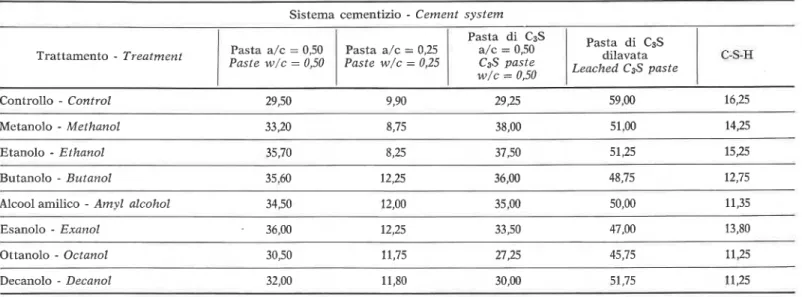
I valori di porosita totale sono riportati in Tabella 111.
Quelli relativi alle paste di cemento e di C3S general- mente aumentano con trattamento icon alcool: per le paste di C3S si osserva un aumento fino a1 23%. I1 trat- tamento della pasta di C3S dilavata (essenzialmente una forma di C-S-H) e di C-S-H da sintesi comporta una ri- duzione della porolsita fino al 30% (per il C-S-H sinte- tico). Data la presenm di CH libera nelle paste ma non nei sistemi C-S-H, viene avanzata l'idea che la CH libera svolga un certo ruolo nelle variazioni delle porosita.
Prove ottenute con il diffrattometro a raggi X e con IRS
sembrano indicare la formazione di un metossido per
interazione tra metanolo e calce libera [13]. E' possi-
bile che i legami Ca-0 associati alla CH libera ed alla CH presente nella struttura del C-S-H siano influen- zati dal trattamento con alcool. La leggera diminuzione della porosita per le paste dilavate di C3S e per il C-S-H sintetico k attribuibile ad una specie di interazione tra la calce e gli alcoli.
Le paste dilavate di C3S hanno un vdume dei pori maggiore di quello del campione di riferimento; ma nel campo dei pori piu piccoili, 0,002-0,0015 pm, e vero il contrario per il C-S-H sintetico.
decanol produced a greater number of pores
in
the finest pore-size region, 0,002 t o 0,0015 pm (as for nor- mal cement paste) and i n the region 0,006 t o 0,003 pm (except for amyl alcohol). Methanol treatment resulted i n a reduction of pore volume for all size ranges except 1 t o 0,2 pm. I n the latter, only decanol and methanol had pore volumes greater than the control. I n the region of 2-1 ym methanol, ethanol, amyl alcohol, octa- no2 and decanol had pore volumes greater than the control. Cement paste has very little pore volume i n this region. Hexanol treatment reduced pore volume i n the large pore range, 10-2 pm.C-S-H: W i t h the exception of methanol and ethanol
treatment, there was a reduction of pore volume
in
the finest pore range, 0,002-0,0015 ym. This is different from the reaction of cement paste and C3S paste ( w / c = 0,50) but similar t o that of low-porosity cemenl paste (W/C = 0,25). T h e C-S-H compacts had total po- rosity values closest t o that of the w / c = 0,25 cement paste. As well, all treatments reduced pore volumein
the range 0,003-0,002 pm. Unlike the cement paste reac- tion, however, pore volume increased (except for octa- no2 and decanol treatment) in the size range 0,006-0,003 pm. Decanol treatment produced a small increase i n pore volumein
the region of 1-0,2 pm.Total porosity values are tabulated i n Table IIZ. Those for cement pastes and C3S paste generally increase w i t h alcohol treatment: u p t o 23% were observed for C3S paste. Treatment of leached C3S paste (essentially a form of C-S-H) and synthetic C-S-H resulted i n a re- duction i n porosity of as m u c h as 30% (for synthetic C-S-H). As free CH i s present i n the pastes and absent from the C-S-H systems, i t is suggested that free CH plays some role i n changes of porosity. X-ray diffrac- tion and I R S evidence suggest the formation of a m e - thoxide by the interaction of methanol and free CH [ 1 3 ] . I t is possible that Ca-0 bonds associated w i t h free CH and CH
in
the C-S-H structure are affected b y alcohol treatment. T h e slight decrease i n porosity for leached C3S paste and synthetic C-S-H i s attributable t o some sort of interaction between lime and the alcohols.Leached C3S paste had a greater pore volume than did the controls; but i n the finest size range, 0,002 t o 0,0015 !Lm, the opposite was true for synthetic C-S-H.
Questa differenza 5 in accord0 con quanto osservato This difference is consistent w i t h the observed increase
in termini di aumento di superficie specifica per le i n surface area for leached C3S paste and decrease for
paste dilavate di C3S e di diminuzione per il C-S-H. C-S-H.
Le differenze nell'interazione con alcool per le paste di Differences i n interaction w i t h alcohol for the cement
ALCOLI ALIFATICI 206
cemento (a/c = 0,50 e 0,25) rifilesse dalla distribuzione dei pori possono derivare dalla grande differenza nella porosita iniziale, da una maggiore quantita di CH nel- le paste con a/c = 0,50 e da un signifilcativo numero di granuli di cemento non idratati nelle paste con a/c = 0,25. Se l'interazione della pasta con alcool com- porta un processo di precipitazione-dissoluzione, un aumento dei pori piccoli con la pasltta ard a/c = 0,50 e con la pasta di C3S pub derivare dal riempimento dei pori piu grandi col precipitato.
L'aumento del volume fdei pori piu grandi e la diminu- zione di quello dei pori piu pilacoli a seguito del trat- tamento con ottanolo e decanolo pub perb comportare il riempimento dei pori piu piccoli con materiale tra- sportato da quelli pit1 grandi. Un simile processo di riempimento dei pori pub derivare dal trattamento con alcool delle paste con a/c = 0,25 a bassa porosita. Se un meccanismo di riempimento dei pori i: valido,
i: probabile che esso dipenda dalla porosita iniziale del materiale. La porosita totale per questi sistemi aumenta con il trattamento con alcool, indicando uhe tutto il materiale disciolto non i: precipitato.
pastes ( w / c = 0,.50, 0,25) as reflected i n pore size di- stribution m a y result from the large difference i n ini- tial porosity, a larger amount of CH
in
the w!c = 0,50 paste and a significant number of unhydrated cement grains i n the w / c = 0,25 paste. If interaction of paste w i t h alcohol involves a dissolution-precipitation pro- cess, a n increase i n fine pores w i t h the w / ~ = 0,50 paste and C3S paste may result from filling of the lar- ger pores w i t h precipitate.Increase i n pore volume of the largest pores and de- crease i n volume of the finest pores w i t h octanol and decanol treatment, however, may involve the filling of finer pores w i t h material transported from larger ones. A similar pore filling process m a y result from alcohol treatment of low-porosity, w / c = 0,25 paste. If a pore-filling mechanism is operative, it is probable that i t is dependent o n the initial porosity of the ma- terial. Total porosity for these preparations increases witlz alcohol treatment, suggesting that all dissolved material is not precipitated.
Effetti di interazione Interaction effects
Si sono eseguiti dei fotogrammi dello spettro di dif- frazione a raggi X su polveri dei sistemi cementizi trat- tati con vari alcoli. In fig. 3 vengono presentati i trac- ciati densitometrici del C-S-H (TI). Le modifiche del- lo spettro di riferimento causate dal trattamento con alcool includono il troncamento o l'eliminazione del picco a 0,279 nm, la riduzione dell'intensita del picco a 0,183 nrn e l'effettiva eliminazione dei picchi a 0,166 e a 0,139 nm.
Gli effetti del trattamento con decanolo sugli spettri dei raggi X delle sei preparazioni del C-S-H sono simili a quelli mostrati in fig. 3. Simili sono anche gli effetti sugli spettri dei raggi X delle paste di C3S e di C3S dila- vato. I t~aociati del densiftometro per le paste di cemen- to portban~d (non mostrate) non sono marcatamente dif- ferenti da quelle dei campioni trattati con allcool, ad eccezione di un picco a 0,171 nm presente solamente nel campione di riferimento. Tale somiglianza potreb- be derivare dalla sovrapposizione di picchi a causa del- la presenza di altre fasi nel cemento idratato. La mo- difica degli spettrogrammi dopo il trattamento con alcool dei sistemi cementizi pub essere il risultato del- l'interazione del solvente con la calce interstrato.
X - m y diffraction powder films were obtained for the cement systems treated w i t h the various alcohols. Den- sitometer traces of C-S-H ( T I ) are presented i n fig. 3. Modification of the reference pattern following alcohol treatment includes truncation or elimination of the peak at 0,279 nm, reduction of peak intensity at 0,183 n m , and virtual elimination of peaks at 0,166 and 0,139 n m .
T h e effects of decanol treatment o n the X-ray patterns of six C-S-H preparations are similar t o those given in fig. 3. Ttze effects i n the X-ray patterns of C3S paste and leached C3S paste are also similar. X-ray densito- meter traces for portland cement paste (not shown) are not markedly different from those for samples treated i n alcohol, w i t h the exception of a peak at 0,171 nm present only i n the reference. This similarity may result from overlapping of peaks due t o the pre- sence of other phases i n hydrated cement. Modification of X-ray patterns following alcohol treatment of ce- m e n t systems m a y result from interaction of alcohol w i t h interlayer lime.
Le curve DTA per di C-S-H (di rife- DTA curves for C-S-H ( T I ) samples (reference and me-
rimento e trattato con metanolo) riscaldati in aria
thanol-treated) heated in air are given i n fig. 4 . Free
sono riportate in fig. 4. I1 metanolo libero viene allon-
tanato dal campione mediante pompaggio (pressione di was removed from the by pumping vapore 1 X lop4 mm Hg) per 8 ore oppure riscaldan- ( V ~ P O " ~ pressure 1 X mm H ~ ) for 8 h or b y heat-
dolo per 3 ore a 110°C sotto vuoto. La curva a1 DTA ing
in Vacuum at
llooC f o r h- The DTA curve for the per i i campione trattato ha un piccolo picco endoter- treated samples has a small endothermic peak at about mico a ca. 270"tC seguito da un picco esotermico a 270°C, followed by a n exothermic peak at 375OC. B o t h375°C. Entrambi questi picchi sono assenti nella curva di DTA del campione di riferimento e sono da attri- buirsi ad una modificazione del C-S-H. I1 forte picco esotermico a ca. 825°C e caratteristico del C-S-H ed 6 stato attribuito alla conversione del C-S-H in p-wolla- stonite [14]. L'effetto endotermico a bassa tempera- tura (campione di riferimento) e attribuito alla perdita di acqua interreticolare del C-S-H.
Le curve di TGA, per il C-S-H di riferimento e per quello trattato con CH30H, sono riportate in fig. 5. I1
C-S-H trattato ha una perdita di peso inferiore entro il campo di temperature indicato. Si pub pensare che il trattamento comporti la modifica del C-S-H.
Le tecniohe di flusso d'elio sono state usate per stu- diare la microstmttura dei sistemi cementizi idrata- ti [ll]. I campioni, trattati con decanolo sono stati
207
ALIPHATIC ALCOHOLSI I I I I I I I I I 1
0 200 400 600 800 1000 1200
Temperatura ("C)
-
Temperature PC) 4-
Curve DTA del C-S-H: campione di riferimento e C-S-H trat- tat0 con CH30H4 - DTA curves for C-S-H: reference and C-S-H treated in CH30H
4
3-
Diffrattogrammi ai raggi X del C-S-H (TI) trattato con vari alcoli: R-
riferimento; M-
mctanolo; E-
etanolo; B -. butanolo; A-
alcool amilico; H-
esanolo; 0-
ottanolo; D-
decanolo 3 - X-ray diffraction traces o f C-S-H (TI) treatad in various alcohols: R-
reference; M-
methanol; E-
ethanol; B-
butand; A-
Amy1 alcohol; H-
hexanol; 0-
octanol; D-
decanolpeaks are absent from the DTA curve of the reference sample and are attributed t o a modification of C-S-H. T h e strong exothermic peak at about 825°C is charac- teristic of C-S-H and has been attributed t o conversion of C-S-H t o p-wollastonite 1141. T h e low temperature endothermic effect (reference sample) is attributed t o loss of interlayer water from the C-S-H.
T G A curves for the reference C-S-H and that treated i n CHjOH are given i n fig. 5. T h e treated C-S-H has less weight loss over the temperature range indicated. I t is suggested that treatment has modified the C-S-H. Helium inflow techniques have been used t o study the microstructure of hydrated cement systems [ I 11. Sam- ples treated i n decanol were prepared for helium inflow
ALCOLI ALIFATICI
208
1
-
Trattato con CH3 OH - CH3 OH treated 2-
Riferimento-
Reference1
84b
IAO
200 3 i 4bo o 6;O 7bo 80;Temperatura (DC)
-
Temperature PC)5
-
Curve TGA del G S H : campione di riferimento e C-S-H trat- tat0 con CH30H5 - TGA curves for C-S-H: reference and C-S-H treated in CH30H
preparati per le misure di flusso d'elio a 11 e a 0 % measurements at 11 and 0 % R H . T h e amount of helium di umidita relativa. La quantita di elio penetrata in inflow under these test conditions is usually small. T h e queste condizioni di prova e generalmente piccola difference i n helium inflow between treated and un- come la differenza tra le penetrazioni dei campioni treated samples was small. Alcohol treatment did not trattati e non. I1 trattamento con alcool non provvede provide increased penetration of helium into t h e mi- quindi ad aumentare la penetrazione dell'elio alllinter- crostructure.
no della microstruttura.
CONCLUSlONl CONCLUSIONS
1. La microstruttura della pasta di cemento, della pa- I . Microstructure of cement paste, C3S paste, and sta di CB e del C-S-H e modificata dal trattamento C-S-H is modified b y treatment w i t h aliphatic alcohols.
con alcoli alifatici.
2. Le superfici specifilch,e dei sistemi cementizi deter- 2. Nitrogen surface areas of cement systems are chan- minate con azoto sono significativamente modificate ged significantly b y alcohol treatment. Large reduc- dal trattamento con alcool. Grosse riduzioni nell'area tions i n surface area result from decanol treatment. superficiale sono causate dal trattamento con deca-
nolo.
3. La porosita e la distribuzione delle dimensioni dei 3. Porosity and pore size distribution of cement sy- pori dei sistemi cementizi sono marcatamente alterate stems are markedly affected by alcohol treatment. De- dal trattamento con alcool. I1 trattamento con deca- can01 treatment r e s u l ~ s
in
a significant coarsening of nolo si risolve in un significative aumento della gros- the pore structure.solanita della struttura dei pori.
4. I cambiamenti nella microstruttura dei sistemi ce- 4. Changes i n the microstructure of alcohol-treated ce- mentizi trattati con alcool sono rivelabili mediante dif- m e n t systems can be detected b y X-ray diffraction and frattometria con i raggi X e metoldi termoanalitici, co- thermal analytical methods such as DTA.
me DTA.
5. Esistono serie limitazioni sull'uso degli alcoli per 5. There are serious limitations o n the use of alcohols
l'esame microstrutturale delle paste cementizie. Cio for microstructuraZ examination of cement paste. T h i s
comprende l'analisi della struttura dei pori e le deter- minazioni della superf icie specif ica.
* * *
L'autore ringrazia R.E. Myers e J.J. Wood per l'assi-
stenza fornita nell'espletamento del lavoro sperimen-
tale. I1 lavoro si deve alla Division of Building Re-
search, National Research Council Canada.
Gennaio 1986
209
ALIPHATIC ALCOHOLSincludes pore structure analysis and surface area determinations.
* * *
T h e author wishes t o thank R.E. Myers and J.J. W o o d for assistance w i t h the experimental work. T h i s paper is a contribution from the Division of Building Re- search, National Research Council Canada.
January, 1986
National Research Council Canada
-
Institute of Research in Construction-
Ottawa, Canada KIA 0R6.Su quest0 articolo e aperta la discussione fino al 31 Marzo 1987. Discussion on this Paper is open until 31st March 1987.
BlBLlOGRAFlA
-
REFERENCES[I] RAMACHANDRAN V.S., FELDMAN R.F., BEAUDOIN J.J.: Concrete
Science, Heyden & Sons, U.K., 427 (1980).
[2] LITVAN G.G.: a Variability of the nitrogen surface area of
hydrated cement paste D, Cement and Concr. Res. 6 , (I),
139-144 (1976).
[3] GIMBLETT F.G.R., MOHD. AMIN Z., SING K.S.W.: K Influence
of pretreatment on the microstructure of calcium silicate
hydrate gels r,, Proc. 7 t h Int. Congr. Chem. Cements, I1 225
-
I1 231, Parigi
-
Paris (1980).[4] PARROTT L.:
.
Thermogravimetric and sorption studies ofmethanol exchange in an alite paste )), Cement and Concr.
Res. 13 (I), 18-22 (1983).
[5] FELDMAN R.F.: a Density and porosity studies of hydrated
portland cement n, Cement Technology 3 (I), 5-14 (1972).
[6] FELDMAN R.F.: a Sorption and length-change scanning iso-
therms of methanol and water on hydrated portland ce- ment n, V. Int. S y m p . Chem. Cem., Vol. I I I , Part 111, 53-66,
ALCOLI ALIFATICI 21
0
[7] MIKHAIL R. SH., SELIM S.A.: <(Adsorption of organic va-
pors in relation to the pore structure of hardened portland
cement pastes D, Highway Res. Board Special Rept. 90, 123-
134 (1966).
[81 BEAUDOIN J.J.: <( Effect of water and other dielectrics on
subcritical crack growth in cement paste,, Cement and
Concr. Res. 15, (6), 988-994 (1985).
[9] BEAUDOIN J.J.: Mechanisms o f subcritical crack growth in
cement paste, Proc., Int. Conf. Fracture Mechanics Con-
crete, Lausanne, Ottobre
-
Oct. 1985. In pubblicazione-
Tobe published.
[lo] RAMACHANDRAN V.S., POLOMARK G.: << Extraction of Ca(0H)z
from portland cement and 3Ca0 . SiOz pastes >,, J. Chem.
Tech. and Biotech., 32, 946-952 (1982).
[ l l ] FELDMAN R.F.: << The flow of helium into the interlayer
spaces of hydrated portland cement paste D, Cement and
Concr. Res., 1 (3). 285-300 (1971).
[12] LITVAN G.G., MYERS R.E.: a Surface area of cement paste
conditioned at various relative humidities x, Cement and
Concr. Res., 13 ( 1 ) . 49-60 (1983).
[13] BEAUDOIN J.J.: cc Interaction of methanol with calcium hy-
droxide D. In pubblicazione - To be published.
1141 RAMACHANDRAN V.S.: Differential thermal analysis in cement
chemistry, 86, Chem. Pub. Co. (1969).
Interazione degli alcoli alifatici con i sistemi cementizi
-
Riassunto-
L'interazione degli alcoli alifatici con le paste di cement0 port-land, con quelle di C3S e c d C-S-H viene valutata mediante misure di superficie specifica, determinazioni della struttura dei pori, analisi per diffrazione a raggi X, analisi termica e misure di intrusione con elio. Vengono discusse le implicazioni delle modifi- che alla microstruttura dei sistemi cementizi in esame in seguito a1 trattamento con gli alcdi.
Interaction of aliphatic alcohols with cement systems - Synopsis
-
The interaction of aliphatic alcohols with portland cement paste,C3S paste, and GS-H is assessed by surface area measurements, pore structure determinations, X-ray diffraction analysis, ther- mal analysis, and helium inflow measurements. The implications of modifications to the microstructure of the cement systems following treatment with the alcohols are discussed.
Interaction des alcools aliphatiques avec les systkmes en ciment
-
Rtsumt-
L'interaction des alcools aliphatiques avec les pdtes deciment portland, avec celles de C3S et avec C-S-H est Cvaluee par des mesures de surface spCcifique, des determinations de la
structure des pores, l'analyse par diffraction avec les rayons X, l'analyse thermique et des mesures d'intrusion avec helium. On
discute les implications des modifications a la microstructure des systemes en ciment examines a la suite du traitement avec les
alcools.
Die Wechselwirkung zwischen alphatischen Alkoholen und Zementsystemen
-
Zusammenfassung-
Die Wechselwirkung zwischenalphatischen Alkoholen und Portlandzementpaste, C3S-Paste und C-S-H wird durch Messungen der spez. Oberflache, durch Poren-
strukturbestimmungen, Rontgenbeugungs- und thermische Analysen, sowie durch Heliumintrusionsmessungen bestimmt. Es werden