READ THESE TERMS AND CONDITIONS CAREFULLY BEFORE USING THIS WEBSITE.
https://nrc-publications.canada.ca/eng/copyright
Vous avez des questions? Nous pouvons vous aider. Pour communiquer directement avec un auteur, consultez la première page de la revue dans laquelle son article a été publié afin de trouver ses coordonnées. Si vous n’arrivez pas à les repérer, communiquez avec nous à [email protected].
Questions? Contact the NRC Publications Archive team at
[email protected]. If you wish to email the authors directly, please see the first page of the publication for their contact information.
NRC Publications Archive
Archives des publications du CNRC
This publication could be one of several versions: author’s original, accepted manuscript or the publisher’s version. / La version de cette publication peut être l’une des suivantes : la version prépublication de l’auteur, la version acceptée du manuscrit ou la version de l’éditeur.
Access and use of this website and the material on it are subject to the Terms and Conditions set forth at
Integrating mechanistic and statistical deterioration models for
effective bridge management
Lounis, Z.; Madanat, S. M.
https://publications-cnrc.canada.ca/fra/droits
L’accès à ce site Web et l’utilisation de son contenu sont assujettis aux conditions présentées dans le site
LISEZ CES CONDITIONS ATTENTIVEMENT AVANT D’UTILISER CE SITE WEB.
NRC Publications Record / Notice d'Archives des publications de CNRC:
https://nrc-publications.canada.ca/eng/view/object/?id=db204aee-6857-4dd9-af20-d271e4aca149 https://publications-cnrc.canada.ca/fra/voir/objet/?id=db204aee-6857-4dd9-af20-d271e4aca149
Integrating mechanistic and statistical deterioration
models for effective bridge management
Lounis, Z. and Madanat, S.M.
A version of this paper is published in / Une version de ce document se trouve dans:
7th ASCE International Conference on Applications of Advanced Technology in Transportation (Boston, MA., U.S.A), Aug 2002, pp. 513-520
www.nrc.ca/irc/ircpubs
Integrating Mechanistic and Statistical Deterioration
Models for Effective Bridge Management
Z. Lounis1 and S.M. Madanat2
Abstract
This paper presents a two-level approach for the maintenance management of aging highway bridges that integrates two different probabilistic deterioration prediction models. The level-1 management is based on Markovian cumulative damage models that predict the macro-response of bridge structures. The level-2 management is based on quantitative reliability-based mechanistic deterioration models that predict the micro-response of bridge structures. The level 1-management identifies the critically damaged structures and forecasts the overall deterioration and required maintenance funds for both short and long term planning for a bridge network or a bridge component. The level-2 management focuses on the critical structures that were identified from the level-1 management or from a specific condition assessment to evaluate their safety and serviceability, and optimize their maintenance. The proposed two-level approach to bridge maintenance management, which integrates two different probabilistic deterioration models, will help improve the effectiveness of maintenance management systems in satisfying the safety, serviceability, and budgetary requirements of highway agencies.
Introduction
The effective maintenance management of existing bridge structures depends primarily on the quality or accuracy of the deterioration models used to predict their time-dependent performance and service life. In the past, highway agencies have often relied upon simple heuristic deterioration models that tend to be linear and deterministic curves. Recent bridge management systems have adopted deterioration models based on Markov chains for network level and / or project level analyses. This represents a major step forward as the stochastic nature of the deterioration process is recognized. The deterioration of bridge components or networks is modeled using a stationary Markov chain in which the cumulative damage after a stress cycle is assumed to depend only on the length of the stress cycle and the initial condition of the component or network (Golabi et al. 1993; Hawk 1999). More realistic models that are not necessarily stationary and account for other explanatory variables have also been proposed (Madanat et al. 1997). The Markovian models are simple to use and the statistics of the state of damage and service life at any given time are easily
1
Research Officer, National Research Council Canada, 1200 Montreal Rd., IRC, Bldg. M20, Ottawa, ON, Canada, Tel: 613-993-5412; [email protected]
2
Associate Professor, Department of Civil and Environmental Engineering, 114 McLaughlin Hall, University of California, Berkeley, CA 94720,Tel: 510-643-1084; [email protected].
2 determined (Bogdanoff 1978; Lounis 2000).
Although the proposed Markovian models are practical and relatively easy to develop, they have some shortcomings, especially at the detailed project level and are not adequate for safety-critical structures. The most important limitation is the use of qualitative performance indicators (condition ratings) that are mainly based on visual inspections and not explicitly related to quantitative physical parameters such as material properties, stress conditions, structural behavior, etc.
To overcome these limitations, reliability-based mechanistic deterioration models that are based on quantitative indicators of performance that take into account the above parameters are proposed for the project-level analysis, especially for safety-critical structures. However, such models also have limitations, as they cannot be used to analyze every bridge structure of a highway bridge network. These networks may consist of hundreds or thousands of bridge components that have several failure modes and different consequences of failure.
The objective of this paper is to propose a two-level bridge management approach, which is based on the integration of the above probabilistic models and takes advantage of their strengths and overcomes their shortcomings. The proposed approach combines the desired practicality of Markovian models and the accuracy of mechanistic models to improve the effectiveness of bridge maintenance management systems.
Prediction of Bridge Deterioration - An Imperative for Probabilistic Modeling The prediction of the safety and serviceability of existing structures and the assessment of their maintenance needs is a very complex problem. This is due to the multitude of causes of deterioration and failure mechanisms and their interaction, which are very hard to quantify. For bridge structures, the main causes of failure may include aggressive environments; overstress due to heavy traffic load; accidental impacts; inadequate design, protection, and construction; aging; and insufficient inspection and maintenance. Both the external effects, and the material and structural parameters are time-dependent and random in nature, with considerable levels of uncertainty. As a result the response of the structure is also random with large fluctuations from the mean value identified by high coefficients of variation or low signal-to-noise ratios. Examples of damage mechanisms leading to high levels of uncertainty in the structural response include fatigue, corrosion, creep, overstress due to mechanical loads, etc. (Freudenthal 1972; Bogdanoff 1978; Melchers 1987; Mori and Ellingwood 1993; Frangopol et al 1997; Lounis and Mirza 2001). This requires the use of stochastic deterioration models to predict the structural response. The sources of uncertainty can be identified as: physical uncertainty; statistical uncertainty; model uncertainty; and decision uncertainty.
The physical or inherent uncertainty is that identified with the inherent random nature of a basic variable such as: (i) variability of the structure geometry (e.g. concrete cover thickness, member depth, etc.); (ii) variability of the material properties (strength, diffusivity, etc.); (iii) variability of the micro-environment (e.g.
3
surface chloride concentration on the deck); (iv) variability of the applied loads (e.g. traffic load and superimposed load); and (v) variability of the condition rating.
The statistical uncertainty arises from modeling the parameters and / or performance indicators using simplified stochastic processes or random variables by using lower order of stochastic correlation of stochastic processes or assuming independence of random variables. This uncertainty arises also from the use of a limited sample size to estimate the statistical parameters that describe the probabilistic model of the governing parameters and performance indicators.
The model uncertainty results from the use of simplified physical models to describe the damage initiation or damage growth mechanisms, such as corrosion, cracking, spalling, collapse, etc. An example of such uncertainty arises in the modeling of the deterioration of concrete structure subjected to chloride attack from deicing salts (Lounis and Mirza 2001). This modeling uncertainty includes: (i) use of a simplified diffusion law to model the chloride transport mechanism; (ii) use of simplified chloride threshold level to define the corrosion resistance of concrete structures; and (iii) use of a simplified resistance degradation model in the propagation stage to assess the safety and serviceability of the structure.
The decision uncertainty is that associated with the definition of the acceptable level of damage or limit state or acceptable probability of failure for both serviceability and ultimate limit states. This is quite a complex problem due to its dependence on the risk of loss of life and injury, cost of repair and replacement, redundancy of the structure, and failure mode considered.
Therefore, given the considerable uncertainty that affects the material, structure, environment, and loading, and the resulting structural response, probabilistic modeling of bridge deterioration is an imperative to achieve reliable predictions. A brief description of the two probabilistic prediction models considered in this paper is given in the next section.
Probabilistic modeling of complex failure mechanisms of bridge structures has much to offer with regard to practicality and reliability as compared with attempts at formulating purely deterministic models (Freudenthal 1972; Ditlevsen 1984; Melchers 1987; Mori and Ellingwood 1993; Frangopol et al 1997; Lounis and Mirza 2001). Ditlevsen (1984) states: “Probabilistic models are almost always superior to deterministic models of equal level of complexity in the sense that the former have considerable higher threshold of realism when dealing with phenomena taking place in uncertain environments”.
Overview of Proposed Probabilistic Deterioration Models
Prediction of macro-response using Markovian cumulative damage models
These models predict the macro-response of the structure or network in terms of a qualitative global indicator of performance or damage (e.g., condition rating) using either a stationary or non-stationary transition probability matrix. The components of this matrix are the probabilities of remaining in the same condition or deteriorating by one or more rating in a given time period. These models are proposed for the
4
preliminary stage or level-1 of maintenance management to provide estimates of the overall deterioration of the bridge network or a bridge component and to forecast the short and long term budgetary needs for maintenance.
Two types of models have been used for infrastructure facility deterioration prediction: state-based models and time-based models. State-based models predict the probability that a facility will undergo a change in condition-state at a given time, conditional on an array of explanatory variables such as traffic loading, environmental factors, design attributes and maintenance history. Typical examples of a state-based model are the Markov and semi-Markov processes. Researchers have refined the simple Markovian transition probabilities that have been used in infrastructure management, by accounting for the effects of age (time heterogeneity) and deterioration history, thus eliminating the Markovian assumption (or equivalently, imposing it on an augmented state which includes the history of the process). At the same time, more rigorous econometric methods such as Poisson regression and Probit regression have been used to estimate the parameters of these models and to compute the transition probabilities (Madanat and WanIbrahim 1995; Madanat et al. 1995; Madanat et al. 1997).
Time-based models predict the probability distribution of the time taken by an infrastructure facility to change its condition-state, conditional on an array of explanatory variables such as traffic loading, environmental factors, design attributes and maintenance history. An example of the use of these models in bridge deck deterioration modeling is given in Mauch and Madanat (2001).
It is important to observe that while the two modeling approaches are based on different econometric techniques, they have a number of similarities. In particular, it is possible to use one modeling approach to predict the dependent variable of the other. For example, given a set of condition-state transition probabilities, one can derive the probability distribution of the time to condition-state change. Similarly, given a distribution of time-in-state, it is possible to compute time-dependent transition probabilities. The relationship between the two probabilistic models is similar to the relationship between the Poisson process and the exponential distribution. The state-based model gives the probability of n events (transitions in condition-state) in a fixed time period, while the time-based model gives the probability density of the inter-event times (time between transitions in condition-state).
Prediction of micro-response using reliability-based mechanistic deterioration models
These models predict the micro-response of the structure to the action of applied loads and in-service environment. These micro-responses include onset of damage (e.g. onset of corrosion and cracking), damage growth and its impact on the safety and serviceability of the structure. These models are proposed for the level-2 maintenance management that includes the final project level analysis and the analysis of safety-critical structures. At this level, the response of structures is related to quantitative physical parameters and described by quantitative performance indicators such as resistance, stress, deflection, etc.
5
The deterioration and failure of bridge structures is a complex process that varies with the applied loading, in-service environment, initial design and construction, structural system behavior, material, and application of systematic inspection and maintenance procedures. The failure mechanisms of bridge structures may be divided into three broad categories: (i) overstress failures such as those due to total or partial collapse (brittle or ductile mode), yielding, buckling, cracking, large deformations; (ii) wear-out failures such as those due to material wear, fatigue, corrosion; and (iii) combination of overstress and wear-out failures. These failure mechanisms affect differently the safety, serviceability and functionality of the bridge structure or the entire bridge system depending on the type of material behavior, bridge system, and its redundancy.
Several researchers have developed reliability-based mechanistic deterioration models for deteriorating structures that are subject to the action of aggressive environment and to the combined action of the environment and mechanical loads. In North America, the deterioration of concrete bridge structures due to corrosion from deicing salts is of great concern to bridge owners. It is estimated that one-third to one-half of the projected bridge rehabilitation costs in the U.S. are related to bridge deck deterioration (Cady and Weyers 1983). The corrosion of the reinforcement leads to delamination and spalling of the concrete surface, reduction of concrete and reinforcement cross sectional areas, loss of bond between the reinforcement and concrete, reduction in strength (flexural, shear, etc.), and ductility. This corrosion-induced damage of concrete structures is compounded by other effects such as overloading, poor initial design and construction and inadequate inspection and maintenance. As a result, the safety and serviceability of concrete decks are reduced, and their useful service lives shortened.
Several reliability-based models have been used to predict the deterioration of concrete structures subjected to aggressive environment and mechanical loads. These include the first-order and advanced first order reliability method; second order method; Monte-Carlo simulation; and more sophisticated time-dependent reliability analysis methods that model both the load and resistance as stochastic processes (Freudenthal 1972; Mori and Ellingwood 1993; Melchers 1987; Frangopol et al. 1997; Lounis et al. 1998; Lounis and Mirza 2001).
Integration of Markovian and Mechanistic Models into a Two-Level Approach to Bridge Maintenance Management
The
main problem with existing bridge management systems is the reliance on statistical deterioration models only, which predict the macro-response of structures, specifically identified by their condition ratings. Such an approach can become quite inappropriate for critical structures with severe consequences of failure and advanced levels of deterioration. On the other hand, the use of detailed mechanistic models for every structure of a network of bridges that consists of hundreds or thousands of structures can become unmanageable, in addition to being costly.To overcome these shortcomings and address the need of bridge managers for decision support tools that are both practical and reliable, the two proposed
6
probabilistic deterioration models need to be integrated and used at different stages and for different purposes in the management process. Thus, the maintenance management of aging bridges can be formulated as a two-level decision process as follows:
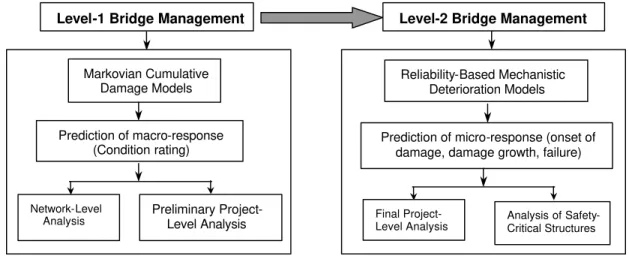
Level-1 bridge management
It uses Markovian cumulative damage models to forecast the overall deterioration and required maintenance funds for both short and long term planning of a network or a bridge component. This first level identifies the structures that are in need of maintenance and rehabilitation.
Level-2 bridge management
It uses reliability-based mechanistic deterioration models for the analysis of critical structures, which are identified from: (i) above first level of management analysis; and / or (ii) specific condition assessment of a damaged critical structure (e.g. collision damage, earthquake, etc.). The analysis at this level provides quantitative estimates of the safety and serviceability of structures and provides refined selection of the most cost-effective maintenance strategies for the deteriorated structures.
Conclusions
This paper makes the case for formulating the bridge maintenance problem as a two-level decision process that improves the effectiveness of bridge maintenance management systems in meeting the safety, serviceability and budgetary requirements of highway agencies. The level-1 management is based on Markovian cumulative damage models that predict the macro-response of bridge structures (condition rating). The level-2 management is based on quantitative reliability-based mechanistic deterioration models that predict the micro-response of bridge structures (load effect, resistance, crack, deflection, etc.)
Figure 1. Integration of macro- and micro-deterioration models for multilevel bridge management
Prediction of macro-response (Condition rating) Network-Level Analysis Markovian Cumulative Damage Models Preliminary Project- Level Analysis
Level-1 Bridge Management Level-2 Bridge Management
Reliability-Based Mechanistic Deterioration Models
Prediction of micro-response (onset of damage, damage growth, failure)
Analysis of Safety- Critical Structures Final Project-
Level Analysis
7
The level-1 management identifies the critically damaged structures and forecasts the overall deterioration and required maintenance funds for both short and long term planning for a network or a bridge component. The level-2 management focuses on the critical structures (in terms of damage and consequences of failure) that were identified from the level-management or from a specific condition assessment to evaluate their safety and serviceability. At this level, maintenance decisions are optimized and can include rehabilitation, posting or possibly closure of some structures that are identified as unsafe, depending on the budgetary constraints.
The proposed two-level approach to bridge maintenance management, which integrates two different probabilistic deterioration models, will help improve the effectiveness of maintenance management systems in satisfying the safety, serviceability, and budgetary requirements of highway agencies.
References
Bogdanoff, J.L. (1978). “A new cumulative damage model- Part 1.” J. of Applied Mechanics, 45, 246-250.
Cady, P.D., and Weyers, R.E. (1983). “Chloride penetration and the deterioration of concrete bridge decks.” Cement, Concrete and Aggregates, 5(2), 81-87.
Ditlevsen, O. (1984). “Probabilistic thinking: an imperative in engineering modeling.” Danmarks Tekniske Hojskole, Lyngby, 1-23.
Frangopol, D.M., et al. (1997). “Reliability of reinforced concrete girders under corrosion attack.” J. of Struct. Engrg., ASCE, 123(3), 286-297.
Freudenthal, A. M. (1972). “Reliability analysis based on time to first failure.” Aircraft Fatigue, Pergamon Press, New York, 13-48.
Golabi, K. et al. (1993). “Pontis version 2.0 Technical Manual: A network optimization system for bridge improvement and maintenance.” Report FHWA-SA-94-031, FHWA, USDOT.
Hawk, H. (1999). “Bridgit: user-friendly approach to bridge management.” 8th Int. Conf. on Bridge Management, Denver, CO, Paper F-7.
Lounis, Z., et al. (1998). “Further steps towards a quantitative approach to durability design.” CIB World Congress, Gävle, Sweden, Vol.1, 315-324.
Lounis, Z. (2000). “Reliability-based life prediction of aging concrete bridge decks.” In Life prediction & aging management of concrete structures, Naus, D ,ed., 229-238. Lounis, Z., and Mirza, M.S. (2001). “Reliability-based service life prediction of deteriorating concrete structures.” Proc. 3rd. Int. Conf. on Concrete under Severe Conditions, Vancouver, Vol.1, 965-972.
Madanat, S. and WanIbrahim, W.H., (1995) "Poisson Regression Models Of
Infrastructure Facility Deterioration", Journal of Transportation Engineering, ASCE, 121( 3),
8
Madanat, S., Mishalani, R. and Wan Ibrahim, W.H., (1995), “Estimation of Infrastructure Transition Probabilities From Condition Rating Data”, Journal of Infrastructure Systems, ASCE, 1(3),120-125.
Madanat, S., Karlaftis, M.G., and McCarthy, P.S., (1997), “Probabilistic
Infrastructure Deterioration Models with Panel Data”, Journal of Infrastructure Systems, ASCE, Vol. 3, No. 1, pp. 4-9.
Mauch M. and Madanat S., (2001) “Stochastic Duration Models of Bridge Deck Deterioration”, Journal of Infrastructure Systems, ASCE, 7(2),.
Melchers, R. E.(1987). Structural reliability: Analysis and prediction. Ellis Horwood. Mori, Y., and Ellingwood, B. (1993). “Reliability-based service life assessment of aging concrete structures.” J. of Struct. Engrg., ASCE, 119(5),1600-1621.