HAL Id: tel-01761771
https://hal.archives-ouvertes.fr/tel-01761771
Submitted on 9 Apr 2018HAL is a multi-disciplinary open access archive for the deposit and dissemination of sci-entific research documents, whether they are pub-lished or not. The documents may come from teaching and research institutions in France or abroad, or from public or private research centers.
L’archive ouverte pluridisciplinaire HAL, est destinée au dépôt et à la diffusion de documents scientifiques de niveau recherche, publiés ou non, émanant des établissements d’enseignement et de recherche français ou étrangers, des laboratoires publics ou privés.
Naly Rakoto-Ravalontsalama
To cite this version:
Naly Rakoto-Ravalontsalama. Control of Hybrid Systems and Discrete-Event Systems. Computer Science [cs]. IMT Atlantique, 2017. �tel-01761771�
Universit´
e de Nantes, France
HABILITATION A DIRIGER DES RECHERCHES
English VersionNaly Rakoto-Ravalontsalama IMT Atlantique - LS2N
Control of Hybrid Systems and Discrete-Event Systems
Commande de Syst`emes Hybrides et de Syst`emes `a Ev`enements Discrets
Ecole Doctorale : STIM Specialization: Automatic Control
Date of defense: 6 September 2017
EXAMINING COMMITTEE
Reviewers:
Didier Henrion Research Director, LAAS-CNRS Toulouse
Daniel Liberzon Professor, University of Illinois at Urbana-Champaign, USA
Eric Niel Professor, INSA Lyon - Amp`ere
Examiners:
Alexandre Dolgui Professor, IMT Atlantique - LS2N Claude Jard Professor, University of Nantes - LS2N
Stephane Lafortune Professor, University of Michigan, Ann Arbor, USA Jean-Jacques Loiseau Research Director, CNRS - LS2N
Contents
Remerciements 5 Introduction 7 1 Curriculum Vitae 9 1.1 Personal Data . . . 9 1.2 Teaching Activities . . . 9 1.3 Research Activities . . . 10 1.4 Supervision of Students: PhD, MSc. . . 111.5 Funded and Submitted Projects . . . 12
1.6 Organization of Invited Sessions . . . 13
1.7 Complete List of Publications . . . 13
2 Analysis and Control of Hybrid and Switched Systems 21 2.1 Modeling and Control of MLD systems . . . 21
2.1.1 Piecewise Affine (PWA) Systems . . . 21
2.1.2 Mixed Logical Dynamical (MLD) Systems . . . 22
2.1.3 Converting PWA into MLD Systems . . . 22
2.2 Stability of Switched Systems . . . 29
2.3 Optimal Control of Switched Systems . . . 29
2.3.1 Switched Linear Systems . . . 29
2.3.2 Switched Nonlinear Systems . . . 30
3 Supervisory Control of Discrete-Event Systems 31 3.1 Multi-Agent Based Supervisory Control . . . 31
3.2 Switched Discrete-Event Systems . . . 32
3.3 Switchable Languages of DES . . . 33
3.3.1 Triplet of Switchable Languages . . . 33
3.3.2 Transitivity of Switchable Languages (n = 3) . . . . 34
3.3.3 N-uplet of Switchable Languages . . . 34
3.3.4 Transitivity of Switchable Languages (n > 3) . . . . 34
4 Conclusion and Future Work 35 4.1 Summary of Contributions . . . 35
4.2 Perspective 1: Control of Smart Grids . . . 35
4.3 Perspective 2: Simulation with Stochastic Petri Nets . . . 36
4.4 Perspective 3: Planning/Inventory Control . . . 36
A Appendix 1 – Paper [C.24]: 43
B Appendix 2 – Paper [J.5]: 51
C Appendix 3 – Paper [J.9]: 65
Remerciements
Je voudrais remercier :• les rapporteurs : Didier Henrion, Daniel Liberzon et Eric Niel.
• les examinateurs : Alexandre Dolgui, Claude Jard, Stephane Lafortune et Jean-Jacques
Loiseau.
• mes Doctorants: Santi, Jose-Luis, Eduardo et German.
• ma famille : Pascale, Alice et Camille, et ma m`ere, Emilienne
Enfin, cette Th`ese d’HDR est d´edi´ee `a la m´emoire de mon p`ere, Prof. Dr. Georges Rakoto-Ravalontsalama (1937-2011).
Introduction
The HDR (Habilitation `a Diriger des Recherches) is a French Degree that you get some years after the PhD. It allows the candidate to apply for some University Professor positions and/or to apply for a Research Director position at CNRS. Instead of explaining it in details, the selection phases process after an HDR is summarized with a Petri Net model in Figure 1.
n
selec−n qualification (CNU)
HDR
Professor
univ−1 univ−2 univ−n
CNRS Research Director
selec−1 selection
2
Figure 1: Selection Phases after the HDR
After obtaining the HDR Thesis Degree, the candidate is allowed to apply for a Research Director position at CNRS, after a national selection. On the other hand, in order to apply for some Univer-sity Professor positions, the candidate should first apply for a National Qualifcation (CNU). Once this qualification obtained, the candidate can then apply to some University Professor positions, with a selection specific to each university.
This HDR Thesis is an extended abstract of my research work from my PhD Thesis defense in 1993 until now. This report is organized as follows.
• Chapter 1 is a Curriculum Vitae
• Chapter 2 presents the Analysis and Control of Hybrid and Switched System • Chapter 3 is devoted to Supervisory Control of Discrete-Event Systems • Chapter 4 gives the Conclusion and Future Work
Chapter 1
Curriculum Vitae
1.1
Personal Data
Born on February 19, 1965; Married and has 2 daughters (19 and 15 years old, resp.) Citizenship: French.
A. Affiliation
- Dept. of Automation, Production and Computer Science (DAPI)
IMT Atlantique (ex-Mines Nantes) Phone: +33 (0)2 5185 8306
4 Rue Alfred Kastler Fax: +33 (0)2 5185 8349
44307 Nantes Cedex 03 e-mail: [email protected]
France web: www.imt-atlantique.fr
- Also member of LS2N Laboratory, Nantes (UMR CNRS 6004) in the PSI Research Group www.ls2n.fr
B. Education
1993 Ph.D. in Automatic Control (Tr`es Honorable) LAAS-CNRS and University of Toulouse, France
1989 M.Sc. [DEA] in Automatic Control (A. Bien) LAAS-CNRS and University of Toulouse, France 1987-88 Licence + Maˆıtrise EEA (Assez Bien) University of Toulouse, France
1985 DEUG A Physique-Chimie (Bien) University of Toulouse, France
1983 National Service Tananarive, Madagascar
1982 Baccalaur´eat s´erie C (Assez Bien) Tananarive, Madagascar
1.2
Teaching Activities
A. Teaching
I am teaching regularly a yearly normal service i.e. 192 h eq TD since I arrived at Ecole des Mines in September 1994. The subject and the students have a bit evolved since 1994. Here below is a summary of the courses that I gave during the Academic year 2015-2016. What is new compared to the beginning in 1994 are the courses given in the 2 Master of Science programs MOST (Management and Optimization in Supply Chain and Transport) and PM3E (Project Management for Environmental, and Energy Engineering). These 2 programs are offered entirely in English.
Promo Course CM PC TD TP-MP PFE Resp Lang.
A1 Automatique 10h 10h 10h Fr.
A2 Optim. 10h 5h Fr.
A2 AII SED 10h 5h 5h Fr.
A3 AII SysHybrides 7.5h 7.5h Fr.
MSc. PM3E Control 7.5h 7.5h Eng.
MSc. MOST Simulation 5h 5h 5h Eng.
MSc. MOST Resp. MSc+UV 90h Eng.
A3 PFE superv. 36h Fr.
Masters PFE superv. 36h Eng.
Total 1 272h 10h 30h 30h 40h 72h 90h
Total 2 283up 15up 36up 30up 40up 72up 90up
Table 1.1: Teaching in 2015-2016
B. Responsabilities (Option AII, Auto-Prod, MSc MLPS, MSc MOST) I had and am having the following administrative responsabilities at Mines Nantes:
• 1997-2000: Last Year’s Option AII (Automatique et Informatique Industrielle) • 2001-2004: First and Second Year: Control and Industrial Eng. courses at DAP • 2006-2012: MSc. MLPS (Management of Logistic and Production Systems)
• 2012-present: MSc. MOST (Management and Optimization of Supply Chains and Transport) C. Courses given abroad
• May 2008: Univ. of Cagliari (Italy): Control of Hybrid Systems (10h) Erasmus • Apr. 2009: Univ. Tec. Bolivar UTB, Cartagena (Colombia): Tutorial on DES (15h) • May 2014: Univ. Tec. Bolivar UTB, Cartagena (Colombia): Intro. to DES (15h) • Dec 2015: ITB Bandung (Indonesia): Simulation with Petri Nets (10h) Erasmus • Apr. 2017: Univ. of Liverpool (UK): Course 1 (10h) Erasmus
• May 2017: ITB Bandung (Indonesia): Simulation with Petri Nets (10h) Erasmus
1.3
Research Activities
My main topics of research are the following:
1. Analysis and control of hybrid and switched systems 2. Supervisory control of discrete-event systems
These will be detailed in Chapter 2 and Chapter 3, respectively. The following other topics of research will not be presented. However, the corresponding papers can be found in the Complete List of Publications.
• Resource Allocation • Holonic Systems • Inventory Control
NR HDR 11
1.4
Supervision of Students: PhD, MSc.
A. PhD Students:
• Santi Esteva, PhD defended in Girona in March 2003.
-Modelling, Control and Supervision for a Class of Hybrid Systems
- PhD Committee: J. Aguilar-Martin, J.L. de la Rosa, J. Colomer, J.C. Hennet, E. Garcia, J. Melendez, V. Puig, N. Rakoto, G. Roux
- Supervision: J.L. de la Rosa (50 %), N. Rakoto (50 %) - Publications: 1 conference paper
- Current activity: Associate Professor at University of Girona, Spain.
• Jose-Luis Villa, PhD defended in Nantes in February 2004.
-Mod´elisation et commande de syst`emes hybrides : L’approche MLD
- PhD Committee: M. Morari, K.E. Arzen, M. Duque, A. Gauthier, J.J. Loiseau, N. Rakoto - Supervision: M. Duque (40 %), A. Gauthier (10 %), N. Rakoto (40 %), J.J. Loiseau (10 %) - Publications: 1 book chapter, 12 conference papers
- Current activity: Profesor Titular at Universidad Tecnologica Bolivar, Cartagena, Colombia.
• Eduardo Mojica, PhD defended in Nantes in September 2009.
-A polynomial approach for analysis and optimal control of switched nonlinear systems - PhD Committee: P. Caines, D. Henrion, A. Gauthier, J.J. Loiseau, N. Quijano, P. Riedinger, N. Rakoto
- Supervision: M. Quijano (40 %), A. Gauthier (10 %), N. Rakoto (40 %), J.J. Loiseau (10 %)
- Publications: 2 journal papers, 6 conference papers
- Current activity: Associate Professor at Universidad Nacional, Bogota, Colombia.
• German Obando, PhD defended in Nantes in October 2015.
-Distributed methods for resource allocation: A passivity-based approach
- PhD Committee: C. Ocampo-Martinez, H. Gueguen, A. Dolgui, A. Gauthier, J.J. Loiseau, N. Quijano, N. Rakoto
- Supervision: M. Quijano (40 %), A. Gauthier (10 %), N. Rakoto (40 %), J.J. Loiseau (10 %)
- Publications: 1 journal paper, 2 conference papers
- Current activity: PostDoc at Universidad de los Andes, Bogota, Colombia.
B. MSc Students:
• 2017: Nawapol Yamclee (IMTA / MSc. PM3E) – Control of Smart Grids
• 2017: Dina Lavender (IMTA / MSc. MOST) – Simulation with Stochastic Petri Nets • 2010: Amadou Sagna (ECN / Master AIA) – Model Predictive Control
• 2003: Xiaoyu Chen (EMN Nantes / MSc. MOST) – Supervisory Control • 1996: Nadia Pariset (EMN Nantes / Option AII) – Hybrid Petri Nets • 1994: Jean-Sebastien Besse (INSA Toulouse) – G2 Expert System
C. Member of Ph.D. Thesis Committees (other than my PhD Students) - Ph.D. examiner of D. Fragkoulis, LAAS-CNRS, Univ. of Toulouse, France (Nov. 2008)
Detection et localisation des d´efauts provenant des capteurs et des actionneurs : application sur un syst`eme non lin´eaire.
- Ph.D. examiner of Aimed Mokhtari, LAAS-CNRS, Univ. of Toulouse, France (Sep. 2007)
Diagnostic de syst`emes hybrides : d´eveloppement d’une m´ethode associant la d´etection par classification et la simulation dynamique.
- Ph.D. examiner of Hector Hernandez de Leon, LAAS-CNRS, Univ. of Toulouse, France (Sep. 2006)
Supervision et diagnostic des proc´ed´es de production d’eau potable.
- Ph.D. examiner of Flavio Neves-Junior, LAAS-CNRS, Univ. of Toulouse, France (Nov. 1998)
Supervision et commande des phases transitoires des processus industriels : application a une colonne de distillation.
D. Short Research Visits
- May-June 2004: McGill University, Montreal, Canada. Host: Prof. Peter E. Caines (2 months) - Sep. 2013: University of Michigan, Ann Arbor, MI, USA. Host: Prof. Stephane Lafortune (1 month)
E. Invited Plenary Talks
- Invited Plenary Talk, Analysis and Control of Hybrid and Switched Systems, Colombian Control Conf., Cartagena, Colombia, April 2009.
F. Member of Conference International Program Committees
- IFAC Conf. on Analysis and Design of Hybrid Systems (ADHS 2006), Alghero, Italy, June 2006. - IEEE Conf. on Emerging Technologies and Factory Automation (ETFA 2001) Antibes, FR, 2001 - Int. Conf. on Automation of Mixed Processes: (ADPM 1998), Reims, France, March 1998.
G. Member of Conference Organizing Committees
- 7th Workshop on Service Orientation in Holonic and Multi-Agent Manufacturing (SOHOMA 2017) Nantes, France, 2017.
- IFAC Conf. on Analysis and Design of Hybrid Systems (ADHS 2003), St. Malo, France, 2003. - Conf. Int. Francophone en Automatique (CIFA 2002), Nantes, France, July 2002.
- Int. Conf. on Automation of Mixed Processes (ADPM 2000), Dortmund, Germany, Sep. 2000.
1.5
Funded and Submitted Projects
• Co-Principal Investigator (with Andi Cakravastia, ITB), LOG-FLOW, PHC
NUSANTARA France Indonesia, Project N. 39069ZJ, 2017, Accepted on 31 May 2017.
• Participant, ”Industrial Validation of Hybrid Systems”, France and Colombia ECOS Nord
Project N.C07M03, A. Gauthier and J.J. Loiseau PIs, Jan. 2007 to Dec. 2009 (3 years) Euro 12,000.
• Participant, French ”Contrat Etat-R´egion” 2000-2006, CER STIC 9 / N.18036,
J.J. Loiseau PI, Euro 182,940 (US$ 182,940).
• Co-Principal Investigator (with Ph. Chevrel), Modeling and Simulation of ESP Program,
Peugeot-Citroen PSA France, Sep. 2000 - Jan 2001, FF 20,000 (US$ 3,000).
• Co-Principal Investigator (with J. Aguilar-Martin), Control and Supervision of a Distillation
Process, Conseil R´egional Midi-Pyr´en´ees, France, 1994-1995, FF 200,000 (US$ 30,000).
• Participant, European Esprit Project IPCES (Intelligent Process Control by means of
NR HDR 13
1.6
Organization of Invited Sessions
- Invited Session, Diagnosis and Prognosis of Discrete-Event Systems, 48th IEEE CDC Shanghai, China, Dec 2009
(jointly organized and chaired with Shigemasa Takai).
- Invited Session, Diagnosis of DES Systems, 1st IFAC DCDS 2007, Paris, France, June 2007 (jointly organized and chaired with Shigemasa Takai).
- Invited Session, DES and Hybrid Systems, IEICE NOLTA 2006, Bologna, Italy, Sep. 2006 (jointly organized and chaired with Shigemasa Takai).
- Invited Session, Supervisory Control, IFAC WODES, Reims, France, Sep. 2004 (jointly organized and chaired with Toshimitsu Ushio).
- Invited Session, Hybrid Systems, IEEE ISIC 2001, Mexico City, Mexico, Sep. 2001 (jointly organized and chaired with Michael Lemmon).
- Invited Session, Knowledge Based Systems, IEEE ISIC 1999, Cambridge, MA, USA, Sep. 1999 (jointly organized and chaired with Karl-Erik ˚Arz`en).
- Workshop on G2 Expert System, LAAS-CNRS, Toulouse, France, Oct. 1995 (jointly organized and chaired with Joseph Aguilar-Martin).
1.7
Complete List of Publications
A summary of the papers, classified per year, from 1994 to 2017, is given in the following table. Conf. Book Chap. Book Ed. Journal Total
1994 2 2 1995 2 1 1 4 1996 1 1 2 1997 1 1 1998 2 2 1999 1 1 2000 2001 4 1 5 2002 1 1 2003 5 1 6 2004 6 6 2005 1 1 2006 3 3 2007 4 4 2008 2 2 2009 1 1 2010 1 1 2011 2012 1 1 2013 2 2 2014 4 1 5 2015 2 1 3 2016 4 4 2017 1+3* 1* 1+4*
Complete List of Publications
[] Book Edition
[B.1] Supervision de processus `a l’aide du syst`eme expert G2, N. Rakoto-Ravalontsalama and J.
Aguilar-Martin (Eds.), Hermes Ed. Paris, Oct. 1995, ISBN 2-86601-499-5.
[Proceedings of Workshop on G2 Expert System, LAAS-CNRS Toulouse, France, Oct. 1995] [Includes 4 papers in English and 6 papers in French]
International Refereed Journals
[J.sub1] F. Torres, C. Garcia-Diaz and N. Rakoto-Ravalontsalama. ”Evolutionary Dynamics of Two-actor VMI-driven Supply Chains”, Submitted, Dec. 2016.
[J.9] G. Obando, N. Quijano, and N. Rakoto-Ravalontsalama. ”A Center-Free Approach for Resource Allocation with Lower Bounds”, International Journal of Control, 2016. DOI: 10.1080/00207179.2016.1225167.
[J.8] C. Indriago, O. Cardin, N. Rakoto-Ravalontsalama, P. Castagna, E. Chacon. ”H2CM: A holonic architecture for flexible hybrid control systems”’, Computers in Industry, Elsevier, 77 (2016) pp. 15–28.
[J.7] C. Indriago, O. Cardin, O. Morineau, N. Rakoto-Ravalontsalama, P. Castagna, E. Chacon. ”Performance evaluation of holonic control of a switch arrival system”’, Concurrent Engineer-ing: Research and Applications, SAGE, 2016, DOI: 10.1177/1063293X16643568.
[J.6] C. Indriago, O. Cardin, O. Bellenguez-Morineau, N. Rakoto, P. Castagna, E. Chacon. ”Evalu-ation de l’applic”Evalu-ation du paradigme holonique `a un syst`eme de r´eservoirs”’, Journal Europ´een des Syst`emes Automatis´es JESA, vol. 49 N.23, pp.325-347, 2016.
[J.5] E. Mojica, N. Quijano, and N. Rakoto-Ravalontsalama A polynomial approach for optimal
control of switched nonlinear systems, Int. Journal of Robust and Nonlinear Control, Wiley,
2014, 24 (12), pp.1797-1808.
[J.4] E. Mojica, N. Quijano, N. Rakoto-Ravalontsalama, and A. Gauthier A polynomial approach
for stability analysis of switched systems, Systems and Control Letters 59 (2010) 98–104.
[J.3] N. Rakoto-Ravalontsalama, J. Aguilar-Martin, Knowledge-based modelling of a TV-tube
man-ufacturing system, IFAC Journal of Control Engineering Practice, Jan. 1996, 4(1), pp. 117–123.
[J.2] P. Bourseau, K. Bousson, P. Dague, J.L. Dormoy, J.M. Evrard, F. Guerrin, L. Leyval, O. Lhomme, B. Lucas, A. Missier, J. Montmain, N. Piera, N. Rakoto-Ravalontsalama, J.P. Steyer, M. Tomasena, L. Trave-Massuyes, M. Vescovi, S. Xanthakis and B. Yannou, Qualitative reasoning: A survey of techniques and applications AICOM Journal, Sept-Dec. 1995, vol. 8,
N. 3-4, pp. 119–192.
[J.1] N. Rakoto-Ravalontsalama, A Missier, and J.S. Kikkert, Qualitative operators and process
en-gineer semantics of uncertainty. In B. Bouchon-Meunier, L. Valverde, and R.R. Yager (Eds.)
Lecture Notes in Computer Science N. 682, IPMU’92 - Advanced Methods in Artificial
Intel-ligence, Springer Verlag 1992, pp. 284–293. Book Chapters
[B.Ch.4] C. Indriago, O. Cardin, N. Rakoto, E. Chacon, P. Castagna, ”Application of holonic paradigm to hybrid processes: Case of a water treatment process”’ Chapter of the book ”Ser-vice Orientation in Holonic and Multi-agent Manufacturing”, Springer, 2015 ISBN 978-3-319-15159-5.
[B.Ch.3] J.L. Villa, M. Duque, A. Gauthier, and N. Rakoto-Ravalontsalama, Hybrid modeling of
potable water treatment plant. In. Pumps, Electromechanical Devices and Systems Applied to Urban Water Management, Cabrera and Cabrera Jr. Eds., 2003 Swets and Zeitlinger, Lisse,
Switzerland, ISBN 90 5809 560 6, pp. 909–917.
[B.Ch.2] Y. Quenec’hdu, J. Buisson, N. Rakoto-Ravalontsalama, Rappels sur les syst`emes continus et ´echantillonn´es, Chapitre de l’ouvrage Mod´elisation et commande de syst`emes dynamiques hybrides (J. Zaytoon coord.), Hermes Ed., Paris, 2001, pp. 29–59 (in French).
[B.Ch.1] N. Rakoto-Ravalontsalama, Supervision et diagnostic de proc´ed´es industriels : IPCES,
Chapitre du livre Le raisonnement qualitatif (L. Trave-Massuyes, Ph. Dague, F. Guerin coord.), Hermes Ed., Paris 1997, pp. 279–322 (in French).
International Conferences with Proceedings
[C.sub3] D. Lavender, A. Cakravastia, Y Lafdail, and N. Rakoto-Ravalontsalama, Modeling and
Simulation of Baggage Handling System in a Large Airport , Submitted, June 2017.
[C.sub2] N. Yamclee, C. Nicolas-Rodriguez, and N. Rakoto-Ravalontsalama, Switched LQR Control
of Interleaved Double Dual Boost Converters, Submitted, May 2017.
[C.sub1] M. Canu and N. Rakoto-Ravalontsalama. On Switchable Languages of Discrete-Event Systems with Weighted Automata, Submitted, March 2017.
[C.50] Z. Michaelides, N. Rakoto, and R. Michaelides, Big Data Driven Demand Networks, Proc. of POMS 2017 Conf., Seattle, WA, USA, May 2017.
[C.49] G. Obando, N. Quijano, and N. Rakoto-Ravalontsalama. ”Distributed resource allocation over stochastic networks: An application in smart grids ”, Proc. of IEEE CCAC 2015, Man-izales, Colombia, Oct 2015.
[C.48] C. Indriago, O. Cardin, O. Morineau, N. Rakoto, P. Castagna, ”Performance evaluation of holonic-based online predictive-reactive scheduling for a switch arrival system”’ Proc. of INCOM 2015, Ottawa, Canada, May 11-13, 2015. IFAC-PapersOnLine 48-3 (2015) pp. 1105– 1110.
[C.47] C. Indriago, O. Cardin, N. Rakoto, E. Chacon, P. Castagna, ”Application of holonic paradigm to a water treatment process”’ Proc. of SOHOMA 2014, Nancy, France, Nov. 2014, pp. 32–39.
[C.46] C. Indriago, O. Cardin, N. Rakoto, P. Castagna, E. Chacon. ”Application du paradigme holonique `a un syst`eme de reservoirs”’ Proc. of MOSIM 2014, Nancy, France, Nov. 2014. [C.45] G. Obando, N. Quijano, and N. Rakoto-Ravalontsalama. ”Distributed Building Temperature
Control with Power Constraints ”, Proc. of ECC 2014, pp. 2857–2862, Strasbourg, France, June 2014.
NR HDR 17
[C.44] F. Torres, C. Garcia-Diaz, and N. Rakoto-Ravalontsalama. ”An Evolutionary Game Theory Approach to Modeling VMI Policies”, Proc. of IFAC World Congress 2014, pp. 10737–10742, Capetown, South Africa, Aug. 2014.
[C.43] M. Canu and N. Rakoto-Ravalontsalama, From mutually blocking to switched
non-blocking DES. Presented at MSR’13 Workshop (Poster Session), Rennes, France, Nov 13-15,
2013.
[C.42] F. Torres, C. Garcia-Diaz, and N. Rakoto-Ravalontsalama, Evolutionary stability of a manufacturer-buyer VMI-conduced supply chain, Proc. of POMS 2013 Conf., Denver,
Col-orado, USA, May 2013.
[C.41] N. Rakoto-Ravalontsalama, On Stability Analysis of Switched Circulant Systems, Proc. of MATHMOD 2012, Vienna, Austria, Feb 14-17, 2012.
[C.40] E. Mojica, N. Quijano, and N. Rakoto-Ravalontsalama, A generalization of a polynomial
control of switched systems, Proc. of IFAC ADHS 2009, Zaragoza, Spain, Sep 2009, pp. 120–
125.
[C.39] E. Mojica, N. Quijano, A. Gauthier, and N. Rakoto-Ravalontsalama, Stability analysis of
switched polynomial systems using dissipation inequalities, Proc. of the 47th IEEE CDC 2008,
Cancun, Mexico, Dec 2008, pp. 31–36.
[C.38] E. Mojica, R. Meziat, N. Quijano, A. Gauthier, and N. Rakoto-Ravalontsalama, Optimal
control of switched systems: A polynomial approach. Proc. of 2008 IFAC World Congress,
Seoul, Korea, July 2008, pp. 7808–7813.
[C.37] E. Mojica, A. Gauthier, and N. Rakoto-Ravalontsalama, Canonical piecewise linear
ap-proximation of nonlinear cellular growth. Proc. of the 46th IEEE CDC 2007 (Conference on
Decision and Control), Dec 2007, New Orleans, LA, USA, pp. 1640-1645.
[C.36] E. Mojica, A. Gauthier, and N. Rakoto-Ravalontsalama, Piecewise linear approximation of
nonlinear cellular growth. Proc. of 2007 IFAC SSSC (Symp. on Systems Structure and Control),
Oct 17–19, 2007, Foz do Iguacu, Brazil.
[C.35] E. Mojica, A. Gauthier, and N. Rakoto-Ravalontsalama, Probing control for PWL
approx-imation of nonlinear cellular growth. Proc. of 2007 IEEE MSC (Multi-conference on Systems
and Control), Oct 1-3, 2007, Singapore.
[C.34] M. Canu, D. Morel, and N. Rakoto-Ravalontsalama. ”Modeling and control of an experi-mental switched manufacturiung system,” Proc. of ICINCO 2007, May 2007, Angers, France. [C.33] M. Canu, J. Haurogne, D. Morel, and N. Rakoto-Ravalontsalama. ”Supervisory control of an experimental switched DES,” Proc. of IEICE NOLTA 2006, Sep 11-14, 2006, Bologna, Italy, pp. 275–278.
[C.32] N. Rakoto-Ravalontsalama. ”Supervisory control of switched discrete-event systems,” Proc. of Int. Symposium on MTNS 2006, July 24-28, 2006, Kyoto, Japan, pp. 2213–2217.
[C.31] M. Canu and N. Rakoto-Ravalontsalama, Flatness Based Control of Switched Systems.
Presented at HSCC’06 Workshop (Poster Session), Santa Barbara, CA, USA, March 29–31, 2006.
[C.30] J.L. Villa, M. Duque, A. Gauthier, and N. Rakoto-Ravalontsalama, Model predictive control
of MLD models with integrators. Proc. of 2005 IEEE CCA Conf. on Control Applications, Aug.
[C.29] J.L. Villa, M. Duque, A. Gauthier, and N. Rakoto-Ravalontsalama, Commande par MLD
d’une usine de traitement d’eau. Proc. of CIFA 2004, Douz, Tunisie, Nov 22-24, 2004 (in
French).
[C.28] J.L. Villa, M. Duque, A. Gauthier, and N. Rakoto-Ravalontsalama, Control of Hybrid Systems using the MLD Approach. Part I: Modelling. In Proc. of VI Congreso Nacional de la
Asociacion Colombiana de Automatica. Ibague, Colombia. 11-13 Nov. 2004 (in Spanish). [C.27] J.L. Villa, M. Duque, A. Gauthier, and N. Rakoto-Ravalontsalama, Control of Hybrid
Systems using the MLD Approach. Part II: Synthesis of Control. In Proc. of VI Congreso
Nacional de la Asociacion Colombiana de Automatica. Ibague, Colombia. 11-13 Nov. 2004 (in Spanish).
[C.26] J.L. Villa, M. Duque, A. Gauthier, and N. Rakoto-Ravalontsalama, ”Translating PWA systems into MLD systems”. In Proc. of 2004 IEEE CCA/CASCD/ISIC Conf., Taipei, Taiwan, Sep 2-4, 2004, pp. 37-42.
[C.25] X. Chen, D. Morel, and N. Rakoto-Ravalontsalama Multi-Agent Based Supervisory Control
of an Experimental Manufacturing Cell. Proc. of IFAC Symposium on Large Scale Systems
(LSS 2004) Osaka, Japan, July 26-28, 2004, pp. 391–394.
[C.24] J.L. Villa, M. Duque, A. Gauthier, and N. Rakoto-Ravalontsalama, A new algorithm for
translating MLD systems into PWA systems. Proc. of IEEE American Control Conference
(ACC 2004), June 30 - July 2, 2004, Boston, MA, USA, pp. 1208–1213.
[C.23] S. Esteva, J.L. de la Rosa, and N. Rakoto-Ravalontsalama, Modeling Hybrid Systems by
Piecewise Decomposition. In Proc. of IEEE Conf. on Systems, Man and Cybernetics (SMC
2003), Washington DC, USA, Oct. 2003, pp. 195–198.
[C.22] J.L. Villa, M. Duque, A. Gauthier, and N. Rakoto-Ravalontsalama, MLD Control of
Hy-brid Systems: Application to the Three-Tank Benchmark Problem. In Proc. of IEEE Conf. on
Systems, Man and Cybernetics (SMC 2003), Washington DC, USA, Oct. 2003, pp. 666-671. [C.21] J.L. Villa, M. Duque, A. Gauthier, and N. Rakoto-Ravalontsalama, Modeling and Control
of a Water Treatment Plant. In Proc. of IEEE Conf. on Systems, Man and Cybernetics (SMC
2003), Washington DC, USA, Oct. 2003, pp. 171-176.
[C.20] N. Rakoto-Ravalontsalama, J.L. Villa, and D. Morel, Supervisory Control Oriented Modeling
of an Experimental Manufacturing Cell. Proc. of IEEE Int. Symposium on Intelligent Control
(ISIC 2003) Houston, TX, USA, Oct. 2003, pp. 395–398.
[C.19] J.L. Villa, M. Duque, A. Gauthier, and N. Rakoto-Ravalontsalama, Supervision and Optimal
Control of a Class of Industrial Processes. In Proc. of IEEE Conf. on Emerging Technologies
and Factory Automation (ETFA 2003), Lisbon, Portugal, Sep. 2003, vol.2, pp. 177–180. [C.18] N. Rakoto-Ravalontsalama and J.L. Villa, Modeling and simulation of an experimental cell.
Proc. of International Conf. on Computational Science and its Applications (ICCSA 2003), Montreal, Canada, May 2003, LNCS N. 2667, Springer Verlag, pp. 533-538.
[C.17] J.L. Villa, M. Duque, A. Gauthier, and N. Rakoto-Ravalontsalama, Hybrid modeling of
potable water treatment plant. In Proc. of Pumps, Electromechanical Devices and Systems
(PEDS 2003), April 2003, Valencia, Spain, paper N.10089.
[C.16] N. Rakoto-Ravalontsalama. Controllability Issues in Supervisory Control Systems with Order
Relations. Proc. of IEEE Conf. on Systems, Man and Cybernetics (SMC 2002), Hammamet,
NR HDR 19
[C.15] N. Rakoto-Ravalontsalama, Partial and total order relations for supervisory control of hybrid
systems. Proc. of IEEE Emerging Technologies and Factory Automation (ETFA 2001) Antibes,
France, Oct 2001, vol.2, pp. 675–678.
[C.14] N. Rakoto-Ravalontsalama, Modeling of continuous and hybrid systems using partial order
relations. Proc. of IEEE Int. Symposium on Intelligent Control (ISIC 2001) Mexico City,
Mexico, Sep. 2001, pp. 156–160.
[C.13] N. Rakoto-Ravalontsalama, Discrete approximation of continuous and hybrid systems: Some
consequences to supervisory control. Proc. of IFAC Symposium on System Structure and
Control (SSSC 2001), Prague, Czech Republic, Aug. 2001.
[C.12] N. Rakoto-Ravalontsalama, Diagnosis algorithms for a symbolically modeled manufacturing
process. Proc. of International Conf. on Computational Science (ICCS 2001), LNCS N. 2073,
Springer Verlag, San Fransisco, CA, USA, May 2001, pp. 1228–1236.
[C.11] N. Rakoto-Ravalontsalama, Knowledge-based process control. Proc. of 1999 IEEE Int. Sym-posium on Intelligent Control (ISIC 1999), Cambridge, MA, USA, Sep. 1999, pp. 237–241. [C.10] N. Rakoto-Ravalontsalama, Mixed qualitative/quantitative modeling for process diagnosis.
Proc. of 13th European Simulation Multiconference (ESM 1999), Warsaw, Poland, June 1999, vol.2, pp. 414–418.
[C.9] L. Libeaut and N. Rakoto-Ravalontsalama, ”Modeling and analysis of a manufacturing cell: Petri net vs. automata approach”, Proc. of WESIC’98 Conf., Girona, Spain, June 1998, pp. 71–78.
[C.8] N. Rakoto-Ravalontsalama and J. Aguilar-Martin, Diagnosing uncertain parameters to
im-prove hybrid process model. Proc. of 3rd, International Conf. on Automation of Mixed
Pro-cesses: Dynamic Hybrid Systems (ADPM’98), Reims, France, March 1998, pp. 49–53.
[C.7] N. Rakoto-Ravalontsalama and J. Aguilar-Martin, Control of hybrid systems: The expert
sys-tem approach. In Proc. of IEEE/IMACS Computational Engineering in Syssys-tems Applications
(CESA 1996) Symp. on Discrete Event and Manufacturing Systems, Lille, France, July 1996, pp. 402–406.
[C.6] N. Rakoto-Ravalontsalama, Process supervision with expert systems: The Esprit IPCES
expe-rience, in ”Supervision de Processus `a l’Aide du Syst`eme Expert G2”, Rakoto-Ravalontsalama and Aguilar-Martin (Eds.), Hermes Ed. Paris 1995, pp. 11–20.
[C.5] N. Rakoto-Ravalontsalama and J. Aguilar-Martin, Modelling and simulation of hybrid
sys-tems: The expert system approach, Analysis and Design of Event-Driven Operations in Process
Systems (ADEDOPS’95) Workshop, London, UK, April 10-11, 1995.
[C.4] N. Rakoto-Ravalontsalama and J. Aguilar-Martin, Knowledge-based modelling of a TV-tube
manufacturing process. In Proc. of IFAC Workshop on Computer Software Structures
Inte-grating AI/KBS in Process Control, Lund, Sweden, Aug. 1994, pp. 111–117.
[C.3] J. Aguilar-Martin and N. Rakoto-Ravalontsalama, Uncertainty propagation in fuzzy
simula-tion of dynamic system – Applicasimula-tion to a simplified turbine. Proc. of SCS IFQN’94 Conf.,
Barcelona, Spain, June 1994.
[C.2] N. Rakoto-Ravalontsalama and J. Aguilar-Martin (1992), Automatic clustering for
sym-bolic evaluation for dynamical system supervision. In Proc. of Conf. Canadienne sur
[C.1] N. Rakoto-Ravalontsalama and J. Aguilar-Martin, Automatic clustering for symbolic
evalua-tion for dynamical system supervision. In Proc. of IEEE American Control Conference (ACC
Chapter 2
Analysis and Control of Hybrid and
Switched Systems
2.1
Modeling and Control of MLD systems
Piecewise affine (PWA) systems have been receiving increasing interest, as a particular class of hybrid system, see e.g. [2], [13], [11], [16], [14], [12] and references therein. PWA systems arise as an approximation of smooth nonlinear systems [15] and they are also equivalent to some classes of hybrid systems e.g. Linear complementarity systems [9]. On the other hand Mixed Logical and Dynamical (MLD) systems have been introduced by Bemporad and Morari as a suitable represen-tation for hybrid dynamical systems [3]. MLD models are obtained originally from PWA system, where propositional logic relations are transformed into mixed-integer inequalities involving integer and continuous variables. Then mixed-integer optimization techniques are applied to the MLD system in order to stabilize MLD system on desired reference trajectories under some constraints. Equivalences between PWA systems and MLD models have been established in [9]. More precisely, every well-posed PWA system can be rewritten as an MLD system assumung that the set of fea-sible states and inputs is bounded and a completely well-posed MLD system can be rewritten as a PWA system [9]. Conversion methods from MLD systems to equivalent PWA models have been proposed in [4], [5], [6] and [?]. Vice versa, translation methods from PWA to MLD systems have been studied in [3] (the original one), and then in [8], [?]. A tool that deals with both MLD and PWA systems is HYSDEL [17].
The motivations for studying new methods of conversion from PWA systems into their equiva-lent MLD models are the following. Firstly the original motivation of obtaining MLD models is to rewrite a PWA system into a model that allows the designer to use existing optimization algo-rithms such as mixed integer quadratic programming (MIQP) or mixed integer linear programmimg (MILP). Secondly there is no unique formulation of PWA systems. We can always address some particular cases that introduce some differences in the conversions. Finally, it has been shown that the stability analysis of PWA systems with two polyhedral regions is in general NP-complete or undecidable [7]. The conversion to MLD systems may be another way to tackle this problem.
2.1.1 Piecewise Affine (PWA) Systems
A particular class of hybrid dynamical systems is the system described as follows. {
˙
x(t) = Aix(t) + ai+ Biu(t)
y(t) = Cix(t) + ci+ Diu(t)
(2.1)
where i∈ I, the set of indexes, x(t) ∈ Xi which is a sub-space of the real space Rn, andR+ is the
set of positive real numbers including the zero element. In addition to this equation it is necessary to define the form as the system switches among its several modes. This equation is affine in the state space x and the systems described in this form are called piecewise affine (PWA) systems
[15], [9]. The discrete-time version of this equation will be used in this work and can be described
as follows. {
x(k + 1) = Aix(k) + bi+ Biu(k)
y(k) = Cix(k) + di+ Diu(k)
(2.2) where i∈ I is a set of indexes, Xi is a sub-space of the real spaceRn, andR+ is the set of positive
integer numbers including the zero element, or an homeomorphic set toZ+.
2.1.2 Mixed Logical Dynamical (MLD) Systems
The idea in the MLD framework is to represent logical propositions with the equivalent mixed integer expressions. MLD form is obtained in three steps [3], [4]. The first step is to associate a binary variable δ∈ {0, 1} with a proposition S, that may be true or false. δ is equal to 1 if and only if proposition S is true. A composed proposition of elementary propositions S1, . . . , Sq combined
using the boolean operators like AND, OR, NOT may be expressed with integer inequalities over corresponding binary variables δi, i = 1, . . . q. The second step is to replace the products of linear
functions and logic variables by a new auxiliary variable z = δaTx where aT is a constant vector. The variable z is obtained by mixed linear inequalities evaluation. The third step is to describe the dynamical system, binary variables and auxiliary variables in a linear time invariant system. An hybrid system described in MLD form is represented by Equations (2.3-2.5).
x(k + 1) = Ax(k) + B1u(k) + B2δ(k) + B3z(k) (2.3)
y(k) = Cx(k) + D1u(k) + D2δ(k) + D3z(k) (2.4)
E2δ(k) + E3z(k)≤ E1u(k) + E4x(k) + E5 (2.5)
where x = [xTcxTl ]∈ Rnc×{0, 1}nlare the continuous and binary states, respectively, u = [uT
CuTl ]∈ Rmc× {0, 1}ml are the inputs, y = [yT
cylT]∈ Rpc× {0, 1}pl the outputs, and δ∈ {0, 1}rl, z∈ Rrc,
represent the binary and continuous auxiliary variables, respectively. The constraints over state, input, output, z and δ variables are included in (2.5).
2.1.3 Converting PWA into MLD Systems
In this subsection two algorithms for converting PWA systems into MLD systems are given. The first case consists of several sub-affine systems with switching regions are explained in detail. The second case deals with several sub-affine systems, each of them belongs to a region which is described by linear inequalities is a variation of the first case. Each case is applied to an example in order to show the validity of the algorithm.
A. Case I
The PWA system is represented by the following equations:
x(k + 1) = Aix(k) + Biu(k) + fi
y(k) = Cix(k) + Diu(k) + gi
Sij = {x, u|k1ijT x + kT2iju + k3ij≤ 0}
(2.6)
where i∈ I = {1, . . . , n}. The case with jumps can be included in this representation considering each jump as a discrete affine behavior valid during only one sample time. The switching region Sij
is a convex polytope which volume, or hypervolume, can be infinite, and the sub-scripts denotes the switching from mode i to mode j. For this purpose we introduce a binary variable δi for each
index of the setI and a binary variable δi,j for each switching region Sij. In order to gain insight
in the following equations, we consider the hybrid the partition and the corresponding automaton is depicted in Figure 2.1. Introductory material on hybrid automata can be found in [1] and [10].
NR HDR 23
Figure 2.1: Partition and Automaton
The δij variables are not dynamical and, when the elements k in Sij are vectors, the binary variable
can be evaluated by the next mixed integer inequality
(δij = 1)⇔ (kT1ijx + kT2iju + k3ij ≤ 0) (2.7)
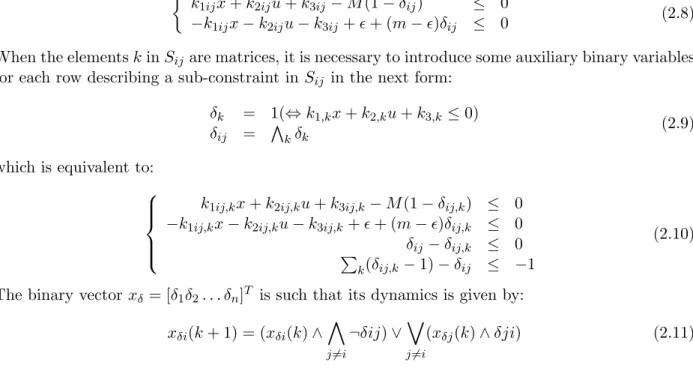
which is equivalent to: {
k1ijx + k2iju + k3ij− M(1 − δij) ≤ 0
−k1ijx− k2iju− k3ij+ ϵ + (m− ϵ)δij ≤ 0
(2.8)
When the elements k in Sij are matrices, it is necessary to introduce some auxiliary binary variables
for each row describing a sub-constraint in Sij in the next form:
δk = 1(⇔ k1,kx + k2,ku + k3,k ≤ 0) δij =
∧
kδk
(2.9)
which is equivalent to:
k1ij,kx + k2ij,ku + k3ij,k− M(1 − δij,k) ≤ 0
−k1ij,kx− k2ij,ku− k3ij,k+ ϵ + (m− ϵ)δij,k ≤ 0
δij− δij,k ≤ 0
∑
k(δij,k− 1) − δij ≤ −1
(2.10)
The binary vector xδ= [δ1δ2. . . δn]T is such that its dynamics is given by:
xδi(k + 1) = (xδi(k)∧ ∧ j̸=i ¬δij) ∨∨ j̸=i (xδj(k)∧ δji) (2.11)
where k is an index of time, and ∧, ∨, and ¬, are standard for the logical operations AND, OR, NOT, respectively. This equation can be explained as follows: The mode of the system in the next time is i if the current mode is mode i and any switching region is enabled in this time, or, the current mode of the system is j different to i and a switching region that enables the system to go into mode i is enabled. Considering that the PWA system is well posed, i.e. for a given initial state [xTiT]T0 and a given input u
0,τ there exists only one possible trajectory [xTiT]T0,x. That is
equivalent to the following conditions: ∑ i∈I xδi= 1, ∏ i∈I xδi= 0 (2.12)
The dynamical equations for xδ vector are equivalent to the next integer inequalities:
xδj(k) + δji− xδi(k + 1) ≤ 1, ∀i, j ∈ I, i ̸= j xδi(k)− ∑ j̸=i δij − xδi(k + 1) ≤ 0, ∀i, j ∈ I, i ̸= j −xδi(k)− ∑ j̸=i δji− xδi(k + 1) ≤ 0, ∀i, j ∈ I, i ̸= j (2.13)
The first inequality states that the next mode of the system should be mode i if the current mode is j different to i and a switching region for going from mode j to mode i is enabled. The second inequality means that the next mode of the system should be mode i if the current mode is i and any switching region for going from mode i into mode j different to i is enabled. And the third equation states that the system cannot be in mode i in the next time if the current mode of the system is not mode i and any switching region for going from mode i, (j different to i), into mode
This form for finding xδ(k + 1) causes a problem in the final model because it cannot be represented
by a linear equation in function of x, u, δ and Z. For this reason, xδ(k + 1) is aggregated to the
δ general vector of binary variables, and finally assigned directly to xδ(k + 1). The dynamics and
outputs of the system can be represented by the next equations: {
x(k + 1) = Ax(k) + Bu(k) +∑i∈I(Aix(k) + Biu(k) + fi)× xδi(k)
y(k) = Cx(k) + Du(k) +∑i∈I(Cix(k) + Diu(k) + gi)× xδi(k)
(2.14)
If we introduce some auxiliary variables: {
Z1i(k) = (Aix(k) + Biu(k) + fi)× xδi(k)
Z2i(k) = (Cix(k) + Diu(k) + gi)× xδi(k)
(2.15)
which are equivalent to: Z1i ≤ Mxδi(k) −Z1i ≤ −mxδi(k) Z1i ≤ Aix(k) + Biu(k) + fi− m(1 − xδi(k))
−Z1i ≤ −Aix(k)− Biu(k)− fi+ M (1− xδi(k))
(2.16) Z2i ≤ Mxδi(k) −Z2i ≤ −mxδi(k)
Z2i ≤ Cix(k) + Diu(k) + gi− m(1 − xδi(k))
−Z2i ≤ −Cix(k)− Diu(k)− gi+ M (1− xδi(k))
(2.17)
where M and m are vectors representing the maximum and minimum values, respectively, of the variables Z, these values can be arbitrary large. Using the previous equivalences, the PWA system ( 2.2) can be rewritten in an equivalent MLD model as follows:
x(k + 1) = Arrx(k) + Abrxδ(k) + B1ru(k) + B2rδ + B3r ∑ i∈I Z1i(k) xδ(k + 1) = Arbx(k) + Abbxδ(k) + B1bu(k) + B2bδ + B3b ∑ i∈I Z1i(k) yr(k) = Crrx(k) + Cbrxδ(k) + D1ru(k) + D2rδ + D3r ∑ i∈I Z2i(k) yδ(k) = Crbx(k) + Cbbxδ(k) + D1bu(k) + D2bδ + D3b ∑ i∈I Z2i(k) (2.18) s.t. E2 xδ(k + 1)δij δk + E3Z(k)≤ E4 x(k)δij δk + E1u(k) + E5 (2.19)
Using this algorithm, most part of the matrices are zero, because x and y are defined by Z, and
xδ is defined by δ. This situation can be avoided by defining the next matrices at the beginning of
the procedure: A = 1n(A1+ . . . + An), Ai = Ai− A, ∀i ∈ I B = 1n(B1+ . . . + Bn), Bi = Bi− B, ∀i ∈ I C = n1(C1+ . . . + Cn), Ci = Ci− C, ∀i ∈ I D = n1(D1+ . . . + Dn), Di= Di− D, ∀i ∈ I (2.20)
Finally, the equality matrices in (2.18) and (2.19) can be chosen as follows: Arr = A, Abr = 0nc×n, B1r = B, B2r= 0nc×(n+m+tk), B3r = [Inc×nc0nc×pcInc×nc0nc×pc. . . Inc×nc0nc×pc]nc×n×(nc+pc) Arb= 0n×nc, Abb= 0x×n, B1b = 0n×mc, B2b= [In×n0n×m0n×tk]n×n×(n+m+tk), B3b= 0nc×n×(nc+pc) (2.21)
NR HDR 25 Crr = C, Cbr = 0pc×n, D1r = D, D2r= 0pc×(n+m+tk), D3r = [0pc×ncIpc×pc0pc×ncIpc×pc. . . 0pc×ncIpc×pc]pc×n×(nc+pc) Crb= 0n×nc, Cbb= 0x×n, D1b= 0n×mc, D2b= [In×n0n×m0n×tk]n×n×(n+m), D3b= 0n×n×(nc+pc) (2.22)
where nC is the number of continuous state variables, mC the number of continuous input variables,
pC the number of continuous output variables, n the number of affine sub-systems, m the number
of switching regions and tk the number of auxiliary binary variables. The algorithm for converting a PWA system in the form of (2.1) into its equivalent MLD system can be summarized as follows:
B. Algorithm 1
1. Compute matrices A, B, C, D and Ai, Bi, Ci and Di using (2.20).
2. Initialize E1, E2, E3, E4, E5 matrices.
3. For the m switching regions Sj,i, include the inequalities defined in (2.8) or (2.10) which define the
values of the m auxiliary binary variables δj,i.
4. Generate 2∗ nxδi auxiliary binary dynamical variables associated with the n affine models and m auxiliary binary variables δj,iassociated with the m Sij switching regions.
5. For i = 1 to n include the inequalities using (2.13) representing the behavior on the xδ vector.
6. For i = 1 to n generate the nc-dimensional Z1i vector and pc-dimensional Z2i vector of auxiliary variables Z.
7. For each Z1i vector introduce the inequalities defined in (2.16), by replacing Ai, and Bi by Ai, and Bi, computed in Step 1. M and m are nc-dimensional vectors of maximum and minimum values of x,
respectively.
8. For each Z2i vector introduce the inequalities defined in (2.17), by replacing Ci, and Di by Ci, and Di, computed in Step 1. M and m are pc-dimensional vectors of maximum and minimum values of x,
respectively (This completes the inequality matrices). 9. Compute the matrices defined in (2.21) and (2.22) 10. End.
C. Example 1
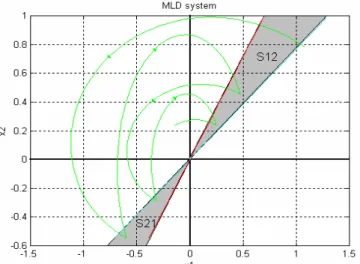
Consider the system whose behavior is defined by the following PWA model: x(k + 1) = Aix(k), i∈ {1, 2} S1,2 = {(x1, x2)|(x1≤ 1.3x2)∧ (0.7x2 ≤ x1)∧ (x2> 0) S2,1 = {(x1, x2)|(x1≤ 0.7x2)∧ (1.3x2 ≤ x1)∧ (x2< 0) whereA1= [ 0.9802 0.0987 −0.1974 0.9802 ] , A2= [ 0.9876 −0.0989 0.0495 0.9876 ]
The behavior of the system is presented in Figure 2.2. The initial points are (x10, x20) = (1, 0.8). We can see that the system switches between the two behaviors, from A1 to A2 in the switching region S1,2, and from A2 to A1 in the
switching region S2,1, alternatively. The switched system is stable.
D. Case 2
Consider now the system whose behavior is defined by the following PWA model: {
x(k + 1) = Aix(k) + bi+ Biu(k), i∈ I, x(k) ∈ Xi
y(k) = Cix(k) + di+ Diu(k), i∈ I, x(k) ∈ Xi
(2.23)
with conditions Xi ∩ Xj̸=i = ∅, ∀i, j ∈ I,
∪
i∈IXi = X, where X is the admissible space for
Figure 2.2: Phase portrait of Example 1 in PWA
Figure 2.3: Phase portrait of Example 1 MLD
variables and can be represented using the appropriate δ variables instead of xδ(k) variables in the
definition of Z in (2.16) and (2.17). However, note that the conditions X∪ i∩ Xj̸=i=∅ ∀i, j ∈ I and i∈IXi= X require a careful definition in the sub-spaces Xi in order to avoid a violation to these
conditions in its bounds. On the other hand, the MLD representation uses non-strict inequalities in its representation and the ε value in (2.8) and (2.9) should be chosen appropriately. Another way to overcome this situation and to insure an appropriated representation is the use of the following conditions in the bounds of the sub-spaces Xi:
δij = δi⊗ δj
which is equivalent to: { δi+ δj − 1 ≤ 0 1− δi− δj ≤ 0 or more generally ∑ i∈I δi− 1 ≤ 0 1−∑ i∈I δi ≤ 0 (2.24)
We now modify Equations (2.8), (2.10), (2.16), (2.17), (2.21), and (2.22) as follows: {
k1ix + k2iu + k3i− M(1 − δi) ≤ 0
−k1ix− k2iu− k3i+ ϵ + (m− ϵ)δi) ≤ 0
NR HDR 27
k1i,kx + k2i,ku + k3i,k− M(1 − δi,k) ≤ 0
−k1i,kx− k2i,ku− k3i,k+ ϵ + (m− ϵ)δi,k ≤ 0
δi− δi,k ≤ 0
∑
k(δi,k− 1) − δi ≤ −1
(2.26)
The auxiliary variables Z1i become:
Z1i ≤ Mδi(k) −Z1i ≤ −mδi(k) Z1i ≤ Aix(k) + Biu(k) + fi− m(1 − δi(k))
−Z1i ≤ −Aix(k)− Biu(k)− fi+ M (1− δi(k))
(2.27)
where the matrices Aiand Biare those previously defined in Equation (2.20).The auxiliary variable
Z2i is now modified according to the following equations: Z2i ≤ Mδi(k) −Z2i ≤ −mδi(k) Z2i ≤ Cix(k) + Diu(k) + gi− m(1 − δi(k)) −Z2i ≤ −Cix(k)− Diu(k)− gi+ M (1− δi(k)) (2.28)
where the matrices Ci and Di are those that have been defined in Equation (2.20). Finally the
matrices from Equation (2.18) can be chosen as follows: Arr= A, Abr = 0nc×n, B1rr = B, B2rb = 0nc×(n+tk), B3rr = [Inc×nc0nc×pcInc×nc0nc×pc. . . Inc×nc0nc×pc]nc×n×(nc+pc) Crr = C, Cbr = 0pc×n, D1rr = D, D1rb= [ ], D2rb= 0pc×(n+tk), D3rr = [0pc×ncIpc×pc0pc×ncIpc×pc. . . 0pc×ncIpc×pc]pc×n×(nc+pc) (2.29)
We give now an algorithm that converts a PWA system in the form of (2.23) into its equivalent MLD system.
E. Algorithm 2
1. Compute matrices A, B, C, D and Ai, Bi, Ci and Di using (2.20).
2. Initialize E1, E2, E3, E4, E5 matrices.
3. For i = 1 to n include the inequalities using (2.25) or (2.26) that represent the behavior on the n affine regions of the PWA system.
4. For all affine regions include the inequalities in (2.24).
5. For i = 1 to n generate the nc-dimensional Z1i vector and pc -dimensional Z2i vector of auxiliary variables Z.
6. For each Z1ivector introduce the inequalities defined in (2.27). M and m are nc-dimensional vectors
of maximum and minimum values of x, respectively.
7. For each Z2i vector introduce the inequalities defined in (2.28). M and m are pc-dimensional vectors
of maximum and minimum values of x, respectively (This completes the inequality matrices). 8. Compute the matrices defined in (2.29) where the binary state variables are removed. 9. End.
F. Example 2
Consider the system whose behavior is defined by the following PWA model: x(k + 1) = Aix(k), i∈ {1, 2} i = 1 if x1x2 ≥ 0 i = 2 if x1x2 < 0
whereA1= [ 0.9960 0.0199 −0.1995 0.9960 ] , A2= [ 0.9960 0.1995 −0.0199 0.9960 ]
The behavior of the system is presented in Figure 2.4. The PWA system with linear constraints has 4 sub-affine systems. Algorithm 2 produces an MLD system with 12 binary variables (4 variables for the affine sub-system, and 8 auxiliary variables), 16 auxiliary variables Z and 94 constraints.
Figure 2.4: Phase portrait of Example 2 in PWA
The behavior of the equivalent MLD system is shown in Figure 2.5. We can notice that the behavior of the MLD system is exactly the same as the original PWA model.
NR HDR 29
2.2
Stability of Switched Systems
A polynomial approach to deal with the stability analysis of switched non-linear systems under arbitrary switching using dissipation inequalities is presented. It is shown that a representation of the original switched problem into a continuous polynomial system allows us to use dissipation inequalities for the stability analysis of polynomial systems. With this method and from a theo-retical point of view, we provide an alternative way to search for a common Lyapunov function for switched non-linear systems. We deal with the stability analysis of switched non-linear sys-tems, i.e., continuous systems with switching signals under arbitrary switching. Most of the efforts in switched systems research have been typically focused on the analysis of dynamical behavior with respect to switching signals. Several methods have been proposed for stability analysis (see [53], [19], and references therein), but most of them have been focused on switched linear systems. Stability analysis under arbitrary switching is a fundamental problem in the analysis and design of switched systems. For this problem, it is necessary that all the subsystems be asymptotically stable. However, in general, the above stability condition is not sufficient to guarantee stability for the switched system under arbitrary switching. It is well known that if there exists a common Lyapunov function for all the subsystems, then the stability of the switched system is guaranteed under arbitrary switching. Previous attempts for general constructions of a common Lyapunov function for switched non-linear systems have been presented in [20], [21] using converse Lyapunov theorems. Also in [22], a construction of a common Lyapunov function is presented for a particular case when the individual systems are handled sequentially rather than simultaneously for a family of pairwise commuting systems. These methodologies are presented in a very general framework, and even though they are mathematically sound, they are too restrictive from a computational point of view, mainly because it is usually hard to check for the set of necessary conditions for a common function over all the subsystems (it could not exist). Also, these constructions are usu-ally iterative, which involves running backwards in time for all possible switching signals, being prohibitive when the number of modes increases.
The main contribution of this topic of stability of switched systems is twofold. First, we present a reformulation of the switched system as an ordinary differential equation on a constraint manifold. This representation opens several possibilities of analysis and design of switched systems in a con-sistent way, and also with numerical efficiency [C.39], [C.38], which is possible thanks to some tools developed in the last decade for polynomial differential-algebraic equations analysis [8,10]. The second contribution is an efficient numerical method to search for a common Lyapunov function for switched systems using results of stability analysis of polynomial systems based on dissipativity theory [23], [C.39]. We propose a methodology to construct common Lyapunov functions that pro-vides a less conservative test for proving stability under arbitrary switching. It has been mentioned in [26] that the sum of squares decomposition, presented only for switched polynomial systems, can sometimes be made for a system with a non-polynomial vector fields. However, those cases are restricted to subsystems that preserve the same dimension after a recasting process.
2.3
Optimal Control of Switched Systems
2.3.1 Switched Linear Systems
A polynomial approach to solve the optimal control problem of switched systems is presented. It is shown that the representation of the original switched problem into a continuous polynomial systems allow us to use the method of moments. With this method and from a theoretical point of view, we provide necessary and sufficient conditions for the existence of minimizer by using partic-ular features of the minimizer of its relaxed, convex formulation. Even in the absence of classical minimizers of the switched system, the solution of its relaxed formulation provide minimizers.
switch-ing signals. Recent efforts in switched systems research have been typically focused on the analysis of dynamic behaviors, such as stability, controllability and observability, etc. (e.g., [19], [53]). Al-though there are several studies facing the problem of optimal control of switched systems (both from theoretical and from computational point of view [37], [36], [27], [39], there are still some prob-lems not tackled, especially in issues where the switching mechanism is a design variable. There, we see how these difficulties arise, and how tools from non-smooth calculus and optimal control can be combined to solve optimal control problems. Previously, the approach based on convex analysis have been treated in [36], and further developed in [27], considering an optimal control problem for a switched system, these approaches do not take into account assumptions about the number of switches nor about the mode sequence, because they are given by the solution of the problem. The authors use a switched system that is embedded into a larger family of systems and the optimal control problem is formulated for this family. When the necessary conditions indicate a bang-bang-type of solution, they obtain a solution to the original problem. However, in the cases when a bang-bang type solution does not exist, the solution to the embedded optimal control problem can be approximated by the trajectory of the switched system generated by an appropriate switching control. On the other hand, in [36] and [34] the authors determine the appropriated control law by finding the singular trajectory along some time with non null measure.
2.3.2 Switched Nonlinear Systems
The nonlinear, non-convex form of the control variable, prevents us from using the Hamilton equations of the maximum principle and nonlinear mathematical programming techniques on them. Both approaches would entail severe difficulties, either in the integration of the Hamilton equations or in the search method of any numerical optimization algorithm. Consequently, we propose to convexify the control variable by using the method of moments in the polynomial expression in order to deal with this kind of problems. In this paper we present a method for solving optimal control for an autonomous switched systems problem based on the method of moments developed in for optimal control, and in [28], [29], [30] and [32] for global optimization. We propose an alternative approach for computing effectively the solution of nonlinear, optimal control problems. This method works properly when the control variable (i.e., the switching signal) can be expressed as polynomials. The essential of this paper is the transformation of a nonlinear, non-convex optimal control problem (i.e., the switched system) into an equivalent optimal control problem with linear and convex structure, which allows us to obtain an equivalent convex formulation more appropriate to be solved by high performance numerical computing. To this end, first of all, it is necessary to transform the original switched system into a continuous non-switched system for which the theory of moments is able to work. Namely, we relate with a given controllable switched system, a controllable continuous non-switched polynomial system.
Optimal control problems for switched nonlinear systems are investigated. We propose an alterna-tive approach for solving the optimal control problem for a nonlinear switched system based on the theory of moments. The essence of this method is the transformation of a nonlinear, non-convex optimal control problem, that is, the switched system, into an equivalent optimal control prob-lem with linear and convex structure, which allows us to obtain an equivalent convex formulation more appropriate to be solved by high-performance numerical computing. Consequently, we pro-pose to convexify the control variables by means of the method of moments obtaining semidefinite programs. The paper dealing with this approach is given in the Appendix 2, paper [J.5].
Chapter 3
Supervisory Control of Discrete-Event
Systems
3.1
Multi-Agent Based Supervisory Control
Supervisory control initiated by Ramadge and Wonham [56] provides a systematic approach for the control of discrete event system (DES) plant. The discrete event system plant be is modeled by a finite state automaton [50],[43]:
Definition 1 (Finite-state automaton). A finite-state automaton is defined as a 5-tuple
G = (Q, Σ, δ, q0, Qm,C)
where
• Q is the finite set of states, • Σ is the finite set of events,
• δ : Q × Σ → Q is the partial transition function, • q0 ⊆ Q is the initial state,
• Qm⊆ Q is the set of marked states (final states),
Let Σ∗ be the set of all finite strings of elements in Σ including the empty string ε. The transition function δ can be generalized to δ : Σ∗× Q → Q in the following recursive manner:
δ(ε, q) = q
δ(ωσ, q) = δ(σ, δ(ω, q)) for ω∈ Σ∗
The notation δ(σ, q)! for any σ ∈ Σ∗ and q ∈ Q denotes that δ(σ, q) is defined. Let L(G) ⊆ Σ∗ be the language generated by G, that is,
L(G) ={σ ∈ Σ∗|δ(σ, q0)!}
Let K ⊆ Σ∗ be a language. The set of all prefixes of strings in K is denoted by pr(K) with
pr(K) = {σ ∈ Σ∗|∃ t ∈ Σ∗; σt ∈ K}. A language K is said to be prefix closed if K = pr(K).
The event set Σ is decomposed into two subsets Σc and Σuc of controllable and uncontrollable
events, respectively, where Σc∩ Σuc =∅. A controller, called a supervisor, controls the plant by
dynamically disabling some of the controllable events.
A sequence σ1σ2. . . σn∈ Σ∗ is called a trace or a word in term of language. We call a valid trace a
path from the initial state to a marked state (δ(ω, q0) = qm where ω∈ Σ∗ and qm ∈ Qm).
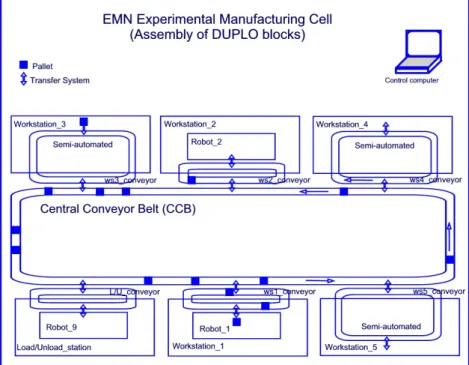
In this section we will focus on the Multi-Agent Based Supervisory Control, introduced by Hubbard and Caines [64]; and the modified approach proposed by Takai and Ushio [65]. The two approaches have been applied to the supervisory control of the EMN Experimental Manufacturing Cell. This cell is composed of two robotized workstations connected to a central conveyor belt. Then, three new semi- automated workstations have been added in order to increase the flexibility aspects of the cell. Indeed, each semi-automated workstation can perform either manual of robotized tasks. These two aspects correspond to the two different approaches of multi-agent product of subsystems, for supervisory control purpose. The results can be found in [C.25].
Figure 3.1: EMN Cell
3.2
Switched Discrete-Event Systems
The notion of switched discrete-event systems corresponds to a class of DES where each au-tomaton is the composition of two basic automata, but with different composition operators. A switching occurs when there is a change of the composition operator, but keeping the same two basic automata. A mode behavior, or mode for short, is defined to be by the DES behavior for a given composition operator. Composition operators are supposed to change more than once so that each mode is visited more than once. This new class of DES includes the DES in the context of fault diagnosis where different modes such as e.g., normal, degenerated, emergency modes can be found. The studied situations are the ones where the DES switch between different normal modes, and not necessary the degenerated and the emergency ones.
The most common composition operators used in supervisory control theory are the product and the parallel composition [43], [63] However many different types of composition operators have been defined, e.g., the prioritized synchronous composition [49], the biased synchronous composition [52], see [61] for a review of most of the composition operators. Multi-Agent composition operator [57], [58] is another kind of operator, which differs from the synchronous product in the aspects of simultaneity and synchronization.
The new class of DES that we define in this paper includes the class of DES in the context of fault diagnosis, with different operating modes. Furthermore this new class addresses especially the DES for which the system can switch from a given normal mode, to another normal mode. More
NR HDR 33
precisely this new class of DES is an automaton which is the composition of two basic automata, but with different composition operators. A switching corresponds to the change of composition operator, but the two basic automata remains the same. A mode behavior (or mode for short) is defined to be the DES situation for a given composition operator. Composition operators are supposed to change more than once so that each mode is visited more than once.
We give here below some examples of switched DES:
• Manufacturing systems where the operating modes are changing (e.g. from normal mode to
degenerated mode)
• Discrete event systems after an emergency signal (from normal to safety mode)
• Complex systems changing from normal mode to recovery mode (or from safety mode to
normal mode).
We can distinguish, like for the switched continuous-time systems, the notion of autonomous switch-ing where no external action is performed and the notion of controlled switchswitch-ing, where the switchswitch-ing is forced. The results for this section can be found in [55].
3.3
Switchable Languages of DES
The notion of switchable languages has been defined by Kumar, Takai, Fabian and Ushio in [Kumar-et-al. 2005]. It deals with switching supervisory control, where switching means switching between two specifi- cations. In this paper, we first extend the notion of switchable languages to n languages,
(n≥ 3). Then we consider a discrete-event system modeled with weighted automata. The switching
supervisory control strategy is based on the cost associated to each event, and it allows us to synthesize an optimal supervisory controller. Finally the proposed methodology is applied to a simple example.
We now give the main results of this paper. First, we define a triplet of switchable languages. Second we derive a necessary and sufficient condition for the transitivity of switchable languages (n = 3). Third we generalize this definition to a n-uplet of switchable languages, with n > 3. And fourth we derive a necessary and sufficient condition for the transitivity of switchable languages for
n > 3.
3.3.1 Triplet of Switchable Languages
We extend the notion of pair of switchable languages, defined in [51], to a triplet of switchable languages.
Definition 2 (Triplet of switchable languages). A triplet of languages (K1, K2, K3), Ki ⊆ Lm(G)
with Hi ⊆ Ki, i = {1, 2, 3} are said to be a triplet of switchable languages if they are pairwise
switchable languages, that is,
SW (K1, K2, K3) := SW (Ki, Kj), i̸= j, i, j = {1, 2, 3}.
Another expression of the triplet of switchable languages is given by the following lemma.
Lemma 1 (Triplet of switchable languages). A triplet of languages (K1, K2, K3), Ki ⊆ Lm(G)
with Hi ⊆ Ki, i ={1, 2, 3} are said to be a triplet of switchable languages if the following holds:





![Fig. 1. Equivalence relation between hybrid systems Every well-posed PWA system can be re-written as an MLD system assuming that the feasible states and inputs are bounded [6, proposition 4*]](https://thumb-eu.123doks.com/thumbv2/123doknet/14710723.748838/46.892.172.367.791.896/equivalence-relation-systems-written-assuming-feasible-bounded-proposition.webp)