HAL Id: hal-03169781
https://hal-amu.archives-ouvertes.fr/hal-03169781
Submitted on 15 Mar 2021
HAL is a multi-disciplinary open access
archive for the deposit and dissemination of
sci-entific research documents, whether they are
pub-lished or not. The documents may come from
teaching and research institutions in France or
abroad, or from public or private research centers.
L’archive ouverte pluridisciplinaire HAL, est
destinée au dépôt et à la diffusion de documents
scientifiques de niveau recherche, publiés ou non,
émanant des établissements d’enseignement et de
recherche français ou étrangers, des laboratoires
publics ou privés.
Copyright
from the Rapid Parallel Visual Presentation Paradigm
(RPVP)
Yun Wen, Jonathan Mirault, Jonathan Grainger
To cite this version:
Yun Wen, Jonathan Mirault, Jonathan Grainger. Fast Syntax in the Brain: Electrophysiological
Evidence from the Rapid Parallel Visual Presentation Paradigm (RPVP). Journal of Experimental
Psychology: Learning, Memory, and Cognition, American Psychological Association, 2020, 47 (1),
pp.99-112. �10.1037/xlm0000811.supp�. �hal-03169781�
Fast Syntax in the Brain: Electrophysiological Evidence from the Rapid
Parallel Visual Presentation Paradigm (RPVP)
Yun Wen, Jonathan Mirault, and Jonathan Grainger
Aix-Marseille University and National Center for Scientific Research (CNRS), Marseille, France
In 2 ERP experiments participants read 4-word sequences presented for 200 ms (RPVP paradigm) and were required to decide whether the word sequences were grammatical or not. In Experiment 1, the word sequence consisted of either a grammatically correct sentence (e.g., she can sing now) or an ungram-matical scrambled sequence (e.g., sing can now she). A reduced N400 effect was obtained in the grammatically correct sequences compared to the ungrammatical sequences. In Experiment 2, the critical comparison was between 2 types of ungrammatical sequences: transposed-word sequences (e.g., you that
read wrong, transposing 2 adjacent central words can form a grammatical sequence) and control
sequences (e.g., you that read worry, transposing any 2 adjacent central words still forms an ungram-matical sequence). An N400 reduction was observed in the transposed-word sequences relative to the control sequences. We interpret these N400 effects as evidence that an elementary syntactic represen-tation can be rapidly constructed on the basis of parallel processing of word identities and their parts-of-speech.
Keywords: ERPs, fast syntax, grammaticality judgments, rapid parallel visual presentation Supplemental materials:http://dx.doi.org/10.1037/xlm0000811.supp
Event-related potentials (ERPs) have been extensively used to reveal linguistic operations in the brain (for a review, seeSwaab, Ledoux, Camblin, & Boudewyn, 2012). In the domain of reading comprehension, the majority of studies have focused on two ERP components, namely, the N400 component (a negative deflection peaking around 400 ms after stimuli onset, discovered byKutas & Hillyard, 1980) and the P600 component (a positive deflection peaking around 600 ms poststimulus, discovered byOsterhout & Holcomb, 1992). Using the N400 and P600 components as the neural correlates of semantic and syntactic processing respectively, ERP research has substantially advanced our understanding of how skilled readers retrieve syntactic and semantic information en-coded in sentences (for reviews, see Friederici & Weissenborn, 2007; Hagoort, 2009; Kuperberg, 2007; Kutas & Federmeier, 2011; Kutas, Van Petten, & Kluender, 2006; Lau, Phillips, & Poeppel, 2008;Molinaro, Barber, & Carreiras, 2011;Osterhout, McLaughlin, Kim, Greenwald, & Inoue, 2004). It is important to
note that the existing ERP findings on reading comprehension are predominantly built on the rapid serial visual presentation (RSVP) paradigm, which uses an incremental word-by-word presentation procedure in order to avoid contamination of ERPs by eye move-ments. In these RSVP studies, the presentation duration of each word is fixed (e.g., 300 ms), and the ERPs are time-locked to the onset of the fixated words, thus providing precise and continuous measures of processing as sentences unfold over time. However, it is obvious that this passive reading involved in the RSVP para-digm is dramatically different from natural reading (for reviews, seeDimigen, Sommer, Hohlfeld, Jacobs, & Kliegl, 2011; Korn-rumpf, Niefind, Sommer, & Dimigen, 2016; Metzner, von der Malsburg, Vasishth, & Rösler, 2015). For example, during natural reading the words outside the foveal visual field can be processed as well as the fixated word, and this cannot happen when words are presented in isolation in the RSVP. Because of such methodolog-ical limitations, the conventional RSVP studies may not uncover the full cognitive architecture of reading comprehension.
Recent electrophysiological research dedicated to reading has provided complementary approaches to move the field forward. The first promising approach is to measure fixation-related brain potentials (FRPs) rather than ERPs (e.g., Baccino & Manunta, 2005; Degno et al., 2019; Dimigen, Kliegl, & Sommer, 2012; Dimigen et al., 2011;Hutzler et al., 2007;Metzner et al., 2015; Nikolaev, Meghanathan, & van Leeuwen, 2016). In FRP studies, eye movements and the electroencephalogram (EEG) are simulta-neously recorded, and the FRPs are time-locked to the first fixation onset of the target stimuli. The most prominent advantage of this approach is that participants can control their eye movements to read experimental stimuli in a way that closely mimics everyday reading. A key finding in FRP studies is that the amplitude of FRPs
This article was published Online First January 23, 2020.
X Yun Wen and Jonathan Mirault, Cognitive Psychology Laboratory, Aix-Marseille University, and National Center for Scientific Research (CNRS), Marseille, France; Jonathan Grainger, Cognitive Psychology Lab-oratory and Institute for Language Communication and the Brain, Aix-Marseille University, and National Center of Scientific Research (CNRS). This research was supported by ERC Grant ADG 742141. We thank Cécile Mahnich, Fanny Broqua, and Charlotte Leflaëc for help with stimuli creation and data collection.
Correspondence concerning this article should be addressed to Yun Wen, Cognitive Psychology Laboratory, Aix-Marseille University, Cam-pus St Charles, 3 Place Victor Hugo, 13331 Marseille, France. E-mail:
[email protected] This document is copyrighted by the American Psychological Association or one of its allied publishers. Content may be shared at no cost, but any requests to reuse this content in part or whole must go through the American Psychological Association.
Learning, Memory, and Cognition
© 2020 American Psychological Association 2021, Vol. 47, No. 1, 99 –112ISSN: 0278-7393 http://dx.doi.org/10.1037/xlm0000811
is modulated by parafoveal processing (e.g.,Baccino & Manunta, 2005; Degno et al., 2019; López-Peréz, Dampuré, Hernández-Cabrera, & Barber, 2016;Mirault, Yeaton, Broqua, Dufau, Hol-comb, & Grainger, 2019). This finding not only mirrors the parafoveal-on-foveal effect found in the eye-tracking studies (for a review, seeDrieghe, 2011), but also unravels neural mechanisms underlying parafoveal processing which cannot be captured by RSVP studies. However, this FRP approach has potential issues (for a systematic review, seeDimigen et al., 2011). For example, the late components of the previously fixated word may temporally overlap with the early components of the currently fixated word, and this overlap may have an unclear impact if experimental stimuli across conditions trigger systematically different fixation durations.
A second complementary approach is to use the RSVP-with-flanker paradigm, a modified version of the RSVP paradigm. Barber, Doñamayor, Kutas, and Münte (2010)used this RSVP-with-flanker paradigm for the first time to determine whether semantic congruency of the parafoveal words can modulate the ERP response to the fixated word. In this seminal study, the RSVP was used to present sentences, but critically three words were presented at one go, that is, the currently fixated word at the center, accompanied by two flankers with the previously fixated word on the left and the next word to be fixated on the right. Unknown to participants, the target words were accompanied by right flankers that were either semantically congruent or incongruent with the preceding context, that is, the target word without in Tino could not read well without glasses was presented with either the congruent flanker glasses or the incongruent flanker mice on the right. A reduced N400 was found in the congruent flanker condition com-pared with the incongruent flanker condition, providing evidence for parafoveal processing at the semantic level. Follow-up studies using the same paradigm observed similar findings of parafoveal processing as evidenced by P2 or N400 effects (Barber, Ben-Zvi, Bentin, & Kutas, 2011;Barber, van der Meij, & Kutas, 2013;Li, Niefind, Wang, Sommer, & Dimigen, 2015; Stites, Payne, & Federmeier, 2017;Zhang, Li, Wang, & Wang, 2015;Zhang, Zhen, Liang, & Mo, 2019). Critically, the ERP parafoveal-on-foveal effect was obtained even if the words with flankers were only presented for 100 ms (e.g., Barber et al., 2013;Li et al., 2015; Stites et al., 2017), indicating that processing of multiple words may occur very rapidly. Admittedly, the RSVP-with-flanker par-adigm still dramatically differs from natural reading (Kornrumpf et al., 2016). Nevertheless, this paradigm offers a simple and elegant alternative to investigate ERP correlates of parafoveal processing, which is feasible for EEG labs without an eye-tracker.
Note that the FRP and RSVP-with-flanker studies not only provide methodological innovations for electrophysiological in-vestigations of reading, but also contribute to a fundamental issue addressed in reading research, that is, whether skilled reading involves a strictly one-word-at-a-time serial processing, or the parallel processing of multiple words at the same time (Reichle, Liversedge, Pollatsek, & Rayner, 2009;Snell & Grainger, 2019a; see Schotter & Payne, 2019; and White, Boynton, & Yeatman, 2019, for commentaries). Although eye-tracking studies have found evidence for parafoveal-on-foveal effects in favor of parallel processing, the serial processing view can be maintained by argu-ing that this effect is caused by extralargu-inguistic factors, such as mislocated fixations (for discussions, seeDrieghe, 2011;Schotter,
Reichle, & Rayner, 2014; Snell, Declerck, & Grainger, 2018). However, such extralinguistic explanations cannot account for the parafoveal-on-foveal effect observed in FRP and RSVP-with-flanker studies, and therefore this electrophysiological evidence provides crucial support that foveal and parafoveal word process-ing can occur in parallel (seeSnell, Meade, Meeter, Holcomb, & Grainger, 2019, for further ERP evidence for parafoveal-on-foveal effects using a flanked lexical decision paradigm).
In addition to the FRP and RSVP-with-flanker studies, another methodological advance also sheds light on the debate concerning serial and parallel processing. The rapid parallel visual presenta-tion (RPVP) paradigm was first combined with an investigapresenta-tion of a syntactic sentence superiority effect in Snell and Grainger (2017).1 In this RPVP study, a sequence of four horizontally aligned words was briefly presented (i.e., 200 ms). The experi-mental task was to identify one postcued word within the se-quence. Snell and Grainger found that individual words (e.g., sing) are easier to identify in a syntactically correct word sequence (e.g., she can sing now) compared with a scrambled version of the same words (e.g., now she sing can). This behavioral sentence superi-ority effect has three important implications. First, it demonstrates that simultaneous processing of multiple words is possible, and this parallel processing occurs at a remarkable speed. Second, because semantic constraints were minimized in the syntactically correct sequences used in this study, syntactic representations are the likely source of the effect. Importantly, the sentence superiority effect is assumed to reflect the interactive processing operating between sentence-level structures and word identities which al-lows sentence-level constraints to influence ongoing word process-ing (Snell & Grainger, 2017). In a follow-up ERP study, Wen, Snell, and Grainger (2019)sought the neural index of the sentence superiority effect by combining ERP measures with the RPVP paradigm. The logic of that ERP study was straightforward: if the sentence superiority effect is driven by parallel word processing guided by sentence-level constraints, an N400 reduction should be observed in the syntactically correct sequences relative to the scrambled sequences. And the N400 sentence superiority effect is exactly what was found.
One puzzling aspect of the results ofWen et al. (2019)is why no P600 effect was found given that the P600 is the classic ERP component associated with syntactic processing. One possible explanation is thatWen et al. (2019)used a postcued partial report task instead of the grammaticality judgment task widely used in the P600 literature. There is a general consensus that the P600 effect may be sensitive to the experimental task and that the P600 effect is more likely to be evoked when the task involves an explicit judgment of sentence structure, that is, grammaticality or acceptability judgments (Kuperberg, 2007). In the Wen et al. study, the main task of participants was to identify a single word among the sequence of four words, and it might be differences in
1The sentence superiority effect has also been investigated in memory
research (e.g.,Bonhage, Meyer, Gruber, Friederici, & Mueller, 2017) and auditory sentence processing (e.g.,Marslen-Wilson & Tyler, 1975,1980). See alsoJackson and McClelland (1975)for an early application of the RPVP paradigm, Asano and Yokosawa (2011) for an investigation of sentence superiority in Japanese Kanji using a similar paradigm, and
Hagiwara, Soshi, Ishihara, and Imanaka (2007) as well as Ueno and Kluender (2003)for ERP investigations of word order processing.
This document is copyrighted by the American Psychological Association or one of its allied publishers. Content may be shared at no cost, but any requests to reuse this content in part or whole must go through the American Psychological Association.
difficulty in word identification that was driving the N400 effect (e.g.,Grainger & Holcomb, 2009).
To address this unresolved issue, the present study combines the RPVP paradigm with a grammaticality judgment task. The present study set out to test whether the N400 sentence superiority effect can be observed in a grammaticality judgment task with briefly presented sequences of words. Therefore, in Experiment 1 we compared ERP responses to grammatically correct normal word sequences (e.g., the man can run) with ungrammatical scrambled sequences of the same words (e.g., run can man the) in the RPVP paradigm combined with a grammaticality judgment task. If the N400 sentence superiority effect seen in our prior work (Wen et al., 2019) is driven by sentence-level syntactic processing, then it should also be observable in conditions where participants’ only task is to make grammaticality judgments.
Experiment 1
Method
Participants. Twenty-six native French speakers (21 females; mean age⫽ 22.5 years, SD ⫽ 2.6 years) received €20 or course credit for their participation. All participants reported being right-handed, with normal or corrected-to-normal vision, and with no history of neurological, psychiatric or language impairment. Their average LexTALE_Fr vocabulary score (Brysbaert, 2013) was 90.7, SD⫽ 4.1, and their average self-rated language proficiency score was 9.0, SD⫽ 1.0 (10-point scale, 1 ⫽ virtually nonexisting, 10 ⫽ perfect). Data from two additional participants were ex-cluded from the analyses because of too many slow drifts in the EEG data.
Materials and design. We constructed 200 four-word se-quences in French that were grammatically correct. These 200 four-word sequences were different from those used inWen et al. (2019), and contained different syntactic structures (e.g., ce plat est bon [the dish is good], je pars en juin [I leave in June], tu bois du rhum [you drink the rum], il te dit cela [he tells you that]). The words in these sequences consisted of two to six letters (average word length⫽ 3.27 letters). The average word frequency in Zipf values was 6.03, SD⫽ 1.27 (Ferrand et al., 2010;van Heuven, Mandera, Keuleers, & Brysbaert, 2014). A scrambled version of every sequence was constructed by switching word positions, and therefore the scrambled sequences were syntactically incorrect (e.g., a grammatically correct sequence: the man can run; the corresponding scrambled sequence: run can man the). Two coun-terbalanced lists were generated to ensure that in each list all the 200 sequences were presented in only one condition (normal or scrambled) and all the sequences were viewed in both conditions
across lists with different participants. Participants were randomly assigned to one of the lists. The full list of materials is presented in theonline supplemental materials.
Procedure. The study was approved by the “Comite= de Pro-tection des Personnes SUD-EST IV” (No. 17/051). All participants provided their written informed consent before the experiment started. Participants were seated in a comfortable chair in a dimly lit, electrically shielded booth. Each participant received a unique pseudorandomized presentation order of the stimuli with the same condition (normal vs. scrambled) occurring no more than three times in a row. Stimuli were presented on a CRT monitor (18⬙, 1024⫻ 768 pixels, 75 Hz) controlled by OpenSesame (Mathôt, Schreij, & Theeuwes, 2012) using the PsychoPy back-end (Peirce, 2009). Each trial began with a central fixation cross together with two vertical fixation bars presented for 500 ms, followed by only two vertical fixation bars for 300 ms. Next, a sequence of four words was presented for 200 ms, followed by a backward mask with hash marks (seeFigure 1for an illustration of visual events in Experiment 1). Participants had to decide whether the presented sequence was grammatically correct nor not. Feedback was then provided with a green (correct) or red (incorrect) dot presented for 700 ms. The intertrial interval varied from 600 ms to 700 ms. Participants were instructed to fixate between the fixation bars and minimize blinks, eye-movements, and body movements. Prior to the experiment, 20 practice trials were used to familiarize the participants with the procedure. A different button was assigned to each yes/no response, and response sides were counterbalanced between participants. Short breaks were provided every 40 trials and the whole experiment lasted approximately two hours (includ-ing electrode placement and breaks).
EEG recording and preprocessing. The electroencephalo-gram (EEG) was recorded with a 64-channel active-electrode system (Biosemi ActiveTwo) at a sample rate of 1024 Hz. Two additional electrodes near Pz (CMS and DRL) were used for online referencing (Metting van Rijn, Peper, & Grimbergen, 1990; Schut-ter, Leitner, Kenemans, & van Honk, 2006). Six external elec-trodes were applied: two placed at left and right mastoids for off-line rereferencing, and four placed below and at the outer canthus of each eye to monitor eye movements. The electrode offset was kept below 30 mV.
The preprocessing of the EEG data were conducted using the EEGlab/ERPlab Toolbox (Delorme & Makeig, 2004; Lopez-Calderon & Luck, 2014). EEG data were rereferenced to the averaged mastoids and high-pass filtered at 0.1 Hz. The continuous data were then segmented into epochs ranging from⫺100 to 1,000 ms after the onset of word sequences. The epochs were baseline-corrected using the prestimulus interval (⫺100 to 0 ms), and
Figure 1. Illustration of the sequence of events in the rapid parallel visual presentation (RPVP) procedure used in Experiment 1. This document is copyrighted by the American Psychological Association or one of its allied publishers. Content may be shared at no cost, but any requests to reuse this content in part or whole must go through the American Psychological Association.
low-pass filtered at 30 Hz. Trials with incorrect responses were discarded (16.58% of the data). Epochs contaminated by drifts and muscle activity were manually removed (5.29% of the data). For seven participants, epochs containing ocular artifacts were first corrected using an independent component analysis (ICA) algo-rithm (Jung et al., 2000), otherwise these participants would have more than 20% of the epochs rejected due to ocular artifacts (Tanner, 2019). Epochs containing ocular artifacts or remaining artifacts after ICA correction were automatically dismissed (6.77% of the data). A minimum of 30 epochs were required per condition for each participant (Thierry & Wu, 2007).
Statistical analysis. To analyze the behavioral data, we con-ducted a logistic mixed-effects model for the accuracy rates ( Jae-ger, 2008) and a linear mixed-effects model for the response times using the lme4 package (Bates, Maechler, Bolker, & Walker, 2015) in R (R Core Team, 2017). Participants and items were included as random effects (Baayen, Davidson, & Bates, 2008), and random slopes were also included in the analysis (Barr, Levy, Scheepers, & Tily, 2013). Reaction times of correct responses were analyzed, and values beyond 3.5 standard deviations from the mean of each condition for each participant were discarded as outliers (0.95%).
The ERP data were analyzed using the cluster-based random permutation test implemented in FieldTrip (Oostenveld, Fries, Maris, & Schoffelen, 2011). The cluster-based random permuta-tion approach can effectively control for Type I errors involved in multiple comparisons (seeMaris & Oostenveld, 2007for details, and see theonline supplemental materialsfor a brief introduction). The cluster-based random permutation test was used as a data-driven method so that the analysis was conducted from 0 ms to 1,000 ms poststimulus on all 64 electrodes.
Results
Behavioral results. Accuracy rates of the grammaticality judgment were significantly higher in the word sequences pre-sented in the normal condition than in the scrambled condition, mean accuracy rates: 87.1% versus 79.8% respectively, z⫽ 3.545, p⬍ .001 (seeTable 1). Responses to the word sequences presented in the normal condition were faster than to those in the scrambled condition, mean RTs: 848 ms versus 932 ms respectively, t⫽ ⫺3.376, p ⬍ .01 (seeTable 2).
ERP results. Only correct trials were included in the ERP analysis. ERP amplitude was reduced in the normal condition
compared to the scrambled condition from 288 to 499 ms (cluster with p⫽ .004, seeFigure 2).
Discussion
Using the RPVP paradigm with a grammaticality judgment task, Experiment 1 observed a reduction in N400 amplitude in the grammatically correct normal word sequences relative to the un-grammatical scrambled sequences. This result successfully repli-cates the N400 sentence superiority effect found in Wen et al. (2019), which used a postcued partial report task. The consistent observation of the N400 sentence superiority effect in Experiment 1 andWen et al. (2019)further suggest that this effect is unlikely to be task-dependent. In line with previous studies (Snell & Grainger, 2017;Wen et al., 2019), we suggest that this N400 effect reflects parallel processing of multiple words which quickly gen-erates an elementary syntactic representation when this is possible (i.e., in the grammatical sequences), and such syntactic represen-tations then influence ongoing word identification processes. This interpretation is compatible withHagoort’s (2003)syntactic boost account of N400 effects. In this seminal study, a larger N400 effect was found in the combined syntactic and semantic violation con-dition compared to the pure semantic violation concon-dition, which was explained in terms of syntactic influences on semantic pro-cesses. Thus, the syntactic-related N400 effect is not without precedent (seeKutas et al., 2006, for a review). However, given that the critical comparison inWen et al. (2019)and Experiment 1 involved grammatically correct sequences and ungrammatical scrambled sequences, it is unclear whether the syntactic-driven N400 effect is specific for this contrast. Moreover, this contrast in Experiment 1 involved different behavioral responses, with un-grammatical responses being harder to make than un-grammatical responses, and this may have had an impact on the ERP effects. Therefore, in Experiment 2, we devised a means to induce an effect of syntactic structure in the grammaticality judgment task but with the same ungrammatical response in the two critical conditions.
Experiment 2
Experiment 2 also combines the RPVP paradigm and a gram-maticality judgment task. The design of Experiment 2 is motivated by our recent work revealing a behavioral transposed-word effect. In a grammaticality judgment study,Mirault, Snell, and Grainger (2018)found higher error rates and slower RTs to the transposed-Table 1
Results of Logistic Mixed-Effects Modeling on Accuracy Data (Experiment 1)
Random effects Variance SD
Item Intercept 0.5380 0.7335 Scrambled vs. Normal 2.5252 1.5891 Subject Intercept 0.7935 0.8908 Scrambled vs. Normal 0.8940 0.9455 Fixed effects Estimate SE z value p
Scrambled vs. Normal 0.8641 0.2438 3.545 ⬍.001
Table 2
Results of Mixed-Effects Modeling on RT Data (Experiment 1)
Random effects Variance SD
Item Intercept 3848 62.03 Scrambled vs. Normal 12286 110.84 Subject Intercept 75664 275.07 Scrambled vs. Normal 11924 109.19
Fixed effects Estimate SE t value p
Scrambled vs. Normal ⫺81.79 24.22 ⫺3.376 ⬍.01 This document is copyrighted by the American Psychological Association or one of its allied publishers. Content may be shared at no cost, but any requests to reuse this content in part or whole must go through the American Psychological Association.
word sequences (e.g., you that read wrong can be transformed into a grammatical sequence by transposing the two adjacent central words: that read into read that) compared with control sequences (e.g., you that read worry, which cannot be transformed in to a
grammatical sequence by transposing any two adjacent words). In line with Snell and Grainger (2017);Mirault et al. (2018) sug-gested that an initial representation of sentence structure can be quickly generated, and this elementary syntactic representation
Figure 2. Results of event-related potentials (ERPs) analyses of Experiment 1. Left: ERPs time-locked to the onset of word sequences (Fz, Cz, Pz); Right: Topography of voltage differences (scrambled minus normal) between 289 and 499 ms. See the online article for the color version of this figure.
This document is copyrighted by the American Psychological Association or one of its allied publishers. Content may be shared at no cost, but any requests to reuse this content in part or whole must go through the American Psychological Association.
constrains possible word candidates at each position. The combi-nation of such top-down syntactic constraints and the noisy bottom-up encoding of word order drives the transposed-word effect (see Snell & Grainger, 2019b, for further evidence). The transposed-word effect is taken as evidence against the persisting notion of a strictly serial one-word-at-a-time left-to-right word encoding, although it is well-established that eye movements dur-ing readdur-ing do not simply move from left-to-right. Such serial processing would have resulted in the detection of incorrect word ordering in the transposed-word condition (Reichle et al., 2009; Snell & Grainger, 2019a).
Apart from supporting parallel word processing, the transposed-word effect reported byMirault et al. (2018)also appeals to two well-known accounts of sentence parsing, namely the good-enough account (Ferreira, 2003;Ferreira, Bailey, & Ferraro, 2002; Ferreira & Lowder, 2016;Ferreira & Patson, 2007; Gigerenzer, 2000;Sanford, 2002;Townsend & Bever, 2001) and the noisy-channel account (Gibson, Bergen, & Piantadosi, 2013). According to the good-enough account of parsing, readers can rely on heu-ristics to build quick but imperfect syntactic representations of the written input, and readers’ failure in noticing errors in a sentence is therefore to be expected. On the basis of such an assumption, word position coding during sentence reading is not completely precise (just good-enough), giving rise to the transposed-word effect. Likewise, the noisy-channel account also assumes that readers can understand imperfect sentences, and further predicts that readers’ recovery from erroneous input depends on the dis-tance between the inaccurate and correct counterparts. Taking Mirault et al. (2018)as an example, switching two adjacent words is enough to amend a transposed-word sequence (e.g., changing that read into read that in you that read wrong), whereas repairing a control sequence (you that read worry) involves the switching plus an additional replacement (changing that read into read that, and replacing worry as wrong). Consequently, repairing the con-trol sequences is more difficult than the transposed sequences, and thus ungrammatical decisions are easier to make for the control sequence.
FollowingMirault et al. (2018), Experiment 2 also investigates the transposed-word effect and thus focuses on the ERP responses to two types of ungrammatical sequences, that is, the transposed-word sequences and the control sequences. Under the hypothesis that transposed-word effects reflect the partial activation of syn-tactic structures that suggest the presence of a grammatically correct sequence of words, then we expect to observe a reduced N400 amplitude in the transposed-word condition relative to the control condition. Here, it is important to note that the transposed-word condition that is expected to reduce N400 amplitude should generate the slowest RTs and greatest errors. This is the opposite
of Experiment 1 where faster RTs and less errors were observed in the grammatically correct normal sequences that caused a reduced N400.
Method
Participants. Twenty-six native French speakers (18 females; mean age⫽ 23.2 years, SD ⫽ 2.9 years) received €20 or course credit for their participation. One participant had also participated in Experiment 1. All participants reported being right-handed, with normal or corrected-to-normal vision, and with no history of neurological, psychiatric or language impairment. Their average LexTALE_Fr vocabulary score (Brysbaert, 2013) was 91.1, SD⫽ 4.4, and their average self-rated language proficiency score was 8.7, SD ⫽ 1.3 (10-point scale, 1 ⫽ virtually nonexisting, 10 ⫽ perfect). Data from an additional two participants were excluded from the analyses because of excessive eyeblinks or high error rates (⬎25%).
Materials and design. We constructed a new set of grammat-ically correct sequences to generate the critical stimuli. One hun-dred sixty four-word sequences were first constructed, and then the last words in those sequences were replaced so as to create the corresponding ungrammatical sequences (e.g., the man can run vs. the man can big). Next, the words at positions 2 and 3 were transposed in all the 160 pairs of sequences. The transposed-word version of grammatically correct sequences was referred to as the transposed-word condition (e.g., the can man run), whereas the transposed-word version of ungrammatical sequences was referred to as the control condition (e.g., the can man big). The words in all these sequences consisted of two to seven letters (average word length⫽ 4.25 letters). The average word frequency in Zipf values was 5.79, SD ⫽ 1.09 (Ferrand et al., 2010; van Heuven et al., 2014). Two counterbalanced lists were created to ensure that in each list all the 160 pairs of sequences were presented in only one condition (transposed-word vs. control condition) and all the pairs were viewed in both conditions across lists. Participants were randomly assigned to one of the lists. Because all the critical stimuli in both conditions require No responses, another 160 grammatically correct four-word sequences were included as fill-ers (e.g., the guy is tall) to have an equal number of Yes and No responses. The words in the grammatically correct filler sequences matched the words used in the critical stimuli in word length (average word length: 4.25 letters) and frequency (average word frequency in Zipf values ⫽ 5.96, SD ⫽ 1.19). The full list of materials is presented in theonline supplemental materials.
Procedure. The procedure was identical to the procedure used in Experiment 1 except for one aspect (see Figure 3 for an illustration of visual events in Experiment 2). The backward mask
Figure 3. Illustration of the sequence of events in the rapid parallel visual presentation (RPVP) procedure used in Experiment 2. This document is copyrighted by the American Psychological Association or one of its allied publishers. Content may be shared at no cost, but any requests to reuse this content in part or whole must go through the American Psychological Association.
was not used in Experiment 2 to avoid visual event-related poten-tials generated by the appearance of masks overlapping with the N400 component.
EEG recording and preprocessing. The same EEG record-ing setup and EEG preprocessrecord-ing pipeline were used for Experi-ment 2 as in ExperiExperi-ment 1. Trials with incorrect responses were discarded (11.69% of the data). Epochs contaminated by drifts and muscle activity were manually removed (3.39% of the data). For 13 participants, epochs containing ocular artifacts were first cor-rected using an independent component analysis (ICA) algorithm (Jung et al., 2000), otherwise these participants would have more than 20% of the epochs rejected due to ocular artifacts (Tanner, 2019). Epochs containing ocular artifacts or remaining artifacts after ICA correction were automatically dismissed (4.65% of the data).
Statistical analysis. In line with Experiment 1, we conducted a logistic mixed-effects model for the accuracy rates, a linear mixed-effects model for the response times, and the cluster-based random permutation test for the ERP data. Reaction times of correct responses were analyzed, and values beyond 3.5 standard deviations from the mean of each condition for each participant were discarded as outliers (0.94%). The ERP results from Exper-iment 1 were used to guide the ERP analysis of ExperExper-iment 2. Given that a significant cluster was found within the N400 time window (around 290 to 500 ms) in Experiment 1, we focused on this time window in Experiment 2. The ERP amplitude of this a priori selected time window was first averaged for each electrode and each condition, and then a cluster-based random permutation test was applied on all 64 electrodes. Therefore, cluster-based random permutation tests in Experiment 2 were conducted over electrode. The logic is that the cluster-based random permutation test can be conservative when used as a pure data-driven approach, and an a priori region of interest or time window can improve the sensitivity of the analysis (for a similar approach, seeWen, Filik, & van Heuven, 2018).
Results
Behavioral results. Consistent with Mirault et al. (2018), accuracy rates were significantly higher in the control condition than in the transposed-word condition, mean accuracy rates: 90.5% versus 82.4% respectively, z⫽ 8.248, p ⬍ .001 (seeTable 3). In addition, participants were quicker in judging the control quences as ungrammatical relative to the transposed-word se-quences, mean RTs: 1183 ms versus 1230 ms respectively, t⫽ ⫺3.481, p ⬍ .01 (seeTable 4).
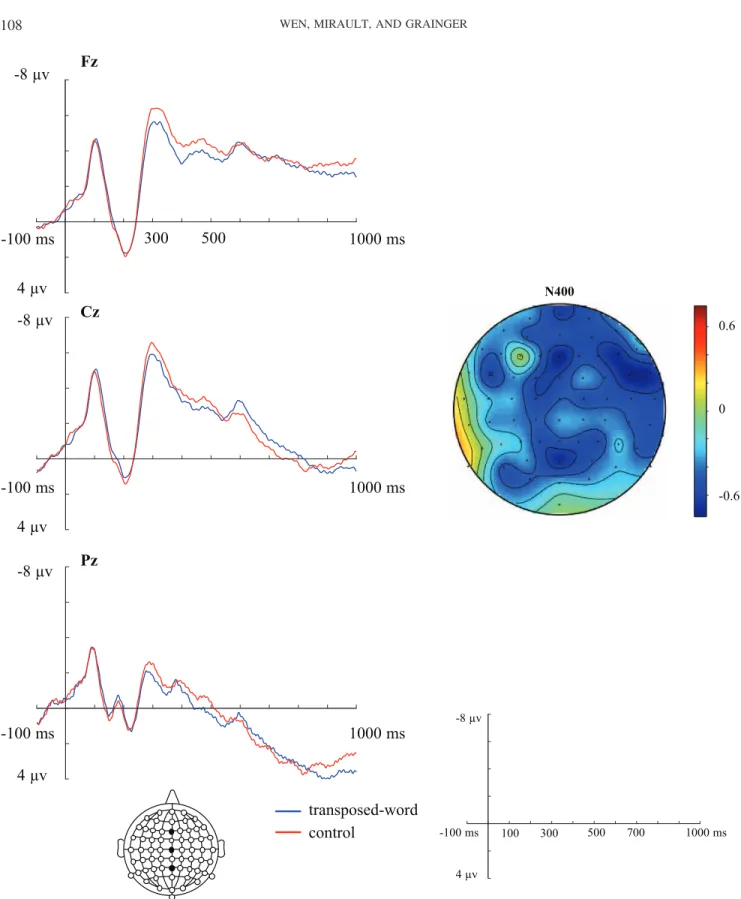
ERP results. Only correct trials were included in the ERP analysis. Testing for an N400 effect in the a priori time window (290 –500 ms poststimulus), the cluster-based permutation tests revealed a significant reduction in N400 amplitude in the transposed-word condition compared to the control condition (cluster with p⫽ .0382, seeFigure 4).2
Discussion
Experiment 2 used the transposed-word effect seen in grammati-cality judgments (Mirault et al., 2018) to compare conditions requiring the same ungrammatical response. As in Experiment 1, the grammaticality judgment task was combined with the RPVP
paradigm. The behavioral transposed-word effect reported in Mi-rault et al. (2018) was again observed, which supports parallel processing as well as the good-enough account and the noisy channel account of syntactic parsing. As expected, an attenuated N400 was observed in the transposed-word condition (e.g., you that read wrong, transposing the two central words forms a gram-matically correct sequence) relative to the control condition (e.g., you that read worry, transposing any two words still forms an ungrammatical sequence). This result is consistent with the hy-pothesis that parallel word processing can quickly generate an initial representation of sentence structure, which then constrains possible word candidates at each position (Mirault et al., 2018). Hence the transposed-word effect was attributed to the joint effect of the top-down sentence-level constraints and the noisy bottom-up processing of word order (see alsoPegado & Grainger, 2019; andSnell & Grainger, 2019b). The results of Experiment 2 therefore extend the findings of Experiment 1 and Wen et al. (2019) by providing another demonstration of a syntactically driven N400 effect in RPVP generated by a different experimental manipulation.
General Discussion
The present study reports two experiments that for the first time combined the RPVP paradigm and a grammaticality judgment task with EEG recordings. Sequences of four words were presented simultaneously for 200 ms, and participants were required to decide whether these sequences were grammatical or not. In Ex-periment 1, the four words consisted of either a grammatically correct sentence (e.g., the man can run) or an ungrammatical scrambled sequence of the same words (e.g., run can man the). The key finding is that a reduction in N400 amplitude was ob-served in the grammatical sequences compared to the scrambled sequences. This result replicates the N400 sentence superiority
2The finding remained the same when using the time window between
300 and 500 ms. We also conducted a conventional ANOVA analysis on ERP mean amplitudes, which revealed the same finding. Additional anal-yses on the later time-window (500 – 800 ms) did not reveal any significant effect, although the numerically larger amplitude in the control condition (see Cz inFigure 4) seems to be a P600-like effect.
Table 3
Results of Logistic Mixed-Effects Modeling on Accuracy Data (Experiment 2)
Random effects Variance SD
Item
Intercept 0.4509 0.6715
Subject
Intercept 0.5379 0.7334
Fixed effects Estimate SE z value p
Scrambled vs. Normal 0.81364 0.09865 8.248 ⬍.001
Note. The maximal model failed to converge, and a backward model selection procedure was used. The random slopes of items were first removed, and then the random slopes of subjects. The complex model was compared with the simpler model using a chi-squared test. We proceeded with the simpler model because the chi-squared test was not significant.
This document is copyrighted by the American Psychological Association or one of its allied publishers. Content may be shared at no cost, but any requests to reuse this content in part or whole must go through the American Psychological Association.
effect obtained using a postcued partial report procedure combined with the same RPVP paradigm (Wen et al., 2019). The present findings therefore suggest that the N400 sentence superiority effect reported by Wen et al. is not a reflection of differences in ease of word identification as a function of surrounding context but most likely reflects the interaction between sentence-level processing and word identification. The general idea is that an elementary syntactic representation of the word sequence can be rapidly activated as a result of parallel word processing, and this syntactic representation then constrains ongoing word identification pro-cesses via feedback connections. The fact that in the present study we found a very similar reduction in N400 amplitude when par-ticipants had to respond to the complete sequence of words rather than a single word, confirms the hypothesized role of syntactic processing in driving the N400 sentence superiority effect.
Crucially, Experiment 2 contrasted two types of ungrammatical sequences, the transposed-word sequences (e.g., you that read wrong) and the control sequences (e.g., you that read worry). This allowed us to test for effects of syntactic structure in conditions where partici-pants made the same ungrammatical response to word sequences. Furthermore, here the transposed-word condition that was predicted to reduce N400 amplitude was the condition that was expected to gen-erate the slowest RTs and highest error rates. Indeed, Experiment 2 replicated the behavioral findings ofMirault et al. (2018)whereby participants made more errors and were slower in judging the transposed-word sequences (e.g., you that read wrong) as ungram-matical compared with the control sequences (e.g., you that read worry). We predicted a reduced N400 amplitude in the transposed-word condition because this condition was expected to provide evi-dence in favor of the presence of a correct sentence.
The N400 transposed-word effect was indeed what we observed. To our knowledge, we provide the first neurophysiological dem-onstration of the transposed-word effect. This effect is analogous to the N400 transposed-letter effect in visual word recognition studies (e.g.,Carreiras, Vergara, & Perea, 2007;Vergara-Martínez, Perea, Gómez, & Swaab, 2013), which reflects the coarse coding of letter positions in words (Grainger & Holcomb, 2009;Grainger & Ziegler, 2011). In a similar vein, the N400 transposed-word effect indicates the noisy bottom-up processing of word order as the consequence of good-enough heuristic mechanisms during sentence reading (Ferreira, 2003;Ferreira et al., 2002;Ferreira &
Lowder, 2016;Ferreira & Patson, 2007;Gigerenzer, 2000; San-ford, 2002;Townsend & Bever, 2001). The combination of such noisy bottom-up processing with top-down syntactic constraints drives the transposed-word effect.
Taken together, our results are clear-cut. Both experiments observed an N400 effect in conditions where participants were required to make grammaticality judgments about the entire se-quence of words. Therefore, we take this N400 effect as a signa-ture of syntactic processing in the brain given that this effect is driven by the processing of word combinations where semantic relatedness was minimized. It is important to note that the N400 effect well precedes participants’ behavioral responses, which occurred at least 800 ms after the onset of word sequences. Hence the observed N400 effect is not confounded by behavioral re-sponses or any strategic factors. Furthermore, the N400 effect is not just a processing difficulty effect given that the condition that generated the largest N400 amplitude was the condition that gen-erated the slowest RTs and greatest errors in Experiment 1, whereas exactly the opposite was true in Experiment 2.
At first glance, the syntactically driven N400 effect observed in the present study appears at odds with the syntactic P600 effect obtained in traditional RSVP studies. Given that the N400 effect was obtained in both a postcued partial report task (Wen et al., 2019) and a grammaticality judgment task (the present study), we reject the task-dependent account to explain the absence of the P600 effect, the well-established neural index of syntactic process-ing. We would argue that our syntactically driven N400 effects are fundamentally different from the P600 effect observed in RSVP studies (for more discussion on N400 and P600 effects, see Dwivedi, 2013;Kaan, Harris, Gibson, & Holcomb, 2000). In the RSVP studies, when a word is presented to participants, partici-pants have to integrate this word with the prior words in the sentence. However, integration difficulty occurs when encounter-ing syntactic processencounter-ing obstacles, and an enhanced P600 is typ-ically observed in the critical words that trigger such difficulty, for example, eating is the critical word in the syntactically anomalous sentence the cat will eating the fish. It is noteworthy that RSVP studies not only find a P600 effect elicited by the critical word embedded in the sentences, but also report a N400 effect elicited by the final words of the syntactically-incorrect sentences, for example, fish is the sentence-final word in the previous example (e.g.,Hagoort, Brown, & Groothusen, 1993;Osterhout & Mobley, 1995;Osterhout & Nicol, 1999). In addition, the N400 effect may also appear if the critical words appear in the sentence-final positions, for example, himself is the critical word in the girl helps himself (e.g.,Hagoort, 2003;Hagoort & Brown, 1999;Osterhout, 1997). The sentence-final N400 effect is generally interpreted as processing difficulty in generating semantic representations of syntactically ill-formed sentences (Hagoort et al., 1993;Osterhout, 1997;Osterhout & Holcomb, 1992).3In other words, the final-word N400 effect reflects a global processing of semantics and the critical-word P600 effect indicates a local difficulty in syntactic processing. Such incremental sentential processing in the RSVP paradigm stands in clear contrast to parallel proceeding in the
3Another slightly different view of the final-word N400 effect is that it
may reflect a sentence wrap-up effect (for a recent review, seeStowe, Kaan, Sabourin, & Taylor, 2018).
Table 4
Results of Mixed-Effects Modeling on RT Data (Experiment 2)
Random effects Variance SD
Item
Intercept 5038 70.98
Subject
Intercept 102127 319.57
Transposed-word vs. Control 1750 41.83 Fixed effects Estimate SE t value p
Transposed-word vs. Control ⫺50.56 14.53 ⫺3.481 ⬍.01
Note. The maximal model failed to converge, and a backward model selection procedure was used. The random slopes of items were first removed, and then the random slopes of subjects. The complex model was compared to the simpler model using an ANOVA test. The more complex model was chosen because the ANOVA test was significant.
This document is copyrighted by the American Psychological Association or one of its allied publishers. Content may be shared at no cost, but any requests to reuse this content in part or whole must go through the American Psychological Association.
RPVP paradigm. Furthermore, the cognitive mechanisms under-lying the P600 effect of syntactic processing difficulty (e.g., syn-tactic violations or ambiguities) and our N400 effect (i.e., sentence superiority or transposed-word effects) are obviously distinct.
Admittedly, another possibility is that the P600 effect in re-sponse to syntactic difficulty is restricted to the RSVP paradigm. The fact that the semantic N400 component precedes the syntactic P600 component is seemingly in contrast to the traditional syntax-first view of language processing (e.g.,Friederici & Weissenborn, 2007) or the parallel view of semantic and syntactic processing (e.g.,Jackendoff, 2007).4If the relatively late syntactic P600 effect is attributable to the serial presentation used in RSVP, an early effect is expected with the parallel presentation procedure of RPVP. Future studies should examine this issue by presenting syntactically ill-formed sentences in the RPVP paradigm. In short, the most parsimonious conclusion is that our observations of syntactically driven N400 effects are not necessarily in contradic-tion with the classic P600 literature because of differences in the linguistic phenomena under investigation and presentation tech-niques.
The observed ERP evidence of the sentence superiority effect and transposed-word effect fits well with the idea that parallel processing of multiple words is possible during sentence reading (Engbert, Nuthmann, Richter, & Kliegl, 2005; Grainger, 2018; Snell & Grainger, 2019a;Snell, Meeter, & Grainger, 2017). This conclusion is fully compatible with the parafoveal-on-foveal effect obtained in the FRP and RSVP-with-flanker studies as discussed in the Introduction. Although growing evidence from electrophysio-logical investigations has suggested that the parallel word process-ing account is more plausible, the one-word-at-a-time incremental processing approach still dominates current theories of reading (for a review, seeReichle et al., 2009). It should be noted that these popular serial theories are mainly proposed on the basis of behav-ioral eye-tracking data rather than ERP data. However, ERP data provide a direct real-time measurement of reading, and these electrophysiological studies are abundant and essential in empiri-cal investigations. Accordingly, theories of reading will be more informative if they consider electrophysiological data as well. Therefore, we tentatively suggest that future theoretical models of reading should take neural data into accounts in order to capture the complete picture of cognitive mechanisms underlying reading (seeBrouwer, Crocker, Venhuizen, & Hoeks, 2017, for a neuro-computational approach).
Overall, the present study demonstrates that the RPVP paradigm is a useful methodology in electrophysiological investigations of reading comprehension which complements the mainstream RSVP as well as other newly developed methods (e.g., coregistering eye-tracking and EEG, RSVP-with-flanker, and the self-paced ERP paradigm: Payne & Federmeier, 2017). Of course, we ac-knowledge that the RPVP paradigm is not exactly the same as natural reading, but we would argue that it provides a useful method for demonstrating that, in principle, words can be pro-cessed in parallel. We would further argue that this paradigm helps avoid some potential complexities or confounds in alternative paradigms (e.g., temporal overlap issues in FRP studies) and thus provides a potentially better focus on the basic mechanisms in-volved in skilled reading. However, one might question whether the parallel presentation of RPVP forces participants to process the words in parallel, contrary to natural reading. Although this
pos-sibility cannot be ruled out with our own data, it is noteworthy that such parallel processing is observed in other studies using different paradigms (see the FRP and RSVP-with-flanker studies discussed in the Introduction). Based on the converging evidence from different paradigms, we believe that it is reasonable to suggest that parallel word processing also occurs during natural reading. An-other speculation concerning the RPVP paradigm is whether this specific presentation procedure encourages heuristic processing, thus driving the transposed-word effect. It is worth pointing out that the transposed-word effect was originally discovered by Mi-rault et al. (2018)without using the RPVP paradigm. InMirault et al. (2018), the word sequences remained on screen until partici-pants responded. Moreover, the classic evidence of good-enough heuristic processing comes from studies using various paradigms (e.g., the RSVP paradigm:Christianson, Hollingworth, Halliwell, & Ferreira, 2001;van Herten, Chwilla, & Kolk, 2006; the self-paced reading paradigm:Dwivedi, 2013; for a recent review, see Ferreira & Lowder, 2016). By virtue of these different research strands, we believe that it is unlikely that heuristic processing is a strategy adopted specifically in the RPVP paradigm.
There are nevertheless some potential caveats of the existing RPVP studies, which will require clarifications in future studies. First, although semantic factors were minimized in the investiga-tion of the sentence superiority effect (Snell & Grainger, 2017; Wen et al., 2019), it is still possible that a sentence-level semantic representation was driving the effect. Future research using syn-tactically correct but semantically uninterpretable sequences as well as semantically interpretable but anomalous sequences will allow us to separate out syntactic and semantic contributions to the sentence superiority effect (see Marslen-Wilson & Tyler, 1975, 1980, for an example of how to disassociate syntactic and semantic factors during sentence processing). Additionally, it is unclear whether word co-occurrence frequency contributes to the sentence superiority effect, and thus future research could manipulate word co-occurrence frequency in both the grammatically correct and ungrammatical sequences. Although the role of word co-occurrence frequency has not been directly explored, a bilingual sentence superiority effect was observed where the potential role of word co-occurrence frequency was minimized (Declerck, Wen, Snell, Meade, & Grainger, in press). Using the same RPVP para-digm,Declerck et al. (in press)found that word identification was more accurate in an interpretable grammatical sequence composed of two French and two English words (e.g., ses feet sont big, ses and sont mean his and are in French) compared with an ungram-matical sequence (e.g., sont feet ses big). Given that the co-occurrence frequency of grammatical sequences with intermixing French and English words must be very low, the bilingual sentence
4We note here that the left anterior negativity (LAN:Friederici, Hahne,
& Mecklinger, 1996), another ERP component associated with syntactic processing, may appear earlier than the N400. However, the LAN effect is generally limited to morphosyntactic violations and the occurrence of LAN is not systematically consistent across studies (Caffarra, Mendoza, & Davidson, 2019;Kaan, 2009;Molinaro et al., 2011;Tanner, 2015;Tanner & Van Hell, 2014). In contrast, the P600 is sensitive to most syntactic manipulations, and consequently is considered as the neural index of syntactic processing in general.
This document is copyrighted by the American Psychological Association or one of its allied publishers. Content may be shared at no cost, but any requests to reuse this content in part or whole must go through the American Psychological Association.
Figure 4. Results of event-related potentials (ERPs) analyses of Experiment 2. Left: ERPs time-locked to the onset of word sequences (Fz, Cz, Pz); Right: Topography of voltage differences (control minus transposed-word) between 290 and 500 ms. See the online article for the color version of this figure.
This document is copyrighted by the American Psychological Association or one of its allied publishers. Content may be shared at no cost, but any requests to reuse this content in part or whole must go through the American Psychological Association.
superiority effect cannot be driven by word co-occurrence fre-quency. Furthermore, another speculative issue of the present study as well as Wen et al. (2019)is that word sequences only consist of four words. It is true that the length of word sequences is highly constrained, but various sentence structures were used in our studies so that it is unlikely that our conclusions are limited to specific types of sentences. Given that the beauty of language is its infinite nature, it is impossible to test all the sentence types in one single experiment, and this limitation is shared across all the studies on sentence reading. Nevertheless, future RPVP explora-tions could use word sequences with various length to further test the sentence superiority and transposed-word effects.
In conclusion, the present study introduces the RPVP as a new and useful approach in electrophysiological investigations of read-ing and addresses the central question of serial and parallel pro-cessing views in skilled reading. The observations of the sentence superiority and transposed-word effects in terms of the reduced N400 reflect the influence of the syntactic representations on word identification. Our findings suggest that words presented in paral-lel can be quickly processed by skilled readers, and we advocate the use of RPVP as a complementary approach in future studies to better understand the neural and cognitive underpinnings of read-ing comprehension.
References
Asano, M., & Yokosawa, K. (2011). Rapid extraction of gist from visual text and its influence on word recognition. Journal of General
Psychol-ogy, 138, 127–154.http://dx.doi.org/10.1080/00221309.2010.542510
Baayen, R. H., Davidson, D. J., & Bates, D. M. (2008). Mixed-effects mod-eling with crossed random effects for subjects and items. Journal of
Mem-ory and Language, 59, 390 – 412.http://dx.doi.org/10.1016/j.jml.2007.12 .005
Baccino, T., & Manunta, Y. (2005). Eye-fixation-related potentials: Insight into parafoveal processing. Journal of Psychophysiology, 19, 204 –215.
http://dx.doi.org/10.1027/0269-8803.19.3.204
Barber, H. A., Ben-Zvi, S., Bentin, S., & Kutas, M. (2011). Parafoveal perception during sentence reading? An ERP paradigm using rapid serial visual presentation (RSVP) with flankers. Psychophysiology, 48, 523– 531.http://dx.doi.org/10.1111/j.1469-8986.2010.01082.x
Barber, H. A., Doñamayor, N., Kutas, M., & Münte, T. (2010). Parafoveal N400 effect during sentence reading. Neuroscience Letters, 479, 152– 156.http://dx.doi.org/10.1016/j.neulet.2010.05.053
Barber, H. A., van der Meij, M., & Kutas, M. (2013). An electrophysiological analysis of contextual and temporal constraints on parafoveal word process-ing. Psychophysiology, 50, 48 –59.http://dx.doi.org/10.1111/j.1469-8986 .2012.01489.x
Barr, D. J., Levy, R., Scheepers, C., & Tily, H. J. (2013). Random effects structure for confirmatory hypothesis testing: Keep it maximal. Journal
of Memory and Language, 68, 255–278.http://dx.doi.org/10.1016/j.jml .2012.11.001
Bates, D., Maechler, M., Bolker, B., & Walker, S. (2015). Fitting linear mixed-effects models using lme4. Journal of Statistical Software, 67, 1– 48.http://dx.doi.org/10.18637/jss.v067.i01
Bonhage, C. E., Meyer, L., Gruber, T., Friederici, A. D., & Mueller, J. L. (2017). Oscillatory EEG dynamics underlying automatic chunking dur-ing sentence processdur-ing. NeuroImage, 152, 647– 657.http://dx.doi.org/ 10.1016/j.neuroimage.2017.03.018
Brouwer, H., Crocker, M. W., Venhuizen, N. J., & Hoeks, J. C. J. (2017). A neurocomputational model of the N400 and the P600 in language process-ing. Cognitive Science, 41, 1318 –1352. http://dx.doi.org/10.1111/cogs .12461
Brysbaert, M. (2013). LEXTALE_FR: A fast, free, and efficient test to measure language proficiency in French. Psychologica Belgica, 53, 23–37.http://dx.doi.org/10.5334/pb-53-1-23
Caffarra, S., Mendoza, M., & Davidson, D. (2019). Is the LAN effect in morphosyntactic processing an ERP artifact? Brain and Language, 191, 9 –16.http://dx.doi.org/10.1016/j.bandl.2019.01.003
Carreiras, M., Vergara, M., & Perea, M. (2007). ERP correlates of transposed-letter similarity effects: Are consonants processed differently from vowels? Neuroscience Letters, 419, 219 –224.http://dx.doi.org/10 .1016/j.neulet.2007.04.053
Christianson, K., Hollingworth, A., Halliwell, J. F., & Ferreira, F. (2001). Thematic roles assigned along the garden path linger. Cognitive
Psy-chology, 42, 368 – 407.http://dx.doi.org/10.1006/cogp.2001.0752
Declerck, M., Wen, Y., Snell, J., Meade, G., & Grainger, J. (in press). Unified syntax in the bilingual mind. Psychonomic Bulletin & Review.
http://dx.doi.org/10.3758/s13423-019-01666-x
Degno, F., Loberg, O., Zang, C., Zhang, M., Donnelly, N., & Liversedge, S. P. (2019). Parafoveal previews and lexical frequency in natural reading: Evidence from eye movements and fixation-related potentials.
Journal of Experimental Psychology: General, 148, 453– 474.http://dx .doi.org/10.1037/xge0000494
Delorme, A., & Makeig, S. (2004). EEGLAB: An open source toolbox for analysis of single-trial EEG dynamics including independent component analysis. Journal of Neuroscience Methods, 134, 9 –21.http://dx.doi.org/ 10.1016/j.jneumeth.2003.10.009
Dimigen, O., Kliegl, R., & Sommer, W. (2012). Trans-saccadic para-foveal preview benefits in fluent reading: A study with fixation-related brain potentials. NeuroImage, 62, 381–393.http://dx.doi.org/ 10.1016/j.neuroimage.2012.04.006
Dimigen, O., Sommer, W., Hohlfeld, A., Jacobs, A. M., & Kliegl, R. (2011). Coregistration of eye movements and EEG in natural reading: Analyses and review. Journal of Experimental Psychology: General,
140, 552–572.http://dx.doi.org/10.1037/a0023885
Drieghe, D. (2011). Parafoveal-on-foveal effects on eye movements during reading. In S. P. Liversedge, I. D. Gilchrist, & S. Everling (Eds.), The
Oxford handbook of eye movements (pp. 839 – 855). New York, NY:
Oxford University Press.
Dwivedi, V. D. (2013). Interpreting quantifier scope ambiguity: Evidence of heuristic first, algorithmic second processing. PLoS ONE, 8, e81461.
http://dx.doi.org/10.1371/journal.pone.0081461
Engbert, R., Nuthmann, A., Richter, E. M., & Kliegl, R. (2005). SWIFT: A dynamical model of saccade generation during reading. Psychological
Review, 112, 777– 813.http://dx.doi.org/10.1037/0033-295X.112.4.777
Ferrand, L., New, B., Brysbaert, M., Keuleers, E., Bonin, P., Méot, A., . . . Pallier, C. (2010). The French Lexicon Project: Lexical decision data for 38,840 French words and 38,840 pseudowords. Behavior Research
Methods, 42, 488 – 496.http://dx.doi.org/10.3758/BRM.42.2.488
Ferreira, F. (2003). The misinterpretation of noncanonical sentences. Cognitive
Psychology, 47, 164 –203. http://dx.doi.org/10.1016/S0010-0285 (03)00005-7
Ferreira, F., Bailey, K. G. D., & Ferraro, V. (2002). Good-enough repre-sentations in language comprehension. Current Directions in
Psycho-logical Science, 11, 11–15.http://dx.doi.org/10.1111/1467-8721.00158
Ferreira, F., & Lowder, M. W. (2016). Prediction, information structure, and good-enough language processing. Psychology of Learning and
Motivation, 65, 217–247.http://dx.doi.org/10.1016/bs.plm.2016.04.002
Ferreira, F., & Patson, N. D. (2007). The ‘good enough’ approach to language comprehension. Language and Linguistics Compass, 1, 71– 83.
http://dx.doi.org/10.1111/j.1749-818X.2007.00007.x
Friederici, A. D., Hahne, A., & Mecklinger, A. (1996). Temporal structure of syntactic parsing: Early and late event-related brain potential effects.
Journal of Experimental Psychology: Learning, Memory, and Cogni-tion, 22, 1219 –1248.http://dx.doi.org/10.1037/0278-7393.22.5.1219 This document is copyrighted by the American Psychological Association or one of its allied publishers. Content may be shared at no cost, but any requests to reuse this content in part or whole must go through the American Psychological Association.
Friederici, A. D., & Weissenborn, J. (2007). Mapping sentence form onto meaning: The syntax-semantic interface. Brain Research, 1146, 50 –58.
http://dx.doi.org/10.1016/j.brainres.2006.08.038
Gibson, E., Bergen, L., & Piantadosi, S. T. (2013). Rational integration of noisy evidence and prior semantic expectations in sentence interpreta-tion. Proceedings of the National Academy of Sciences of the United
States of America, 110, 8051– 8056. http://dx.doi.org/10.1073/pnas .1216438110
Gigerenzer, G. (2000). Adaptive thinking: Rationality in the real world. New York, NY: Oxford University Press.
Grainger, J. (2018). Orthographic processing: A ‘mid-level’ vision of reading.
Quarterly Journal of Experimental Psychology: Human Experimental Psy-chology, 71, 335–359.http://dx.doi.org/10.1080/17470218.2017.1314515
Grainger, J., & Holcomb, P. J. (2009). Watching the word go by: On the time-course of component processes in visual word recognition. Language
and Linguistics Compass, 3, 128 –156. http://dx.doi.org/10.1111/j.1749-818X.2008.00121.x
Grainger, J., & Ziegler, J. C. (2011). A dual-route approach to orthographic processing. Frontiers in Psychology, 2, 54.http://dx.doi.org/10.3389/fpsyg .2011.00054
Hagiwara, H., Soshi, T., Ishihara, M., & Imanaka, K. (2007). A topograph-ical study on the event-related potential correlates of scrambled word order in Japanese complex sentences. Journal of Cognitive
Neurosci-ence, 19, 175–193.http://dx.doi.org/10.1162/jocn.2007.19.2.175
Hagoort, P. (2003). Interplay between syntax and semantics during sen-tence comprehension: ERP effects of combining syntactic and semantic violations. Journal of Cognitive Neuroscience, 15, 883– 899.http://dx .doi.org/10.1162/089892903322370807
Hagoort, P. (2009). Reflections on the neurobiology of syntax. In D. Bickerton & E. Szathmáry (Eds.), Biological foundations and origin of
syntax (pp. 279 –298). Cambridge, MA: MIT Press.
Hagoort, P., & Brown, C. M. (1999). Gender electrified: ERP evidence on the syntactic nature of gender processing. Journal of Psycholinguistic
Research, 28, 715–728.http://dx.doi.org/10.1023/A:1023277213129
Hagoort, P., Brown, C., & Groothusen, J. (1993). The syntactic positive shift (sps) as an erp measure of syntactic processing. Language and
Cognitive Processes, 8, 439 – 483. http://dx.doi.org/10.1080/0169096 9308407585
Hutzler, F., Braun, M., Võ, M. L-H., Engl, V., Hofmann, M., Dambacher, M., . . . Jacobs, A. M. (2007). Welcome to the real world: Validating fixation-related brain potentials for ecologically valid settings. Brain Research,
1172, 124 –129.http://dx.doi.org/10.1016/j.brainres.2007.07.025
Jackendoff, R. (2007). A Parallel architecture perspective on language pro-cessing. Brain Research, 1146, 2–22. http://dx.doi.org/10.1016/j.brainres .2006.08.111
Jackson, M. D., & McClelland, J. L. (1975). Sensory and cognitive deter-minants of reading speed. Journal of Verbal Learning & Verbal
Behav-ior, 14, 565–574.http://dx.doi.org/10.1016/S0022-5371(75)80044-2
Jaeger, T. F. (2008). Categorical data analysis: Away from ANOVAs (trans-formation or not) and towards logit mixed models. Journal of Memory and
Language, 59, 434 – 446.http://dx.doi.org/10.1016/j.jml.2007.11.007
Jung, T. P., Makeig, S., Humphries, C., Lee, T. W., McKeown, M. J., Iragui, V., & Sejnowski, T. J. (2000). Removing electroencephalographic artifacts by blind source separation. International Journal of Psychophysiology, 37, 163–178.http://dx.doi.org/10.1111/1469-8986.3720163
Kaan, E. (2009). Fundamental syntactic phenomena and their putative relation to the brain. In D. Bickerton & E. Szathmáry (Eds.), Biological
foundations and origin of syntax (Vol. 3, pp. 117–134). Cambridge, MA:
MIT Press.
Kaan, E., Harris, A., Gibson, E., & Holcomb, P. (2000). The P600 as an index of syntactic integration difficulty. Language and Cognitive
Pro-cesses, 15, 159 –201.http://dx.doi.org/10.1080/016909600386084
Kornrumpf, B., Niefind, F., Sommer, W., & Dimigen, O. (2016). Neural correlates of word recognition: A systematic comparison of natural
reading and rapid serial visual presentation. Journal of Cognitive
Neu-roscience, 28, 1374 –1391.http://dx.doi.org/10.1162/jocn_a_00977
Kuperberg, G. R. (2007). Neural mechanisms of language comprehension: Challenges to syntax. Brain Research, 1146, 23– 49.http://dx.doi.org/ 10.1016/j.brainres.2006.12.063
Kutas, M., & Federmeier, K. D. (2011). Thirty years and counting: Finding meaning in the N400 component of the event-related brain potential (ERP). Annual Review of Psychology, 62, 621– 647.http://dx.doi.org/10 .1146/annurev.psych.093008.131123
Kutas, M., & Hillyard, S. A. (1980). Reading senseless sentences: Brain potentials reflect semantic incongruity. Science, 207, 203–205.http://dx .doi.org/10.1126/science.7350657
Kutas, M., Van Petten, C. K., & Kluender, R. (2006). Psycholinguistics Electrified II (1994 –2005). In M. J. Traxler & M. A. Gernsbacher (Eds.),
Handbook of psycholinguistics (pp. 659 –724). San Diego, CA:
Aca-demic Press.http://dx.doi.org/10.1016/B978-012369374-7/50018-3
Lau, E. F., Phillips, C., & Poeppel, D. (2008). A cortical network for semantics: (de)constructing the N400. Nature Reviews Neuroscience, 9, 920 –933.http://dx.doi.org/10.1038/nrn2532
Li, N., Niefind, F., Wang, S., Sommer, W., & Dimigen, O. (2015). Parafoveal processing in reading Chinese sentences: Evidence from event-related brain potentials. Psychophysiology, 52, 1361–1374.http:// dx.doi.org/10.1111/psyp.12502
Lopez-Calderon, J., & Luck, S. J. (2014). ERPLAB: An open-source toolbox for the analysis of event-related potentials. Frontiers in Human
Neuroscience, 8, 213.http://dx.doi.org/10.3389/fnhum.2014.00213
López-Peréz, P. J., Dampuré, J., Hernández-Cabrera, J. A., & Barber, H. A. (2016). Semantic parafoveal-on-foveal effects and preview benefits in reading: Evidence from Fixation Related Potentials. Brain and
Lan-guage, 162, 29 –34.http://dx.doi.org/10.1016/j.bandl.2016.07.009
Maris, E., & Oostenveld, R. (2007). Nonparametric statistical testing of EEG- and MEG-data. Journal of Neuroscience Methods, 164, 177–190.
http://dx.doi.org/10.1016/j.jneumeth.2007.03.024
Marslen-Wilson, W., & Tyler, L. K. (1975). Processing structure of sentence perception. Nature, 257, 784 –786. http://dx.doi.org/10 .1038/257784a0
Marslen-Wilson, W., & Tyler, L. K. (1980). The temporal structure of spoken language understanding. Cognition, 8, 1–71.http://dx.doi.org/10 .1016/0010-0277(80)90015-3
Mathôt, S., Schreij, D., & Theeuwes, J. (2012). OpenSesame: An open-source, graphical experiment builder for the social sciences. Behavior
Research Methods, 44, 314 –324. http://dx.doi.org/10.3758/s13428-011-0168-7
Metting van Rijn, A. C., Peper, A., & Grimbergen, C. A. (1990). High-quality recording of bioelectric events. Part 1. Interference reduction, theory and practice. Medical & Biological Engineering & Computing,
28, 389 –397.http://dx.doi.org/10.1007/BF02441961
Metzner, P., von der Malsburg, T., Vasishth, S., & Rösler, F. (2015). Brain responses to world knowledge violations: A comparison of stimulus- and fixation-triggered event-related potentials and neural oscillations.
Jour-nal of Cognitive Neuroscience, 27, 1017–1028. http://dx.doi.org/10 .1162/jocn_a_00731
Mirault, J., Yeaton, J., Broqua, F., Dufau, S., Holcomb, P., & Grainger, J. (2019). Parafoveal-on-foveal repetition effects in sentence reading: A
co-registered eye-tracking and EEG study. Manuscript under review.
Mirault, J., Snell, J., & Grainger, J. (2018). You that read wrong again! A transposed-word effect in grammaticality judgments. Psychological
Sci-ence, 29.http://dx.doi.org/10.1177/0956797618806296
Molinaro, N., Barber, H. A., & Carreiras, M. (2011). Grammatical agree-ment processing in reading: ERP findings and future directions. Cortex,
47, 908 –930.http://dx.doi.org/10.1016/j.cortex.2011.02.019
Nikolaev, A. R., Meghanathan, R. N., & van Leeuwen, C. (2016). Com-bining EEG and eye movement recording in free viewing: Pitfalls and
This document is copyrighted by the American Psychological Association or one of its allied publishers. Content may be shared at no cost, but any requests to reuse this content in part or whole must go through the American Psychological Association.