Publisher’s version / Version de l'éditeur:
Nano Letters, 10, 7, pp. 2470-2474, 2010-07-14
READ THESE TERMS AND CONDITIONS CAREFULLY BEFORE USING THIS WEBSITE. https://nrc-publications.canada.ca/eng/copyright
Vous avez des questions? Nous pouvons vous aider. Pour communiquer directement avec un auteur, consultez la
première page de la revue dans laquelle son article a été publié afin de trouver ses coordonnées. Si vous n’arrivez pas à les repérer, communiquez avec nous à [email protected].
Questions? Contact the NRC Publications Archive team at
[email protected]. If you wish to email the authors directly, please see the first page of the publication for their contact information.
NRC Publications Archive
Archives des publications du CNRC
This publication could be one of several versions: author’s original, accepted manuscript or the publisher’s version. / La version de cette publication peut être l’une des suivantes : la version prépublication de l’auteur, la version acceptée du manuscrit ou la version de l’éditeur.
For the publisher’s version, please access the DOI link below./ Pour consulter la version de l’éditeur, utilisez le lien DOI ci-dessous.
https://doi.org/10.1021/nl100817h
Access and use of this website and the material on it are subject to the Terms and Conditions set forth at
Relating energy level alignment and amine-linked single molecule
junction conductance
Dell’angela, M.; Kladnik, G.; Cossaro, A.; Verdini, A.; Kamenetska, M.;
Tamblyn, I.; Quek, S. Y.; Neaton, J. B.; Cvetko, D.; Morgante, A.;
Venkataraman, L.
https://publications-cnrc.canada.ca/fra/droits
L’accès à ce site Web et l’utilisation de son contenu sont assujettis aux conditions présentées dans le site LISEZ CES CONDITIONS ATTENTIVEMENT AVANT D’UTILISER CE SITE WEB.
NRC Publications Record / Notice d'Archives des publications de CNRC:
https://nrc-publications.canada.ca/eng/view/object/?id=f92eeebf-2437-4ea2-838a-5823a08c7795 https://publications-cnrc.canada.ca/fra/voir/objet/?id=f92eeebf-2437-4ea2-838a-5823a08c7795
Relating Energy Level Alignment and
Amine-Linked Single Molecule Junction
Conductance
M. Dell’Angela,
†,‡,¶G. Kladnik,
§A. Cossaro,
†A. Verdini,
†M. Kamenetska,
|I. Tamblyn,
⊥S. Y. Quek,
⊥J. B. Neaton,*
,⊥D. Cvetko,
§A. Morgante,*
,†,‡and L. Venkataraman*
,|†CNR-IOM Laboratorio Nazionale TASC, Basovizza SS-14, km 163.5, I-34012 Trieste, Italy,‡Department of Physics, University of Trieste, Trieste, Italy,§Department of Physics, University of Ljubljana, Ljubljana, Slovenia,
|
Department of Applied Physics and Applied Mathematics, Columbia University, New York, NY, and⊥Molecular Foundry, Lawrence Berkeley National Laboratory, Berkeley, CA
ABSTRACT Using photoemission spectroscopy, we determine the relationship between electronic energy level alignment at a
metal-molecule interface and single-molecule junction transport data. We measure the position of the highest occupied molecular orbital (HOMO) relative to the Au metal Fermi level for three 1,4-benzenediamine derivatives on Au(111) and Au(110) with ultraviolet and resonant X-ray photoemission spectroscopy. We compare these results to scanning tunnelling microscope-based break-junction measurements of single molecule conductance and to first-principles calculations. We find that the energy difference between the HOMO and Fermi level for the three molecules adsorbed on Au(111) correlate well with changes in conductance and agree well with quasiparticle energies computed from first-principles calculations incorporating self-energy corrections. On the Au(110) that presents Au atoms with lower-coordination, critical in break-junction conductance measurements, we see that the HOMO level shifts further from the Fermi level. These results provide the first direct comparison of spectroscopic energy level alignment measurements with single molecule junction transport data.
KEYWORDS Photoemission spectroscopy, metal-organic interface, density functional theory, single molecule conductance,
benzenediamine
U
nderstanding the electronic structure of individual molecules bonded between metal electrodes is criti-cal to progress in molecular electronics.1Typically,the electronic structure of molecular junctions is inferred from low-bias conductance measurements.2-6 However,
transport measurements are at best indirect probes of the alignment of the molecular orbitals to the metal Fermi level. While the ionization potential and electron affinity of mol-ecules can be routinely characterized and calculated in the gas-phase, additional physical effects, such as charge trans-fer and rearrangement, hybridization, and electrode polar-ization are expected to drastically alter these electronic removal and addition energies in molecular junctions. In fact, it is well-known that at the interfaces of organic semiconductors and metals, the vacuum level alignment rule breaks down,7and thus gas-phase electronic structure
can-not be used to quantitatively determine level alignments in molecular junctions. Although trends in zero-bias conduc-tance as a function of substituents,8,9oxidation potential10
or thermo-electric voltage measurements11,12 have been
used to infer the nature of transport (hole or electron) through molecular junctions, spectroscopic measurements are required to probe level alignments directly.13,14
Quan-titative measurement of junction level alignment is currently beyond the resolution of standard photoemission spec-troscopies. However, photoemission from molecules ad-sorbed to metal contact surfaces, a related system, is accessible. As we shall show, combined with conductance measurements and a first-principles theory capable of ac-counting for the physical effects outlined above, an explicit connection between single-molecule junction conductance and level alignment can be obtained.
Here, we use photoemission spectroscopy to measure quantitatively the position of the highest occupied molecular orbital (HOMO) energy of three 1,4-benzenediamine deriva-tives relative to the Fermi energy on two Au surfaces (Au(111) and Au(110)). We find excellent quantitative agree-ment between these results and those from first-principles density functional theory (DFT) calculations including self-energy corrections. Comparing our results on Au(110) with Au(111), we find that HOMO levels shift further away from
EFon the Au(110) surface, while the adsorption energy of
the molecules on the metal surface increases, as expected due to the decrease in coordination of the surface atoms on Au(110). Finally, comparing these molecule-on-surface mea-surements and calculations to single molecule conductance
* To whom correspondence should be addressed. E-mail: (A.M.) morgante@ tasc.infm.it; (J.B.N.) [email protected]; (L.V.) [email protected].
¶Current address: Institut fu¨r Experimentalphysik, Universita¨t Hamburg, 22761
Hamburg, Germany.
Received for review: 03/7/2010 Published on Web: 06/25/2010
data8from scanning tunnelling microscope (STM)-based break-junction measurements we find that the shifts in the molecular levels correlate well with changes in conductance values.
We focus here on three amine-terminated molecules, tetramethyl-1,4-diaminobenzene (TMBDA), which has four electron donating methyl substituents; 1,4-diaminobenzene (BDA); and tetrafluoro-1,4-diaminobenzene (TFBDA), which has four electron withdrawing fluorine substituents (all are from commercial sources). We use ultraviolet photoemission spectroscopy (UPS) and resonant X-ray photoemission spec-troscopy (resonant XPS) to study the electronic properties of monolayer coverage on Au(111) and Au(110), and near edge X-ray absorption fine structure (NEXAFS) to determine the molecule orientation on these surfaces. The measure-ments are performed at the ALOISA/HASPES beamline (Elettra Synchrotron, Trieste).15-17
Monolayers of these three molecules are prepared on Au(111) and first characterized using helium atom scattering (HAS) measurements. Thick films of molecules on Au(111) are first grown at 270 K. The sample temperature is then ramped at a constant heating rate of about 6 K/min, during which the helium specular reflectivity is measured (Figure 1). The HAS signal is close to zero when the Au(111) surface is covered with a thick film and increases with increasing temperature as molecules desorb until it reaches a maximum when the surface is clean. When an ordered monolayer is formed, the HAS signal is typically higher than that on a multilayer film. This may be observed for a molecule dependent range of temperatures (see Supporting Information Figure S2), and as the temperature is increased further, the HAS signal starts to increase steeply, as molecules of the monolayer film desorb exposing the Au substrate beneath. The temperature at which the three mol-ecules desorb from the Au(111) surface18is observed to be 297
( 15, 327 ( 15, and 415 ( 15 K for TFBDA, BDA, and TMBDA, respectively, and monolayer coverages of the three molecules on Au(111) are obtained from a multilayer film by heating the samples to 260, 270, and 300 K, respectively, where these temperature are chosen within the region with approximately constant HAS signal. Since these molecules bind to gold through an N-Au donor-acceptor bond,6,19we expect electron with-drawing (donating) substituents on the benzene ring to weaken (strengthen) this bond.8Indeed, this agrees with estimated the molecular adsorption energies of 0.9, 1.0, and 1.2 eV for TFBDA, BDA, and TMBDA, respectively, calculated using
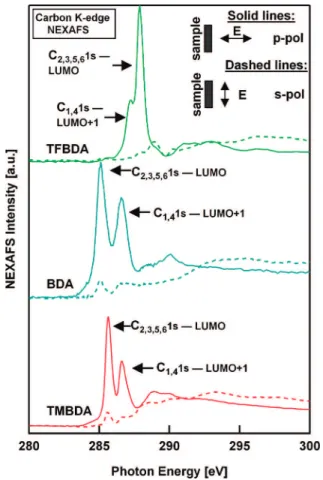
Red-head formula,20assuming first order desorption kinetics.21 NEXAFS measurements are performed at the C K-edge to determine the orientation of the molecule on the surface. In Figure 2, we show the partial electron yield (PEY) of the C K-edge NEXAFS for each molecular monolayer, acquired with the light polarization parallel with respect to the surface (s-pol) and perpendicular with respect to the surface (p-pol). The first two sharp peaks are assigned to the C1s f π* excitation, which are localized on the benzene ring.22,23The intensity of these two peaks depends on the orientation of the benzene ring on the surface and the angle of the light polarization vector with respect to the surface. It is maximal when the polarization is
FIGURE 1. Helium specular reflectivity curves measured during thermal desorption of the thick films of tetramethyl-1,4-benzene-diamine (TMBDA), 1,4-benzenetetramethyl-1,4-benzene-diamine (BDA) and tetrafluoro-1,4-benzenediamine (TFBDA) on Au(111). The reported desorption temperature is defined as the point when the HAS signal has reached half its maximal value.
FIGURE 2. Partial electron yield C K-edge NEXAFS for the monolayers of the three molecules on Au(111) acquired with the light polariza-tion parallel/perpendicular with respect to the surface (dotted/solid lines). The benzene rings tilt angles obtained from NEXAFS linear dichroisms are 27° ( 10°, 24° ( 10° and 12° ( 10° for TMBDA, BDA, and TFBDA, respectively.
orthogonal to the plane of the ring. Thus, from the change in intensity of these two peaks as a function of the light polariza-tion angle,24we determine the angle θ of the benzene rings with respect to the surface to be 27° ( 10°, 24° ( 10°, and 12° ( 10° for TMBDA, BDA, and TFBDA, respectively.
UPS spectra (HeI, hν)21.2 eV) for monolayers of the three molecules on Au(111) acquired at normal emission are shown in Figure 3a (dots). The HOMO peaks are determined from best-fits to the raw data which are also shown (see Supporting Information for details). Compared with BDA, we find that the HOMO peak is shifted closer to the Au Fermi level by ∼0.4 eV for TMBDA, but shifted away from the Au Fermi level by ∼0.1 eV (relative to BDA) for TFBDA (see Table 1). To elucidate features of the valence band of the TMBDA, BDA and TFBDA monolayers films, we have performed resonant XPS measure-ments, which allows us to distinguish molecular features from the valence band of the Au substrate, which dominates the UPS spectra.25-27 In resonant XPS, the energy of the incident photon is tuned to the energy corresponding to the peaks in the NEXAFS spectra, and thus an electron from the core (from the C1s orbital) is first promoted to an unoccupied molecular state (lowest unoccupied molecular orbital (LUMO), LUMO+1...). When the decay of this electron results in an Auger-like electron emission from the molecular occupied orbitals, a resonant enhancement is achieved. Thus in resonant XPS, an additional electron emission channel opens from the occupied orbitals due to a resonant process involving a core-hole excitation.26,28,29 Figure 3b shows a series of valence band photoemission spectra taken with photon energies of hν ) 286.6, 286.6, and 287 eV for TMBDA, BDA, and TFBDA, respectively. These energies correspond to the C1,41s f πC-N* transitions
in the C K-edge NEXAFS, that is, from C1,4 1s to the
LUMO+1. Only the resonant contribution of the measured occupied orbitals spectra for the three molecules is shown
in Figure 3b. The nonresonant part, measured at a photon energy of (hν ) 284 eV) has been subtracted from the raw data. Distinct valence band peaks are identified in these spectra for all three molecules, both on the Au(111) and Au(110) surfaces. The chosen photon energies show clearly the HOMO peak position for different systems.
Both UPS and resonant XPS measurements find that TMBDA has the HOMO closest from EF, while TFBDA has
the HOMO furthest from EF. We note here a slight difference
of the HOMO positions measured with UPS and resonant XPS. This is primarily due to the occupation of different vibrational sublevels of the electronic final state in the resonant XPS.30 Notwithstanding these small differences
the sequence and relative energies of the HOMO peaks are the same for both methods, giving confidence in our results reported in Table 1. Comparing the HOMO positions relative to EF across these three molecules with single-molecule
break-junctions conductance data,8where the molecules are
bonded to Au at both amine end-groups (see Table 1) we see that a deeper HOMO correlates with a smaller conduc-tance. Interestingly, for both the conductance and photo-emission data, the effect of four electron-withdrawing F groups on the HOMO position is not the same as that of four electron-donating CH3groups, although they have Hammett
parameters of similar magnitude.31
On Au(110), resonant XPS measurements place the HOMO energies deeper relative to Fermi, by about ∼0.3 eV when compared to the EF- EHOMOdifference on the Au(111). This
can be attributed partly to the difference in the nature of the adsorption site between the two surfaces: the (110) surface Au atoms have a lower coordination when compared with the (111) surface Au atoms. Indeed, we find from HAS measure-ments that these molecules are more strongly bound on Au(110) (see Supporting Information). However, the ∼0.3 eV shift in the HOMO position on Au(110) could also result from a difference in the screening between the two surfaces.32
To understand further the correlation between spectro-scopic and conductance measurements, we perform first-principles DFT calculations within the generalized gradient approximation (GGA-PBE),33as implemented in VASP.34We use a periodic supercell with ∼10 Å of vacuum and a six-layer gold slab with each six-layer consisting of 16 atoms (4 × 4 unit cell) to model a (111) surface. The bottom three Au layers are frozen in their bulk positions and all other atoms are allowed to relax until forces are converged to within 50 meV/Å. The planewave cutoff is 435 eV, and the electronic charge density is determined self-consistently in the pres-ence of an external electrostatic potential, which removes artifacts introduced when using periodic boundary condi-tions for adsorbates on one side of the metal slab.35The molecular orbital energy level alignments are calculated for the VASP-relaxed structures within a self-energy corrected DFT-GGA framework, implemented in SIESTA,36 as de-scribed below.19We use k-grids of 2 × 2 × 1 and 5 × 5 × 1 to calculate the charge density and electronic density of states
FIGURE 3. UPS (hν ) 21.2 eV) and resonant XPS (hν ) 286.6 eV for BDA and TMBDA and hν ) 287 eV for TFBDA) valence band measurements of thin molecular films on Au(111) and Au(110). The solid black lines are the best fits and the HOMO peaks resulting from the best fitting procedure are reported at the bottom of each trace (see Supporting Information for details).
respectively. The DFT-PBE HOMO energies computed in this manner are within 0.1 eV of those obtained with VASP.
We optimize geometries within VASP for all three molecules on the Au(111) surface and find the Au-N-C angle, θ, to be 23, 27, and 54 for TFBDA, BDA, and TMBDA with GGA-PBE adsorption energies of 0.26, 0.36, and 0.44 eV, respectively37,38 (see Supporting Information for details). In all three cases, the molecule binds to the planar Au(111) surface via the atop site with Au-N bond lengths of 2.8, 2.6, and 3.1 Å. Our optimized angles differ from those measured in experiment, probably because van der Waals interactions, which are of the scale of our computed adsorption energies, are not described within GGA-PBE. In what follows, we compute level alignment for molecules relaxed with θ fixed to the value reported in experi-ment as shown in Figure 4.
For a given adsorbate geometry, energy level alignment is determined with SIESTA by evaluating the site-projected partial density of states (PDOS) for atoms on the molecule. Since DFT underestimates electron removal/addition (qua-siparticle) energy gaps between the HOMO and LUMO orbital energies, molecular resonances are predicted far too close to the metal Fermi level, EF, resulting in poor
agree-ment with spectroscopy experiagree-ments. To correct for DFT level alignment and compare quantitatively with photoemis-sion data, we employ a physically motivated electron self-energy correction to the molecular orbital energies at the surface (DFT+Σ)19,39which consists of two parts, a “bare or molecular” term, correcting for the DFT HOMO-LUMO gap of the gas-phase molecule, computed from total energy differences, and second, an “image-charge” term that ac-counts for the effect of electrode polarization on the energy of the added electron or hole.40(See Supporting Information for details.) This interface-dependent self-energy has no
adjustable parameters and is expected to give an accurate description of quasiparticle level alignment for weakly coupled molecule-metal substrate states for which frontier orbital character is not significantly altered from their gas-phase counterparts through coupling to the surface.
Using the DFT+Σ approach, implemented within SIESTA, the HOMO energy levels, relative to EF, are calculated to be
-1.2, -1.6, and -1.8 for TMBDA, BDA, and TFBDA, respec-tively, for the experimentally determined geometries. These results are in excellent quantitative agreement with our pho-toemission data summarized in Table 1. In the absence of self-energy corrections at this coverage, the DFT HOMO self-energy levels are computed to be -0.1, -0.4, -0.5 eV for TMBDA, BDA, and TFBDA respectively, where although the trends are predicted correctly, the agreement with experimental data is extremely poor. Furthermore, this disagreement between the experiment and DFT HOMO levels cannot be accounted for with changes to the angle θ within the (10° experimental error41or with changes to the molecular coverage, as we have explored different molecular coverages using three different unit cells (3 × 3, 4 × 4, 5 × 5). We find that these changes in coverage lead to variations in HOMO of about (0.2 eV, and as coverage increases, the surface (or bond) dipole decreases and the HOMO energy moves further away from EF.
Interestingly, our DFT+Σ calculations predict a much deeper HOMO level of about -3.4 eV in the Au-BDA-Au junction geometry (where BDA is bound to adatoms at both amine groups)19,39compared with -1.6 eV for the BDA on the atop site of the Au(111) surface. This large difference has three main physical origins. First, binding to undercoordinated Au adatoms results in larger charge transfer from BDA to Au; at the DFT level, when BDA binds to an adatom rather than the atop site on Au(111), the HOMO deepens from -0.4 to -0.6 eV.
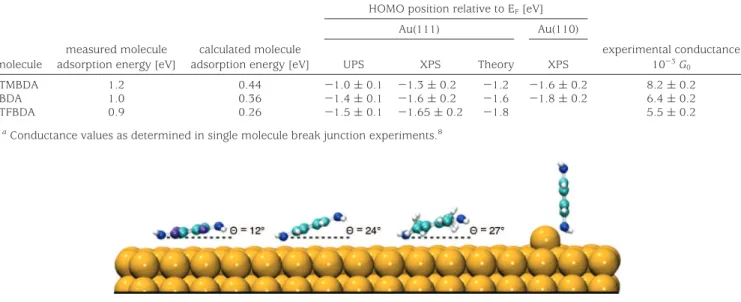
TABLE 1. Measured Molecule Adsorption Energy on Au(111) Determined from Temperature Dependent HAS Measurement, Calculated Molecule Adsorption Energy on Au(111) Using Optimized Molecule Geometries, HOMO Energy Level Relative to EF, As Determined
Experimentally from UPS and Resonant XPS on Au(111) and Au(110) and Determined Theoretically and Measured Conductance Valuesa
HOMO position relative to EF[eV]
Au(111) Au(110) molecule
measured molecule adsorption energy [eV]
calculated molecule
adsorption energy [eV] UPS XPS Theory XPS
experimental conductance 10-3G 0 TMBDA 1.2 0.44 -1.0 ( 0.1 -1.3 ( 0.2 -1.2 -1.6 ( 0.2 8.2 ( 0.2 BDA 1.0 0.36 -1.4 ( 0.1 -1.6 ( 0.2 -1.6 -1.8 ( 0.2 6.4 ( 0.2 TFBDA 0.9 0.26 -1.5 ( 0.1 -1.65 ( 0.2 -1.8 5.5 ( 0.2
aConductance values as determined in single molecule break junction experiments.8
FIGURE 4. Left to right: Atomic geometries for TFBDA, BDA, TMBDA on Au(111) for molecular angles determined from NEXAFS analysis and BDA bound to an atom.
Second, binding to adatoms on Au(111) in a junction geometry further deepens the DFT HOMO to -1.1 eV, reflecting more charge transfer due to binding at both amines. Third, the image-charge self-energy corrections, which depend on the position and orientation of BDA relative to the image plane, can be smaller in the junction, resulting in a deeper HOMO. Thus transport measurements through junctions where the molecule is bonded only on one surface can yield results that are significantly different from measurements in which molecules are bonded to two electrodes as long as the transport mecha-nism is the same in both cases.42
In conclusion, we determined the HOMO energy levels for three different 1,4-diaminobenzene derivatives on Au(111) using ultraviolet and resonant X-ray photoemission spec-troscopy and find excellent quantitative agreement between these measurements and self-energy corrected DFT calcula-tions. We find that the trends in the measured level alignment correlate well with single molecule conductance data, indicating that the trend for the HOMO energy levels in a junction geometry is consistent with that on Au(111). Furthermore, we note that the measured molecular adsorption energies increase from TFBDA to BDA to TMBDA. These results thus provide the first direct comparison between energy level alignment and single molecule transport measurements.
Acknowledgment. This work was supported in part by the
NSEC program of the NSF (Grant CHE-0641523), and a NSF Career Grant (CHE-07-44185). Portions of this work were performed at the Molecular Foundry, Lawrence Berkeley Na-tional Laboratory, and were supported by the Office of Science, Office of Basic Energy Sciences, of the U.S. Department of Energy. A.M. gratefully acknowledges the NSEC at Columbia University and the Italian Academy at Columbia University for the warm hospitality and financial support during his visit.
Note Added after ASAP Publication. The caption of
Figure 4 was changed in the version of this paper published ASAP June 25, 2010; the correct version published on June 28, 2010.
Supporting Information Available. Experimental methods
and theoretical calculations details. This material is available free of charge via the Internet at http://pubs.acs.org.
REFERENCES AND NOTES
(1) Aviram, A.; Ratner, M. A. Chem. Phys. Lett.1974, 29 (2), 277–283.
(2) Reichert, J.; Ochs, R.; Beckmann, D.; Weber, H. B.; Mayor, M.; von Lohneysen, H. Phys. Rev. Lett.2002, 88 (17), 176804.
(3) Xu, B. Q.; Tao, N. J. J. Science2003, 301 (5637), 1221–1223.
(4) Reed, M. A.; Zhou, C.; Muller, C. J.; Burgin, T. P.; Tour, J. M. Science
1997, 278 (5336), 252–254.
(5) Wu, S. M.; Gonzalez, M. T.; Huber, R.; Grunder, S.; Mayor, M.; Schonenberger, C.; Calame, M. Nat. Nanotechnol.2008, 3 (9), 569–574.
(6) Venkataraman, L.; Klare, J. E.; Tam, I. W.; Nuckolls, C.; Hybertsen, M. S.; Steigerwald, M. L. Nano Lett.2006, 6 (3), 458–462.
(7) Cahen, D.; Kahn, A. Adv. Mater.2003, 15 (4), 271–277.
(8) Venkataraman, L.; Park, Y. S.; Whalley, A. C.; Nuckolls, C.; Hybertsen, M. S.; Steigerwald, M. L. Nano Lett.2007, 7 (2), 502–506.
(9) Mowbray, D. J.; Jones, G.; Thygesen, K. S. J. Chem. Phys.2008,
128(11), 111103.
(10) Quinn, J. R.; Foss, F. W.; Venkataraman, L.; Breslow, R. J. Am.
Chem. Soc.2007, 129 (41), 12376–12377.
(11) Baheti, K.; Malen, J. A.; Doak, P.; Reddy, P.; Jang, S. Y.; Tilley, T. D.; Majumdar, A.; Segalman, R. A. Nano Lett.2008, 8 (2), 715–719.
(12) Reddy, P.; Jang, S. Y.; Segalman, R. A.; Majumdar, A. Science
2007, 315 (5818), 1568–1571.
(13) Zangmeister, C. D.; Robey, S. W.; van Zee, R. D.; Kushmerick, J. G.; Naciri, J.; Yao, Y.; Tour, J. M.; Varughese, B.; Xu, B.; Reutt-Robey, J. E. J. Phys. Chem. B2006, 110 (34), 17138–17144.
(14) Beebe, J. M.; Engelkes, V. B.; Miller, L. L.; Frisbie, C. D. J. Am.
Chem. Soc.2002, 124 (38), 11268–11269.
(15) Floreano, L.; Naletto, G.; Cvetko, D.; Gotter, R.; Malvezzi, M.; Marassi, L.; Morgante, A.; Santaniello, A.; Verdini, A.; Tommasini, F.; Tondello, G. Rev. Sci. Instrum.1999, 70 (10), 3855–3864.
(16) Cvetko, D.; Lausi, A.; Morgante, A.; Tommasini, F.; Prince, K. C.; Sastry, M. Meas. Sci. Technol.1992, 3 (10), 997–1000.
(17) Floreano, L.; Cossaro, A.; Gotter, R.; Verdini, A.; Bavdek, G.; Evangelista, F.; Ruocco, A.; Morgante, A.; Cvetko, D. J. Phys.
Chem. C2008, 112 (29), 10794–10802.
(18) The desorption temperature is defined as the temperature when the HAS signal has reached half its maximal value.
(19) Quek, S. Y.; Venkataraman, L.; Choi, H. J.; Loule, S. G.; Hybertsen, M. S.; Neaton, J. B. Nano Lett.2007, 7 (11), 3477–3482.
(20) Redhead, P. A. Vacuum , 12 (4), 203–211.
(21) Lukas, S.; Vollmer, S.; Witte, G.; Woll, C. J. Chem. Phys.2001, 114
(22), 10123–10130.
(22) Luk, Y. Y.; Abbott, N. L.; Crain, J. N.; Himpsel, F. J. J. Chem. Phys.
2004, 120 (22), 10792–10798.
(23) Cooney, R. R.; Urquhart, S. G. J. Phys. Chem. B2004, 108 (47),
18185–18191.
(24) Stohr, J. NEXAFS Spectroscopy; Springer-Verlag: Heidelberg, Germany, 1992.
(25) Vilmercati, P.; Castellarin-Cudia, C.; Gebauer, R.; Ghosh, P.; Lizzit, S.; Petaccia, L.; Cepek, C.; Larciprete, R.; Verdini, A.; Floreano, L.; Morgante, A.; Goldoni, A. J. Am. Chem. Soc.2009, 131 (2), 644–652.
(26) Bruhwiler, P. A.; Karis, O.; Martensson, N. Rev. Mod. Phys.2002,
74(3), 703–740.
(27) Wurth, W.; Menzel, D. Chem. Phys.2000, 251 (1-3), 141–149.
(28) Vilmercati, P.; Cvetko, D.; Cossaro, A.; Morgante, A. Surf. Sci.
2009, 603 (10-12), 1542–1556.
(29) Menzel, D. Chem. Soc. Rev.2008, 37 (10), 2212–2223.
(30) Peisert, H.; Biswas, I.; Zhang, L.; Schuster, B.-E.; Casu, M. B.; Haug, A.; Batchelor, D.; Knupfer, M.; Chasse, T. J. Chem. Phys.
2009, 130 (19), 194705.
(31) Smith, M. B.; March, J. March’s Advanced Organic Chemistry:
Reactions, Mechanisms, and Structures, 5th ed.; John Wiley & Sons, Inc: New York, 2001.
(32) Smith, N. V.; Chen, C. T.; Weinert, M. Phys. Rev. B1989, 40 (11),
7565–7573.
(33) Perdew, J. P.; Burke, K.; Ernzerhof, M. Phys. Rev. Lett.1996, 77
(18), 3865–3868.
(34) Kresse, G.; Hafner, J. Phys. Rev. B: Condens. Matter Mater. Phys.
1993, 47, 558. Kresse, G.; Hafner, J. Phys. Rev. B: Condens. Matter
Mater. Phys.1994, 49, 14251.
(35) Neugebauer, J.; Scheffler, M. Phys. Rev. B1992, 46 (24), 16067–
16080.
(36) Soler, J. M.; Artacho, E.; Gale, J. D.; Garcia, A.; Junquera, J.; Ordejon, P.; Sanchez-Portal, D. J. Phys.: Condens. Matter2002,
14(11), 2745–2779.
(37) Hoft, R. C.; Ford, M. J.; McDonagh, A. M.; Cortie, M. B. J. Phys.
Chem. C2007, 111 (37), 13886–13891.
(38) Pong, B.; Lee, J.; Trout, B. L. Langmuir2005, 21 (25), 11599–11603.
(39) Quek, S. Y.; Choi, H. J.; Louie, S. G.; Neaton, J. B. Nano Lett.2009,
9(11), 3949–3953.
(40) Neaton, J. B.; Hybertsen, M. S.; Louie, S. G. Phys. Rev. Lett.2006,
97(21), 216405.
(41) For BDA, changes in the HOMO energy with angle are small. For TMBDA and TFBDA, we find that increasing (decreasing) θ by 10° (5°) leads to an increase (decrease) in HOMO-EFseparation of 0.2 (0.0) eV
and 0.4 (0.1) eV in TMBDA and TFBDA, respectively.
(42) Selzer, Y.; Cai, L. T.; Cabassi, M. A.; Yao, Y. X.; Tour, J. M.; Mayer, T. S.; Allara, D. L. Nano Lett.2005, 5 (1), 61–65.