HAL Id: hal-00512232
https://hal.archives-ouvertes.fr/hal-00512232
Submitted on 23 Apr 2018
HAL is a multi-disciplinary open access
archive for the deposit and dissemination of
sci-entific research documents, whether they are
pub-lished or not. The documents may come from
teaching and research institutions in France or
abroad, or from public or private research centers.
L’archive ouverte pluridisciplinaire HAL, est
destinée au dépôt et à la diffusion de documents
scientifiques de niveau recherche, publiés ou non,
émanant des établissements d’enseignement et de
recherche français ou étrangers, des laboratoires
publics ou privés.
Photon antibunching in the optical near field
Renaud Marty, Arnaud Arbouet, Vincent Paillard, Christian Girard, Gérard
Colas Des Francs
To cite this version:
Renaud Marty, Arnaud Arbouet, Vincent Paillard, Christian Girard, Gérard Colas Des Francs. Photon
antibunching in the optical near field. Physical Review B: Condensed Matter and Materials Physics
(1998-2015), American Physical Society, 2010, 82 (8), pp.081403(R). �10.1103/PhysRevB.82.081403�.
�hal-00512232�
Photon antibunching in the optical near field
R. Marty, A. Arbouet, V. Paillard, and C. Girard
CEMES, UPR 8011, CNRS–Université de Toulouse, 29 rue Jeanne Marvig, BP 94347, F-31055 Toulouse, France
G. Colas des Francs
LICB, UMR 5209, CNRS–Université de Bourgogne, 9 Avenue A. Savary, BP 47870, F-21078 Dijon, France
共Received 24 June 2010; published 9 August 2010兲
We show that a combination of the field-susceptibility technique with the optical Bloch equations gives access to the temporal evolution of the populations and coherences of any quantum system placed in the optical near field of a nanostructure. In particular, we show that the near-field evanescent states, confined around dielectric or plasmonic particles, can be used to modify and control the photon statistics of the quantum system. This theoretical scheme leads to second-order autocorrelation functions in good agreement with recent experi-mental measurements performed with nitrogen-vacancy center in diamond nanocrystals placed in interaction with gold nanoparticles.
DOI:10.1103/PhysRevB.82.081403 PACS number共s兲: 78.20.Bh, 42.50.Ar, 07.79.Fc
In the last 20 years, a tremendous interest has been de-voted to the study of the optical near field generated in the vicinity of dielectric or plasmonic nanostructures.1,2
Control-ling the near field enables light transfer in highly reduced geometries and paves the way for future optical technologies, integrable, and scalable down to molecular dimensions.3,4In
a closely related context, single molecules or quantum dots are often used as efficient local sensors of the plasmonic near-field intensity.5–7Very recently, the direct control of the
photon statistics of various quantum systems共QSs兲 coupled with plasmonic structures has been demonstrated.3,4,8–10
In particular, recent measurements of the second-order photon autocorrelation function g共2兲共兲 are well illustrated into elegant experiments where local probe-based methods are used to tune the spacing between a single quantum sys-tem and a plasmonic nanostructure.9,10For example,
impres-sive photon antibunching control has been recently reported9
by approaching gold nanoparticles close to single nitrogen-vacancy共NV兲 color center in diamond nanocrystals with the tip of an atomic force microscope.
In this Rapid Communication, we generalize the theoret-ical framework described in Ref.11to the study of the pho-ton statistics of a quantum system coupled with complex nano-optical structures, including dielectric, metallic, or hy-brid materials. The approach is based on the combination of the field-susceptibility/Green’s-tensor technique with the op-tical Bloch equations.12 The former provides an accurate
electromagnetic description of the system, including both the local electric field and local density of states.13,14These two
techniques are merged to describe time-dependent popula-tions, correlation funcpopula-tions, and antibunching characteristic times. Specific applications on realistic systems9,10 are
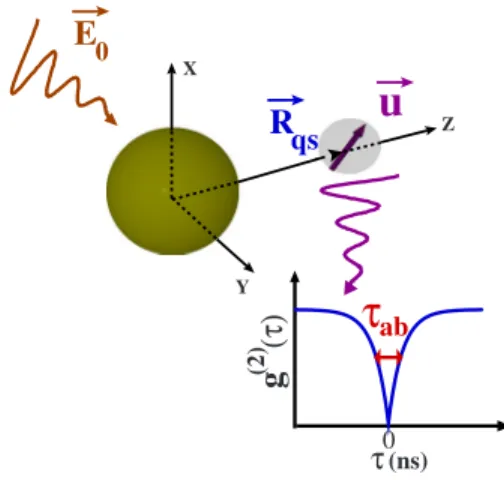
de-scribed in the second part of the Rapid Communication. Let us consider a single QS located at the position
Rqs=共Xqs, Yqs, Zqs兲 in the near field of a nanostructure and
characterized by its dipolar operator mˆ and Hamiltonian Hˆ0 共Fig. 1兲. The whole system is illuminated by a
monochro-matic plane wave of electric field E0and frequency0. The QS is treated as a two-level system兵兩g典,兩e典其, whereegis the
frequency of the transition 共兩g典→兩e典兲 and ␦L=eg−0
is the detuning. The dipolar coupling Hamiltonian Wˆ 共t兲=−mˆ·E共Rqs, t兲 can then be deduced from the local field
E共Rqs, t兲,
Wˆ 共t兲 = −
兺
␣
mˆ␣E␣共Rqs,0兲cos关0t +␣共Rqs兲兴, 共1兲
whereE␣共Rqs,0兲 and␣共Rqs兲 共with␣= x, y, or z兲 represent
the magnitudes and the phases of the three Cartesian compo-nents of E共Rqs, t兲. Applying the usual rotating-wave
approximation,12 one obtains Wˆ 共t兲 =
兺
␣=x,y,z
ប⍀␣共Rqs兲
2 兵e
−i共0t+␣共Rqs兲兲兩e典具g兩 + c.c.其, 共2兲 where ⍀␣共Rqs兲 is the ␣ component of the vectorial Rabi
frequency. This quantity which characterizes the strength of the interaction between the incident electric field and the quantum system is proportional to the ␣ component of the absorption transition dipole meg,␣=具e兩mˆ␣兩g典,
E
0R
qsu
Z Xg
(τ) (2) τ(ns)τ
ab Y 0FIG. 1. 共Color online兲 Schematic representation of a QS inter-acting with an arbitrary optical environment represented by a gold sphere. The unit vector u defines the orientation of the transition dipole moment.
⍀␣共Rqs兲 = −
meg,␣E␣共Rqs,0兲
ប . 共3兲
From the coupling Hamiltonian 共2兲, we can calculate the
time-dependent quantities 共populations, coherences, and fluctuating dipole moment兲 to finally describe the photon sta-tistics of the emitter. This can be achieved by numerically solving the time-dependent density matrix 共t兲 evolution equation,
˙共t兲 = 1
iប兵关H0+ W共t兲兴,共t兲其 + Rspont共t兲 共4兲
with a time-domain finite-difference method. The Redfield operatorRspontdescribes the coupling with the photon bath.
The photon emission of a single two-level system is anti-bunched because the generation of a photon projects the QS wave function into the ground state from which a second photon cannot be emitted. This pure quantum phenomenon is revealed by the particular variation in the second-order auto-correlation function g共2兲共兲=具I共t兲I共t+兲典t/具I共t兲典t具I共t+兲典t
de-fined from the signal I共t兲 emitted by the QS.15,16For a single
quantum system, g共2兲共兲 presents an antibunching dip when →0. In a more general manner, g共2兲共兲 represents the joint
probability of detecting a second photon at time knowing that a first one has been emitted at= 0, i.e.,ee共0兲=0.
Con-sequently, the normalized second-order photon correlation function can be written as
g共2兲共兲 = ee共兲 ee共⬁兲
, 共5兲
in whichee共t兲=具e兩共t兲兩e典 andee共⬁兲 is the stationary
popu-lation of the excited state. The direct numerical resolution of the optical Bloch equations following from Eq. 共4兲 gives
access to the QS photon statistics for any illumination sity. Nevertheless, let us note that for moderate laser inten-sity共weak Rabi frequency regime兲, we can assume that the coherences eg共t兲 andge共t兲 adiabatically follow the
popula-tion inversion 共t兲. Within this approximation, the formal integration of the optical Bloch equations resulting from Eq. 共4兲 is straightforward and the evolution of the system is
gov-erned by rate equations from which an analytical expression of the time-dependent excited state populationee共t兲 can be
obtained, ee共t兲 =
⌬共Rqs兲/2
⌬共Rqs兲 + ⌫tot共Rqs兲
关1 − e−共⌬共Rqs兲+⌫tot共Rqs兲兲t兴, 共6兲 where ⌫tot共Rqs兲 is the total decay rate of the excited level.
This coefficient is proportional to the imaginary part of the surroundings field-susceptibility S共Rqs, Rqs,eg兲,11
⌫tot共Rqs兲 =
2meg
ប u · Im兵S共Rqs,Rqs,eg兲其 · u. 共7兲
In Eq.共6兲, ⌬共Rqs兲 represents the QS absorption rate,
⌬共Rqs兲 = 2⍀−⍀+⌫ tot共Rqs兲 ␦L 2 +⌫tot 2 共R qs兲/4 共8兲 and ⍀−/+=
兺
␣=x,y,z ⍀␣共Rqs兲 2 e 共−/+兲i␣共Rqs兲. 共9兲The second-order photon autocorrelation function g共2兲共兲 can be deduced from Eqs. 共5兲 and 共6兲,
g共2兲共兲 = 1 − e−关⌬共Rqs兲+⌫tot共Rqs兲兴, 共10兲 from which an analytical expression of the antibunching time abcan be defined,
ab=
1
⌬共Rqs兲 + ⌫tot共Rqs兲
. 共11兲
Relations共8兲 and 共11兲 are interesting because they provide a
simple expression of the antibunching time in which both total decay and absorption rates appear clearly. Nevertheless this assumption fails to properly describe the photon statis-tics for strong local-field-QS couplings. In this case, the au-tocorrelation function g共2兲共兲 exhibits Rabi oscillations17,18
that must be computed by direct time integration of Bloch equations 关cf. curves of Fig. 4共f兲兴. In the following, three different applications illustrate the exposed framework in ei-ther the weak- or strong-coupling regime.
In a first step, we have investigated the evolution of the antibunching timeabof a QS when entering the near field of
an illuminated gold nanosphere. To perform the computation, the sphere has been discretized in volume using 1279 cells located at the nodes of a hexagonal compact array.19Figure2
shows the results for a fixed orientation u of the transition dipole moment and three different wavelengths. We have used the permittivity of gold20and the lifetime of the QS in
vacuum is fixed at 1/⌫e= 20 ns. In that example, the vacuum
Rabi frequency ⍀0 remains small compared to the total de-cay rate so that the adiabatic approximation is still valid and expression 共11兲 applies. Far from the gold nanosphere, the
antibunching time ab converges toward the lifetime of the
excited state in vacuum. When entering the optical near field located around the particle, both excitation field and optical evanescent modes density increase. This effect is further en-hanced when working near the plasmon resonance 共solid
τ
ab(ns)
R
qs
(nm)
u// E Rqs =460nm =600nm =520nmλ
λ
λ
Wavelength (nm) (arb. units) ext σ 0 5 10 15 20 0 20 40 60 80 100 600 400 800FIG. 2. 共Color online兲 Antibunching time of a QS in the near field of a gold nanosphere in vacuum for a given orientation of the transition moment and three different wavelengths 共particle diam-eter D = 20 nm兲.␦L= 0,⌫e= 1/20 ns−1, and vacuum Rabi frequency
⍀0= 1/100 ns−1=⌫e/5. The inset represents the extinction spectra
of the isolated gold sphere.
MARTY et al. PHYSICAL REVIEW B 82, 081403共R兲 共2010兲
green curve: 520 nm兲 of the spherical particle. At such weak Rabi frequency, the antibunching time ab is mainly
gov-erned by the total decay rate which is composed of both radiative and nonradiative contributions. At very short dis-tance from the particle surface, abdecreases rapidly due to
the nonradiative channels responsible for the metal quench-ing effect.
A closely related configuration recently studied in Schi-etinger et al.9has been investigated in Fig.3. It concerns the
second-order autocorrelation function measurement of a single color center embedded in a nanodiamond when the hosting nanodiamond is surrounded by either a single gold particle 共configuration A兲 or by two particles 共configuration B兲. The parameters used for describing the NV center of diamond are summarized in the caption of Fig.3. Two static configurations 共A兲 and 共B兲 are considered where gold par-ticles and nanodiamond volumes are discretized with a hex-agonal compact array. The NV emitter is located at the center of the nanodiamond. In good agreement with experimental data reported in Ref.9, we observe a significant squeezing of the g共2兲共兲 dip. According to the result of Fig.2, the observed reduction inabis a consequence of the significant
amplifi-cation of⌫tot共Rqs兲 and of the optical near field generated by
the gold particles. This is consistent with the results of Ref.9
that demonstrated that passing from configuration共A兲, with a single gold sphere, to configuration 共B兲, with two gold spheres, significantly increases the total radiative decay rate and the antibunching rate. Moreover, in the second configu-ration, the creation of hot spots between the two metal spheres enhances the excitation of the NV center via local-field effects. Our calculations are in excellent agreement with this experiment. They reproduce this result with an anti-bunching timeabvarying from 13.8 ns 共configuration A兲 to
6.4 ns共configuration B兲.
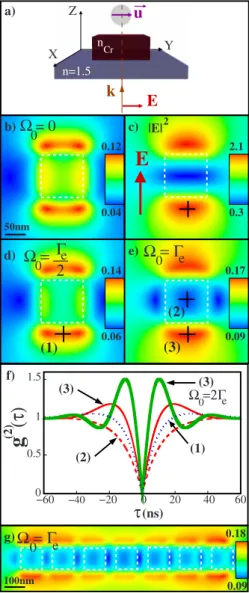
Many other interesting behaviors of QS placed in the vi-cinity of complex near-field optical landscapes can be pre-dicted with the model. In the application of Fig.4, we have considered a second system of experimental interest10 in
which a single NV center probes the optical near field gen-erated by illuminating a glass sample supporting chromium
microfabricated pads. We have computed the evolution of the antibunching rate ⌫ab= 1/ab of the NV center when it is
raster scanned across a plane parallel to the lithographically structured surface. The calculations presented in Figs.
4共b兲–4共g兲 are performed for a transition dipole moment aligned along the 共OY兲 axis and an incident electric field polarized along the same direction 共normal incidence兲. The NV center is scanned at a constant distance Zqs= 80 nm
above the sample. The variations in the antibunching rate ⌫ab共Xqs, Yqs, Zqs= 80 nm兲 reveal a dramatic dependence of
the photon statistics with respect to the lateral NV center 共Xqs, Yqs兲 location: 共i兲 when the laser intensity completely
g
(2)(τ)
(ns)τ
A B 1 0.8 0.6 0.4 0.2 0 100 −100 −50 0 50FIG. 3. 共Color online兲 Second-order autocorrelation function of the photons emitted at 680 nm by a single NV center located in the center of a single nanodiamond. The nanodiamond 共⑀=6.0兲 is modeled by a truncated pyramid of square cross section 共height h=30 nm, lower side L=48 nm, and upper side l=38 nm兲. The gold nanospheres have a diameter of 60 nm and are deposited on a glass substrate共n=1.5兲. The dielectric constant has been taken from Ref. 20. ␦L= 0, ⌫e= 1/20 ns−1, and ⍀0= 1/100 ns−1=⌫e/5.
Solid line: result without gold nanosphere.
n=1.5 n Cr
u
k
Y ZE
X a) 2.1 0.12 0.04 0.3 0.17 0.09 0.14 0.06τ
(ns)g
(2)(τ)
100nmE
Ω =2Γ b) c) e) d)Ω = Γ
2
Ω
2 |E|Ω = Γ
50nm f)Ω = Γ
g) 0.18 0.09 = 0 0 e 0 e 0 e 0 0 e (1) (3) (2) (3) (1) (2) (3) −60 −40 −20 0 20 40 60 1.5 1 0.5 0FIG. 4. 共Color online兲 Photon statistics of a NV center 共⌫e= 1/20 ns−1兲 located above chromium pads 共height=40 nm,
side= 100 nm, center-to-center distance= 150 nm兲. 共a兲 Perspective view of a NV center scanning a single chromium pad illuminated with a normal incident plane wave.共b兲 Map of the total decay rate. 共c兲 Field intensity map. 关共d兲 and 共e兲兴 Evolution of the antibunching rate map共⌫ab= 1/ab兲 when passing from ⍀0=⌫e/2 to ⍀0=⌫e.共f兲
Second-order correlation functions of a NV center at positions共1兲 共dotted line兲, 共2兲 共dashed line兲, or 共3兲 共solid line兲 of maps 共d兲 and 共e兲. Thick solid line: NV at position 共3兲 and ⍀0= 2⌫e. 共g兲
Anti-bunching rate map computed near a line of chromium pads 共⍀0=⌫e兲.
vanishes关see Fig.4共b兲where⍀0→0兴, the antibunching rate
map corresponds to the total decay rate map which is gener-ally proportional to the fluorescence intensity. In this limit case, according to relation 共11兲, ⌬共Rqs兲=0 and
⌫ab共Rqs兲=⌫tot共Rqs兲. At this height Zqs= 80 nm, ⌫tot varies
between 0.12 ns−1 共on the pad top兲 to 0.03 ns−1 共far from the pad top兲.
共ii兲 In the following maps 共c兲–共e兲, the laser illuminates the sample and produces the typical near field pattern repre-sented in 共c兲 where the intensity has been normalized with respect to the incident field intensity computed without any structure. When increasing the laser intensity关maps 共d兲 and 共e兲兴, the photon bunching effect is reinforced along the pad sides and decreases on the top of the structures. A similar reversal contrast phenomenon was already observed in near-field optics.21,22As expected, a strong illumination regime is
reached when ⍀0 is comparable to ⌫e. In this regime 关cf.
Figs. 4共e兲and 4共f兲兴, a dramatic change in the second-order
correlation function is observed when passing from a top site 关labeled 共2兲 in Figs.4共e兲and4共f兲兴 to the side site labeled 共3兲 where we can observe the first modulations of the Rabi os-cillation关see curve 共3兲 of g共2兲共兲兴. This change is induced by the strong variation in the optical near field between these two sites关see 共c兲 map兴.
共iii兲 Finally, by keeping the illumination parameters of Fig.4共e兲, we observe that an elongated antibunching area can
be created when several dielectric pads are aligned关cf. map of Fig.4共g兲兴. In other words, the optical near field produced by the pad chain tends to symmetrically produce areas with simultaneous photon antibunching and bunching zones that could be exploited for the emission control of single quan-tum systems. This calculation could also find a direct experi-mental counterpart in near-field optical microscopy using a nanodiamond-based single photon tip.10
In conclusion, we have developed a concise theoretical framework that can reproduce and analyze experimental pho-ton statistics recorded on hybrid architectures composed of a quantum system coupled with complex dielectric or metallic nanostructures. By directly solving Bloch equations, all illu-mination regimes are accessible within the same numerical framework. The obtained equations provide information about the mechanisms responsible for the photon antibunch-ing changes共spatial and polarization control, plasmon reso-nance effects,…兲. Our method enables direct comparison with the current experimental work and could be generalized without formal difficulties to more complex systems.
The authors would like to thank G. Dujardin, S. Huant, and A. Drezet for fruitful discussions. This work was sup-ported by the computing facility center CALMIP of the Uni-versity Paul Sabatier of Toulouse共France兲 and funded by the ANR Projects NAPHO and PlasTips.
1L. Novotny and B. Hecht, Principles of Nano-Optics, 1st ed.
共Cambridge University Press, London, 2006兲.
2S. A. Maier, Plasmonics: Fundamentals and Applications, 1st
ed.共Springer, New York, 2007兲.
3A. V. Akimov, A. Mukherjee, C. L. Yu, D. E. Chang, A. S.
Zibrov, P. R. Hemmer, H. Park, and M. D. Lukin,Nature 共Lon-don兲 450, 402 共2007兲.
4T. M. Babinec, B. J. M. Hausmann, M. Khan, Y. Zhang, J. R.
Maze, P. R. Hemmer, and M. Loncar,Nat. Nanotechnol. 5, 195 共2010兲.
5H. G. Frey, S. Witt, K. Felderer, and R. Guckenberger, Phys.
Rev. Lett. 93, 200801共2004兲.
6P. Anger, P. Bharadwaj, and L. Novotny, Phys. Rev. Lett. 96,
113002共2006兲.
7S. Kühn, U. Håkanson, L. Rogobete, and V. Sandoghdar,Phys.
Rev. Lett. 97, 017402共2006兲.
8Y. Sonnefraud, A. Cuche, O. Faklaris, J.-P. Boudou, T. Sauvage,
J.-P. Roch, F. Treussart, and S. Huant,Opt. Lett. 33, 611共2008兲.
9S. Schietinger, M. Barth, T. Aichele, and O. Benson,Nano Lett.
9, 1694共2009兲.
10A. Cuche, A. Drezet, Y. Sonnefraud, O. Faklaris, F. Treussart, J.
F. Roch, and S. Huant,Opt. Express 17, 19969共2009兲.
11C. Girard, O. J. F. Martin, G. Lévèque, G. Colas des Francs, and
A. Dereux,Chem. Phys. Lett. 404, 44共2005兲.
12C. Cohen-Tannoudji, J. Dupont-Roc, and G. Grynberg, Proces-sus d’interaction entre photons et atomes 共InterEditions, Paris,
1988兲.
13G. Colas des Francs, C. Girard, J. C. Weeber, C. Chicane, T.
David, A. Dereux, and D. Peyrade, Phys. Rev. Lett. 86, 4950 共2001兲.
14G. Baffou, C. Girard, E. Dujardin, G. Colas des Francs, and O. J.
F. Martin,Phys. Rev. B 77, 121101共R兲 共2008兲.
15M. Orrit,Single Mol. 3, 255共2002兲.
16Y. Zheng and F. L. H. Brown, Phys. Rev. Lett. 90, 238305
共2003兲.
17G. Wrigge, I. Gerhardt, J. Hwang, G. Zumofen, and V.
Sandogh-dar,Nat. Phys. 4, 60共2008兲.
18Y. Gu, L. Huang, O. J. F. Martin, and Q. Gong,Phys. Rev. B 81,
193103共2010兲.
19C. Girard, E. Dujardin, G. Baffou, and R. Quidant,New J. Phys.
10, 105016共2008兲.
20P. B. Johnson and R. W. Christy,Phys. Rev. B 6, 4370共1972兲. 21J. C. Weeber, E. Bourillot, A. Dereux, J. P. Goudonnet, Y. Chen,
and C. Girard,Phys. Rev. Lett. 77, 5332共1996兲.
22D. Barchiesi, C. Girard, O. J. F. Martin, D. Van Labeke, and D.
Courjon,Phys. Rev. E 54, 4285共1996兲.
MARTY et al. PHYSICAL REVIEW B 82, 081403共R兲 共2010兲