Publisher’s version / Version de l'éditeur:
ASHRAE Transactions, 118, 1, pp. 636-643, 2012-01-21
READ THESE TERMS AND CONDITIONS CAREFULLY BEFORE USING THIS WEBSITE. https://nrc-publications.canada.ca/eng/copyright
Vous avez des questions? Nous pouvons vous aider. Pour communiquer directement avec un auteur, consultez la première page de la revue dans laquelle son article a été publié afin de trouver ses coordonnées. Si vous n’arrivez pas à les repérer, communiquez avec nous à [email protected].
Questions? Contact the NRC Publications Archive team at
[email protected]. If you wish to email the authors directly, please see the first page of the publication for their contact information.
NRC Publications Archive
Archives des publications du CNRC
This publication could be one of several versions: author’s original, accepted manuscript or the publisher’s version. / La version de cette publication peut être l’une des suivantes : la version prépublication de l’auteur, la version acceptée du manuscrit ou la version de l’éditeur.
Access and use of this website and the material on it are subject to the Terms and Conditions set forth at
Design fires for road tunnels safety design
Kashef, A.; Viegas, J.; Mos, A.; Harvey, N.
https://publications-cnrc.canada.ca/fra/droits
L’accès à ce site Web et l’utilisation de son contenu sont assujettis aux conditions présentées dans le site LISEZ CES CONDITIONS ATTENTIVEMENT AVANT D’UTILISER CE SITE WEB.
NRC Publications Record / Notice d'Archives des publications de CNRC:
https://nrc-publications.canada.ca/eng/view/object/?id=15a6f36f-7c94-4f3a-a3b2-031e7681f833 https://publications-cnrc.canada.ca/fra/voir/objet/?id=15a6f36f-7c94-4f3a-a3b2-031e7681f833Design fires for road tunnels
safety design
Kashef, A.; Viegas, J.; Mos, A.; Harvey, N.
NRCC-54573
A version of this document is published in:
ASHRAE Annual Meeting, Chicago, Illinois, January 21-25, 2012, pp. 1-8
The material in this document is covered by the provisions of the Copyright Act, by Canadian laws, policies, regulations and international agreements. Such provisions serve to identify the information source and, in specific instances, to prohibit reproduction of materials without written permission. For more information visit http://laws.justice.gc.ca/en/showtdm/cs/C-42
Les renseignements dans ce document sont protégés par la Loi sur le droit d’auteur, par les lois, les politiques et les règlements du Canada et des accords internationaux. Ces dispositions permettent d’identifier la source de l’information et, dans certains cas, d’interdire la copie de documents sans permission écrite. Pour obtenir de plus amples renseignements : http://lois.justice.gc.ca/fr/showtdm/cs/C-42
A. Kashef is a Senior research officer at the National Research Council, Ottawa, Ontario, Canada. J. Viegas is a researcher at the
Laboratório Nacional de Engenharia Civil, Lisboa, Portugal. A. Mos is a researcher at the Centre d’Etudes des Tunnels, Bron Cedex – France. N. Harvey is a consulting engineer at Parsons Brinckerhoff Americas, Inc., New York, NY, USA.
Design Fires for Road Tunnels Safety
Design
A. Kashef, PEng, PhD
J. Viegas, PhD
A. Mos, PhD
N. Harvey, PE
Member ASHRAE Member ASHRAE
ABSTRACT
Design fires are an intrinsic part in designing tunnels for fires. They provide, quantitatively, the fire characteristics that are used to establish the sizing of equipment in tunnels and the scenarios to consider when developing emergency response plans. They are also used, indirectly, when considering the impact of fires on the structure. As such, design fires form the base input for emergency ventilation, evacuation, and structural design analyses. A design fire is generally defined in terms of heat release rate, and species output as functions of time. This paper summarizes efforts to develop a set of design fire curves as a useful tool for road tunnel fire risk assessment. The developed design fire curves include the following phases: (1) incubation phase, (2) growth phase, (3) fully-developed phase, and (4) decay phase.
INTRODUCTION
A prescriptive approach has traditionally been adopted in which a specific fire size, usually the peak heat release rates depending on the type of vehicle, is chosen as a basis for the tunnel fire-life safety design. The peak heat release rates were of the order of 5 MW (4743 BTU/s) to 30 MW (28460 BTU/s). The adequacy of the design fire sizes used for the design of fire protection systems used in road tunnels was seriously questioned following the occurrence of major fire catastrophes in late 1990’s. This has promoted the shift from prescriptive to performance-based regulations. Performance-based designs are usually based upon explicitly stated objectives that allow the freedom to develop innovative designs satisfying these objectives. Such innovative designs often lead to lower fire protection costs.
The performance-based design approach makes possible the evaluation of the tunnel fire safety as a whole. An important step in the performance-based design is the establishment of possible fire scenarios. Different fire scenarios are created to instigate the design analyses of emergency ventilation, egress, structural, and fire safety tunnel equipment (e.g. detection and fixed fire fighting systems). A design fire scenario describes qualitatively the key time events following the ignition of a fire such as: quantity and characteristics of combustible materials, material arrangement and location, tunnel geometry, environment, fire protection systems, etc. The design fires are the cornerstone in developing such fire scenarios. As such, design fires are the underpinning in conducting a performance-based design.
A design fire is an idealization of a real fire that might occur in a tunnel. It is a set of data that provides the actual fire characteristics such as, ignition sources, nature and configuration of the fuel, fire growth, peak heat release, production rates of combustion products (smoke CO, CO2, etc.) and extinction. For the design purposes, it is necessary to choose a typical design fire corresponding to the traffic type and pattern in the tunnel and whether hazardous transports are permitted.
Different aspects of a design fire are more important to certain types of analysis than others. For example, the peak heat release (PHRR) and burning duration are important to evaluating structural response to fire. The HRR at the end of evacuation and the PHRR are considerations in evaluating tunnel ventilation equipment. The early transient stages of fire
development during the growth phase are important to life safety analyses.
This paper summarizes the efforts to develop a set of idealized design fire curves as a useful tool for road tunnel fire risk assessment. The data from major international experimental programs, such as The Eureka-project EU499 – FIRETUN Project, Benelux Tunnel Tests and Runehamar tests in Europe and the Memorial Tunnel Tests in the United States, are compiled and analyzed to develop a set of idealized design fire curves for different possible fire loads in road tunnels. The fire loads include: passenger cars, buses, heavy goods vehicles and pool fires. The developed idealized design fire curves include the following phases: (1) incubation phase, (2) growth phase, (3) fully-developed phase, and (4) decay phase.
IDEALIZATION METHODOLOGY
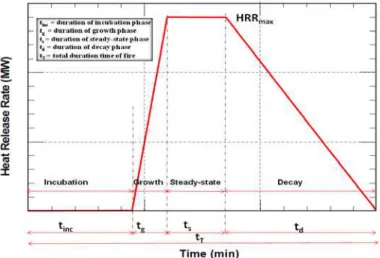
The main objective of this paper is to develop a set of idealized design fire curves as a useful tool for road tunnel fire risk assessment. The proposed idealized HRR plateau is characterized by four regions: incubation, fire growth, steady-state, and decay. Figure 1 shows a schematic of the proposed idealized HRR curve where: tinc is the time from ignition until the fire is producing flame (smouldering or incubation region); tg is the time from end of incubation to maximum heat release (fire growth region); ts is the duration time of the steady-state region; td is the time from the start of the decay to the end of it (decay region); and tT is the duration time of the fire from ignition.
In this representation, the fire initially smolders for a period of time after ignition. The incubation phase is followed by the fire growth phase in which the fire will spread and rapidly grow. At the end of the growth phase, the fire will sustain a peak HRR at the end of which the fire will decay and eventually extinguish for a lack of fuel.
In developing these idealized curves, some constraints or criteria were respected. The total energy released, growth rate, and decay rate of the idealized curves were approximately maintained the same as of the experimental data. The idealized HRR is generally not very different from the real peak HRR in realistic fires (by 12% maximum). However, special considerations should be given to whether the experimental setup is a representative of actual road traffic.
Figure 1 Idealized HRR-time curves.
In the idealized curves, the incubation time has to be as close to reality as possible. The duration of this phase is very important for the choice of early detection device. During this time, the users' safety is not really threatened, so overestimating (or underestimating) it could result in overly optimistic (or pessimistic) results of evacuation studies. The growth rate of the fire is another key parameter for the evacuation of users and intervention of the emergency services, so it also has to be accurately selected.
Adequate definition of the fire resistance objectives and intervention planning requires a good estimate of the total fire duration and total energy released. From these constraints, one can derive an average HRR during the fully developed fire
phase. This value is relevant for the sizing of ventilation systems and the assessment of intervention conditions. The instant peak HRR does not affect significantly the performance of ventilation systems due to their short duration periods.
EXPERIMENTAL DATA
One of the most important characteristics of fire phenomenon and central in assuring tunnel safety is the HRR. The HRR is strongly interrelated to other parameters, e.g. temperature, smoke production, radiation, fire spread, fire severity, and flame profile. Parameters influencing the HRR include fire load, ventilation, thermal insulation and tunnel geometry. However, there is limited data available regarding the magnitude and severity of vehicle design fires. Most of the information available is based on the relatively little experimental data available due to the high costs involved in full scale tunnel tests. The limited information available, in the absence of more specific data, provides first-order guidance in the selection of an appropriate design fire for the evaluation of a tunnel. The PIARC report (PIARC, 1999) and NFPA 502 (NFPA, 2004) provide summaries of vehicle fire tests.
Experience from full scale fire tests show some specific correlation between some of the characteristics apparent in a tunnel and the fire characteristics, such as: correlation between the total released energy and the peak HRR; impact of air velocity in the tunnel on fire growth and peak HRR, and impact of the fuel blocking to the cross section ratio on the tunnel ventilation efficiency and the fire growth and peak HRR.
Four major test programs were analyzed in this paper in an effort to deduce representative design fires. These tests are: EUREKA 499-project, Benelux Tunnel Tests, Runehamar Tests, and Memorial Tunnel Fire tests.
EUREKA 499-project
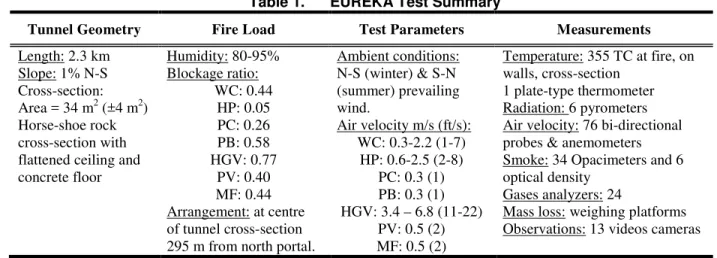
In the Eureka-project EU499 (Haack, 1994) full-scale tests were conducted in the unused Repparfjord Tunnel in Norway. The tunnel ceiling and walls in the immediate vicinity of the fire load (260 m (853 ft) – 345 m (1132 ft)) were lined with a steel-fibre reinforced light-weight shotcrete. The test program consisted of 20 full-scale fire tests with different fuel sources and loads, including: wood cribs (WC), Heptane pools (HP), public bus (PB), passenger car (PC), plastic vehicle (PV), Lorry load mixed fuel (MF: wood, tires, and plastic), and heavy goods vehicles (HGV). Extensive instrumentation was used to measure gas temperature, velocity profiles, heat fluxes, smoke obscuration, and gas composition at various distances in both directions from the location of the fire. Several approaches were used to determine the HRR of the burning object based on the available temperature, velocity, mass loss, and gas composition data. Table 1 summarizes the information on the tests conducted. Figure 2 shows the measured HRR versus time for the Eureka-project tests.
Table 1. EUREKA Test Summary
Tunnel Geometry Fire Load Test Parameters Measurements
Length: 2.3 km Slope: 1% N-S Cross-section: Area = 34 m2 (±4 m2) Horse-shoe rock cross-section with flattened ceiling and concrete floor Humidity: 80-95% Blockage ratio: WC: 0.44 HP: 0.05 PC: 0.26 PB: 0.58 HGV: 0.77 PV: 0.40 MF: 0.44 Arrangement: at centre of tunnel cross-section 295 m from north portal.
Ambient conditions: N-S (winter) & S-N (summer) prevailing wind. Air velocity m/s (ft/s): WC: 0.3-2.2 (1-7) HP: 0.6-2.5 (2-8) PC: 0.3 (1) PB: 0.3 (1) HGV: 3.4 – 6.8 (11-22) PV: 0.5 (2) MF: 0.5 (2) Temperature: 355 TC at fire, on walls, cross-section 1 plate-type thermometer Radiation: 6 pyrometers Air velocity: 76 bi-directional probes & anemometers Smoke: 34 Opacimeters and 6 optical density
Gases analyzers: 24
Mass loss: weighing platforms Observations: 13 videos cameras
Benelux Tunnel Tests
within the Civil Engineering Division of Rijkswaterstaat (2002). The tests were performed in tube D of the 2nd Benelux tunnel near Rotterdam, Netherlands. The cross-section is approximately rectangular, with a width of 9.8 m (32 ft) and a height of 5.1 m (17 ft). The ceiling was originally protected by an insulating material; extra insulation was added over a length of 75 m (246 ft) around the fire during the tests, on the ceiling, sidewalls and floor. A sand bed was also used to protect the floor and absorb spilt fuel.
Figure 2 Measured and idealized HHR curves (Haack, 1994).
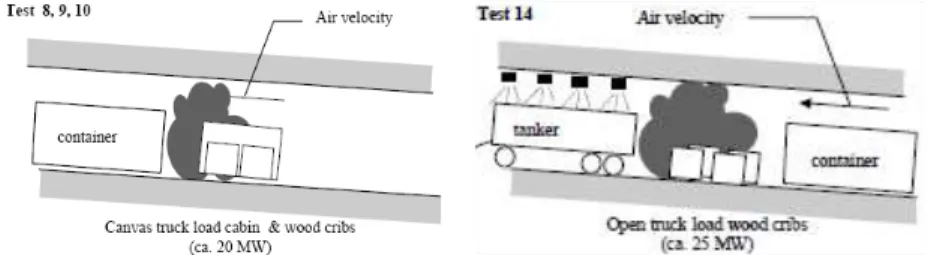
The HGV loads were simulated by means of a construction with a synthetic canvas and a stack of loading pallets underneath to achieve a rate of heat release of approximately 20 MW (18973 BTU/s) in conformity with that of a small HGV (4.5 m (15 ft) x 2.4 m (8 ft) x 2.5 m (8 ft)). The cargo area consisted of a steel sheet floor with a self-sustaining hood made up of aluminum sheets. The cargo area was loaded with 4 stacks each having 9 wooden Euro-pallets (in total 36 pieces) and a car tire on top of each stack. The load was ignited by lighting two small bowls of petrol which were placed in the middle of the cargo floor between the wooden stacks.
In order to realize a maximum rate of heat release of approximately 40 MW (37946 BTU/s), an additional test (Test 14) comprised in total 72 pallets were conducted. In order to have extra smoke developing, 6 car tires were added. Schematics of the test setups are given in Figure 3. Test 14 was conducted with almost no longitudinal air flow. The sprinkler system was only activated after 22 minutes in the fire region. Table 2 summarizes the main test conditions and Figure 4 shows the time versus the measured HRR for tests 9, 10, 14.
The Runehamar large scale fire tests were conducted in 2003 in an unused tunnel in Norway (Ingason and Lönnermark, 2003). The 1600 m (5249 ft) tunnel had a cross section, at the fire site, of about 9 meters (30 ft) wide and 6 meters (20 ft) high. The area was reduced to about 32 m2 (344 ft2) due to the installation of a steel structure which supported the fire protection boards. In total four tests were performed with a fire in a semi-trailer mock-up (10.45 m (34 ft) in length, 2.9 m (10 ft) in width and a total height of 4.5 m (15 ft)). The height of the platform floor was 1.1 m (4 ft) above the road surface. In three tests mixtures of different chosen cellulose and plastic materials were used, and in one test a “real” commodity consisting of furniture and fixtures was used. In all tests the mass ratio was approximately 80% cellulose and 20% plastic. A polyester tarpaulin cover was used in all tests.
Figure 3 Benelux test setups.
Table 2. Summary of Benelux Tests
Test # Fire load Intended HRR
MW (BTU/s)
Intended air velocity
m/s (ft/s) Ventilation Sprinkler
Effect of wind on HRR
9 Canvas hood, 36 pallets, 4 tires 20 (18673) 6 (19.7) On 10 Canvas hood, 36 pallets, 4 tires 20 (18673) 6 (19.7) On
Sprinkler tests 14 72 pallets, 6 tires 35 (33203) 0 – 1 (3.3) Off Delayed
activation
Memorial Tunnel Fire tests
Other large scale fire tests have been conducted to evaluate the fire and smoke behavior in tunnels using pool fires. In most of them, measurements showed a clear correlation between the pool surface and maximum HRR. Nevertheless, due to the immediate development of the flashover phase, no interesting findings can be stated on this topic. One of the most complete large scale fire test campaigns involving pool fires was the Memorial Tunnel (1995).
The Memorial Tunnel Fire Ventilation Test Program consisted of a series of full-scale fire tests conducted in an unused road tunnel. Various tunnel ventilation systems and configurations of such systems were operated to evaluate their respective smoke and temperature management capabilities. These tests generated a significant database relevant to the design and operation of road tunnel ventilation systems under fire emergency conditions. The tunnel is 853-meter-long tunnel (2799 ft) originally built in 1953 as part of the West Virginia Turnpike in the USA. Combustion was achieved by burning diesel fuel oil that was floating on water and tests were conducted for HRR in the range 20 to 100 MW (18673 to 94866 BTU/s). The HRR was measured according to change of weight of the fuel pans corrected for the CO/CO2 ratio.
Figure 6 shows a sampling of 12 of the 20 MW (11384to 18673 BTU/s) tests performed. The sample is shown in order to maintain clarity in the chart. The time of incubation once the fuel was ignited ranged from 0 s to 110 s. The fire growth period took approximately 100 s and the sustained HRR was maintained (with fluctuations) as long as fuel was supplied. The tests varied widely in terms of when the fuel was shut off, so the decay is not shown.
IDEALIZED CURVES
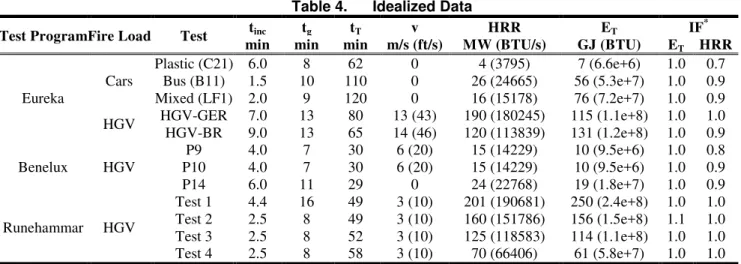
the total released energy of the tests and idealization was 1.0 for all tests (a constraint of the idealization process). Both Table 4 and Figure 7 show a correlation in the range of 0.7-1.0 between the experimental HRR peaks and the idealized HRR for real vehicles or realistic mock-ups.
Figure 4 Benelux tunnel measured and idealized HHR curves.
Table 3. Runehamar Test Data
FIRE LOAD Test 1 Test 2 Test 3 Test 4
Materials
Wood pallets (82%) and plastic pallets (18%). (10160 kg, 22399 lb)
Wood pallets (82%) and PUR mattresses (18%).
(6390 kg, 14088 lb)
Furniture, fixtures and rubber tires. (8330 kg, 18364 lb) Plastic cups in cardboard boxes on wood pallets. (2850 kg, 6283 lb)
Incubation period (min) 4.5 2.5 2.0 3.0
Growth time* (min) 18.5 14.1 10 7.4
Maximum HRR value
MW (BTU/s) 201.9 (191535) 156.6 (148560) 118.6 (112511) 66.4 (62991)
*
Time from developed fire to peak HRR
Figure 5 Runehamar measured and idealized HHR curves.
Figure 8 shows the developed idealized HRR curves for each type of fuel load (PB, PV, MF, HGV, HP, and WC) of the Eureka Tests. The figure also includes a table of the proposed values for the duration times of different regions of the curves.
Figure 6 Memorial tunnel – 20 MW (18673 BTU/s) HRR test results.
Table 4. Idealized Data
Test Program Fire Load Test tinc tg tT v HRR ET IF*
min min min m/s (ft/s) MW (BTU/s) GJ (BTU) ET HRR
Eureka Cars Plastic (C21) 6.0 8 62 0 4 (3795) 7 (6.6e+6) 1.0 0.7 Bus (B11) 1.5 10 110 0 26 (24665) 56 (5.3e+7) 1.0 0.9 Mixed (LF1) 2.0 9 120 0 16 (15178) 76 (7.2e+7) 1.0 0.9 HGV HGV-GER 7.0 13 80 13 (43) 190 (180245) 115 (1.1e+8) 1.0 1.0 HGV-BR 9.0 13 65 14 (46) 120 (113839) 131 (1.2e+8) 1.0 0.9 Benelux HGV P9 4.0 7 30 6 (20) 15 (14229) 10 (9.5e+6) 1.0 0.8 P10 4.0 7 30 6 (20) 15 (14229) 10 (9.5e+6) 1.0 0.9 P14 6.0 11 29 0 24 (22768) 19 (1.8e+7) 1.0 0.9 Runehammar HGV Test 1 4.4 16 49 3 (10) 201 (190681) 250 (2.4e+8) 1.0 1.0 Test 2 2.5 8 49 3 (10) 160 (151786) 156 (1.5e+8) 1.1 1.0 Test 3 2.5 8 52 3 (10) 125 (118583) 114 (1.1e+8) 1.0 1.0 Test 4 2.5 8 58 3 (10) 70 (66406) 61 (5.8e+7) 1.0 1.0 *
Idealization Factor =Idealized value / Experimental value
CONCLUSIONS AND DISCUSSIONS
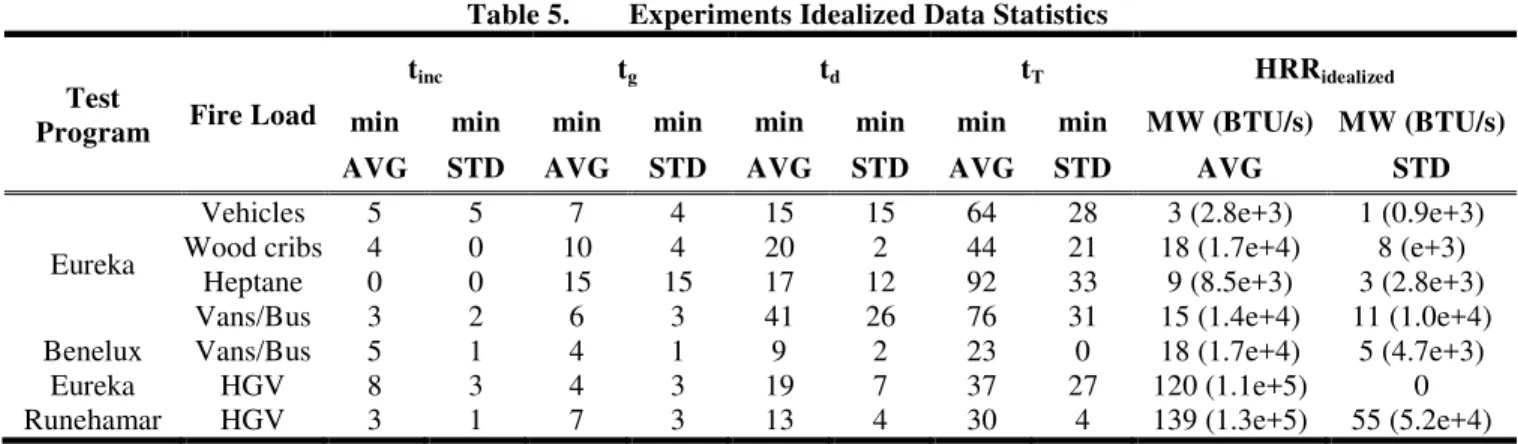
Table 5 shows the different events of the proposed idealized fire curves. For every class of fire, the average (AVG) and standard deviation (STD) for the timescales and HRR are calculated. It is suggested to use the average and standard deviation values in combination (average ± standard deviation). The range should reflect the variability of different influencing parameters (mainly the ventilation and load arrangement). The use of the range is adopted in order to avoid retaining spurious values, but still having values close enough to the most unfavourable fire conditions. Figure 5 shows the experimental and idealized heat release curves for Runehamar tests. The figure shows the range of the proposed values of the HRR.
REFERENCES
R.O. Carvel, A.N. Beard & P.W. Jowitt “The influence of longitudinal ventilation and tunnel size on HGV fires in tunnels” Proc. 10th Int. Fire Science & Engineering Conf. (Interflam 2004), Edinburgh, Scotland, 5-7 July 2004, pp. 815-820. PIARC Committee on Road Tunnels, “Fire and Smoke Control in Road Tunnels” PIARC – World Road Association, 1999. National Fire Protection Association, "NFPA 502 Standard for Road Tunnels, Bridges, and Other Limited Access
Highways", 2004 Edition, NFPA, Quincy, MA.
Haack, A., “Introduction to the Eureka-EU 499 Firetun Project,” in International Conference on Fires in Tunnels, Swedish National Testing and Research Institute, Borås, Sweden, pp. 3-19, 1994.
Dutch Ministry of Transport, Public Works and Water Management, Directorate-General for Public Works and Water Management, Civil Engineering Division, Project "Safety Test" Report on Fire Tests, 2002.
Ingason, H. and Lönnermark, A., Large Scale Fire Tests In The Runehamar Tunnel – Heat Release Rate (HRR), at the International Seminar on ‘Catastrophic Tunnel Fires (CTF)’, Borås, Sweden, 20-21 November 2003.
Bechtel/Parsons Brinckerhoff, Memorial Tunnel Fire Test Ventilation Program, Comprehensive Test Report, prepared for Massachusetts Highway Department/Federal Highway Administration, 1995.
Figure 7 Idealized versus maximum data.
Figure 8 Idealized HRR plateaus for EUREKA tests.
Table 5. Experiments Idealized Data Statistics Test
Program Fire Load
tinc tg td tT HRRidealized
min min min min min min min min MW (BTU/s) MW (BTU/s)
AVG STD AVG STD AVG STD AVG STD AVG STD
Eureka
Vehicles 5 5 7 4 15 15 64 28 3 (2.8e+3) 1 (0.9e+3)
Wood cribs 4 0 10 4 20 2 44 21 18 (1.7e+4) 8 (e+3)
Heptane 0 0 15 15 17 12 92 33 9 (8.5e+3) 3 (2.8e+3)
Vans/Bus 3 2 6 3 41 26 76 31 15 (1.4e+4) 11 (1.0e+4)
Benelux Vans/Bus 5 1 4 1 9 2 23 0 18 (1.7e+4) 5 (4.7e+3)
Eureka HGV 8 3 4 3 19 7 37 27 120 (1.1e+5) 0