Vous avez des questions? Nous pouvons vous aider. Pour communiquer directement avec un auteur, consultez la première page de la revue dans laquelle son article a été publié afin de trouver ses coordonnées. Si vous n’arrivez pas à les repérer, communiquez avec nous à [email protected].
Questions? Contact the NRC Publications Archive team at
[email protected]. If you wish to email the authors directly, please see the first page of the publication for their contact information.
https://publications-cnrc.canada.ca/fra/droits
L’accès à ce site Web et l’utilisation de son contenu sont assujettis aux conditions présentées dans le site LISEZ CES CONDITIONS ATTENTIVEMENT AVANT D’UTILISER CE SITE WEB.
READ THESE TERMS AND CONDITIONS CAREFULLY BEFORE USING THIS WEBSITE. https://nrc-publications.canada.ca/eng/copyright
NRC Publications Archive Record / Notice des Archives des publications du CNRC :
https://nrc-publications.canada.ca/eng/view/object/?id=9edfbc3b-2fd0-4b22-b437-8c1dd3e8c996 https://publications-cnrc.canada.ca/fra/voir/objet/?id=9edfbc3b-2fd0-4b22-b437-8c1dd3e8c996
NRC Publications Archive
Archives des publications du CNRC
Access and use of this website and the material on it are subject to the Terms and Conditions set forth at
NRC TimeLinkTM
Bernard, John; Charbonneau, Andre; Hoger, Bill; Pham, Hai; Gertsvolf,
Marina
NRC TimeLink
TM
Disseminating UTC(NRC) to remote users with nanosecond precision
John Bernard, Andre Charbonneau, Bill Hoger, Hai Pham and Marina Gertsvolf
National Research Council (NRC) Ottawa, Canada
Abstract—We present a system and service for traceable time
dissemination of UTC(NRC) to users across Canada. The time synchronization is based on the GPS common-view method and we achieve uncertainties of nanoseconds, long holdover times and performance monitoring for jamming detection.
Keywords—traceable time; remote time dissemination
I. TRACEABLE TIME
In recent years, the demand for accurate time with uncertainties reaching into the sub-microsecond range has become a requirement for the new technology development in 5G wireless communication, smart power grids and autonomous navigation. In the financial sector, new regulatory requirements for traceable timestamping of financial transactions also drive the demand for access to accurate time sources. In the recent past, several National Metrology Institutes (NMI) started the development of time dissemination services to remote clients with sub-microsecond accuracy and satisfying rigorous traceability requirements [1, 2, 3]. These services rely on two different technologies: direct connection to the client via a dedicated telecommunication data link; and GNSS-based time synchronization. We, at NRC, have developed a GPS common-view based time synchronization service that provides a 1PPS time signal synchronized to UTC(NRC) at different locations across Canada.
II. SYSTEM DESIGN AND PERFORMANCE
The new NRC time dissemination tool, NRC TimeLinkTM, is based on a high quality rubidium frequency standard (Rb) and a GPS timing receiver (Rx). The TimeLinkTM unit at a remote location collects the measurement of the time offset between Rb and Rx , compares these measurements with the data collected at the NRC main lab in Ottawa, and applies corrections to the Rb output 1PPS and frequency to keep the 1PPS output of the NRC TimeLinkTM unit synchronized to UTC(NRC). Every link in the time transfer chain between UTC, UTC(NRC) and the remote unit is calibrated, it’s uncertainty is evaluated, and the performance is continuously monitored. There are several major contributors to the uncertainty budget: the GPS receiver delays; the time interval counter delays; and the phase and frequency servo algorithm that ensures the reliable operation of the Rb in the remote unit with long holdover times.
We use commercial single-frequency GPS timing receivers. We first calibrate the receiver’s internal offset at the NRC main laboratory in Ottawa. Based on the ongoing key comparison, CCTF-K001.UTC, and the NRC GNSS receiver calibrations
[4] we measure the offset of the TimeLinkTM GPS 1PPS from UTC(NRC) and compare it with the values obtained with our calibrated Septentrio receiver NRC4.
We operate the TimeLinkTM GPS in self-survey mode and test its performance with different GNSS antennas we have available to provide a representative sample of typical timing equipment used for commercial applications. We also compare the receiver performance when it is connected to different antenna types to evaluate the time offset uncertainty when the NRC TimeLinkTM unit is installed at a client location using the antenna available at the site. In addition we evaluate the variations between different receiver units and their ageing.
Several other delays in the system are individually calibrated: the time interval counter used for the measurement of the Rb offset from Rx, delays introduced by 1PPS signal cables, distribution buffers, and switches. These delays all have been measured and accounted for in the device configuration settings.
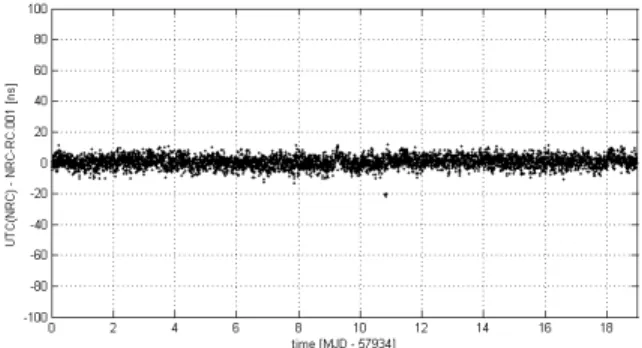
For the purpose of the system testing, we installed one NRC TimeLinkTM unit (RC001) in our main laboratory and evaluated the performance of the time transfer algorithm. The goal was to synchronize the output of RC001 to UTC(NRC). Figure 1 shows the measurement result, UTC(NRC) – RC001, collected over 19 days of uninterrupted operation. The offset is under 1 ns and the Alan Deviation follows white phase noise, averaging down to × in one week of measurements.
For an NRC TimeLinkTM unit installed at a remote client site with client calibrated antenna and antenna cable, the total uncertainty budget for the synchronization to UTC(NRC) includes the GPS receiver uncertainties and the time interval counter and equipment delay uncertainties and is well under 50 ns with k=2 coverage factor.
The GPS signal levels are continually detected and monitored. In case of sudden jumps, signal level changes, or other unusual performance, the NRC TimeLinkTM switches to holdover mode, where the Rb is free running. This helps protect the time signal performance from jamming and spoofing.
Fig. 1. NRC TimeLinkTM performance testing. The average offset of the test unit RC001 from UTC(NRC) was 0.6 ns and the standard deviation 3.6 ns.
[1] Lombardi, et. al. "Accurate, traceable, and verifiable time synchronization for world financial markets." Journal of research of the National Institute of Standards and Technology 121 (2016): 436-463. [2] Tavella, P., et. al. "The Horizon 2020 DEMETRA project:
DEMonstrator of EGNSS services based on Time Reference Architecture." Metrology for Aerospace (MetroAeroSpace), 2015 IEEE. IEEE, 2015.
[3] E. Laier English, et. al. “Update on the NPLTime® Service and Future Developments with White Rabbit”, PTTI17-0011, 2017
[4] https://www.bipm.org/utils/common/TimeCalibrations/Current/1017-2016_GPSP3_NRC.pdf