Publisher’s version / Version de l'éditeur:
Fuel, 61, 5, pp. 477-479, 1982-05
READ THESE TERMS AND CONDITIONS CAREFULLY BEFORE USING THIS WEBSITE. https://nrc-publications.canada.ca/eng/copyright
Vous avez des questions? Nous pouvons vous aider. Pour communiquer directement avec un auteur, consultez la première page de la revue dans laquelle son article a été publié afin de trouver ses coordonnées. Si vous n’arrivez pas à les repérer, communiquez avec nous à [email protected].
Questions? Contact the NRC Publications Archive team at
[email protected]. If you wish to email the authors directly, please see the first page of the publication for their contact information.
NRC Publications Archive
Archives des publications du CNRC
This publication could be one of several versions: author’s original, accepted manuscript or the publisher’s version. / La version de cette publication peut être l’une des suivantes : la version prépublication de l’auteur, la version acceptée du manuscrit ou la version de l’éditeur.
For the publisher’s version, please access the DOI link below./ Pour consulter la version de l’éditeur, utilisez le lien DOI ci-dessous.
https://doi.org/10.1016/0016-2361(82)90077-1
Access and use of this website and the material on it are subject to the Terms and Conditions set forth at
Comparative study of three laboratory methods for the extraction of
bitumen from oil sands
Majid, Abdul; Sirianni, Aurelio F.; Ripmeester, John A.
https://publications-cnrc.canada.ca/fra/droits
L’accès à ce site Web et l’utilisation de son contenu sont assujettis aux conditions présentées dans le site LISEZ CES CONDITIONS ATTENTIVEMENT AVANT D’UTILISER CE SITE WEB.
NRC Publications Record / Notice d'Archives des publications de CNRC:
https://nrc-publications.canada.ca/eng/view/object/?id=7fc78f8f-4abc-4314-afbe-35fa786df058 https://publications-cnrc.canada.ca/fra/voir/objet/?id=7fc78f8f-4abc-4314-afbe-35fa786df058
Mutagenicity testing and in vivo tests for skin carcinogenicity in mice are being carried out to assess whether the materials recovered at <37O”C from the distillation exhibit any mutagenic or carcinogenic activity. If these biological tests are found to be essentially negative, as predicted from the analytical data presented here, then optimized process distillation should certainly warrant consideration as an option in the development of process modifications to produce safer coal-derived liquid fuels. Fuels obtained from an optimized distillation process step should be substantially less genotoxic than the full-boiling-range source materials from which they came.
ACKNOWLEDGEMENTS
This work was supported by the US Department of Energy under Contract DE-AC06-76RL0 1830 to Pacific Northwest Laboratory.
REFERENCES
1 Wilson, B. W. and Pelroy, R. A. Proceedings 27th ASMS, Seattle, Washington, 1979
2 Guerin, M. R., Ho, C.-h., Rao, T. K., Clark, R. B. and Epler, J. L.
7
Letters to the Editor
Env. Res. 1980, 23, 42
Wilson, B. W., Pelroy, R. A. and Cresto, J. T. Mutat. Rex 1980,19, 193
Wilson, B. W., Petersen, M. R., Pelroy, R. A. and Cresto, J. T. Fuel
1981,60, 289
Guerin, M. R., Rubin, I. B., Rao, T. K., Clark, B. R. and Epler, J. L. Fuel 1981,60,282
PNL-3464, ‘Initial Chemical and Biological Characterization of Hydrotreated Solvent Relined Coal (SRC-II) Liquids: A Status Report’, Prepared for the US Department of Energy under Contract DE-ACO6-76RL0 1830 by Pacific Northwest Laboratory (NTIS), July 1980
PNL-3189. ‘Biomedical Studies on Solvent Refined Coal Liquefaction Materials: A Status Report’, Prepared for the US Department of Energy under Contract DE-ACO6-76RL0 1830 by Pacific Northwest Laboratory (NTIS), October 1979 Later, D. W., Lee, M. L., Bartle, K. D., Kong, R. C. and Vassilaros. D. L. Anal. Chem. 1981.53, 1612
Later, D. W., Lee, M. L., Pelroy, R. A. and Wilson, B. W. Fuel
(submitted for publication)
Later, D. W., Lee, M. L. and Wilson, B. W. Anal. Chem. 1982.54, 117
Ho, C.-h., Clark, B. R., Guerin, M. R., Barkenbus, B. D., Rao, T. K. and Epler, J. L. Mutation Res. 1981, 85, 335
PNL-3787, ‘Fractional distillation as a strategy for reducing the genotoxic potential of SRC-II coal liquids: a status report’, (Eds. R. A. Pelroy and B. W. Wilson), prepared for the US Deparment of Energy under Contract DE-AC06-76RL0 1830 by Pacific Northwest Laboratory (NTIS), September 1981
Comparative study of three laboratory methods for the extraction of bitumen from oil sands
Abdul Majid, Aurelio F. Sirianni and John A. Ripmeester
Division of Chemistry, National Research Council of Canada, Ottawa, Ontario Kl A OR9, Canada (Received 14 November 1980; revised 23 June 1981)
Measurements of total organic content and extractable bitumen for a number of different grade oil sands were used to obtain the extraction efficiency of several common bench-scale bitumen recovery techniques. The hot-water process was inefficient for feeds of moderate to high fines content. Soxhlet
extraction and spherical agglomeration were found to be of similar efficiency zyxwvutsrqponmlkjihgfedcbaZYXWVUTSRQPONMLKJIHGFEDCBAfo r most grades of feed. For these two processes the efficiency is limited by the mineral fines content, probably because of surface
absorption of bitumen components.
(Keywords: zyxwvutsrqponmlkjihgfedcbaZYXWVUTSRQPONMLKJIHGFEDCBAoil sa nds; bit um e n; e x t ra c t ion)
The recent commercial development of the Alberta oil sands, based on the hot-water-separation process developed by Clark’, is one of the major advances in the petroleum industry. The separation of bitumen is particularly straightforward for oil sands feeds which are substantially free from mineral lines (< ~44 pm, 325 mesh). Small quantities of these fines are, however, inevitably present even in high-grade oil sands feeds, and as recycle water for the hot-water process cannot contain more than ~5% lines, large volumes of non-settling tailings must be confined and stored indefinitely’. Higher concentrations of lines cause an operational problem in the hot-water process3, leading to poor bitumen recovery.
For feeds with higher fines contents alternative processes, usually based on solvent extraction, have been investigated. A continuous, combined counter-current solvent extraction-spherical agglomeration process4 has shown promise in the ability to extract bitumen from such feeds. To establish the important factors which determine the extraction efficiency of different bitumen separation methods, the distribution of organic matter in the
residues, left after extracting bitumen from oil sands of different composition, was measured.
In industry, extraction with toluene or benzene using Soxhlet apparatus is employed to determine the bitumen content, even though extraction by combinations of solvents is not sufficient to remove all organic matter from high fines oil sand. Owing to this difficulty both carbon analysis and the simple loss on ignition methods were used here to assess the organic matter in both oil sands and fractionated extraction residues.
Different bitumen separation processes were tested on a bench-scale: the hot-water process, solvent extraction spherical agglomeration with toluene as the continuous phase, and Soxhlet extraction using toluene.
EXPERIMENTAL
Oil sands were obtained from the Oil Sand Sample Bank of the Alberta Research Council. All samples were broken into pieces < w 0.5 cm using a Comomill model No. 197- I-L (Quadro Engineering Co.) and were thoroughly mixed
00162361/82/050477-03$3.00
Letters to the Editor
to ensure homogeneity. Speclflc surface area (m’g-’ 1
C, H and N analyses were carried out using a Perkin Elmer model 240 CHN analyser. Carbonate carbon was measured titrimetrically after acid digestion.
Extractable bitumen was measured using Soxhlet extraction with toluene as solvent for ~24 h. Total organic matter contents were measured by carbon analysis or loss on ignition at 380°C ’ (after correction for carbonate content). All analyses were done in triplicate.
After extraction, the solids were dried at 110°C and dispersed in water using a high-speed blender. Particle size distributions were measured by wet screening, followed by drying to constant weight at 110°C.
Specific surface areas of a number of solid samples were measured by low-temperature nitrogen adsorption using a Strohlein area meter. Prior to each measurement,
5 5 I 10 I 15 1 20 I 25 I 30 I 35
I
02 04 06 08 zyxwvutsrqponmlkjihgfedcbaZYXWVUTSRQPONMLKJIHGFEDCBA10
Fines fraction
figure 3 Effect of fines (surface area) on the residual organic matter in the tailings. Organic contents are average values derived from carbon analysis and loss on ignition. Surface area scale is derived from data in Tab/e 1. 0, Organic content of tailings after agglomeration; 0, organic content of tailings from Soxhlet extrac- tion
I I II I I I I I I
0 4 8 12 16
Total carbon (wt %)
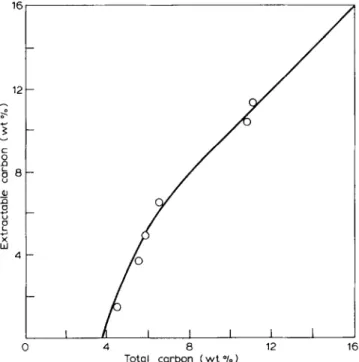
Figure I Extractable carbon content (calculated from bitumen extracted with toluene in a Soxhlet apparatus) as a function of total carbon content (after correcting for carbonate carbon)
16
I
Frnes content (wt 4.)
Figure 2 Effect of fines on bitumen recovery. 0, Total organic content (as calculated from carbon analysis); 0, bitumen extracted using batch agglomeration;o, Soxhlet apparatus: fl, hot-water process
Tab/a 1 Analysis of oil sands
Oil samp no. Ile Fines fractiona Specific Loss on
surface ignition Carbon areab at 380°C content (m2 g-* 1 (wt %I (wt %) 1 0.77 26.6 5.0 4.5 2 0.55 14.8 7.0 6.1 3 0.46 15.0 7.9 6.2 4 0.35 12.9 7.6 7.2 5 0.19 2.6 13.6 11.4 6 0.12 0.3 13.3 10.8 a 37 brn (<400 mesh) b After ashing at 380°C
samples were ashed at 380°C to remove adsorbed organic matter, mixed by gentle grinding in a mortar, so as to break up the lumps but not alter the surface area of the particles, and dried at 130+5”C for several hours.
Procedures for the three extraction methods used in this study, carried out on a small scale, have been described previouslysqEq9.
RESULTS AND DISCUSSION
Analy sis of representative samples
The organic matter and mineral lines contents vary over a wide range for the oil sands used in this study (Table I). The organic content of the samples was measured using both carbon microanalysis and loss on ignition, and on assuming that the carbon content of Athabasca bitumen is 83 wt%,” it is evident that the two methods are in good agreement. Two trends are apparent in Table 1. The first is the inverse dependence of organic content on the mineral lines fraction. Such a relation has been examined previously” although the study was concerned only with bitumen extracted with toluene. The second trend is the not unexpected dependence of surface area on mineral lines content.
Figure 1 shows the correlation between recoverable bitumen and the total organic content for the oil sands listed in Table I. For feeds with > ~8 wt% organic matter, the bitumen recovered approaches the total organic content; however, from oil sands containing
< m 34 wt% organic material very little, if any, bitumen was recovered.
Evidently it is important to assess total organic content, in addition to recoverable bitumen, because these two quantities may differ considerably. Regardless of the bitumen separation method used, the difference has clear environmental implications in its effect on the nature of the tailings. In processing low-grade oil sands, difficulties in establishing a mass balance of organic matter can be envisaged unless total organic content is measured. Comparison 0s extraction efjiciencies
The percentage bitumen recoveries for the three bitumen separation techniques applied to the samples listed in Table 1 were calculated according to:
wto/, recovery = wt of bitumen recovered total organic content x 100 The results are shown in Figure 2. It is evident that the hot-water process is not effective for feeds with moderate to high fines contents; however, the efficiency of the agglomeration method is essentially the same as that of Soxhlet extraction.
The significance of the mineral fines is also shown in
Figure 2; both total organic content, as mentioned previously, and recoverable bitumen depend inversely on the fines content. The operational problems of feeds with high fines content in the hot-water-separation process have been described elsewhere’. For the other two techniques, however, recovery appears to be related to the adsorption of bitumen components on mineral lines. This is in agreement with recent reportsi2*15 which suggest that bitumen components are strongly adsorbed on clays commonly found in oil sand formations.
Nature of the tailings
Sludge from the tailings ponds of the commercially operating, hot-water-separation plants is quite complex in nature, containing quantities of free and adsorbed bitumen and mineral fines suspended in water. Several reports have been published on this subject2,‘3~14~‘6.
The, tailings left after removal of bitumen using the
Letters to the Editor
agglomeration process or Soxhlet extraction with toluene are similar in nature. Residual organic matter was determined for extraction residues fractionated according to particle size using both carbon microanalysis and loss on ignition at 380°C. It was found that residual organic matter is associated primarily with the 37 pm (~400 mesh) fraction. This is also shown in Figure 3, where the residual carbon content is plotted as a function of the 37pm fraction present in the tailings. As; surface area depends approximately rectilinearly on the 37 pm fraction
(Table I), a surface area scale is also shown in Figure 3.
REFERENCES 4 5 6 7 8 9 10 11 12 13 14 15 16
Clark, K. A. and Pasternack, D. S. zyxwvutsrqponmlkjihgfedcbaZYXWVUTSRQPONMLKJIHGFEDCBAInd. Eng. Chem. 1932,24(12), 1410
Camp, F. W. ‘Processing Athabasca Tar Sands Tailings Disposal’, 26th Can. Chem. Eng. Conference, Toronto, 1976 Innes, E. D. and Fear, J. V. D. ‘Canada’s First Commercial Tar Sands Development’, Seventh World Petroleum Congress, 1967, chap. 3, p. 633
Sparks, B. D. and Meadus, F. W. Energy Process, Canada, 1979, Sept.-Oct.
‘Syncrude Analytical Methods for Oil Sand and Bitumen Processing’, (Eds. J. T. Bulmer and J. Starr), The Alberta Oil Sands Technology and Research Authoritv. 1979
Bowman, C. W_World Petroleum Congress Proc. 7th, 1967, chap. 3, pp. 5833604
Majid, A. and Sparks, B. D. to be submitted for publication Speight, J. G. and Moschopedis, S. E. Fuel Process. Technol.
1977178 1, 261
Meadus, F. W., Sparks, B. D., Puddington, I. E. and Farnand, J. R. Can. Patent 1,031,712, May 23, 1978
Starr, J. and Prats, J. M. First Int. Conf. on the Future of Heavy Crude and Tar Sands, Edmonton, Alberta, June 1979, Paper 65 Camp, F. W. ‘The Tar Sands of Alberta, Canada’, Ed. Cameron Engineers, Denver, 1974
Clementz, D. W. Clays Clay Minerals 1976, 24, 312
‘Clay Tailings from Alberta Oil Sands and Other Sources’, Alberta Research Council report July, 1977
Kessick, M. A. J. Can. Petr. Techn. 1979, 49 Kessick, M. A. Clays CIay M aterials 1979, 27, 301
Ripmeester, J. A. and Sirianni, A. F. J. Can. Petr. Techn. 1981.20, 131
Determination of the stability of coal-oil mixtures (COM) by infrared analysis
Enzo Benedetti”, Rinaldo Santini, Aldo D’Alessio and Piegiorgio Vergamimi
lstituto di Chimica Organica Industriale dell’Universita’ di Piss. Italy - Centro Ricerche Termiche e Nucleari, ENEL. Piss. Italy
(Received 1 July 1981; revised 16 December 1981)
The stability of coal-oil mixtures (COM) may be assessed by using infrared (i.r.) spectroscopy. An i.r.
spectrum of a COM has analytical bands at 540 cm-’ for coal and at 810 cm-’ for oil; these bands are
used to determine the change in concentration of coal in a COM with time. The ir. spectra provides
information on the oossibfe interactions between the two materials and an indication of the physico-
chemical properties of such mixtures.
(Keywords: coal-oil mixtures; suspensions (chemical); instrumental methods of analysis)
As a result of the possible future exhaustion of the world reserves of crude oil and, therefore, the ever-increasing cost of fuel oil, the possibility of using coal in the electric and industrial power plants has aroused great interest. * Present address: Department of Polymer Science and Engineering, University of Massachusetts, Amherst, MA 01002, USA
As conversion of most of the gas- or oil-fired boilers to coal is associated with drastic modifications, high costs and also the inconvenience of long-term plant shut-down, with a consequent heavy loss of productivity, the importance of coal-oil mixtures (COM), which may avoid these problems, is emphasised.
00162361/82/050479903$3.00