Publisher’s version / Version de l'éditeur:
SPE Plastics Research Online, 2011-03-15
READ THESE TERMS AND CONDITIONS CAREFULLY BEFORE USING THIS WEBSITE. https://nrc-publications.canada.ca/eng/copyright
Questions? Contact the NRC Publications Archive team at
[email protected]. If you wish to email the authors directly, please see the first page of the publication for their contact information.
This publication could be one of several versions: author’s original, accepted manuscript or the publisher’s version. / La version de cette publication peut être l’une des suivantes : la version prépublication de l’auteur, la version acceptée du manuscrit ou la version de l’éditeur.
Access and use of this website and the material on it are subject to the Terms and Conditions set forth at Clay-containing polymeric nanocomposites
Utracki, L. A.
https://publications-cnrc.canada.ca/fra/droits
L’accès à ce site Web et l’utilisation de son contenu sont assujettis aux conditions présentées dans le site LISEZ CES CONDITIONS ATTENTIVEMENT AVANT D’UTILISER CE SITE WEB.
NRC Publications Record / Notice d'Archives des publications de CNRC: https://nrc-publications.canada.ca/eng/view/object/?id=908e2e10-1539-493b-b604-adf0b4c35618 https://publications-cnrc.canada.ca/fra/voir/objet/?id=908e2e10-1539-493b-b604-adf0b4c35618
Clay-containing polymeric
nanocomposites
L. A. Utracki, National Research Council Canada, Industrial Materials Institute, 75 de
Mortagne, Boucherville, QC, Canada, J4B 6Y4L. A. Utracki,
National Research Council Canada, Industrial Materials Institute, 75 de Mortagne, Boucherville, QC, Canada, J4B 6Y4The clay-containing polymeric nanocomposites (CPNC) are dispersions of clay in a polymer. For good performance, finely dispersed clay (preferably exfoliated) is important. Thus this article focuses on the clay quality and method of compounding.
In the IUPAC nomenclature, the particles must have at least one dimension in the nano-meter range, ≤ 2 nm. For industrial production of structural CPNC crystalline natural or synthetic clays are employed with platelets 0.7 – 1.7 nm thick, having an aspect ratio: p = diameter/thickness = 20 – 6000. 1 The natural clays originate from the hydrothermal alteration of volcanic ashes, deposited in seas and lakes. 2
Historically, the industrial CPNC production involved polymerization in the presence of clay, but now the emphasis has shifted toward melt compounding in a single or twin-screw extruder (SSE or TSE, respectively) in the shear or extensional flow field. Dispersing in extensional flow is superior since it is more energy-efficient, generates better dispersive and distributive mixing, is performed in a more uniform flow field at lower temperatures and it does not re-aggregates solid particles as the shear field does. Some years back the extensional flow mixer (EFM) and then its dynamic version, DEFM were developed. These devices may be attached to a SSE or TSE, or it may be used as stand-alone mixer.
. Clay contaminants are: (1) organic (e.g., humic substances, HS), (2) non-expandable clays (e.g., amorphous or kaolin) and (3) particulate minerals (quartz, sand, silt, feldspar, gypsum, orthoclase, apatite, calcite, dolomite, biotite, etc).
3
The CPNC mechanical properties will exemplify advantages of clay addition. 4
synthetic) exfoliating clays are: montmorillonite (MMT), hectorite (HT), and saponite (SP). These minerals have an octahedral layer (Oc) sandwiched between two tetrahedral (Tc) ones. For example, substitution of Al+3 by Mg+2 in MMT Oc-layer engenders 0.25 to 1.2 negative charges per unit cell, expressed as the cation exchange capacity, CEC ≈ 0.5 to 2 meq/g.
The synthetic clays are classified as: 5
1. Semi-synthetic, prepared in a reaction of a natural mineral with salt, e.g., talc with Na2SiF6, at T ≈ 900oC.
2. Synthetic, formed in a reaction of metal salts or oxides, viz. in: a. Low temperature, high pressure hydrothermal synthesis.
b. Reaction of e.g., Li2O, MgO, SiO2 and MgF2 at 1300 – 1500°C.
c. Co-precipitation of di- and tri-valent aqueous ions into layered double hydroxides (LDH). 3. Templated, starting with organic templates, which after synthesis may be pyrolyzed.
In the recent VAMAS TWA-33 project three types of sodium-clays were studied: 6
Table 1. Properties of the sodium-clays.
(1) the natural MMT, Cloisite®-Na+ (C-Na+), (2) the semi-synthetic fluoro-hectorite, Somasif ME-100, and (3) the synthetic fluoro-tetrasilicic mica, Topy-Na+. Their properties are listed in Table 1.
Property C-Na+ ME-100 Topy-Na+
Specific density, g/mL 2.86 2.6 2.6
Interlayer spacing, d001 (nm) 1.17 0.95 1.23 Platelets thickness, nm 0.96 0.91
CEC (meq/g) 0.92 1.2 0.80
Nominal aspect ratio, p (-) 280 ≤ 6000 ≤ 5000
The clays were characterized for platelet shape, size, chemical composition and impurities. The test methodology and results are published in the cited PES article. Briefly, the findings are as follows.
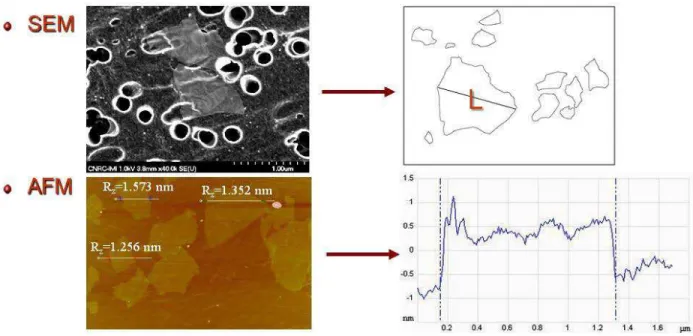
Figure.1. Scanning electron microscopy (SEM) and atomic force microscopy (AFM) images of Somasif ME-100 platelets. As an example, the platelet length is indicated as L; the width is taken as the largest perpendicular to L platelet size.
Example of ME-100 images is shown in Figure 1. The number and weight average values of the platelet length and the orthogonal width (subscripts n and w, respectively) are listed in Table 2. The average clay platelet dimensions in three orthogonal directions are: thickness t ≈ 1 nm, width
W ≈ 20 – 4000 nm, length L ≈ 30 – 6000 nm, and the nearly universal ratio L/W ≈ 1.5 ± 0.1. The
distribution of clay platelet size is approximately Gaussian. Table 2. Statistical analysis of three clays.
Clay Length L (nm) Width, W (nm) Ratios Ln Lw Wn Ww (L/W)n (L/W)w
Natural, C-Na+ 290 350 183 219 1.58 1.60
Semi-synthetic, ME-100 872 1097 572 743 1.52 1.48
Synthetic, Topy-Na+ 1204 1704 761 1186 1.58 1.44
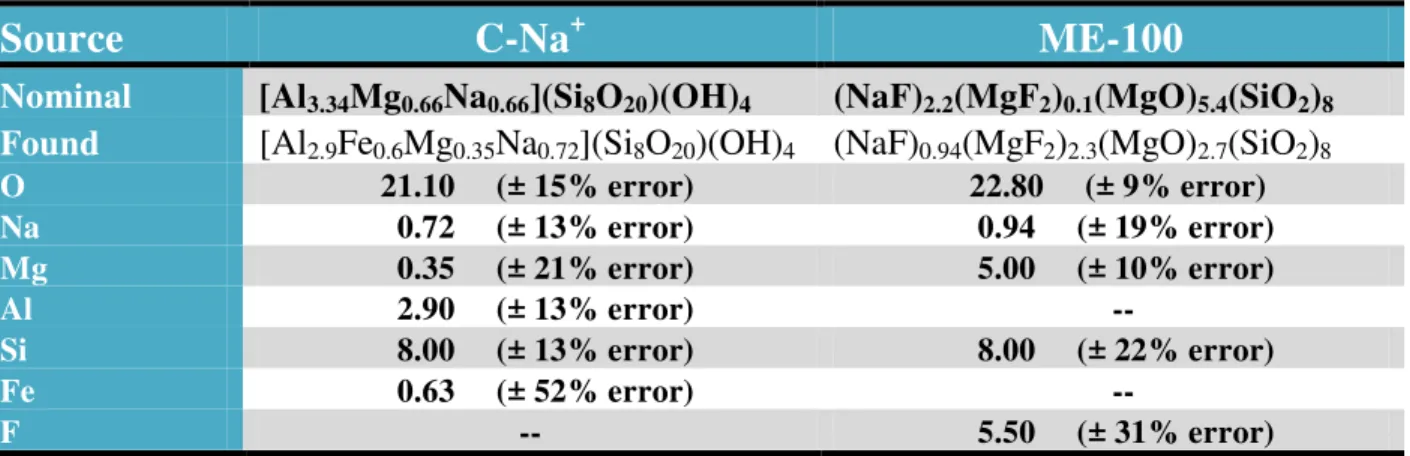
Table 3. Elemental composition of C-Na and ME-100 clays
Source
C-Na
+ME-100
Nominal [Al3.34Mg0.66Na0.66](Si8O20)(OH)4 (NaF)2.2(MgF2)0.1(MgO)5.4(SiO2)8
Found [Al2.9Fe0.6Mg0.35Na0.72](Si8O20)(OH)4 (NaF)0.94(MgF2)2.3(MgO)2.7(SiO2)8
O 21.10 (± 15% error) 22.80 (± 9% error) Na 0.72 (± 13% error) 0.94 (± 19% error) Mg 0.35 (± 21% error) 5.00 (± 10% error) Al 2.90 (± 13% error) -- Si 8.00 (± 13% error) 8.00 (± 22% error) Fe 0.63 (± 52% error) -- F -- 5.50 (± 31% error)
There is large variability of composition both for the natural C-Na+ and semi-synthetic ME-100 clay. There are three principal sources of error: (a) non-uniform atomic substitution in the crystalline cells, (b) reported tendency of natural clays to vary composition with particle size, (c) presence of mineral impurities. Owing to the presence of impurities, in natural clays the scatter of ±15% has been observed. Variability in ME-100 is larger than the error of measurements what may reflect the local variation of composition. The chemical heterogeneity may cause batch-to-batch variability of the mechano-chemical sensitivity during CPNC compounding, degradability, weatherability, sensitivity or lack of it toward antioxidants and stabilizers, etc.
Purification of natural clays into a polymer-grade material is a long process of about 300 steps. The patents specify that the product should contain ≤ 5 wt% (“preferably less than about 2% by weight”) of impurities, > 300 nm large. 7
2
Compounding CPNC
The identified the following minerals in C-Na+: vermiculite, quartz, cristobalite, rutile, albite, microcline, aragonite, vaterite, dolomite, gypsum, anhydrite, alunite and sylvite. As expected, the semi-synthetic ME-100 contained traces of natural talc contaminants: vermiculite and gypsum. The presence of particulates, incompatible with the matrix polymer, reduces mechanical performance as well as the barrier performance.
Principles of clay dispersion in SSE or TSE resembles that of polymer alloys and blends (PAB), thus thermodynamic interactions and complex flow field (shear, chaotic and extensional mixing) are of key importance. 8, 9, 10 In CPNC, the interactions are modified by intercalant, and
3
Mechanical properties
The CPNC tensile and flexural properties (i.e., modulus or strength) are proportional to each other. 11 At low loadings the relative modulus follows:
/ 1 ( %)
R c m w
E ≡E E = +a w wt (1) (subscripts c and m stand for composite and matrix, respectively). For CPNC with PA or PP matrix aw ≈ 0.2, thus at 5 wt% clay the modulus doubles. In elastomers the effect is larger: aw ≈ 0.7. Factorial analyses indicate that ER is a linear function of the interlayer spacing, d001.
The simplest tensile strength theory predicts that relative strength:
1 f 1 c R f m m σ σ σ φ σ σ ≡ ≤ + − (2)
where φf is clay volume fraction. Because of polymer solidification on clay, from the experimental values of σ σ σ , for CPNC with PA-6 and PP, respectively, Eq. 2 predicts 9 c, m, f
and 5 times larger φf than factual. The strength linearly increases with the degree of exfoliation.
4
References
1
L. A. Utracki, Clay-Containing Polymeric Nanocomposites, RAPRA, Shawbury, UK (2004).
ISBN: 978-1-85957-488-1
2
B. K. G. Theng, The Chemistry of Clay - Organic Reactions, J. Wiley & Sons, New York (1974). ISBN: 0470858524
3
L. A. Utracki, M. Sepehr and J. Li, Melt compounding of polymeric nanocomposites, Intern.
5
L. A. Utracki, M. Sepehr, and E. Boccaleri, Synthetic, layered nano-particles for polymeric
nanocomposites (PNC’s), Polym. Adv. Technol. 18 (1), pp. 1–37, 2007. DOI: 10.1002/pat.852
6
L. A. Utracki, W. Broughton, N. Gonzalez Rojano, L. Carvalho, C. A. Achete, Clays for
polymeric nanocomposites, Polym. Eng. Sci. (2011).
7
M. Clarey, J. Edwards, S. J. Tsipursky, G. W Beall., D. D. Eisenhour, Method of manufacturing
polymer - grade clay for use in nanocomposites, US Pat., 6,050,509, 18.04.2000.
8
L. A. Utracki, Ed., Polymer Blends Handbook, Kluwer, Dordrecht (2002). ISBN: 978-0-306-48244-1
9
Song, W., Comprehensive study of a new extensional flow mixer, SPE ANTEC, Techn. Pap.
46, pp. 270-275, 2000. 10
J. Li, M.-T. Ton-That, W. Leelapornpisit, L. A. Utracki, Melt compounding of
polypropylene-based clay nanocomposites, Polym. Eng. Sci. 47, pp. 1447 – 1458, 2007. DOI
10.1002/pen.20841 11
M. Tokihisa, K. Yakemoto, T. Sakai, L. A. Utracki, M. Sepehr, J. Li, Y. Simard, Extensional
Flow Mixer for Polymer Nanocomposites, Polym. Eng. Sci. 46, pp. 1040–1050, 2006. DOI