HAL Id: cea-02570832
https://hal-cea.archives-ouvertes.fr/cea-02570832
Submitted on 12 May 2020
HAL is a multi-disciplinary open access
archive for the deposit and dissemination of
sci-entific research documents, whether they are
pub-lished or not. The documents may come from
teaching and research institutions in France or
L’archive ouverte pluridisciplinaire HAL, est
destinée au dépôt et à la diffusion de documents
scientifiques de niveau recherche, publiés ou non,
émanant des établissements d’enseignement et de
recherche français ou étrangers, des laboratoires
Qualification program of the ASTRID SFR project:
Definition, Methodology and associated Risk Evaluation
& Management
Gilles Rodriguez, Jean-François Dirat, Amaël Traina, Mickaël Christofari
To cite this version:
Gilles Rodriguez, Jean-François Dirat, Amaël Traina, Mickaël Christofari. Qualification program of
the ASTRID SFR project: Definition, Methodology and associated Risk Evaluation & Management.
ICAPP 2015, May 2015, NICE, France. pp.15093. �cea-02570832�
Proceedings of ICAPP 2015 May 03-06, 2015 - Nice (France) Paper 15093
*: Corresponding author, E-mail address: [email protected]
Qualification program of the ASTRID SFR project:
Definition, Methodology and associated Risk Evaluation & Management
Gilles RODRIGUEZ1*, Jean-François DIRAT2, Amaël TRAINA3, Mickaël CHRISTOFARI3
1 : CEA - Commissariat à l’Énergie Atomique, CEA/CADARACHE DER/CPA, Blg 155, 13108 St Paul Lez Durance, France.
2 : AREVA, NP, 10 Rue Juliette Récamier 69456 Lyon Cedex, France.
3 : SONOVISION Group associated to the ASTRID project, Blg 155, 13108 St Paul Lez Durance, France.
Abstract – The Preconceptual Design phase of the ASTRID French Sodium Fast Reactor project had the objective to
integrate innovative options to meet the requirements of the 4th generation reactors and to comply with the related specifications. It was followed by the conceptual phase studies (AVP2 phase 2013-2015) where some technical options are left opened with an advanced option and a backup alternative. In the same time of the AVP2 phase studies, the qualification program related to ASTRID project was initiated. It consists in collecting the exhaustive list of R&D needs and technological demonstration tests to be fulfilled on representative mockup prior to component implementation in the prototype. The ASTRID Qualification Program (AQP) objectives are to collect needs expressed by all Engineering companies involved in ASTRID, and then to organize the answer to this expression of needs. This significant work of needs compilation has been divided in several tasks, according to the ASTRID project decomposition in the Product Breakdown Structure (PBS).
Compilation of needs was jointly performed by engineering company, R&D responsible and coordinated by the ASTRID Qualification project responsible. It was associated with an evaluation of the maturity level of the technical options thanks to a Technological Readiness Level grid (TRL ranking table), an identification of major risks, and an evaluation of the R&D potentiality and associated facility platform.
The methodology applied for the ASTRID Qualification Program (AQP) is presented. It is explained what methodology was used associated to the TRL process, and how is managed the associated risk analysis evaluation: evaluation of major risks, definition of a risk portfolio and a corresponding Action Plan for risk reduction (synthetized under the RE&M acronym: Risk Evaluation & Management). This methodology is a mean used to facilitate ASTRID risk-informed decision making, technology qualification and management of engineering development, orientation in R&D priorities. Some examples of the ASTRID Qualification Program are finally presented. These examples will highlight how some significant technological options are consistent with the R&D and qualification program, carried out on related technological platforms.
I. INTRODUCTION
The ASTRID project has been initiated according to the French law on the sustainable management of radioactive materials and waste, which requires the commissioning of a 4th generation reactor1,2. The choice made is a sodium-cooled fast reactor power plant. After three years of studies and R&D performed jointly by CEA, EDF and AREVA to explore innovative solutions, the project itself was launched in late 2009 and a project team was set up in 2010. Funding was granted through an agreement between the French Government and CEA within the scope of the “investments for the future” program. The ASTRID preliminary design is in two phases:
- The Preconceptual Design (AVP1), over the years 2011-2012, which purpose was to study innovative options
which can be integrated into the reactor; this stage was
not aimed at finding consistency between the various
options or opening a complete basic preliminary design;
- The Conceptual Design (AVP2), 2013 to end 2015, which started with the selection of reference options and which aim is to achieve a complete and consistent basic preliminary design.
Even during the Conceptual Design, some technical options are still left opened with in any case an advanced option and a backup alternative. In the same time, the evaluation of the qualification program of the ASTRID Sodium Fast Reactor was initiated. It consists in collecting the exhaustive list of R&D needs and technological demonstration tests to be fulfilled on representative mockup before concept implementation in the prototype. The ASTRID Qualification Program (AQP) objectives are to collect and compile needs expressed by all Engineering companies involved in ASTRID, and to organize the program of work stemmed from this list of needs, plus an
May 03-06, 2015 - Nice (France) Paper 15093
associated Risk Evaluation & Management (RE&M) program.
This paper is presenting the methodology used to organize, collect and compile the qualification needs related to the ASTRID reactor, decomposed - according to its Product Breakdown Structure (PBS) - in Structure, Systems (plus sub-systems) and Components (SSC). It will be then presented how this compilation of needs is managed, evaluated thanks to a Technological Readiness Level grid (TRL), and prioritized in terms of Project Risk Management.
II. ASTRID REACTOR DESCRIPTION, ORGANIZATION AND MANAGEMENT
II.1. ASTRID Technical design and safety orientations
The ASTRID conceptual design phase will be ended by the finalization of technological options and the submission of the Safety Option Report. Some options have been already selected for the ASTRID reactor as from the beginning of the project: i.e. a sodium-cooled pool type reactor of 1500 MWth generating about 600 electric MW. ASTRID lifetime target is 60 years.
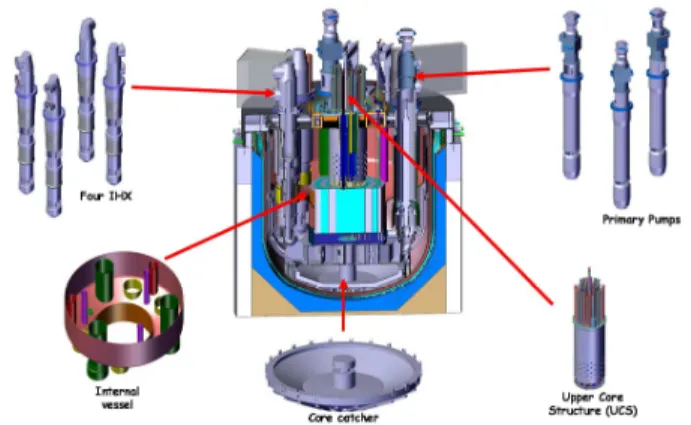
Several ASTRID options are ambitious and will be therefore studied until the end of 2015 for definite selection. Thus, it can be listed some significant innovation or improvement compared to previous SFR designs (Fig. 1), e.g.:
- Two Power Conversion Systems (PCS) are studied in
parallel until the end of conceptual design phase: Rankine steam cycle or Brayton gas (pure nitrogen) based energy conversion cycle. With these two cycles, enhanced safety approach has been pointed out impacting on the reactor design. The Brayton cycle with nitrogen gas is leading de facto to the suppression of the sodium / water reaction scenario. The ASTRID Rankine steam cycle is designed in a way of minimizing the occurrence of a sodium/water reaction and the secondary sodium loops design are providing in addition a robust and intrinsic safety demonstration of their robustness.
- Choice of the low sodium void effect core thanks to a
heterogeneous core concept. This core combines various types of geometrical options individually favorable to the sodium void effect reduction like internal breeder zone, upper Na plenum, upper absorbing zone …).
- Reinforced diversification of the decay heat removal
systems with a combination of two active DHR in the cold plenum and three passive DHR systems in the hot plenum, plus a Reactor Vessel Auxiliary Cooling System.
- Large core catcher positioned inside the primary
vessel able to contain fusion of whole core fuel assemblies.
- Development of instrumentation techniques making
possible to early detect potential dysfunctions or possible accidents, such as sodium/water reaction (in case of steam cycle), clad failure, enhance detection of sodium leak out of pipes, etc.
- A large flow Electro Magnetic Pump for each
secondary circuit.
- Plant installed on anti-seismic bearing pads.
In addition, the safety orientations of ASTRID have been described in a dedicated document – the Safety Orientations Document3. The main safety features concern:
- Improvements concerning local faults (in particular
control rod withdrawal and local fuel melting).
- More in depth prevention of severe accident, favoring
the potentiality of natural behavior of the reactor.
- New approach devoted to the severe accident analysis,
considering a larger range of scenarios.
- Approach for designing the equipment necessary for
mitigating severe accidents to avoid cliff edge effect.
- Integration of Fukushima lessons, involving a robust
design of equipment, necessary for avoiding large radiological releases.
- Safety demonstrations justifying the practical
elimination of a limited number of situations which cannot be reasonably mitigated.
- Consideration of situations which were not deeply
previously analyzed for SFR: e.g. a no confined large sodium-water reaction.
- Consideration of potential releases of non-radiological
materials: i.e. sodium aerosols in accident conditions. Consequently, the sum of these technological options combined with these new safety features are leading to new needs in terms of Qualification, demonstration of the relevance of the proposed safety options, efficiency & robustness of the concepts, plus validation of the related simulation tools (Verification & Validation). These new options are therefore justifying the definition of a specific Qualification program (AQP: ASTRID Qualification Program) which could significantly differ from precedent qualification programs carried out on previous SFRs.
Proceedings of ICAPP 2015 May 03-06, 2015 - Nice (France) Paper 15093
I.2. ASTRID Organization amongst engineering partners4
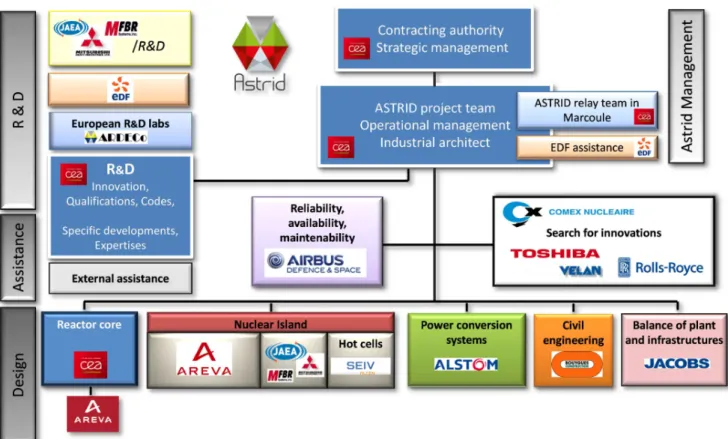
In the ASTRID project, CEA has set up partnerships with industrial companies to carry out the conceptual design. The CEA chose to assume the role of architect engineer itself instead of using a prime contractor. For this reason, CEA defined the different project engineering packages and then organize them among the industrial partners. Covering this engineering organization, CEA is the project owner, responsible for drafting the safety reports and establishing dialogue with the French Nuclear Safety Authority (ASN).
The project is therefore divided in different engineering packages which were entrusted to its industrial partners within the scope of bilateral collaboration agreements until end of the conceptual design phase. The CEA has decided to ensure the engineering of the core design. A simplified overview of the involvement of all partners within the ASTRID project is summarized in Fig. 2 and 3. More explanations on this specific organization can be found in related papers2, 4, 5. The ASTRID project is therefore today including twelve partners. Each partner is responsible of its studies and development within its work package. ASTRID
project team is overviewing the global coherence of the project and is in charge of interfaces management.
Fig. 2: Today Industrial participation in ASTRID project In addition ASTRID project is in charge of collecting from all partners R&D and Qualification needs, and will have to ensure - if all these needs are relevant -, how, where, and when they shall be fulfilled. Today the ASTRID project is decomposed in Product Breakdown Structure (PBS) with a first level simplified chart shown in Fig. 3.
May 03-06, 2015 - Nice (France) Paper 15093
Organization of the AQP has been decomposed in several Working Groups in coherence with this related PBS sub-divided for the Nuclear Island in Structure, Systems (plus sub-systems) and Components (SSC). Animation, coordination and synthesis of the Working Groups are realized by two ASTRID Qualification project responsibles (one from CEA and one from AREVA).
III. METHODOLOGY OF THE ASTRID QUALIFICATION PROGRAM (AQP) AND RELATED
RISK EVALUATION & MANAGEMENT (RE&M) In every major and complex project principally driven by innovation, the perspective of future and significant R&D needs and Qualification program is a matter of concern. As a consequence, it is essential to anticipate - as soon as possible - these needs and to implement a methodology for Risk Evaluation & Management (RE&M); then to pilot the process of risk mitigation. This methodology is frequently used in complex projects with technical and programmatic uncertainties such as advanced Nuclear reactor design6, Fuel fabrication7, Aeronautic or Aerospace projects8.
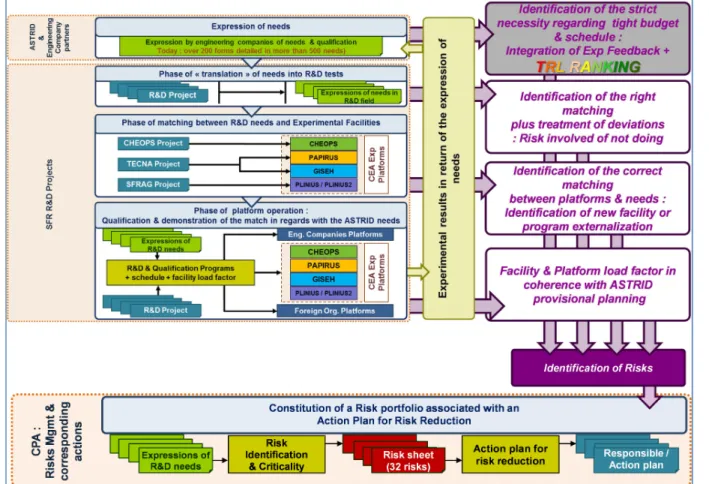
For ASTRID project, a systematic methodology to identify the AQP followed by the RE&M process started at the end of the AVP1 phase, when the major design and safety options were correctly pre-selected. It is decomposed in four main steps:
- Step 1: Compilation of R&D and qualification needs (Creation of a R&D & Qualification Need database). - Step 2: Evaluation of these needs in terms of maturity
level (TRL ranking) of the concepts, and corres-ponding Risk evaluation.
- Step 3: Identification of R&D capability and corresponding experimental platforms.
- Step 4: Risk evaluation, risk management and mitigation (Creation of a Risk portfolio).
III.1. Step 1: The Compilation of qualification needs
As a starting point, the purpose was to make an exhaustive inventory of all needs expressed by all engineering companies involved in ASTRID project. To simplify this process, it has been split into several thematic tasks covering the entire ASTRID PBS. The following themes were identified: Thermal hydraulic/ Reactor design & structures/ Safety systems/ Design for mitigation of severe accidents/ Instrumentation/ In Service Inspection & Repair/ Main components/ Fluids and sodium technology/ Fuel & component handling operations/ Material selection/ Design codes & standards/ Core design/ Sodium-Gas Heat Exchanger/ Gas Energy Conversion System/ Civil engineering/ and Simulation tools. For each item, the inventory is carried out by the AQP responsible, at least one representative of ASTRID project, the corresponding engineering company and a CEA R&D representative.
It is then necessary to compile and organize this expression of needs, to identify if there is some duplication amongst the Working Group, and in some cases to reinterpret these needs into R&D tests. Today this step has led to over 200 forms detailed in more than 500 different expression of needs associated to a R&D program. This exhaustive list is regularly up-dated anytime an ASTRID option is confirmed or cancelled.
III.2. Step 2: Evaluation of needs / TRL Scale and Ranking
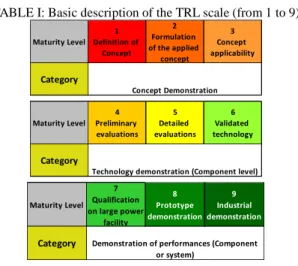
The second step consists in evaluating the level of necessity of the expressed needs, in the light of the large experimental feedback gained from previous SFRs and the level of maturity of the different options. This step is requiring a systematic approach carried out thanks to a Technological Readiness Level (TRL) scale for maturity evaluation and risk assessment. TRL scale is a metric that was initially pioneered by NASA in the mid-1970s to assess readiness and risk of space technology. It is defined as a “systematic metric/measurement system that supports
assessments of the maturity of a particular technology and the consistent comparison of maturity between different types of technology” 9. Since then, a huge number of scales and tools to assess maturity have been declined coming from various engineering company. In ASTRID case we chose a uniform TRL scale provided by AREVA Company focused on nuclear technology. It was declined to each component, itself decomposed in several sub-parts.
TABLE I: Basic description of the TRL scale (from 1 to 9)
For instance, a complex component like a Steam Generator can be detailed into ten to twelve sub-technologies (overall performances, vapor side in tubes, vapor collectors, sodium inlet and outlet systems, material used in each part, instrumentation to detect sodium water reaction, instrumentation to inspect tubes, …). Each sub-technology will be ranked independently, to accurately evaluate where the critical R&D lacks remain. Then the R&D program can focus either on one specific item which TRL is too low, and / or towards an integral test on reduced
Maturity Level 1 Definition of Concept 2 Formulation of the applied concept 3 Concept applicability Category Concept Demonstration Maturity Level 4 Preliminary evaluations 5 Detailed evaluations 6 Validated technology Category
Technology demonstration (Component level)
Maturity Level 7 Qualification on large power facility 8 Prototype demonstration 9 Industrial demonstration
Category Demonstration of performances (Component or system)
Proceedings of ICAPP 2015 May 03-06, 2015 - Nice (France) Paper 15093
scale mockup. Line by line, the TRL is estimated leading to some risks identification if:
- TRL value is too low and R&D program is not considered to be sufficient to raise this TRL in time.
- TRL is low and no or few R&D action is engaged.
- R&D needs are justified but no existing facility can today comply with the requirements.
In addition, we tried to realize a systematic assessment, by answering in each case to the following question: “What would be the risk of not doing?” This step is leading to get a clear view of the strict necessity in R&D and Qualification program, integrating an assumed level of risk. The TRL scale is in our case used to get a common basis of evaluation amongst all experts in the maturity ranking. TRL is considered as a useful indicator tool but only for qualitative assessment.
III.3. Step 3: Identification of R&D capability and corresponding experimental platforms
Step 1 and 2 are performed in close relationship with the R&D responsible, being therefore able to evaluate on-line if his current and pluri-annual R&D program is matching with the expressed needs. This also helps adjusting the R&D future program and early detecting the
need of a new R&D facility. Today the CEA R&D facilities in support to ASTRID project are gathered in four technological platforms: CHEOPS (a set of large sodium facilities for component or systems qualification), PAPIRUS (small sodium facilities for technology development), GISEH (water platform for thermal hydraulic tests) and PLINIUS 2 (SFR severe accident platform). These R&D platforms are largely described in specific papers10, 11. Investigation of collaboration to work with foreign platforms and irradiation facilities is also carried out in parallel.
III.4. Step 4: Risk Evaluation, Management and Mitigation
In Step 1, 2 and 3, the respective Working Groups are compiling the needs, evaluating the maturity of their concepts and evaluating the R&D response (effective or potential) in regards with their needs. This work helps highlighting numerous risks that are listed and evaluated in terms of criticality levels. This list of risks is then classified to principally treat the High Level Critical risks. They are all registered in a Risk Portfolio. Today this portfolio is composed of thirty-two major risks. It implies for each risk, a set of actions to engage for risk reduction and risk mitigation (Action Plan for Risk Reduction - Fig. 4).
May 03-06, 2015 - Nice (France) Paper 15093
This AQP process has been initiated early 2013 and the risk portfolio created in mid-2014. This process is now regularly updated according to the project progress and R&D studies. The AQP and its corresponding RE&M is reported to the ASTRID strategic management and shared with all partners once a year minimum. In addition, a detailed roadmap of the AQP integrating the respective facility platform roadmap is in preparation.
IV. SPECIFIC EXAMPLE OF THIS METHODOLOGY APPLIED ON SYSTEMS: THERMOHYDRAULIC
It has been chosen to illustrate the AQP through an important item in Sodium Fast Reactors: Thermal Hydraulic of the Primary vessel.
IV.1. Needs in Thermal Hydraulic (TH) of the primary vessel
The expression of needs in Thermal hydraulic has started with an extensive review and synthesis of the experimental feedback of the R&D TH tests performed for previous Sodium Fast Reactor (mainly EFR – European Fast Reactor and SUPERPHENIX)12. It was also integer some integral tests performed on SUPERPHENIX (starting tests) and PHENIX13 (end of life thermal hydraulic tests). This feedback has been also compared and exchanged through international benchmarks13.
Consequently the list of needs has been reduced - according to all experts - to the strictly necessity. These needs are divided in several sub-sections:
- Overall systems: Thermal Hydraulic of the primary circuit, natural convection of the primary loop. - Local needs: gas entrainment and vortex creation on
free surfaces, evaluation of sodium aerosols density on the gas plenum and its influence of heat transfer coefficients, thermal fatigue of the Upper Core Structure due to core outlet temperature fluctuations. - Needs in elementary mock-up to qualify TH data:
fundamental law on vortex creation, thermal mixing of jets, natural circulation for convection in sodium pool with a cavity.
- Some R&D needs must also be used to validate some thermal hydraulic computing codes14, 15.
- Some additional needs in TH are concerning main components such as IHX or Steam Generator. They are taken into consideration in the AQP but will not be presented in this paper.
IV.2. Platform and facilities in Thermal Hydraulic (TH)
Today, to solve these needs, the GISEH platform is developing several experimental benches where different R&D studies will be performed. GISEH platform is gathering the facilities operating with simulant fluids (water or air) in support of SFR program. Within it, a new
facility named PLATEAU (for in Water (Eau in French)
PLATform) is a multipurpose water service facility
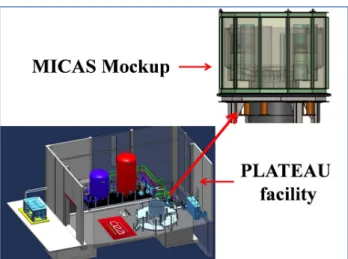
enabling in parallel water distribution to several Plexiglas mockups. PLATEAU is designed to perform some hydraulic tests programmed on large mockups (scale 1:6 to 1:8). The PLATEAU facility is today operational.
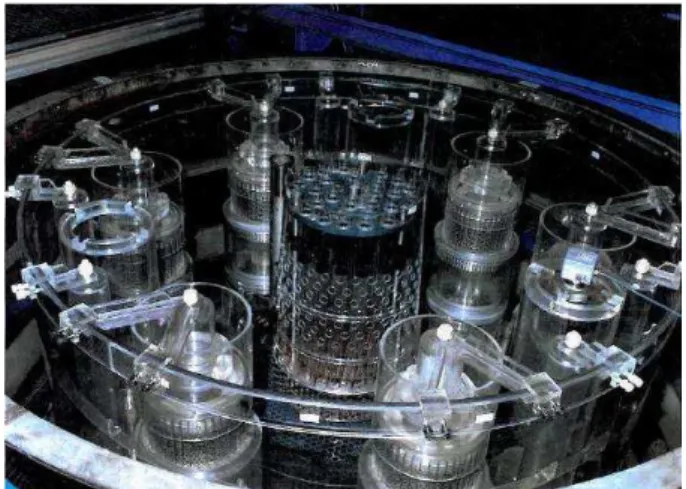
Fig. 5: Picture of the COLCHIX Plexiglas mockup for EFR
The first mockup to be tested in 2015 will be the ASTRID upper plenum (360°, scale 1:6). This mockup is known as MICAS (MICAS for Maquette Intégrale du Collecteur Chaud d’ASTRID / ASTRID Integral Mockup of the hot plenum). MICAS will be used to confirm the overall TH behavior of the hot plenum (with possibility to realize transients), to validate CFD code, to confirm the absence of gas entrainment and some specific design choice (i.e. on the UCS and on the position of IHX). The maximum flowrate is 350 m3/h and the range of water temperature is 10 to 60°C. This mockup is equivalent to the one developed in the 90’s to validate the EFR main vessel TH (COLCHIX mockup - see Fig. 5).
On PLATEAU facility, all mockups will be plunged into water pool to perform Laser velocimetry in every radius. It will be able to get therefore a 3D representation of the flow distribution (see Fig. 6).
In continuation, the next Plexiglas mockup under conception will represent the Pump / Diagrid connection. Then a mockup representing the Upper Core Structure shall follow. In total, at least four mockups are planned to be tested on PLATEAU facility during the ASTRID Basic Design. This qualification process has gained a lot from the EFR R&D program and only a reduced number of mockups are today necessary thank to the significant knowledge gained and preserved from past experiences.
Proceedings of ICAPP 2015 May 03-06, 2015 - Nice (France) Paper 15093
Fig. 6: Sketch of the PLATEAU facility and MICAS Mockup In addition to the PLATEAU facility, supplementary needs are covered by other dedicated facilities such as BANGA for the study of vortex on free surface16, or BACCARA and HERMES facilities to study specific TH of one single or a group of fuel assembly mockup.
At least, discussion has been engaged with JAEA company through ASTRID Collaboration, with the definition of a joint R&D program test to be performed on in sodium PLANDTL facilities17 (in particular for the verification of decay heat removal by natural circulation).
Fig. 7: Sketch and picture of the BACCARA facility
IV.3. Risk Evaluation and Management in Thermal Hydraulic (TH)
Today several risks have been identified in TH validation leading to new needs to prioritize (see Table 2). Of course the TRL evaluation in TH is not relevant..
TABLE 2: RE&M on Primary circuit TH
Risk identification Action(s) and new needs
Intensive use of PLATEAU facility.
The project is looking for complementary water platform facility, in first priority at AREVA company.
Need of a better knowledge on the influence of Na aerosols on heat transfer in the cover gas region.
AREVA will design taking account design margins. In parallel CEA is seeking for international exchanges. This program is integrated within the scope of the CHEOPS facility. If necessary, experimental verification tests could be realized later. The requirement of a large
sodium mockup to confirm natural circulation Decay Heat Removal in ASTRID primary vessel has to be ascertained.
An expert group has been created to definitely assess the
need and evaluate the
consequence (“Risk of not doing”).
Seeking for international
collaboration is anticipated.
All past and current
experimental data regarding SFR natural circulation are collected for appropriate code validation plus code bench-marking.
V. SPECIFIC EXAMPLE OF THIS METHODOLOGY APPLIED ON COMPONENT: THE SODIUM GAS
HEAT EXCHANGER
The study of an ASTRID option with Gas Energy Conversion System (ECS) is leading to an important R&D and design program work which is largely described in related papers18,19. In the Gas ECS, the key component remains the Sodium / Gas Heat Exchanger (SGHE) design which is integrating PCHE type modules in order to get a better heat power density compared to a standard shell & tubes HX type (Fig. 8).
A PCHE-type HX has never been industrially used with sodium and it is necessary to test mockups to qualify this concept, to quantify the heat exchange correlations, to investigate conditions of sodium flow in narrow channels (draining, cleaning, potential self-plugging, stop / restart, inspection …).
V.1. R&D needs in SGHE qualification
The qualification program of the SGHE is organized step by step with progressive scale factors on modular compact heat exchanger modules. Moreover, it must be in
May 03-06, 2015 - Nice (France) Paper 15093
parallel studied several specific topics involving multiple facilities.
Fig. 8: Sketch of a SGHE module
To synthetize the SGHE development program, it could be said that three major domains are covered: Thermomechanic, Thermohydraulic and General Design. The Qualification Program is carried out in two steps:
- Step 1: Test on elementary Heat Exchanger mockups
with a heat power capacity of maximum 40 kW. These tests are performed on the DIADEMO facility (Fig. 9). These experimental tests that started in 2013 will contribute to raise the TRL index from 2 to 4.
- Step 2: Power tests on large scale modules on a large
tests facility named NSET belonging to the CHEOPS platform. The NSET facility allows a power exchange up to 10 MWth. This facility is designed to bring validation on the operation and performance of heat exchanger module (scale 2:3 of the ones foreseen for ASTRID) and components (regrouping a set of modules) (scale 1:12) in stable conditions and transient conditions (in case of fast reactor trip). These tests have to be performed during the ASTRID Basic design phase. These qualification tests will raise the TRL index from 5 to 7.
To perform these tests, it will be necessary to fabricate several Compact HX modules. The challenging plate assembly process is performed by Diffusion Welding by Hot Isostatic Pressing (HIP-DW).
Complementary to these tests, a series of elementary tests are carried out in parallel of Step 1, on numerous facilities belonging to the PAPIRUS platform (see TABLE 3).
Fig. 9: Picture of the sodium gas PCHE mockup and DIADEMO facility where the HX mockup are tested
TABLE 3: R&D needs and corresponding facility
R&D Needs Platform / Facility
Material characterization and compatibility in contact with Na or with N2
PAPIRUS / CORRONa2
Interaction study (Na / N2) in case of loss of tightness in the SGHE
PAPIRUS / Elementary chemical facility + ANL Facility
Codification Material testing facility
Development of tools for SGHE inspection
PAPIRUS / Glove box compatible with Na Development of tools for
SGHE instrumentation
PAPIRUS / DOLMEN Development of Process for
Na technologic constraints (draining / cleaning)
PAPIRUS / VAUTOUR
TH validation of the SGHE gas collectors
GISEH / PLATEAU
Development of specific
parameters for the HIP-DW process
R&D labs at CEA Grenoble plus final testing of the mockups on the PAPIRUS / DIADEMO facility
V.2. Risk Evaluation and Management in SGHE design
Today the risks identified are leading to the following new needs:
- Need to identify companies able to fabricate large SGHE mockups plus prototypes (identification of the availability of large oven to realize large scale assembly by HIP-DW).
- Need to follow accurately the CHEOPS platform
construction roadmap, from which the SGHE roadmap is directly dependent.
VI. CONCLUSIONS
The Qualification Program is an important task which must be done systemically, especially when the industrial project is integrating several significant innovative options. In addition, in ASTRID case, due to its wide number of engineering participants, it was absolutely necessary to proceed to a standardized Qualification process in which the ASTRID team and the main engineering company
Proceedings of ICAPP 2015 May 03-06, 2015 - Nice (France) Paper 15093
(AREVA) are playing a key role in group animation, needs collection and risk evaluation.
Once all needs are collected, an effort of prioritization is absolutely necessary, because every project has cost and time constraints. Thus, the evaluation of a reasonable but acceptable level of performance in regards with the planned R&D program will lead to prioritize the actions and to identify several major project risks. All risks are collected in a Risk Portfolio associated with Action Plan for Risk reduction and mitigation.
The next step is then to drive the project according to this risk portfolio and to precise with time the Qualification Program roadmap in parallel and in coherence with the ASTRID schedule.
ACKOWLEDGMENTS
Many people are involved in this program and it was not possible to put all of them as co-authors. Neither the less authors would like to thank all persons involved in the different Working Groups, coming from ASTRID project team, Engineering teams (in particular AREVA team), and R&D teams, for their important involvement in the expression of needs and Risk Evaluation.
A special thank is addressed to the TH group (M. S. Chenaud, T. Sageaux, A. Gerschenfeld, O. Gastaldi, D. Guenadou, I. Tkatschenko and L. Martin) and the SGHE R&D team (L. Cachon et al.) who permit us to summarize in this paper their significant works.
NOMENCLATURE AQP: ASTRID Qualification Program ASN: French Nuclear Safety Authority
ASTRID: Advanced Sodium Technological Reactor for Industrial Demonstration
AVP1/2: Conceptual design studies, phase 1/2 of ASTRID project
CEA: French Atomic Energy Commission CFD: Computational Fluid Dynamic ECS: Energy Conversion System EFR: European Fast Reactor
HIP-DW: Diffusion Welding by Hot Isostatic Pressing
HX: Heat eXchanger
IHX: Intermediate Heat eXchanger ISI&R: In-Service Inspection & Repair JAEA: Japan Atomic Energy Agency PBS: Product Breakdown Structure PCHE: Printed Circuit Heat Exchanger PCS: Power Conversion System R&D: Research and Development RE&M: Risk Evaluation & Management
SFR: Sodium Fast Reactor SG: Steam Generator
SGHE: Sodium Gas Heat Exchanger SPX: Superphenix (French SFR) SSC: Structure System and Component TH: Thermal Hydraulic
TRL: Technology Readiness Level UCS: Upper Core Structure WG: Working Group 3D: Three-Dimensional
REFERENCE
1. E. ABONNEAU et al., “The ASTRID project: status and prospects towards the conceptual design phase”,
Proc. of ICAPP 2014, Paper 14116, p. 447-455, ANS,
Charlotte, USA (2014).
2. J. ROUAULT et al., “ASTRID, The SFR GENIV Technology Demonstrator Project: Where Are We, Where Do We Stand For”, Proc. of ICAPP 2015,
Paper 15439, SFEN, Nice, France (2015).
3. P. LO PINTO et al., “The Safety orientations during ASTRID conceptual design phase”, Proc. of FR13,
Paper CN-199-267, IAEA CN-199, Paris, France
(2013).
4. M. LADURELLE et al. “An original and efficient project organization for ASTRID”, Proc. of FR13,
Paper CN-199-264, IAEA CN-199, Paris, France
(2013).
5. J. ROUAULT et al., “Japan-France Collaboration on the ASTRID Program and Sodium Fast Reactor”,
Proc. of ICAPP 2015, Paper 15440, SFEN, Nice,
France (2015).
6. J. W. COLLINS, “Assessing risk and driving risk mitigation for First-Of-A-Kind advanced reactors”
Proceedings of the ASME 2011 Small Modular Reactor Symposium, SMR2011, ASME, Sept. 28-30,
2011, Washington, DC, USA (2011).
7. D. C. CRAWFORD et al., “An approach to fuel development and qualification” Journal of Nuclear
Materials, vol. 371, pp 232-242 (2007).
8. J-M. SALOTTI et al., “Manned missions to Mars: Minimizing risks of failure”, Acta Astronautica, vol.
93, pp 148–161 (2014).
9. J. C. MANKINS, “Technology readiness assessments: A retrospective”, Acta Astronautica, vol. 65, pp 1216-1223 (2009).
10. G. RODRIGUEZ et al., “Development of experi-mental facility platform in support of the ASTRID program”, Proc. of FR13, Paper CN-199-122, IAEA CN-199, Paris, France (2013).
11. O. GASTALDI et al., “Experimental platforms in support of the ASTRID program: Main experimental needs and devoted existing or planned facilities”,
Proc. of ICAPP 2015, Paper 15126, SFEN, Nice,
May 03-06, 2015 - Nice (France) Paper 15093
12. D. TENCHINE, “Some thermal hydraulic challenges in sodium cooled fast reactors” Nuclear Engineering
and Design Journal, vol. 240, pp 1195-1217, (2010).
13. D. TENCHINE et al., “International benchmark on the natural convection test in Phénix reactor” Nuclear
Engineering and Design Journal, vol. 258, pp
189-198, (2013).
14. D. TENCHINE et al., “Status of CATHARE code for sodium cooled fast reactors” Nuclear Engineering and
Design Journal, vol. 245, pp 140-152, (2012).
15. D. TENCHINE et al., “Status of TRIO U code for sodium cooled fast reactors” Nuclear Engineering and
Design Journal, vol. 242, pp 307-315, (2012).
16. D. TENCHINE et al., “Gas entrainment issues in sodium cooled fast reactors”, Nuclear Engineering
and Design Journal, vol. 270, pp 302-311, (2014).
17. H. KAMIDE et al., “Sodium experiments on natural circulation decay heat removal and 3D simulation of plenum thermal hydraulics”, Proc. of FR13, Paper
CN-199-137, IAEA CN-199, Paris, France (2013).
18. G. LAFFONT et al. “ASTRID power conversion system based on steam and gas options”, Proc. of
ICAPP 2014, Paper 14116, p. 447-455, ANS,
Charlotte, USA (2014).
19. L. CACHON et al. “Status of the Sodium Gas Heat Exchanger (SGHE) Development for the Nitrogen Power Conversion System Planned for the ASTRID SFR Prototype”, Proc. of ICAPP 2015, Paper 15439, SFEN, Nice, France (2015).