Publisher’s version / Version de l'éditeur:
Construction Technology Update, 2014-10
READ THESE TERMS AND CONDITIONS CAREFULLY BEFORE USING THIS WEBSITE.
https://nrc-publications.canada.ca/eng/copyright
Vous avez des questions? Nous pouvons vous aider. Pour communiquer directement avec un auteur, consultez la première page de la revue dans laquelle son article a été publié afin de trouver ses coordonnées. Si vous n’arrivez pas à les repérer, communiquez avec nous à [email protected].
Questions? Contact the NRC Publications Archive team at
[email protected]. If you wish to email the authors directly, please see the first page of the publication for their contact information.
NRC Publications Archive
Archives des publications du CNRC
For the publisher’s version, please access the DOI link below./ Pour consulter la version de l’éditeur, utilisez le lien DOI ci-dessous.
https://doi.org/10.4224/21274788
Access and use of this website and the material on it are subject to the Terms and Conditions set forth at
Compressed-air foam (CAF) in fixed-pipe systems for fire suppression
Kim, Andrew
https://publications-cnrc.canada.ca/fra/droits
L’accès à ce site Web et l’utilisation de son contenu sont assujettis aux conditions présentées dans le site LISEZ CES CONDITIONS ATTENTIVEMENT AVANT D’UTILISER CE SITE WEB.
NRC Publications Record / Notice d'Archives des publications de CNRC:
https://nrc-publications.canada.ca/eng/view/object/?id=cb140ddd-215f-491f-b5cb-d1d86faed708 https://publications-cnrc.canada.ca/fra/voir/objet/?id=cb140ddd-215f-491f-b5cb-d1d86faed708NRC Construction
Construction Technology Update No. 75, Advances in Fire
Suppression Systems, reviewed the characteristics and
performance of several ire suppression systems including compressed-air foam (CAF). This new Update, focusing exclusively on CAF, reviews the performance of CAF systems in further detail, including tests done to improve the ixed-pipe foam systems, which expand the ire suppression applications for foam technology.
CAF is generated by combining air, chemical agents and water to produce foam with a high nozzle velocity. It uses much less water and foam concentrate than traditional foam systems. It suppresses ire by forming a blanket that blocks the radiation from the lames and reduces the evolution of gaseous fuel. The foam blanket also constitutes a slowly draining source of water conined in the foam bubbles, which cools the fuel.
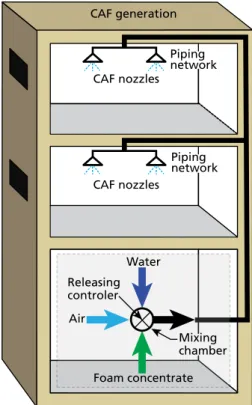
Fixed-pipe systems using CAF technology are most suitable for suppressing ires in such spaces as liquid fuel storage areas, machinery spaces and any compartments that have limited water supply (Figure 1).
Technology Development
Early research reported that the ignition-delaying capability and ire suppression effectiveness of CAF was much better than that of water. However, simple injection of the foam solution and air into steel piping caused instability in the discharge pressure, and resulted in the generation of a pulsating, soapy water stream that is a poor-quality ire suppressant.
Subsequent research focused on three innovations that led to the successful production of good quality CAF in a ixed-piping system:
Figure 1. General arrangement of a fixed-pipe CAF system
1. Air injection and mixing zone: Air was injected through a small oriice into a large-diameter pipe carrying a stream of foam solution. This eliminated the pulsations that occurred in a large-diameter pipe when air and water pressures were not balanced.
2. Foam development zone: As a mixture of foam solution
and air travel through a length of smooth, lexible pipe, the friction on the tube walls as well as the lexibility of
Compressed-Air Foam (CAF)
in Fixed-Pipe Systems for Fire Suppression
Researchers at NRC conducted comprehensive tests to assess the performance of compressed-air foam ire
suppression systems for four different ire protection scenarios. The results showed excellent ire suppression
performance with low water usage.
NRC CoNstRuCtioN
teChNology update
No. 83, October 2014
By Andrew Kim
Water Air Releasing controler Mixing chamber Foam concentrate CAF nozzles CAF nozzles Piping network Piping network CAF generationConstruction Technology Update No.83
the tubing generate uniform-sized, small bubbles. For the successful CAF system developed, a 10 m long, 25 mm diameter section of polypropylene tubing was used for the development zone. This allowed the production of uniform foam with expansion ratios ranging from 1:4 to 1:20.
3. Piping geometry and discharge zone: It was determined
that it is important for the piping to be free of sharp bends or impact points such as sprinkler delectors so that the foam does not collapse. In addition, the geometry of the discharge oriice affects foam quality. A special nozzle was designed to permit the smooth low of foam from the delivery pipe to form a circular discharge pattern.
Foam for the ixed-pipe system tests was made by mixing water with foam concentrate in a tank. This foam solution was then pressurized to 690 kPa (100 psi). Compressed air was injected into the lowing foam solution, and the mixture evolved into foam as it lowed through the piping system. All tests were made using a solution of 0.3% Class A foam or 2% Class B foam — less than half the concentration needed for an air-aspirated system.
Early experiments included CAF tests in both open spaces and enclosed compartments for heptane, diesel fuel, and wood-crib ires. The research resulted in the development of a ixed-pipe CAF system that provides effective ire suppression for Class A and B ires. CAF ixed-pipe systems were able to extinguish ires more eficiently and effectively than standard sprinklers or water mist, in both open spaces and enclosed compartments. The tests demonstrated the importance of uniform foam distribution, meaning that nozzle placement in multiple-nozzle systems is important. It was also noted that the positive effect that an enclosure has with water mist systems is not a factor with CAF, which is equally effective with or without an enclosing compartment. Finally, CAF adhered well to the enclosure walls and other vertical surfaces, providing an effective ignition-retarding barrier for the surfaces.
Typical Applications
Researchers identiied and veriied several applications where CAF could perform better than current ire protection systems.
Flammable Liquid Storage Fires
CAF was tested for extinguishing laming liquids typical of both spill and shelf ires that might occur with paints or solvents in hardware or building supply stores, and in storage rooms found in a number of occupancies.
Four suppression methods were tested: no suppression (free burn); standard sprinkler suppression; water-mist nozzle suppression; and CAF nozzle suppression. These experiments showed the CAF system was able to suppress the ire, whereas the standard sprinkler and water-mist systems were able to cool the space but did not achieve suppression until the fuel was completely burned. Figure 2 shows the ability of CAF to lower ire temperature faster that water deluge.
Figure 2. CAF extinguishment versus water (deluge) extinguishment
The tests were repeated with the walls of the test space enclosed with 26-gauge sheet steel, except for a doorway opening. Again, only the CAF system was able to extinguish the ires. The sprinkler and water-mist systems were able to cool the enclosure but not extinguish the lames. As well, CAF effectively adhered to the enclosure walls and shelves. These experiments demonstrated the capabilities of ixed-pipe CAF systems to penetrate the plumes of ires with heat release rates in excess of 2 MW and to extinguish the ire either by direct contact from above or by foam low to the ire source. The CAF system performed well in both the open-space and enclosed-space scenarios, achieving ire control and suppression in approximately 1 min 30 s, even in situations where the ire was shielded from direct CAF spray.
Another beneit of CAF is that ireighters are able to see objects in a room or space through the spray while it is discharging. This enables responders to more quickly identify the base of a ire, which is sometimes dificult to do with discharging sprinkler and water-mist systems.
0 0 200 400 600 800 25 50 75 100125 150 175 200 225 250 275 300 325 350 375 400 Time (s) Deluge extinguishment Extinguishing activation system CAF extinguishment Ignition Temper atur e (C)
CAF Class A Test 2 Deluge Test 1
NRC Construction
Aircraft Hangar Fires
Foam-water sprinkler systems with overhead applicators are commonly used for aircraft hangar protection. NRC used a full-scale prototype CAF ire suppression system for an aircraft hangar to determine whether it could match or surpass conventional ire suppression systems.
A systematic comparison of the ire suppression performance of the CAF system and foam-water sprinkler system was made using procedures similar to that prescribed in UL162,
UL Standard for Safety for Foam Equipment and Liquid Concentrates.
The tests showed that the CAF system performed much better than the foam-water sprinkler system, using Class B foam concentrates. The CAF system used 40% of the sprinkler water low rate and extinguished the ire in less than half the time of the sprinkler system. The CAF system used a concentration of only 2% foam concentrate while the sprinkler system used 3%. Burn-back time (the length of time it takes for lames to fan up again) of the CAF system was also much longer than the sprinkler system, typically 20 minutes for the CAF system and approximately 10 minutes for the sprinkler system.
The height of the CAF nozzles above the ire had little effect and clearly showed that the CAF system can provide much better ire protection in aircraft hangars compared to the currently used foam-water sprinkler systems.
Power Transformer Fires
Power transformers contain hazardous materials, and it is costly to provide the infrastructure to contain run-off water from ire suppression activities. Sprinkler ire protection systems for power transformers require large quantities of water, which may affect their electrical function, and cause water damage and environmental impacts.
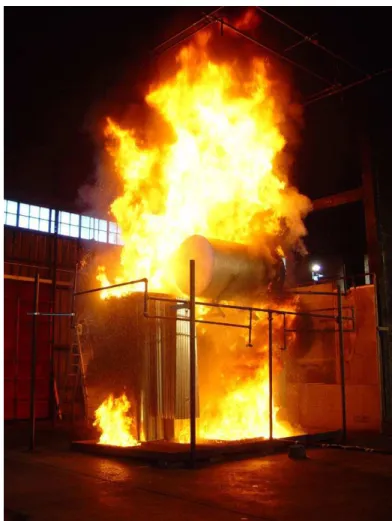
NRC evaluated the potential of CAF to extinguish power transformer ires by constructing a full-scale representation of the front half of the transformer of Hydro Quebec’s Berri Station in Montreal (Figure 3). The ire scenario tested was an explosion in the main transformer body due to internal arcing. This caused a high voltage bushing to blow through the top of the transformer or its oil reservoir to rupture, leaking oil onto the top of the transformer.
Several conigurations of CAF distribution systems were developed to determine the most eficient way to distribute foam around the vertical and horizontal obstacles of the transformer. The inal CAF system selected incorporated two
Figure 3. Transformer test fire
types of nozzles: a large-low, gear-driven rotary (GDR) nozzle and a small-low, turbine-action rotary (TAR) nozzle. A parallel test was conducted using a water deluge system similar to the one at the Berri Station.
The CAF systems performed much better than the water deluge system. The CAF system with three TAR nozzles using 0.3% Class A foam concentrate extinguished the test ire in 4 min 2 s, almost the same time as the water deluge system. However, it used less than 8% of the water.
The CAF system with two GDR nozzles using 2% Class B foam concentrate achieved extinguishment in 1 min 58 s, about half the extinguishment time of the water deluge system. Water usage was less than 18% of the total low rate of the water deluge system.
The CAF system with eight TAR nozzles using 2% Class B foam concentrate extinguished the test ire in 1 min 29 s, using far less water than the water deluge system.
Construction Technology Update No.83
Residential Fires in Remote Northern Areas
Residential ires in remote northern areas result in heavy losses owing to the lack of nearby ire services. As well, replacement costs are much higher than in urban areas. Although
conventional sprinkler systems are feasible for such areas, water supply is often limited and the cost of installing them is high. An option is the use of CAF technology.
In cooperation with Canada Mortgage and Housing
Corporation (CMHC), NRC developed a prototype CAF system for protecting housing in remote areas. It was tested in a vacant house in Yellowknife, Northwest Territories, in realistic residential ire scenarios: a kitchen ire involving cooking oil and a living room ire involving upholstered furniture. The tests showed that the CAF system was very effective in extinguishing the kitchen cooking oil ire and had a shorter extinguishment time than a residential sprinkler system. For the living room scenario involving a large ire load and challenging geometric coniguration, the CAF system provided good control and prevented the ire from spreading from the sofa to other combustibles in the room, thus preventing lashover.
The CAF system produced a deep layer of foam over all open surfaces of the combustibles in the room and on the loor, thus preventing any remaining small lames from spreading to other combustibles and laring up again after the termination of the foam discharge. These small lames eventually self-extinguished when all combustibles in the sofa were burned off. In comparison, the residential sprinkler system failed to prevent lames from spreading to other combustibles; as a result, lashover occurred. Twice the water was used compared to the CAF system.
Conclusions
NRC research demonstrated that compressed-air foam (CAF) technology is effective for suppressing ires involving lammable liquid storage spaces, aircraft hangars, power transformers, and housing in remote areas. Although the beneits vary depending on ire type, the use of CAF generally results in reduced suppression time, lesser tendency of ires to reignite, lower temperatures, reduced water use, shorter clean-up time and cost, and safety advantages for ireighters.
CAF technology has been licenced to a company that provides engineering services and equipment sales. Its integrated compressed air foam (ICAF) system has received Factory Mutual (FM) approval for Class B hydrocarbon spill ires, pool ires, and cascading ires. CAF systems have been recognized by the National Fire Protection Association in NFPA 11, 850 and 851.
References
Madrzykowski, D., Study of the Ignition Inhibiting Properties of
Compressed Air Foam, NISTIR 88-3880, National Institute of Standards and Technology, Gaithersburg, MD, 1988.
Madrzykowski, D. and Stroup, D., ed., Demonstration of
Biodegradable, Environmentally Safe, Non-Toxic Fire Suppression Liquids, NISTIR 6191, National Institute of Standards and Technology, Gaithersburg, MD, 1998.
Kim, A.K. and Dlugogorski, B.Z., An Effective Fixed Foam System Using
Compressed Air, Proceedings of the International Conference on Fire Research and Engineering, Orlando, FL, 1995.
Kim, A.K. and Dlugogorski, B.Z., Multipurpose Overhead
Compressed-Air Foam System and its Fire Suppression Performance, Journal of Fire Protection Engineering, Vol. 8, No. 3, 1997.
UL 162 – UL Standard for Safety for Foam Equipment and Liquid Concentrates, seventh edition, Underwriters Laboratories Inc., Northbrook, IL, 1994.
Dr. Andrew Kim is a senior research officer in Fire Safety at NRC Construction.
For information about engineering and system specification, contact FireFlex Systems Inc. http://www.fireflex.com/