HAL Id: cea-02339460
https://hal-cea.archives-ouvertes.fr/cea-02339460
Submitted on 4 Dec 2019HAL is a multi-disciplinary open access
archive for the deposit and dissemination of sci-entific research documents, whether they are pub-lished or not. The documents may come from teaching and research institutions in France or abroad, or from public or private research centers.
L’archive ouverte pluridisciplinaire HAL, est destinée au dépôt et à la diffusion de documents scientifiques de niveau recherche, publiés ou non, émanant des établissements d’enseignement et de recherche français ou étrangers, des laboratoires publics ou privés.
Development of a high velocities co-flowing stratified
microfluidic process to obtained kinetic constants for
liquid-liquid extraction
F. Corne, A. Lelias, A. Magnaldo, C. Sorel, N. Raimondi, L. Prat
To cite this version:
F. Corne, A. Lelias, A. Magnaldo, C. Sorel, N. Raimondi, et al.. Development of a high velocities co-flowing stratified microfluidic process to obtained kinetic constants for liquid-liquid extraction. Continuous Flow Technology IV, SCI; RSC, May 2019, Manchester, United Kingdom. �cea-02339460�
P
(please leave blank for poster number to be filled in by SCI conference office)
Development of a high velocities co-flowing stratified
microfluidic process to obtained kinetic constants for
liquid-liquid extraction
Florian Corne
1, Anne Lélias
1, Alastair Magnaldo
1, Christian Sorel
1, Nathalie
Raimondi
2, Laurent Prat
21
CEA, Nuclear Energy Division, Research Department on Mining and Fuel
Recycling Processes, Research Service for Dissolution and Separation
Processes, Laboratory of Conception of Extraction Processes, F-30207
Bagnols-sur-Cèze, France
2
Laboratoire de Génie Chimique, Université de Toulouse, CNRS, INPT, UPS,
Toulouse, France
Kinetic constant in liquid-liquid extraction processes are generally determined using constant interfacial area method as the single drop method, Nitsch cell or Lewis cell. Those technics only reach the overall mass transfer constant that can be subdivided on chemical constant and diffusive ones. Molecular diffusive transfer is quite hard to be restrained in a non-stirred device while any phase stirring has to be avoided to determine chemical kinetics. Hence, our microfluidic process carried out high velocities stratified flow in co-flowing configuration to aim chemical kinetics constant determination, thanks to both diffusive length reduction and fine flow control of the microfluidic technology. Moreover, to avoid any Dean vortexes or other convective movements that can be presents at high velocities even at laminar flow, all extraction experiments were realized in a 1.25 cm straight and linear microchannel. Our experimental hypothesis as a centred interface have also been verified tanks to confocal experiments.
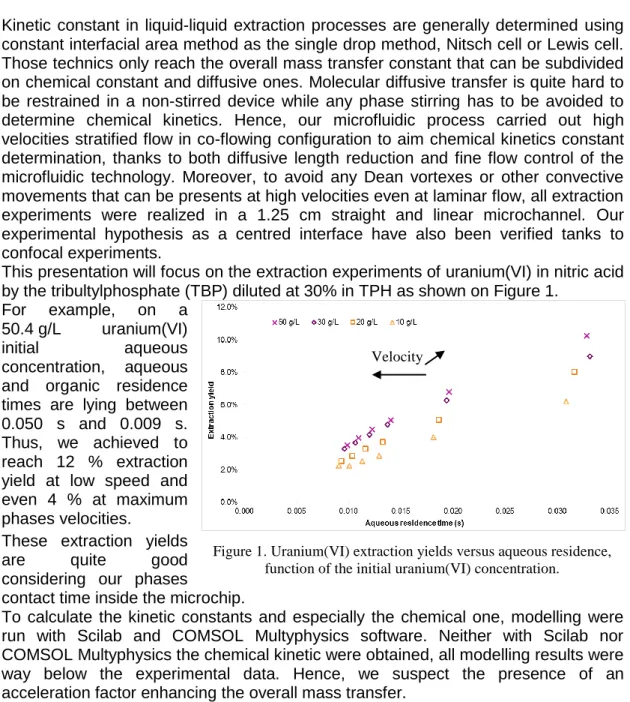
This presentation will focus on the extraction experiments of uranium(VI) in nitric acid by the tribultylphosphate (TBP) diluted at 30% in TPH as shown on Figure 1.
For example, on a 50.4 g/L uranium(VI) initial aqueous concentration, aqueous and organic residence times are lying between 0.050 s and 0.009 s. Thus, we achieved to reach 12 % extraction yield at low speed and even 4 % at maximum phases velocities.
These extraction yields are quite good considering our phases
contact time inside the microchip.
To calculate the kinetic constants and especially the chemical one, modelling were run with Scilab and COMSOL Multyphysics software. Neither with Scilab nor COMSOL Multyphysics the chemical kinetic were obtained, all modelling results were way below the experimental data. Hence, we suspect the presence of an acceleration factor enhancing the overall mass transfer.
Figure 1. Uranium(VI) extraction yields versus aqueous residence, function of the initial uranium(VI) concentration.