pQuattro vectors allow one-step multigene metabolic engineering and
auto-selection of quattrocistronic artificial mammalian operons
Short Communication
Martin Fussenegger, Samuel Moser & James E. Bailey
∗Institute of Biotechnology, Swiss Federal Institute of Technology, ETH Zurich, CH-8093 Zurich, Switzerland
Received 25 August 1998; accepted 25 August 1998
Key words: CITE, EMCV, GFP, IRES, picornavirus
Abstract
Based on internal ribosomal entry sites (IRES) of picornaviral origin we constructed a novel family of mammalian expression vectors. pQuattro vectors contain quattrocistronic artificial eukaryotic operons which link, in a single transcript, the simultaneous and coordinated as well as adjustable expression of up to three independent genes of interest to a terminal neomycin (neo) resistance marker. Due to the strict genetic linkage of the transgenes and the terminal selection marker, this genetic configuration enables, by the selection on neomycin, multigene metabolic engineering of mammalian cells in a single step (one-step metabolic engineering). Furthermore, selection on the terminal cistron of multicistronic expression units enforces cocistronic expression of all upstream encoded genes and maximises genetic integrity of the eukaryotic operon in stable mammalian cell lines, since clones harbouring damaged multicistronic expression units become neomycin-sensitive and are automatically counterselected (auto-selection). The modular set-up and the abundance of restriction sites in pQuattro vectors facilitate the movement of individual genes between multicistronic expression vectors and guarantees high compatibility with genetic elements of a wide variety of existing mammalian expression vectors.
Introduction
Current metabolic engineering technology is in most cases based on the transfection of a single transgene, the expression of which is maintained and selected for by cotransfection of a second vector encoding a selectable marker which often confers resistance to an antibiotic. However, due to unlinked expression of the selection marker and the gene of interest, rarely more than 30% of the stable integrants expressing the antibiotic resistance also express the desired trans-gene (Fussenegger et al., 1998a). This phenomenon either results from a deletion or inactivation of the gene of interest during or following plasmid integra-tion or from the exclusive integraintegra-tion of the vector encoding the resistance marker. Even if stable cell lines with concomitant expression of the selection marker and the gene of interest could be generated, the expression level of the transgene is unpredictable
∗ Author for all correspondence.
and often decreases during extended cultivations since there is no positive selection for the maintenance and the transcriptional activity of the transgene.
Furthermore, as contemporary basic research con-tinues to reveal more and more details on the molec-ular complexity of metabolic pathways and networks, classical one-gene metabolic engineering is becoming increasingly limited in its potential to realised desired global phenotypes. In order for metabolic engineer-ing to keep up with the current detailed knowledge of physiological pathways and metabolic networks simultaneous expression of multiple genes is a pre-requisite to achieve difficult-to-attain metabolic char-acteristics or cell culture states (Papoutsakis, 1998; Fussenegger et al., 1998b). Although current expres-sion technology may in principle enable such multi-gene metabolic engineering by subsequent rounds of transfections with a single gene, such methodology is tedious, time consuming, and increases the risk of gen-erating secondary effects unrelated to the transgenes
at every round of transfection due to random integra-tions of the different vectors into the host chromosome (Fussenegger et al., 1998a).
Results and discussion
Based on specific viral genetic elements which en-able cap-independent translation initiation (internal ribosomal entry sites, IRES; Fussenegger et al.,
this issue for a review), multicistronic expression technology was recently established and success-fully used for multigene metabolic engineering of Chinese hamster ovary cells (CHO) (Papoutsakis, 1998; Fussenegger et al., 1998b; Fussenegger et al., 1998c). The concept of multicistronic eukaryotic expression leading to the quattrocistronic family of mammalian expression vectors is based on the pre-viously reported pTRIDENT system (Fussenegger et al., 1998d). The tricistronic expression unit contained in plasmid pTRIDENT1 consists of a tetracycline-repressible promoter (PhCMV∗−1) and three multiple cloning sites which are separated by two identical
IRES elements of polioviral origin (Fussenegger et
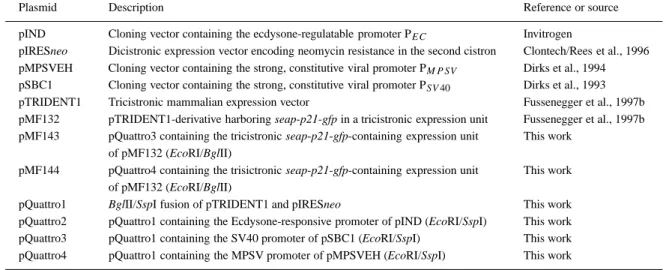
al., 1998d). In order to extend this tricistronic expres-sion unit to the quattrocistronic level by the addition of a selectable marker (pQuattro1), the SspI/BglII fragment of pTRIDENT1 (PhCMV∗−1 -MCSI-IRESI-MCSII-IRESII-MCSIII) was fused to the correspond-ing fragment of pIRESneo (SspI/BglII; Clontech, Palo Alto, CA; Rees et al., 1996) containing a cap-independent translation enhancer (CITE) an IRES el-ement of the encephalomyocarditis virus (EMCV) fused to the neomycin resistance gene as well as the pUC-derived origin of replication (ori) for high copy number amplification in E. coli (Figure 1; Ta-ble 1). Additional quattrocistronic vectors pQuattro2, pQuattro3 and pQuattro4 containing different regu-latable as well as constitutive promoters such as the ecdysone-responsive promoter (PEC; pQuattro2), the SV40 promoter (pQuattro3) and the MPSV promoter (pQuattro4) were constructed by replacing PhCMV∗−1 of pQuattro1 by the respective promoter elements (SspI/EcoRI) of pIND (Invitrogen), pSBC1 (Dirks et al., 1993), and pMPSVEH (Dirks et al., 1994), respectively (Figure 1).
In order to test the quattrocistronic expression unit, pQuattro3 and pQuattro4 derivatives pMF143 and pMF144 were constructed which harbour the secreted alkaline phosphatase (seap, Berger et al., 1988), the tumor suppressor gene p21 (El-Deiry et al., 1993), the
green fluorescent protein (GFP; Crameri et al., 1996) and the neomycin resistance gene (Rees et al., 1996; Table 1). In addition, a pQuattro1 derivative was con-structed to assess tetracycline-dependent regulation of the multicistronic expression unit (data not shown; Fussenegger et al., 1998d). pMF143 and pMF144 re-sulted from an EcoRI/BglII fusion of the pTRIDENT1 derivative pMF132 (Fussenegger et al., 1998d) and the respective pQuattro vectors (Table 1). pMF143 and pMF144 were transfected into wildtype CHO-K1 cells (ATCC: CCL61) as described before (Fusseneg-ger et al., 1997a). Transfected populations were grown in FMX-8 medium (Messi Cell Culture Technology, Switzerland) supplemented with 10% fetal calf serum (FCS, Boehringer Mannheim, Lot Nr. 14713602) and for the selection of stable transfectants also with 400 µL mL−1 G418. The neomycin-resistant cell population was qualitatively tested for expression of SEAP, p21, and GFP using an enzymatic assay or (im-muno)fluorescence microscopy (Berger et al., 1988; Fussenegger et al., 1997a, Figure 2). Besides the SEAP activity measured in the cell culture supernatant the transfected cells show a coordinated expression of p21 and GFP (Figure 2). Owing to the cytostatic effect of the tumor suppressor gene p21, transfected cells stop their cell cycle and cell division following transfection of the quattrocistronic expression vector. Consequently, cells harbouring the pQuattro deriva-tives pMF143 and pMF144 are not able to proliferate and remain single for extended time periods of at least 4 weeks and probably beyond that period (Figure 2). Because of the instantaneous proliferation arrest of CHO cells transfected with pMF143 and pMF144, SEAP, p21 and GFP expression levels were assessed in transient transfection experiments. The SEAP produc-tion derived from pMF143 and pMF144 was identical to levels expressed from pTRIDENT derivatives or from isogenic mono- or dicistronic expression vec-tors (Fussenegger et al., 1997a; Fussenegger et al., 1998d). Similarly, (immuno)fluorescence intensities of p21 and GFP were comparable to the ones de-rived from isogenic di- or tricistronic configurations (Fussenegger et al., 1997a; Fussenegger et al., 1998d). Despite this complete proliferation block the cells display no morphologies suggestive of apoptosis and seem to remain viable since their cell membranes re-tain intracellular GFP during the entire time period (Figure 2; Fussenegger et al., 1997a). Certainly, p21 has been previously shown to arrest CHO cells at G1-phase in transient transfection experiments at high in-tracellular concentrations (Fussenegger et al., 1997a)
Figure 1. Maps of pQuattro1-4. All mammalian expression vectors contain the high copy number pUC-derived ori as well as the ampicillin resistance gene (bla) for high level amplification and selection in E. coli. The quattrocistronic expression units consist of three multiple cloning sites, eukaryotic promoter elements PhCMV∗−1 (tetracycline-responsive), PEC (ecdysone-responsive) or the constitutive viral promoters PSV 40and PMP SV, two internal ribosomal entry sites (IRES), a cap-independent translation enhancer (CITE) fused to the G418 resistance gene (neo), and a terminal polyadenylation signal (pA) derived from bovine growth hormone.
Figure 2. Immunofluorescence of CHO-K1 cells stably transfected with pMF143 (A and B) and pMF144 (C and D). A and C show immunoflu-orescence of p21 encoded by the second cistron whereas B and D show GFP-mediated green fluimmunoflu-orescence. The expression of both genes is strictly correlated due to their expression from a single expression unit.
Table 1. Plasmids used in this study
Plasmid Description Reference or source
pIND Cloning vector containing the ecdysone-regulatable promoter PEC Invitrogen
pIRESneo Dicistronic expression vector encoding neomycin resistance in the second cistron Clontech/Rees et al., 1996 pMPSVEH Cloning vector containing the strong, constitutive viral promoter PMP SV Dirks et al., 1994 pSBC1 Cloning vector containing the strong, constitutive viral promoter PSV 40 Dirks et al., 1993 pTRIDENT1 Tricistronic mammalian expression vector Fussenegger et al., 1997b pMF132 pTRIDENT1-derivative harboring seap-p21-gfp in a tricistronic expression unit Fussenegger et al., 1997b pMF143 pQuattro3 containing the tricistronic seap-p21-gfp-containing expression unit This work
of pMF132 (EcoRI/BglII)
pMF144 pQuattro4 containing the trisictronic seap-p21-gfp-containing expression unit This work of pMF132 (EcoRI/BglII)
pQuattro1 BglII/SspI fusion of pTRIDENT1 and pIRESneo This work pQuattro2 pQuattro1 containing the Ecdysone-responsive promoter of pIND (EcoRI/SspI) This work pQuattro3 pQuattro1 containing the SV40 promoter of pSBC1 (EcoRI/SspI) This work pQuattro4 pQuattro1 containing the MPSV promoter of pMPSVEH (EcoRI/SspI) This work
but stable transfection of regulated, PhCMV∗−1-based p21-expression vectors such as recently developed for the cytostatic production process were not able to arrest the cell cycle, most probably due to insuffi-cient expression levels (Fussenegger et al., 1997a; Fussenegger et al., 1998c).
The pQuattro family of mammalian expression vectors is a highly modular multicistronic expression system which allows the simultaneous, coordinated and, in some cases, adjustable expression of up to three genes of interest which are transcriptionally linked to the neomycin resistance marker in the ter-minal cistron. The concept of the quattrocistronic expression vectors presented here has several advan-tages over existing mammalian expression systems and has been designed for maximum compatibility with existing and future expression technologies:
(1) pQuattro vectors contain three multiple cloning sites harbouring up to 19 unique restriction sites (pQuattro2), 7 of which represent 8 bp target se-quences for restriction endonucleases. The abundance of unique restriction sites present combined with the modular configuration of the functional genetic ele-ments (promoter cassettes, IRES and CITE eleele-ments) avoids conflicting cloning situations arising from con-secutive gene integrations, guarantees optimal com-patibility with existing di- and tricistronic mammalian expression vectors (Dirks et al., 1993; Dirks et al., 1994; Rees et al., 1996; Fussenegger et al., 1998d) and allows the downsizing of pQuattro to tri- and di-cistronic vectors by deleting individual IRES elements
using either restriction sites contained in the MCS (PmeI, BclI/BglII; SrfI/SwaI; BssHII/MluI) or in the
IRES elements (EspI). The vector backbone as well
as the neomycin resistance cassette are most easily replaced using a restriction site of the various MCS and the SspI (or XmnI) sites contained in the promoter region of the ampicillin resistance gene (bla). Also, the pQuattro vectors are compatible to the pIRESpuro (Clontech) vector for SspI/BglII replacement of the neomycin cassette with the puromycin resistance gene and to the dual selection marker vectors pNeoEGFP and pHygEGFP (Clontech) via SspI/MluI sites. Fur-thermore, the promoter cassette of pQuattro vectors can be replaced by corresponding SspI/EcoRI pro-moter elements contained in a great variety of ex-isting mammalian expression vectors (Dirks et al., 1993 and 1994; Fussenegger et al., 1998). The mod-ular structure of the pQuattro vector family allows straightforward adaptation for special applications and future expression technologies. Additionally, useful promoter-IRESI-IRESII, IRESI-IRESII,
IRESI-IRESII-neo cartridges can be generated from the pQuattro
vectors.
A single AatII site at the 50 end of the mul-ticistronic expression unit which is present in all pQuattro vectors and allows further modifications and integration of additional genetic elements.
(2) The pQuattro family of multicistronic expres-sion vectors allows the simultaneous and coordinated expression of up to three genes of interest which is most useful for (i) multigene engineering of
com-plex metabolic pathways (e.g. cell cycle and apopto-sis or glycosylation; Fussenegger et al., submitted), (ii) evaluation of multiple gene functions (functional genomics), (iii) tissue engineering as well as cell and gene therapy, (iv) auto-regulated expression systems (Fussenegger et al., 1997b), (v) production of multi-protein complexes (e.g. antibodies), (vi) production of viral packaging cell lines (expression of gag, env,
pol), (vii) multi-antigen/epitope (DNA) vaccination or
(viii) the combination of antigens with immunomod-ulatory or -stimimmunomod-ulatory components (adjuvants). Fur-thermore, the use of developmentally regulated IRES elements (Bernstein et al., 1997) in multicistronic expression units could superimpose additional trans-lational regulation on multigene metabolic engineer-ing approaches which would be especially valuable for technologies such as tissue engineering and gene therapy.
(3) pQuattro allows novel polycistronic ‘one-step auto-select’ expression technology. Since the se-lection marker is encoded by the terminal cistron and transcriptionally and translationally linked to the multicistronic expression unit (one-step multigene metabolic engineering), selection on neomycin en-sures the presence of all 50 cistrons (‘auto-select’ engineering) and exerts a positive selection pres-sure for the maintenance of all genes encoded on the multicistronic expression unit in an intact and transcriptional active chromosomal context. Further-more, after selection in G418-containing cell culture medium, nearly all surviving colonies will stably ex-press the gene of interest, thus decreasing the need to screen large numbers of colonies to find func-tional clones (Rees et al., 1996). Consequently, the expression of proteins which impair cell viability or genetic configurations imposing high counterselective constraints (such as controlled proliferation engineer-ing, Fussenegger et al., 1997a) are expected to be selectable (Kaufman et al., 1991; Rees et al., 1996; Müller et al., 1997). Auto-selection also decreases the risk of genetic drift in bioprocesses (Rees et al., 1996). Additionally, the CITE element contained in pQuattro harbours a reduction-in-function mutation which has been previously reported for the dicistronic expression vector pIRESneo (Rees et al., 1996; Clon-tech). The lower translation efficiency of the resistance cistron has been repeatedly shown to be compensated by the selection of chromosomal integration sites with overall high transcription activity (Kaufman, et al., 1991; Rees et al., 1996; Krömer et al., 1997).
Despite repetitive IRES elements, problems with genetic stability of the pQuattro vectors has never been observed neither during cloning or amplification in E.coli nor following transfection into mammalian cells (Fussenegger et al., 1997b and 1998). Taken together, the family of quattrocistronic mammalian ex-pression vectors harbours the potential for coordinated multicistronic, auto-selective as well as regulatable ex-pression of several transgenes in mammalian cells fol-lowing a single engineering step. Owing to its modular set-up, pQuattro can be easily adapted to any state-of-the-art expression technology currently evaluated for use in tissue engineering and gene therapy.
Acknowledgement
This work was supported by the Bundesamt für Bil-dung und Wissenschaft (BBW) within the Framework IV Biotechnology Program of the European Commis-sion and the Swiss Priority Program in Biotechnology (SPP BioTech).
References
Berger J, Hauber J, Hauber G, Geiger R and Cullen BR (1988) Secreted alkaline phosphatase: A powerful new quantitative indicator of geneexpression in eukaryotic cells. Gene 66: 1–10. Bernstein J, Sella O, Le SY and Elroy-Stein O (1997) PDGF2/C SIS
mRNAleader contains a differentiation linked internal ribosomal entry site (DIRES). J Biol Chem 272: 9356–9362.
Crameri A, Whitehorn EA, Tate E and Stemmer WPC (1996) Im-proved green fluorescent protein by molecular evolution using DNA shuffling. Nature Biotechnology 14: 315–319.
Dirks W, Wirth M and Hauser H (1993) Dicistronic transcription units for gene expression in mammalian cells. Gene 128: 247– 249.
Dirks W, Schaper F, Kirchhoff S, Morelle C and Hauser H (1994) A multifunctional vector family for gene expression in mammlian cells. Gene 149: 387–388.
El-Deiry WW, Tokino T, Velculescu VE, Levy DB, Parsons R, Trent JM, Lin D, Mercer WE, Kinzler KW and Vogelstein B (1993) WAF1, a potential mediator of p53 tumor suppression. Cell 75: 817–825.
Fussenegger M, Mazur X and Bailey JE (1997a) A novel cytosta-tic process enhances the productivity of Chinese hamster ovary cells. Biotechnol Bioeng 55: 927–939.
Fussenegger M, Moser S, Mazur X, Bailey JE (1997b) Au-toregulated multicistronic expression vectors provide one-step cloning of regulatedproduct gene expression in mammalian cells. Biotech Prog 13: 733–740.
Fussenegger M, Bailey JE, Hauser H and Müller PP (1998a) Genetic optimizationof recombinant protein production by mammalian cells. TIBTECH (in press).
Fussenegger M, Schlatter S, Dätwyler D, Mazur X and Bailey JE (1998b) Controlled proliferation by multigene metabolic engi-neering enhancesthe productivity of Chinese hamster ovary cells. Nature Biotechnology 16: 468–472.
Fussenegger M, Mazur X, Renner WA and Bailey JE (1998c) Higher productivity of growth-arrested Chinese hamster ovary (CHO) cells expressing the cyclin-dependent kinase inhibitor p27. Biotechnol Prog (in press).
Fussenegger M, Mazur X and Bailey JE (1998d) pTRIDENT, a novel vector family for tricistronic gene expression in mam-malian cells. Biotech Bioeng 57: 1–10.
Kaufman RJ, Davis MV, Wasley LC and Micknick D 1991. Im-proved vectors for the stable expression of foreign genes in mammalian cells by use of the untranslated leader sequence from DMC virus. Nucl Acids Res 19: 4485–4490.
Krömer WJ, Carafoli E and Bailey JB (1997) Purification of the car-diacsarcoplasmic reticulum membrane protein phospholamban
from recombinant E. coli. Eur J Biochem 248: 814–819. Müller P, Kirchhoff S and Hauser, H (1998) Sustained expression
in proliferation controlled BHK-21 cells. in New developments andapplications in animal cell technology, Merten OW, Perrin P and Griffiths JB (eds.), Kluwer Academic Publishers, Dordrecht, The Netherlands (in press).
Papoutsakis ET (1998) Express together and conquer. Nature Biotechnology 16: 416–417.
Rees S, Coote J, Stables J, Goodson S, Harris S and Lee MG (1996) Bicistronic vector for the creation of stable mammalian cell lines that predisposes all antibiotic-resistant cells to express recombinant protein. BioTechniques 20: 48–56.