Ministry of Higher Education and Scientific Research
University of Mostaganem
Faculty of Foreign Languages
Department of English
MASTER DEGREE IN
Applied Linguistics and ICT’s
Presented by: BOUCHENTOUF Ladouya
The Board of Examiners
Chairwoman:
Mrs. BELLEL HananExaminer:
Mrs. OUALI FaridaSupervisor:
Mrs. BENOUDA SihemAcademic Year 2016/2017
Fluency and Accuracy Weaknesses in EFL
learners’ Written Production: A
Case Study of Third Year LMD Students, Mostaganem University
I
Dedication
This thesis is dedicated to:
My beloved Mother and father, thanks for your care and prayer for me everywhere and every time.
My sisters and my brothers whom give me cheers in my life.
All my best friends Nouria, Zahia, Asma, Halima, Mohamed with whom I shared nice times at university or outside.
II
Acknowledgments
This dissertation is the result of the inspiring and thoughtful guidance and supervision of my guide Mrs. Benaouda Sihem, Whom I would like to express my sincere thanks. I am grateful for her encouragements and insightful advice throughout the completion of this work. With her endless care, I was able to complete this study and to learn more through my
research.
I am grateful to my teacher Mrs. Sernou, D. for her help and guidance.
Special thanks are addressed to the boards of the examiners for evaluating my theses Mrs. OUALI Farida and Mrs. BELLEL Hanane.
I am grateful too to all the third year LMD students and teachers for their participation and cooperation.
III
Abstract
The present study aims to investigate the importance of the two components fluency and accuracy within writing skill that mainly belongs to the field of teaching English as foreign language (EFL). In this context, many EFL learners are failing to represent their ideas and unable to convey messages and information effectively, briefly they are struggling to produce a fluent and accurate writing. Thus, this research intends to find out the main reasons that decrease learner’s writing fluency and accuracy in which three research questions and three hypotheses are pointed in this study after it is confirmed the need of fluency and accuracy on learners through testing them by writing essays. In order to deal with this issue and to test the suggested hypotheses and to collect a reliable data as well, a questionnaire is used as a scientific procedure for gathering information; it is directed to both the third year LMD students and teachers of Written Expression module at Abed El-Hamid IBEN BADIS university of Mostaganem. As result to this study the findings revealed that the majority of learners are not familiar with the terms writing fluency and accuracy, it is also uncovered that the lack of reading and practicing in writing as well as learner’s ignorance and uninterested in addition to the negative use of technology considered as the main reasons for decreasing writing fluency and accuracy. Moreover, studies in writing suggest some techniques to improve the two powers such as journal writing and creating blogs as well as teacher’s feedback and error corrections as an effective ways.
Key words: Writing Skill, Fluency, Accuracy. Fluency and Accuracy Weaknesses, Improving
IV
List of Acronymes
EFL English as foreign language ESL English as second language ESP English for specific purposes
DJW Dialogue journal writing
GTM Grammar Translation MethodV
List of Tables
VI
List of Figures
Figure 2.1. Teacher’s Motivation ………....22
Figure 2.2. Task’s Impact……….23
Figure 2.3. The Importance of Using Dictionaries………..23
Figure 2.4. Teacher’s Techniques in Correcting Errors………24
Figure 2.5. The Role of Practicing in Enhancing Writing………25
Figure 2.6. Teacher’s Awareness toward Learner’s Mistakes………..26
Figure 2.7. Learner’s Awareness about the Terms of Fluency and Accuracy………..26
VII
Table of Contents
Dedication………I Acknowledgements………....II Abstract………III List of Acronyms………..IV List of Tables………..V List of figures………VI Table of Content………..VII General Introduction………...1CHAPTER ONE REVIEW OF LITERATURE 1.1.Introduction………..3
1.2.Defining Writing………...3
1.2.1. Writing in the Language Classroom ………...5
1.2.2. The Writing Process Activities ………...6
1.2.3. Approaches to Teaching Writing ………7
1.2.4. The Importance of Writing ………...9
1.3.Fluency and Accuracy as Different Notions………...10
1.4.The Importance of Accuracy and Fluency in Writing ………...12
1.5.Elements towards Focusing on Accuracy and Fluency………..13
1.6.Fluency and Accuracy as Features in the Free-Writing Approach ………15
1.7.Conclusion………. 16
CHAPTER TWO FIELD OF INVESTEGATION 2.1.Introduction……….17
2.2.The Research Methodology………17
2.2.1. The Description of Data Collection………...17
2.2.1.1. Population……….18 2.2.1.2. Writing Task………..18 2.2.1.3. Questionnaire……….18 2.3.Data Analysis………..19 2.3.1. Essays Analysis ………19 2.3.2. Learner’s Questionnaire………21 2.3.3. Teacher’s Questionnaire………27 2.4.Conclusion………..31
VIII
CHAPTER THREE FINDINGS AND RECOMMENDATIONS
3.1.Introduction………32
3.2.Discussion of the Findings………...32
3.3.Recommendations ………..35
3.4.Further Suggestions to Improve Fluency and Accuracy ………37
3.5.Suggestions to Balance between Fluency and Accuracy………... 40
3.6.Limitations of the Study………..42
3.7.Conclusion ……….42
General Conclusion………...44
References……….46 Appendices………IX
1
English has become a global language that controls most of the domains, with this exceptional spread there has been an increasing attention to develop this language for two purposes; educational, and professional. Thus, to master English language is preferable master the fourth skills (reading, listening, speaking, writing). In this context, the writing skill is one of the key points that many researchers in the field of English as Foreign Language are interested in improving and developing, since the most of EFL learners have serious problems to produce successfully written works.
In the Algerian learner case, writing in English gains little attention, and its syllabus are not much efficient. Besides, writing is not performed outside the class, and what is taught inside the class is done inside and not much improved outside which means that daily practice is nearly ignored. Moreover, writing becomes a hard task for a learner which generates a kind of production difficulties among them that result in negative outcome in their academic achievement.
Writing is therefore the ability to transfer ideas and thoughts in a structured way in order to have an effective communication. However, researchers in the writing field state that writing is not only the ability to produce sentences; it is rather the ability to set a fluent and accurate written language which means that those two components are the basis of the writing skill. Thus, in the present time both teachers and learners are struggling to build up the writing ability. Another personal reason, is that we as students can notice this phenomenon within our writings which enhance teachers’ remarks and dissatisfaction that try always to encourage us to do more efforts in order to reach fluency and accuracy. These were our motivations to investigate this issue in our thesis study.
Thus, this study offers a golden opportunity to all students to test personal beliefs and experiences during their carrier of study. It aims to identify the terms fluency and accuracy as different notions in writing and intends to reveal the importance of the two powers in mastering writing skill. It also aspires at raising learners’ awareness about the beneficial role of fluency and accuracy. So, in order to highlight this issue, three main questions are raised as follows:
What are the reasons behind learner’s poor performance in writing fluency and accuracy?
Are learners familiar with the two notions fluency and accuracy in writing? What are the main techniques that may help learners to be fluent and accurate?
2
We assume that lack of reading and practicing as well as the lack of writing syllabus and the influence of learners’ mother tongues are the main factors that stand after learners’ weaknesses in fluency and accuracy. Therefore, the majority of learners are not familiar with the two terms fluency and accuracy in writing they may think that the two terms exist only in speaking skill.So, may increasing motivations to read and to practice can affect positively learners’ fluency and accuracy.
The descriptive study that contains both quantitative and qualitative approaches examine the needs of EFL learners in writing fluency and accuracy. For this sake, some of our writing essays and questionnaires tasks are directed to third year LMD students at Abed El-Hamid IBEN BADIS Mostaganem University in order to identify their needs and the reasons behind these needs. The other part of questionnaire is addressed to teachers of Written Expression module at the same university in order to suggest some solutions for learner’s weaknesses in fluency and accuracy through their experiences.
We attempt to divided the present research into three main chapters, the first chapter is a literature review of both the writing skill and fluency and accuracy terms, it is devoted to introduce the two powers of fluency and accuracy as different notions, its elements and its importance. This chapter aims to prepare the ground for readers in writing.
The second chapter is practical part; it is concerned with the data’s analysis that is gathered through “questionnaire”. The sample includes the third year LMD students and some teachers at Abed El-Hamid IBEN BADIS Mostaganem University, their ages are between 21 and 22-year-old, in order to pick from them the best answers that guides to find answers to the research’squestions, this chapter shows how the topic is worked and how the hidden truth is discovered.
The third chapter includes the obtained data, it also about the discussion of the finding that is gathered by applying scientific tool, the last point in this chapter is some suggestions and recommendations after testing the previous hypotheses. It aims to show the final results that the study is about.
3
1.1. Introduction
In literacy research, writing in aforeignlanguage hasachieved great interest. Along language teaching progress, there were hundred attempts to find out the best and the easiest way that allow learnersachieve satisfactory outcomes in their writing, TheWriting skill is the most challenging task in learning and teaching a foreign language due to the fact that writing is the most demanding skill to be learned and to be taught. Most of learners find difficulties to express their ideas and to convey what they do have in themind. Thus, writing ability required the improvement of the two essential components which are fluency and accuracy; the two factors have been much debated nowadays.
This chapter is review of literature about both the writing skill and fluency and accuracy terms, it is devoted to introduce the two powers fluency and accuracy as different notions, and itattempts to shed the light on its elements and its importance. This chapter aims to provide the readers to be familiar with the two terms particularly in writing English as foreign language ((EFL)learners, due to the fact that fluency and accuracy are more important in English as second language (ESL).
1.2. Defining Writing
Recently, writing skill takes place and has become more important than the speaking skill Alexander (2008) believes that good writing may increase for learners some successful chances of the academic achievement, and in another debate about the role of writing in learning Suleiman (2000) mentions that writing is an essential element of language. Therefore, writing is the expression of ideas and thought in an organized way, it describes how words are structured into sentences and how sentences combine to form texts. The writing skill includes the use of correct grammar and spelling, capitalization, appropriate punctuation and coherent sentences with a suitable vocabulary. Moreover, Varghese (1990, p.78) States that:
“The student who learn to write English has not only to cope with the mechanical problems connected with the script of the language but also with the problems of ease and fluency of expression of grammatical and lexical accuracy and of
4
appropriateness of the style of writing as demanded by the occasion or the situation”
Depending on Varghese‟s view the meaning of writing is more than producing words and sentences, according to him writing is the ability to write with a fluent and accurate language, and good writing is based on the ability to convey messages, it helps to produce information with great accuracy and fluency. On the one hand, Learners are writing to communicate, to represent thought, and share knowledge, to express feelings and beliefs. On the other hand, teachers are teaching writing for the purpose of evaluating the academic achievements of learners.
According to Bello(1997).citedin (Monica M. Catramado,2004)mentions that «Writing enhance language acquisition as learners experiment with words, sentences and large chunks of writing to communicate their ideas effectively and to reinforce the grammar and vocabulary they are learning in class”. Bello describes the importance of writing process in communication in both the native and the target language due to the fact thatwriting helps learners to represent their feelings ,judgments ,views and beliefs .In this context,teachers intend to develop learner‟s writing ,the later cannot be separate to others skills or taught without them. Furthermore, Widdowoson (1972) proves the Varghese‟s definition (1990) when he states that writing is not only the expressions of ideas or producing words but it isthe ability to produce sets of sentences that are grammatically and logically related. In this case,Widdowoson points out that “to compose sentences is not the only ability we need to communicate. Communication takes place when we make use of sentences, to perform a variety of different acts of anessentially social nature” (ibid).It is clear to understand from widdowson‟s sight that communication is not based on the ability to form sentences; communication takes place when teachers based on teaching writing technique.Moreover, he states that (1981, p.21) “we mean by writing in foreign language the ability to use structures, the lexical items, and their conventional representation in ordinary matter of fact writing” widdowson he defines writing in foreign language as the ability to create and represent some correct sentences and “transmitting them through the visual medium as marks on paper”
According to Walters(1983, p.17)“writing is the last and perhaps the most difficult skill student learns if they ever do”.Walters‟s point is that writing skill is the most complicated and difficult skill.Writing is one of the main skills that are demanded by language learners as it is as
5
an important means not only for academic achievement but also as essential for a personal need in life. Writing is the ability to produce a structure sentences, which can be grasped easily the readers.
1.2.1. Writing in the Language Classroom
a) Writing for Learning
Nowadays, writing also takes place in teaching English syllabus as other skills (listening, speaking, and reading). It differs from teaching a situation to another with sharing some points with other skills. In some teaching situations and according to Harmer (2008) writing can be used for the purpose of “writing for learning” role for example: the need of learners to learn grammar and vocabulary of the language which particularly relates to the need of accuracy. However, the way those learners write differ to the way that they discussor to deal with any kind of speaking activities. For the reason that writingmotivates learners to think carefully in which they use some materials to help them such as using grammar books or dictionaries. So, they need more time to write rather than time to speak. Writing supports learners to focus on accurate language and help them to develop their knowledge, through writing they will be able to solve problems when they representing what they have in mind.
The role of writing in “writing for learning” is not to create writers but to help learners to develop their knowledge. Moreover, there are three features that characterized “writing for learning”, the first feature called a reinforcement writingFor example when teacher asks learners to write a short paragraph about a story that happened to them, teacher here is reinforce the learners to use language by focusing on the use of grammar, this activity also provides them with new vocabulary that they have to memorize it.
The second feature of “writing for learning” called preparation writing. In this case, learners before they start writing, they prepare themselves in which they need time to think how to express their ideas, for example when teacher asks them to complete the following sentence (Icall her so many times to tell her………..), after they completed this sentence, they willread what they have written and starting exchange their point ofviews about this topic, thinking about the reasons of calling her.In this case, writing used as preparation tool for the reason that learners write their opinions in order to prepare themselves for discussion and
6
interaction.From the preparation writing feature to the third one feature, it is called activitywriting. In this element, writing can also be used to do an action or to practice language for example when teacher asks learners to write a short conversation or dialogue, then ask them to act this dialogue .At this point, Learners play an actionabout what they wrote means they do an activity about what they wrote before.Therefore, Teacher based on writingas key to introduceanother activity. “Writing for learning” focuses on the main activities that help learners to get new knowledge and develop their language skills.
b) Writing for Writing
The aims of “writing for learning” activities aim to increase the leaner‟s ability to write. While, in “writing for writing”the aim of activities is to promote learners to become better writers and show them how to work with unfamiliar topics. According to Harmer (2008) “writing for writing”can prepare learners for real life communication. In addition, when teachers shed light on “writing for writing”they have to take into consideration the learner‟s aims,since the good writers establish themselves through designing an aim to their writing. Besides that, for learners, writing is going to be more revealing, convincing only they based on something real mainly when they are performing activities. The main purpose of “writing for writing” tasks is to show learner‟s aims behind studying English.For instance, English as second language (ESL) English for specific purposes (ESP) and English as a foreign language (EFL), and within these languages learners need a written exam in order to test their writing abilities including correct grammar, appropriate lexis, cohesion and coherence and all aspect of language. “Writing for writing” practice can also use fortesting leaners at the level of language.
1.2.2. The Writing ProcessActivities
There are some activities that separate writing for the fourth skills. The first one is “Planning activity”; the successful writers start their work from the meaning and the structure of the textand design an aim before writing, In “Planning activity” the style of writing is always in changing from simple writing to the complex one and can also be changed according to the preferred style of the writer. However, Flower and Hyes (1981) propose that “planning activity” based on the structure of sentences and designing an aim in writing. Thus, the first planning starts when the writer develops the new ideas and the way to express and organize these ideas, and this
7
what Widdowoson(1983, p .41)confirms when he mentions that “In writing one so frequently arrives at a destination not originally envisaged, by a route not yet planned for in the original itinerary” .Widdowoson claims that if planning sets the interaction between writing and thinking, it will be useful way to motivate learners to plan their writing in order to enhance it.
The second activity isrevising, as we mentioned before that the successful writersfocus on the structure and the organization of ideas as well as when the writers‟ comeback to verifier their writing in order to present the next idea. Moreover, writers also may ask themselves some questions during writing such as how attract the reader may this question make them to revise their writing many times. Therefore, Faigley and witte(1981, p.110) add this point:
“One expert writer… made almost no revisions; another started with an almost stream-of-consciousness text that she then convertedto an organized essay in the seconddraft; another limited his major revision to a single long interest; and another revised mostly by pruning”
Faigley and Witte think that revision activity deals not with the writer abilities, it takes into consideration the need for writing. For this purpose, Teacher in theclassroom activities advise learners to revise and proofread their writing because revising helps them to correct their mistakes or change some ideas. Additionally,the last activityis “reader based”prose it names by Flower and Hayes(1980), this activityincludes the style of writing depending on the reader means the writers concentrate on the need of reader and how facilitate information. Moreover, in “reader based” prose, the source of writer‟s inspiration is from the real world in order tomake the reader more interested,and the writers alsofocus on the style and the content that the reader prefers it, they more aware about their readers in their writing. As result to these activities, all of them are an important source of the effective writers.
1.2.3.Approaches to Teaching Writing
There are several types of approaches that can be followed by teachers in classroom when they teaching writing. The following discussion contain three major types of approaches which are: the controlled –to-free-approach, the free-writing approach and the process approach.
8
a. The Controlled-to-Free Approach
This approach consists of three main elements grammar, syntax, and mechanics. It focuses on accuracy more than fluency. According to Leki (1991, p.8) “the writing is carefully controlled sothatthe student see only correctlanguage and practice grammar structures that they have learned”, Leki notices that writing should controlled through the structure of grammar.Thus, the controlled-to-free-approach gives great importance to grammar in which leaners do not focus on establishing texts but how to form grammar sentences, itsupportsthem to write free compositions ,and moving from questions to statements, or from presentto past. They can also learn to link words in order to combine sentences.
b. The free-Writing Approach
This approach based on the content and fluency in writing as first point, then on grammatical accuracy as second, in the sense that it empowerslearners to be involved in their writing with giving less attention to the form. Moreover, as this approach called free-writing, it reinforces learners to write freely or to choose any topic they prefer, without fearing about making grammar or spelling mistakes, and it is also concentrate on the quantity in writing not on the quality. However, after the learner expressed and represented their ideas on paper, the teachers may ask them to read aloud in order to correct their grammar or spelling mistakes or reformulate their ideas. In this case,accuracy is occurred and became more interested Additionally, Raimes (1983)points that the main focus of this approach is “audience” and “content”. Due to the fact that, it allows learners to write whatever they want.
c. The Process Approach
In this approach, learners need to focus on the progress of writing not on the product,means on the way they produce their writing not on what their outcome. The process approach encourages learners to understand themselves. Likewise, Brown(2001) claims that writing is created through thinking process, when a writer is thinking, writing will produce. In addition, Kroll (as cited Applebee, 1986, p.96) mentions that the process approach “provided a way to think about writing in terms of what the writer does (planning, revising, and the like) instead of in terms of what the final product looks like (patterns of organization, spelling ,and grammar)”
9
The process approach is concerned with learner‟s needs, goals, and their learning style and knowledge; it also provided them with enough time and motivates them to feel comfortable during writing in order to express their ideas effectively,this approach includes some stages such as prewriting, drafting and rewriting. Then, sub stages like thinking, planning writing, and editing. Thus, each stage depends on each leaner‟s goal and what he/she wants to achieve.
1.2.4. TheImportance of Writing
The main purpose of today‟s teachers is to enhance leaner‟s abilities in the fourth skills (listening, speaking, reading, and writing) and if we look in the order of these skills, it isfound that writing is classified as the last skill, this is does not mean that writing is less important. Yet, it is the difficult skill to be improved. Furthermore, Graham and Perin (2007) think that writing is an effective means for successful communication and forthe academic performance .ithelps to examine learner‟s knowledgeand language uses. However, Maclellan (2004) notices that writing is not totally a measure for testing language, it is an expression of ideas and thought in an organized way consists of cohesion and grammatical accuracy. Moreover, other communication skills, writing include the study of content within a different subject and itreflects learner‟scompetence. Thus, writing has a significant rolefor two main reasons, one is the academic occupational achievement and the second is the lower level of many learners. McArthur (2008, p. 11)“The power of writing is so strong that writing about one’s feelings and experiences can be beneficial psychologically and physiologically because it can reduce depression, lower blood pressure, and boost the immune system” writing plays an important physiologically role it helps in stress decreasing. However,according to Hyland (2003, p. 69), “writing is one of the main ways that we create a coherent social reality through engaging with others”.According to Hyland writing can create a coherent social relationship. Writing is important skill due to the fact that, itcannot be taught alone, but usually with relation to the other skills.
Writing plays a key role in social life which supports individuals to present their thought, reactions and feelings. It also helps them to convey messages in the sense of information in various domains such as professional andoccupational work,it reflects a different personal ideas and what people have in theirminds, and itfacilitates communication between people. Through
10
writing, the writer feels comfortable and free during his imagination and innovation. Actually, writing has affected positively both the individual and groups.
1.3. Fluency and Accuracy as Different Notions
Accuracy and fluency are the two aspects thataffect the learners of English languagesuccessfullyin their language skills. It is main issue that challenged by language teachers today. Jason Anderson (1984) points that the two terms fluency and accuracyare emerged in 1980s as communicative language teaching to vary classroom activities.
a. Fluency
Brand and Brand (2006, p .2)consider fluency as the ability to complete an activity or a task easily “automatically fluidly, rapidly, quickly and accurately”, Brand and Brand explain the term fluency contributes in ending the practice speedily. while , Lannin (2007, p.4) claims that some researchers describe writing fluency as “cohesiveness and coherence of ideas in writing by aided syntactic structures that enable readers to easily move through the text” .while, Elbow and Belaoff (2000) state that this description does not include free writing , since free writing is a writing personal it is defined as private writing, furthermore , free writing is more connected to the term fluency as it is linked to the term “flow” it means writer focuses only on writing and forget about time and space. Casanave (2006, p.67) define writing fluency as “writer‟s ability to produce a lot oflanguage (or to read) without excessive hesitation, blocks and interruption”, Casanave adds that fluency in writing is the use of language without pauses or blockage.
Additionally, Brière (1966, p.142), in debate of teaching writing to second language learners 1960s that emphasize on what leaners should focus on the quantity or quality? Brière (1966) mentions that Pincas (1962) suggests “quality before quantity” and Erasmus (1960, p.142) claims that “quantity before quality” particularly when the learners in their first stage how to write. In his research, Brière (1966, p.142) gives more explanation to the quantity and the quality in writing fluency, in which he defines the quantity as “the total number of words or sentences written about a subject within a given period time” and quality as “grammatically correct, coherent and interesting development of a theme or idea”. In this context, Brière describes fluency according toPincas as a coherent and structure ideas which grammatically correct, while Erasmus defines it as a whole number of sentences or word that producing in limited time.
11
However, we mayadapt this definition to English as foreign language (EFL)writing; we may find that it is shared the same features with EFL writing fluency, since EFL learners also have the same problems to (ESL) learners in the sense of grammar and the structure of ideas. Likewise, the oxford dictionary states the same definition; it is defined fluency as “the quality or condition of being fluent, in particular the ability to express oneself easily and articulately”
Bumft (1984, p.56) has also his own view about fluency, he considers it “as the natural languageuse” and he links the term to these characteristics; speed, continuity, coherence, context, sensitivity and creativity, Bumfit notices that fluency is the normal use of language. However, Bruton and Kirby (1987.p.89) point out that fluency is:
“The word fluency crops up often in discussions of written composition and holds anambiguous position in theory and in practice…Written fluency is not easily explained, apparently, even when researchers rely on simple, traditional measures such as composing rate. Yet, when any of these researchers referred to the term fluency, they did so as though the term were already widely understood and not in need of any further explication”.
According to them fluency is debatable point when producing a piece of writing and it has various definitions which depend on the method that the researchers rely on. Yet, there is no accepted definition of the term fluency.
b. Accuracy
The term accuracy refers to the correct use of grammar in any teaching and learning language, accuracy according to (Buck, 1989; Byrnes and Thompson 2003, p.17) refersto “the acceptability, quality and precision of the message conveyed” .while, Brown (2001, p.268) states accuracy as “clear, articulate, grammatically and phonologicallycorrect” and according to Richards and Schmidt (2002, p.204) “accuracy is the ability to produce grammatically- correct sentences, but it not include the ability to speak or to write fluently” .consequently, all the authors that are mentioned before agree that accuracy is the ability to use correct grammar and to convey messages and information effectively. While, Richards and Schmidt state that accuracy is the ability toproduce a correct grammar at the same time he mentions that correct grammar is not enough to be a fluent writer.Moreover, the oxford dictionary describes accuracy“as the quality or
12
state of being correctand precise”,this definition also notices that accuracy consists of correct and structure ideas.
In the classroom, teachers focus on teaching grammar in order to help their learners to use English language grammatically correct in both writing and speaking skills. Likewise, Grammar as means to structure and builds meaningful sentences, it is also about semantics, syntax morphology in sense of how words are changed to get the right meaning. Therefore, accuracy which based on grammar. In this case, some linguists seethat grammar is beneficial as it is the onlything that helps us to describe language. Additionally,it is included the accurate use of language for better communication, this discussion according toteacher and learners of language, they explain the importance of grammar within the term accuracy. Also, Brumfit (1980) considers that the successful communication based on accuracy product. As well as, Siti Rohani (2007) proves this idea when he thinks that the real communication is related to the need of both fluency and accuracy.
1.4. The Importance of Accuracy and Fluency in Writing
In this part, both accuracy and fluency are required in teaching English as foreign language. There has been much debate about the two aspects, it is agreed that both fluency and accuracy are important elements that need to be considered when producing language. Moreover, each one completes the other.
Recently, teaching methods supported accuracy related to fluency. Such as, the Grammar-Translation Method (GTM) has been utilized by teachers in language classrooms. Cook (2001)Defines GTM asatraditionalteaching method which characterized by grammar and translation through this method, learners will learn the target languages‟ form. In which theteacher plays an authority role,Learners follow their teachers and applywhat they articulate and acquire fromthem. If learners make mistakes or do not have an idea to answers questions. In this case, it is the teachers‟ role togive or to provide them with a best and correct answer.
Though, accuracy is not adequate to be considered in language learning. As stated by Larsen-Freeman (2000), the use of classrooms‟ language in the Grammar-Translation Method, typically includes native language of learners. Thus, there is a less interested to English as foreign
13
language in other skills such as speaking and listening. However,fluency also demanded in language learning.
For this purpose, fluency is alsohighlighted in language learning. Theuse of language in real situations based on the need of fluency. Eskey (1983).As language is commonly used to express ideas or feelings. When there is a purpose to convey messages and information. In this context, fluency is used as way to produce ideas and information; it is the key point to use language effectively which mainly related to the use of accuracy at the same time,both of them make language understandable and more pure in real environment.
However, Eskey (1983, p. 319) appeals "fluency in a language is no guarantee of formalaccuracy". According to Eskey the concentrating on fluency mayproduce a negative impact on accuracy, and he also claims "rewarding a learner's fluency may, in some cases, actually impede his or her achievement of accuracy."(ibid), such as when learners obtain meaning through language learners heard some new words, but they either writ it incorrectly, orputthem in unsuitable context. Due to the fact that they can write fluently but inaccurately which includes much mistakes in grammar and spelling, punctuation. Thus, although accuracy cannot produce by itself. Yet, it is also regarded as important aspect in language learning. Even though, learners will able to express and transmit the message with ungrammatical form and poor vocabulary and punctuation, it is not right to neglect the use of correct grammar in the use oflanguage; learners should be able togo over the grammatical forms in order to be able to use it correctly after.
Consequently, fluency also is not enough by itself;confusion may happenwithout accuracy for the reasons of grammar mistakes and misspelling, incorrect pronunciation and all inaccurate language. It is clear thatboth fluency and accuracy are important components which must be similar points and they should have the same valuein teaching language.
1.5. Elements towardsFocusing on Accuracy and Fluency
As it has mentioned in the previous section, accuracy and fluency are demanded in teaching and learning language. In this discussion, it will be confirmed thatthe both components fluency and accuracy areessential aspects that need to be take into account, there are three fundamental elements that may attract attentions to them.
14
Learner goals are considered as the first element. It is proposed that teachers make an effort to develop language useson their learners for the sake of using it in real life situations. Nevertheless, what learners obtain from the teacher may differ of what the teacher want from them to obtain.Accuracy‟srequirement should be concentrated in language learning. As result, it looks that both accuracy‟s and fluency‟s needshave a relation to learner‟s goals and what they want to achieve,for example learners before start writing should design an aimto their writing, this will contribute on focusing on fluency and accuracy.
Additionally, focusing on accuracy and fluency can also influence by learner variables element. In this context, Celce-Murcia (1985) in his study points thatlearners‟ variables contain the age, proficiency level, educational background, in which each one has different learning ways, such as in ESL language, little grammar is required to young ESL learners, for the reasons that they focusing on language structure. However, for adolescents and adult they may concentrate on language form. So, if we relate this element to EFL leaners may, it will be similar to ESL learners.Due to the fact that, EFL leaners in secondary school are focusing on the form of paragraphs or essays, and little attention to grammar. Conversely, young EFL learners at university may focus on both grammar and the form. Thus, it seems that concentrating on fluency and accuracy may influence by learner‟s age.
Furthermore, educational level is also an important toward fluency and accuracy. As teaching language for leanersarediffered from level to another, such as if leaners are beginners means may they have a higher level. In this case. Language form has little attention, whereas fluency has the main concern. On other word,if the level includes the intermediate or advanced learners may they well-educated level.in this case, accuracy is needed particularly for the teachers to give some feedback to their leaners about the form, but accuracy isinsufficient, fluency also should involvein the matter of learner variables (age, proficiency level and educational background)
Also, the third element called the instructional variables; this element consists of skills, register and need. In instructional variables, teaching instruction goals may change according to the need of accuracy and fluency. If theproductive skilllike writing is the main interest of teachers. In this context, accuracy plays an important role. At the same time, fluency also isrequired in conveying messages and information. Thus, both of them are in need to use
15
language in order to express ideas and thought effectively such as in academic writing or essays or getting a diplomat. So, grammatical accuracy is crucial point depending on Eskey( 1983, p.318)When he mentions that “The higher the stakes, the more likely that accuracy will be important” it is seems that the two components fluency and accuracy are important and demanded which is related to the needs of leaners and their aims.
1.6. Fluency and Accuracy asFeatures in the Free-Writing Approach
The free- writing approach listedthat learners can improve their writing ability when they write freely without rules through choosing a topic by themselves, in this approach the teacher is less responsible for his learners and he cannot limit them on their writing. Additionally, the main focus of this approach is fluency and accuracy; it is started with fluency then accuracy. On one thehand, learners should concentrate on fluency as key point in their writing, they express all what they come to their mind and put it on the paper, and they represent their ideas and feeling and write without stopping or worrying about the form, they only deal with the content, after learners finished their free compositions, the teacher can correct their grammatical accuracy and enrich their ideas such as Peyton and Staton (1996, p.16.32) claim:
“learners write for a period of time in class on a topic of interest to them ,this writing can take many forms including quick writing, which are time-limited ,done individually ,and not always shared; and dialogue journals, written to a teacher, a classmate or another partner who them responds”and as writings “may be kept in a notebook, from these pieces, themes may emerge that can act as a facilitator for more extensive writing that is discussed, revised, edited, and published”
As Raimes (1983) stated before the free –writing approach focuses on two main points “the content” and “audience”, means learners concentrate on the content and how to answer their topic‟s question that is suggested by them, while the role of teacher is limited, they only give their comments and their feedback about learners‟ writing. Then, “audience” iswhen the teacher asked his learners to read their compositions loudly, and he also correct to them grammar and spelling mistakes.
The free-writing approach is uncontrolled approach due to the fact that learners write freely and set any concept or feeling that they have .Therefore, through this approach they
16
produce non-coherent composition. accordingly, Raimes (1983)claims that this non-coherent writing can lead learners to produce a pure and a natural language ,and the choice of the topic motivates them to feel free during writing and the main step in this writing is when learners undertake their composition after they reading a short story ,this step called a reflective writing. Anderson (1992, p.198) articulates that:
“While free-writing, you (the writer) should not reread what you have already written. Rather, if stuck on what to write next, just continue to write anything that comes to mind or rewrite the last world until another idea comes to mind. You should incorporate your thought and not summarize or retell the story, to facilitate this type of writing you might implement “reading with and against the grain” while reading you canthen reflect on this expression in your free write”
Anderson motivates the writer only to write without worrying about grammar and spelling as the latter becomes after the writer finished his writing, he can check their grammar. However, he also points out (1990, p.200) that “free-writing makes a mess, but this in that mess is the material you need to make a good paper or memo or report”Anderson states that free-writing approach is not the best one or the good way for writing since it is created a kind of chaos when learners choose their topic by themselves, but he mentions that through this chaos “mess” the writer can generate a good paper.
1.7. Conclusion
To conclude, this chapter stated that good writing leads learners to academic success, it defined generally writing skill with its components fluency and accuracy, it explains how the written competence can increase chances for job, and how fluency and accuracy are important tin improving writing. Unfortunately, many learners have problems with writing which make them lost and less confident. Thus, teachers are working to solve this problemand improve the ability to writ well.In regard to that, many studies in writing state that the need to improve this skill is the need to improve fluency and accuracy. On the one hand, through the use of accurate grammar learners will be able to produce a successful piece of writing. On the other hand, learners with good fluency can communicate ideas effectively and produce language easily. So, what about the lacks of the two factors? This what the second chapter will investigate about, it will show the main reasons that stand behind learner „s weaknesses in fluency and accuracy
17
2.1. Introduction
The improvement of the writing skill is based on the improvement of fluency and accuracy. Through them learners will be able to reach an academic achievement and can have a golden opportunity to get a job which needs some professional writers. Regrettably, today many learners are not able to produce a successful piece of writing or even how to express and structure their hidden ideas that could be a great and wonderful. One of the most reasons that impact mostly on learner’s best writing is the absence of the two abilities which are fluency and accuracy. In respect to this, the present chapter is a workable and practical step which devoted to look for finding the main causes that make learners stumble and not having fluent and accurate writing. Such as in most studies and researches which use some procedures to collect data, the same thing with this study that used to gather information throughout a scientific tool which is “questionnaires” in order to prove the previous hypothesis or to reject it.
2.2. The Research Methodology
The study based on both quantitative and qualitative approaches. On the one hand, the issue of quantitative research has to do with the close ended questions. They are included in the questionnaire. On the other hand, the qualitative data deals with open ended questions. We use open ended questions to obtain relevant answers towards people for their different ideas, notions and opinions to be well-structured. Moreover, the qualitative approach examines the exploratory research. It is used to understand multiple reasons, points of view to elaborate different ideas or hypothesis for possible and potential quantitative research.
2.2.1. Description of Data Collection
In order to get reliable results and to solve the research’s issue. Primarily, the study aims to prove learners needs in fluency and accuracy. In this case, learners were asked to write essays in which they are limited by time and a particular topic .Then, this study is also followed a certain scientific procedures in collecting data. Among these procedures, the present study selected the “questionnaire” as tool to pick possible information from the participation for the purpose of answering the research question.
18
2.2.1.1. Population
Two Groups of fifty-four third year LMD students are participated in this study, they were selected from Abed El-Hamid IBEN BADIS university of Mostaganem, they were aged of 21 to 22, this sample includes eleven males and forty-three females from good to an average level and they were studying English a ten years in different stages of study from the middle school to secondary school until university now. The first groups twenty-eight of participants were asked to write an essay in order to test fluency and accuracy level and the second group twenty-six were required to answer some questions in behalf of the study. The study also includes some teachers only who teach the module of Written Expression at the same university, they were twelve teachers. Some difficulties for them since most of teachers were not collaborative and were busy and some of them took too much time to answer. Unfortunately, others with no or poor answers. The research carefully chosen this group of teachers as they do have a good experience. So, they might be an efficient volunteer who may contribute in this research and supporting it, by giving their suggestions and their views about some points that relates to the research’s issue.
2.2.1.2. Writing Task
The aim is to confirm learners’ weaknesses in writing fluency and accuracy, learners were asked to write an essay about whether they prefer living alone or living with a family by giving arguments related to their choices. Thus, group of twenty-eight (28) third year LMD students at Abed El-Hamid IBEN BADIS University in Mostaganem were taken part on this test. It aimed to examine learner’s level in writing fluency and accuracy .On the one hand, to test their fluency; they were requested to finish their writing essays by given period time. On the other hand, learner’s accuracy will tested through looking for their grammar, spelling, punctuation and the appropriate vocabulary. This task enables us discovering both the problems of their fluency and accuracy and we may also be able to obtain some reasons that affect them.
2.2.1.3. Questionnaire
The questionnaires one of the most common procedures that some researchers depend on to collect data, as stated by Anderson (1990, p. 207) “Allow the gathering of reliable and valid data, relatively, in a short time”. It is all about asking a set of questions and statements on
19
specific number of people. As points out by Brown (2001, p. 6) “questionnaires are any written instruments that present respondents with series of questions or statements which they are to react either by writing out their answers or selecting from among existing answers”. Then, analyzing and discussing answers as well as to classifying them according to their aims in order to collect enough information that the study aims to investigate. This study pick up this tool to find out suitable answers and helpful information, this tool was distributed to both teachers and learners at Abed El –Hamid IBN BADIS University in Mostaganem. In particular, “questionnaires” is addressed to dig up the reasons of the lack of learners’ fluency and accuracy at the level of writing. This questionnaire is also directed for teachers to get their suggestions views, solutions and strategies to share it with learners and that may be fruitful and having a good result in order to supply learners with successful steps that allow them conveying their thoughts in better and correct way.
2.3. Data Analysis
Concerning the variable steps of this paper, collecting and examining the data has been the main step to get the result in which all the hypothetical ideas and terms are verified. After the researcher selected the sample and obtained information, the intended step for analyzing the data and to transmit it into graphs and percentage that seeks to underline the validity and the possibility of the thesis.
2.3.1. Essays Analysis
In this part learners were tested through writing essay in particular topic. In order to discover the main mistakes that they make it. Throughout their mistakes and the given period time, this will help us to know more about their needs within the two components and uncover the reasons that stand behind this need.
20
a. Accuracy analysis within the student’s essays Accuracy Features
Grammar Mistakes Spelling Mistakes Poor Punctuation Lack of Vocabulary Ex:
- live with friends -if it were be with distinction
-that can realized -Can said
-To built -To living
-Should be look for -education becames -want have to do -student will be more -who lived
-can manages
-how your mates lives -living with my family provid and this depend on
-I will not care nor spending
-with put
-because life need -to studying -it’s said Ex : -dammege - to fell happy -requiere -compus -relay -personalityes -baccoulouret -improuve -forgeting -basides -specially -therfore -realy -waching -creat -wich -mor -ther -finaly
Ex: when it comes to studying.it also gives - although providing that you performed - first thing that obstruct
-.in university many students
-finaly; living alone -first; students can -third;university -when living with family obviously. -he can revise his lessons by himself without the need of his parents
-at university living alone is the best way -As result their confidence will improve.
Ex:
-Wich faces in poor individual
-this last can take breaks as they see fit -in this general life -Way of living life -empty time
-to manage his money
-to know about living with flat mates is to make souvenirs ,also to feel like we are still in our home -Home-worked meals by your mother hand are something
unforgettable there is no food in the world can be similar as her cook.
Table 2.3.1. Accuracy Analysis within the Third Year LMD Student’s Essays
Accuracy refers to the correct grammar, spelling, punctuations and appropriate vocabulary as well as the ability to produce structured sentences. In respect to this, the result of essay’s analysis proves that the third year LMD students have a lack in writing accuracy in which they make a lot of grammar mistakes; even they ignore the use of tenses such as when some of them write “but that can realized only… and she also stated “students can manages to take ….and others “we can said is the begging to build”, “he is capable to living alone”. Additionally, of learners make spelling mistakes such as instead to write damage he writes “dammege”, and to write feel “fell”, require “requiere”, campus “compus”, Baccalaureate “baccalouret”, besides “basides” therefore,
21
“therfore” watching “waching” improve “improuve” forgetting “foregeting” and others, these mistakes express that they do not check dictionaries to confirm their vocabulary. Moreover, little of them have a problem of punctuations one of them “.in university” he put full stop at the beginning of the essay, another write “to manage his money, second; revise” “when living with family obviously, our family”. Yet, the use of vocabulary and the negative influence of mother tongue in which some of them have Arabic meaning in their essays, “for me personally”, “empty time”, “draw good image” and lot of repetition “freedom, family, life, living, lonely". Accordingly, the common mistakes that learners make it in their essays such as it is mentioned in table, it expresses that the third-year students have inaccurate writing particularly, grammar mistakes.
a. Fluency Analysis within the students essays
The term fluency refers to the ability to write rapidly without hesitation, it also includes a cohesions and coherence sentences. Thus, to test fluency level, learners were limited their writing essays in given period of time. Most of learners did not finish their essays, some of them did not follow the structure of essays and they write a short paragraphs, other do not structure their ideas .Moreover, their essays were missed a kind of a cohesion and a coherence in which the teachers noticed for them to reconstruct their sentences while some of them were a apart of the topic, for example “in university especially, need to be work on my personality and living alone can help me on this ,there are many benefits many positive points (for instance a new freedom comes with a greater responsibility as well you want to go ,you want to eat ,to sleep …..you do it without control” this ones’ learner example, it is unstructured sentences and a lack of cohesion and coherence in his essay, this result also show the absence of fluency in their writing.
2.3.2. Learner’s Questionnaires
This research consists of fourteen questions(see appendices two), that were directed to the third year LMD students at university of Abed El –Hamid IBN BADIS, the study based on this populations (26 students) since their writing’s syllabus includes lessons for writing paragraphs and essays, and they will graduate and may be they will become teachers. This questionnaire contains a different type of questions for instance closed questions yes-no, and semi-closed questions, and opened questions. Additionally, each question has specific aim and set to test the learner’s ideas. But, generally have one object which to uncover the main causes of learner’s
22
needs in writing fluency and accuracy after the analyses of learner’s essays confirmed their weaknesses, and to know if the learners are familiar with the two factors.
(a) Learner’s Gender and Profiles
This question indicates the age and the sex of learners. All of the participants were as third year university level. In fact, the number of females more than the number of males, in which females were (73%) whereas males were (27%), they aged between twenty-one to twenty-two (21 -22) years.
(b) Teacher’s Motivation
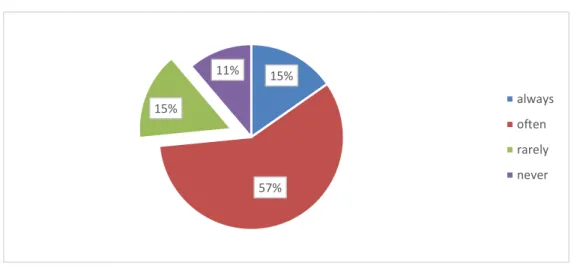
Figure 2.1 Teacher’s Motivation
The first question for learners starts with the motivation as main point to encourage learners for accomplishing their academic performance. The question’s point is to know if teachers motivated their learners in order to enhance their writing and asked them to practice it in classroom. Learners were required to state how much does the teacher invite them to write, learner’s answers were (15 %) claimed that teachers always invite them to write. (57%)state that teachers often ask them to writ. while, (15%)claimed that rarely teachers did. The rest (11%)answer with never, theses answers showed that teachers are not aware about their learner’s weaknesses in writing. As the majority of learners agree that sometimes their teachers are invite them to write. In this case, learner’s lack of motivation may impact their writing performance negatively.
15% 57% 15% 11% always often rarely never
23
(c) The Writing Tasks Frequency
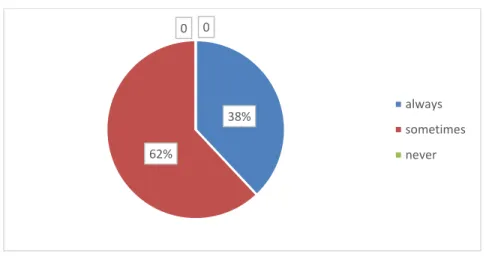
Figure 2.2 Task’s Impact
This question aimed to grasp the importance of tasks which depend on each task, and also to know how much are teachers give their learners tasks mainly in grammar lesson. So, leaners were asked about how many times does the teacher give them tasks in each lesson, some of them (38%) mentioned that “always” their teachers provide them with tasks, in which majority (62%) of them chose “sometimes” as best answer, and none of them (0%) states that teachers never give them tasks. Thus, learner’s answers illustrated that they have need to practice more on their grammar at classroom since teachers are merely provide them with tasks after grammar lesson.
(d) The Use of Dictionary
Figure 2.3 The Importance of Using Dictionaries
38% 62% 0 0 always sometimes never 42% 58% 0 0 yes No
24
Dictionary is a main tool that helps learners to get new vocabularies or to avoid their spelling mistakes, the researcher’s intention was to discover if learners check out new and odd words in dictionaries as way to increase their abilities in writing accuracy and if they do efforts to develop their knowledge, they should tick if they use it or not. Unfortunately, the majority of them (58%) said they did not check dictionary during writing, and (42%) are using this tool to help them, this shows that learners are not interested in improving their writing ability, in which they do not care about making mistakes on their papers.
(e) Teacher’s Techniques in Correcting Errors
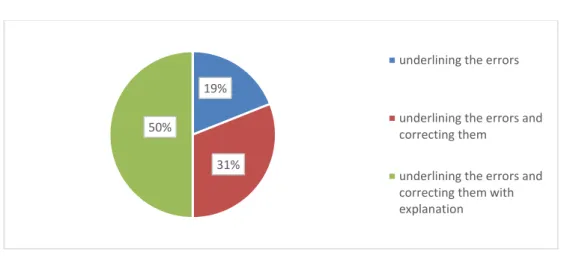
Figure 2.4 Teacher’s Techniques in Correcting Errors
The previous answers has noticed that the majority of learners do not use dictionaries to correct their mistakes, in this question the researcher want to show the role of teacher in correcting errors ,learners were required to select which way do teachers follow when correcting their errors,(19%) focus on the underling errors,(31%) pointed out that their teachers are underling the errors and correcting them .whereas,( 50%) stated that their teachers are underling the errors and correcting them with explanation. fortunately, teachers help their learner’s to avoid their mistakes again and to make them well-known with a different of types errors.
19%
31% 50%
underlining the errors
underlining the errors and correcting them
underlining the errors and correcting them with explanation
25
(f) Learner’s Practice in Writing
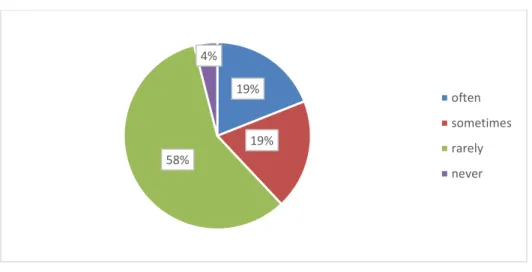
Figure 2.5 The Role of Practicing in Enhancing Writing
The purpose of the question six is discovering how many times learners practice on their writing outside the classroom in sense that if they interested in enhancing their abilities to write well or they do not care about it, learners should pick the suitable response, their answers were (19%) indicated that they often practice on their writing .However, (19%) mentioned that sometimes they practice it on, and (58%) claimed that rarely do so, and the rest (4%) they never practice it. Hence, majority of learners do not practice on their writing for the reasons that may don not prefer writing in English or May they are not interested at all.
(g) Learner’s Interest toward Reading
The previous question’s result stated that a great number of learners do not practice on their writing so what about reading? The role of this question was to see learners interested in reading, particularly in their free time since the later has a positive impact in learner’s skills, they have to select between the two choices if they read or not. On the one hand,(33%)they prefer reading. on the other hand,(67%)decelerated that they are not like reading.it is the same with practicing in writing; majority of learners expressed that do not read much, this has a negative influence on their writing and decreases their others skills.
19% 19% 58% 4% often sometimes rarely never
26
(h)Teacher Awareness toward Learner’s Mistakes
Figure 2.6Teacher’s Awareness toward Learner’s Mistakes
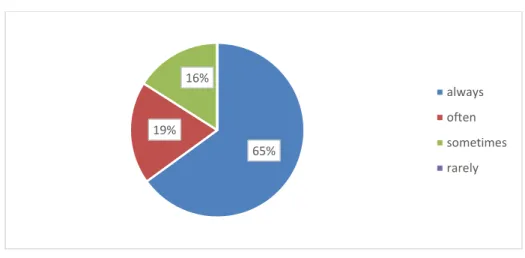
After identifying teacher’s way in correcting learners’ errors, the reason through asking this question was to know more about teachers’ role in classroom environment; learners were asked to choose how much do their teachers correcting their mistakes. Moreover, they are (65%) answered that always their teachers help them to correct mistakes, (19%)answered that often teachers did it. Therefore, (16%) said sometimes in which no one for the two choice of rarely and never .in regard to this, correcting mistakes for learners may help them to get better in their writing and motivates them to increase their efforts to write in an effective way.
(i) Learner’s Awareness about the Terms Fluency and Accuracy
Figure 2.7 Learner’s Awareness about the Terms Fluency and Accuracy
The last question for learners was test their background, the purpose behind asking this question was to recognize if learners have an idea or is they familiar with the two notions fluency
65% 19% 16% always often sometimes rarely 31% 69% yes No
27
and accuracy, learners were asked to choose on answer yes or no, if they say yes, they were required to define fluency and accuracy briefly, (31%) pointed out that they know the two terms, (69%) they are not familiar with the two. Additionally, for those who know the terms ,one of them was defined it as “to be smooth and easy, accuracy is quality of being true and correct However, another one said that fluency is means the eloquence and glibness in speaking or saying something correctly without any mistakes, while accuracy is to do something exactly without any doubt” ,each one defined it differently, another definition who mentioned that fluency “is the ability to speak and pronounce words in a perfect quick way and accuracy means précised and accurate” .therefore, other leaners points out that fluency “is the ability to speak and write easily”. Whereas, “accuracy is the quality of nearness to the truth or the true value. Furthermore the rest of them stated that fluency “means speaking without mistakes; accuracy is how to manage your use of language, or fluency means to speak language without problems, accuracy means when someone is weak in speaking language”, we may notice that all them defined fluency and accuracy as the ability to speak, only one who mentioned the definitions in both skills speaking and writing.
2.3.3 Teacher’s Questionnaires
The questionnaires were addressed to teachers of written expression module at the University of Abed El-Hamid IBN BADIS in Mostaganem and they are twelve teachers with eight questions (see appendices three) which made up of closed questions in which they have to pick up the right answers and other questions are opened that need from them to show their point view or to answer according to their teaching experiences.
28
(a) The Common Mistakes of Learners in Writing
Figure 2.8 Learner’s Common Mistakes
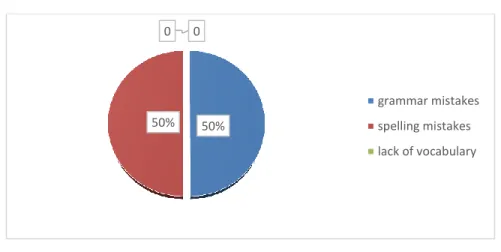
Teachers were asked about what kinds of mistakes do they face it during the correction of exam paper, this question aimed to determine the most kinds of mistakes that the learners may make it in their writing, particularly in the exams since the later limited by time. Thus, most teachers ticked the answer of “grammar errors” and “spelling mistakes”, this confirms that really the learners have serious problem in accuracy because they do not concentrate on grammar while writing; they concentrate only on time and to finish their essays or paragraph which means that they cannot balance between fluency and accuracy.
(b) The Changes of Teacher’s Tasks Techniques
The second question for teacher was about how does their technique change depending on the task they have to complete, the purpose of this question was to get an idea about teacher s’ role and how they contribute on the leaner s’ academic achievement, it also to verify how their technique is differs from one task to another, teachers were demanded to give and explain the changing of their technique. So, one of them states that “this change according to students’ needs, the focus should be on the language area that is not a part of the syllabus” While another one mentioned that this change “depends on the objectives of each task, and on the subject”. However, each teacher has his/her technique and each one mentioned a different idea.
50% 50% 0 0 grammar mistakes spelling mistakes lack of vocabulary