HAL Id: hal-02989595
https://hal.archives-ouvertes.fr/hal-02989595
Submitted on 26 Apr 2021
HAL is a multi-disciplinary open access archive for the deposit and dissemination of sci-entific research documents, whether they are pub-lished or not. The documents may come from teaching and research institutions in France or abroad, or from public or private research centers.
L’archive ouverte pluridisciplinaire HAL, est destinée au dépôt et à la diffusion de documents scientifiques de niveau recherche, publiés ou non, émanant des établissements d’enseignement et de recherche français ou étrangers, des laboratoires publics ou privés.
Natural Glasses
Maria Rita Cicconi, Daniel Neuville
To cite this version:
Maria Rita Cicconi, Daniel Neuville. Natural Glasses. J. David Musgraves; Juejun Hu; Laurent Calvez. Springer Handbook of Glass„ Springer, pp.771-812, 2019, Springer Handbooks, 978-3-319-93726-7. �10.1007/978-3-319-93728-1_22�. �hal-02989595�
1 1
Natural glasses
2 3
Maria Rita Cicconi1 and Daniel R. Neuville2
4
1 – Department Werkstoffwissenschaften, Lehrstuhl für Glas und Keramik, Universität 5
Erlangen-Nürnberg. Martensstrasse 5, D-91058 Erlangen 6
2 - Institut de Physique du Globe de Paris, CNRS, Géomatériaux, Sorbonne Paris Cité, 1, rue 7 Jussieu, F- 75238 Paris 8 9
Abstract
10On Earth, natural glasses are typically produced by rapid cooling of melts, and as in 11
the case of minerals and rocks, natural glasses can provide key information on the evolution 12
of the Earth. However, we are aware that natural glasses are products not solely terrestrial and 13
that the formation mechanisms give rise to a variety of natural amorphous materials. On the 14
Earth´s surface, glasses are scarce compared to other terrestrial bodies (i.e. Moon), since the 15
conditions on the surface give rise to devitrification or weathering. 16
In order to provide an exhaustive overview, we are going to classify natural glasses 17
based on the mechanisms by which they were formed. When talking about natural glasses, the 18
first image is that of an obsidian, a volcanic glass that has been used since prehistoric times 19
and has accompanied and influenced human evolution. Indeed, the largest volumes (km3) of 20
natural glasses (e.g. obsidian, perlite and pitchstone) are linked to volcanic activity and 21
associated with cooling close to the surface. Tektites and impact glasses are formed in a 22
completely different way since their formation is related to the impact of an extraterrestrial 23
body on the surface of the Earth. Therefore, since glasses are formed by different processes, 24
2 we will provide a subdivision based on the formation mechanisms: temperature related,
25
temperature-pressure related, temperature-pressure-volatiles related, and others: 26 - Quenched glasses 27 - Impact glasses 28 - Obsidian 29 - Others. 30
At the end we will provide some insights into the structure and properties of natural 31
glasses and melts. 32
33
Several reviews, for the different natural glasses, have been published and the readers 34
are referred to these exhaustive papers: i.e. [1–7]. An interesting nomenclature for natural 35
glasses was provided by Heide and Heide [6], which divided natural non-crystalline solids 36
into four main groups, depending on their origin: magmatic, metamorphic, sedimentary and 37
biogenetic. 38
39
The chemical composition of natural glasses varies from mafic to felsic. Figure 1 40
reports the Total Alkali vs. Silica (TAS) diagram, where the compositions of many natural 41
glasses (Table 1) have been recalculated to 100% excluding water and carbon dioxide. The 42
enormous variability of natural glasses composition can be appreciated in the TAS diagram, 43
since they are differentiated as many common types of volcanic rocks ([8]). Indeed, the 44
diagram shows how widely natural glasses can vary in their composition, with SiO2 contents 45
ranging from 30 to 99wt%, and total alkali contents ranging from 0% up to 15wt%. The list 46
presented is, of course, not exhaustive, but represents many different glasses and their average 47
compositions. 48
49 50
3 Table 1 - Average composition of the major oxides (wt%) in several natural glasses.
51
52
Fig. 1 - Total alkali vs. silica (TAS) diagram for several natural glasses (most of the data
53
and references are reported in Table 1).
54 55
4
CONTENTS
56 1 – QUENCHED GLASSES 57 1.1 - Volcanic glasses 58Applications: alteration of natural glasses as analogue of nuclear waste glasses 59 1.2 - Lunar glasses 60 61 2 – IMPACT GLASSES 62
2.1 - Tektites and microtektites
63
2.2 - K-Pg (KT) spherules
64
2.3 - Younger Dryas (YD) event
65
2.4 – Enigmatic impact glasses
66
2.4.1 - LDG - Libyan Desert Glass 67 2.4.2 - Darwin glass 68 2.5 – Fulgurites 69 70 3 – OBSIDIAN 71
3.1 – Hydrated and altered obsidians
72 73
4 – OTHERS
74
4.1 - Glasses from nuclear explosion
75 4.2 - Friction melts 76 4.3 - Bioglasses 77 78
5 – Insights into the structure and properties of glasses
79 80
6 - Conclusions
81 82
5
Important abbreviations
83 Ab = albite - NaAlSi3O8 84 An = anorthite - CaAl2Si2O8 85Basalt = extrusive igneous rock (forms from lava that cools rapidly at Earth's surface) 86
Deep Sea Drilling Project (DSDP) = Multi-institution US programme operating a drilling ship 87
for scientific sampling of the oceans from 1968 to 1985 [9]
88
Effusion rate = the volume rate of lava production (m3/s) [8]
89
FAMOUS = French-American Mid-Ocean Undersea Study 90
Feldspar: group of silicate minerals (e.g. Anorthite, Albite, Orthoclase) 91
Felsic = (e.g. rhyolite) term used for magmas/rocks enriched in lighter elements: SiO2, alkali 92
elements and Al2O3. 93
Hypervelocity impacts = Impacts, involving impacting bodies that are traveling at speed 94
(generally greater than a few km/s) higher enough to generate shock waves upon impact. 95
K-Pg = Cretaceous–Paleogene (K–Pg) boundary (~66 million years ago) 96
KT = Cretaceous-Tertiary boundary (former name for K-Pg) 97
Lechatelierite = shock-fused SiO2 glass 98
LDG = Libyan Desert Glass 99
Mafic rocks = (e.g. basalt) magmas/rocks with ~50wt% SiO2, enriched in Fe, Mg and Ca, and 100
usually dark in color. 101
MN = Muong Nong-Type tektites 102
MORB = Mid-Ocean Ridge Basalt 103
Or = orthoclase - KAlSi3O8 104
Planar deformation features (PDFs) = microscopic parallel, isotropic features in minerals that 105
originate from elevated shock metamorphism. 106
Pyroxenes = group of silicate minerals (e.g. diopside CaMgSi2O6) 107
SF = tektite/impact glass strewn fields 108
TAS = Total-Alkalis versus Silica diagram 109
Tektites = millimeter- to centimeter-scale, glassy particles of ballistically transported impact 110
melt, formed by the impact of an extraterrestrial projectile. Microtektites are less than 1 mm 111
in size. 112
6 Tg = Glass Transition temperature
113
YD = Younger Dryas is a geological period from ~ 12,900 to ~ 11,700 BP 114
YDB = Younger Dryas boundary 115
Ultramafic rocks = (e.g. komatiite) magmas/rocks with very low silica content (< 45wt% 116
SiO2). 117
Wo = wollastonite - CaSiO3 118
XAS = X-ray Absorption Spectroscopy 119
7
1 - QUENCHED GLASSES
121
Basalt is a mafic igneous rock with a SiO2 content that lies between 45-52 wt%. 122
Basaltic melts are produced in a wide variety of tectonic environments on Earth (and also 123
occur on other terrestrial bodies including the Moon) [8], and can be classified depending on 124
the geological setting in which they have formed. 125
Mid-ocean Ridges, where new oceanic lithosphere is continually built from mantle 126
melting, has a total length of more than 60000 km and produce ~ 21 km3 of lava per year. Mid 127
- ocean ridge basalts (MORBs) are tholeiitic basalts (mafic magmas enriched in Mg and Fe) 128
that commonly contain phenocrysts of silicate minerals and oxides (e.g. olivine (Mg,Fe)2SiO4, 129
chromite (Mg,Fe)Cr2O4, etc…) [8].The most distinctive aspect of Mid - ocean ridge basalts is 130
their chemical composition: i.e. most MORBs (normal MORB) have similar major element 131
compositions, and are characterized by low contents of K2O and other incompatible elements. 132
Another class of MORB, referred to as E-MORB (enriched MORB), has very different trace 133
element compositions and is significantly enriched in the more incompatible elements [9].
134
The chemical variations observed between basalts from different terrestrial tectonic settings 135
can provide key information about the processes by which basaltic melts are generated in the 136
Earth’ s interior [8]. 137
Basalt flows, erupted under water, differ in form from those erupted on land, and a 138
variety of lava flow morphologies (typically classified as pillowed, lobate, or sheet flows on 139
the basis of their morphology) is found at Mid-ocean Ridges. Pillow lavas (see Fig. 2) are 140
approximately spherical or cylindrical bodies result from lower effusion rates, whereas sheet 141
flows form from higher effusion rates [9]. The lobate morphologies is a type of bulbous lava 142
flow wider and flatter than pillow lava, typical of intermediate effusion rates or flow on 143
moderate sea floor slopes [9]. Indeed, Gregg and Fink [10] by carrying out 182 controlled 144
laboratory simulations, in order to quantify the effects of effusion rate, cooling rate, and sea 145
8 floor slope on lava morphologies, suggested that the variation from sheet flows to pillows 146
reflects a decreasing effusion rate for a given viscosity and sea floor slope [10]. 147
Rapid quenching in cold seawater commonly results in a glassy matrix. Because of the 148
fast quench of basaltic melt causes fragmentation, submarine lava flows are often associated 149
with deposits of fine, glassy pieces called hyaloclastite (from the Greek: “glassy fragment”). 150
The glassy fragments alter to a yellow or green-brown hydrated mass called palagonite (see 151
later). 152
153
Figure 2 – Basaltic glass from French-American Mid-Ocean Undersea Study (FAMOUS) area 154
on the Mid-Atlantic Ridge. Image copyright: D.R. Neuville. 155
156 157
Several studies have been devoted to understanding the oxidation state of Mid - ocean 158
ridge basalt glasses since the redox state of the mantle is reflected in the oxidation state of 159
MORBs (e.g. [11–14] and references therein). The understanding of the mantle redox 160
equilibria is deeply linked to the magmatic differentiation, element partitioning, and 161
speciation: e.g. C-O-H-S equilibria in magma and during degassing. 162
9 1.1 – Volcanic glasses
164
Volcanism is not exclusively basaltic in all tectonic environments on Earth, even if basalts 165
are found on the surface of the Earth in greater volume than any other volcanic type. 166
Basaltic glasses have an average composition of about (wt%) 49-54% SiO2, 15-20% 167
Al2O3, 8-10% FeOtot, 2-5% alkali (K2O + Na2O), 10-20% alkali-earth (CaO + MgO) [15] and 168
their low viscosity favors crystallization (devitrification). Volcanic glass commonly produced 169
upon rapid cooling of melts of basaltic composition is called sideromelane. Basaltic glasses 170
also occur as volcanic ash, fibers and teardrops (i.e. Pele’s Hair and Pele’s Tears) and more 171
rarely form solidified foam – reticulite (Fig. 3) [16]. 172
173
174
Figure 3 – Reticulite from Erebus volcano. This highly foamed sample is mainly composed of 175
glass. Image copyright: D.R. Neuville (sample dimension 7x6x5cm). 176
10 Pele's tears are spherical pyroclasts with sizes varying from few μm to hundreds of μm 178
of diameter, and the droplet shape is mainly controlled by the surface tension, the acceleration 179
of the droplet after eruption and air friction [17]. In contrast, Pele's hairs have cylindrical 180
forms (1 to 500 μm in diameter) and are extremely delicate (Fig. 4). Pele´s hair and tears form 181
during fountaining of the fluid lava (hawaiian-style eruptions) with an extremely high cooling 182
rate. Hawaiian tholeiitic basalt magmas have temperatures of 1050°-1200°C, and gas contents 183
ranging from 0.5 to 2 wt% [18]hence Hawaiian eruptions are characterized by the emission 184
of very fluid lava. Shimozuru [19] suggested that Pele´s hairs are produced when the velocity 185
of erupting magmas is high and Pele's tears when it is “relatively” lower. Moune et al. [20]
186
observed that Pele's tears can be associated with Pele's hairs after their formation. Pele's hairs 187
have vesicles, typically parallel to the axis of elongation that break and often form long open 188
cavities. Pele´s tears can be also trapped on the walls and/or in these cavities [20]. These 189
pyroclastic products are not solely associated to Hawaii volcanisms, since many other 190
volcanoes produce them (e.g. Etna, Réunion, Masaya volcano, etc… ). 191
192
193
Figure 4 – Photograph of Pele's hairs along with few melt droplets (Pele´s tears). Samples from 194
Hawaiian Islands. Image copyright: D.R. Neuville (square dimension=5mm). 195
196 197
11 Fiber is usually one of basic reinforcing elements of composite materials, and in the
198
framework of developing environmentally sustainable composites, the use of natural fibers
199
(e.g. basaltic fibers) has been an active field of study in the last decade [e.g. [21]]. Indeed,
200
basalt fibers have properties, comparable to those of the synthetic ones, are cheaper of carbon
201
fibers, and have even better mechanical properties than most types of E-Glass [22]. Fiore et
202
al.[21] in their review report the main properties and several applications of basalt fibers.
203
Here we report a few of the advantages of the use of these fibers:
204
- use of natural basalt rocks as raw material, thus no additive needed;
205
- the manufacturing process of basalt fibers is similar to that of other glass fibers, but with less
206
energy consumed (lower temperatures required), which makes it cheaper than glass or carbon
207
fibers [21–23];
208
- mechanical properties similar to those of synthetic glasses (e.g. E-Glass) [21, 23];
209
- high thermal and chemical stability [21, 24];
210 211
Among the volcanic glasses, an interesting melt/glass composition is the phonolitic 212
one. There are few long-lived lava lakes, and among them the phonolitic lava lake of the 213
Erebus volcano (Ross Island, Antarctic) has attracted many scientists. Both chemical and 214
isotopic compositions of the magma in the Erebus lake have remained almost constant since 215
the 1970s, when it was discovered [25, 26]. Erebus phonolitic magma/glass (Fig. 5) is Na 216
enriched (average composition: SiO2 ~55wt%, Al2O3 ~20wt%, FeOtot >5wt% and alkali 217
(Na2O + K2O) >14wt%; see Table 1) and has low viscosities (for an anhydrous and crystal-218
free melt, in the temperature range ~ 670-770°C, viscosity ranges between 1010 and 1012 Pa*s 219
[27]). 220
Interestingly, foamed phonolite has been observed in some lava bombs from the 221
Erebus. Kyle [28] describes some phonolitic bombs as extremely breakable samples, since 222
they consist of highly pumiceous - dark green to black - glass with anorthoclase phenocrysts. 223
12 The bombs are “fusiform” and highly vesiculated with the size of vesicles from 1-2 mm up to 224
40 mm on the surface and with some of the holes crossed by fine glassy hairs. 225
226
227
Figure 5 – Bomb sample from Erebus volcano with the surface covered by olive green and black 228
glass with a metallic lustre, and anorthosite crystals. Image copyright: D.R. Neuville (square 229
dimension=5mm). 230
231 232
The small thickness of basaltic glasses that are formed by natural processes, along 233
with a strong tendency to devitrify, result in the alteration of basaltic glass in relatively short 234
time (a few thousand to tens of thousands of years) [29]. The alteration processes of volcanic 235
glasses, and in particular the formation of secondary minerals, is an extremely important topic 236
of study, and in a review paper, Stroncik and Schmincke [30] listed three main reasons: i) the 237
alteration of volcanic glass influences the chemistry of natural waters; ii) the economic 238
relevance of bentonite deposits (clay mineral) formed by the alteration of pyroclastic 239
materials; iii) the alteration processes of natural glasses can be used as analog for modeling 240
the long-term stability of glasses used for nuclear waste immobilization (see below). 241
13 In altered basaltic glasses of hyaloclastite deposits from Sicily (Monti Iblei, Sicily) it 242
was first described a resin-like transparent substance that thereafter was called “palagonite” 243
[30]. Palagonite is considered the first stable product of the alteration caused by the 244
interaction of glass and aqueous solutions (Fig. 6). Indeed, basaltic glass in contact with water 245
forms this alteration zone whose thickness increases linearly with time [29]. The occurrence 246
of this layer has been confirmed under various alteration conditions, and it can be more or less 247
crystalline and commonly associated with the presence of clays (e.g. [30, 31]). 248
249
Figure 6 – Palagonite specimen. Image copyright: D.R. Neuville. 250
14 252
Applications: alteration of natural glasses as analogue of nuclear waste glasses 253
The study of basaltic glasses is not only related to Geoscience (s.l.) for understanding
254
the eruptive processes, or for understanding the formation of economic mineral deposits.
255
Natural basaltic glasses have been widely used as analogues in studies for evaluation of the
256
long-term stability of nuclear waste form glasses [32, 33] because a challenging aspect of
257
nuclear waste repositories is the extrapolation of short-term laboratory data (hours to years) to
258
the long time periods (hundred to thousand years) [34]. Therefore, in the last decades many
259
studies have been devoted to get information from natural analogues, in order to corroborate
260
predictive models of the long-term processes which affect the stability of radioactive waste
261
repositories, since they provide the opportunity to examine processes occurring over
262
geological timescales (natural basalt provide data on the alteration behavior of amorphous
263
materials over tens or hundreds of thousands years) (e.g. [35–38]).
264
From all the studies it has been highlighted that basaltic glasses and borosilicate
265
nuclear waste form glasses appear to be similar in their corrosion rates and mechanisms
266
despite the significant compositional differences. Thus, the alteration processes observed for
267
natural basalt glasses are relevant to understanding the alteration of nuclear waste glass, as
268
both appear to react via similar processes. An early study from Zielinski [35] on the stability
269
of glass in geological environments report three main observations for natural silicate glasses:
270
1 - Breakdown of glass in a water-free environment is too slow to be of concern for the
271
periods of time required for safe waste disposal;
272
2- Contact between glass and a hot aqueous phase accelerates all processes of glass alteration.
273
Glass hydration and dissolution rates become fast enough that significant alteration of glass
274
can occur in the period required for hazardous radionuclides to decay;
15 3- Other parameters that can influence hydration/dissolution rates of glass/water interaction,
276
include pH, composition, salinity, etc... [35].
277
Byers et al. [37] reported that the alteration of basalt glasses in nature is driven by a
278
hydrolytic dissolution/re-precipitation mechanism which results in the formation of
well-279
defined iron-rich aluminosilicate surface layers (palagonite). Natural glass alteration is also
280
accompanied by the precipitation of authigenic cements (e.g., zeolites, clay minerals), and the
281
clay mineralization observed on natural glasses is very similar to that produced on laboratory
282
altered glasses [39, 40]. More recently, Techer and coauthors [38], Poinssot and Gin [41] and
283
Parruzot et al. [31] corroborate the analogy of alteration kinetics/mechanisms for natural and
284
synthetic basaltic glasses, archaeological glasses, and the SON68 (or R7T7) nuclear waste
285
glass (a simulated French inactive nuclear reference glass).
16 1.2 Lunar Glasses
287
Lunar glasses with colours from red through green are widely distributed in lunar soil. 288
Lunar glasses differ completely from terrestrial ones by the very low content of water or other 289
volatiles, and really high contents of MgO and FeO. The volcanic lunar glasses are mainly 290
homogeneous spherules (50 m to 1 mm in diameter) with compositions from basic to 291
ultrabasic (SiO2 ~33-48 wt%, Al2O3 ~4.6-9 wt%, TiO2 ~0.26-16 wt%, MgO ~11–20 wt%, 292
and FeO ~16-24 wt%; see Fig. 1 and Table 1). 293
Since the Apollo missions, several homogeneous glass samples have been returned 294
from six different lunar locations. Delano [2] distinguished 25 different types of lunar 295
volcanic ejecta, which differ conspicuously from terrestrial volcanic ones both in composition 296
and in shape, with the lunar ones, typically having extremely low silica content (see Table 1) 297
and spherical shape [16]. The high variability of TiO2 contents led to several studies to 298
understand the origin and differences of these glasses. Indeed, as pointed out by Delano [2]
299
the TiO2 abundance variability could reflect the complex processes associated with lunar 300
magma petrogenesis. Figure 7 shows the variation of SiO2 and FeO against TiO2 content in 301
lunar glasses (data and references in Table 1). It is possible to distinguish several areas, 302
depending on Ti content: the green glasses from Apollo 15 landing site have the lowest Ti 303
content (low-Ti) and are enriched in SiO2. On the contrary, orange/red/black glasses have 304
high-Ti and lower SiO2 contents. The intermediate yellow glasses were found in samples from 305
Apollo 14, 15 and 17 landing sites. Apollo 14 suite contains the highest iron content of all the 306
known glasses [42] and some black glasses. 307
17 309
Figure 7 – Variation of SiO2 and FeO contents vs. TiO2 content in lunar glasses (data in
310
Table 1). Modified after Delano [2] and Brown and Grove [42] and references therein).
311 312
Lunar glasses were at first believed to be of impact origin, but later studies pointed to 313
volcanism. The Lunar Magmatism (so called Mare basalts) is represented by the dark smooth 314
areas on the Moon. In addition to the eruption of large volumes of lava, the colored volcanic 315
glass beads were produced by lava fountaining. These glass beads, as homogeneous quenched 316
materials, provide some of the most important constraints to models of mare-basalt 317
petrogenesis and for studying the characteristics of lunar interiors (composition, phase 318
stability, thermodynamic parameters) [43]. Indeed, several studies on lunar glasses have been 319
performed in order to provide constrains on models used to represent the lunar interior and 320
insights into the thermal histories of lunar regions (experimental constraints on the origin of 321
lunar ultramafic glasses e.g. [2, 44–51]. 322
An examination of experimental data and thermal models is reported in a review by 323
Shearer et al. [52]. From low-pressure phase equilibria experiments it was highlighted that 324
glasses are characterized by (1) high liquidus temperatures, (2) olivine ((Mg, Fe)2SiO4) (± 325
Chrome spinel, (Mg,Fe)(Al,Cr)2O4) as the only liquidus phase, and (3) the remaining silicate 326
and oxide phases are relegated to much lower temperatures [52]. These features suggest that 327
the glass beads are primitive (least fractionated) magmas generated at considerable depths in 328
18 the lunar mantle. The phase equilibria experiments on glasses provided range of pressure from 329
1.5 to 2.4 GPa and high temperatures (1430-1560°C) [52]. 330
331
Particular attention has been given to quantifying the redox conditions on the Moon
332
(the readers are referred to the exhaustive review by Wadhwa [53]). First of all, it is important
333
to point that in Geosciences, the oxidation-reduction conditions of a system usually are
334
described by using “redox buffer”, that is the fugacity-temperature stability field for minerals
335
and oxides (the phases coexist only at the buffer line). Examples of such redox buffers are:
336
- magnetite-hematite (MH) 2Fe3O4+ ½O2 = 3Fe2O3
337
- nichel-nichel oxide (NNO) 2Ni + O2 = 2NiO
338
- iron-wüstite (IW) 2Fe + O2 = 2FeO
339
Iron is one of the most abundant elements that exists in more than one oxidation state 340
(Fe0, Fe2+ and Fe3+), thus, generally the redox is expressed in terms of iron oxidation state, 341
i.e., the relative proportions of the different iron valences [54]. Fe2+ and Fe3+ are most 342
applicable to the range of oxygen fugacity (fO2) in terrestrial and martian basalts[55]. Lunar 343
basalts formed under significantly more reducing conditions than terrestrial basalts and the 344
estimations of the fO2 conditions for lunar basalts and lunar glasses have been made using a 345
variety of methods (e.g. [56–59]). Based on the several experimental works done, Moon redox 346
conditions are estimated to range from ~2 log units below the Iron- Wüstite buffer (~IW–2) to 347
close to the IW buffer [53]. For comparison, the range of oxygen fugacity on Earth can be 348
represented by oxygen fugacity in the range IW+2 to IW+6. Papike et al. [55] provided a 349
schematic representation of the range of valence states of several multivalent elements with 350
the range of fO2 of planetary basalts (relative to the IW buffer) (Fig. 1 in [55]). 351
352
Few Si-enriched glasses (with SiO2 contents > 60wt%) have been found in soil (and 353
breccia) samples from the Apollo 11, 12, 14, 15 and 17 landing sites and from the Luna 16 354
19 and 20 sites [60]. Among them Glass [60] found only one colorless (without vesicles or 355
crystalline inclusions) high-silica spherule. The analysis of these glasses results in an average 356
composition of the major elements similar to that of terrestrial volcanic glasses, even if the 357
lunar glasses have higher K2O and lower Na2O contents than the terrestrial ones. The author 358
studied both petrology and chemistry of several Si-enriched glasses and described the 359
origin/source of these material not as residual glass or impact-produced glasses from a 360
granitic source, but as products of lunar acidic volcanism [60]. 361
20
2 – Impact glasses
363 364
The generic term impactite refers to a large variety of rocks formed by the melting of 365
crustal rocks during the impact of a large extraterrestrial body. A series of distinct materials 366
(impactites) is generated by the forces of a hypervelocity impact, starting with shock 367
compression and followed by decompression from peak shock pressures, with associated heat 368
generation [61]. Depending on the pressure generated, several distinct markers will be 369
formed, and by increasing pressure there are: planar deformation features (PDFs), diaplectic 370
mineral glasses (produced without fusion), fused mineral glasses (produced with fusion), and 371
melts [61]. 372
We will mainly discuss the most homogeneous glasses created by such events, i.e. 373
tektites. To distinguish “impact glasses” and tektites, Koeberl [62] provides the following 374
characteristics for tektites: i) are amorphous and fairly homogeneous, ii) contain lechatelierite 375
(amorphous SiO2), iii) occur within definite areas, called strewn-fields (SF), iv) tektites do not 376
occur directly in or around a source crater (distal ejecta), and have v) low water content 377
(<0.02wt%, at least an order of magnitude lower than the H2O content of volcanic glasses). 378
Moreover, studies on iron oxidation state show that Fe is generally highly reduced in tektites, 379
with almost all occurring as Fe2+[63–66]. 380
381
2.1 Tektites and microtektites 382
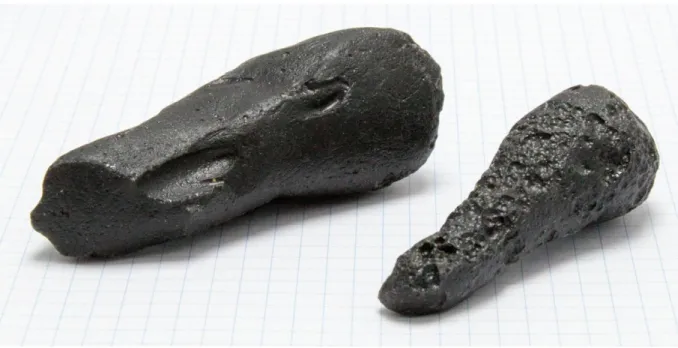
Tektites are small, black, glassy objects that are found only in certain areas of the 383
Earth’s surface. Most of the tektites are Si-rich glasses of various sizes (usually > 1 cm), with 384
typical aerodynamic shapes and very characteristic surface features (Figs. 8-9). Microtektites 385
are microscopic tektites (< 0.1mm) found in deep-sea sediments [4]. 386
21 387
Figure 8 – Tektites specimens with the typical aerodynamic shapes and characteristic surface 388
features. Image copyright: D.R. Neuville (square dimension=5mm) 389
390
Based on their shapes it is possible to distinguish three types of tektites: Muong Nong-391
Type (or layered), splash forms, and ablated/flanged tektites. Splash-form tektites (the most 392
common form), include spheres, flattened ellipsoids, tear-shaped bodies (Fig. 8), rod-shaped 393
bodies (generally thickened at both ends), canoes, and saucer-shaped objects [67].
394 395
396
Figure 9 – Photos of some tektites, including a moldavite (length ~ 18 mm) and two indochinites 397
(length ~ 25 mm). Image copyright: M.R. Cicconi 398
399
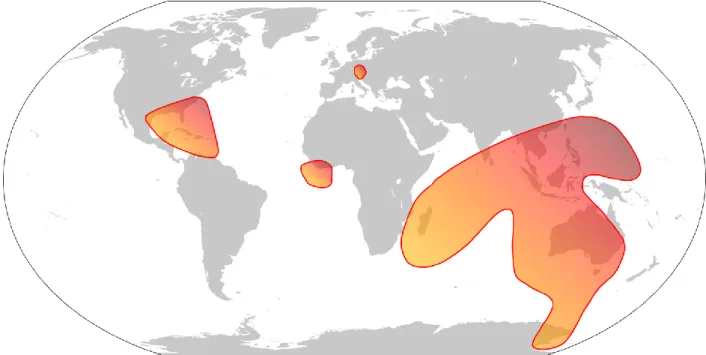
To date, four main groups of tektites, associated with separate impacts and strewn 400
fields (SF), are known (e.g., [68–71]): the North American, the Ivory Coast, the central 401
European and the Australasian (Fig. 10). The source craters have been located for three of the 402
22 four tektite strewn fields, based on geographic location, geochemical evidences, and
403
composition [72–74]. 404
The oldest strewn field is the North American (NA) field of ~ 35.5 Ma age associated 405
with the ~ 40 km wide Chesapeake Bay impact structure [75] and includes Bediasites, 406
Georgianites, Barbados and Cuba tektites, respectively found in Texas, Georgia, Barbados 407
and Cuba (Fig. 10). The central European (CE) or moldavite strewn field of 14.4 Ma age is 408
associated with the Ries crater of about 24km in diameter (Nördlinger Ries, Bavaria, D). 409
There is another impact crater, the Steinheim crater, ~ 3.8 km in diameter, located about 42 410
kilometers west-southwest from the centre of Ries. These two craters are believed to have 411
formed nearly simultaneously by the impact of a binary asteroid [76]. The Ivory Coast (IC) 412
tektite strewn field is associated with the 1.07 Ma old Bosumtwi crater (10.5 km diameter, 413
Ghana, Africa). The youngest SF, of about 0.8 Ma, is the Australasian one, for which no 414
source crater has been identified so far. Tektites of the Australasian strewn field (AA) include 415
australites, thailandites, indochinites, philippinites and javanites and spread from the 416
southeastern region of Asia down to Australia (Fig. 10). Recently, glass spherules 417
(microtektites) were discovered on the Victoria Land Transantarctic Mountains (Antarctica) 418
and there is clear evidence [69, 77, 78] that these microtektites represent a major 419
southeastward extension of the Australasian strewn field. 420
Even if no source crater has been discovered yet, several authors suggest a location for 421
the AA crater in the Indochina region (see [79–82]). 422
23 424
Figure 10 – Approximate location and extension of the four strewn fields: NA (North American), 425
IC (Ivory Coast), CE (central Europe) and Australasian (AA). The location of the known source 426
craters are Chesapeake Bay (NA), Ries (CE) and Bosumtwi crater (IC). Image copyright: M.R. 427
Cicconi 428
429 430
Three of the four tektite strewn fields so far known also present microtektites 431
(diameter < 0.1mm): the North American, the Ivory Coast, and the Australasian SF. These 432
spherules have been found in deep-sea deposits (see, e.g. [4, 83–85]) and are very important 433
for defining the extension of the strewn fields (e.g., [86]), for constraining the stratigraphic 434
age of tektites, and to provide an indication regarding the location of possible source craters 435
(e.g., [79]). Trace element abundances confirm that microtektites are genetically related to 436
tektites in the associated strewn field [87], but microtektites usually show a wider 437
compositional range than tektites. Glass [4] assigns the different methods of analysis used, to 438
explain the compositional differences between microtektites and tektites. A difference 439
between microtektite and tektite samples was recently found by Giuli and coauthors [88]. The 440
authors have shown that some North American microtektites present higher Fe3+/Fe2+ ratio 441
(up to 0.61), compared to the respective tektites, implying that, probably, different formation 442
mechanisms are involved for the formations of such small objects [88]. 443
24 444
Muong Nong-Type tektites (MN - named after a region in Laos) are a subgroup of 445
tektites that are unusually large (up to several tens of centimeters in size) and with layered 446
structures. MN tektites are enriched in volatile trace elements (e.g., Cl, Br, Zn, Cu, Pb), 447
present chemical heterogeneity (darker and lighter layers), and may contain relict mineral 448
grains (e.g. corundum, quartz, chromite and cristobalite) and bubbles [71]. Muong Nong-Type 449
tektites strongly differ from volcanic glasses because of the presence of shocked mineral 450
inclusions, for differences both in major and trace element contents (e.g. REE patterns), very 451
low water content, highly reduced iron and the presence of 10Be [89]. Koeberl [89]observed 452
that Muong Nong-Type tektites contain higher abundances of the most volatile elements (the 453
halogens, Cu, Zn, Ga, As, Se, Pb) compared to the splash-form tektites (the most common 454
tektites). The presence of relict mineral grain, and the relatively higher water amount in 455
Muong Nong-Type tektites suggest that MN have experienced the lowest temperatures of all 456
tektites [89]. Is assumed that Muong Nong-type tektites have been deposited closer to the 457
source crater and that they derive from a greater depth in the target deposits than were most of 458
the other tektites [82]. 459
The details of tektite and microtektite formation and on their distribution from the 460
source crater are unknown and greatly debated. Numerical modeling indicates that high-461
velocity impacts (35–40 km/s) into a dry target with impact angles of 30° to 50° may provide 462
the best conditions for tektite production [90, 91]. Indeed, the position of the strewn fields, 463
with respect the inferred parent crater, indicates that tektites formed after oblique impacts. 464
However, the tektite-producing impact processes still have several open questions [92]
465
because physical and mathematical models are hampered by the limited information available 466
(e.g. the importance of superheating), and because the impact process is a highly non-467
equilibrium and heterogeneous process. For instance, the exact target rocks from which 468
25 tektites have been produced are not known yet, because it would require an accurate
469
understanding of the physical-chemical processes, which may alter the chemical composition 470
of the target rocks during impact. Moreover, the extent of volatilization, the state of tektite 471
material after impact melting, or, what the size distribution of the melt droplets is [93], are 472
still not understood. Engelhardt and coauthors [72] suggested that the tektite material is 473
completely vaporized to a plasma state, and then the condensation from the plasma could 474
form coalescing droplets. The hypothesis of tektite formation from a vapour plume might 475
explain the ejecta homogeneity, and also the rapidity of homogenization of large volumes and 476
the long distance transport. More recently, Johnson and Melosh [94] investigated droplets 477
formation in impact produced vapor plumes and defined a linear correlation between the size 478
of the ejected droplets and the size of the impacting object. 479
480
2.2 - K-Pg (KT) spherules 481
These small spherules (100-500m), that resemble microtektites, were first detected in 482
the Cretaceous-Paleogene K-Pg (formally known as KT- Cretaceous-Tertiary) layer in 483
Gubbio (I) [95] and are associated with the most recent major impact event on Earth. Around 484
65-66 Ma ago there was the collision of an asteroid that caused a massive extinction with an 485
impact crater of about 180 km identified on the Yucatan Peninsula and known as Chicxulub 486
crater [96]. This large (cataclysmic) event is responsible for the formation of worldwide ejecta 487
horizons, and caused the end-Cretaceous mass extinction, around 66 Ma ago. 488
K-Pg distal impact ejecta layers are associated with Ir enrichments, siderophile 489
element anomalies, shock metamorphosed mineral (quartz grains, coesite and stishovite) and 490
rock debris. Because of the poor preservation of the claystone K-Pg boundary, there was an 491
early discussion about the origin of these spherules. Some authors supported the impact 492
hypothesis (e.g. [97]), whereas others attributed an authigenic origin for those microspherules 493
(e.g. [98]). However, Sigurdsson et al. [99], by studying the glasses preserved at the K-Pg 494
26 layer at Beloc in Haiti, provide clear evidences of an impact event. Moreover, Koeberl [100]
495
and Koeberl and Sigurdsson [101] also provided exhaustive geochemical data for the impact 496
origin of these Haitian Si-rich glasses and reported the occurrence of rare inhomogeneous 497
glasses with lechatelierite and other mineral inclusions, which are typical for an origin by 498
impact [100]. In particular, the identification of Planar deformation features (PDF) in quartz 499
in the K–Pg boundary-event bed was the key for the acceptance of this layer as an impact 500
horizon [102]. Usually PDFs occur in silicate minerals, such as quartz and feldspars, which 501
develop PDFs at pressures between 10–15 and 35 GPa. [71]
502
The study of the K–Pg boundary ejecta provided the most influence for the discussion 503
about the importance of impact events with respect to the evolution of the planet and of life, 504
and the detailed study of a K-Pg distal impact ejecta layers had led to the discovery of one of 505
the largest impact structures on Earth – the 180 km Chicxulub crater [93]. 506
507
2.3 – Younger Dryas Spherules 508
The Younger Dryas (YD) event is the name of a hypothesized impact event that may 509
have occurred at the beginning of the Younger Dryas (~12.8 ka), and as emphasized by Bunch
510
et al. [103], “impact” denotes a collision by a cosmic object either with Earth’s surface, 511
producing a crater, or with its atmosphere, producing an airburst. 512
This hypothetical impact event seems to be supported by several markers, listed by 513
Firestone and coauthors [104]. The authors describe the occurrence of a <5-cm-thick sediment 514
layer dated ca. 12.9 ka in several sites in North America ([105] expand the list and report also 515
a few layers in Europe and in Syria). The markers include: magnetic microspherules, grains 516
enriched in Ir, vesicular carbon spherules, glass-like carbon, nanodiamonds, fullerenes 517
containing extraterrestrial concentrations of 3He, the presence of singular forms of soot, and 518
charcoal. 519
27 Younger Dryas boundary (YDB) spherules resemble the K-Pg spherules. Wittke et al.
520
[105] report detailed geochemical and morphological analyses of nearly 700 glass spherules 521
from quite a few sites. These samples are Fe-and/or Si-rich magnetic spherules with 522
dimensions ranging from 10 μm to 5.5 mm in diameter, with shapes from simple spheroids, to 523
teardrops and dumbbells. The authors describe three groups of YDB objects based on 524
chemistry: i) an Al/Si group, ii) a Fe-rich group, and iii) a high-Si/low-Al group. Some scoria-525
like objects and spherules are mainly composed of shock-fused vesicular lechatelierite, 526
whereas other present enrichment in Fe. Wittke et al. [105] conclude that these spherules are 527
geochemically and morphologically comparable to cosmic ejecta associated to other high-528
energy events. Despite all this evidence, the hypothesis of the YD impact or airburst is still 529
largely debated, since most of the reported markers could not be confirmed in independent 530
studies. In the last few years several arguments for and against this hypothesis have been 531
published, and the readers are referred to: (e.g. Surovell et al. [106], Pinter et al. [107],
532
Boslough et al. [108], Van Hoesel et al. [109]). 533
The YD impact is not the only debated event, and recently, Reimold and coauthors 534
published a detailed paper on impact controversies [110]; e.g. the Maniitsoq structure 535
(Greenland), and the unconfirmed Khebira (Egypt), Arkenu (Libya), Bedout (Australia) 536
craters (cf. [110]). 537
538
2.4 - Enigmatic Impact glasses 539
Glass and Simonson [71] in their review on distal impact ejecta describe the 540
occurrence of glasses, believed (almost certainly) to be of impact origin, but not found in 541
stratigraphic contexts. These natural glasses have been found in several locations on Earth, 542
and we are going to describe two of the most famous: i) Libyan Desert Glass, and ii) Darwin 543
glass. 544
545
28 2.4.1 - Libyan Desert Glass - LDG
546
In an area of about 6500 km2 in southwest Egypt, close to the border with Libya, 547
fragments of a natural silica-rich glass, known as Libyan Desert Glass (or LDG, Fig. 11), of 548
age 28-29 million years, are found [111, 112]. Since its discovery, early in the 20th century 549
[113] the origin of the Libyan Desert Glass still represents an unanswered enigma to all 550
scientists and researchers. However, an origin by impact seems the most plausible 551
mechanism. In fact, LDG fragments are thought to be the remains of a glassy surface layer, 552
resulting from high temperature melting of sandstones/desert sand, caused either by a 553
meteorite impact, or - to explain the absence of an impact crater- by airburst (shock melting 554
caused by a cosmic object exploding in the atmosphere) [5, 114]. 555
LDG is very silica-rich (about 96.5–99 wt% SiO2; see Table 1) and shows a limited 556
variation in major and trace element abundances. The remaining few wt% are oxides of iron, 557
titanium, calcium, and magnesium plus a few other oxides. LDG occurs as centimetre- to 558
decimeter-sized, irregularly shaped, and strongly wind-eroded glass pieces (Fig. 11). The age 559
of the LDG was mainly made by fission-track methods. Indeed, due to the low K content of 560
the glass, the age errors from the K-Ar determinations are too high to be meaningful ([115]
561
and references therein). The fission track dating from different investigation provides similar 562
ages: 28.5 ± 2.3 Ma to 29.4 ± 0.5 Ma [116], and 28.5 ± 0.8 Ma [111]. 563
Evidences for an impact origin include the presence of detectable amount of Ir [117]
564
lechatelierite and baddeleyite [118] and, more in general, high pressure–temperature phases 565
[119]. Moreover, the high concentration of Platinum-group elements [117], osmium isotope 566
data of included dust, the presence of graphite-rich bands [120], and reduced Fe [121], are 567
additional evidence for the impact origin. 568
Recently, Gomez-Nubla and coauthors [115] performed several spectroscopy 569
measurements on LDG specimens (SEM-EDS, energy-dispersive micro X-ray fluorescence, 570
electron microprobe, and optical cathodoluminescence) in order to identify and characterize 571
29 the different phases. The authors identified several mineral phases, such as coesite,
-572
cristobalite, corundum, rutile (TiO2 polymorph), and also not-high temperature phases, such 573
as anhydrite (CaSO4), gypsum (CaSO4·2H2O), calcite, and aragonite (calcite polymorph). 574
Based on the presence of phases, stable both at high and at low temperatures and pressures, 575
the authors delimited a range of T and P conditions during the impact event: from 300 to 576
>1470 °C, and from 10 to >30 GPa [115]. 577
In 2007 a crater-like feature (Kebira crater, Gilf Kebir region, Egypt) was discovered 578
by using satellite images and initially it was inferred as the source of LDG, because of its size, 579
geographic location and topography. However, almost immediately it was disregarded since it 580
lacked the geologic features associated with impact craters, such as impactites, breccias, and 581
shatter cones. 582
583
Figure 11 – Photo of a LDG fragment. The sample has a clear pale yellow color and the
584
typical wind erosion surface. Image copyright: D.R. Neuville (square dimension=5mm).
585 586 587 588 589
30 2.4.2 - Darwin glass
590
The Darwin Glass is found in a strewn-field of about 400Km2 in western Tasmania 591
(Australia). The age of this glass, estimated by Ar-Ar methods, is around 800 ka [122]. The 592
glass generally occurs as irregular fragments, or masses, but small glasses (spheres and 593
teardrops <5mm) can be found across the Darwin SF. The color ranges from white, gray, light 594
or dark green, dark brown, to black, and the glasses are generally vesicular and often exhibit 595
flow structure marked by bands of elliptical vesicles [71]. Interesting, the proportion of white 596
glasses is greatest in the proximity of the crater, and the proportion of darker glasses increase 597
with distance from the crater [123, 124]. 598
The Darwin crater, a small (~1.2 km) simple impact crater formed in sedimentary 599
target rocks, has been proposed as the source of Darwin glasses [125]. Howard and Haines
600
[126] carried out a detailed petrographic study of the crater-filling samples, but no conclusive 601
evidence of shock metamorphism has been found (e.g., shocked quartz grains, PDFs). 602
The chemistry suggests the presence of two main glass groups: the first one richer in 603
SiO2 (average ~ 85wt.%), and depleted in CaO and Na2O, and a second one with a lower 604
average abundance of SiO2 and a significant higher content of MgO and FeO [127]. 605
Moreover, the second group is enriched in Ni, Co and Cr, with contents higher than in the 606
surrounding sedimentary rocks. The enrichment in these elements (likely a meteoritic 607
contamination), and the presence of coesite (high-pressure quartz polymorph) and 608
lechatelierite seem to confirm the impact origin of these glasses [71]. 609
Recently, Gomez-Nubla et al. [124] did a detailed investigation of Darwin glasses by 610
using Raman spectroscopy, Energy Dispersive X-Ray Fluorescence, SEM-EDS and Electron 611
Probe Microanalysis. The authors report that the same major elements were found in all the 612
samples they analysed, with compositions ranging from: SiO2 = 80-90 wt.% (excluding the 613
SiO2 pure inclusions), Al2O3 = 5-9 wt.%, FeO = 2-4 wt.%, MgO = 0.3-0.8 wt.%, K2O = 1.8-614
2.3 wt.%, CaO = 0.01-0.03 wt.% and TiO2 = 0.35-0.6 wt.% [124]. Data from Raman 615
31 spectroscopy identified, beside the silica glassy matrix, small inclusions of α-cristobalite, and 616
iron or iron/nickel oxides. In one specimen the authors also report the presence of secondary 617
phases (formed or incorporated to the glass matrix after the impact, most likely due to 618 weathering) [124]. 619 620 2.5 - Fulgurites 621
Fulgurite is a glass formed as a result of fusion of rock by lightning in desert sands 622
and in many other soils. Usually fulgurites consist of irregularly shaped tubes (Fig. 12) 623
ranging from approximately 1 cm in diameter to 1 mm, but that may extend laterally or 624
vertically for up to 10 m [128]. The chemical composition of fulgurites is determined by the 625
extremely high melting temperatures (peak temperatures of lightning up to 39000 K in the air 626
and to heat target materials to temperatures around 2500 K) and very short heating times 627
(heating rate of the order of 1000K/s) [129–132]. In Table 1 are reported some chemical 628
compositions from the literature and these studies suggest that fulgurites are typically 629
enriched in SiO2. During the lightning strike in a mafic or ultramafic rock, SiO2 and TiO2 630
contents increase noticeably, and fulgurites formed in the sand dunes of the Libyan Desert 631
Glass region have compositions that are similar to LDG. 632
32 634
Figure 12 – Some fulgurite specimens with the characteristic irregular tube shapes. Image 635
copyright: D.R. Neuville (square dimension=5mm). 636
637 638
A subdivision in five groups of fulgurites has been proposed by Pasek and coauthors
639
[7] based on the different morphology and petrology occurring as a result of target material 640
composition. According to Pasek and coauthors [7] it is possible to divide fulgurites in four 641
main types of morphologies (plus a minor type): 642
Type I fulgurites are formed in quartz sand and usually have thin glassy walls; Type I
643
can contain one or two melts consisting prevalently of lechatelierite, and sometimes,
644
also a SiO2-rich melt with higher concentrations of Al and/or Fe. In the groundmass
645
has been reported also enrichments in Zr oxide- and Fe–Ti oxide- rich glass [7].
646
Fulgurites type II has a lower amount of lechatelierite (<50%), but higher glass
647
thicknesses compared to fulgurites type I. The melt is more compositionally varied,
648
because formed in different environments than quartz sand soils (e.g. soils composed
649
also of clays minerals, quartz, and/or small rocks) [7].
33 Type III consists of lechatelierite and feldspar glasses, and a calcite-rich matrix.
651
Fulgurite type III, are mostly found in calcite-rich soils and are the densest (average
652
density1 2.1 ± 0.5 g/cm3) [7]. No zircons were observed in the type III fulgurites.
653
Type IV fulgurites are heterogeneous melts: with the outer portion consisting of unmelted
654
(or partially melted) rocks and minerals. Type IV fulgurites form usually in bulk rocks
655
and have densities similar to those of the target rocks.
656
Type V droplet fulgurites are thoroughly mixed and have a homogeneous melt. The two
657
main oxides contained in type V droplets are enriched in SiO2 and K2O relative to the
658
originating fulgurite, whereas other oxides are depleted [7].
659
Usually the outer portion of a fulgurite tube is very rough and this is attributed to 660
fragments of unaltered, or partially melted, minerals and rocks (Fig. 13). On the other hand 661
the inner portion is mainly smooth and glassy (typically lechatelierite) and may also contain 662
spherical inclusions: i.e. Pasek and Block [133] report iron phosphide spherules and Ca-P-Si 663
oxide rich grains in type II fulgurites. 664
665 666
667
Figure 13 - Photographs of a fulgurite sample. The inner part is more smoothed and has a 668
heterogeneous glassy material, whereas the outer portion is very irregular. Image copyright: 669
M.R. Cicconi. Length of the specimen: ~5.5 cm. 670
671
1 The density value reported is related to the density of the material as approximated by a whole fulgurite
34 Several studies have reported the occurrence of metallic phases [128, 134, 135] and 672
several explanations have been proposed to clarify the metallic oxide reduction occurring 673
during fulgurite formation. Essene and Fisher [128], explained the occurrence of metallic 674
globules rich in silicon, or spheroids of silicon-bearing metals (99.5 at% of metallic silicon 675
phase with minor amounts of titanium, iron, and phosphorus), via thermodynamic calculations 676
that indicate that extremely high temperatures (> 2000 K) and reducing conditions close to the 677
SiO2-Si buffer were needed. Thus, the formation of coexisting metallic and silicate liquids 678
was attributed to thermodynamic instability - at high temperature and strong reducing 679
conditions - of the oxide species with respect to the metals. However the authors were not 680
able to rule our other mechanisms, such as the presence of carbon, degassing of oxygen or 681
formation of nitrogen oxide gases. Rowan and Ahrens [136] produced, by shock experiments, 682
Fe-, Si- and Mo-rich metallic microspheres embedded in a shocked glass. Thus, there is the 683
possibility that shockwaves induce reduction. Jones et al. [131], artificially (triggered-684
lightning) produced fulgurite specimens composed of 99.9% pure binary oxides of manganese 685
and nickel in order to study the reduction mechanisms, and while they observed the formation 686
of nickel oxide particles, the manganese oxide fulgurite showed no metallic phase formation. 687
Hence, the mechanism proposed by Essene and Fisher [128] – the thermodynamic stability of 688
an oxide – is the most likely. 689
35
3 – OBSIDIAN
691 692
The most common natural glass deserves a special section. The Elder Pliny in his 693
famous ‘Natural History’, first described “obsiana”, so named from its similarity to a stone 694
found in Ethiopia. The shape, the color and the properties of this volcanic glass (Fig. 14) have 695
been key factors for its use and contribution to Human history. Indeed, in prehistoric times it 696
was widely used for cutting tools or arrowheads (Fig. 15), but also for the production of 697
decoration and mirrors. 698
699
Figure 14 - Obsidian from Lipari (I). Image copyright: D.R. Neuville (square dimension=5mm). 700
701
Obsidian occurs in several geological settings [137], such as primitive and mature 702
island arcs, active continental margins, continental interiors, and oceanic extensional zones 703
and it occurs both as flows of several kilometers in length (e.g. exceptionally large obsidian 704
flows in Oregon, USA) and as domes up to hundreds of meters high. There are a number of 705
different types of obsidian occurring worldwide with different chemical compositions, and the 706
36 average chemical compositions of some obsidians are reported in Table 1. Within each type, 707
there is a restricted range of major-element abundances; however the minor and trace 708
elements can show order-of-magnitude variations [137]. Since the composition of this glass 709
varies from place to place, the study of the minor (and trace) elements has been particularly 710
useful for archeologists. 711
712
Figure 15 – Arrowhead made of obsidian. Image copyright: D.R. Neuville (square 713
dimension=5mm). 714
715
The origin of the most common natural glass is not a simple matter of fast cooling. 716
The glass-forming processes of obsidian melt are strongly influenced by the contents of 717
volatile components such as water, fluorine and chlorine, sulphur and carbon oxides [6, 138]. 718
Indeed, small variations in volatile content can cause notable changes in the physical 719
properties, such as rheology, which strongly influences flow dynamics of obsidian melts. 720
Moreover, depending on various parameters such as temperature, pressure, chemical 721
composition, water content, strain rate and also microlite (acicular crystals typically less than 722
10 μm in length) preferred orientation [139], obsidian may exhibit elastic, viscous, or brittle 723
behavior [140]. 724
37 There are many studies focused on the chemistry and hydration of obsidians, but 725
curiously, there are not many studies on magnetical, mechanical and optical properties of 726
these specimens that can provide strong insights on formation mechanisms and the nature of 727
obsidians. An early study by Ericson et al. [141] provided an exhaustive study of 28 obsidian 728
specimens and results from many techniques: thermal expansion, density measurements, 729
Vicker's hardness, chemical durability, electrical properties, Mössbauer and infrared 730
spectroscopy studies. The mechanical properties of obsidians are characteristic and differ 731
from other glasses, such as windows glasses. However, the authors report also that obsidian is 732
has high chemical durability, comparable to Pyrex, and high hardness, comparable with SiO2 733
glass [141]. 734
Despite the dominant glassy matrix, obsidian specimens have several crystalline 735
inclusions, such as Feldspars, pyroxenes, silica (and polymorphs), Fe a/o Ti, a/o Fe-Ti oxides 736
(e.g. hematite Fe2O3, ilmenite FeTiO3 …), and in particular, obsidians have several coexisting 737
paramagnetic, ferrimagnetic and/or superparamagnetic phases. To explain the complex 738
magnetic behavior of obsidian, recently, Mameli et al [142] studied the magnetic and 739
microstructural properties of 12 obsidian samples from Sardinia (I). By coupling several 740
techniques the authors were able to discern that the presence of magnetite nanolites, dispersed 741
into the obsidian glassy matrix, is responsible for the ferrimagnetism and superparamagnetism 742
behaviours. Moreover, the coexistence of other two Fe-minerals could be responsible for the 743
antiferromagnetic and paramagnetic behaviour [142].
744 745
Obsidian is a preferred material for provenience studies (to determine from which 746
location an “archaeological” obsidian came), and in particular, there are several studies on 747
obsidians geochemical composition, fission-track dating, and chemical analyses [143]. 748
Moreover, Mössbauer, Electron Spin Resonance, Raman spectroscopies, and magnetization 749
have been largely used in provenance studies [144–147]. On the other hand, it is interesting to 750
38 note that there are not many studies dedicated to the investigation of the redox state of
751
obsidians. Indeed, as pointed out by Heide and Heide [6], many analyses have been 752
concentrated only on the determination of the total Fe content. 753
754
Another interesting point of obsidians is their colour. The obsidian colour depends 755
upon the presence of various transition elements along with the formation mechanisms, but 756
obsidian is typically black or grey and sometimes occurs banded or streaky. However, it is 757
possible to find several obsidian specimens with interesting optical properties, such as the so-758
called “rainbow”, “sheen”, or “fire” obsidian. 759
Rainbow obsidian shows iridescence bands of various colors, ranging from red 760
through purple. Ma et al. [148] investigated the optical properties of rainbow obsidians with 761
several techniques and they observed a correlation of the color bands both with the thickness 762
and with the position of microcrystallites (pyroxenes or feldspars) within the samples. 763
Moreover, they identify as possible cause of the rainbow effect a thin-film interference. 764
Arrays of crystallites produce interference effects, and the crystallites size and spacing control 765
the rainbow effect. 766
Sheen obsidian usually is black to dark-brown and displays a single-color sheen, 767
generally characterized by either a silvery or a golden hue. For a long time the sheen was 768
assumed to be produced by reflections from oriented bubbles. However, Ma et al. [148] found 769
that two kinds of vesicles coexist in these obsidians: vesicles filled with a slightly different 770
glass or unfilled. In conclusion, Ma and coauthors[148] attribute the sheen to differences in 771
indices of refraction between the glassy obsidian matrix and the lower indices of refraction of 772
either gas-filled or glass-filled vesicles. 773
Fire obsidians have thin layers showing various colors. Indeed, under bright light, 774
these glasses reflect colored bands resembling an iridescent oil slick. Ma et al. [149] reported 775
that the iridescent layers were made of nano-particles of magnetite (Fe3O4) that increased the 776
39 refractive index, giving rise to thin-film interference and are the cause of the “fire” coloration 777
[149]. 778
779
3.1 – Hydrated and Altered obsidians
780
Natural glasses are thermodynamically unstable at ambient temperatures and pressures 781
and they slowly hydrate through the diffusion of water into the outer surface and along cracks. 782
Natural rhyolitic glasses hydrated at temperatures below the glass transition (Tg) are volcanic 783
glasses that lately had a significant economic use in industry (e.g. supports of heterogeneous 784
metal catalysts). The water-rich glasses are pumice, perlite and pitchstone. 785
Pumices are microvesicular, volcanic “foam” materials formed by decompression of 786
volatile -rich melts [8]. Thus, pumices have compositions close to that of obsidian, while after 787
ejection they release the enclosed gas, forming a porous material. Perlite is a hydrated 788
obsidian and the perlite deposits mostly occur as lava flows, dykes and domes. Perlitic glass 789
which is relatively more altered, fractured and contains water > 4 wt% is often called 790
pitchstone [150]. 791
Rhyolitic obsidian glasses from different locations are plotted in the TAS diagram 792
(Fig. 16), along with data for perlite and pitchstone, and it is possible to observe that the 793
composition of the latters resembles that of obsidians (see Fig. 16). 794
40 796
Figure 16 – TAS diagram for obsidians, perlites and pitchstones. Obsidian Data for 1) subalkalic 797
silicic obsidians [137]; 2) from [151]; 3) from [152]; 4) from [153] and 5) from [147]. See also 798
Table 1. 799
800
Obsidian is frequently accompanied by the formation of pumice (Fig. 17). Indeed, 801
pumice is usually considered to be foamed obsidian, and often has water contents similar to 802
that of perlite glasses [15]. A beautiful example for a combined obsidian-pumice deposit can 803
be found at the Rocche Rosse on Lipari Island (I). 804
Usually pumice samples have pale colors that range from white, grey or blue, to 805
darker colors green-brown or black, depending on the presence/amount of iron. The samples 806
are highly vesiculated with porosity up to ~ 90%, with the remaining solid part being mainly 807
amorphous. As comparison, the volcanic scoria is less vesiculated (denser), thus it sinks 808
rapidly, whereas pumice samples float on water. Bubbles form a percolating network at 809
porosities between 30-80 vol.%, depending on melt viscosity, crystallinity, magnitude of 810
shear, and bubble expansion rate [154–157]. Several studies have been done in order to 811
explain the absence of vesicles in obsidian and thus, to provide insights on the change in 812
eruptive behaviour (from explosive to effusive) in silicic volcanic systems (e.g. [157]). 813
41 Experimental works have shown that cooling and heating kinetics strongly control the 814
release of gases of obsidian melts. Indeed, depending on the heating rate, an obsidian glass 815
can transform into pumice or form a melt flow ([6] and references therein). 816
817
818
Figure 17 – Photograph of a pumice specimen from Glass Mountain (USA). The sample has the 819
typical highly vesicular irregular texture. Image copyright: D.R. Neuville (square 820
dimension=5mm). 821
822
By thermal analysis, Bagdassarov and coauthors [150] observed that the main factor 823
governing the uniform vesiculation and expansion of perlites is due to the microfracture 824
pattern, which is developed during the dehydration of perlites below the glass transition 825
temperature. Thus, the higher amount of water in perlite glasses is due to diffusion of 826
meteoric water into the glass, and not from the original magma. Denton et al. [158] report a 827
study on the crystalline and volatile contents in obsidians and perlites. The authors observed 828
that the volatile enrichment in perlites is often accompanied by secondary crystalline phases 829
growth (zeolites). 830
831
During devitrification the glass slowly crystallizes [159]. Figure 18 shows spherulites 832
in black obsidians. Spherulites are confocal radial polycrystalline aggregates that commonly 833
42 occur in glassy felsic materials [160]. Usually there are several polymineralic aggregates, 834
such as intergrowths of quartz, feldspar and magnetite. The formation conditions of 835
spherulitic textures and the kinetics of spherulite growth in natural silicate are still much 836
debated. E.g. Castro et al. [161] determined the kinetics of spherulite growth in Island 837
obsidians, and the water diffusion modeling yields spherulite growth rates of a few tenths to 838
hundredths of a millimeter per day, depending on temperature [161]. Watkins et al. [162]
839
found that spherulites can grow on the order of days to months at temperatures above the 840
glass transition temperature. Arzilli et al. [160] by using several techniques demonstrated that 841
the development of spherulites is dominated by heterogeneous nucleation and the growth can 842
occur in a short time in water saturated trachytic melts, reaching ~400 μm diameter in a few 843
hours [160]. 844
845
846
Figure 18 - Photograph of spherulitic obsidians (length ~ 4 cm; unknown locality). Spherulites 847
are distributed homogeneously all over the samples with size ranging from 3.0 to 8.0 mm. Image 848
copyright: M.R. Cicconi 849
850 851