HAL Id: hal-01788407
https://hal.archives-ouvertes.fr/hal-01788407
Submitted on 5 Mar 2019
HAL is a multi-disciplinary open access archive for the deposit and dissemination of sci-entific research documents, whether they are pub-lished or not. The documents may come from teaching and research institutions in France or abroad, or from public or private research centers.
L’archive ouverte pluridisciplinaire HAL, est destinée au dépôt et à la diffusion de documents scientifiques de niveau recherche, publiés ou non, émanant des établissements d’enseignement et de recherche français ou étrangers, des laboratoires publics ou privés.
Optimization of 3D die extrusion using response surface
method
Nadhir Lebaal, Fabrice Schmidt, Stéphan Puissant
To cite this version:
Nadhir Lebaal, Fabrice Schmidt, Stéphan Puissant. Optimization of 3D die extrusion using response surface method. ESAFORM 2006 -9th International conference on material forming, Apr 2006, Glas-gow, United Kingdom. p.703-706. �hal-01788407�
O
ptimization of 3D die extrusion using response surface method.
N. Lebaal
1, F.M. Schmidt
1, S. Puissant
21
Ecole des mines d’Albi Carmaux, Laboratoire CROMeP,- Campus Jarlard- Route de Teillet
81013 Albi Cedex 9, France
URL: www.enstimac.fr e-mail: [email protected]; [email protected]
2
Institut Supérieur d’Ingénierie de la Conception, ERMeP,-27 rue d’Hellieule, 88100 Saint-Dié, France URL: www.insic.fr e-mail: [email protected];
ABSTRACT: The primary objective of the geometrical design of extrusion dies in polymer processing is to obtain a uniform velocity distribution across the die exit. A design procedure for complex coat-hanger die is presented. While optimizing the exit velocity distribution, geometric constraints are applied. Three dimensional extrusion simulation software REM3D® is used to simulate the flow in this flat die.
An objective function is defined as the global relative between velocity in exit die and the average exit velocity. This objective function is minimized by varying the flow channel cross-section. For this minimization the global response surface method with Kriging interpolation is used.
Key words: Polymer extrusion, Response surface method, Optimization, Kriging Interpolation, REM3D.
1 INTRODUCTION
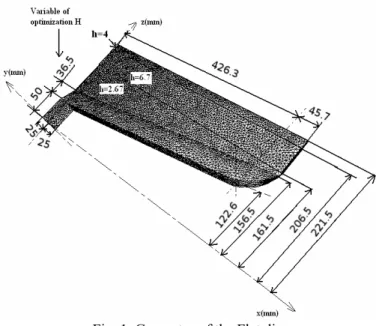
The design of dies for polymer extrusion often involves trial and error corrections to the die to achieve uniform flow at the exit. Manual correction to die geometry is a time consuming and a costly procedure. A flat die (Fig.1) is commonly used to extrude thermoplastics thin sheets [1-3]. If the channel geometry in a flat die is not designed properly, the velocity at the exit of the flat die may not be uniform [4,5]. A non-uniform velocity distribution at the die exit may lead to a variation in the sheet thickness across the width of the die. Since a tight control on thickness is required for a high quality plastic sheet, the ultimate goal of this work is to optimize the die channel geometry in a way that a uniform velocity distribution is obtained at the die exit [6-8]. Prior works in sheet die optimization have involved the use of lubrification approximations of the momentum equations [9-12]. If the geometry is more complex, a flow channel can be approximated with simple geometric sections [13]. Others have used three-dimentional analysis to design die extrusion [14,15] but they did not take into account the thermal dependence. Network algorithms have been developed to optimize die designs [16] but they are difficult to apply to arbitrary shapes. Michaeli et al [2] have used a combination of finite-element-analysis and flow finite-element-analysis network. To optimize the die geometry they used respectively the evolution
strategy algorithm and network theory with isothermal flow. But this geometry is varied manually and the optimization by evolution strategy makes a lot of time to converge. Sun et al [18], Smith [10] have used respectively BFGS and SQP algorithms to optimize die geometry but the used algorithms are time consuming and it is not easy to apply them with different software and to change different geometries. Reddy et al [6] have used response surface method with polynomial approximation, but this approximation is not accurate and needs a lot of iteration to converge. The complexity of the polymer rheology further increases the difficulty of the die optimization problem [9]. If the polymer rheological behaviour is not accounted accurately while optimizing the die, the computed velocity, pressure and temperature fields are expected to have large errors. There are many works in the literature that used rheological behaviours of power law [9, 10, 12, 14, 16]; however, this does not permit to present accurately the rheological behaviour. Sun et al [18] have optimized a flat die and they have taken into account the elongation effect. They obtained optimal distribution but the pressure drop could not be decreased. In the present work we have developed an automatic optimization algorithm based on response surface method together with Kriging interpolation. We used REM3D® software to compute 3D simulation of the flow in extrusion dies. This software takes into account strain rate and
temperature dependence. The optimal design procedure is applied to a coat hanger die used to extrude thermoplastic sheets. The viscosity models and the values of the various parameters of these models are summarized in the next section for the polymer used in the present work.
Fig. 1. Geometry of the Flat die
2 THE OPTIMIZATION BENCHMARK
In this paper, a geometry of a flat die is optimized for an Acrylonitrile Butadiene Styrene (ABS, Astalac EPC 10000). The polymer flow is supposed purely viscous (the viscoelastic behaviour is not taken into account). According to Sun and Gupta [17-18] the elongation effect does not influence the exit velocity distribution at the die exit. The simulation of extrusion is carried out on a 3D computation software by finite elements REM3D® [19]. The behaviour laws used in Rem3D give an expression of the viscosity in function of the shear rate and temperature. The thermal and rheological parameters of the ABS are given in Table 1. Carreau Yasuda/WLF viscosity model is used to characterize the temperature and shear rate dependence of viscosity [20]. It is written as:
(
)
(
)
(( )) α α τ γ η η η 1 0 2 1 2 1 0.exp 1 − ⎥ ⎥ ⎦ ⎤ ⎢ ⎢ ⎣ ⎡ ⎟⎟ ⎠ ⎞ ⎜⎜ ⎝ ⎛ + ⎥ ⎥ ⎦ ⎤ ⎢ ⎢ ⎣ ⎡ − + − − − + − = m s s s s ref s ref T T A T T A T T A T T A & (1)The thermal conductivity (K), density (ρ) and heat capacity (Cp) of the polymer used for the flow
simulation were assumed to be constant throughout the range of temperature in the flat die.
Table1. Margin settings
0
η Pa.s m no unit α0 no unit τs Pa
716.997 0.15862 1 224063
A1 no unit A2 [K] Ts [K] Tref [K]
20.4 101.6 397.7 524.7
2.1 Automation of the finite element model:
In order to save time at the optimization process and to be able to control effectively and easily the preprocessing REM3D (GLPre), the solver REM3D and design routine, it is necessary to use all the possibilities of automation offered by this code (via Matlab). Matlab makes it possible to launch the executable files. This fact enables us to couple Matlab with REM3D. Fig. 2, shows a diagram of the principle of operation and possible interactions of Matlab with REM3D/GLpre, REM3D/Solver and design routine. It is also possible to automate all the tasks usually carried out through graphic interface from the creation of FEM until the recovery of the results.
Fig. 2. Optimization algorithm.
3 DESIGN VARIABLES AND OBJECTIVE FUNCTIONS
The variable of optimization is the depth of the channel of distribution H. Initially, it is fixed at 36.5 mm, but during the processes of optimization it is limited between 30 and 110 mm (fig.1). It was mentioned earlier that the goal in design of a flat die is to minimize the velocity variation across the die exit. The objective function is:
∑
= ⎟⎟ ⎠ ⎞ ⎜⎜ ⎝ ⎛ − = N i i v v v N J 1 2 1 (2)Where N is the total number of nodes at the die exit in the middle plane, i is the velocity at an exit
node,
v
v is the average exit velocity.
4 OPTIMISATION PROCEDURE
The method of response surface [21] consists in the
Trial Parameters Pre-Processor
GL-Pre Operating conditions Temperature of regulation, flow rate,
rheological parameters and Mesh generation
Routine for change channel geometry Definition of die channel geometry
Solver REM3D Simulation of no-isothermal 3D
Optimization routine Evaluation of the geometry
construction of an approximate expression of objective function starting from a limited number of evaluations of the real function. The main idea is to approximate the objective function through a response surface. In order to obtain a good approximation, we used a Kriging interpolation [22]. In this method, the approximation is computed by using the evaluation points by composite design of experiments, the number of evaluation is 5 points which permits to give a good interpolation. After the interpolation of the objective function we minimize it using SQP sequential quadratic programming method. In addition, to avoid to obtain a local minimum, we change the initial points of the SQP method by all the points of the design of experiment because the evaluation of the interpolation function does not cause problems and does not take much time. After we obtain the best minimum of this interpolation we use the weight function of Gaussian type which allows to slightly change the interpolation and gives more importance to the points which are closer to the minimum and less importance to the other points. The iterative procedure stops when the successive points are superposed with a tolerance ε=10-3.
5 RESULTS AND DISCUSSION
ow conditions, the optimal value for H is 94.9 mm.
After 2 iterations, the objective function is varying quite fast at the beginning of the optimization until the 2nd step. Its final value is about 5.3 10-2. However the global relative error between exit velocities in initial and optimal die, Fig. 3, is minimized for 94.7%. This optimization run represents 11 hours 23 min of CPU time on a computer Pentium IV, 3 GHz, 1Go RAM.. Given the fixed geometry constraints of the die, the rheological parameters of the ABS and the fl
0 100 200 300 400 500 0 0.1 0.2 0.3 0.4 0.5
Width of the die [mm]
Er
ro
r
Optimal die Initial die
Fig. 3. Error between th optimal and initial exit velocity.
e average,
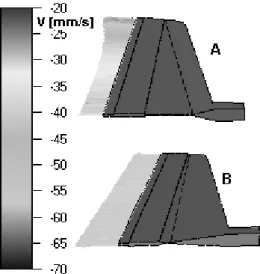
Fig. 4. Velocity distributions of the initial and optimized die.
Velocity distributions at the exit of the optimized die in Fig. 4-B are more uniform than the exit velocity in the initial die design in Fig. 4-A, it is evident that in the initial die design the exit velocity at the border of the die is significantly higher than the velocity in the centre of the die. In Fig. 4-B, the exit velocity distributions for the optimized die design are much more uniform across the complete width of the half die. Only in the small regions near the border of this die, the exit velocity is reduced to zero to satisfy the no slip condition at the walls.
Fig. 5. Pressure distributions in initial and optimized die
The pressure drop in the initial die design is 4.423 MPa Fig. 5-A. It should be noted that the pressure drop decreases during the optimization iteration. The total pressure drop in the optimal die was decreased by 49.9% or 2.215 MPa, Fig.5-B. With the optimized geometry, we can obtain the same pressure as with the initial geometry by increasing the flow rate by 140%. To summarize, it is possible to increase the productivity of more than 140% with the same pressure as for the initial die. To improve the uniformity of die exit velocity, the width of the channel cross-section is typically increased from 36 mm to 94.9 mm.
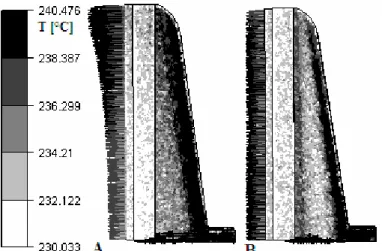
Bad temperature distribution is observed in the initial die Fig. 6-A. However, it is noted that more polymer is flowing towards the edge because of the shear heating. Hence, the temperature is lower near the middle of the die and higher near the edge. By
comparison, the shear heating in the optimal die and the temperature distribution are more uniform Fig. 6-B, because of the homogeneous distribution of the exit velocity.
Fig. 6. Temperature distributions in initial and optimized die.
6 CONCLUSION AND PROSPECTS
We conclude that we obtain good results using the response surface method with a very fast convergence (2 iterations), this is due to the good interpolation obtained with Kriging. The weight function and the various evaluations of the interpolation function (which does not take much of CPU time) permit to give a precise global minimum. A program for optimizing the geometry of a flat die for polymer sheet extrusion has been developed. To save time and to control easily the optimisation procedure, we have automised this program with REM3D software and design routine which we have also developed. The optimization program used the REM3D software to simulate the polymeric flow in the flat die. This program optimized successfully the 3D geometry of a flat die such that a uniform velocity and temperature distribution were obtained at the die exit with decreasing the pressure drop in the die. In our perspectives, we envisage to optimise the temperature of regulation instead of modifying the geometry while keeping the same objective function, that is to say homogenizing the exit velocity in the die.
REFERENCES
1. Y. Sun, M. Gupta, Effect of elongational viscosity on the flow in flat die,In: International Polymer Processing, XVIII , (2003), 356-361.
2. W. Michaeli, S. Kaul, Approch of automatic extrusion die optimisation, In: Journal of Polymer Enginering. Vol 24, (2004), 123-136.
3. L. G. Reifschneider, Automated sheet Die design, In:
SPE Annual Technical Conference (2002).
4. C. Chen, P. Jen, F. S. Lai, Optimization of the
Coathanger manifold via computer simulation and orthogonal array method, In: Polymer Engineering and
Science, vol.37, No.1 (1997), 188-196.
5. Y. Wang, The flow distribution of molten polymers in slit dies and coathanger die through three-dimensional finite element analysis, In: Polymer Engineering and
Science , vol.31, No.3 (1991), 204-212.
6. M. P. Reddy, E. G. Schaub, L. G. Reifschneider, H. L. Thomas, Design and optimisation of three dimensional extrusion dies using adaptative finite element method, In: SPE Annual Technical Conference, (1999), 622-626. 7. J. M. Nóbrega, O. S. Carneiro, F. T. Pinho., P. J.
Oliveira., Flow Balancing in extrusion dies for thermoplastic profiles, In: International Polymer
Processing, Vol XIX, (2004), 225-235.
8. J. M. Nóbrega, O. S. Carneiro, P. J. Oliveira, F. T. Pinho, Sensitivity of flow distribution and flow patterns in profile extrusion dies, In: SPE Annual Technical
Conference, (2003), 310-314.
9. Y. W. Yu, T. J. Liu, A simple numerical approach for the optimal design of an extrusion die, In: Journal of
Polymer Research, Vol 5, No 1, (1998), 1-7.
10. D. E. Smith, An optimisation-based approach to compute sheeting die designs for multiple operating conditions, In: SPE Annual Technical Conference, (2003), 315-319. 11. Y. Xiaorong, S. Changyu, L. Chuntai, W. Lixia, Optimal
design for polymer sheeting dies, In: Chinese Journal of
Computational Mechanics, Vol 21, No 2, (2004),
253-256,.
12. H. J. Ettinger., J. Sienz, J. F. T. Pittman., A. Polynkin., Parameterization and optimisation strategies for the automated design of U PVC profile extrusion dies, In:
Struct. Multidisc. Optim, Vol 28, (2004), 180-194.
13. S. Puissant, Y. Demay, B. Vergnes, J. F. Agassant, Two dimensional multilayer coextrusion flow in a flat Coat-Hanger die. PartI: Modeling, In: Polymer Engineering
and Science, Vol. 34, (1994), 201-208.
14. W. Michaeli, S. Kaul, T. Wolff, Computer aided optimisation of extrusion dies, In: Journal of Polymer
Enginering, Vol 21, No 2-3, (2001), 225-237.
15. J. M. Nóbrega, O. S. Carneiro, F. T. Pinho, P. J. Oliveira, Flow balancing of profile extrusion dies, In:
SPE Annual Technical Conference, (2001), 31-35.
16. P. Hurez, P. A. Tanguy, D. Blouin, A New Design procedure for profile die, In: Polymer Engineering and
Science, Vol 36, No 5, (1996), 626-635.
17. Y.Sun, M.Gupta, An analysis of the effect of elongational viscosity on the flow in a flat die, In: SPE
Annual Technical Conference, (2003), 290-294.
18. Y. Sun, M. Gupta, Optimization of a flat die geometry, In: SPE Annual Technical Conference, Vol 3, (2004), 3307-3311.
19. E. Pichelin, T. Coupez, Finite element solution of the 3D mold filling problem for viscous incompressible fluid, In: Computer Methods in Applied Mechanics
Engineering, Vol 163, (1998), 359-371.
20. G. Balasubrahman, D. Kazmer, Thermal control of melt flow in cylindrical geometries, In: SPE Annual Technical
Conference, (2003), 387-391.
21. N. Lebaal, S. Puissant, F. M. Schmidt, Rheological parameters identification using in-situ experimental data of a flat die extrusion, In: Journal of Materials
Processing Technology, Vol 164-165 (2005), 1524-1529.
22. F. Trochu and P. Terriault, Nonlinear modelling of hysteretic material laws by dual kriging and Application, In: Computer Methods in Applied Mechanics