HAL Id: hal-00416447
https://hal.archives-ouvertes.fr/hal-00416447
Submitted on 14 Sep 2009
HAL is a multi-disciplinary open access
archive for the deposit and dissemination of
sci-entific research documents, whether they are
pub-lished or not. The documents may come from
teaching and research institutions in France or
abroad, or from public or private research centers.
L’archive ouverte pluridisciplinaire HAL, est
destinée au dépôt et à la diffusion de documents
scientifiques de niveau recherche, publiés ou non,
émanant des établissements d’enseignement et de
recherche français ou étrangers, des laboratoires
publics ou privés.
Reducing Network Traffic in Unstructured P2P Systems
Using Top-k Queries
Reza Akbarinia, Esther Pacitti, Patrick Valduriez
To cite this version:
Reza Akbarinia, Esther Pacitti, Patrick Valduriez. Reducing Network Traffic in Unstructured P2P
Systems Using Top-k Queries. Distributed and Parallel Databases, Springer, 2006, 19 (2-3), pp.67-86.
�10.1007/s10619-006-8313-5�. �hal-00416447�
Reducing Network Traffic in Unstructured P2P
Systems Using Top-k Queries
1Reza Akbarinia1,2, Esther Pacitti1, Patrick Valduriez1
1ATLAS group, INRIA and LINA, University of Nantes, France
2
Shahid Bahonar University of Kerman, Iran
{[email protected], [email protected]}
Abstract. A major problem of unstructured P2P systems is their heavy network
traffic. This is caused mainly by high numbers of query answers, many of which are irrelevant for users. One solution to this problem is to use Top-k que-ries whereby the user can specify a limited number (k) of the most relevant an-swers. In this paper, we present FD, a (Fully Distributed) framework for execut-ing Top-k queries in unstructured P2P systems, with the objective of reducexecut-ing network traffic. FD consists of a family of algorithms that are simple but effec-tive. FD is completely distributed, does not depend on the existence of certain peers, and addresses the volatility of peers during query execution. We vali-dated FD through implementation over a 64-node cluster and simulation using the BRITE topology generator and SimJava. Our performance evaluation shows that FD can achieve major performance gains in terms of communication and response time.
1 Introduction
Peer-to-peer (P2P) systems adopt a completely decentralized approach to data sharing and thus can scale to very large amounts of data and users. Popular examples of P2P systems such as Gnutella [ 10] and KaaZa [ 12] have millions of users sharing petabytes of data over the Internet. Initial research on P2P systems has focused on improving the scalability of the unstructured systems, such as Gnutella and KaaZa, which rely on flooding. This work led to structured solutions that provide a distrib-uted lookup mechanism to route search requests, e.g. CAN [ 15], CHORD [ 19], P-Grid [ 2] and FreeNet [ 7]. Although these designs can give better performance guarantees than unstructured systems, more research is needed to understand their trade-offs be-tween autonomy, fault-tolerance, scalability, self-organization, etc. Meanwhile, the unstructured model which imposes no constraint on data placement and topology re-mains the most used today on the Internet.
A major problem of unstructured systems, which prevents them from being really scalable, is their heavy network traffic. Measurements in [ 17] have shown that al-though 95% of any two nodes are less than 7 hops away, the flooding based routing algorithm generates 330 TB/month in a Gnutella network with only 50,000 nodes. A
main portion of this traffic is caused by the large amount of query answers, a lot of which may not be of interest to users. One obvious solution to this problem is to send the query only to the peers that are very close to the query originator [ 23], e.g. to those which are at most 3 hops a away. However, this significantly reduces the quality of results, in the sense that the user cannot get potentially “good” answers.
As another solution, we propose to use Top-k queries whereby the user can specify a number k and the system should return k of the most relevant answers. The degree of relevance (score) of the answers to the query is determined by a scoring function. Efficient techniques have been proposed for Top-k query processing in distributed systems [ 24] [ 25]. The algorithms typically use histograms, maintained at a central site, to estimate the score of databases with respect to the query and send the query to the databases that are more likely to involve top results. These techniques can some-how be used in super-peer P2P systems where super-peers maintain the histograms and perform query sending and result merging. However, because they rely on central information, these techniques no longer apply in unstructured systems.
In this paper, we present FD, a (Fully Distributed) framework for executing Top-k queries in unstructured P2P systems, with the goal of reducing network traffic. FD in-volves a family of algorithms that are simple but effective. FD has several salient fea-tures. First, it reduces significantly the communication cost of executing queries in unstructured systems. Second, its execution is completely distributed and does not de-pend on the existence of certain peers. Third, it addresses the volatility of peers during query execution and deals with situations where some peers leave the system before finishing query processing. We validated FD through a combination of implementa-tion and simulaimplementa-tion and the results show very good performance, in terms of commu-nication and response time.
The rest of this paper is organized as follows. In Section 2, we make precise our assumptions and define the problem. In Section 3, we present the basic algorithm of FD, analyze its communication cost and propose techniques in order to reduce this cost. In Section 4, we address the volatility of peers by proposing algorithms extend-ing the basic algorithm. Section 5 describes a performance evaluation of FD through implementation over a 64-node cluster and simulation using the BRITE topology gen-erator [ 4] and SimJava [ 11]. Section 6 discusses related work. Section 7 concludes.
2 Problem Definition
In this section, we first give our assumptions regarding schema management and the P2P architecture. Then we can precisely state the problem we address in this paper.
In a P2P system, peers should be able to express queries over their own schema without relying on a centralized global schema as in data integration systems [ 20]. Several solutions have been proposed to support decentralized schema mapping. However, this issue is out of the scope of this paper and we assume it is provided us-ing one of the existus-ing techniques, e.g. [ 14], [ 20] and [ 3]. Furthermore, also for sim-plicity, we assume relational data.
We assume that the P2P system is unstructured, so the only requirement is that each peer knows some other peers, its neighbors, to communicate. In an unstructured P2P environment, there are two major aspects that make query processing difficult:
• No centralized information: there is no node for keeping global information
about the data shared by all peers. Each peer keeps its own shared data and has no idea about the data shared by the other peers. The only thing that a peer knows is its neighbors’ addresses.
• Dynamicity: peers are very dynamic and can join or leave the system at any
time. During the execution of the query, some participating peers may thus leave the system.
Now we can define the problem as follows. Let Q be a Top-k query, i.e. the user is interested to receive k top answers to Q. Let TTL (Time-To-Live) determine the maximum hop distance which the user wants her query be sent. Let D be the set of all data items (i.e. tuples) that can be accessed through ttl hops in the P2P system during the execution of Q. Let Sc(d, Q) be a scoring function that denotes the score of rele-vance of a data item d∈D to Q. Our goal is to find the set T⊆ D, such that:
T = k and ∀ d1∈ T, ∀ d2 ∈ (D – T) then Sc(d1, Q) ≥ Sc(d2, Q)
while minimizing the communication cost.
3 Top-k Query Processing
In this section, we first present the basic algorithm of FD. Then, we analyze its com-munication cost and propose some techniques for reducing it. For simplicity, we as-sume no dynamicity of peers which means that all peers remain reachable during query processing. This assumption will be relaxed in the next section.
3.1 Basic Algorithm
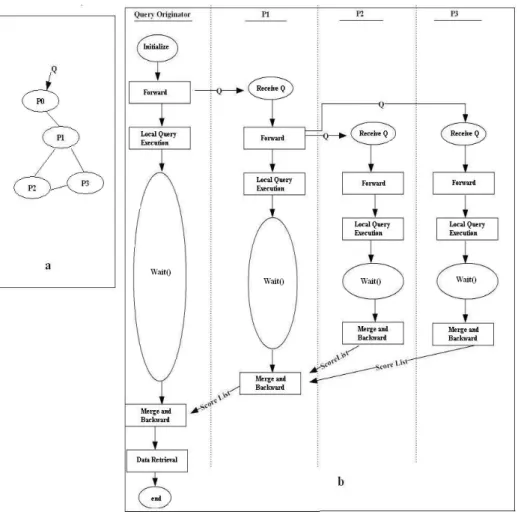
The algorithm starts at the query originator, the peer at which a user issues a Top-k query Q. The query originator performs some initialization. First, it sets TTL with a value which is either specified by the user or default. Second, it gives Q a unique identifier, denoted by QID, which is made of a unique peer-ID and a query counter managed by the query originator. Peers use QID to distinguish between new queries and those received before. After initialization, the query originator triggers the se-quence of the following four phases (see the example in Figure 1): query forward, lo-cal query execution, merge-and-backward, and data retrieval.
Fig. 1. A sample P2P system (a) and a sequence diagram of the basic algorithm of FD (b)
Query Forward
Q is included in a message that is broadcast by the query originator to its reachable
neighbors. Each peer p that receives the message including Q performs the following steps.
1. Check QID: if Q has been already received, then discard the message else save the address of the sender as the parent of p.
2. Decrement TTL by one: if TTL > 0, make a new message including Q, QID, new TTL and the query originator’s address and send the message to all neighbors (except parent).
Local Query Execution
After sending Q to its neighbors, p executes Q locally, i.e. accesses the local data items that match the query predicate, scores them using a scoring function, selects the
k top data items and saves them as well as their scores locally. For scoring the data
items, we can use one of the scoring functions proposed for relational data, e.g. Euclidean function [ 6][ 5]. These functions require no global information and can score peer’s data items only using local information. The scoring function can also be specified explicitly by the user.
After selecting the k local top data items, p must wait to receive its neighbors’ score-lists before starting the next phase. However, since some of the neighbors may leave the P2P system and never send a score-list to p, we must set a limit for the wait time. We compute p’s wait time using a cost function based on TTL, network de-pendent parameters and p’s local processing parameters. We provide the details of this cost function in Appendix A. If the cost function is inaccurate (for some peers), then it may happen that score-lists get received after the expiration of the wait time. We will deal with this situation in Section 4.
Merge-and-Backward
After its wait time has expired, p merges its k local top scores with those received from its neighbors and sends the result to its parent (the peer from which it received
Q) in the form of a score-list. In order to minimize network traffic, we do not “bubble
up” the top data items (which could be large), only their scores and addresses. A score-list is simply a list of k couples (a, s), such that a is the address of the peer own-ing the data item and s its score. Thus, p performs the followown-ing steps:
1. Merge the score-lists received from the neighbors with its local k top scores and extracting the k top scores (along with the peers’ addresses).
2. Send the merged score-list, which contains the k highest scores (and peers’ ad-dresses) extracted from local top scores and those received from the neighbors, to its parent.
Data Retrieval
By the three first phases, the merged score-lists containing top scores are bubbled up to the query originator. After the query originator has produced its merged score-list, which is called the final score-list, and which is gained by merging its k local top scores with the merged score-lists received from its neighbors, it directly retrieves the
k top data items from the peers in the list as follows. For each peer address a in the
fi-nal score-list:
1. Determine the number of times a appears in the final score-list, say m times. 2. Ask the peer at a to return its m top scored items.
Formally, consider the final score-list Lf which is a set of at most k couples (a, s),
in this phase for each a∈Domain(Lf), the query originator determines Ta = {s (a, s)
∈ Lf } and asks the peer at a to return Ta of its top scored items.
3.2 Analysis of Communication Cost
In this section, we analyze our basic algorithm’s communication cost. As we will see, it is not very high. We also propose strategies to reduce it. We measure the communi-cation cost in terms of number of messages and number of bytes which should be
transferred over the network in order to execute a query by our algorithm. The mes-sages transferred can be classified as: 1) forward mesmes-sages, for forwarding the query to peers. 2) backward messages, for returning the score-lists from peers to the query originator. 3) retrieve messages, to request and retrieve the k top results. We first pre-sent a model reprepre-senting the peers that collaborate on executing our algorithm, and then analyze the communication cost of backward, retrieve and forward messages.
Model
Let P be the set of the peers in the P2P system. Given a query Q, let PQ ⊆ P be a set
containing the query originator and all peers that receive Q. We model the peers in PQ
and the links between them by a graph G(PQ, E) where PQ is the set of vertices in G
and E is the set of the edges. There is an edge p-q in E if and only if there is a link be-tween the peers p and q in the P2P system. Two peers are called neighbor, if and only if there is an edge between them in G. The number of neighbors of each peer p∈PQ is
called the degree of p and is denoted by d(p). The average degree of peers in G is called the average degree of G and is denoted by d(G). The average degree of G can be computed as
∑
∈ = Q P p Q P p d G d( ) ( ( ))/During the execution of our algorithm, p∈PQ may receive Q from some of its
neighbors. The first peer, say q, from which p receives Q, is the parent of p in G, and thereby p is a child of q. A peer may have some neighbors that are neither its parent nor its children.
Backward Messages
In the Merge-and-Backward phase, each peer in PQ, except the query originator, sends
its merged score-list to its parent. Therefore, the number of backward messages, de-noted by mbw, is mbw= PQ-1.
Let L be the size of each element of a score-list in bytes (i.e. the size of a score and an address), then the size of the score-list is k×L, where k is the number of top results
specified in Q. Since the number of score-lists transferred by backward messages is PQ-1, then the total size of data transferred by backward messages, denoted by bbw,
can be computed as bbw = k× L× (PQ-1). If we set L=10, i.e. 4 bytes for the score
and 6 bytes for the address (4 bytes for IP address and 2 bytes for the port number), then bbw = k× 10× (PQ-1).
Let us show with an example that bbw is not significant. Consider that 10,000 peers
receive Q (including the query originator), thus PQ=10,000. Since users are
inter-ested in a few results and k is usually small, we set k=20. As a result, bbw is less than 2
megabytes. Compared with the tens of megabytes of music and video files, which are typically downloaded in P2P systems, this is small.
Retrieve Messages
By retrieve messages, we mean the messages sent by the query originator to request the k top results and the messages sent by the peers owning the top results to return these results. In the Data Retrieval phase, the query originator sends at most k mes-sages to the peers owning the top results (there may be peers owning more than one
top result) for requesting their top results and these peers return their top results by at most k messages. Therefore, the number of retrieve messages, denoted by mrt, is mrt≤ 2× k.
Forward Messages
Forward messages are the messages that we use to forward Q to the peers. According to the basic design of our algorithm, each peer in PQ sends Q to all its neighbors
ex-cept its parent. Let po denote the query originator. Consider the graph G(PQ, E)
de-scribed before, each p∈( PQ – {po}), sends Q to d(p)–1 peers, where d(p) is the degree
of p in G. The query originator sends Q to all of its neighbors, in other words to d(po)
peers. Then, the sum of all forward messages mfw can be computed as
) ( )) 1 ) ( ( ( }) {p ( o o P p fw d p d p m Q + − =
∑
− ∈We can write mfw as follows :
1 ) ) ( ( ( 1 )) 1 ) ( ( ( − + = − + =
∑
∑
∈ ∈P p P Q p fw d p d p P m Q QBased on the definition of d(G), mfw can be written as mfw = (d(G) -1)×PQ+1,
where d(G) is the average degree of G. According to the measurements in [ 16], the average degree of Gnutella is 4. If we take this value as the average degree of the P2P system, i.e. d(G)=4, we have mfw = 3×PQ+1. From the above discussion, we can
de-rive the following lemma.
Lemma 1: The number of forward messages in the basic algorithm is (d(G)
-1)×PQ+1.
Proof: Implied by the above discussion.
To determine the minimum number of messages necessary for forwarding Q, we prove the following lemma.
Lemma 2: The lower bound of the number of forward messages for sending Q to all
peers in PQ is PQ - 1.
Proof: For sending Q to each peer p∈PQ, we need at least one forward message. Only
one peer in PQ has Q, i.e. the query originator, thus Q should be sent to PQ - 1 peers.
Therefore, we need at least PQ - 1 forward messages to send Q to all peers in PQ.
Thus, the number of forward messages in the basic algorithm is far from the lower bound.
3.3 Reducing the Number of Messages
We can still reduce the number of forward messages using the following strategies. 1) sending Q across each edge only once. 2) Sending with Q a list of peers that have re-ceived it. 3) using statistics to send Q to only a subset of neighbors, which are more expected to return top results.
Sending Q across each edge only once
In graph G, there may be many cases that two peers p and q are neighbors and none of them is the parent of the other, e.g. two neighbors which are children of the same par-ent. In these cases, in the basic form of our algorithm, both peers send Q to the other,
i.e. Q is sent across the edge p-q twice. We develop the following strategy to send Q
across an edge only once.
Strategy 1: When a peer p receives Q, say at time t, from its parent (which is the first
time that p receives Q from), it waits for a random, small time, say λ, and then sends
Q only to the neighbors which p has not received Q from them before t + λ.
Lemma 3: With a high probability, the number of forward messages with Strategy 1
is reduced to d(G)×PQ / 2.
Proof: Since λ is a random number and different peers generate independent random values for λ, the probability that two neighbors send Q to each other simultaneously is very low. Ignoring the cases where two neighbors send Q to the other simultaneously, with Strategy 1, Q is sent across an edge only once. Therefore, the number of forward messages can be computed as mfw = E. Since E= d(G)×PQ/2, then mfw= d(G)×PQ/2.
Considering d(G)=4 (similar to [ 16]), the number of forward messages is mfw= 2×PQ.
With Strategy 1, mfw is closer to the lower bound than the basic form of our
algo-rithm. However, we are still far from the lower bound. By combining Strategy 1 and another strategy, we can reduce the number of forward messages much more.
Attaching to each forward message a list of peers that have received Q
Even with Strategy 1, between two neighbors, which are children of the same parent
p, one forward message is sent although it is useless (because both of them have
re-ceived Q from p). If p attaches a list of its neighbors to Q, then its children can avoid sending Q to each other. Thus, we propose a second strategy.
Strategy 2: Before sending Q to its neighbors, a peer p attaches to Q a list containing
its Id and the Id of its neighbors and sends this list along with Q. Each peer that re-ceives the Q’s message, verifies the list and does not send Q to the peers involved in the list.
Theorem 1: By combining Strategy 1 and Strategy 2, with a high probability, the
number of forward messages is less than d(G)×PQ/2.
Proof: With Strategy 2, two neighbors, which have the same parent, do not send any
forward message to each other. If we use Strategy 1, with a high probability at most one forward message is sent across each edge. Using Strategy 2, there may be some edges such that no forward message is sent across them, e.g. edges between two neighbors with the same parent. Therefore, by combining Strategy 1 and Strategy 2, the number of forward messages is mfw≤E, and thus mfw≤ d(G)×PQ/2.
Considering d(G)=4, the number of forward messages is mfw≤ 2×PQ.
Using statistics to reduce the messages
If the peers send Q to only a subset of their neighbors, which are more likely to return the k top answers, then we can significantly reduce the number of messages, including the forward and backward messages. However, the peers need some statistics to select the best neighbors. For this, each peer p keeps some statistics about the content of the score-lists returned by every neighbor. These statistics can include: 1) The number of scores returned by the neighbor that are in the p’s merged score-list. 2) The position of the greatest score, returned by the neighbor, in the p’s merged score-list. Using
these statistics, we can develop a number of heuristics to send Q to the neighbors, which are more likely to return the top results. These heuristics include:
• Do not send Q to the neighbors which none of their scores was in the merged score-list in the previous execution of Q.
• Send Q to the neighbors for which at least x percent (e.g. x=10) of their scores was in the merged score-list.
• Send Q to the neighbors which the position of their highest returned score in the merged score-list was lower than z×n, where z≤1, e.g. z=0.80. With this
heuris-tic, we select the neighbors that have previously returned better top scores.
Using the above heuristics, we can reduce the number of messages, but this may decrease the quality of the results. However, our experiments (see Section 5) show that, by selecting a good heuristic and well adjusting the parameters, we can achieve a significant reduction in the messages without a significant loss of quality.
4 Dealing with Peers’ Dynamicity
In Section 3, we proposed FD’s basic algorithm assuming no dynamicity of peers. Obviously, P2P systems are very dynamic, and it may well happen that some peers leave the system (or fail) at any time during query processing. Furthermore, peers can suddenly take more time than expected to respond. This can create the following problems to our basic algorithm: late reception of score-lists by a peer, after its wait time has expired; peers becoming inaccessible in the Merge-and-Backward phase; and peers that hold top data items becoming inaccessible in the Data Retrieval phase. In this section, we deal with these problems and propose extensions to the basic algo-rithm.
4.1 Late Reception of Score-Lists
In FD’s basic algorithm, each peer p, after its wait time has expired, merges its top lo-cal scores with the score-lists received from its neighbors and sends the result as a score-list to its parent. However, p may underestimate its wait time which is based, among other parameters, on local processing parameters of other peers. Thus, it may happen that score-lists of some neighbors arrive late, i.e. after p has sent its score-list to its parent. We could simply ignore these late score-lists and discard them. How-ever, they may refer to answers which are highly relevant to the user’s query. Thus, we propose that p sends the late-score lists as an urgent score-list to its parent. The urgent score-lists should be bubbled up without wait until arriving to a peer of which wait time has not expired. When a peer q receives an urgent score-list, it performs the following actions:
• If q is not the query originator: if it has already sent its merged score-list to its parent, sends the urgent score-list immediately to its parent too; else, deals with the urgent score-list as any other received score-list.
• If q is the query originator: if it is in the Data Retrieval phase, discards the ur-gent list; else, deals with the urur-gent list as any other received score-list.
Therefore, using urgent score-lists, we can save late score-lists from being dis-carded (except those that reach to the query originator in the Data Retrieval phase), and this increases the accuracy of the algorithm’s answer to the Top-k query.
4.2 Peers Inaccessible in the Merge-and-Backward Phase
In the Merge-and-Backward phase, each peer p sends a score-list to its parent. And it may happen that p’s parent is inaccessible (e.g. it has left the system). We could sim-ply ignore p’s score-list and have p discard it. But we can find alternative paths to backward p’s core list. We propose the following strategy:
• If p has a neighbor, say q, which is not p’s child (i.e. p is not the first peer from which q has received Q), send to q the score-list as an urgent score-list. The ur-gent score-list will be bubbled up rapidly until it reaches a peer of which wait time has not expired.
• If p has not such a neighbor, send the score-list directly to the query originator which can deal with this score-list like any other score-list received from its neighbors. Recall from Section 3 that the address of the query originator is com-municated to all peers along with Q.
Using this strategy, if the parent of a peer p leaves the system during query execu-tion, the score-list of p is never lost.
4.3 Top Data Items Inaccessible in the Data Retrieval Phase
In the Data Retrieval phase, the peers which hold the top data items in the final-score list need be accessed by the query originator. However, it may happen that one or more of those peers are inaccessible, e.g. because of leaving the system, thus hamper-ing the production of the complete final result. One simple way to deal with this is to produce an incomplete result, with less than k top items. A better solution is to in-crease k before starting the first phase to compensate the inaccessible data items. But, how many should we add to k? We can answer this question if we know a little more about peers’ accessibility. Let P<1 be the probability that any top data item belonging to the final score-list be inaccessible, the following lemma gives us an answer:
Lemma 4: If we increase k to k / (1 - P), then the expected number of accessible top
data items in the Data Retrieval phase is k.
Proof: If the requested list size is x, then x(1-P) items are expected to be accessible.
Solving x(1-P)=k, the required value of x is x=k/(1- P).
Therefore, to compensate the inaccessible top data items in the Data Retrieval phase, before sending Q to its neighbors, the query originator can set k as k / (1 - P). The query originator can use the statistics gathered from previous query executions for estimating P.
5 Performance Evaluation
We evaluated the performance of FD through implementation and simulation. The implementation over a 64-node cluster was useful to validate our algorithm and cali-brate our simulator. The simulation allows us to study scale up to high numbers of peers (up to 10,000 peers).
The rest of this section is organized as follows. In Section 5.1, we describe our ex-perimental and simulation setup, and the algorithms used for comparison. In Section 5.2, we evaluate the response time of FD. We first present experimental results using the implementation of FD and two other baseline algorithms on a 64-node cluster, and then we present simulation results on the response time using various parameters: number of peers, effect of latency, and bandwidth. Section 5.3 presents the evaluation of communication cost, and Section 5.4 evaluates the accuracy of FD w.r.t. the dy-namicity of P2P systems.
5.1 Experimental and Simulation Setup
For our implementation and simulation, we used the Java programming language, the SimJava package and the BRITE universal topology generator.
SimJava [ 11] is a process based discrete event simulation package for Java. Based on a discrete event simulation kernel, SimJava includes facilities for representing simulation objects as animated icons on screen. A SimJava simulation is a collection of entities each running in its own thread. These entities are connected together by ports and can communicate with each other by sending and receiving event objects.
BRITE [ 4] has recently emerged as one of the most promising universal topology generators. The objective of BRITE is to produce a general and powerful topology generation framework. Using BRITE, we generated topologies similar to those of P2P systems and we used them for determining the linkage between peers in our tests.
We first implemented FD in Java on the largest set of machines that was directly available to us. The cluster has 64 nodes connected by a 1-Gbps network. Each node has an Intel Pentium 2.4 GHz processor, and runs the Linux operating system. We make each node act as a peer in the P2P system. To have a P2P topology close to real P2P overlay topologies, we determined the peer neighbors using the topologies gener-ated by the BRITE universal topology generator [ 4]. Thus, each node only is allowed to communicate with the nodes that are its neighbors in the topology generated by BRITE.
To study the scalability of FD far beyond 64 peers and to play with various per-formance parameters, we implemented a simulator using SimJava. To simulate a peer, we use a SimJava entity that performs all tasks that must be done by a peer for execut-ing FD. We assign a delay to communication ports to simulate the delay for sendexecut-ing a message between two peers in a real P2P system. For determining the links between peers, we used the topologies generated by BRITE.
In all our tests, we use the following simple query as workload: SELECT R.data FROM R ORDER BY R.score
Each peer has a table R(score, data) in which attribute score is a random real num-ber in the interval [0..1] with uniform distribution, and attribute data is a random variable with normal distribution with a mean of 1 (kilo bytes) and a variance of 64. Attribute score represents the score of data items and attribute data represents (the de-scription of) the data item that will be returned back to the user as the result of query processing. The number of tuples of R at each peer is a random number (uniformly distributed over all peers) greater than 1000 and less than 20,000.
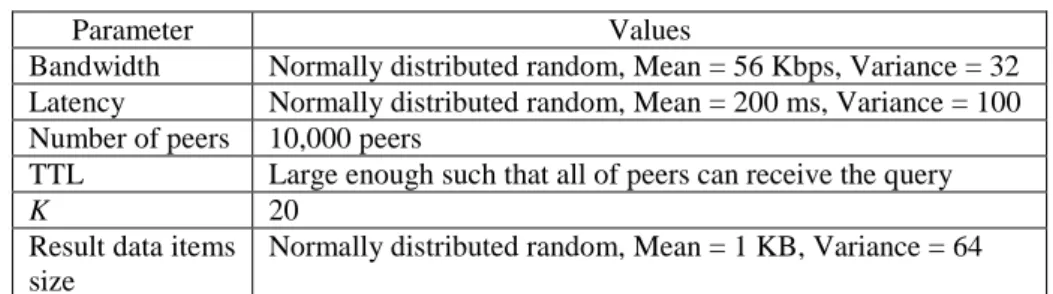
The simulation parameters are shown in Table 1. Unless otherwise specified, the latency between any two peers is a normally distributed random number with a mean of 200 (ms) and a variance of 100. The bandwidth between peers is also a random number with normal distribution with a mean of 56 (kbps) and a variance of 32. Since users are usually interested in a small number of top results, we set k=20.
The simulator allows us to perform tests up to 10,000 peers, after which the simu-lation data no longer fit in RAM and makes our tests difficult. This is quite sufficient for our tests. Therefore, the number of peers of P2P system is set to be 10,000, unless otherwise specified. In all tests, TTL is set as the maximum hop-distance to other peers from the query originator, thus all peers of the P2P system can receive Q. We observed that in the topologies with 10,000 nodes, with TTL=12 all peers could re-ceive Q. Our observations correspond to those based on experiments with the Gnutella network [ 16]; for instance, with 50,000 nodes, the maximum hop-distance between any two nodes is 14.
Table 1. Simulation parameters
Parameter Values
Bandwidth Normally distributed random, Mean = 56 Kbps, Variance = 32 Latency Normally distributed random, Mean = 200 ms, Variance = 100 Number of peers 10,000 peers
TTL Large enough such that all of peers can receive the query
K 20
Result data items size
Normally distributed random, Mean = 1 KB, Variance = 64 In our simulation, we compare FD with two other algorithms. The first algorithm is a centralized algorithm, which we denote as CN, which works as follows. Each peer receiving Q sends its k top relevant data items directly to the query originator. The query originator merges the received results and extracts the k overall top scored data items from them. The second algorithm is an optimized version of CN, which we de-note as CN*, by which the peers return directly to the query originator only their score-lists (not data items).
5.2 Response Time
Scale up
In this section, we investigate the scalability of FD. We use both our implementation and our simulator to study response time while varying the number of peers. The
re-sponse time includes local processing time and data transfers, i.e. sending query mes-sages, score-lists and data items.
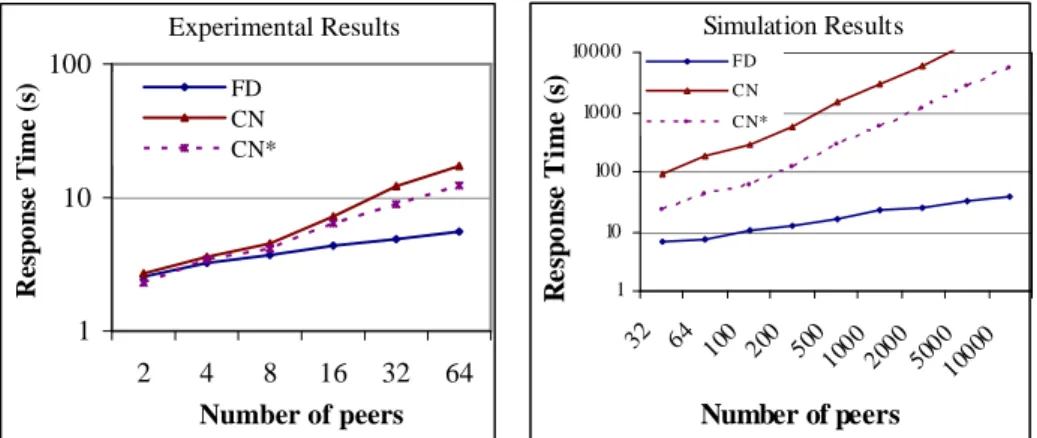
Using our implementation over the cluster, we ran experiments to study how re-sponse time increases with the addition of peers. Figure 2 shows excellent scale up of FD since response time logarithmically increases with the addition of peers until 64. Using simulation, Figure 3 shows the response times of the three algorithms with a number of peers increasing up to 10000 and the other simulation parameters set as in Table 1.
FD always outperforms the two other algorithms and the performance difference increases significantly in favor of FD as the number of peers increases. The main rea-son for FD’s excellent scalability is its fully distributed execution. With CN and CN*, a central node, i.e. the query originator, is responsible for query execution, and this creates two problems. First, the central node becomes a communication bottleneck since it must receive a large amount of data from other peers that all compete for bandwidth. Second, the central node becomes a processing bottleneck, as it must merge many answers to extract the k top results.
Overall, the experimental results correspond with the simulation results. However, the response time gained from our experiments over the cluster is a little better than that of simulation because the cluster has a high-speed network.
Experimental Results 1 10 100 2 4 8 16 32 64 Number of peers R es p o n se T im e (s ) FD CN CN*
Fig. 2. Response time vs. number of peers Fig. 3. Response time vs. number of peers
Effect of Latency and Bandwidth
In this section, we study the effect of latency and bandwidth on response time. We only use our simulator since these parameters are fixed in our implementation. In the previous simulation tests the latency and bandwidth were normally distributed ran-dom numbers with mean values of 200 (ms) and 56 (kbps) respectively. In this test, we vary the mean values of the latency and bandwidth and study their effects on the response time.
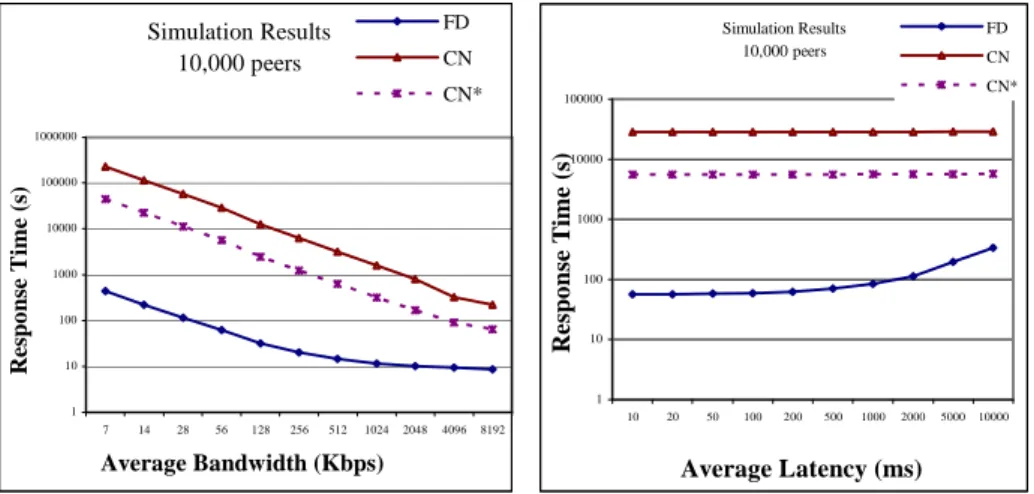
Figure 4 shows how response time decreases with increasing bandwidth, with the other simulation parameters set as in Table 1. Increasing the bandwidth has strong,
Simulation Results 1 10 100 1000 10000 32 64 100 200 500 1000200050001000 0 Number of peers R e sp o n se T im e ( s) FD CN CN*
similar effect on all three algorithms which have to transfer some data over the net-work. FD outperforms the other algorithms for all the tested bandwidths.
Figure 5 shows how response time evolves with increasing latency, with the other simulation parameters set as in Table 1. Latency has little effect on the CN algorithm, because the peers return their results directly to the query originator, and do not bub-ble up the results. Although FD outperforms the other algorithms for all the tested values, high latency, e.g. more than 1000 ms, has strong impact and increases sponse time much. However, below 1000 ms, latency has not much effect on FD’s re-sponse time. According to studies reported in [ 18], more than 80% of links between peers have good latency, less than 280 ms, for which FD has very good performance.
Simulation Results 10,000 peers 1 10 100 1000 10000 100000 1000000 7 14 28 56 128 256 512 1024 2048 4096 8192 Average Bandwidth (Kbps) R es p o n se T im e (s ) FD CN CN* Simulation Results 10,000 peers 1 10 100 1000 10000 100000 10 20 50 100 200 500 1000 2000 5000 10000 Average Latency (ms) R e sp o n se T im e ( s) FD CN CN*
Fig. 4. Effect of bandwidth on response time Fig. 5. Effect of latency on response time
5.3 Communication Cost
Now, using our simulator we study the communication cost of FD in its basic form and also with the strategies proposed in Section 3.2 for reducing the communication cost. We measure the communication cost in terms of the number of bytes, which should be transferred on the network for processing a top-n query Q.
Effect of Strategy 1 and Strategy 2
In this section, we study the communication cost of three versions of FD: 1) its basic form, noted as FD-Basic; 2) using Strategy 1, denoted by FD-St1; 3) using a combina-tion of Strategy 1 and Strategy 2, denoted by FD-Str1+2.
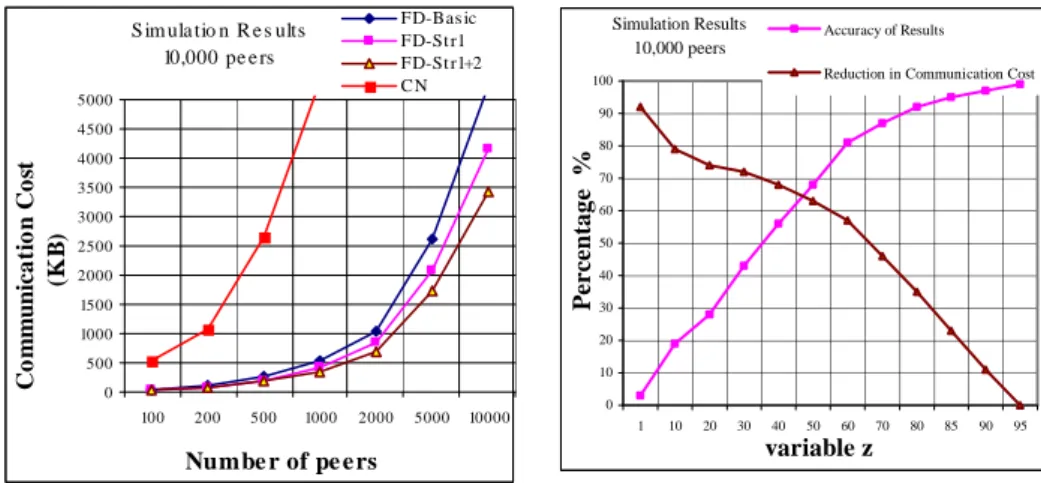
Figure 6 shows how communication cost evolves with increasing the number of peers, with the other parameters set as in Table 1. With 10,000 peers, the communica-tion cost of FD-Basic is about 5 MB, but FD-Str1+2 has reduced this cost to about 3.5MB, thus approximately 30% reduction in communication cost.
S im ula tio n R e s ults 10,000 pe e rs 0 500 1000 1500 2000 2500 3000 3500 4000 4500 5000 100 200 500 1000 2000 5000 10000 Numbe r of pe e rs C o m m u n ic a ti o n C o st (K B ) FD-Bas ic FD-St r1 FD-St r1+2 CN Simulation Results 10,000 peers 0 10 20 30 40 50 60 70 80 90 100 1 10 20 30 40 50 60 70 80 85 90 95 variable z P e r ce n ta g e % Accuracy of Results
Reduction in Communication Cost
Fig. 6. Communication cost vs. number of peers Fig. 7. Effect of using statistics for selecting
“best” neighbors
Effect of using statistics on communication cost
As stated in Section 3, we can use the statistics gathered during previous query execu-tions in order to select a subset of the “best” neighbors, which are more likely to re-turn top results, and to send Q only to them, thereby reducing the communication cost. In this section, we study the effect of this strategy on the communication cost. We measure the communication cost in terms of the number of bytes which should be transferred over the network for processing a Top-k query Q.
We used the following heuristic for selecting the neighbors: send Q to the neighbors which the position of their greatest score in the merged score-list was lower than z×n, where z≤1.
We also studied the effect of the above heuristic on the accuracy of the returned results. We define the accuracy of results as follows. Let PQ ⊆ P be a set containing
the query originator and all peers that receive Q. Let TQ be the set of the k top results
owned by the peers involved in PQ. Let Tr be the set of the results which will be
re-turned to the user as the response of Q. We denote the accuracy of results by acQ and
we define it as acQ = (TQ∩ Tr) /TQ.
We increased z from zero to one and we measured acQ and the percentage of the
reduction in communication cost. The results are depicted in Figure 7. For z = 0.80, the accuracy of results is higher than 90%, despite the fact that the communication cost is reduced by approximately 35%. Thus, with a small loss of accuracy, we can obtain a significant reduction in communication cost.
5.4 Dealing with Peers’ Dynamicity
Using the simulator we now study the effect of the strategies presented in Section 4 for dealing with the dynamic behavior of P2P systems, on the accuracy of results.
We defined the accuracy of results acQ in Section 5.3. We now measure acQ in two
versions of FD. The first version, denoted as FD-Basic, is the basic form of FD in which peers discard the late score-lists, as well as their merged score-list in the case that their parent is inaccessible. The second one, denoted as FD-Dynamic, is a version in which in the case of receiving late score-lists or inaccessibility of the parent, the peers use the urgent score-lists for bubbling up the late score-list or merged score-list as described in Section 4.
In our tests, we investigated how the accuracy of results changes with varying the average lifetime of the peers according to the distributions observed in [ 18]. The life-time of a peer is defined as the life-time period the peer stays in the P2P system. In our tests, we assumed that the query originator doesn’t leave the system before releasing the results to the user.
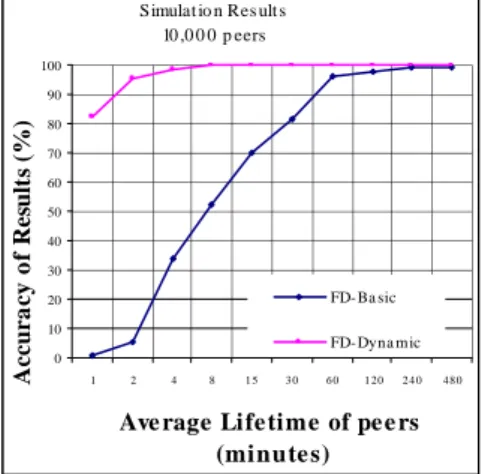
The results are shown in Figure 8. For lifetimes above 4 minutes, the accuracy of results in FD-Dynamic is approximately one. But, in FD-Basic, even for lifetimes above one hour, the accuracy of results is less than one. This shows the excellent im-pact of our strategy on the accuracy of the results in dynamic environments.
Simulat io n Res ult s 10 ,0 0 0 p eers 0 10 20 30 40 50 60 70 80 90 100 1 2 4 8 1 5 3 0 6 0 1 20 2 4 0 48 0
Ave rage Life time of pe e rs (minute s) A c c u r a c y o f R e su lt s (% ) FD- Ba sic FD- Dyna mic
Fig. 8. Accuracy of results considering the dynamic behavior of P2P systems
6 Related Work
Most of the techniques proposed for Top-k query processing in distributed systems are based on histograms, maintained at a central site, to estimate the score of data-bases with respect to a query and send the query to the datadata-bases that are more likely to involve top results [ 24][ 25]. In [ 24], a two-step method for Top-k query processing in distributed systems with possibly uncooperative local systems is proposed. The first step determines which databases are likely to contain the top results and rank the databases with respect to the given query. The second step determines how the ranked databases should be searched and which tuples from the searched databases should be returned. A central node maintains some histograms to estimate the rank of the
data-bases with respect to the query. However, this technique can not be used efficiently in a P2P environment, because keeping histograms up-to-date with autonomous peers that may join or leave the system at any time is difficult.
In the context of P2P systems, little research has concentrated on the Top-k query processing. In [ 21], the authors present a Top-k query processing algorithm for Edutella, a super-peer network in which a small percentage of nodes are super-peers and are assumed to be highly available with very good computing capacity. The su-per-peers are responsible for Top-k query processing and other peers only execute the queries locally and score their resources. Although very good for super-peer systems, this technique cannot apply efficiently to other P2P systems, in particular, unstruc-tured, since there may be no peer with higher reliability and computing power. In con-trast, FD makes no assumption about the P2P network topology and the existence of certain peers.
PlanetP [ 8] is a P2P system that constructs a content addressable publish/subscribe service using gossiping to replicate global documents across P2P communities up to ten thousand peers. In PlanetP, a Top-k query processing method is proposed that works as follows. Given a query Q, the query originator computes a relevance ranking of peers with respect to Q, and then contacts them one by one from top to bottom of ranking and asks them to return a set of their top-scored document names together with their scores. To compute the relevance of peers, a global fully replicated index is used that contains term-to-peer mappings. In a large P2P system, keeping up-to-date the replicated index is a major problem that hurts scalability. In contrast, our algo-rithm does not use any replicated data.
For the cases where a data item can have multiple scores at different sites, e.g. the amount of a customer’s purchase in several stores, the Threshold Algorithm (TA) for monotonic score aggregation [ 9] stands out as an efficient method. There have been many works in order to optimize the TA algorithm in terms of communication cost and response time, e.g. [ 22] and [ 13]. In our case, each data item has a unique score. However, we could also use variations of the TA algorithm in the case of multiple scores.
7 Conclusion
In this paper, we proposed FD, a fully distributed framework for executing Top-k queries in unstructured P2P systems, with the objective of reducing network traffic. FD requires no global information, does not depend on the existence of certain peers, reduces significantly the communication cost, and addresses the volatility of peers during query execution.
We validated the performance of FD through implementation over a 64-node clus-ter and simulation using the BRITE topology generator and SimJava. The experimen-tal and simulation results show that FD has logarithmic scale up. The simulations also show the excellent performance of FD, in terms of communication cost and response time, compared with two baseline algorithms. The results show that our strategies can reduce the communication cost significantly, i.e. by about 35%. They also show that, by selecting a good heuristic and well adjusting the parameters, we can take
advan-tage of statistics to achieve a significant reduction, i.e. of more than 35%, in commu-nication cost without a significant loss in accuracy, less than 10%. Furthermore, the simulation results show that the algorithms, proposed in FD for addressing the dy-namic behavior of P2P systems, are effective.
As future work, we plan to deal with replicated data in P2P Top-k query process-ing. In the case of data replication, with our algorithm, there may be replicated data items in the final score-list. This may be fine for the user as it is an indication of the items’ usefulness (in a P2P system, the most useful data get most replicated). But we could also identify replicated items. A simple solution is to add information in the score-lists to help eliminate duplicates (e.g. key values for relational data, descriptors for documents). An issue then is to optimally choose the replicas to access.
References
1. Aberer, K., AND Wu, J. Framework for Decentralized Ranking in Web Information
Retrieval. Proc. of the 5th Asia Pacific Web Conference (APWeb), 2003.
2. Aberer, K., et al. P-Grid: a self-organizing structured P2P system. SIGMOD Record
32(3), 2003.
3. Akbarinia, R., Martins, V., Pacitti, E., and Valduriez, P. Design and Implementation of
Atlas P2P Architecture. Global Data Management (Eds. R. Baldoni, G. Cortese, F. Davide), IOS Press, 2006.
4. BRITE, http://www.cs.bu.edu/brite/.
5. Carey, M.J., AND Kossmann, D. On saying “Enough Already!”. SIGMOD Conf.,
1997.
6. Chaudhuri, S., AND Gravano, L. Evaluating Top-k Selection queries. VLDB Conf.,
1999.
7. Clarke, I., et al. Protecting Free Expression Online with Freenet. IEEE Internet
Com-puting 6(1), 2002.
8. Cuenca-Acuna, F.M., Peery, C., Martin, R.P., AND Nguyen, T.D. PlanetP: Using
Gos-siping to Build Content Addressable Peer-to-Peer Information Sharing Communities.
IEEE Int. Symp. on High Performance Distributed Computing (HPDC), 2003.
9. Fagin, R., Lotem, J., AND Naor, M. Optimal aggregation algorithms for middleware. J.
Comput. Syst. Sci. 66(4), 2003.
10. Gnutella. http://www.gnutelliums.com/.
11. Howell, F., AND McNab, R. SimJava: a discrete event simulation package for Java
with applications in computer systems modeling. Int. Conf. on Web-based Modelling
and Simulation, San Diego CA, Society for Computer Simulation, 1998.
12. Kazaa. http://www.kazaa.com/.
13. Michel, S., Triantafillou, P., AND Weikum, G. KLEE: A Framework for Distributed
Top-k Query Algorithms. VLDB Conf., 2005.
14. Ooi, B., Shu, Y., AND Tan, K-L. Relational data sharing in peer-based data
manage-ment systems. SIGMOD Record, 32(3), 2003.
15. Ratnasamy, S., Francis, P., Handley, M., Karp, R.M., AND Shenker, S. A scalable
con-tent-addressable network. Proc. of SIGCOMM, 2001.
16. Ripeanu, M., AND Foster, I. Mapping the gnutella network: Macroscopic properties of
large-scale peer-to-peer systems. IPTPS, 2002.
17. Ripeanu, M., Iamnitchi, A., AND Foster, I. Mapping the Gnutella Network. IEEE
18. Saroiu, S., Gummadi, P., AND Gribble, S. A Measurement Study of Peer-to-Peer File Sharing Systems. Proc. of Multimedia Computing and Networking (MMCN), 2002.
19. Stoica, I., Morris, R., Karger, D.R., Kaashoek, M.F., AND Balakrishnan, H. Chord: A
scalable peer-to-peer lookup service for internet applications. Proc. of SIGCOMM, 2001.
20. Tatarinov, I., et al. The Piazza peer data management project. SIGMOD Record 32(3),
2003.
21. Thaden, U., Siberski, W., Balke, W.T., AND Nejdl, W. Top-k query Evaluation for
Schema-Based Peer-To-Peer Networks, Int. Semantic Web Conf. (ISWC), 2004.
22. Theobald, M., Weikum, G., AND Schenkel, R. Top-k Query Evaluation with
Probabil-istic Guarantees. VLDB Conf., 2004.
23. Yang, B., AND Garcia-Molina, H. Improving Search in Peer-to-Peer Networks. Proc.
of Int. Conf. on Distributed Computing Systems (ICDCS), 2002.
24. Yu, C., Philip, G., AND Meng, W. Distributed Top-n Query Processing with Possibly
Uncooperative Local Systems, VLDB Conf., 2003.
25. Yu, C., Sharma, P., Meng, W., AND Qin, Y. Databases Selection for Processing k
Nearest Neighbors Queries in Distributed Environments. ACM/IEEE-CS joint Conf. on
DL, 2001.
Appendix A: Computing the Wait time
In the Local Query Execution phase (see Section 3), each peer p, after sending Q to its neighbors and executing Q locally, must wait to receive the results of its neighbors. However, some of the neighbors may leave the P2P system and never send any result to p. Thus, we must determine a limit for p’s wait time.
Let ttl be the value of TTL when p sends Q to its neighbors. We define
sponse(Q,ttl) as the time for p to receive all its neighbors’ results. Thus, sponse(Q,ttl) is the optimal value for p’s wait time. If p waits less than Re-sponse(Q,ttl), it will lose the results of some neighbors. If it waits more time, it will
increase the overall response time. Therefore, we estimate Response(Q,ttl) in order to use it for setting the wait time of p. Response(Q,ttl) is made of the following cost components.
1. The forward time, which is the time to send Q from p to its descendants, i.e. p’s neighbors, p’s neighbors’ neighbors, and so on, until TTL reaches zero.
2. The local query execution time, which is the time needed for the local execution of Q by the descendants of p.
3. The merge time, which is the time it takes the descendants of p merge their local scores with the received score-lists.
4. The backward time, which is the time it takes the descendants of p to bubble up their score-lists, until they reach to p.
To estimate these four cost components, we consider the maximum number of tasks, which must be done sequentially. Because the value of TTL of Q when p sends it to the neighbors is ttl, the forward time has at most ttl sequential sendings of Q. The local execution of Q can be done in parallel by all its neighbors, thus we consider only one sequential local query execution. To estimate the merge time, we consider the maximum number of peers that must do their merge operation sequentially which is
The backward time consists of at most ttl sequential sendings of score-lists. Using the cost parameters described in Table 2 which we discuss below, we can state that:
Response(Q,ttl) ≤ ttl × TQsnd (Q) + Texec(Q)+ ttl × TSLsnd(k) + (ttl - 1)×TMerge(k)
(1)
Now, let Waitp(Q,ttl) be the time that peer p must wait after sending the query Q
with TTL=ttl to its neighbors, we can set Waitp(Q,ttl) as follows:
Waitp(Q,ttl) = ttl × TQsnd (Q) + Texec(Q) + ttl × TSLsnd(k) + (ttl - 1)×TMerge(k) (2)
Table 2. Cost parameters for estimating the wait time
Parameter Description
TQsnd(Q) Maximum time needed to send Q from a peer to its neighbor. Texec(Q) Maximum time to execute Q locally.
TSLsnd(k) Maximum time to send a score-list containing k scores (and
ad-dresses) from a peer to its parent.
TMerge (k) Maximum time for a peer to merge all score-lists received from its
neighbors with its local top scores. Each score-list contains at most
k couples.
Formula (2) relies on the cost parameters described in Table 2. To discuss how we can obtain these cost parameters, we classify them into network-dependent parameters and local processing parameters.
Network-dependent parameters, i.e. TQsnd(Q) and TSLsnd(k). These parameters
de-pend on the P2P physical network characteristics, e.g. the latency and data transfer rate between peers. Peers can estimate these parameters using statistics gathered from previous query executions. During the bubbling up of the scolists, we can also re-cord some network characteristics like minimum latency and minimum data transfer rate between peers. Using these statistics, p can simply compute the network depend-ent parameters.
Local processing parameters, i.e. Texec(Q) and TMerge (k). Estimating Texec(Q)
pre-cisely is hard because it depends on many parameters, e.g. the computing power of peers, their load, their database size, etc. Thus, we simply let the user give a threshold
T for the maximum local query execution time. If a peer cannot execute Q within T
time units, its result may be discarded. In fact, this threshold is the budget that the user invests for the local query execution. She can adjust this parameter according to the desired trade-off between result completeness and response time. For instance, a low value of T may result in loosing the top results of the peers that cannot execute Q within T time units. Estimating TMerge (k) is easier because it is a function of k and the
number of p’s neighbors. Furthermore, the time to merge score-lists is typically much smaller than the other cost parameters. So a simple constant value can be easily com-puted.