Publisher’s version / Version de l'éditeur:
Powder Metallurgy, 54, 3, pp. 183-186, 2011-07-01
READ THESE TERMS AND CONDITIONS CAREFULLY BEFORE USING THIS WEBSITE. https://nrc-publications.canada.ca/eng/copyright
Vous avez des questions? Nous pouvons vous aider. Pour communiquer directement avec un auteur, consultez la
première page de la revue dans laquelle son article a été publié afin de trouver ses coordonnées. Si vous n’arrivez pas à les repérer, communiquez avec nous à [email protected].
Questions? Contact the NRC Publications Archive team at
[email protected]. If you wish to email the authors directly, please see the first page of the publication for their contact information.
NRC Publications Archive
Archives des publications du CNRC
This publication could be one of several versions: author’s original, accepted manuscript or the publisher’s version. / La version de cette publication peut être l’une des suivantes : la version prépublication de l’auteur, la version acceptée du manuscrit ou la version de l’éditeur.
For the publisher’s version, please access the DOI link below./ Pour consulter la version de l’éditeur, utilisez le lien DOI ci-dessous.
https://doi.org/10.1179/174329011X13045076771759
Access and use of this website and the material on it are subject to the Terms and Conditions set forth at
Interstitial elements in titanium powder metallurgy: sources and control
Baril, É.; Lefebvre, L. P.; Thomas, Y.
https://publications-cnrc.canada.ca/fra/droits
L’accès à ce site Web et l’utilisation de son contenu sont assujettis aux conditions présentées dans le site LISEZ CES CONDITIONS ATTENTIVEMENT AVANT D’UTILISER CE SITE WEB.
NRC Publications Record / Notice d'Archives des publications de CNRC:
https://nrc-publications.canada.ca/eng/view/object/?id=6a2432ae-9e1a-4784-a47d-fb4f5eb32bdb
https://publications-cnrc.canada.ca/fra/voir/objet/?id=6a2432ae-9e1a-4784-a47d-fb4f5eb32bdb
Published by Maney Publishing (c) IOM Communications Ltd
metallurgy: sources and control
E. Baril*, L. P. Lefebvre and Y. Thomas
The effect of interstitials on the mechanical properties of cast and wrought titanium alloys has been extensively reported but less
information is available on the effect of contamination during PM processing. The sources of interstitial contamination when processing titanium powders by compaction, isostatic pressing, powder injection moulding (PIM) and innovative foaming processes are reviewed, focusing specifically on oxygen. The initial powder characteristics (surface area, size), process parameters (time, temperature) and environment (atmosphere, binder, support) may all have significant impact on the final interstitial content. It is, therefore, important to identify and control the sources of contamination by interstitials. A case study on PIM is provided to illustrate the relative contribution of the different sources.
It is well established that the mechanical properties of dense titanium and titanium alloys are sensitive to the presence of interstitial solutes such as oxygen, nitrogen, carbon and hydrogen, which tend to increase the elastic modulus and yield strength and reduce the ductility.1 Nitrogen has generally the most significant effect, followed by oxygen and carbon. While nitrogen and carbon are usually not found at high
concentration in dense titanium, oxygen is a common contaminant due to its high solubility in and high affinity for titanium. At low concentration, oxygen occupies octahedral sites of the a-titanium lattice; it increases the lattice parameters as well as the c/a ratio in the crystal, resulting in a volumetric change of 0.0013 nm3/ at.-%O.2,3The oxygen atoms interact
with both the hydrostatic and shear stress fields of dislocations, affecting
both edge and screw dislocation motion. Therefore, increasing oxygen content results in an increase of the yield strength, hardness and fatigue resistance at a given stress level, whereas it decreases the ductility and impact resistance by restricting twinning and prismatic slip.4
Since interstitial elements significantly affect the properties of titanium, standards have been established on the chemical requirements for orthopaedic and dental applications.5–9These standards specify maximum permissible interstitial contents for different manufacturing processes11–13and demonstrate the capability of wrought material, casting and PM processes to keep the oxygen concentration at low levels. The PM standard allows the highest oxygen content in the final component (0.30 wt-%) for Ti–6Al–4V alloy. Oxygen in porous titanium coatings for surgical implants has also been addressed in a standard.10According to this standard, the maximum content of oxygen in the powder used for such coatings must be ,0.4 wt-%. The standard does not, however, specify the amount of oxygen in the final coating.
The high specific surface area of powders means that the potential of increased interstitial contents from sur-face contamination (oxidation, nitriding, carburising, etc.) is significant. The sources of interstitials contamination when processing titanium powders and their respective importance will now be reviewed, focusing specifically on oxygen.
Sources of interstitial
contamination
Figure 1 illustrates typical PM steps and related variables that may affect interstitial contamination.
It should be noted that accuracy of chemical analysis is important in assessing oxygen in titanium, inert gas fusion being the most common technique. While the technique is normalised,14the results are highly
sensitive to the sampling and measurement procedures. The
reliability of the technique has been assessed in a round robin testing campaign conducted on 245 mm cp Ti and Ti–6Al–4V powders at four laboratories certified to serve the aerospace and medical sectors.
As can be seen in Table 1, large variations were observed. The powder supplier was able to reproduce (within 4% variability) the results reported in the powders certificate of analysis and one laboratory (S) gave results relatively close (within 10%, but slightly above) to those reported by the supplier. The other laboratories provided values much higher (B) or well below (G) the certificate of analysis. The results clearly show that values from certified laboratories cannot be taken for granted unless their procedures have been validated and blind controlled to confirm their reliability and suggest that some laboratories need to be trained and monitored specifically for the analysis of titanium powders.
The authors’ laboratory (NRC-IMI) has installed an inert gas fusion oxygen analyser (LECO TCH-600) and
developed sampling, analytical and monitoring procedures for titanium powder. Once training and monitoring procedures were in place, the standard deviations achieved on SP3-126 (Ti) powder were 0.011 wt-%, which corresponds to variability below 4.4%. These values are, nevertheless, above the 1.5% variability values reported by the analytical equipment
manufacturer.15
Powder production
The oxygen content of the starting powder is mainly determined by its manufacturing process, size distribution, surface area, chemistry, and storage conditions. These factors affect the two contributors to total oxygen content: surface oxide and oxygen in solid solution. The oxygen in solution mainly comes from the chemistry of the raw material and the powder manufacturing process. The amount of oxygen in the surface oxide National Research Council Canada/Industrial
Materials Institute (NRC-IMI), 75 de Mortagne Blvd, Boucherville, Que´bec, Canada J4B 6Y4 *Corresponding author, email eric.baril@cnrc-nrc. gc.ca
Published by Maney Publishing (c) IOM Communications Ltd
depends on the specific surface area of the powder (particle size distribution and shape) and thickness of the oxide layer. The oxide layer thickness, on the other hand, depends on processing (exposure to oxygen at moderate temperature) and the storage conditions.
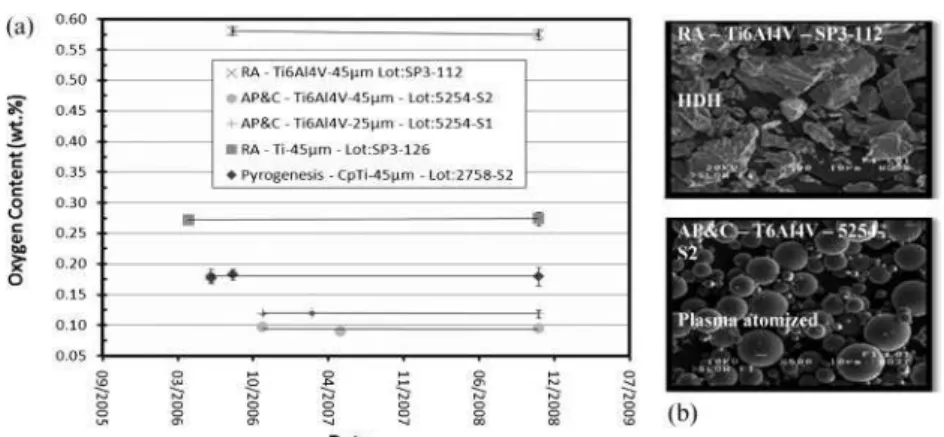
Figure 2 presents the total oxygen content of various titanium powders and the effect of storage on oxygen pick-up. Commercial purity (cp) Ti and Ti–6Al–4V powders from two manufacturers (Reading Alloy: HDH and AP&C-Pyrogenesis: plasma atomised) were analysed over a period of 2.5 years of storage in normal
conditions (unsealed steel containers filled with air of uncontrolled humidity between 20 and 60% RH). The effect of particle size distribution and surface area can clearly be seen with the plasma atomised powders (5254-S1 and 5254-S2). Both powders were from the same atomisation batch but were sieved at 225 mm (S1) and 245 mm (S2), with specific surface areas of 0.1233 and 0.0717 m2g21
respectively. The surface area difference (i.e. 0.0516 m2g21) results
in an increase of oxygen content by 0.0237 wt-% (an oxygen increase of 4.59 mg m22). Assuming the increase
is directly related to surface oxidation
(r54.23 g cm23, O
TiO2540.1 wt-%),
this represents a 3 nm TiO2passivation
layer, which is typical of oxide layers naturally formed on titanium at room temperature (2–7 nm).16The immobilisation of this oxygen in the passivation layer means that the interstitial content (in solution in titanium) in these powders should be y0.062 wt-%. This is close to the level in commercially available high purity titanium (0.04 wt-%) and indicates that, apart from oxidation of the new surfaces created, there is practically no oxygen pick-up during atomisation.
HDH powders show significantly higher oxygen contents than the plasma atomised powders, associated with both the higher surface area due to their irregular shape (0.137 and 0.176 m2g21
for SP3-126 and SP3-112) and higher soluble content. Assuming a 3 nm TiO2
passivation layer, the oxygen in solid solution represents 0.200 wt-% (SP3-126) and 0.484 wt-% (SP3-112).
During the 2.5 year exposure, the containers were opened several times and closed without purging with neutral gas; consequently, the powders were exposed to air. The results in Fig. 2 therefore show the relative resistance to oxidation of the titanium powder when stored and manipulated in a laboratory environment without use of a glove box or neutral gas cover.
Powder mixing and compaction
In most PM processes, the titanium powders are mixed with lubricants, binders and/or alloying elements. The contribution of the mixing procedure is negligible unless mixing is done at high temperature and/or energy. With high mixing energies, such as those involved in mechanical alloying, the titanium particles may deform and/or break, leading to the exposure of new surfaces that will be passivated when exposed to air. The creation of the new oxide film increases the oxygen content in the final powder mixture.Additives such as binders or lubricants can also represent important sources of interstitial contamination. Conse-quently, these additives must be carefully selected to avoid oxygen pick-up during processing. Unless the powder/additives mixture is exposed at high temperature in the presence of oxygen, the forming (moulding, compaction, extrusion, foaming) of titanium powders does not cause important oxygen up. Any pick-up usually comes from reaction with remaining oxygen in the debinding atmosphere and to a lesser extent from decomposition products.
1 Source of interstitial oxygen contamination in typical PM processes
2 aOxygen content of titanium powders stored in unsealed steel containers in air under uncontrolled conditions; b morphology of HDH and plasma ato-mised powders
Table 1 Round robin results on oxygen analysis (wt-%) on 245 mm hydride/ dehydride (HDH) powders conducted with four certified laboratories serving aerospace and medical sectors
Sample Certificate of analysis G B S B2 Supplier Average (labs) Standard deviation (labs) SP3-126 (Ti) 0.25 0.109 0.63 0.276 0.221 0.26 0.30 0.20 SP3-112 (Ti–6Al–4V) 0.54 0.220 0.66 0.570 0.503 0.53 0.50 0.17 N E W S A N D V I E W S
Published by Maney Publishing (c) IOM Communications Ltd
Debinding/delubrication
Thermal processing is often used to decompose and eliminate binders and/or lubricants used during the forming step. Since decomposition usually takes place in inert atmospheres free of oxygen, these additives must have clean decomposition characteristics to avoid reaction with titanium during debinding.Several formulations have recently been developed for the powder injection moulding of titanium. These
formulations, which generally include compounds among polyethylene, polypropylene, polymethylmethacrylate, polyethylene glycol, ethylene vinyl acetate, paraffin wax, naphthalene and stearic acid,17,18have decomposition
temperatures between 200 and 500uC. Thus, thermal debinding profiles must be optimised to the binder system used. Some compounds such as PEG leave excessive residues (oxygen and carbon) if not sufficiently removed during the water based initial debinding treatment.
Thermal debinding is usually done at moderate temperatures to ensure the complete decomposition of the binder while minimising oxygen pick-up. Figure 3 presents the oxygen pick-up of titanium foams (0.05 m2g21; initial oxygen
content: 0.29 wt-%)19exposed for 60 min at various temperatures in argon
containing 20 vol.-%O2. It can be seen
that oxidation dramatically increases above 400uC: below that temperature, the oxidation is not dramatic even in an atmosphere containing 20%O2. This
confirms that no special care is required when mixing or shaping titanium powder below 400uC (unless very fine powders are involved). This also indicates that the debinding/delubrication process should be done at temperature below 400uC.
Sintering
High temperature vacuum sintering is generally preferred for titanium PM components. Since sintering occurs at temperature above 1000uC, the passivation layer is dissolved and the oxygen goes into solution.19The
titanium surface then becomes highly active and will react with oxygen, even at very low concentration in the atmosphere. The initial surface area of the powder, the sintering time– temperature profile and the sintering support are the main factors affecting oxygen pick-up. Figure 4 presents the effect of surface area (225 and 245 mm powder and dense 2 mm rod) on the oxygen pick-up during exposure for 60 min in a 1026torr vacuum. It can
be seen that oxygen pick-up increases significantly with temperature and also with the surface area of the medium (powder or rod). Other variables, such as sintering time and supports, have been analysed elsewhere.20–22
The surface of titanium is repassivated during exposure to air after vacuum sintering, resulting in additional oxygen pick-up. This effect is minimal for dense components but can be important for porous components.19The formation of
this new oxide film contributes to the total oxygen content but should not have an important impact on the final mechanical properties of the components, on which the effect of oxygen in solution is pre-dominant. The oxide film does, however,
confer corrosion resistance and biocom-patibility on titanium and titanium alloys.
Case study
In order to evaluate the relative contribution of different sources of oxygen, a study of a titanium PIM process has been carried out. Titanium alloy PIM components have great potential in high value markets such as defence, medical and aerospace applications and the requirement to meet specified properties is critical in penetrating these markets.23
Understanding and controlling interstitial contamination are an important component of these developments.
For this case study, two Ti–6Al–4V powder particle size distributions were used: 225 and 245 mm. The feedstock was composed of 66 vol.-% of powder in a polyethylene–paraffin wax–stearic acid binder system. Debinding was conducted for 10 h between 100 and 450uC in repurified argon (4 L min21Ar
with 1028ppm O
2). Sintering was done
under vacuum for 3 h at 1300uC. To monitor independently the effect of each variable, reference powders were placed in a BN crucible to avoid contamination from the binder or oxide support. Figure 5 compares the absolute contributions of the powder, debinding, sintering and support to the total oxygen content in the component. As expected, the 225 mm powder had higher oxygen content than the 245 mm powder, the major contributors being the initial powder and the debinding process.
When normalised, the contributions can be ranked in a Pareto graph (Fig. 6). This analysis indicates that the final oxygen content is principally affected by the initial oxygen content of the powder and the interaction with trace oxygen in the vacuum sintering furnace. Interestingly, powder size and surface oxidation do not change the 3 Oxygen content in titanium foams
exposed for 60 min at various tem-peratures in argon containing 20 vol.-%O2
4 Oxygen content of loose titanium powders and 2 mm rod after expo-sure for 60 min in 1026torr
vacuum
5 Absolute contributions of powder, debinding and sintering cycles on final oxygen content of titanium PIM components
Published by Maney Publishing (c) IOM Communications Ltd
relative ranking of the powder, debinding and sintering support contributions. They do, however, impact on the ranking of the binder and sintering atmosphere contributions. The binder contributes more
significantly to oxygen pick-up for the smaller particles. This may be due to the larger surface area available for the reaction with binder components. The relative contribution of the sintering atmosphere is less important for the smaller particles as a result of their faster densification and the faster reduction of surface area during sintering. The reduction of the exposed titanium surface minimises oxygen pick-up during sintering.
The Pareto graph helps to identify areas of potential improvement in the process. Since the major contribution comes from the powder, reduction of the powder oxygen content would be beneficial. However, the Ti–6Al–4V powders employed were already low in oxygen (,0.11 wt-%) and potential for further improvement is limited without significant cost penalty. Improved sintering conditions will, however, contribute significantly to the reduction of the total oxygen content without major cost implications. Optimisation of the sintering time–temperature schedule and use of in situ oxygen getters could further reduce the total oxygen content. Other improvements such as the reduction of the debinding peak temperature will also contribute to the reduction of the oxygen content in the final components.
Conclusions
Oxygen in solution has detrimental effects on the ductility of titanium components. Therefore, its maximum content is generally specified and must be controlled in most applications.
The following conclusions can be drawn on the basis of the present review:
N
analysis of oxygen content can be tricky and must be done with care and good controls according to standard proceduresN
the oxygen content of the final components is mainly determined by: (i) powder oxygen content (process, size distribution, specific surface area) and (ii) thermal processes above 400uCN
when carefully optimised, binders have minimal impact on the total oxygen contentN
at temperatures below 200uC, oxidation of titanium is minimal and no special care is required to minimise oxygen pick-up.Acknowledgements
The authors acknowledge J. P. Nadeau and S. Mercier for their contributions to this work. This contribution is based on a presentation at the PM 2010 World Congress, organised by EPMA in Florence, Italy on 10–14 October 2010.
References
1. H. Conrad: Prog. Mater. Sci., 1981, 26, 123.
2. J. L. Murray and H. A. Wriedt: Bull. Alloy Phase Diagrams, 1987, 8, 378. 3. G. Ottaviani, F. Nava, G. Quierolo, G. Iannuzzi, G. De Santi and K. N. Tu: Thin Solid Films, 1987, 146, 201–207. 4. M. L. Wasz, F. R. Brotzen, R. B. McLellan and A. J. Griffin: Int. Mater. Rev., 1996, 41, 1–12. 5. ASTM standard F67–00, ‘Standard
specification for unalloyed titanium, for surgical implant applications (UNS R50250, UNS R50400, UNS R50550, UNS R50700)’.
6. ASTM standard F1341–99, ‘Standard specification for unalloyed titanium wire’ (UNS R50250, UNS R50400, UNS R50550, UNS R50700)’. 7. ASTM standard F1108–97a,
‘Stan-dard specification for titanium and titanium–6 aluminum–4 vanadium alloy casting for surgical implants (UNS R56406)’.
8. ASTM standard F136–98, ‘Standard specification for wrought titanium–6 aluminum–4 vanadium ELI (extra low interstitial) alloy (UNS R56401) for surgical implant applications’. 9. ASTM standard F1472–02a,
‘Stan-dard specification for wrought titanium–6 aluminum–4 vanadium alloy for surgical implant applications (UNS R56400)’.
10. ASTM standard F1580–01, ‘Stan-dard specification for titanium and titanium–6 aluminum–4 vanadium alloy powders for coatings of sur-gical implants’.
11. ASTM standard B265–09, ‘Standard specification for titanium and tita-nium alloy strip, sheet, and plate’. 12. ASTM standard B 367–09, ‘Standard
specification for titanium and titanium alloy castings’.
13. ASTM standard B 817–08, ‘Stan-dard specification for powder metal-lurgy (PM) titanium alloy structural components’.
14. ASTM standard E 1409–05, ‘Stan-dard test method for determination of oxygen and nitrogen in titanium and titanium alloys by the inert gas fusion technique’.
15. Dennis Lawrenz and John Hawkins: ‘Simultaneous oxygen, nitrogen and hydrogen determination of metals’, LECO, www.leco.com/resources/ application_notes/pdf/analytical_tips/ O-N-H%20Determination%20209-141-004.pdf (accessed 26 April 2011).
16. Y. Oshida: in ‘Bioscience and bioen-gineering of titanium materials’, 82; 2007, New York, Elsevier. 17. F. H. Froes: ‘Titanium PIM – a
review’, Proc. Int. Conf. on ‘Powder injection molding of metals, ceramics and carbides’ (PIM2006), Tampa, FL, USA, March 2006, MPIF.
18. R. German: ‘Titanium powder in-jection moulding: a review of the current status of materials, processing, properties and applica-tions’, Powder Inject. Mould. Int., 2009, 3, (4).
19. L. P. Lefebvre and E. Baril: ‘Effect of oxygen concentration and dis-tribution on the compression prop-erties of titanium foams’, Adv. 6 Pareto plot of contributions of main PIM variables to final oxygen content in
Ti components
N E W S A N D V I E W S
Published by Maney Publishing (c) IOM Communications Ltd
Eng. Mater., 2008, 10, 775– 787.
20. G. Shibo et al: ‘Powder injection molding of Ti–6Al–4V alloy’, J. Mater. Process. Technol., 2006, 173, 310.
21. M. Gauthier and E. Baril: ‘High-temperature interaction of titanium
with ceramic materials’, in Advances in powder metallurgy and particulate materials – 2005’, Vol. 7, 127; 2005, Princeton, NJ, MPIF.
22. E. Baril, Y. Thomas, M. Gauthier: ‘Sintering supports for Ti-based MIM components’, in Proc. Int. Conf. on ‘Powder injection molding
of metals, ceramics and carbides’ (PIM2006), Tampa, FL, USA, March 2006, MPIF.
23. E. Baril: ‘Titanium and titanium alloy powder injection mould-ing: matching application require-ments’, Powder Inject. Mould. Int., 2010, 4, 22–32.