HAL Id: hal-00318328
https://hal.archives-ouvertes.fr/hal-00318328
Submitted on 4 Jun 2007
HAL is a multi-disciplinary open access
archive for the deposit and dissemination of
sci-entific research documents, whether they are
pub-lished or not. The documents may come from
teaching and research institutions in France or
abroad, or from public or private research centers.
L’archive ouverte pluridisciplinaire HAL, est
destinée au dépôt et à la diffusion de documents
scientifiques de niveau recherche, publiés ou non,
émanant des établissements d’enseignement et de
recherche français ou étrangers, des laboratoires
publics ou privés.
The prominent 1.6-year periodicity in solar motion due
to the inner planets
I. Charvátová
To cite this version:
I. Charvátová. The prominent 1.6-year periodicity in solar motion due to the inner planets. Annales
Geophysicae, European Geosciences Union, 2007, 25 (5), pp.1227-1232. �hal-00318328�
www.ann-geophys.net/25/1227/2007/ © European Geosciences Union 2007
Annales
Geophysicae
The prominent 1.6-year periodicity in solar motion due to the inner
planets
I. Charv´atov´a
Geophysical Institute AS CR, Boˇcn´ı II, 141 31 Praha 4, Czech Republic
Received: 19 December 2005 – Revised: 27 February 2007 – Accepted: 13 April 2007 – Published: 4 June 2007
Abstract. The solar motion due to the inner (terrestrial)
plan-ets (Mercury, Me; Venus, V; Earth, E; Mars, Ma) has been calculated (here for the years 1868–2030). The author found these basic properties of this motion: the toroidal volume in which the Sun moves has the inner radius of 101.3 km and the outer radius of 808.2 km. The solar orbit due to the in-ner (terrestrial) planets is “heart-shaped”. The orbital points which are the closest to the centre lie at the time distance of 1.6 years (584 days), on the average, and approximately co-incide with the moments of the oppositions of V and E. The spectrum of periods shows the dominant period of 1.6 years (V-E) and further periods of 2.13 years (E-Ma) (25.6 months, QBO), 0.91 years (V-Ma), 0.8 years ((V-E)/2) and 6.4 years. All the periods are above the 99% confidence level. A possi-ble connection of this solar motion with the mid-term quasi-periodicities (MTQP, i.e. 1.5–1.7 years) in solar and solar-terrestrial indices can be proposed.
Keywords. History of geophysics (Solar-planetary
relation-ships) – Solar physics, astrophysics, and astronomy (Celes-tial mechanics; Photosphere and chromosphere)
1 Introduction
One of the basic questions of solar physics still remains: What is an origin of solar variability? It seems (see Sect. 3) that an origin of a long-term solar variability (solar cycles and their modulation) is likely the solar motion due to the giant planets (SIMGP).
During the latest decades, a shorter stable periodicity of 1.5–1.7 years (so-called mid-term quasi-periodicity (MTQP, e.g. McIntosh et al., 1992; Mursula and Zieger, 2002; . . . , in various solar (e.g. in solar magnetic field, solar wind speed, . . . ) and solar-terrestrial (e.g. in cosmic rays, geomagnetic
Correspondence to: I. Charv´atov´a
indices, . . . ) phenomena has been detected. Its origin has so far been unknown. In this article, the basic properties of the solar motion due to the inner planets (SIMIP) found by the author are shown (Sect. 2). Section 3 describes the previ-ous results concerning the SIMGP in comparison with these SIMIP results. Section 4 reviews the papers which detected MTQP in a series of solar and solar-terrestrial phenomena. SIMIP as a possible origin of MTQP can be taken under con-sideration if connections between the individual mentioned phenomena and SIMIP are found. Predictive assessments for solar and solar-terrestrial phenomena could be established even if a proper physical mechanism has not yet been es-tablished (Sect. 5).
2 Basic properties found in the solar motion due to the inner planets
The SIMGP was computed by our own program created by means of the standard methods of celestial mechanics and it was checked by the program sent to me kindly by J. H. Shirley (Jet Propulsion Laboratory, Pasadena) in 1992. Now, the computations are made according to the basis: http: //ssd.jpl.nasa.gov/. The SIMIP was computed separately.
In comparison with the SIMGP, which occurrs in units of 10−3AU (Astronomical Unit) or 106km, the SIMIP is in minutes but not negligible. The new results of this article that are the centre of the Sun moves inside the toroidal vol-ume with the inner radius of 101.3 km and the outer radius of 808.2 km; see Fig. 1. (A cinquefoil is created in the mid-dle of the motion area.) The maximum radius was reached in the year 1905.311, the minimum radius will be reached in the year 2026.025 (see Fig. 3). Moreover, on the con-trary to the solar orbit, due to the giant planets which consist of loops, the pattern of the solar orbit due to the inner (ter-restrial) planets is similar to a curve called a cardioid; it is “heart-shaped”. Figure 2 shows two examples of this orbit:
1228 I. Charv´atov´a: The prominent 1.6-year periodicity in solar motion
Fig. 1. The solar orbit due to the inner (terrestrial) planets in the
time interval 1920–2010 in units of km.
the solar orbits in the interval a) 1934–1944 and in the in-terval b) 1995–2010. The first example is plotted in steps of 20 days, in order to show and understand better this motion, while the second curve is smooth. One can see in Fig. 2a that the fastest motion (notice the lengths of the 20-day abscis-sas) occurs in the circumference of the toroidal motion area. Then the Sun is forced to go towards the centre and its ve-locity decreases. The veve-locity again increases after the Sun reaches the closest points. The time distance between the two consecutive nearest points has been found to be very close to 1.6 years (584 days). The time positions of the noted closest points approximately coincide in time with the moments of the oppositions of V and E. In this moment, the Sun reaches the smallest distances and the smallest velocities. The solar velocity varies between 16.37 km/day and 0.64 km/day.
In Fig. 3, the distance of the centre of the Sun is depicted. The main feature of this curve is its harmony, its stable mod-ulation by the periods of 1.6 years and 6.4 years. It is pos-sible to see there that every fourth value of the distance is the deepest (smallest) (1.6 years (V-E)×4=6.4 years or 2.13 (E-Ma)×3=6.4 years).
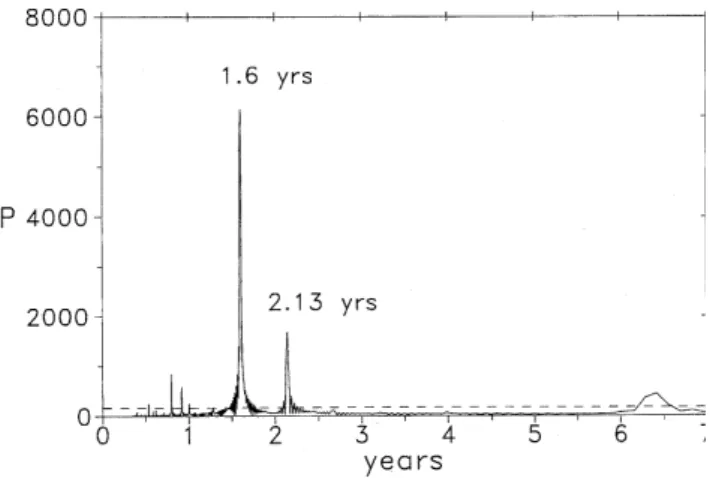
Figure 4 shows the spectrum of periods (the power spec-trum (Blackman and Tuckey, 1958) again in the distance. Be-sides the dominant period of 1.6 years (584 days) (V-E) the significant period of 2.13 years (25.6 months) (E-Ma) and further periods of 6.4 years, 1.0 years (E), 0.91 years (V-Ma), 0.8 years ((V-E)/2), . . . have also been detected. All of these periods are above the 99% confidence level. The period of 1.3 years reaches up to the 99% confidence level. Bucha et al. (1985) also detected the period of 6.4 years (JN/2) in the SIMGP which turns our attention to a harmony of the solar system as a whole. It is interesting and important that the de-tected period of 2.13 years (25.6 month) (E-Ma) corresponds to a mean period of QBO.
Fig. 2. The two examples of the solar orbit due to the inner
(ter-restrial) planets: (a) The solar orbit in the years 1934–1944 plotted in steps of 20 days. The times of the nearest points are: 1934.94, 1936.52, 1938.11, 1939.69, 1941.33, 1942.92. One can see here that the fastest solar motion (notice the lengths of the 20 days ab-scissas) occurrs in the circumference of the motion area. (b) The so-lar orbit in the years 1995–2010. The times of the nearest points are: 1995.61, 1997.22, 1998.84, 2000.41, 2001.99, 2003.62, 2005.25, 2006.81, 2008.42. The future value can serve for establishing of predictive assessments.
3 Discussion of results
The most substantial part of the solar motion is caused by the giant planets (Jupiter, J; Saturn, S; Uranus, U; Neptune, N). The circular area in which the Sun moves has the diameter of 4.34 RS (or 0.02 AU (Astronomical Unit) or 3.02×10⁶km),
where RS is the solar radius (Jose, 1965). The basic period
of SIMGP being 178.7 years was found by Jose (1965) and comfirmed by Fairbridge and Shirley (1987), Jakubcov´a and Pick (1987) or Juckett (2000).
Charv´atov´a (1988, 1990a, b) divided the SIMGP into two basic types, the one ordered in the trefoils (according to JS motion order: 117.3◦, 19.86 years) and the other disordered.
Fig. 3. The distance of the centre of the Sun created by the motion
of the inner (terrestrial) planets in the years 1895–1950. The peaks occur after 1.6 years (584 days) (close to the moments of the oppo-sition of V and E), on the average. Notice that the each fourth min-imum (4×1.6 years (V-E)=6.4 years and 3×2.13 years (E-Ma)=6.4 years) is the deepest (see Fig. 4).
The most disordered intervals of SIMGP coincide with the prolonged minima of solar activity, such as in the last mil-lennium, the Wolf, Sp¨orer, Maunder and Dalton minima (Charv´atov´a, 1990a, b). The Sun returns to the trefoil part of its orbit after 178.7 years (Charv´atov´a and Stˇreˇst´ık, 1991), on the average. When the Sun moves along the trefoil orbit, the diameter of the motion area was always reduced up to 3.5 RS. The trefoil intervals last about 50 years (Charv´atov´a,
1995, 1997a, b), and the cycle lengths are equal to about 10 years (JS/2) there (Charv´atov´a, 1990b, 1997, a, b, 2000). The series of sunspot cycles coresponding to the trefoil intervals (to the same solar orbit) repeats itself, i.e. the cycles −1 to 3 and 15 to 19 (Charv´atov´a, 1990b). All mentioned results show that solar variability is probably caused by the solar inertial motion.
The Sun moving along the nearly identical orbits in the tre-foils created nearly the same series of sunspot cycles −1 to 3 and 15 to 19. Small differences can be ascribed to a lower quality of data in the 18th century. Not only the trefoils, but also other motion (orbital) configurations are sometimes re-peated: (after a rotation), e.g. (158.0 BC to 208.5 AD) and (2560.8 BC to 2193.2 BC), . . . (Charv´atov´a, 2000). The so-lar orbits (motions) in the years 1980–2045 and 1840–1905 are nearly identical (see Charv´atov´a, 1997, Fig. 1b). A rep-etition of solar variability from the years 1840–1905 can be expected after 1980. The comparison of the first 26 years of data in the both intervals is hopeful (Charv´atov´a, in print, 2007).
The predictive assessment for cycle 23 was made in Charv´atov´a (1995, 1997) when only data series of 15–17 years were at our disposal: maximum sunspot cycle height between 65–140 W and cycle lengths between 9.6–12.3 years could occur (Charv´atov´a, 1990b, 1995, 1997). Our
predic-Fig. 4. The power spectrum of the periods in the distance of the
centre of the Sun (computed for the time interval 1868–2030). Be-sides the dominant period of 1.6 years (584 days) (V-E), also the significant periods of 2.13 years (25.6 months) (E-Ma)), 1.0 years, of 0.91 years (332 days) (V-Ma), of 0.8 years (292 days) ((V-E)/2)) and 6.4 years, . . . have been detected. All these periods are above 99% confidence level which is represented by the dashed horizontal line. The period of 1.3 years reaches up to 99% confidence level. The period of 2.13 years corresponds to a mean value of QBO.
tion of the cycle No. 23 height was successful: its height was 120 W, so that it was really between 65–140 W. All the other predictions were unsuccessful; they were too high – between 140 and even 225 W (e.g. Wilson, 1992; Shatten et al., 1996; Kane, 1997). The periods found in the SIMGP are described in Bucha et al. (1985). In Paluˇs et al. (2000), the quantita-tive relation between the solar activity and the SIMGP (here its radius of curvature) was shown, for the first time, by the method of synchronization,
The distance of the Sun’s centre due to the inner (terres-trial) planets varies between 101.3 km and 808.2 km (Fig. 3), i.e. the difference is about 700 km. This is more, for example, than the depth of the solar photosphere, which is considered to be about 300–500 km. The distance of the Sun’s centre due to the giant planets reaches up to 1.51×10⁶km, so that a contribution of the inner planets, which goes up to 808.2 km only, is not visible in the total (common) curve.
The individual solar spheres likely respond to the SIMGP and also to the SIMIP, provoking physical echoes on the boundary layers. The thin layer known as the tachocline lying between the radiative and convective zones, where a shear flow was found by SOHO-MDI “,is likely to be the place where the solar dynamo operates” (Kosowitchev et al., 1997). Is it possible to assume an influence of the SIMIP on the upper spheres of the Sun, on the tachocline or espe-cially on the photosphere? The physical properties of the solar photosphere differ significantly from those of the con-vective zone. The layered Sun is forced to move here along the “heart-shaped” solar orbit. Could its motion, especially in the vicinity of the closest (turning) points, produce some
1230 I. Charv´atov´a: The prominent 1.6-year periodicity in solar motion
solar changes close to MTQP? The motions of the Sun close to the nearest points (close to a turning parts of its orbit) can serve as the intervals (moments) where their possible con-nections with solar and solar-terrestrial phenomena can be, above all, searched for.
Wood and Wood (1965) showed that the inner planets are the most important in determining the jerk of the Sun. Shirley et al. (1990) have shown that the influence of the inner plan-ets is greater for the higher derivatives of the position. We will deal with their results, with this problem, in comparison with our findings in the future.
4 Survey of phenomena where MTQP have been found
Ambroˇz (1992) found the periods of stable behaviour of so-lar magnetic field in steps of 20-25 rotations of the Sun, i.e. in steps of 1.67 years, on the average. A periodicity close to 1.6 years (about 600 days) was reported for the coronal hole area changes in cycle No. 21 (McIntosh et al., 1992). MTQP has also been examined in connection with large-scale pho-tospheric motions (Vald´es-Galicia and Mendoza, 1998) and it was identified in the occurrence of the sudden storm com-mencements (Mendoza et al., 1999): “A long-life stability of this phenomenon implies a non-random generation of the so-lar magnetic flux”. Mursula and Zieger (1999) described a simultaneous occurrence of MTQP in solar wind speed, geo-magnetic activity and cosmic rays (CR). Fraser-Smith (1972) detected the significant period of 1.47 years in the geomag-netic index Ap(1932–1969). Ambroˇz (1973) found that the
structure of the distribution of Ca II flocculae on the whole Sun is repeated regularly after 20–25 rotations of the Sun (the mean period is 1.67 years) during cycle No. 19. He wrote: “It is clear that the fundamental pattern must be simple and must be repeated in time.”
Delouis and Mayaud (1975) detected the significant pe-riod of 1.47 years in the geomagnetic index aa (1868–1970). Kudela et al. (1991) pointed out an abrupt change in both the level and shape of the power spectrum of the CR series at about 20 months (1.66 years). They wrote that this indicates that the CR time variations with periods longer than about 20 months are caused by another physical mechanism other than that of the shorter period variations.
From our point of view, the first mechanism can be con-nected with the solar motion due to the giant planets (see Sect. 3 and Charv´atov´a, 1990a, b, 2000) and the second mechanism can be connected with the solar motion due to the inner (terrestrial) planets (see Sect. 2).
Vald´es-Galicia et al. (1996) detected the prominent peri-ods of 1.68 and 1.6 years in the CR intensity variations mea-sured at the Deep River station during the years 1947–1990, if the mean 11-year period was eliminated. They concluded that one of the characteristic modes of the solar magnetic ac-tivity has been found there. Kudela et al. (2002) detected the most remarkable quasi-period of 1.67 years in the period
range from 60 to 1000 days in CR intensity in the interval 1951–2000. Mursula and Zieger (2002) have found MTQP in the solar wind speed from 1964 onward and in the Kp
in-dex of geomagnetic activity from 1932 onward. They found the periods of 1.5–1.7 years during the odd cycles. Mursula et al. (2003) found MTQP in the geomagnetic index aa in the years 1844–2000. Kato et al. (2003) applied the wavelet transform technique and found the presence of the 1.68-year variation in the Voyagers’ (spacecraft) CR data on their way to the outer Heliosphere. Rouillard and Lockwood (2004) have shown that the 1.68-year variation in galactic CR fluxes is a persistent feature that is linked to a similar variation in the open solar magnetic flux estimated from the IMF strength at the Earth.. Mursula and Vilppola (2004) found the period of 1.7 years in satellite data at 1 AU and probes data (Pio-nier 10, 11 and Voyager 1, 2) in the outer Heliosphere during cycles 21 and 22.
Figure 4 shows the prominent period of 1.6 years and the second significant period of 2.13 years. The second period corresponds to a mean value of QBO. Shapiro and Ward (1962) detected the period of 25 months (2.06 years) in the Wolf sunspot numbers in the interval 1756–1955. Westcott (1964) connected this solar period with stratospheric oscil-lations. Baldwin et al. (2001) have summarized the results concerning QBO and its connections with solar, terrestrial and climatic phenomena.
Starodubtzev et al. (2004) detected, by means of wavelet dynamic spectrum, a strong MTQP in the CR fluctuation in-dex since 1980. Their power spectrum (Fig. 5, right) shows nearly the same prominent periods (1.7 years and 2.2 years) as seen in our power spectrum in Fig. 4. This represents a further, closer evidence about a possible connection between the SIMIP and solar-terrestrial phenomena.
5 Conclusions
This wide survey of MTQP (1.5–1.7 years) presence in many solar and solar-terrestrial phenomena calls for investigations on whether the SIMIP, with the dominant period of 1.6 years and with the second significant period of 2.13 years, could be the origin of MTQP (and may be an origin of QBO). The solar motion can be computed in advance (see the Figs. 1, 2b). If mutual connections (and consequently, a viable mech-anism to explain these correlations) is found, predictive as-sessments for solar and solar-terrestrial phenomena can be done.
Connections seem to be hopeful: Foukal and Lean (1988) studied the total solar irradiance from ACRIM (active cav-ity radiometer irradiance monitor) on the Solar Maximum Mission spacecraft and from ERB (Earth radiation budget radiometer) on the Nimbus 7 satellite in the interval 1978– 1984. Their Figs. 6, 8, 9 show maxima of He 10 830 index and CaK plage index in the moments of the turning points (see here Figs. 2, 3) of the SIMIP. The author of this article
partially studied the mutual connections between the SIMIP and the geomagnetic index aa. The results obtained are hope-ful.
Besides the period of 1.5–1.7 years, the shorter period of 1.3–1.4 years has also sometimes been detected in some phe-nomena (e.g. Richardson et al., 1994; Toomre et al., 2003). We will study this shorter periodicity in detail in the future. Jakubcov´a and Pick (1987b) detected the period of 1.3 years as significant in the solar distance by the method of logarith-mic spectrum analysis. The power spectrum plotted in Fig. 4 also shows the period of 1.3 years (the fifth harmonic of the period of 6.4 years). This period reaches the 99% confidence level.
Acknowledgements. The author thanks the referees for their valu-able comments and suggestions. The author also thanks P. Am-broˇz (Astronomical Institute AS CR) for hopeful preliminary as-sessments of a possible connection between studied SIMIP and so-lar magnetic field changes observed at Kitt Peak. This work was supported by grant No. A 300 12 0608 of the Grant Agency of the Academy of Sciences of the Czech Republic.
Topical Editor B. Forsyth thanks J. Shirley and another referee for their help in evaluating this paper.
References
Ambroˇz, P.: Structural changes and regularities in the distribution of calcium flocculae on the solar surface in the course of the cycle 19, Bull. Astr. Inst. Czech., 24(2), 80–88, 1973.
Ambroˇz, P.: Solar 3-D large-scale magnetic field, its temporal evo-lution, and stability perturbations, Centre of Scientific Informa-tion, Preprint 127, Astronomical Institute CSAS, 1992. Apostolov, E. M.: Quasi-biennial Oscillations in Sunspot Activity,
Bull. Astron.. Inst. Czech, 36, 97–102, 1985.
Baldwin, M. P., Gray, L. J., Dunkerton, T. J., Hamilton, K., Haynes, P. H., Randel, W. J., Holton, J. R., Alexander, M. J., Hirota, I., Hironouchi, T., Jones, D. B. A., Kinnersley, J. S., Marquardt, C., Sato, K., and Takahashi, M.: The quasi-biennial oscillation, Rev. Geophys., 39, 179–229, 2001.
Blackman, R. D. and Tukey, J. W.: The measurement of power spec-tra, Dover Public Inc., New York, 1958.
Bucha, V., Jakubcov´a, I., and Pick, M.: Resonance frequencies in the Sun’s motion, Studia Geophys. et Geod., 29, 107–111, 1985. Charv´atov´a, I.: The solar motion and the variability of solar activity,
Adv. Space Res., 8(7), 147–150, 1988.
Charv´atov´a, I.: The relations between solar motion and solar vari-ability, Bull. Astr. Inst. Czechosl., 41, 56–59, 1990a.
Charv´atov´a, I.: On the relation between solar motion and solar activity in the years 1730–80 and 1910–60, Bull. Astr. Inst. Czechosl., 41, 200–204, 1990b.
Charv´atov´a, I.: Solar-terrestrial variability in relation to solar iner-tial motion, Center for Theoretical Study 95-04 and CTS-95-08, Praha, 1995.
Charv´atov´a, I.: Solar-terrestrial and climatic variability during the last several millennia in relation to solar inertial motion, J. Coastal Res., 17, 343–354, 1995.
Charv´atov´a, I.: Solar-terrestrial and climatic phenomena in relation to solar inertial motion, Surv. Geophys., 18, 131–136, 1997a.
Charv´atov´a, I.: Solar motion (main article), in: Encyclopedia of Planetary Sciences, edited by: Shirley, J. H. and Fairbridge, R. W., Chapman & Hall, New York, London, pp. 748–751, 1997b. Charv´atov´a, I.: Can origin of the 2400-year cycle of solar activity
be caused by solar inertial motion?, Ann. Geophys., 18, 399– 405, 2000,
http://www.ann-geophys.net/18/399/2000/.
Charv´atov´a, I.: Attempt to predict solar and geomagnetic activities on the basis of the similarity of solar inertial motions in the inter-vals 1840–1905 and 1980–2045, Adv. Space Res., in print, 2007. Charv´atov´a, I. and Stˇreˇst´ık, J.: Solar variability as a manifestation of the Sun’s motion, J. Atmos. Terr. Phys., 53, 1019–1025, 1991. Charv´atov´a, I. and Stˇreˇst´ık, J.: Periodicities between 6 and 16 years in surface air temperature in possible relation to solar inertial mo-tion, J. Atmos. Solar-Terr. Phys., 66, 219–227, 2004.
Delouis, H. and Mayaud, P. N.: Spectral analysis of the geomag-netic activity index aa over a 103-year interval, J. Geophys. Res., 80, 4681–4688, 1975.
Foukal, P. and Lean, J.: Magnetic modulation of solar luminosity by photospheric activity, Astron. J., 328, 347–357, 1988. Fraser-Smith, A. C.: Spectrum of the geomagnetic activity index
Ap, J. Geophys. Res., 77, 4209–4220, 1972.
Jakubcov´a, I. and Pick, M.: Correlation between solar motion, earthquakes and other geophysical phenomena, Ann. Geophys., 5B, 135–142, 1987.
Jakubcov´a, I. and Pick, M.: The planetary system and solar-terrestrial phenomena, Problems of recent gravimetry (in Czech), Geophysical Institute CSAS, 229–230, 1987b.
Jose, P. D.: Sun’s motion and sunspots, Astron. J., 70, 193–200, 1965.
Juckett, D.: Solar activity cycle, north/south asymmetries and dif-ferential rotation associated with solar spin-orbit variations, So-lar Phys., 191, 201–226, 2000.
Kane, R. P.: A preliminary estimate of the size of the coming solar cycle 23, based on Ohl’ precursor method, Geophys. Res. Lett., 24, 1899–1902, 1997.
Kato, C., Munakata, K., Yasue, S., Inoue, K., and McDonald, F. B.: A ∼1.7 year quasi-periodicity in cosmic ray intensity variation observed in the outer Heliosphere, J. Geophys. Res., 108(A10), 1367, doi:10.1029/2003JA009897, 2003.
Kosowichev, A. G., Schou, J., Scherer, P. H., Bogart, R. S., Bush, R. I., Hoeksema, J. T., Aloise, J., Bacon, L., Burnette, A. C., De Forest P. M., Giles, K., Leibrand, R., Nigam, N., Rubin, M., Scott, K., and Williams C. D.: Structure and rotation of the solar interior: Initial results from MDI Medium-L program, in: The first results from SOHO, edited by: Fleck, B. and ˇSvestka, Z., Kluwer Dordrecht, 43–61, 1997.
Kudela, K., Ananth, A. G., and Venkatesan, D.: The low frequency spectral behaviour of cosmic ray intensity, J. Geophys. Res., 96, 15 871–15 875, 1991.
Kudela, K., Rybak, J., Antalov´a, A., and Storini, M.: Time evolu-tion of low frequency periodicities in cosmic ray intensity, Solar Phys., 205, 165–175, 2002.
MacIntosh, P. S., Thompson, R. J., and Willock, E. C.: A 600-days periodicity in coronal holes, Nature, 360, 322 p, 1992.
Mendoza, B., Lara, A., Maravilla, D., and Valdes-Galicia, J. F.: Magnetic flux emergence and geomagnetic activity, a close cor-relation, Solar Phys., 185, 405–416, 1999.
1232 I. Charv´atov´a: The prominent 1.6-year periodicity in solar motion
periodicities in solar wind speed, geomagnetic activity and cos-mic rays, Proc. of the Coscos-mic Rays Conference, Utah, 7, pp. 123-126, 17–25 August 1999.
Mursula, K. and Zieger B.: Long-term occurrence of mid-term quasi-periodicities in solar wind speed and geomagnetic activity, Proc. of the SOLSPA 2001 Conference, ESA-SP-477, 467-470, 2002.
Mursula, K., Zieger, B., and Vilppola, J. H.: Mid-term periodicities in geomagnetic activity during the last 15 solar cycles: Connec-tion to solar dynamo strength, Solar Phys., 212, 201–207, 2003. Mursula, K. and Vilppola, J. H.: Fluctuations of the solar dynamo
observed in the solar wind and interplanetary magnetic field at 1AU and in the outer Heliosphere, Solar Phys., 221, 337–349, 2004.
Paluˇs, M., Kurths, J., Schwarz, U., Novotn´a, D., and Charv´atov´a, I.: Is the solar activity cycle synchronozed with the solar inertial motion?, Int. J. Bifurcation and Chaos, 10, 2519–2526, 2000. Programs of celestial mechanics: http://horizons.jpl.nasa.gov/,
1987.
Richardson, J. D., Paularena, K. I., Belcher, J. W., and Lazarus, A. J.: Solar wind oscilation with a 1.3 year period, Geophys. Res. Lett., 21(14), 1559–1560, 1994.
Rouillard, A. and Lockwood, M.: Oscillations in the open magnetic flux with a period of 1.68 years: imprint on galactic cosmic rays and implications for heliospheric shielding, Ann. Geophys., 22, 4381–4395, 2004,
http://www.ann-geophys.net/22/4381/2004/.
Salby, M. and Callaghan, P.: Connection between the solar cy-cle and the QBO: The missing link, J. Climate, 13, 2652–2662, 2000.
Shapiro, R. and Ward, F.: A neglected cycle in sunspot numbers?, J. Atmos. Sci., 19, 506–508, 1962.
Shatten, K. H., Myers, D. J., and Sofia, S.: Solar activity forecast for solar cycle 23, Geophys. Res. Lett., 23, 605–608, 1996. Shirley, J. H.: Programs for calculating the inertial motion of the
Sun, Jet Propulsion Laboratory, Pasadena, 1985.
Shirley, J. H., Sperber, K. R., and Fairbridge, R. W.: Sun’s inertial motion and luminosity, Solar Phys., 127, 379–392, 1990. Starodubtsev, S. A., Usoskin, I. G., and Mursula, K.: Rapid cosmic
ray fluctuations: evidence for cyclic behaviour, Solar Phys., 224, 335–343, 2004.
Toomre, J. T., Christensen-Dalsgaard, J., Hill, F., Howe, R., Komm, R. W., Schou, J., and Thompson, M. J.: Transient oscillations near the solar tachocline, Proc. of SOHO 12/GONG+2002 “Lo-cal and global helioseismology: The present and future”, Big Bear Lake, California (USA), 27 October–1 November 2002, ESA SP-517, February 2003.
Vald´es-Galicia, J. F., Perez-Enriques, and Otaola, J. A.: The cosmic ray 1.68 year variation: a clue to understand the nature of the solar cycle?, Solar Phys., 167, 409-417, 1996.
Vald´es-Galicia, J. F. and Mendoza, B.: On the role of large scale solar photospheric motions in the cosmic ray 1.68 year variation, Solar Phys., 178, 183–191, 1998.
Westcott, P.: The 25- or 26-month Periodic Tendency in Sunspots, J. Atmos. Sci., 21, 572–573, 1964.
Wilson, R. M.: An early estimate for the size of cycle 23, Solar Phys., 140, 181–193, 1992.
Wood, R. M. and Wood, K. D.: Solar motion and sunspot compari-son, Nature, 208, 129–131, 1965.